
PSYC 201 Questions Chapter 3, Fall 2015
American University of Beirut · Psyc-201 · 55 pages

Showing the first 10 of 55 pages. Download the PDF to see all of it.
More PSYC 201 files
- Chapter 12 · Spring 2018ChapterView
- Chapter 13 · Spring 2018ChapterView
- Chapter 15 · Spring 2018ChapterView
- Chapter 17 · Spring 2018ChapterView
- Questions Chapter 2 Test Bank · Spring 2017ChapterView
- Questions Chapter 1 Test Bank · Spring 2017ChapterView
- Problems Chapter 7 · Summer 2016ChapterView
- Questions Chapter 10 · Spring 2015ChapterView
Show the text of this chapter
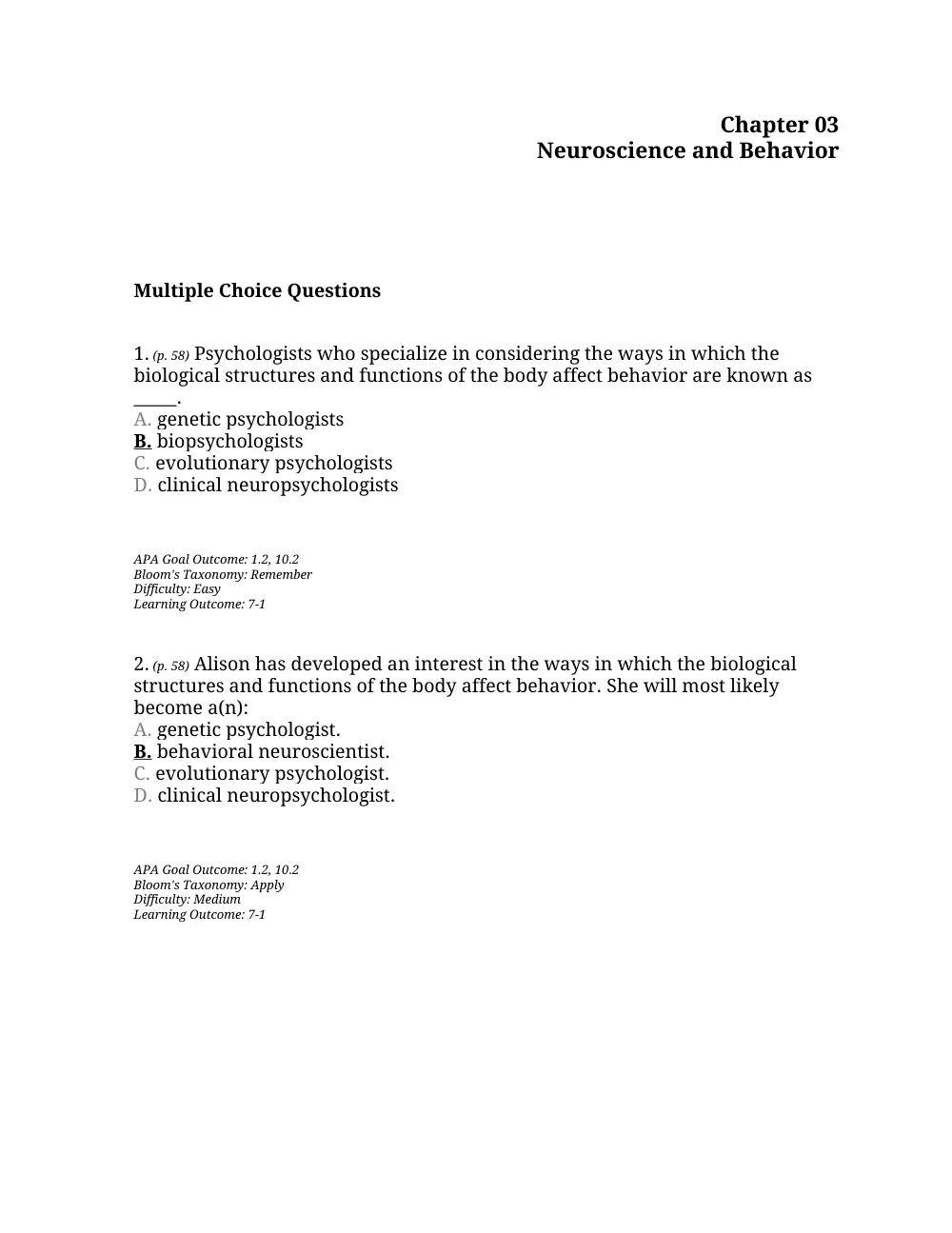
Chapter 03
Neuroscience and Behavior
Multiple Choice Questions
1. (p. 58) Psychologists who specialize in considering the ways in which the
biological structures and functions of the body affect behavior are known as
_____.
A. genetic psychologists
B. biopsychologists
C. evolutionary psychologists
D. clinical neuropsychologists
APA Goal Outcome: 1.2, 10.2
Bloom's Taxonomy: Remember
Difficulty: Easy
Learning Outcome: 7-1
2. (p. 58) Alison has developed an interest in the ways in which the biological
structures and functions of the body affect behavior. She will most likely
become a(n):
A. genetic psychologist.
B. behavioral neuroscientist.
C. evolutionary psychologist.
D. clinical neuropsychologist.
APA Goal Outcome: 1.2, 10.2
Bloom's Taxonomy: Apply
Difficulty: Medium
Learning Outcome: 7-1
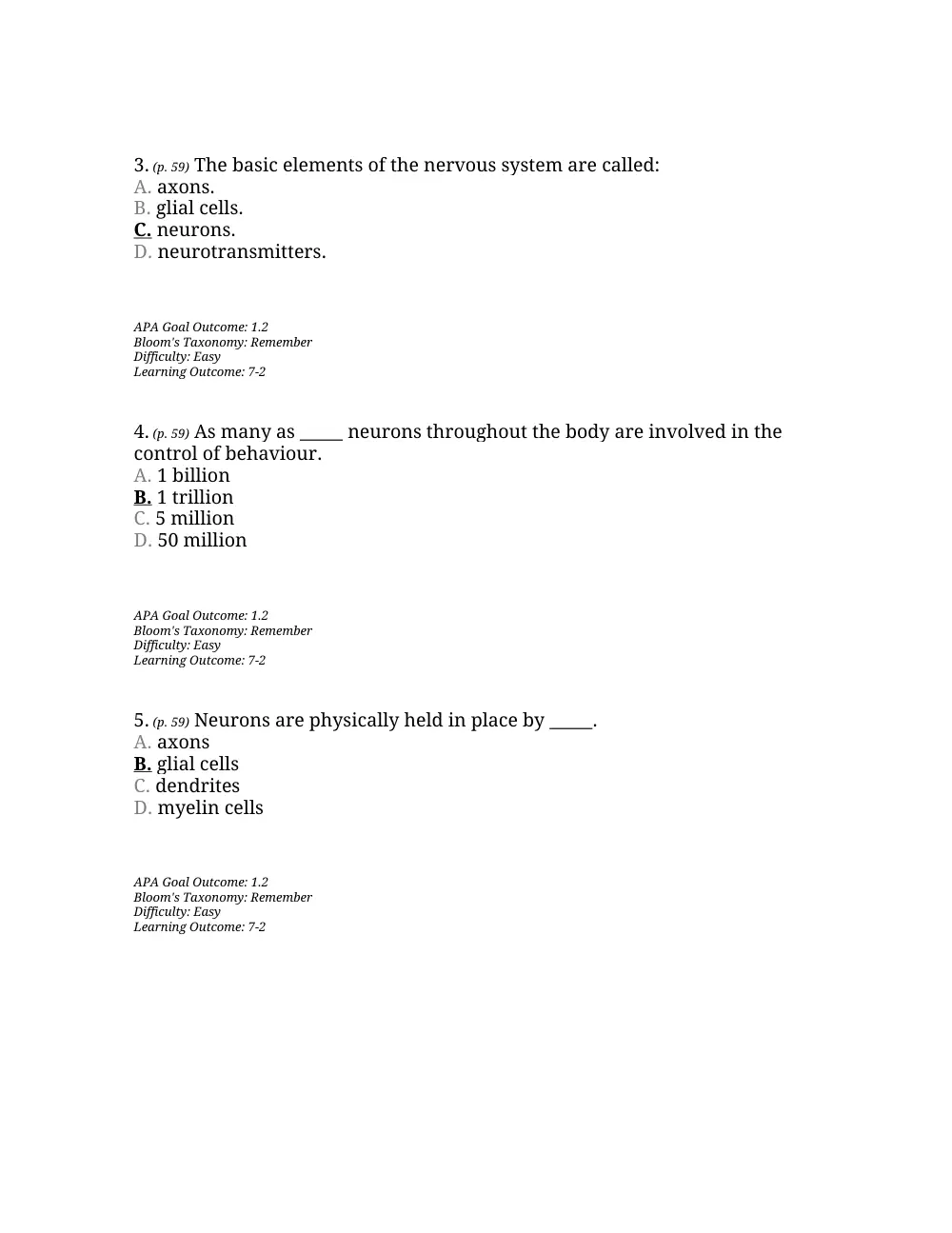
3. (p. 59) The basic elements of the nervous system are called:
A. axons.
B. glial cells.
C. neurons.
D. neurotransmitters.
APA Goal Outcome: 1.2
Bloom's Taxonomy: Remember
Difficulty: Easy
Learning Outcome: 7-2
4. (p. 59) As many as _____ neurons throughout the body are involved in the
control of behaviour.
A. 1 billion
B. 1 trillion
C. 5 million
D. 50 million
APA Goal Outcome: 1.2
Bloom's Taxonomy: Remember
Difficulty: Easy
Learning Outcome: 7-2
5. (p. 59) Neurons are physically held in place by _____.
A. axons
B. glial cells
C. dendrites
D. myelin cells
APA Goal Outcome: 1.2
Bloom's Taxonomy: Remember
Difficulty: Easy
Learning Outcome: 7-2
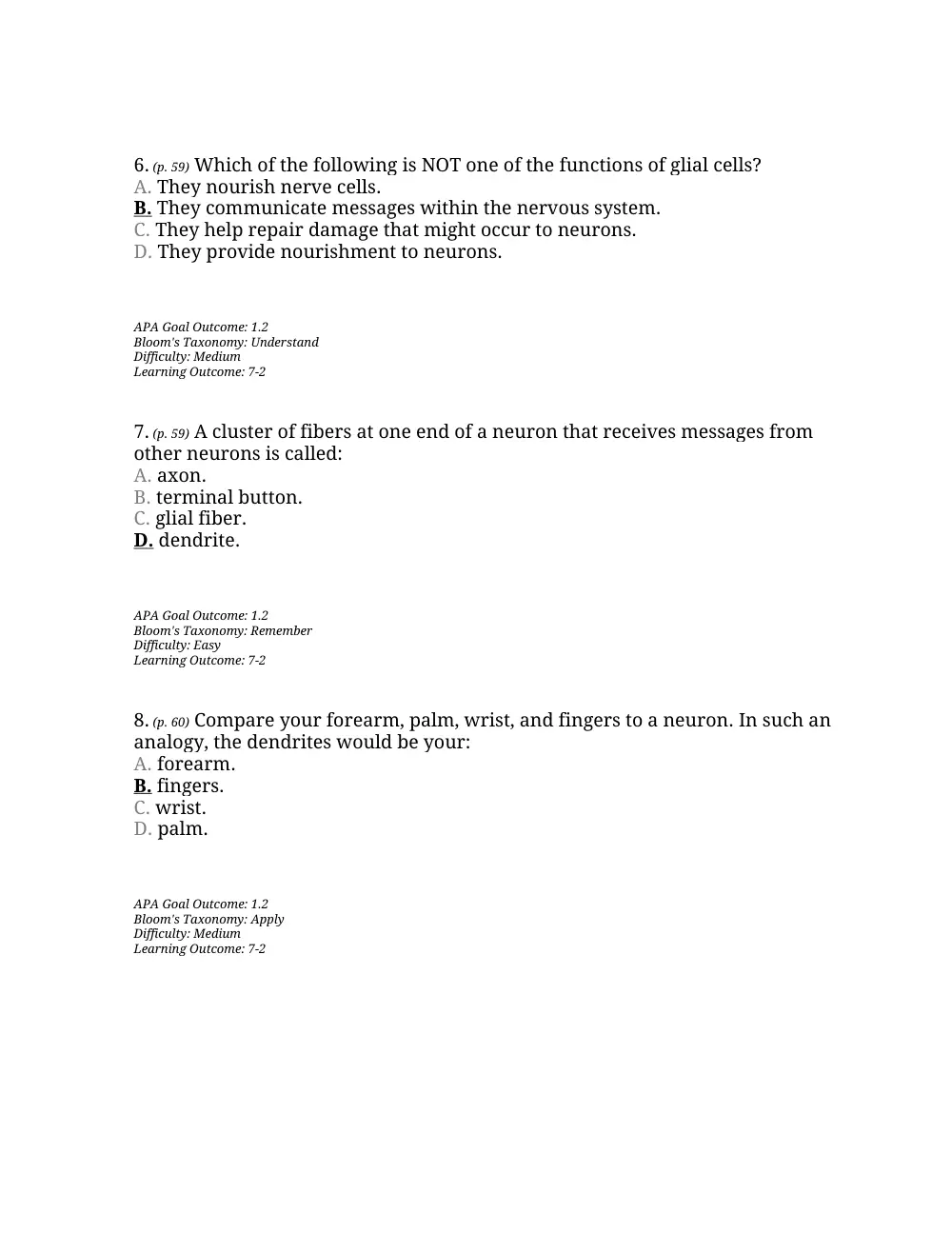
6. (p. 59) Which of the following is NOT one of the functions of glial cells?
A. They nourish nerve cells.
B. They communicate messages within the nervous system.
C. They help repair damage that might occur to neurons.
D. They provide nourishment to neurons.
APA Goal Outcome: 1.2
Bloom's Taxonomy: Understand
Difficulty: Medium
Learning Outcome: 7-2
7. (p. 59) A cluster of fibers at one end of a neuron that receives messages from
other neurons is called:
A. axon.
B. terminal button.
C. glial fiber.
D. dendrite.
APA Goal Outcome: 1.2
Bloom's Taxonomy: Remember
Difficulty: Easy
Learning Outcome: 7-2
8. (p. 60) Compare your forearm, palm, wrist, and fingers to a neuron. In such an
analogy, the dendrites would be your:
A. forearm.
B. fingers.
C. wrist.
D. palm.
APA Goal Outcome: 1.2
Bloom's Taxonomy: Apply
Difficulty: Medium
Learning Outcome: 7-2
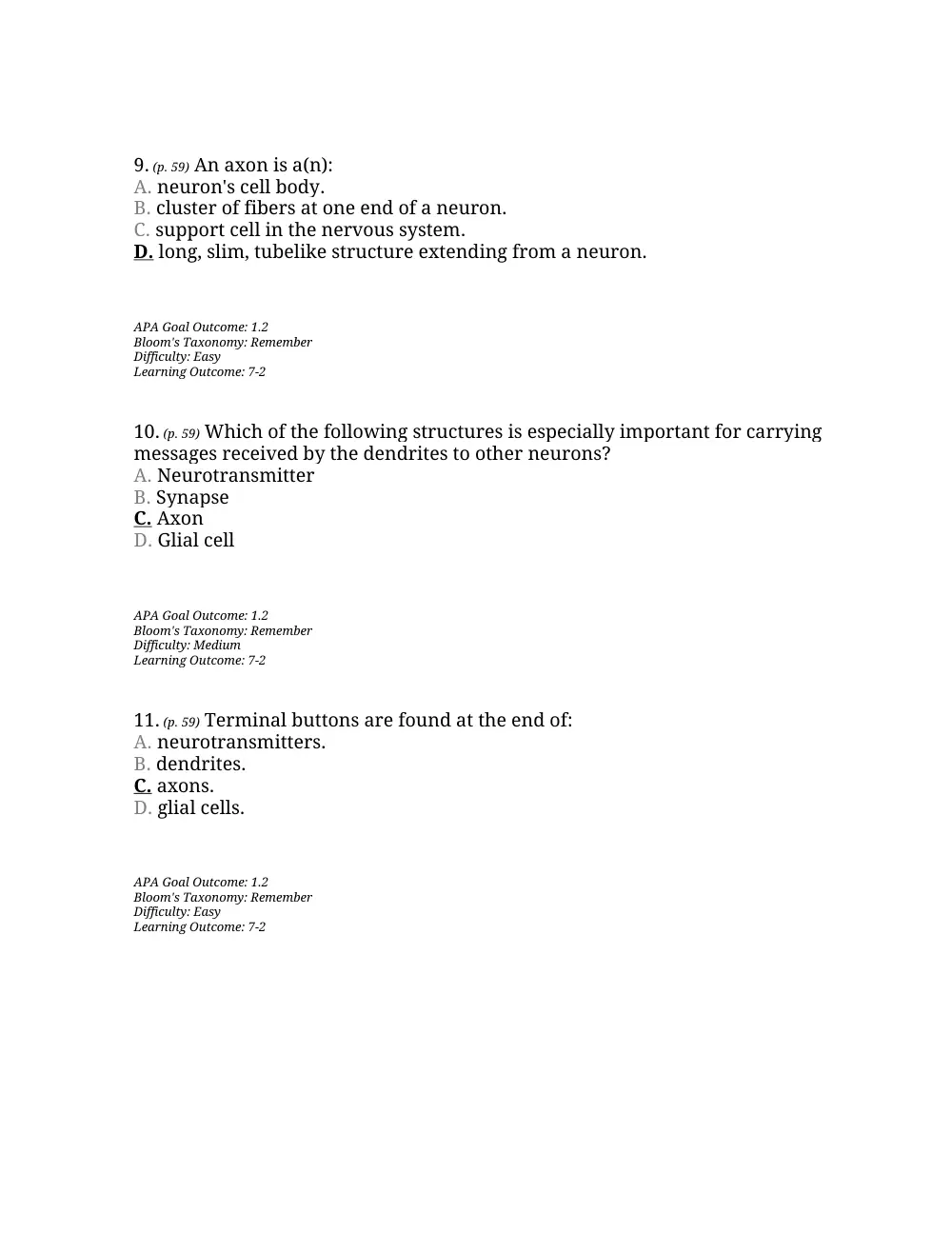
9. (p. 59) An axon is a(n):
A. neuron's cell body.
B. cluster of fibers at one end of a neuron.
C. support cell in the nervous system.
D. long, slim, tubelike structure extending from a neuron.
APA Goal Outcome: 1.2
Bloom's Taxonomy: Remember
Difficulty: Easy
Learning Outcome: 7-2
10. (p. 59) Which of the following structures is especially important for carrying
messages received by the dendrites to other neurons?
A. Neurotransmitter
B. Synapse
C. Axon
D. Glial cell
APA Goal Outcome: 1.2
Bloom's Taxonomy: Remember
Difficulty: Medium
Learning Outcome: 7-2
11. (p. 59) Terminal buttons are found at the end of:
A. neurotransmitters.
B. dendrites.
C. axons.
D. glial cells.
APA Goal Outcome: 1.2
Bloom's Taxonomy: Remember
Difficulty: Easy
Learning Outcome: 7-2
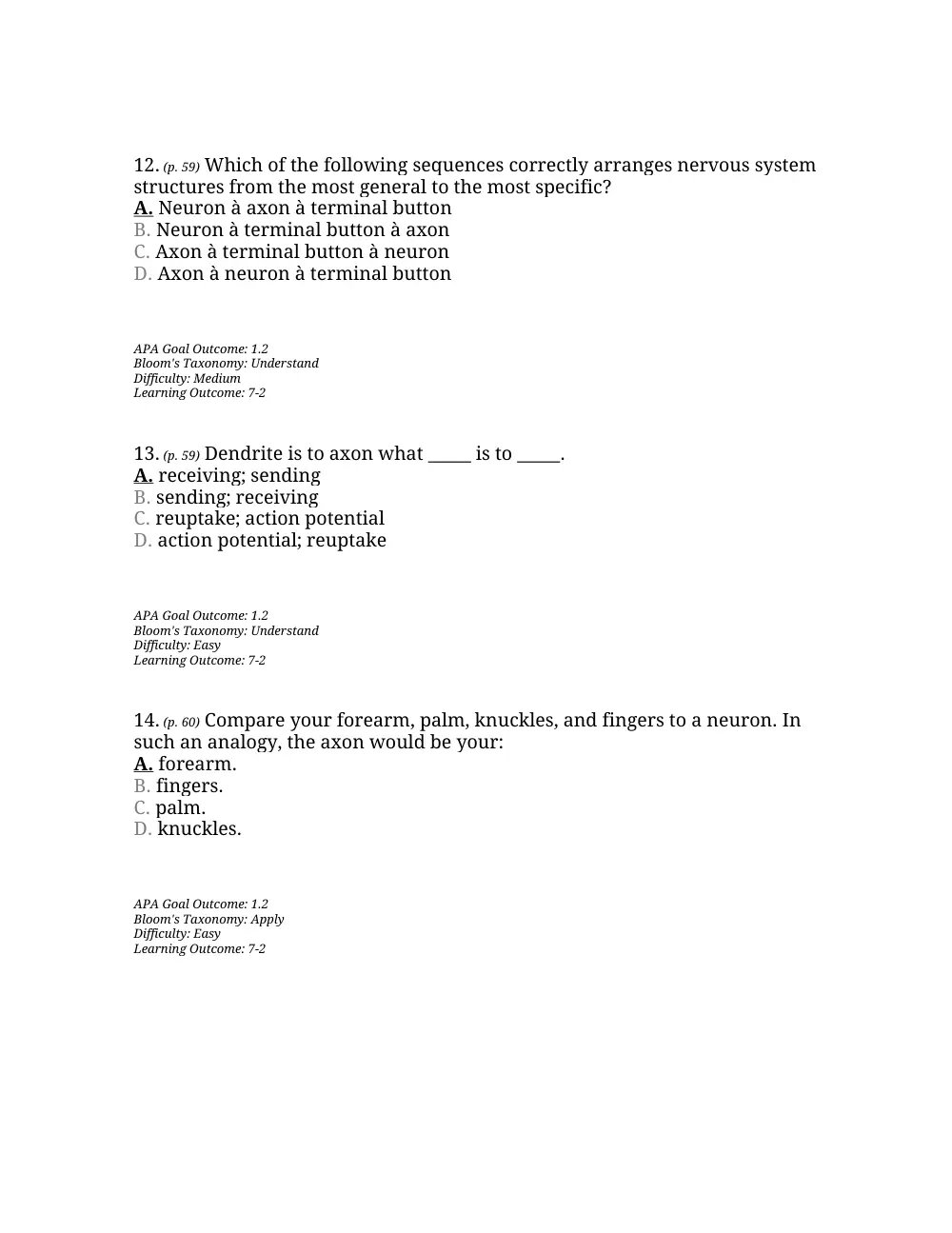
12. (p. 59) Which of the following sequences correctly arranges nervous system
structures from the most general to the most specific?
A. Neuron à axon à terminal button
B. Neuron à terminal button à axon
C. Axon à terminal button à neuron
D. Axon à neuron à terminal button
APA Goal Outcome: 1.2
Bloom's Taxonomy: Understand
Difficulty: Medium
Learning Outcome: 7-2
13. (p. 59) Dendrite is to axon what _____ is to _____.
A. receiving; sending
B. sending; receiving
C. reuptake; action potential
D. action potential; reuptake
APA Goal Outcome: 1.2
Bloom's Taxonomy: Understand
Difficulty: Easy
Learning Outcome: 7-2
14. (p. 60) Compare your forearm, palm, knuckles, and fingers to a neuron. In
such an analogy, the axon would be your:
A. forearm.
B. fingers.
C. palm.
D. knuckles.
APA Goal Outcome: 1.2
Bloom's Taxonomy: Apply
Difficulty: Easy
Learning Outcome: 7-2
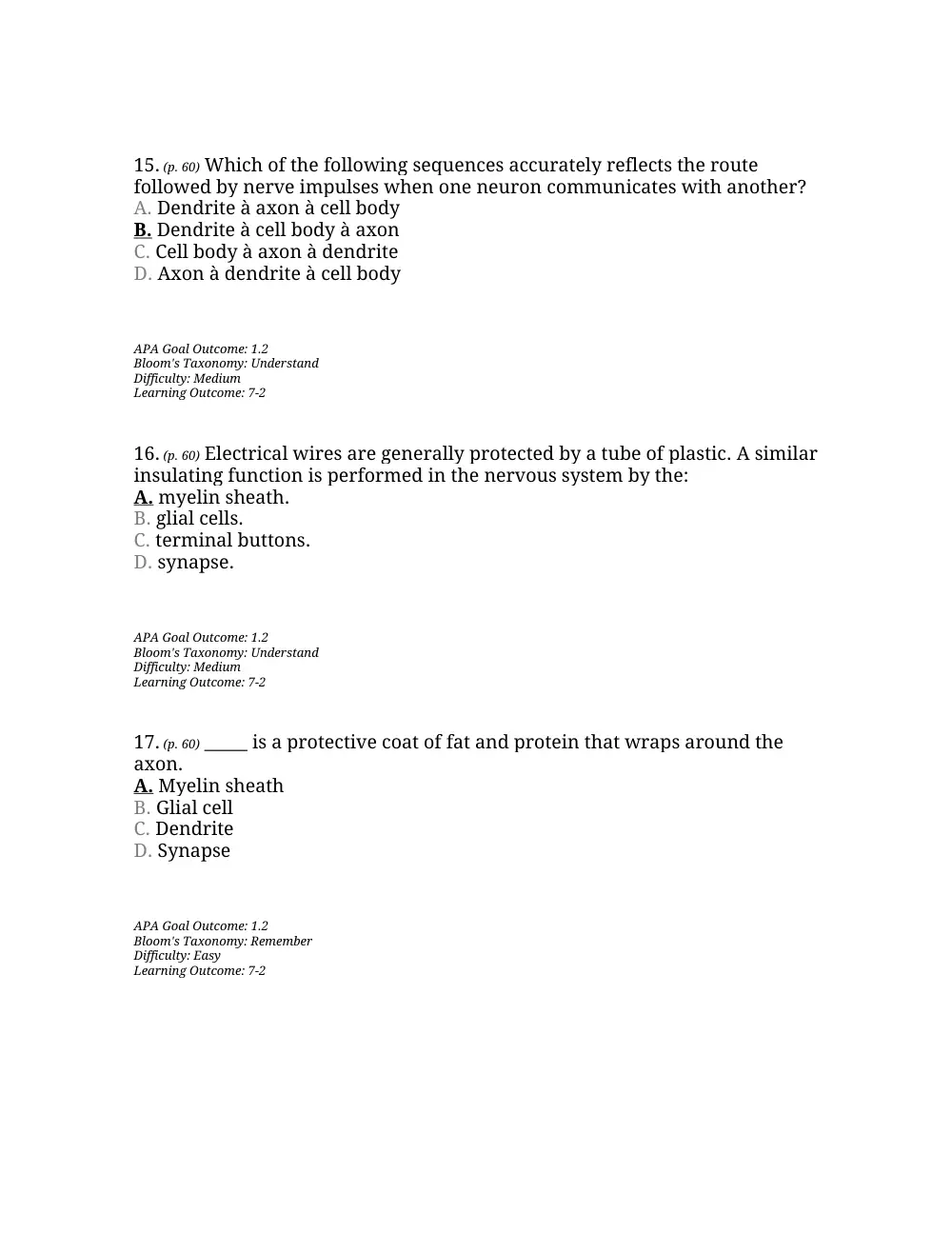
15. (p. 60) Which of the following sequences accurately reflects the route
followed by nerve impulses when one neuron communicates with another?
A. Dendrite à axon à cell body
B. Dendrite à cell body à axon
C. Cell body à axon à dendrite
D. Axon à dendrite à cell body
APA Goal Outcome: 1.2
Bloom's Taxonomy: Understand
Difficulty: Medium
Learning Outcome: 7-2
16. (p. 60) Electrical wires are generally protected by a tube of plastic. A similar
insulating function is performed in the nervous system by the:
A. myelin sheath.
B. glial cells.
C. terminal buttons.
D. synapse.
APA Goal Outcome: 1.2
Bloom's Taxonomy: Understand
Difficulty: Medium
Learning Outcome: 7-2
17. (p. 60) _____ is a protective coat of fat and protein that wraps around the
axon.
A. Myelin sheath
B. Glial cell
C. Dendrite
D. Synapse
APA Goal Outcome: 1.2
Bloom's Taxonomy: Remember
Difficulty: Easy
Learning Outcome: 7-2
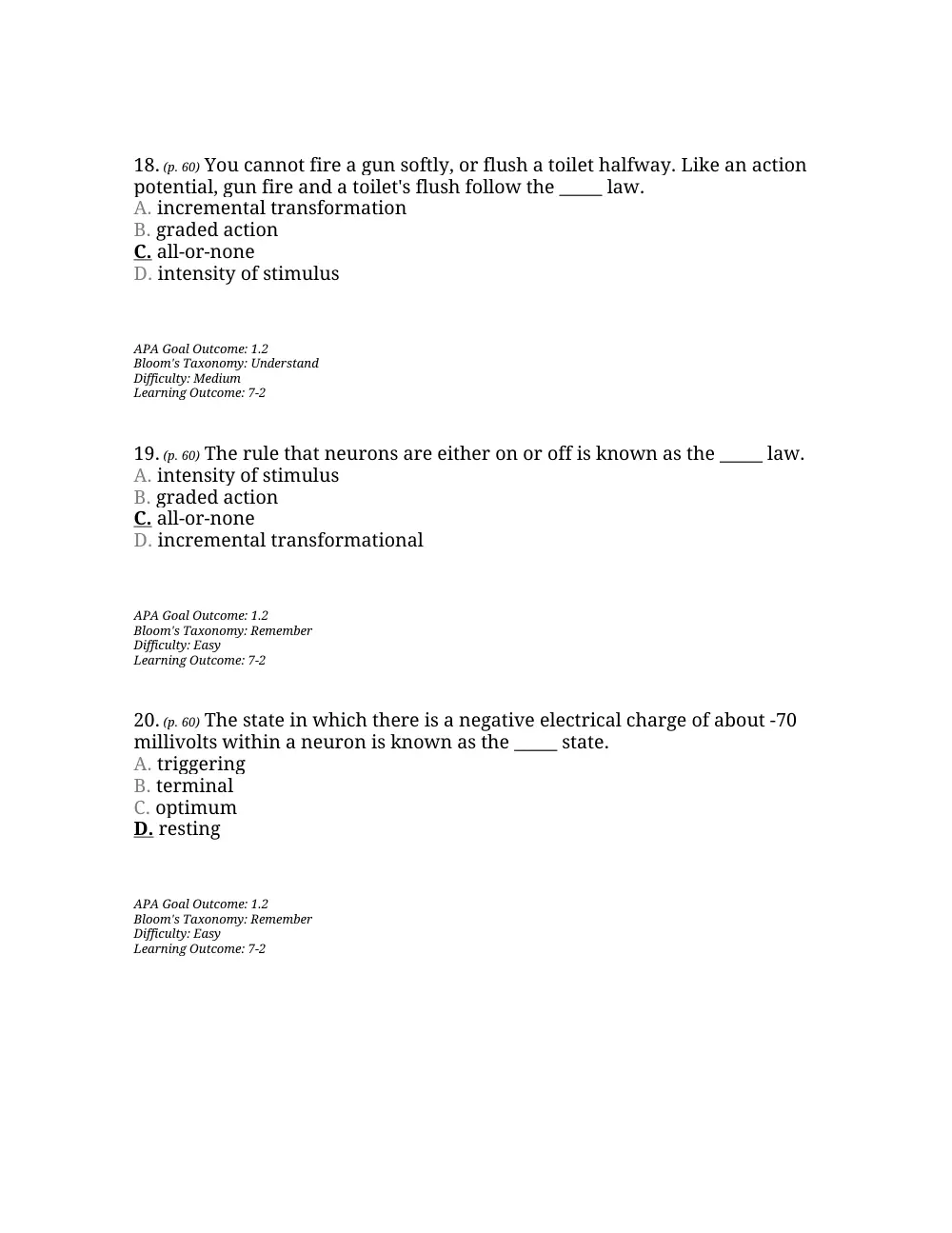
18. (p. 60) You cannot fire a gun softly, or flush a toilet halfway. Like an action
potential, gun fire and a toilet's flush follow the _____ law.
A. incremental transformation
B. graded action
C. all-or-none
D. intensity of stimulus
APA Goal Outcome: 1.2
Bloom's Taxonomy: Understand
Difficulty: Medium
Learning Outcome: 7-2
19. (p. 60) The rule that neurons are either on or off is known as the _____ law.
A. intensity of stimulus
B. graded action
C. all-or-none
D. incremental transformational
APA Goal Outcome: 1.2
Bloom's Taxonomy: Remember
Difficulty: Easy
Learning Outcome: 7-2
20. (p. 60) The state in which there is a negative electrical charge of about -70
millivolts within a neuron is known as the _____ state.
A. triggering
B. terminal
C. optimum
D. resting
APA Goal Outcome: 1.2
Bloom's Taxonomy: Remember
Difficulty: Easy
Learning Outcome: 7-2
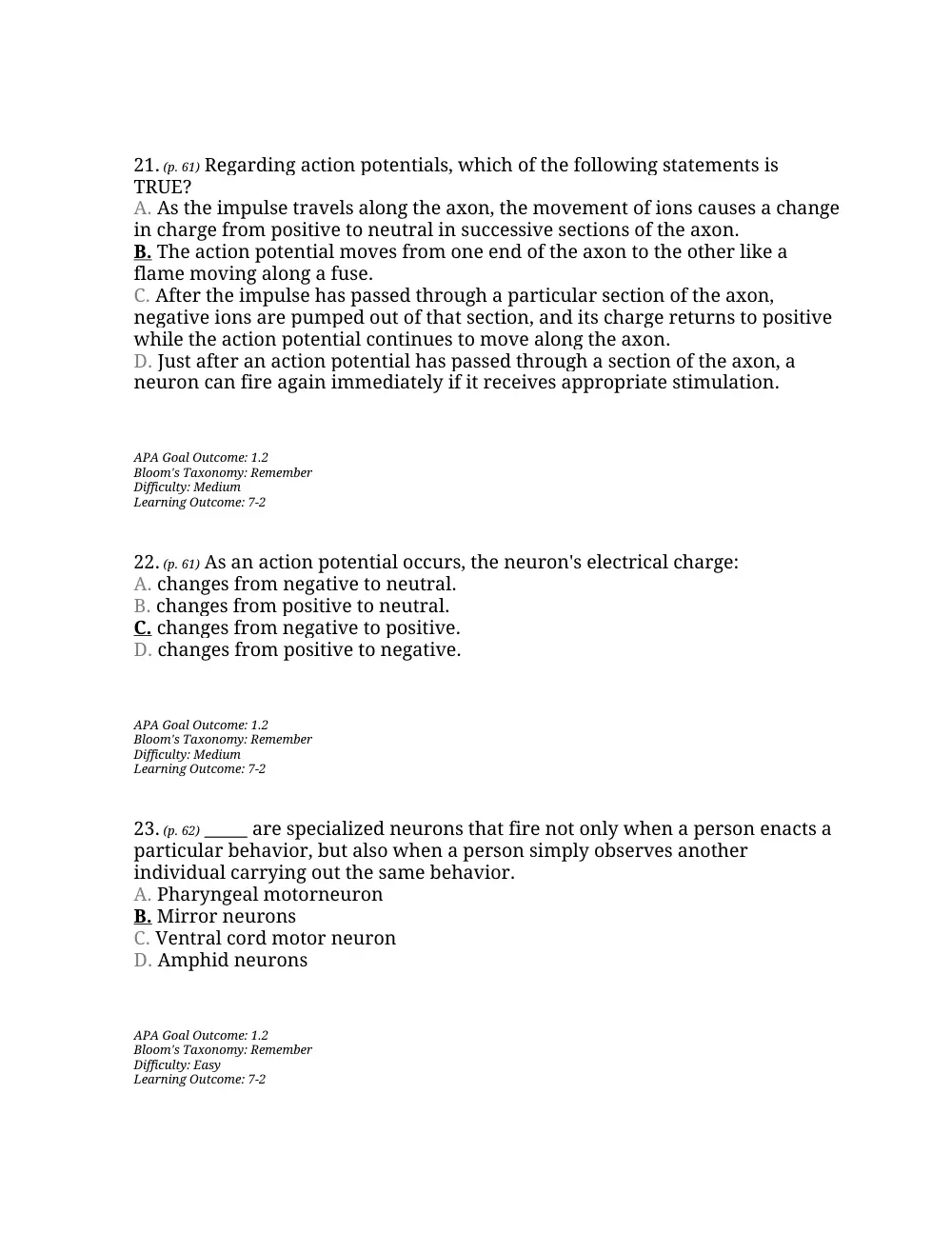
21. (p. 61) Regarding action potentials, which of the following statements is
TRUE?
A. As the impulse travels along the axon, the movement of ions causes a change
in charge from positive to neutral in successive sections of the axon.
B. The action potential moves from one end of the axon to the other like a
flame moving along a fuse.
C. After the impulse has passed through a particular section of the axon,
negative ions are pumped out of that section, and its charge returns to positive
while the action potential continues to move along the axon.
D. Just after an action potential has passed through a section of the axon, a
neuron can fire again immediately if it receives appropriate stimulation.
APA Goal Outcome: 1.2
Bloom's Taxonomy: Remember
Difficulty: Medium
Learning Outcome: 7-2
22. (p. 61) As an action potential occurs, the neuron's electrical charge:
A. changes from negative to neutral.
B. changes from positive to neutral.
C. changes from negative to positive.
D. changes from positive to negative.
APA Goal Outcome: 1.2
Bloom's Taxonomy: Remember
Difficulty: Medium
Learning Outcome: 7-2
23. (p. 62) _____ are specialized neurons that fire not only when a person enacts a
particular behavior, but also when a person simply observes another
individual carrying out the same behavior.
A. Pharyngeal motorneuron
B. Mirror neurons
C. Ventral cord motor neuron
D. Amphid neurons
APA Goal Outcome: 1.2
Bloom's Taxonomy: Remember
Difficulty: Easy
Learning Outcome: 7-2
24. (p. 62) Regarding mirror neurons, which of the following statements is
ACCURATE?
A. Mirror neurons are involved in face recognition and language acquisition,
but not in empathy.
B. Mirror neurons are involved in empathy and face recognition, but not in
language acquisition.
C. Mirror neurons are involved in empathy, language acquisition, and face
recognition.
D. Mirror neurons are involved in empathy and language acquisition, but not
in face recognition.
APA Goal Outcome: 1.2
Bloom's Taxonomy: Understand
Difficulty: Medium
Learning Outcome: 7-2
25. (p. 63) A synapse is a(n):
A. chemical.
B. signal.
C. joint.
D. gap.
APA Goal Outcome: 1.2, 4.2
Bloom's Taxonomy: Understand
Difficulty: Medium
Learning Outcome: 7-2
26. (p. 63) _____ is the space between two neurons where the axon of a sending
neuron communicates with the dendrites of a receiving neuron by using
chemical messages.
A. Synapse
B. Terminal button
C. Axon
D. Cell body
APA Goal Outcome: 1.2, 4.2
Bloom's Taxonomy: Remember
Difficulty: Medium
Learning Outcome: 7-2
27. (p. 64) Which of the following statements regarding inhibitory messages is
TRUE?
A. Inhibitory messages always increase the likelihood that a receiving neuron
will fire.
B. Inhibitory messages decrease the likelihood that a receiving neuron will
fire.
C. The dendrites of a neuron cannot receive both excitatory and inhibitory
messages simultaneously.
D. Inhibitory messages make it more likely that an action potential will travel
down its axon.
APA Goal Outcome: 1.2, 4.2
Bloom's Taxonomy: Understand
Difficulty: Medium
Learning Outcome: 7-3
28. (p. 64) The reabsorption of neurotransmitters by a terminal button is termed
as:
A. recycling.
B. reassertion.
C. reuptake.
D. reuse.
APA Goal Outcome: 1.2, 4.2
Bloom's Taxonomy: Remember
Difficulty: Easy
Learning Outcome: 7-3
29. (p. 65) Which neurotransmitter is described INCORRECTLY?
A. Acetylcholine—transmits messages related to skeletal muscles
B. GABA—an excitatory neurotransmitter inhibited by alcohol or tranquilizers
C. Serotonin—helps regulate sleep and mood
D. Glutamate—plays a role in memory
APA Goal Outcome: 1.2
Bloom's Taxonomy: Understand
Difficulty: Medium
Learning Outcome: 7-3
30. (p. 66) The neurotransmitter dopamine is involved in:
A. the brain's effort to deal with pain.
B. Alzheimer's disease.
C. the regulation of sleep, eating, mood, and pain.
D. movement, attention, and learning.
APA Goal Outcome: 1.2, 4.2
Bloom's Taxonomy: Understand
Difficulty: Medium
Learning Outcome: 7-3
31. (p. 66) Which neurotransmitter is CORRECTLY matched with a psychological
function?
A. Relief of pain—glutamate
B. Regulates mood—acetylcholine
C. Facilitates learning—dopamine
D. Contributes to memory—serotonin
APA Goal Outcome: 1.2
Bloom's Taxonomy: Remember
Difficulty: Medium
Learning Outcome: 7-3
32. (p. 66) Which disorder is CORRECTLY paired with an associated
neurotransmitter?
A. Parkinson's disease: dopamine
B. Depression: glutamate
C. Schizophrenia: serotonin
D. Alzheimer's disease: endorphins
APA Goal Outcome: 1.2, 4.2
Bloom's Taxonomy: Remember
Difficulty: Medium
Learning Outcome: 7-3
33. (p. 66) Inhibitory is to excitatory what _____ is to _____.
A. glutamate; GABA
B. glutamate; acetylcholine
C. GABA; glutamate
D. endorphins; GABA
APA Goal Outcome: 1.2
Bloom's Taxonomy: Understand
Difficulty: Medium
Learning Outcome: 7-3
34. (p. 68) Which expression below most closely approximates the number of
neural connections in the brain?
A. 10 quadrillion
B. 1 million
C. 1 billion
D. 1 trillion
APA Goal Outcome: 1.2, 7.3
Bloom's Taxonomy: Remember
Difficulty: Medium
Learning Outcome: 8-1
35. (p. 68) The nervous system is divided into the _____ and the _____ nervous
systems.
A. primary; secondary
B. somatic; autonomic
C. sympathetic; parasympathetic
D. central; peripheral
APA Goal Outcome: 1.2
Bloom's Taxonomy: Remember
Difficulty: Easy
Learning Outcome: 8-1
36. (p. 68) The brain and the spinal cord constitute the _____ nervous system.
A. central
B. peripheral
C. extraneous
D. parasympathetic
APA Goal Outcome: 1.2
Bloom's Taxonomy: Remember
Difficulty: Easy
Learning Outcome: 8-1
37. (p. 68) _____ is an automatic, involuntary response to an incoming stimulus.
A. Action potential
B. Intuition
C. Instinct
D. Reflex
APA Goal Outcome: 1.2
Bloom's Taxonomy: Remember
Difficulty: Easy
Learning Outcome: 8-1
38. (p. 68) The _____ is the main means for transmitting messages between the
brain and the body.
A. cortex
B. medulla
C. axon
D. spinal cord
APA Goal Outcome: 1.2
Bloom's Taxonomy: Understand
Difficulty: Difficult
Learning Outcome: 8-1
39. (p. 68) Which of the following is TRUE of the spinal cord's control of
behavior?
A. The spinal cord cannot control any behaviors without the help of the brain.
B. The spinal cord is not involved in reflexes.
C. The spinal cord can control some simple reflexes without the brain's help.
D. The spinal cord can control relatively complex behavior without the brain's
help.
APA Goal Outcome: 1.2
Bloom's Taxonomy: Understand
Difficulty: Medium
Learning Outcome: 8-1
40. (p. 68, 70) The central nervous system is composed of _____. The peripheral
nervous system comprises _____.
A. the somatic and autonomic nervous systems; the sympathetic and
parasympathetic nervous systems
B. the somatic and autonomic nervous systems; the brain and the spinal cord
C. the sympathetic and parasympathetic nervous systems; the somatic and
autonomic nervous systems
D. the brain and the spinal cord; the somatic and autonomic nervous systems
APA Goal Outcome: 1.2
Bloom's Taxonomy: Understand
Difficulty: Medium
Learning Outcome: 8-1
41. (p. 70) Sensory is to motor what _____ is to _____.
A. efferent; afferent
B. afferent; efferent
C. afferent; interneuron
D. interneuron; efferent
APA Goal Outcome: 1.2
Bloom's Taxonomy: Understand
Difficulty: Medium
Learning Outcome: 8-1
42. (p. 70) ______ are neurons that connect sensory and motor neurons, carrying
messages between the two.
A. Mirror neurons
B. Amphid neurons
C. Interneurons
D. Autoneurons
APA Goal Outcome: 1.2
Bloom's Taxonomy: Remember
Difficulty: Medium
Learning Outcome: 8-1
43. (p. 70) The two major divisions of the peripheral nervous system are the _____
and _____ divisions.
A. somatic; autonomic
B. sympathetic; parasympathetic
C. afferent; efferent
D. sensory; motor
APA Goal Outcome: 1.2
Bloom's Taxonomy: Remember
Difficulty: Medium
Learning Outcome: 8-1
44. (p. 70) _____ is the part of the peripheral nervous system that specializes in the
control of voluntary movements and the communication of information to and
from the sense organs.
A. Somatic division
B. Sympathetic division
C. Parasympathetic division
D. Autonomic division
APA Goal Outcome: 1.2
Bloom's Taxonomy: Remember
Difficulty: Easy
Learning Outcome: 8-1
45. (p. 70) Somatic is to autonomic what _____ is to _____.
A. involuntary; voluntary
B. voluntary; involuntary
C. excitation; rest
D. rest; excitation
APA Goal Outcome: 1.2
Bloom's Taxonomy: Understand
Difficulty: Medium
Learning Outcome: 8-1
46. (p. 70) The part of the autonomic division of the nervous system that acts to
prepare the body for action in stressful situations, engaging all the organism's
resources to respond to a threat is known as the _____.
A. somatic division
B. sympathetic division
C. parasympathetic division
D. apathetic division
APA Goal Outcome: 1.2
Bloom's Taxonomy: Remember
Difficulty: Easy
Learning Outcome: 8-1
47. (p. 70) The "fight-or-flight" response is associated with the _____ division.
A. somatic
B. sympathetic
C. parasympathetic
D. apathetic
APA Goal Outcome: 1.2
Bloom's Taxonomy: Understand
Difficulty: Easy
Learning Outcome: 8-1
48. (p. 70) The part of the autonomic division of the nervous system that acts to
calm the body after an emergency has ended is known as the _____ division.
A. somatic
B. sympathetic
C. parasympathetic
D. apathetic
APA Goal Outcome: 1.2
Bloom's Taxonomy: Remember
Difficulty: Easy
Learning Outcome: 8-1
49. (p. 70) The _____ division also directs the body to store energy for use in
emergencies.
A. somatic
B. sympathetic
C. parasympathetic
D. apathetic
APA Goal Outcome: 1.2
Bloom's Taxonomy: Understand
Difficulty: Easy
Learning Outcome: 8-1
50. (p. 70) Which of the following situations is most likely to involve the action of
the parasympathetic nervous system?
A. Brooke's finger accidentally grazes the hot iron; she immediately jerks her
hand away.
B. After mistaking her roommate for a thief, Callum relaxes with a glass of
water.
C. Walking toward her car in a deserted parking lot one night, Danica is
surprised by a strange man appearing from nowhere.
D. Peyton is preparing to go to bed and is alarmed to see a stranger at her
window.
APA Goal Outcome: 1.2, 4.4
Bloom's Taxonomy: Apply
Difficulty: Medium
Learning Outcome: 8-1
51. (p. 70) With respect to its potential basis in nervous system activity, "voodoo
death" has been attributed to:
A. an overactive sympathetic nervous system.
B. an overactive parasympathetic nervous system.
C. the cessation of sympathetic nervous system responses.
D. an understimulated central nervous system.
APA Goal Outcome: 1.2, 1.3, 3.1, 4.2
Bloom's Taxonomy: Remember
Difficulty: Easy
Learning Outcome: 8-1
52. (p. 71) Izzy sees a leopard in her backyard. Her pupils are dilated and her
heart is pounding; her breathing is shallow and rapid. Her _____ nervous
system is active.
A. parasympathetic
B. sympathetic
C. apathetic
D. somatic
APA Goal Outcome: 1.2
Bloom's Taxonomy: Apply
Difficulty: Easy
Learning Outcome: 8-1
53. (p. 71) Which of the following terms best describes the organization of the
nervous system today?
A. Linear
B. Recursive
C. Hierarchical
D. Random
APA Goal Outcome: 1.2
Bloom's Taxonomy: Understand
Difficulty: Medium
Learning Outcome: 8-1
54. (p. 71) The branch of psychology that seeks to identify behavior patterns that
are a result of our genetic inheritance from our ancestors is known as _____.
A. social psychology
B. health psychology
C. clinical psychology
D. evolutionary psychology
APA Goal Outcome: 1.2
Bloom's Taxonomy: Remember
Difficulty: Easy
Learning Outcome: 8-1
55. (p. 72) Evolutionary psychologists have spawned a new and increasingly
influential field:
A. social psychology.
B. health psychology.
C. molecular genetics.
D. behavioral genetics.
APA Goal Outcome: 1.2
Bloom's Taxonomy: Remember
Difficulty: Easy
Learning Outcome: 8-1
56. (p. 72) The study of the effects of heredity on how people conduct themselves
is known as _____.
A. behavioral genetics
B. classical genetics
C. development genetics
D. molecular genetics
APA Goal Outcome: 1.2, 10.2
Bloom's Taxonomy: Remember
Difficulty: Medium
Learning Outcome: 8-1
57. (p. 72) Dr. Schilling is investigating the potential genetic basis of antisocial
personality disorder by examining the relative prevalence of the disorder
among either identical or fraternal twins, raised either together or in different
families. Dr. Schilling is best described as a _____.
A. behavioral geneticist
B. classical geneticist
C. development geneticist
D. molecular geneticist
APA Goal Outcome: 1.2, 4.2, 10.2
Bloom's Taxonomy: Apply
Difficulty: Medium
Learning Outcome: 8-1
58. (p. 72) Which of the following statements best expresses the relationship
between the nervous system and the endocrine system?
A. They operate entirely independently.
B. The endocrine system is part of the central nervous system.
C. The endocrine system influences and is influenced by the central nervous
system.
D. The central nervous system is one part of the endocrine system.
APA Goal Outcome: 1.2
Bloom's Taxonomy: Remember
Difficulty: Easy
Learning Outcome: 8-2
59. (p. 72) A key component of the endocrine system is the tiny _____ gland, which
is found near—and regulated by—the _____ in the brain.
A. adrenal; hippocampus
B. pituitary; hippocampus
C. adrenal; hypothalamus
D. pituitary; hypothalamus
APA Goal Outcome: 1.2
Bloom's Taxonomy: Understand
Difficulty: Medium
Learning Outcome: 8-2
60. (p. 72) The _____ gland is a major component of the endocrine system which
secretes hormones that control growth and other parts of the endocrine
system.
A. esophageal
B. apocrine
C. parotid
D. pituitary
APA Goal Outcome: 1.2
Bloom's Taxonomy: Remember
Difficulty: Easy
Learning Outcome: 8-2
61. (p. 72) The _____ gland has sometimes been called the "master gland" because
it controls the functioning of the rest of the endocrine system.
A. pituitary
B. esophageal
C. apocrine
D. parotid
APA Goal Outcome: 1.2
Bloom's Taxonomy: Remember
Difficulty: Easy
Learning Outcome: 8-2
62. (p. 72) The hormone oxytocin has been implicated in each of the following
behaviors EXCEPT the:
A. urge to nurse newborn infants.
B. desire to seek or respond to potential sexual partners.
C. development of trust in others.
D. tendency to produce violent, dangerous behavior.
APA Goal Outcome: 1.2
Bloom's Taxonomy: Remember
Difficulty: Easy
Learning Outcome: 8-2
63. (p. 73) Which of the following glands or structures is CORRECTLY matched
with the hormone it produces?
A. Pineal gland; oxytocin
B. Pancreas; insulin
C. Medulla; melatonin
D. Pituitary gland; aldosterone
APA Goal Outcome: 1.2
Bloom's Taxonomy: Remember
Difficulty: Medium
Learning Outcome: 8-2
64. (p. 73) Which of the following hormones is CORRECTLY matched with its
function?
A. Aldosterone - regulates daily rhythms
B. Erythropoietin - regulates the sodium and potassium balance in the blood
C. Adipokines - regulate the production of red blood cells
D. Parathyroid hormone - increases blood calcium
APA Goal Outcome: 1.2
Bloom's Taxonomy: Remember
Difficulty: Medium
Learning Outcome: 8-2
65. (p. 73) Which of the following statements is TRUE regarding hormone
replacement therapy as a treatment for menopausal symptoms?
A. It is used less frequently now than in the past.
B. It is the only treatment that does not have any side effects.
C. Its benefits outweigh its risks.
D. It has become increasingly popular.
APA Goal Outcome: 1.2, 4.4
Bloom's Taxonomy: Understand
Difficulty: Medium
Learning Outcome: 8-2
66. (p. 74) Your friend is considering using steroids to increase muscle mass. You
would warn him that steroid abuse can lead to:
A. violent, dangerous behavior.
B. obesity.
C. autism.
D. Type II diabetes.
APA Goal Outcome: 1.2, 3.1, 4.4
Bloom's Taxonomy: Apply
Difficulty: Easy
Learning Outcome: 8-2
67. (p. 76) Which of the following is NOT a brain scanning technique?
A. Electroencephalogram (EEG)
B. Electromyogram (EMG)
C. Positron emission tomography (PET)
D. Transcranial magnetic stimulation (TMS)
APA Goal Outcome: 1.2, 2.2
Bloom's Taxonomy: Remember
Difficulty: Easy
Learning Outcome: 9-1
68. (p. 77) Which brain imaging technique below is CORRECTLY matched with its
description?
A. EEG—records the brain's electrical activity with electrodes
B. PET—causes a momentary interruption of the brain's electrical activity
C. fMRI—traces biochemical activity in the brain
D. TMS—produces a graph of electrical wave patterns
APA Goal Outcome: 1.2, 2.2
Bloom's Taxonomy: Understand
Difficulty: Medium
Learning Outcome: 9-1
69. (p. 77) Which brain imaging technique below is INCORRECTLY matched with
its diagnostic use?
A. EEG—facilitates the diagnosis of epilepsy and learning disorders
B. PET—may help identify brain tumors
C. fMRI—improves diagnosis of strokes and multiple sclerosis
D. TMS—facilitates the diagnosis of nervous system disorders such as
Alzheimer's disease
APA Goal Outcome: 1.2, 4.2
Bloom's Taxonomy: Understand
Difficulty: Easy
Learning Outcome: 9-1
70. (p. 77) Brent is taking part in an experiment in the cognitive neuroscience lab
on campus. Silently, he reads rapid sequences of words flashed on a computer
screen. Simultaneously, the electrical activity of his brain is recorded through
skull electrodes. The brain scanning technique used in this study is:
A. fMRI.
B. PET.
C. EEG.
D. TMS.
APA Goal Outcome: 1.2, 2.2
Bloom's Taxonomy: Apply
Difficulty: Medium
Learning Outcome: 9-1
71. (p. 77) The newest brain scanning technique which is popularly used is:
A. PET.
B. EEG.
C. TMS.
D. fMRI.
APA Goal Outcome: 1.2, 2.2
Bloom's Taxonomy: Remember
Difficulty: Easy
Learning Outcome: 9-1
72. (p. 78) Marisol is trying a new treatment for severe depression. Brief magnetic
pulses are sent through her brain. Marisol is undergoing:
A. optogenetic therapy.
B. transcranial magnetic stimulation.
C. positron emission tomography.
D. functional magnetic resonance imaging.
APA Goal Outcome: 1.2, 4.2
Bloom's Taxonomy: Apply
Difficulty: Medium
Learning Outcome: 9-1
73. (p. 78) Soon, it may be possible to view the activity of individual neural
circuits, due to the emerging field of:
A. optogenetics.
B. synaptic reflectance.
C. neurogenetics.
D. transcranial magnetic stimulation.
APA Goal Outcome: 1.2, 2.2
Bloom's Taxonomy: Remember
Difficulty: Easy
Learning Outcome: 9-1
74. (p. 78) Which of the following structures is NOT part of the brain's central
core?
A. Hippocampus
B. Cerebellum
C. Pons
D. Reticular formation
APA Goal Outcome: 1.2
Bloom's Taxonomy: Remember
Difficulty: Medium
Learning Outcome: 9-1
75. (p. 78) The hindbrain includes each of the following structures EXCEPT the:
A. medulla.
B. thalamus.
C. pons.
D. cerebellum.
APA Goal Outcome: 1.2
Bloom's Taxonomy: Remember
Difficulty: Easy
Learning Outcome: 9-2
76. (p. 78) The part of the brain closest to the spinal cord is the _____; it is
important for such functions as _____.
A. cerebellum; maintaining body temperature
B. cerebellum; heart rate and respiration
C. medulla; maintaining body temperature
D. medulla; heart rate and respiration
APA Goal Outcome: 1.2
Bloom's Taxonomy: Remember
Difficulty: Medium
Learning Outcome: 9-2
77. (p. 78) The pons serves to:
A. regulate arousal.
B. relay sensory information to the brain's association areas.
C. integrate movement between the left and right halves of the body.
D. consolidate memories.
APA Goal Outcome: 1.2
Bloom's Taxonomy: Remember
Difficulty: Medium
Learning Outcome: 9-2
78. (p. 78) The part of the brain that controls bodily balance is the _____.
A. hypothalamus
B. thalamus
C. reticular formation
D. cerebellum
APA Goal Outcome: 1.2
Bloom's Taxonomy: Remember
Difficulty: Medium
Learning Outcome: 9-2
79. (p. 78) Yves has been drinking. He has difficulty walking a straight line when
asked to do so by a police officer. Apparently, Yves' _____ is functioning poorly.
A. thalamus
B. cerebellum
C. corpus callosum
D. reticular formation
APA Goal Outcome: 1.2, 4.4
Bloom's Taxonomy: Apply
Difficulty: Medium
Learning Outcome: 9-2
80. (p. 78) The part of the brain extending from the medulla through the pons and
made up of groups of nerve cells that can immediately activate other parts of
the brain to produce general bodily arousal is known as the _____.
A. reticular formation
B. thalamus
C. cerebellum
D. limbic system
APA Goal Outcome: 1.2
Bloom's Taxonomy: Remember
Difficulty: Medium
Learning Outcome: 9-2
81. (p. 80) The thalamus may be likened to a(n):
A. amplifier.
B. receiver.
C. filter.
D. relay station.
APA Goal Outcome: 1.2
Bloom's Taxonomy: Understand
Difficulty: Medium
Learning Outcome: 9-2
82. (p. 80) The _____ is the part of the brain that is located in the middle of the
central core and acts primarily to relay information about the senses.
A. thalamus
B. cerebellum
C. hypothalamus
D. amygdala
APA Goal Outcome: 1.2
Bloom's Taxonomy: Remember
Difficulty: Easy
Learning Outcome: 9-2
83. (p. 80) The _____ is a tiny part of the brain that maintains homeostasis and
produces and regulates vital behavior, such as eating, drinking, and sexual
behavior.
A. medulla
B. cerebellum
C. amygdala
D. hypothalamus
APA Goal Outcome: 1.2
Bloom's Taxonomy: Understand
Difficulty: Easy
Learning Outcome: 9-2
84. (p. 80) Pizza! Beer! Sex! Our motivation or drive for such things is based on
the activity of the brain region known as the:
A. hypothalamus.
B. thalamus.
C. hippocampus.
D. amygdala.
APA Goal Outcome: 1.2, 4.4
Bloom's Taxonomy: Apply
Difficulty: Easy
Learning Outcome: 9-2
85. (p. 80) The _____ maintains a steady internal environment for the body.
A. thalamus
B. amygdala
C. hypothalamus
D. hippocampus
APA Goal Outcome: 1.2
Bloom's Taxonomy: Remember
Difficulty: Easy
Learning Outcome: 9-2
86. (p. 80) The _____ in the brain contributes to the body's maintenance of a
steady internal physiological state, called _____.
A. thalamus; homeostasis
B. hypothalamus; homeostasis
C. hippocampus; equilibrium
D. thalamus; equilibrium
APA Goal Outcome: 1.2
Bloom's Taxonomy: Remember
Difficulty: Medium
Learning Outcome: 9-2
87. (p. 81) The limbic system contains which of the following structures?
A. Amygdala
B. Pons
C. Thalamus
D. Corpus callosum
APA Goal Outcome: 1.2
Bloom's Taxonomy: Remember
Difficulty: Easy
Learning Outcome: 9-2
88. (p. 81) The structures of the _____ jointly control a variety of basic functions
relating to emotions and self-preservation such as eating, aggression, and
reproduction.
A. central core of the brain
B. endocrine system
C. limbic system
D. cerebral cortex
APA Goal Outcome: 1.2
Bloom's Taxonomy: Remember
Difficulty: Easy
Learning Outcome: 9-2
89. (p. 81) Darnell underwent surgery to control his severe epilepsy. Now,
however, Darnell cannot form new memories of his experiences, although he
does remember events in the past. Most likely, the surgery destroyed a portion
of the _____ in Darnell's brain.
A. amygdala
B. striatum
C. medulla
D. hippocampus
APA Goal Outcome: 1.2, 4.2
Bloom's Taxonomy: Apply
Difficulty: Medium
Learning Outcome: 9-2
90. (p. 81) The _____ is referred to as the "new brain."
A. hindbrain
B. limbic system
C. cerebral cortex
D. central core
APA Goal Outcome: 1.2
Bloom's Taxonomy: Remember
Difficulty: Easy
Learning Outcome: 9-2
91. (p. 82) Which of the following sequences correctly identifies the orders of the
lobes of the cortex, from anterior to posterior?
A. Frontal à temporal and parietal à posterior
B. Occipital à temporal and parietal à frontal
C. Frontal à occipital à temporal and parietal
D. Frontal à temporal and parietal à occipital
APA Goal Outcome: 1.2
Bloom's Taxonomy: Understand
Difficulty: Medium
Learning Outcome: 9-2
92. (p. 83) In which lobe is the motor area located?
A. Occipital
B. Frontal
C. Parietal
D. Temporal
APA Goal Outcome: 1.2
Bloom's Taxonomy: Remember
Difficulty: Easy
Learning Outcome: 9-2
93. (p. 83) The _____ area is part of the cortex that is largely responsible for the
body's voluntary movement.
A. attribution
B. sensory
C. motor
D. association
APA Goal Outcome: 1.2
Bloom's Taxonomy: Remember
Difficulty: Easy
Learning Outcome: 9-2
94. (p. 83) In a neurophysiological investigation, a monkey makes an involuntary
gesture when a portion of its brain is e