
PSYC 201 Questions Chapter 5, Fall 2015
American University of Beirut · Psyc-201 · 63 pages

Showing the first 10 of 63 pages. Download the PDF to see all of it.
More PSYC 201 files
- Chapter 12 · Spring 2018ChapterView
- Chapter 13 · Spring 2018ChapterView
- Chapter 15 · Spring 2018ChapterView
- Chapter 17 · Spring 2018ChapterView
- Questions Chapter 2 Test Bank · Spring 2017ChapterView
- Questions Chapter 1 Test Bank · Spring 2017ChapterView
- Problems Chapter 7 · Summer 2016ChapterView
- Questions Chapter 10 · Spring 2015ChapterView
Show the text of this chapter
Chapter 05
States of Consciousness
Multiple Choice Questions
1. (p. 140) _____ is the awareness of the sensations, thoughts, and feelings we
experience at a given moment.
A. Perception
B. Intelligence
C. Speculation
D. Consciousness
APA Goal Outcome: 1.2
Bloom's Taxonomy: Remember
Difficulty: Easy
Learning Outcome: 14-1
2. (p. 140) Which of the following early psychologists viewed the study of
consciousness as central to psychology?
A. Skinner
B. Watson
C. James
D. Freud
APA Goal Outcome: 1.2, 1.4
Bloom's Taxonomy: Remember
Difficulty: Easy
Learning Outcome: 14-1
3. (p. 142) How long is a typical sleep cycle, in which a sleeper progresses through
some or all of the sleep stages?
A. 1 hour
B. 90 minutes
C. 120 minutes
D. 5 hours
APA Goal Outcome: 1.2
Bloom's Taxonomy: Remember
Difficulty: Easy
Learning Outcome: 14-1
4. (p. 142) _____ is the state of transition between wakefulness and sleep,
characterized by relatively rapid, low-amplitude brain waves.
A. Stage 1 sleep
B. Stage 2 sleep
C. Stage 3 sleep
D. Stage 4 sleep
APA Goal Outcome: 1.2, 1.4
Bloom's Taxonomy: Remember
Difficulty: Easy
Learning Outcome: 14-1
5. (p. 142) During _____ images sometimes appear, as if we were viewing still
photos.
A. stage 1 sleep
B. stage 2 sleep
C. stage 3 sleep
D. stage 4 sleep
APA Goal Outcome: 1.2, 1.4
Bloom's Taxonomy: Remember
Difficulty: Easy
Learning Outcome: 14-1
6. (p. 142) _____ is characterized by a slower, more regular wave pattern than the
previous stage, along with momentary interruptions of "sleep spindles."
A. REM
B. Stage 2 sleep
C. Stage 3 sleep
D. Stage 4 sleep
APA Goal Outcome: 1.2, 1.4
Bloom's Taxonomy: Remember
Difficulty: Easy
Learning Outcome: 14-1
7. (p. 142) Brief periods of "spiky" brain wave patterns called sleep spindles are
characteristic of _____ sleep.
A. REM
B. stage 1
C. stage 2
D. stage 4
APA Goal Outcome: 1.2
Bloom's Taxonomy: Remember
Difficulty: Easy
Learning Outcome: 14-1
8. (p. 142) _____ is the deepest stage of sleep, during which we are least responsive
to outside stimulation.
A. Stage 1 sleep
B. Stage 2 sleep
C. Stage 3 sleep
D. Stage 4 sleep
APA Goal Outcome: 1.2, 1.4
Bloom's Taxonomy: Remember
Difficulty: Easy
Learning Outcome: 14-1
9. (p. 142) Of the NREM sleep stages, stage _____ is the longest.
A. 2
B. 4
C. 3
D. 1
APA Goal Outcome: 1.2
Bloom's Taxonomy: Understand
Difficulty: Medium
Learning Outcome: 14-1
10. (p. 142, 143) Adults spend about _____% of their sleep in Stage 2. Approximately
_____% is spent in REM sleep.
A. 25; 20
B. 25; 50
C. 50; 20
D. 50; 35
APA Goal Outcome: 1.2
Bloom's Taxonomy: Remember
Difficulty: Easy
Learning Outcome: 14-1
11. (p. 142) In general terms, how do brain waves change as a sleeper progresses
from stage 1 sleep to stage 4 sleep?
A. Their amplitude decreases.
B. Their frequency increases.
C. The brain waves become slower.
D. The brain waves become faster.
APA Goal Outcome: 1.2
Bloom's Taxonomy: Understand
Difficulty: Medium
Learning Outcome: 14-1
12. (p. 143) Which of the following statements is true of REM sleep and
dreaming?
A. It is the only sleep stage in which dreaming occurs.
B. The major muscles of the body appear to be paralyzed during REM sleep.
C. It is in this stage that dreams are least vivid.
D. Dreams that occur in this stage can rarely be remembered.
APA Goal Outcome: 1.2
Bloom's Taxonomy: Understand
Difficulty: Medium
Learning Outcome: 14-1
13. (p. 143) Which of the following statements is true of dreams occurring in REM
sleep and NREM sleep?
A. Dreams occur only in REM sleep.
B. Dreams are equally likely to occur in REM and NREM sleep.
C. Dreams occur in NREM sleep, but less frequently than in REM sleep; NREM
dreams are also less vivid than are dreams in REM sleep.
D. Dreams occur in NREM sleep, but less frequently than in REM sleep;
however, NREM dreams are more vivid than are dreams in REM sleep.
APA Goal Outcome: 1.2
Bloom's Taxonomy: Understand
Difficulty: Medium
Learning Outcome: 14-1
14. (p. 143) All of the following statements regarding REM sleep are true EXCEPT:
A. heart rate increases and becomes irregular during REM sleep.
B. breathing rate increases during REM sleep.
C. vivid dreams occur during REM sleep.
D. the activity of skeletal muscles increases during REM sleep.
APA Goal Outcome: 1.2
Bloom's Taxonomy: Understand
Difficulty: Medium
Learning Outcome: 14-1
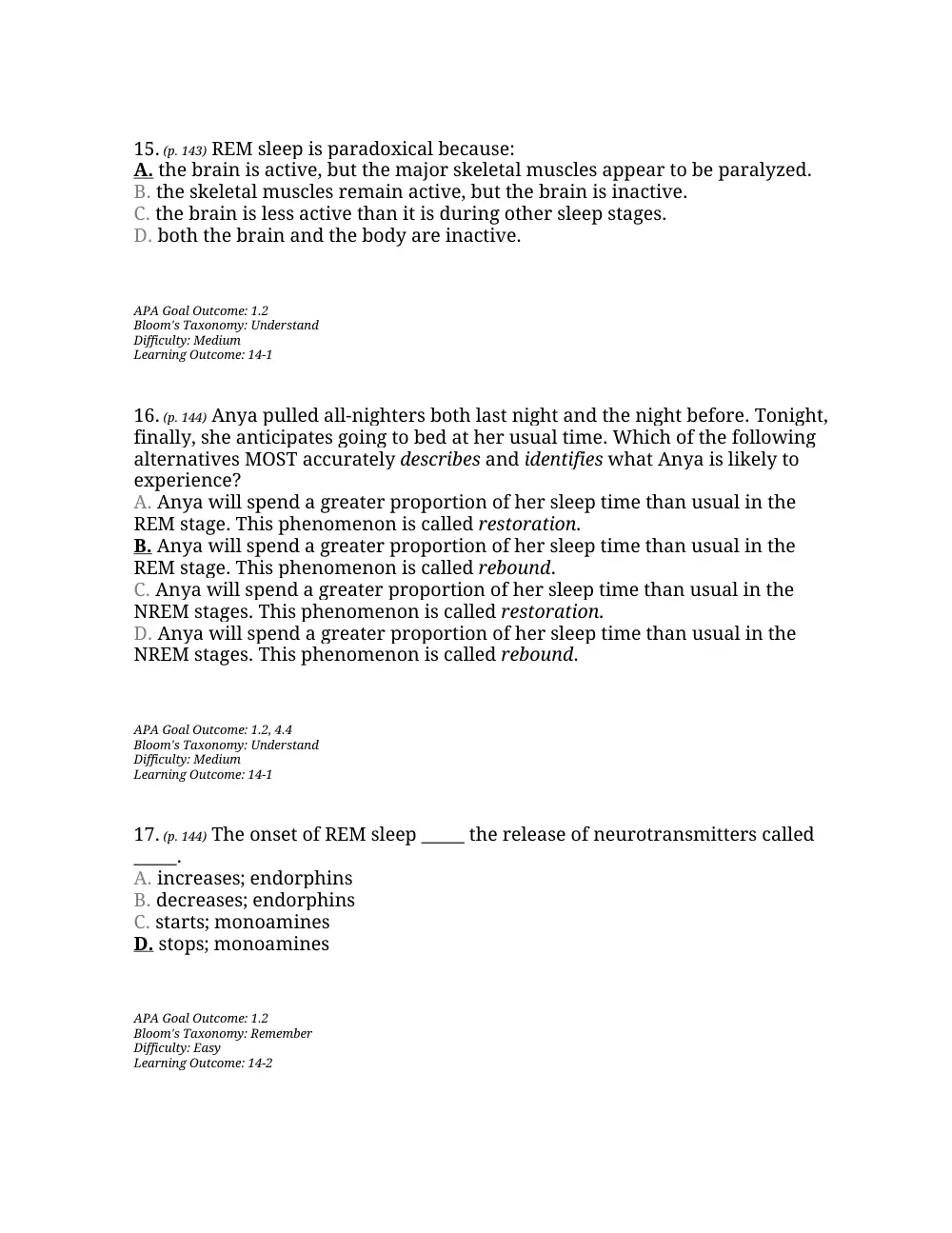
15. (p. 143) REM sleep is paradoxical because:
A. the brain is active, but the major skeletal muscles appear to be paralyzed.
B. the skeletal muscles remain active, but the brain is inactive.
C. the brain is less active than it is during other sleep stages.
D. both the brain and the body are inactive.
APA Goal Outcome: 1.2
Bloom's Taxonomy: Understand
Difficulty: Medium
Learning Outcome: 14-1
16. (p. 144) Anya pulled all-nighters both last night and the night before. Tonight,
finally, she anticipates going to bed at her usual time. Which of the following
alternatives MOST accurately describes and identifies what Anya is likely to
experience?
A. Anya will spend a greater proportion of her sleep time than usual in the
REM stage. This phenomenon is called restoration.
B. Anya will spend a greater proportion of her sleep time than usual in the
REM stage. This phenomenon is called rebound.
C. Anya will spend a greater proportion of her sleep time than usual in the
NREM stages. This phenomenon is called restoration.
D. Anya will spend a greater proportion of her sleep time than usual in the
NREM stages. This phenomenon is called rebound.
APA Goal Outcome: 1.2, 4.4
Bloom's Taxonomy: Understand
Difficulty: Medium
Learning Outcome: 14-1
17. (p. 144) The onset of REM sleep _____ the release of neurotransmitters called
_____.
A. increases; endorphins
B. decreases; endorphins
C. starts; monoamines
D. stops; monoamines
APA Goal Outcome: 1.2
Bloom's Taxonomy: Remember
Difficulty: Easy
Learning Outcome: 14-2
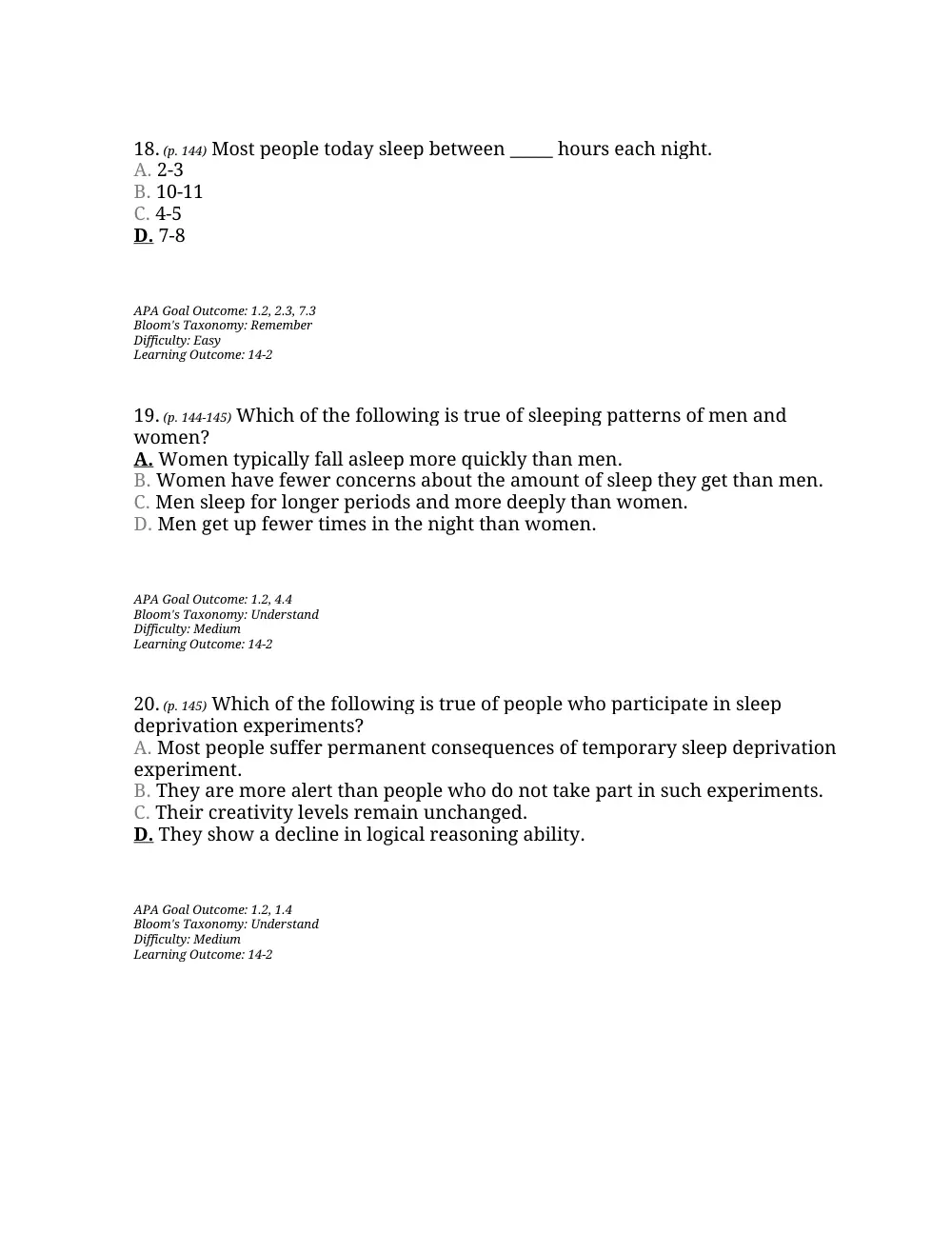
18. (p. 144) Most people today sleep between _____ hours each night.
A. 2-3
B. 10-11
C. 4-5
D. 7-8
APA Goal Outcome: 1.2, 2.3, 7.3
Bloom's Taxonomy: Remember
Difficulty: Easy
Learning Outcome: 14-2
19. (p. 144-145) Which of the following is true of sleeping patterns of men and
women?
A. Women typically fall asleep more quickly than men.
B. Women have fewer concerns about the amount of sleep they get than men.
C. Men sleep for longer periods and more deeply than women.
D. Men get up fewer times in the night than women.
APA Goal Outcome: 1.2, 4.4
Bloom's Taxonomy: Understand
Difficulty: Medium
Learning Outcome: 14-2
20. (p. 145) Which of the following is true of people who participate in sleep
deprivation experiments?
A. Most people suffer permanent consequences of temporary sleep deprivation
experiment.
B. They are more alert than people who do not take part in such experiments.
C. Their creativity levels remain unchanged.
D. They show a decline in logical reasoning ability.
APA Goal Outcome: 1.2, 1.4
Bloom's Taxonomy: Understand
Difficulty: Medium
Learning Outcome: 14-2
21. (p. 145) _____ are unusually frightening dreams, that occur fairly often.
A. Lucid dreams
B. Nightmares
C. Precognitive dreams
D. Breakdown dreams
APA Goal Outcome: 1.2, 7.3
Bloom's Taxonomy: Remember
Difficulty: Easy
Learning Outcome: 14-2
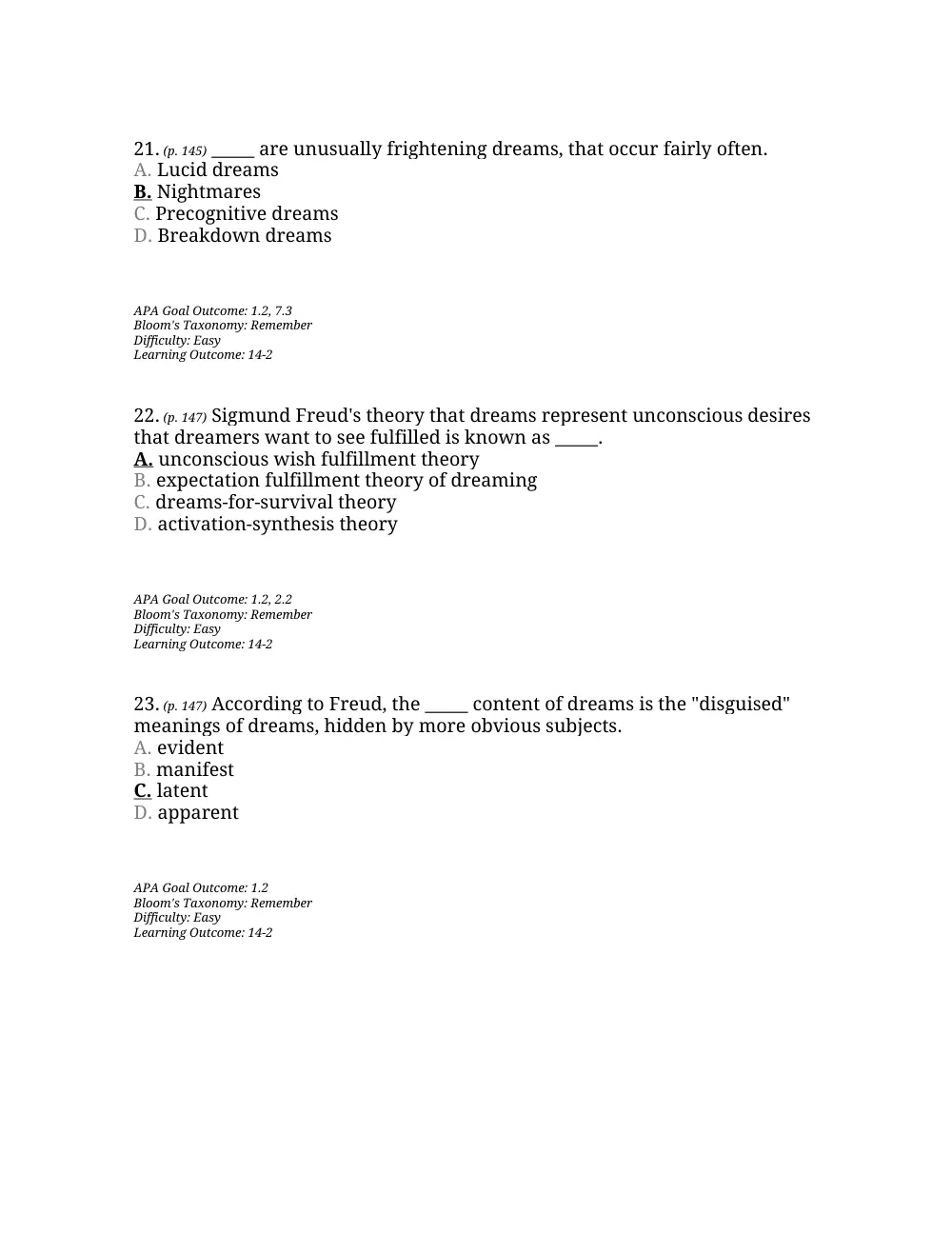
22. (p. 147) Sigmund Freud's theory that dreams represent unconscious desires
that dreamers want to see fulfilled is known as _____.
A. unconscious wish fulfillment theory
B. expectation fulfillment theory of dreaming
C. dreams-for-survival theory
D. activation-synthesis theory
APA Goal Outcome: 1.2, 2.2
Bloom's Taxonomy: Remember
Difficulty: Easy
Learning Outcome: 14-2
23. (p. 147) According to Freud, the _____ content of dreams is the "disguised"
meanings of dreams, hidden by more obvious subjects.
A. evident
B. manifest
C. latent
D. apparent
APA Goal Outcome: 1.2
Bloom's Taxonomy: Remember
Difficulty: Easy
Learning Outcome: 14-2
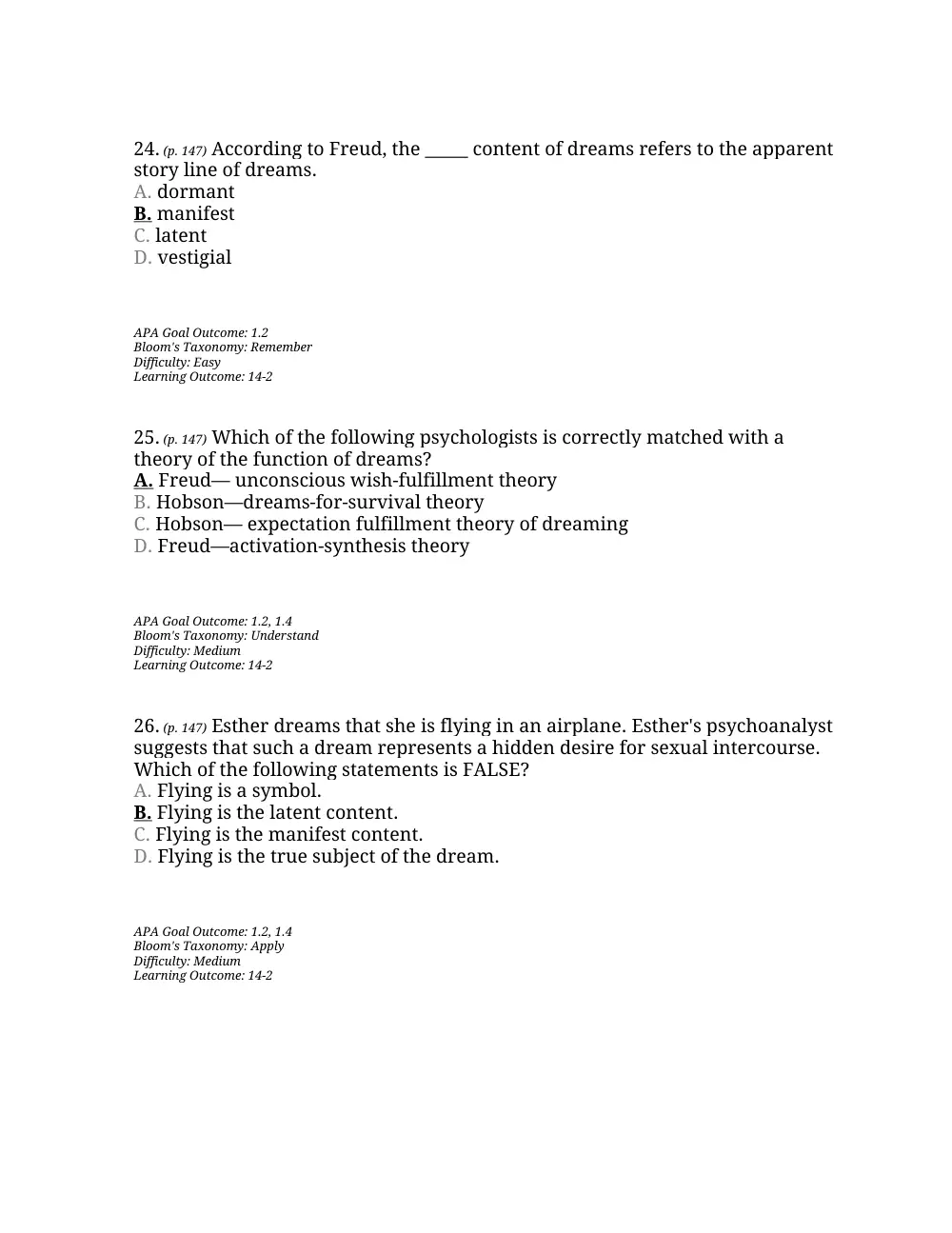
24. (p. 147) According to Freud, the _____ content of dreams refers to the apparent
story line of dreams.
A. dormant
B. manifest
C. latent
D. vestigial
APA Goal Outcome: 1.2
Bloom's Taxonomy: Remember
Difficulty: Easy
Learning Outcome: 14-2
25. (p. 147) Which of the following psychologists is correctly matched with a
theory of the function of dreams?
A. Freud— unconscious wish-fulfillment theory
B. Hobson—dreams-for-survival theory
C. Hobson— expectation fulfillment theory of dreaming
D. Freud—activation-synthesis theory
APA Goal Outcome: 1.2, 1.4
Bloom's Taxonomy: Understand
Difficulty: Medium
Learning Outcome: 14-2
26. (p. 147) Esther dreams that she is flying in an airplane. Esther's psychoanalyst
suggests that such a dream represents a hidden desire for sexual intercourse.
Which of the following statements is FALSE?
A. Flying is a symbol.
B. Flying is the latent content.
C. Flying is the manifest content.
D. Flying is the true subject of the dream.
APA Goal Outcome: 1.2, 1.4
Bloom's Taxonomy: Apply
Difficulty: Medium
Learning Outcome: 14-2
27. (p. 147-148) The manifest content of a dream:
A. consists of symbols.
B. is the dream you remember having.
C. is the underlying meaning of a dream.
D. is the hidden by more obvious subjects.
APA Goal Outcome: 1.2
Bloom's Taxonomy: Understand
Difficulty: Easy
Learning Outcome: 14-2
28. (p. 148) According to the _____ dreams permit us to reconsider and reprocess
during sleep information that is critical for our daily survival.
A. unconscious wish fulfillment theory
B. expectation fulfillment theory of dreaming
C. dreams-for-survival theory
D. activation-synthesis theory
APA Goal Outcome: 1.2, 2.2
Bloom's Taxonomy: Remember
Difficulty: Easy
Learning Outcome: 14-2
29. (p. 148) In the _____, dreams represent concerns about our daily lives,
illustrating our uncertainties, indecisions, ideas, and desires.
A. unconscious wish fulfillment theory
B. expectation fulfillment theory of dreaming
C. dreams-for-survival theory
D. activation-synthesis theory
APA Goal Outcome: 1.2, 2.2
Bloom's Taxonomy: Remember
Difficulty: Easy
Learning Outcome: 14-2
30. (p. 148) Dr. Gremillion argues that dreams function to focus on and
consolidate memories. They represent concerns about our daily lives,
illustrating our uncertainties, indecisions, ideas, and desires. Dr. Gremillion
subscribes to the _____ theory of the function of dreams.
A. wish-fulfillment
B. dreams-for-survival
C. activation-synthesis
D. symbolic-meaning
APA Goal Outcome: 1.2
Bloom's Taxonomy: Apply
Difficulty: Medium
Learning Outcome: 14-2
31. (p. 149) The _____ focuses on the random electrical energy that the brain
produces during REM sleep, possibly as a result of changes in the production of
particular neurotransmitters.
A. unconscious wish fulfillment theory
B. expectation fulfillment theory of dreaming
C. dreams-for-survival theory
D. activation-synthesis theory
APA Goal Outcome: 1.2, 2.2
Bloom's Taxonomy: Remember
Difficulty: Easy
Learning Outcome: 14-2
32. (p. 149) Which of the following alternatives best expresses the relationship
between the activation information modulation (AIM) and activation-synthesis
theories of dreaming?
A. Activation information modulation (AIM) theory is a competitor to
activation-synthesis theory.
B. Activation-synthesis theory is part of the activation information modulation
(AIM) theory.
C. Activation-synthesis theory has been refined by the activation in formation
modulation
D. (AIM) theory.
E. Activation information modulation (AIM) theory was replaced by
activation-synthesis theory.
APA Goal Outcome: 1.2
Bloom's Taxonomy: Understand
Difficulty: Medium
Learning Outcome: 14-2
33. (p. 149) According to activation information modulation (AIM) theory, dreams
are initiated in the brain's:
A. pons.
B. medulla.
C. prefrontal cortex.
D. amygdale.
APA Goal Outcome: 1.2
Bloom's Taxonomy: Remember
Difficulty: Easy
Learning Outcome: 14-2
34. (p. 149) Which figure best approximates the proportion of people afflicted by
insomnia?
A. 1/5
B. 1/4
C. 1/3
D. 1/2
APA Goal Outcome: 1.2, 4.2
Bloom's Taxonomy: Remember
Difficulty: Easy
Learning Outcome: 14-3
35. (p. 149-150) Which sleep disturbance is correctly matched with its description?
A. Sleep apnea— difficulty breathing during sleep
B. Narcolepsy—sudden awakenings accompanied by extreme fear, panic, and
strong physiological arousal.
C. Night terrors—sudden sleep during waking consciousness
D. Insomnia—temporary paralysis of the body before or after sleep
APA Goal Outcome: 1.2, 4.2
Bloom's Taxonomy: Understand
Difficulty: Medium
Learning Outcome: 14-3
36. (p. 150) _____ is a condition in which a person has difficulty breathing while
sleeping.
A. Bruxism
B. Narcolepsy
C. Night terror
D. Sleep apnea
APA Goal Outcome: 1.2, 4.4
Bloom's Taxonomy: Remember
Difficulty: Easy
Learning Outcome: 14-3
37. (p. 150) According to the text, _____ may play a role in sudden infant death
syndrome (SIDS).
A. sleep apnea
B. narcolepsy
C. bruxism
D. insomnia
APA Goal Outcome: 1.2, 4.2
Bloom's Taxonomy: Remember
Difficulty: Easy
Learning Outcome: 14-3
38. (p. 150) _____ is/are sudden awakenings from non-REM sleep that is
accompanied by extreme fear, panic, and strong physiological arousal.
A. Bruxism
B. Narcolepsy
C. Night terrors
D. Sleep apnea
APA Goal Outcome: 1.2, 4.4
Bloom's Taxonomy: Remember
Difficulty: Easy
Learning Outcome: 14-3
39. (p. 150) Night terrors occur during _____ sleep.
A. stage 4
B. REM
C. stage 2
D. stage 1
APA Goal Outcome: 1.2, 4.4
Bloom's Taxonomy: Remember
Difficulty: Easy
Learning Outcome: 14-3
40. (p. 150) Four-year old DeMarcus falls asleep shortly after his 8:30 p.m.
bedtime. At about 9:45, he suddenly sits up in bed, breathing rapidly and
appearing to be in a state of sheer panic. DeMarcus is experiencing:
A. bruxism.
B. a narcoleptic attack.
C. night terrors.
D. sleep apnea.
APA Goal Outcome: 1.2, 4.4
Bloom's Taxonomy: Apply
Difficulty: Medium
Learning Outcome: 14-3
41. (p. 150) _____ refers to uncontrollable sleeping that occurs for short periods
while a person is awake.
A. Bruxism
B. Narcolepsy
C. Night terror
D. Sleep apnea
APA Goal Outcome: 1.2, 4.4
Bloom's Taxonomy: Remember
Difficulty: Easy
Learning Outcome: 14-3
42. (p. 150) Sleepwalking and sleep talking both occur during _____ of sleep.
A. stage 4
B. stage 3
C. stage 2
D. stage 1
APA Goal Outcome: 1.2, 4.4
Bloom's Taxonomy: Remember
Difficulty: Easy
Learning Outcome: 14-3
43. (p. 151) Biological processes occurring on a cycle of approximately 24 hours
are termed as:
A. biorhythms.
B. diurnal rhythms.
C. circadian rhythms.
D. primal rhythms.
APA Goal Outcome: 1.2
Bloom's Taxonomy: Remember
Difficulty: Easy
Learning Outcome: 14-3
44. (p. 151) The brain's _____ nucleus regulates the body's circadian rhythms.
A. suprachiasmatic
B. intralaminar
C. ventromedial
D. lateral geniculate
APA Goal Outcome: 1.2
Bloom's Taxonomy: Remember
Difficulty: Easy
Learning Outcome: 14-3
45. (p. 152) Which of the following is true of daydreams?
A. They are under one's control to a greater extent than dreams that occur
during sleep.
B. They are less tied to the immediate environment than dreams that occur
during sleep.
C. They primarily include sexual content.
D. The brain is inactive during daydreaming.
APA Goal Outcome: 1.2
Bloom's Taxonomy: Understand
Difficulty: Easy
Learning Outcome: 14-4
46. (p. 152) Empirical research reveals that on average, people spend about _____
of their time daydreaming.
A. 10%
B. 25%
C. 35%
D. 50%
APA Goal Outcome: 1.2
Bloom's Taxonomy: Remember
Difficulty: Easy
Learning Outcome: 14-4
47. (p. 153) Which of the following solutions will help overcome insomnia?
A. Trying to sleep even when one is not tired
B. Taking sleeping pills
C. Exercising during the day
D. Drinking caffeine after lunch
APA Goal Outcome: 1.2, 4.4, 9.3
Bloom's Taxonomy: Understand
Difficulty: Easy
Learning Outcome: 14-3
48. (p. 153) Irv can't sleep, so he makes himself a cup of warm milk. Will this
work?
A. No. He should instead buy some sleeping pills from the drug store.
B. No. It is just a myth that milk induces sleep.
C. Yes. Milk contains tryptophan, which promotes sleep.
D. Yes, but it will disrupt his sleep cycle.
APA Goal Outcome: 1.2, 4.4, 9.3
Bloom's Taxonomy: Understand
Difficulty: Medium
Learning Outcome: 14-4
49. (p. 153) Which of the following is NOT a recommended solution if one has
trouble sleeping?
A. Drinking warm milk
B. Taking sleeping pills
C. Exercising during the day
D. Avoiding caffeine
APA Goal Outcome: 1.2, 4.4, 9.3
Bloom's Taxonomy: Understand
Difficulty: Easy
Learning Outcome: 14-4
50. (p. 155) _____ is a trancelike state of heightened susceptibility to the
suggestions of others.
A. Animal magnetism
B. Spiritualism
C. Hypnosis
D. Paralysis
APA Goal Outcome: 1.2
Bloom's Taxonomy: Remember
Difficulty: Easy
Learning Outcome: 15-1
51. (p. 155) Which of the following is the first step in the hypnosis process?
A. The hypnotist explains what is going to happen.
B. The hypnotist tells the person to concentrate on a specific object or image.
C. A person is made comfortable in a quiet environment.
D. The subject is brought to a highly relaxed state, when the hypnotist may
make suggestions that the person interprets as being produced by hypnosis.
APA Goal Outcome: 1.2, 3.1
Bloom's Taxonomy: Remember
Difficulty: Easy
Learning Outcome: 15-1
52. (p. 155) Which of the following notions regarding hypnosis is false?
A. People do not engage in self-destructive acts when hypnotized.
B. People are capable of lying when hypnotized.
C. People cannot be induced to perform antisocial behaviors when hypnotized.
D. People lose all will of their own.
APA Goal Outcome: 1.2, 3.1
Bloom's Taxonomy: Understand
Difficulty: Medium
Learning Outcome: 15-1
53. (p. 155) Which of the following notions regarding hypnosis is TRUE?
A. People may be induced to engage in self-destructive acts when hypnotized.
B. People cannot be hypnotized against their will.
C. People may be induced to perform antisocial behaviors when hypnotized.
D. People always tell the truth when they are hypnotized.
APA Goal Outcome: 1.2, 3.1
Bloom's Taxonomy: Understand
Difficulty: Medium
Learning Outcome: 15-1
54. (p. 155) Approximately what percentage of the population cannot be
hypnotized at all?
A. 5%-20%
B. 70%-90%
C. 30%-40%
D. 50%-80%
APA Goal Outcome: 1.2, 3.1
Bloom's Taxonomy: Remember
Difficulty: Easy
Learning Outcome: 15-1
55. (p. 155) Approximately what percentage of the population can be very easily
hypnotized?
A. 5%
B. 15%
C. 30%
D. 50%
APA Goal Outcome: 1.2, 3.1
Bloom's Taxonomy: Remember
Difficulty: Easy
Learning Outcome: 15-1
56. (p. 155) To which of the following traits does an individual's susceptibility to
hypnosis seem related?
A. The tendency to defer to others' wishes
B. The tendency to seek out new experiences
C. The tendency to become absorbed in one's activities
D. The tendency toward low self-confidence
APA Goal Outcome: 1.2
Bloom's Taxonomy: Remember
Difficulty: Easy
Learning Outcome: 15-1
57. (p. 156) Which of the following statements reflects a difference between
waking consciousness and hypnosis?
A. The brain's electrical activity differs between waking and hypnotic states of
consciousness.
B. Many physiological differences distinguish the hypnotic state from waking
consciousness.
C. Memory of childhood events is much more accurate under hypnosis than in
the waking state.
D. There is an increased ability to construct images under hypnosis than in the
waking state.
APA Goal Outcome: 1.2
Bloom's Taxonomy: Understand
Difficulty: Medium
Learning Outcome: 15-1
58. (p. 156) According to famed hypnosis researcher _____
A. Hilgard, hypnosis causes a division of consciousness.
B. Hilgard, hypnosis is really no different than waking consciousness.
C. Hobson, hypnosis causes a division of consciousness.
D. Hobson, hypnosis is really no different than waking consciousness.
APA Goal Outcome: 1.2
Bloom's Taxonomy: Remember
Difficulty: Easy
Learning Outcome: 15-1
59. (p. 156) According to hypnosis researcher Ernest Hilgard, hypnosis brings
about a dissociation of consciousness into two simultaneous components. This
is known as _____.
A. divided consciousness
B. complementary consciousness
C. simultaneous consciousness
D. binary consciousness
APA Goal Outcome: 1.2
Bloom's Taxonomy: Remember
Difficulty: Easy
Learning Outcome: 15-1
60. (p. 157) Hypnosis can help you:
A. relive experiences you had as a very small child.
B. improve athletic performance.
C. recall memories you've long forgotten.
D. stop drug and alcohol abuse.
APA Goal Outcome: 1.2, 3.1, 9.2
Bloom's Taxonomy: Understand
Difficulty: Medium
Learning Outcome: 15-1
61. (p. 157) In which of the following applications has hypnosis proven to be least
successful?
A. Stopping alcohol and drug abuse
B. Treating psychological disorders
C. Improving athletic performance
D. Relieving pain
APA Goal Outcome: 1.2, 4.2
Bloom's Taxonomy: Understand
Difficulty: Medium
Learning Outcome: 15-1
62. (p. 157) When traditional practitioners of the ancient Eastern religion of Zen
Buddhism want to achieve greater spiritual insight, they turn to a technique
that has been used for centuries to alter their state of consciousness. This
technique is called _____.
A. meditation
B. hypnosis
C. mysticism
D. mesmerism
APA Goal Outcome: 1.2, 8.1
Bloom's Taxonomy: Remember
Difficulty: Easy
Learning Outcome: 15-2
63. (p. 157) _____ is a learned technique for refocusing attention that brings about
an altered state of consciousness.
A. Mysticism
B. Hypnosis
C. Mesmerism
D. Meditation
APA Goal Outcome: 1.2, 8.1
Bloom's Taxonomy: Remember
Difficulty: Easy
Learning Outcome: 15-2
64. (p. 158) How often and for how long should meditation be practiced to realize
its benefits?
A. Twice weekly, for 20 minutes at a time
B. Twice daily, for 20 minutes at a time
C. Daily, for several hours at a stretch
D. Once a month for two hours
APA Goal Outcome: 4.4, 9.2
Bloom's Taxonomy: Remember
Difficulty: Easy
Learning Outcome: 15-2
65. (p. 158) Which of the following statements is most accurate regarding
potential cross-cultural variation in the attempt to alter consciousness?
A. The attempt to alter consciousness appears in some cultures but not in
others; among those cultures in which it appears, though, the means to alter
consciousness are much the same.
B. The attempt to alter consciousness appears to be universal, but the
particular means to do so vary from culture to culture.
C. The attempt to alter consciousness appears to be universal, as are the
particular means to do so.
D. The attempt to alter consciousness appears in some cultures but not in
others; among those cultures in which it appears, the means to alter
consciousness vary dramatically.
APA Goal Outcome: 1.2, 5.5, 8.2
Bloom's Taxonomy: Understand
Difficulty: Medium
Learning Outcome: 15-2
66. (p. 159) Which of the following is true of altered state of consciousness?
A. People start thinking logically.
B. People feel a sense of ineffability.
C. People gain self-control.
D. People's sense of time becomes more distinct.
APA Goal Outcome: 1.2
Bloom's Taxonomy: Understand
Difficulty: Medium
Learning Outcome: 15-2
67. (p. 159) Which of the following statements best encapsulates the text's
argument with respect to potential cultural influences on the experience of
consciousness?
A. Consciousness shows some basic similarities across cultures.
B. The fundamental experience of consciousness varies across cultures.
C. There are no cross-cultural differences in the experience of consciousness.
D. There are dramatic differences between cultures in the experience of
consciousness.
APA Goal Outcome: 1.2, 5.5, 8.2
Bloom's Taxonomy: Understand
Difficulty: Medium
Learning Outcome: 15-2
68. (p. 160) _____ drugs are drugs that influence a person's emotions, perceptions,
and behavior.
A. Psychoactive
B. Antiarrhythmic agent
C. Interferon
D. Antianginal
APA Goal Outcome: 1.2, 4.4
Bloom's Taxonomy: Remember
Difficulty: Easy
Learning Outcome: 16-1
69. (p. 160) If you have ever had a cup of coffee or sipped a beer, you have taken a
_____ drug.
A. psychoactive
B. Antiarrhythmic agent
C. Interferon
D. Antianginal
APA Goal Outcome: 1.2, 4.4
Bloom's Taxonomy: Remember
Difficulty: Easy
Learning Outcome: 16-1
70. (p. 160) Since the 1970s, the number of young adolescents who begin drinking
alcohol by the time they are in the 8th grade has:
A. increased by about 10%.
B. increased by nearly 33.33%.
C. decreased by about 25%.
D. remained fairly constant.
APA Goal Outcome: 1.2, 4.4
Bloom's Taxonomy: Remember
Difficulty: Easy
Learning Outcome: 16-1
71. (p. 160) Which of the following is true about alcohol consumption in the
general population since the 1970s?
A. It has increased by about 10%.
B. It has increased by nearly 33.33%.
C. It has decreased by about 25%.
D. It has stayed fairly steady.
APA Goal Outcome: 1.2, 4.4
Bloom's Taxonomy: Remember
Difficulty: Easy
Learning Outcome: 16-1
72. (p. 160) Which of the following is not a psychoactive drug?
A. Caffeine
B. Nicotine
C. Antibiotics
D. Amphetamines
APA Goal Outcome: 1.2
Bloom's Taxonomy: Understand
Difficulty: Easy
Learning Outcome: 16-1
73. (p. 160) Which of the following figures most closely approximates the
percentage of high school seniors who have tried an illegal drug during the
past year?
A. 15%
B. 23%
C. 41%
D. 67%
APA Goal Outcome: 1.2, 4.2
Bloom's Taxonomy: Remember
Difficulty: Easy
Learning Outcome: 16-1
74. (p. 160) _____ drugs are drugs that produce a biological or psychological
dependence in the user so that withdrawal from them leads to a craving for the
drug that, in some cases, may be nearly irresistible.
A. Antibiotic
B. Interferon
C. Addictive
D. Therapeutic
APA Goal Outcome: 1.2, 4.4
Bloom's Taxonomy: Remember
Difficulty: Easy
Learning Outcome: 16-1
75. (p. 160) Which of the following is true about drugs?
A. Psychoactive drugs are not common is most of our lives.
B. In psychological dependence, the body becomes so accustomed to
functioning in the presence of a drug that it cannot function without it.
C. In physiological dependence, people believe that they need the drug to
respond to the stresses of daily living.
D. Addictive drugs produce a physiological or psychological dependence (or
both) in the user.
APA Goal Outcome: 1.2, 4.4
Bloom's Taxonomy: Remember
Difficulty: Easy
Learning Outcome: 16-1
76. (p. 160) In _____ dependence, people believe that they need the drug to
respond to the stresses of daily living.
A. behavioral
B. pathological
C. psychological
D. physiological
APA Goal Outcome: 1.2, 4.4
Bloom's Taxonomy: Remember
Difficulty: Easy
Learning Outcome: 16-1
77. (p. 161) According to a survey of 14,000 high school seniors across the United
States, which of the following substances have high school seniors LEAST
indulged in?
A. Marijuana
B. Alcohol
C. Cigarettes
D. Steroids
APA Goal Outcome: 1.2, 4.4
Bloom's Taxonomy: Remember
Difficulty: Easy
Learning Outcome: 16-1
78. (p. 161) According to a survey of 14,000 high school seniors across the United
States, which of the following substances have high school seniors used the
most?
A. Marijuana
B. Alcohol
C. Cigarettes
D. Steroids
APA Goal Outcome: 1.2, 4.4
Bloom's Taxonomy: Remember
Difficulty: Easy
Learning Outcome: 16-1
79. (p. 162) According to the text, the DARE program is used in approximately
_____ of the school districts in the U. S.
A. 80%
B. 60%
C. 50%
D. 40%
APA Goal Outcome: 4.2
Bloom's Taxonomy: Remember
Difficulty: Easy
Learning Outcome: 16-1
80. (p. 162) Assessment of the DARE program has revealed that:
A. the program is highly successful in reducing drug use over the longer term.
B. the program is not popular with school officials, parents, and politicians.
C. DARE graduates were more likely to use marijuana than was a comparison
group of non graduates.
D. DARE is the only drug reduction program whose effectiveness has not been
questioned.
APA Goal Outcome: 4.2, 4.3
Bloom's Taxonomy: Remember
Difficulty: Easy
Learning Outcome: 16-1
81. (p. 162) Stimulants are drugs that:
A. cause incapacitation and inability to resist sexual assault.
B. have an arousal effect on the central nervous system, causing a rise in heart
rate, blood pressure, and muscular tension.
C. slow down the nervous system.
D. increase relaxation and relieve pain and anxiety.
APA Goal Outcome: 4.2, 4.3
Bloom's Taxonomy: Remember
Difficulty: Easy
Learning Outcome: 16-1
82. (p. 162) Which drug below is correctly matched with its class?
A. Cocaine - depressant
B. Caffeine - stimulant
C. Marijuana - depressant
D. Heroin - hallucinogen
APA Goal Outcome: 1.2
Bloom's Taxonomy: Remember
Difficulty: Easy
Learning Outcome: 16-1
83. (p. 162) Which category of psychoactive drugs below is correctly matched with
its effects on thought and behavior?
A. Hallucinogens - slow down the nervous system.
B. Stimulants - increase the activity of the central nervous system
C. Narcotics - produce changes in sensory perception
D. Depressants - capable of producing hallucinations
APA Goal Outcome: 1.2
Bloom's Taxonomy: Understand
Difficulty: Medium
Learning Outcome: 16-1
84. (p. 162) Which of the following statements most accurately describes the effect
of caffeine and the other stimulants on the nervous system?
A. They decrease central nervous system activity.
B. They have an arousal effect on the central nervous system.
C. They cause a drop in the heart rate.
D. They increase the reaction time.
APA Goal Outcome: 1.2
Bloom's Taxonomy: Understand
Difficulty: Medium
Learning Outcome: 16-1
85. (p. 162-163) Which of the following drugs is not a stimulant?
A. Cocaine
B. Caffeine
C. Morphine
D. Methamphetamine
APA Goal Outcome: 1.2
Bloom's Taxonomy: Remember
Difficulty: Easy
Learning Outcome: 16-1
86. (p. 163) Caffeine mimics the effects of a natural brain chemical called:
A. adenosine.
B. acetylcholine.
C. adrenaline.
D. dopamine.
APA Goal Outcome: 1.2
Bloom's Taxonomy: Remember
Difficulty: Easy
Learning Outcome: 16-1
87. (p. 163) Nicotine activates neural mechanisms similar to those activated by
_____.