
PSYC 201 Questions Chapter 7, Fall 2015
American University of Beirut · Psyc-201 · 58 pages


Showing the first 10 of 58 pages. Download the PDF to see all of it.
More PSYC 201 files
- Chapter 12 · Spring 2018ChapterView
- Chapter 13 · Spring 2018ChapterView
- Chapter 15 · Spring 2018ChapterView
- Chapter 17 · Spring 2018ChapterView
- Questions Chapter 2 Test Bank · Spring 2017ChapterView
- Questions Chapter 1 Test Bank · Spring 2017ChapterView
- Problems Chapter 7 · Summer 2016ChapterView
- Questions Chapter 10 · Spring 2015ChapterView
Show the text of this chapter
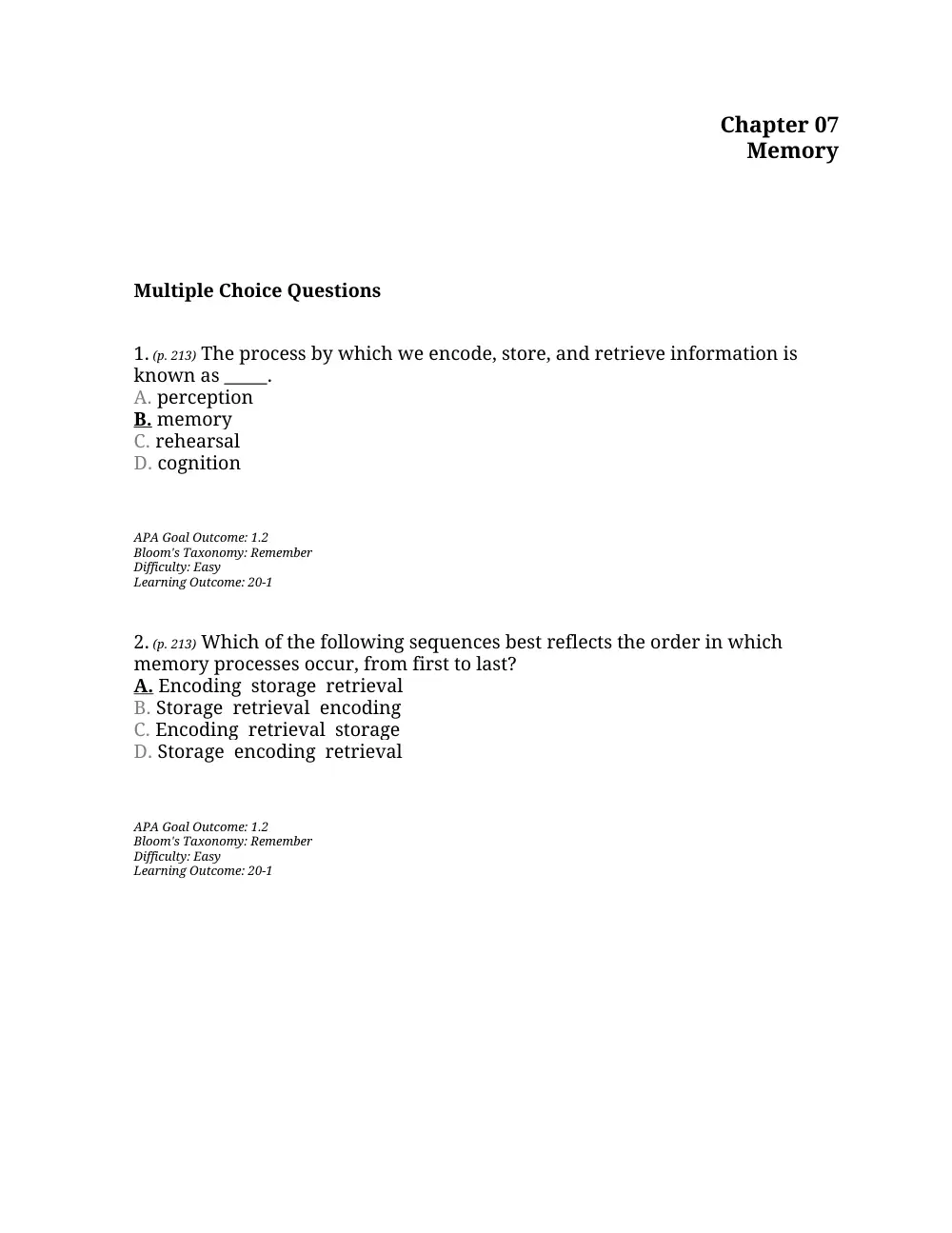
Chapter 07
Memory
Multiple Choice Questions
1. (p. 213) The process by which we encode, store, and retrieve information is
known as _____.
A. perception
B. memory
C. rehearsal
D. cognition
APA Goal Outcome: 1.2
Bloom's Taxonomy: Remember
Difficulty: Easy
Learning Outcome: 20-1
2. (p. 213) Which of the following sequences best reflects the order in which
memory processes occur, from first to last?
A. Encoding storage retrieval
B. Storage retrieval encoding
C. Encoding retrieval storage
D. Storage encoding retrieval
APA Goal Outcome: 1.2
Bloom's Taxonomy: Remember
Difficulty: Easy
Learning Outcome: 20-1
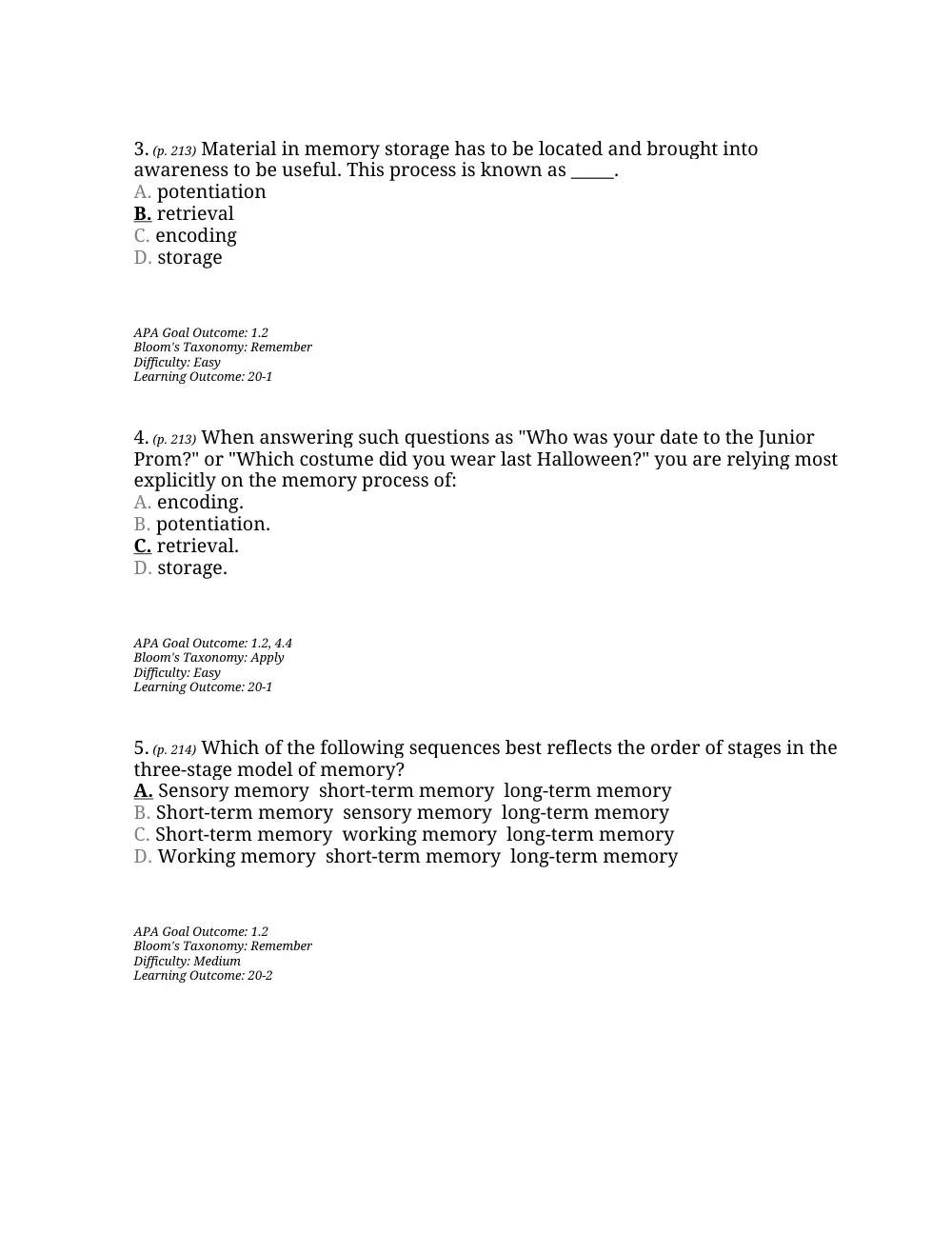
3. (p. 213) Material in memory storage has to be located and brought into
awareness to be useful. This process is known as _____.
A. potentiation
B. retrieval
C. encoding
D. storage
APA Goal Outcome: 1.2
Bloom's Taxonomy: Remember
Difficulty: Easy
Learning Outcome: 20-1
4. (p. 213) When answering such questions as "Who was your date to the Junior
Prom?" or "Which costume did you wear last Halloween?" you are relying most
explicitly on the memory process of:
A. encoding.
B. potentiation.
C. retrieval.
D. storage.
APA Goal Outcome: 1.2, 4.4
Bloom's Taxonomy: Apply
Difficulty: Easy
Learning Outcome: 20-1
5. (p. 214) Which of the following sequences best reflects the order of stages in the
three-stage model of memory?
A. Sensory memory short-term memory long-term memory
B. Short-term memory sensory memory long-term memory
C. Short-term memory working memory long-term memory
D. Working memory short-term memory long-term memory
APA Goal Outcome: 1.2
Bloom's Taxonomy: Remember
Difficulty: Medium
Learning Outcome: 20-2
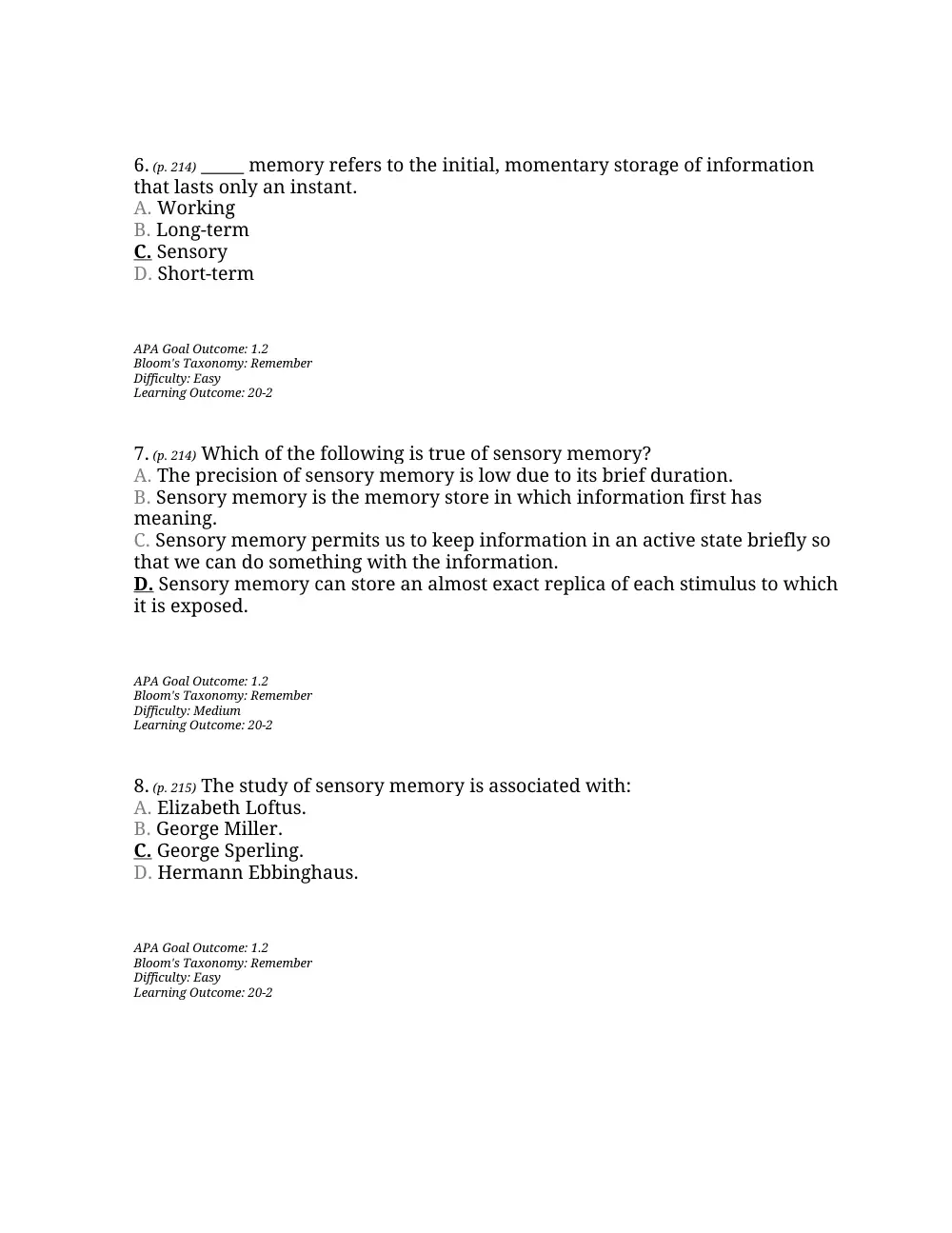
6. (p. 214) _____ memory refers to the initial, momentary storage of information
that lasts only an instant.
A. Working
B. Long-term
C. Sensory
D. Short-term
APA Goal Outcome: 1.2
Bloom's Taxonomy: Remember
Difficulty: Easy
Learning Outcome: 20-2
7. (p. 214) Which of the following is true of sensory memory?
A. The precision of sensory memory is low due to its brief duration.
B. Sensory memory is the memory store in which information first has
meaning.
C. Sensory memory permits us to keep information in an active state briefly so
that we can do something with the information.
D. Sensory memory can store an almost exact replica of each stimulus to which
it is exposed.
APA Goal Outcome: 1.2
Bloom's Taxonomy: Remember
Difficulty: Medium
Learning Outcome: 20-2
8. (p. 215) The study of sensory memory is associated with:
A. Elizabeth Loftus.
B. George Miller.
C. George Sperling.
D. Hermann Ebbinghaus.
APA Goal Outcome: 1.2
Bloom's Taxonomy: Remember
Difficulty: Easy
Learning Outcome: 20-2
9. (p. 215) In the late 1950s and early 1960s, psychologist George Sperling
conducted key studies of:
A. sensory memory.
B. short-term memory.
C. semantic networks.
D. long-term memory.
APA Goal Outcome: 1.2
Bloom's Taxonomy: Remember
Difficulty: Easy
Learning Outcome: 20-2
10. (p. 215) A research participant is required to report as much of a poem as he
can remember immediately after having read the poem once. We would expect
the greatest number of recall errors in lines:
A. at the beginning of the poem.
B. in the middle of the poem.
C. at the end of the poem.
D. anywhere in the poem.
APA Goal Outcome: 1.2
Bloom's Taxonomy: Apply
Difficulty: Medium
Learning Outcome: 20-2
11. (p. 216) Which of the following expressions best reflects the capacity of
short-term memory?
A. One or two items
B. Unlimited
C. About seven +/- two chunks
D. About a dozen chunks
APA Goal Outcome: 1.2
Bloom's Taxonomy: Remember
Difficulty: Easy
Learning Outcome: 20-2
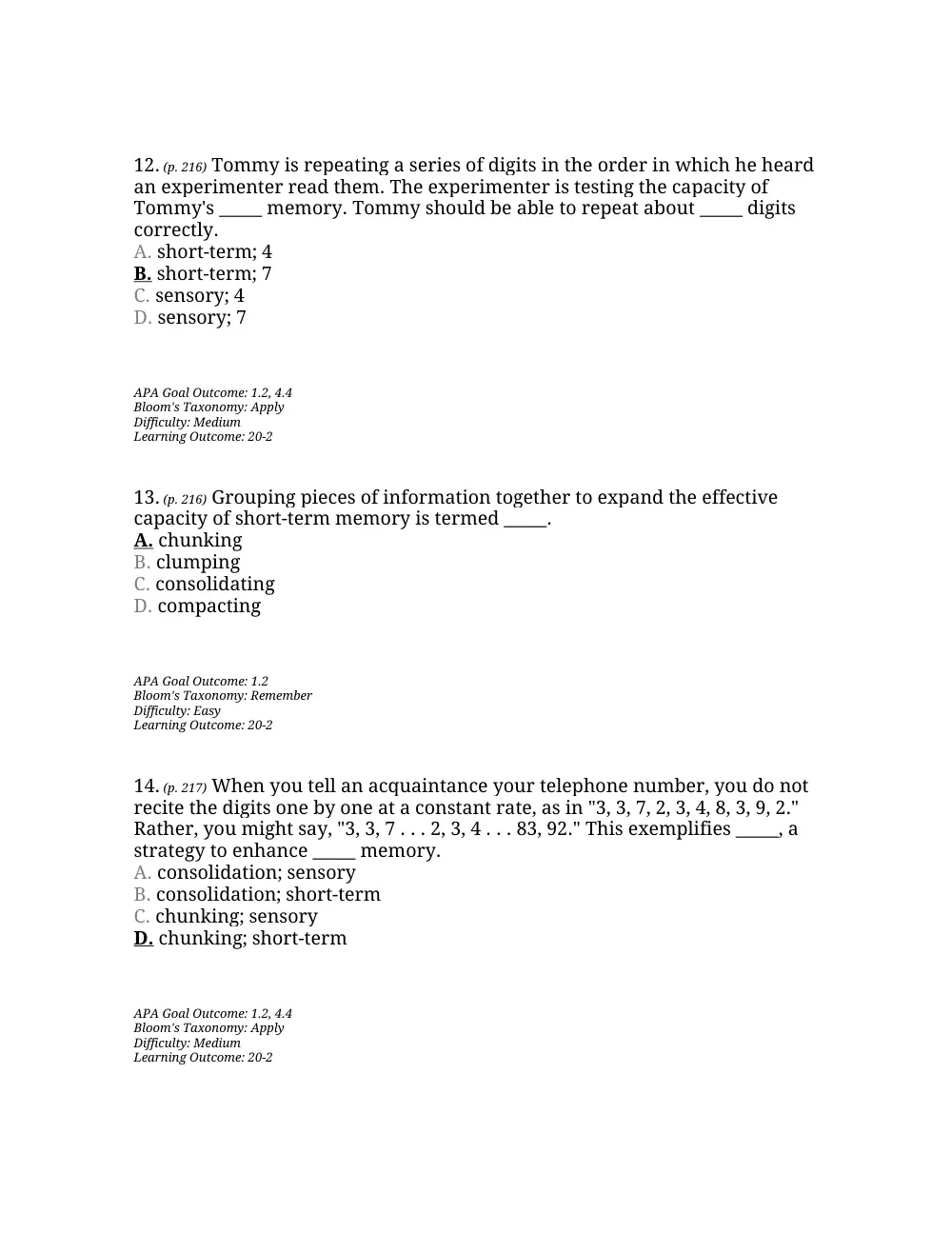
12. (p. 216) Tommy is repeating a series of digits in the order in which he heard
an experimenter read them. The experimenter is testing the capacity of
Tommy's _____ memory. Tommy should be able to repeat about _____ digits
correctly.
A. short-term; 4
B. short-term; 7
C. sensory; 4
D. sensory; 7
APA Goal Outcome: 1.2, 4.4
Bloom's Taxonomy: Apply
Difficulty: Medium
Learning Outcome: 20-2
13. (p. 216) Grouping pieces of information together to expand the effective
capacity of short-term memory is termed _____.
A. chunking
B. clumping
C. consolidating
D. compacting
APA Goal Outcome: 1.2
Bloom's Taxonomy: Remember
Difficulty: Easy
Learning Outcome: 20-2
14. (p. 217) When you tell an acquaintance your telephone number, you do not
recite the digits one by one at a constant rate, as in "3, 3, 7, 2, 3, 4, 8, 3, 9, 2."
Rather, you might say, "3, 3, 7 . . . 2, 3, 4 . . . 83, 92." This exemplifies _____, a
strategy to enhance _____ memory.
A. consolidation; sensory
B. consolidation; short-term
C. chunking; sensory
D. chunking; short-term
APA Goal Outcome: 1.2, 4.4
Bloom's Taxonomy: Apply
Difficulty: Medium
Learning Outcome: 20-2
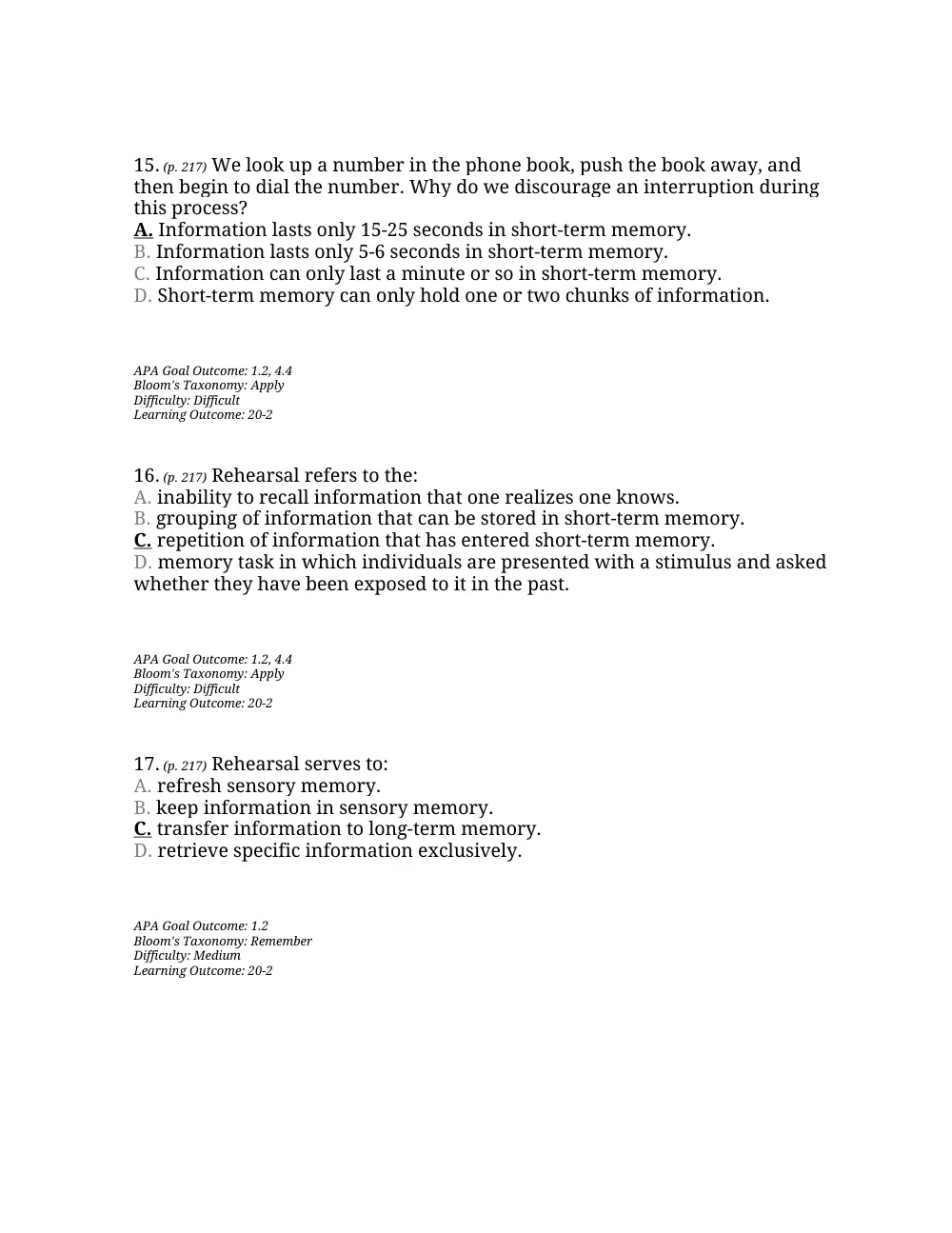
15. (p. 217) We look up a number in the phone book, push the book away, and
then begin to dial the number. Why do we discourage an interruption during
this process?
A. Information lasts only 15-25 seconds in short-term memory.
B. Information lasts only 5-6 seconds in short-term memory.
C. Information can only last a minute or so in short-term memory.
D. Short-term memory can only hold one or two chunks of information.
APA Goal Outcome: 1.2, 4.4
Bloom's Taxonomy: Apply
Difficulty: Difficult
Learning Outcome: 20-2
16. (p. 217) Rehearsal refers to the:
A. inability to recall information that one realizes one knows.
B. grouping of information that can be stored in short-term memory.
C. repetition of information that has entered short-term memory.
D. memory task in which individuals are presented with a stimulus and asked
whether they have been exposed to it in the past.
APA Goal Outcome: 1.2, 4.4
Bloom's Taxonomy: Apply
Difficulty: Difficult
Learning Outcome: 20-2
17. (p. 217) Rehearsal serves to:
A. refresh sensory memory.
B. keep information in sensory memory.
C. transfer information to long-term memory.
D. retrieve specific information exclusively.
APA Goal Outcome: 1.2
Bloom's Taxonomy: Remember
Difficulty: Medium
Learning Outcome: 20-2
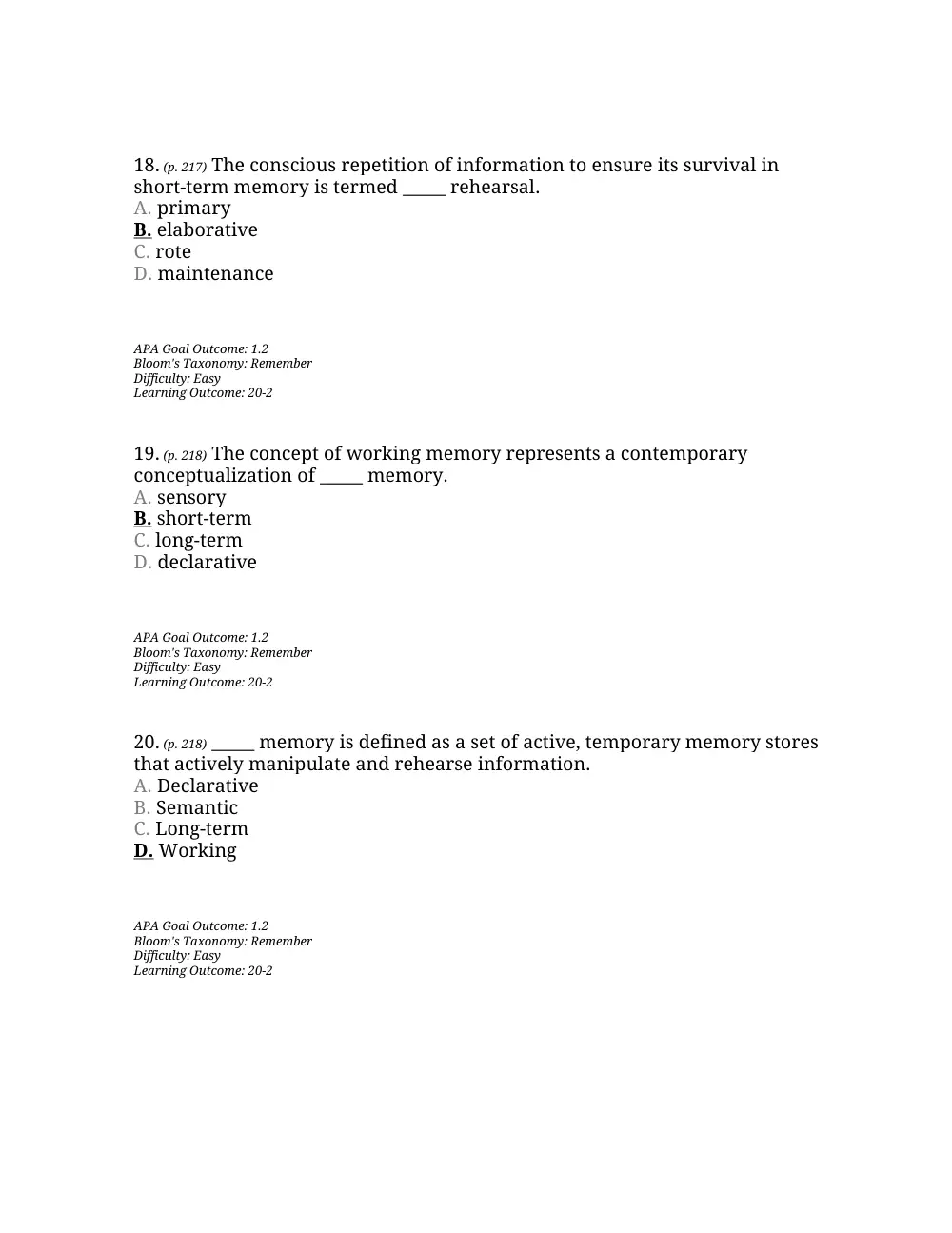
18. (p. 217) The conscious repetition of information to ensure its survival in
short-term memory is termed _____ rehearsal.
A. primary
B. elaborative
C. rote
D. maintenance
APA Goal Outcome: 1.2
Bloom's Taxonomy: Remember
Difficulty: Easy
Learning Outcome: 20-2
19. (p. 218) The concept of working memory represents a contemporary
conceptualization of _____ memory.
A. sensory
B. short-term
C. long-term
D. declarative
APA Goal Outcome: 1.2
Bloom's Taxonomy: Remember
Difficulty: Easy
Learning Outcome: 20-2
20. (p. 218) _____ memory is defined as a set of active, temporary memory stores
that actively manipulate and rehearse information.
A. Declarative
B. Semantic
C. Long-term
D. Working
APA Goal Outcome: 1.2
Bloom's Taxonomy: Remember
Difficulty: Easy
Learning Outcome: 20-2
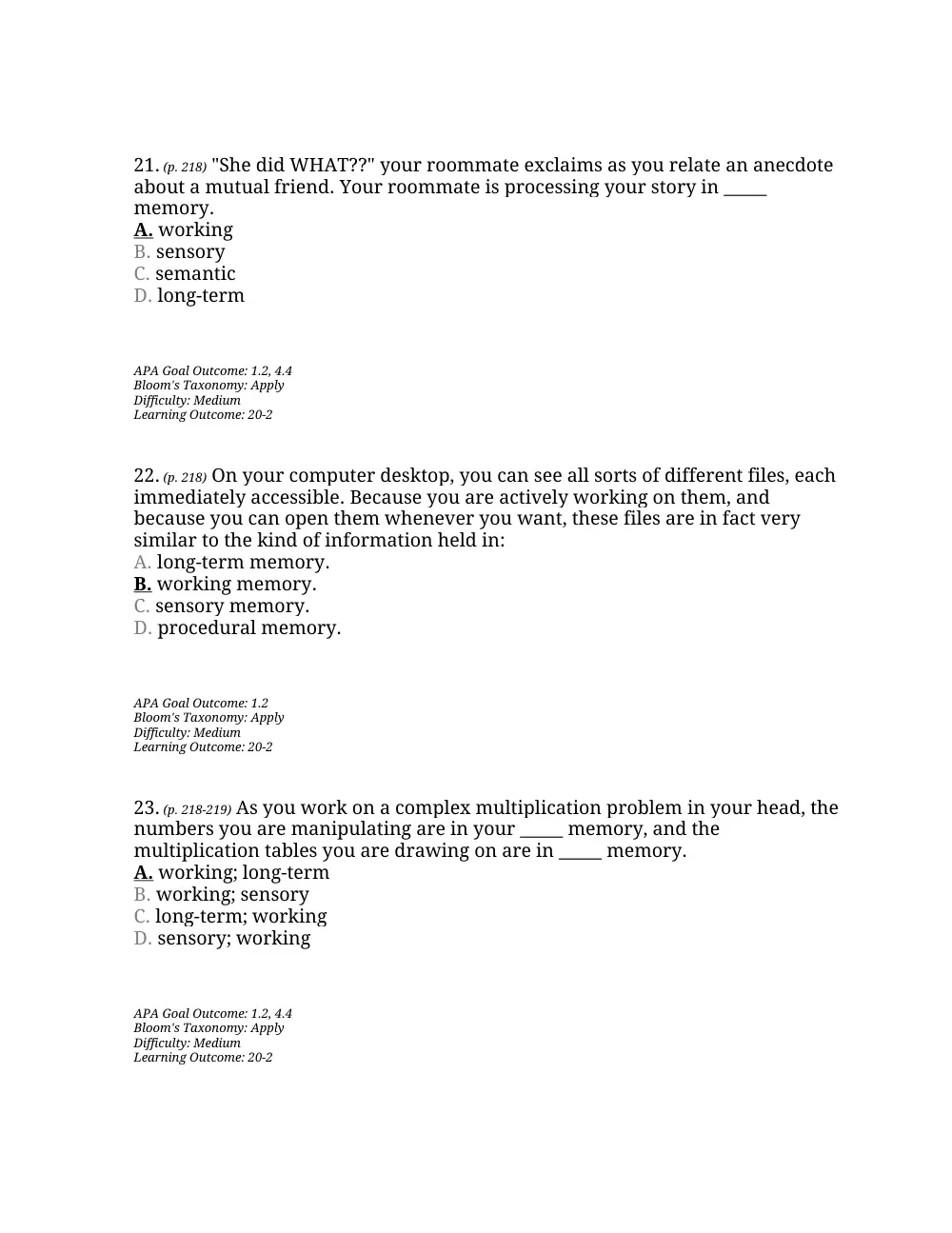
21. (p. 218) "She did WHAT??" your roommate exclaims as you relate an anecdote
about a mutual friend. Your roommate is processing your story in _____
memory.
A. working
B. sensory
C. semantic
D. long-term
APA Goal Outcome: 1.2, 4.4
Bloom's Taxonomy: Apply
Difficulty: Medium
Learning Outcome: 20-2
22. (p. 218) On your computer desktop, you can see all sorts of different files, each
immediately accessible. Because you are actively working on them, and
because you can open them whenever you want, these files are in fact very
similar to the kind of information held in:
A. long-term memory.
B. working memory.
C. sensory memory.
D. procedural memory.
APA Goal Outcome: 1.2
Bloom's Taxonomy: Apply
Difficulty: Medium
Learning Outcome: 20-2
23. (p. 218-219) As you work on a complex multiplication problem in your head, the
numbers you are manipulating are in your _____ memory, and the
multiplication tables you are drawing on are in _____ memory.
A. working; long-term
B. working; sensory
C. long-term; working
D. sensory; working
APA Goal Outcome: 1.2, 4.4
Bloom's Taxonomy: Apply
Difficulty: Medium
Learning Outcome: 20-2
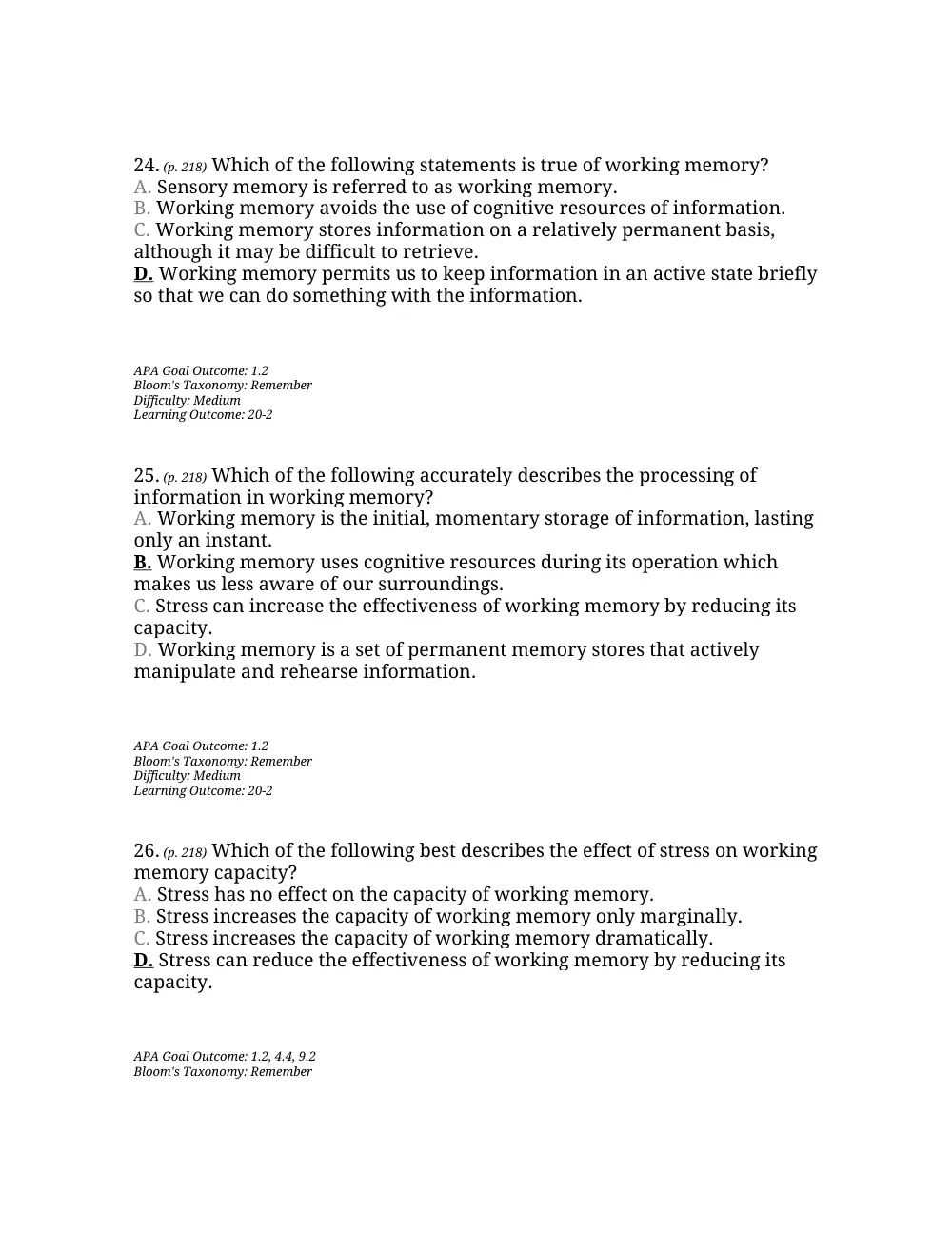
24. (p. 218) Which of the following statements is true of working memory?
A. Sensory memory is referred to as working memory.
B. Working memory avoids the use of cognitive resources of information.
C. Working memory stores information on a relatively permanent basis,
although it may be difficult to retrieve.
D. Working memory permits us to keep information in an active state briefly
so that we can do something with the information.
APA Goal Outcome: 1.2
Bloom's Taxonomy: Remember
Difficulty: Medium
Learning Outcome: 20-2
25. (p. 218) Which of the following accurately describes the processing of
information in working memory?
A. Working memory is the initial, momentary storage of information, lasting
only an instant.
B. Working memory uses cognitive resources during its operation which
makes us less aware of our surroundings.
C. Stress can increase the effectiveness of working memory by reducing its
capacity.
D. Working memory is a set of permanent memory stores that actively
manipulate and rehearse information.
APA Goal Outcome: 1.2
Bloom's Taxonomy: Remember
Difficulty: Medium
Learning Outcome: 20-2
26. (p. 218) Which of the following best describes the effect of stress on working
memory capacity?
A. Stress has no effect on the capacity of working memory.
B. Stress increases the capacity of working memory only marginally.
C. Stress increases the capacity of working memory dramatically.
D. Stress can reduce the effectiveness of working memory by reducing its
capacity.
APA Goal Outcome: 1.2, 4.4, 9.2
Bloom's Taxonomy: Remember
Difficulty: Medium
Learning Outcome: 20-2
27. (p. 219) The distinction between long- and short-term memory:
A. is somewhat artificial.
B. has failed to gain empirical support in memory research.
C. is supported by the effects of certain kinds of brain damage.
D. is supported by the distinction between declarative memory and procedural
memory.
APA Goal Outcome: 1.2
Bloom's Taxonomy: Understand
Difficulty: Medium
Learning Outcome: 20-2
28. (p. 219) Our ability to recall an item from a list depends on where in the list
the item occurs. This is the _____ effect.
A. serial position
B. list memory
C. cereal position
D. item order
APA Goal Outcome: 1.2
Bloom's Taxonomy: Remember
Difficulty: Easy
Learning Outcome: 20-2
29. (p. 219) The primacy effect refers to the fact that:
A. the most important items in a list are remembered better than the less
important items.
B. items presented early in a list are remembered better than items in the
middle of the list.
C. items presented late in a list are remembered better than items presented
earlier.
D. those items in a list which have the greatest emotional impact are those with
the greatest likelihood of recall.
APA Goal Outcome: 1.2
Bloom's Taxonomy: Remember
Difficulty: Easy
Learning Outcome: 20-2
30. (p. 219) "Cat food, cola, toothpaste." Your roommate begins reciting items as
you get to ready to leave to the store. He continues to list a few more items.
Finally, he wraps up: "Coffee creamer, spaghetti sauce, dish liquid, and ice tea
mix." You forget a couple of things, but you do manage to get the cat food, cola,
and toothpaste. Your memory for these items reflects the _____ effect.
A. primacy
B. recency
C. serial memory
D. item order
APA Goal Outcome: 1.2, 4.4
Bloom's Taxonomy: Apply
Difficulty: Medium
Learning Outcome: 20-2
31. (p. 219) You examine the schedule for your favorite football team. The team
plays sixteen games each season. Later you try recalling that schedule for a
friend who likes the same team you do. Chances are you will recall opponents
at the beginning of the schedule particularly well. This is an example of the
_____ effect.
A. list
B. consolidation
C. primacy
D. depth-of-processing
APA Goal Outcome: 1.2, 4.4
Bloom's Taxonomy: Apply
Difficulty: Easy
Learning Outcome: 20-2
32. (p. 219) The recency effect refers to the fact that:
A. items presented late in a list are remembered better than items presented in
the middle of a list.
B. the first several items on a list are remembered better than the items in the
middle of the list.
C. rehearsed items are more likely to be remembered than unrehearsed items.
D. the most personally relevant items on a list are most likely to be
remembered.
APA Goal Outcome: 1.2
Bloom's Taxonomy: Remember
Difficulty: Easy
Learning Outcome: 20-2
33. (p. 219) "Milk, cereal, candy." Your roommate begins reciting items as you get
ready to leave to the store. He continues to list a few more items. Finally, he
wraps up: "Spaghetti sauce, dish liquid, and ice tea mix." You forget a few
things, but the spaghetti sauce, dish liquid, and ice tea mix are in the bag. Your
memory for these items reflects the _____ effect.
A. primacy
B. recency
C. list memory
D. serial order
APA Goal Outcome: 1.2, 4.4
Bloom's Taxonomy: Apply
Difficulty: Medium
Learning Outcome: 20-2
34. (p. 219) When you try to list all the classes you've ever taken in college,
chances are you will recall your last few classes particularly well. What is this
phenomenon called?
A. Chunking
B. Primacy effect
C. Recency effect
D. Memory consolidation
APA Goal Outcome: 1.2, 4.4
Bloom's Taxonomy: Apply
Difficulty: Easy
Learning Outcome: 20-2
35. (p. 219) Which of the following refers to declarative memory?
A. Memory for habits
B. Memory for skills
C. Memory for how to do things
D. Memory for names
APA Goal Outcome: 1.2, 4.4
Bloom's Taxonomy: Remember
Difficulty: Easy
Learning Outcome: 20-2
36. (p. 219) Which of the following forms of memory refers to memory for skills
and habits?
A. Declarative memory
B. Semantic memory
C. Episodic memory
D. Procedural memory
APA Goal Outcome: 1.2, 4.4
Bloom's Taxonomy: Remember
Difficulty: Easy
Learning Outcome: 20-2
37. (p. 219) _____ memory is memory for general knowledge and facts about the
world, as well as memory for the rules of logic that are used to deduce other
facts.
A. Episodic
B. Semantic
C. Nondeclarative
D. Procedural
APA Goal Outcome: 1.2, 4.4
Bloom's Taxonomy: Remember
Difficulty: Easy
Learning Outcome: 20-2
38. (p. 219) Knowing how to serve a badminton birdie is an example of a(n) _____
memory.
A. episodic
B. declarative
C. procedural
D. semantic
APA Goal Outcome: 1.2, 4.4
Bloom's Taxonomy: Apply
Difficulty: Easy
Learning Outcome: 20-2
39. (p. 219) Cory knows that the capital of Vermont is Montpelier. This is an
example of _____ memory.
A. semantic
B. episodic
C. procedural
D. nondeclarative
APA Goal Outcome: 1.2, 4.4
Bloom's Taxonomy: Apply
Difficulty: Medium
Learning Outcome: 20-2
40. (p. 220) Having done "21 for 21" shots, Deanna barely remembers her 21st
birthday. That is, her _____ memory is sketchy.
A. procedural
B. semantic
C. episodic
D. working
APA Goal Outcome: 1.2, 4.4
Bloom's Taxonomy: Apply
Difficulty: Easy
Learning Outcome: 20-2
41. (p. 220) Which of the following statements accurately captures the
relationship among the modules of long-term memory?
A. Episodic and semantic memory are both components of procedural
memory.
B. Episodic and semantic memory are both components of declarative
memory.
C. Declarative and semantic memory are both types of episodic memory.
D. Declarative and semantic memory are both types of procedural memory
APA Goal Outcome: 1.2
Bloom's Taxonomy: Remember
Difficulty: Medium
Learning Outcome: 20-2
42. (p. 221) Activating one memory triggers the activation of related memories in
a process known as:
A. spreading activation.
B. elaborative rehearsal.
C. network priming.
D. rote learning.
APA Goal Outcome: 1.2
Bloom's Taxonomy: Remember
Difficulty: Medium
Learning Outcome: 20-2
43. (p. 222) The hippocampus is located in the _____ lobe.
A. frontal
B. parietal
C. temporal
D. occipital
APA Goal Outcome: 1.2
Bloom's Taxonomy: Remember
Difficulty: Easy
Learning Outcome: 20-3
44. (p. 222) Which of the following is true of the neuroscience of memory?
A. In the process of long-term potentiation, memories become fixed and stable
in long-term memory.
B. The process called consolidation shows that certain neural pathways
become easily excited while a new response is being learned.
C. The initial encoding of information aided by the amygdala is passed along to
the hippocampus, where it is actually stored.
D. The engram is the physical memory trace in the brain that corresponds to a
memory.
APA Goal Outcome: 1.2, 2.3, 4.4, 7.3
Bloom's Taxonomy: Remember
Difficulty: Medium
Learning Outcome: 20-3
45. (p. 223) Which of the following is true of the neuroscience of memory?
A. The initial encoding of information aided by the hippocampus is passed
along to the amygdala.
B. The amygdala is especially involved with memories involving emotion.
C. The hippocampus is located within the brain's frontal lobes.
D. The amygdala aids in the initial encoding of information, acting as a kind of
neurological e-mail system.
APA Goal Outcome: 1.2, 2.3, 4.4, 7.3
Bloom's Taxonomy: Remember
Difficulty: Medium
Learning Outcome: 20-3
46. (p. 222) Estelle remembers a night she was mugged and brutally beaten. This
memory probably involves not only her hippocampus, but also her:
A. cerebellum.
B. hypothalamus.
C. thalamus.
D. amygdala.
APA Goal Outcome: 1.2, 4.4
Bloom's Taxonomy: Apply
Difficulty: Medium
Learning Outcome: 20-3
47. (p. 222) Long-term potentiation refers to the process whereby:
A. the number of synaptic and dendritic connections between neurons
increases with experience.
B. memories become fixed and stable for the long term.
C. neural pathways become activated more easily as learning occurs.
D. disturbing memories seem to gain in intensity over time.
APA Goal Outcome: 1.2
Bloom's Taxonomy: Remember
Difficulty: Medium
Learning Outcome: 20-3
48. (p. 223) Maguire, Woollett, & Spiers conducted an fMRI study of the role of the
hippocampus in spatial memory. The study showed that years of experience
driving a taxi in London was _____ correlated with the size of posterior portions
of the hypothalamus and _____ correlated with the size of anterior portions of
the hypothalamus.
A. positively; negatively
B. positively; positively
C. negatively; negatively
D. negatively; positively
APA Goal Outcome: 1.2, 2.3, 4.4, 7.3
Bloom's Taxonomy: Understand
Difficulty: Difficult
Learning Outcome: 20-3
49. (p. 223) The term engram is generally discouraged by psychologists studying
memory. Why might this be?
A. Psychologists do not believe it is possible to identify the physical brain bases
of a memory.
B. There is probably no single site or process in the brain corresponding to a
particular memory.
C. Any given memory probably involves many simultaneous brain processes
and locations as a stimulus contains a single sensory aspect.
D. The term engram typically involves physical memory that corresponds only
to sensory memory.
APA Goal Outcome: 1.2
Bloom's Taxonomy: Understand
Difficulty: Medium
Learning Outcome: 20-3
50. (p. 226) "I know it! It's um . . . um . . . It starts with ‘G'," begins a trivia game
contestant excitedly. The contestant is falling prey to the _____ effect.
A. tip-of-the-tongue
B. flashbulb memory
C. motivated forgetting
D. retrograde interference
APA Goal Outcome: 1.2, 4.4
Bloom's Taxonomy: Apply
Difficulty: Easy
Learning Outcome: 21-1
51. (p. 226) Almost everybody has had the feeling of knowing the answer to a
question, but not being quite able to say it. This is called the "tip-of-the-tongue"
phenomenon, and is a failure of:
A. retention.
B. storage.
C. retrieval.
D. trace consolidation.
APA Goal Outcome: 1.2
Bloom's Taxonomy: Understand
Difficulty: Easy
Learning Outcome: 21-1
52. (p. 226) Mickey is about to take his psychology final. Just before the exam, the
person sitting next to Mickey asks him the name of the physiologist who
worked on classical conditioning. Mickey suddenly realizes that he cannot
quite remember the name, but he knows that it starts with a P and is two
syllables long. Mickey is experiencing:
A. repression.
B. simple decay.
C. retrograde amnesia.
D. the tip-of-the-tongue phenomenon.
APA Goal Outcome: 1.2, 4.4
Bloom's Taxonomy: Apply
Difficulty: Medium
Learning Outcome: 21-1
53. (p. 226) Why is it so difficult to retrieve information from long-term memory?
A. The capacity of long-term memory is limited.
B. The duration of long-term memories is limited.
C. There is so much information being stored in long-term memory.
D. The material that makes its way to long-term memory is temporary.
APA Goal Outcome: 1.2
Bloom's Taxonomy: Remember
Difficulty: Easy
Learning Outcome: 21-1
54. (p. 226) A stimulus that facilitates the recall of information from long-term
memory is called a:
A. retrieval cue.
B. flashbulb memory.
C. conservation.
D. chunking.
APA Goal Outcome: 1.2
Bloom's Taxonomy: Remember
Difficulty: Easy
Learning Outcome: 21-1
55. (p. 226) An "oldie" playing on the radio may remind you of events that
occurred when the song was current. The song is acting as a(n):
A. retrieval cue.
B. mnemonic.
C. flashbulb.
D. schema.
APA Goal Outcome: 1.2, 4.4
Bloom's Taxonomy: Apply
Difficulty: Easy
Learning Outcome: 21-1
56. (p. 226) Chad is puzzling over a difficult question on a multiple-choice
sociology test. He re-reads the question, scans the options beneath the
question, and glances at other questions on the test. Most likely, Chad is looking
for:
A. mnemonics.
B. flashbulb memories.
C. retrieval cues.
D. a miracle.
APA Goal Outcome: 1.2, 4.4
Bloom's Taxonomy: Apply
Difficulty: Medium
Learning Outcome: 21-1
57. (p. 226) Ralph is preparing a report on his academic field trip to a
manufacturing plant. He is trying to remember each event of the trip in the
order in which it occurred to prepare an accurate report in a presentable form.
Which of the following memory tasks is Ralph using?
A. Rehearsal
B. Recognition
C. Consolidation
D. Recall
APA Goal Outcome: 1.2
Bloom's Taxonomy: Apply
Difficulty: Medium
Learning Outcome: 21-1
58. (p. 226) Three year-old Jane had learned the names of fruits from a picture
book. She was taken to a grocery store and asked to identify apples and melons
kept in the store. Which of the following memory tasks would be used by Jane
to identify the fruits?
A. Rehearsal
B. Recognition
C. Consolidation
D. Recall
APA Goal Outcome: 1.2
Bloom's Taxonomy: Apply
Difficulty: Medium
Learning Outcome: 21-1
59. (p. 226) "Discuss several factors that contributed to the economic collapse of
late 2008," asks a question on the midterm in an Economics course. Such a
question is a test of _____ memory.
A. recall
B. procedural
C. recognition
D. non-declarative
APA Goal Outcome: 1.2, 4.4
Bloom's Taxonomy: Apply
Difficulty: Medium
Learning Outcome: 20-2
Learning Outcome: 21-1
60. (p. 226) _____ is a memory task in which individuals are presented with a
stimulus and asked whether they have been exposed to it in the past or to
identify it from a list of alternatives.
A. Recall
B. Recognition
C. Rehearsal
D. Chunk
APA Goal Outcome: 1.2
Bloom's Taxonomy: Remember
Difficulty: Easy
Learning Outcome: 21-1
61. (p. 227) The levels-of-processing approach:
A. assumes that the longer material is in working memory the more deep will
be its memory traces.
B. is primarily concerned with a type of memory called "procedural."
C. suggests that thinking about material leads to better memory than does
maintenance rehearsal.
D. holds that meaningless material produces greater depth of processing than
does material that can easily be fitted into meaningful contexts.
APA Goal Outcome: 1.2
Bloom's Taxonomy: Understand
Difficulty: Medium
Learning Outcome: 21-1
62. (p. 227) Which of the following is true of the levels-of-processing theory?
A. At deep levels of processing, information is processed in terms of its physical
and sensory aspects.
B. At shallow levels of processing, information is analyzed in terms of its
meaning.
C. When the initial level of processing of specific information is shallow, the
information will be retained for longer.
D. At an intermediate level of processing, information is translated into
meaningful units.
APA Goal Outcome: 1.2
Bloom's Taxonomy: Understand
Difficulty: Medium
Learning Outcome: 21-1
63. (p. 227) The levels-of-processing approach suggests:
A. specific information will be retained for longer when the level of
information processing is deeper.
B. the existence of the three separate memory stores: sensory memory,
shot-term memory, and long-term memory.
C. the lesser the intensity of the initial processing of information, the more
likely we are to remember it.
D. when the initial level of processing of specific information is shallow, the
information will be retained for longer.
APA Goal Outcome: 1.2
Bloom's Taxonomy: Understand
Difficulty: Medium
Learning Outcome: 21-1
64. (p. 227) According to the levels-of-processing theory, which of the following
study techniques would enhance memory best?
A. Highlighting important passages in the text
B. Reading aloud important passages in the text
C. Focusing on the meaning of important passages in the text
D. Visualizing pages from the text, then "reading" the material contained in
them
APA Goal Outcome: 1.2, 4.4, 9.3
Bloom's Taxonomy: Apply
Difficulty: Medium
Learning Outcome: 21-1
65. (p. 227) According to the levels-of-processing theory, which of the following
students should retrieve information more successfully on classroom tests?
A. Grant, who attempts to memorize his notes
B. Irene, who pays close attention to what is taught in class
C. Noel, who reads the content in his text loudly
D. Giselle, who underlines the important content in the text
APA Goal Outcome: 1.2, 4.4, 9.3
Bloom's Taxonomy: Apply
Difficulty: Medium
Learning Outcome: 21-1
66. (p. 227, 228) A typical multiple-choice question on a psychology test is an
example of both a _____ and a(n) _____ test of memory.
A. recall; implicit
B. recall; explicit
C. recognition; implicit
D. recognition; explicit
APA Goal Outcome: 1.2, 4.4
Bloom's Taxonomy: Apply
Difficulty: Medium
Learning Outcome: 21-1
67. (p. 228) Which of the following searches explicit memory?
A. Jumping out of the path of an automobile coming toward us
B. A feeling of vague dislike for an acquaintance, without knowing why we
have that feeling
C. Trying to remember a name encountered or learned about previously
D. Picking up the phone whenever it rings
APA Goal Outcome: 1.2
Bloom's Taxonomy: Understand
Difficulty: Easy
Learning Outcome: 21-1
68. (p. 228) Julia is puzzling over a fill-in-the-blank question on a sociology test. To
answer the question correctly, Julia has to use _____ memory.
A. explicit
B. implicit
C. subconscious
D. implied
APA Goal Outcome: 1.2, 4.4
Bloom's Taxonomy: Apply
Difficulty: Medium
Learning Outcome: 21-1
69. (p. 224) "I know it! It's um . . . um . . . ," begins a trivia game contestant
excitedly. The contestant is engaged in a test of her _____ memory.
A. external
B. explicit
C. internal
D. implicit
APA Goal Outcome: 1.2
Bloom's Taxonomy: Apply
Difficulty: Easy
Learning Outcome: 21-1
70. (p. 224) Bart remembers the release date of his favorite movie director's
upcoming project. Which of the following forms of memory would have helped
Bart?
A. Implicit memory
B. External memory
C. Explicit memory
D. Internal memory
APA Goal Outcome: 1.2
Bloom's Taxonomy: Apply
Difficulty: Easy
Learning Outcome: 21-1
71. (p. 228) Memories of which we are not consciously aware are called _____
memories.
A. internal
B. subliminal
C. subconscious
D. implicit
APA Goal Outcome: 1.2
Bloom's Taxonomy: Remember
Difficulty: Easy
Learning Outcome: 21-1
72. (p. 228) Which of the following is true of explicit memory and implicit
memory?
A. Explicit memory and implicit memory cannot exist side by side.
B. Explicit memory can be studied through experiments that use priming.
C. Implicit memory is involved in prejudice and discrimination.
D. Implicit memory refers to memories of which people are consciously aware.
APA Goal Outcome: 1.2
Bloom's Taxonomy: Understand
Difficulty: Easy
Learning Outcome: 21-1
73. (p. 228) _____ is a phenomenon in which exposure to a word or concept later
makes it easier to recall related information, even when there is no conscious
memory of the word or concept.
A. Rehearsal
B. Priming
C. Chunking
D. Flashbulb
APA Goal Outcome: 1.2
Bloom's Taxonomy: Remember
Difficulty: Easy
Learning Outcome: 21-1
74. (p. 228) Some psychologists consider classical conditioning to be a form of
implicit memory. Which of the following is probably the best reason for
suggesting that classical conditioning is a type of implicit memory?
A. Classical conditioning occurs outside awareness.
B. Classical conditioning requires conscious awareness.
C. Classical conditioning is one mechanism whereby we learn actions and skills
that we can recollect intentionally.
D. Classical conditioning allows us to learn from experience.
APA Goal Outcome: 1.2
Bloom's Taxonomy: Understand
Difficulty: Difficult
Learning Outcome: 21-1
75. (p. 229) The 9/11 attacks on the World Trade Center, Princess Diana's death,
and the 1986 Challenger explosion. People's memories for the moment in
which they learned of these events are termed _____ memories.
A. nondeclarative
B. flashbulb
C. implicit
D. procedural
APA Goal Outcome: 1.2, 4.4
Bloom's Taxonomy: Remember
Difficulty: Easy
Learning Outcome: 21-1
76. (p. 229) Flashbulb memories:
A. typically concern major, unexpected public or personal events.
B. are remarkably accurate, even years after the initial event.
C. must be due to special encoding mechanisms for emotionally charged
events.
D. are generally less accurate than memories for more mundane events,
because of the emotion surrounding the original event.
APA Goal Outcome: 1.2
Bloom's Taxonomy: Understand
Difficulty: Medium
Learning Outcome: 21-1
77. (p. 229) Which of the following is true of flashbulb memories?
A. The less distinctive a stimulus is, the more likely we are to recall it later.
B. A distinctive stimulus always helps us remember where the information
came from.
C. Flashbulb memories contain every detail of an original scene.
D. The details r