
CSC 243 Chapter 7 Object Oriented Design, Fall 2014
Lebanese American University · Introduction to Object Oriented Programming · 84 pages · Mr. Joe Khalife

Showing the first 10 of 84 pages. Download the PDF to see all of it.
More CSC 243 files
Show the text of this chapter
Copyright © 2012 Pearson Education, Inc.
Chapter 7
Object-Oriented Design
Java Software Solutions
Foundations of Program Design
Seventh Edition
John Lewis
William Loftus
Copyright © 2012 Pearson Education, Inc.
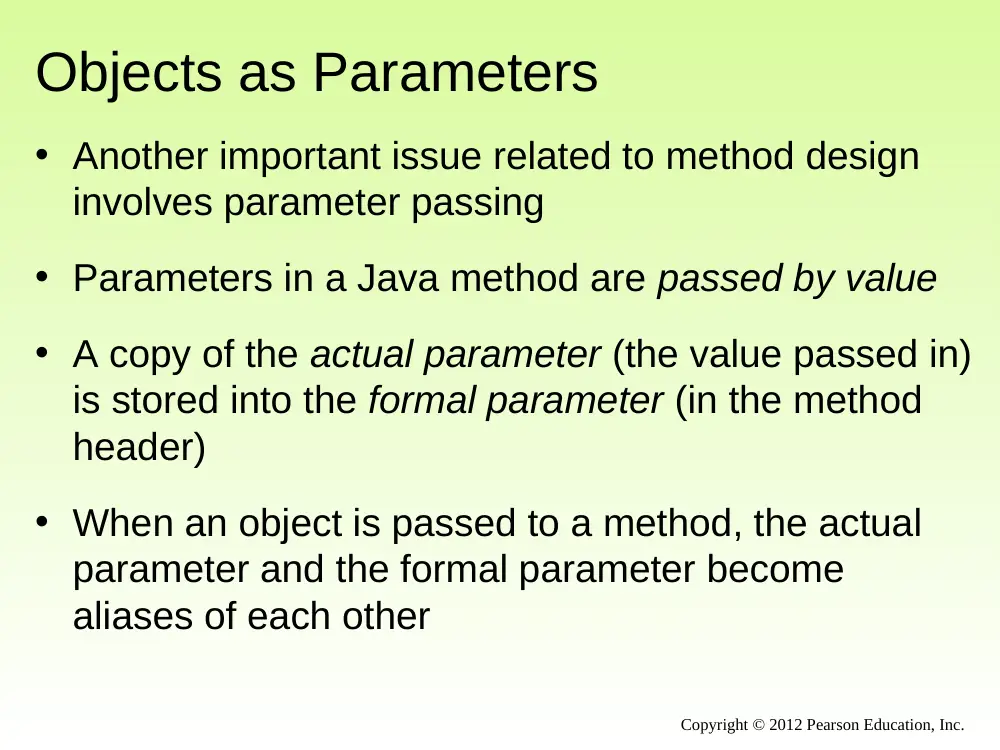
Objects as Parameters
• Another important issue related to method design
involves parameter passing
• Parameters in a Java method are passed by value
• A copy of the actual parameter (the value passed in)
is stored into the formal parameter (in the method
header)
• When an object is passed to a method, the actual
parameter and the formal parameter become
aliases of each other
Copyright © 2012 Pearson Education, Inc.
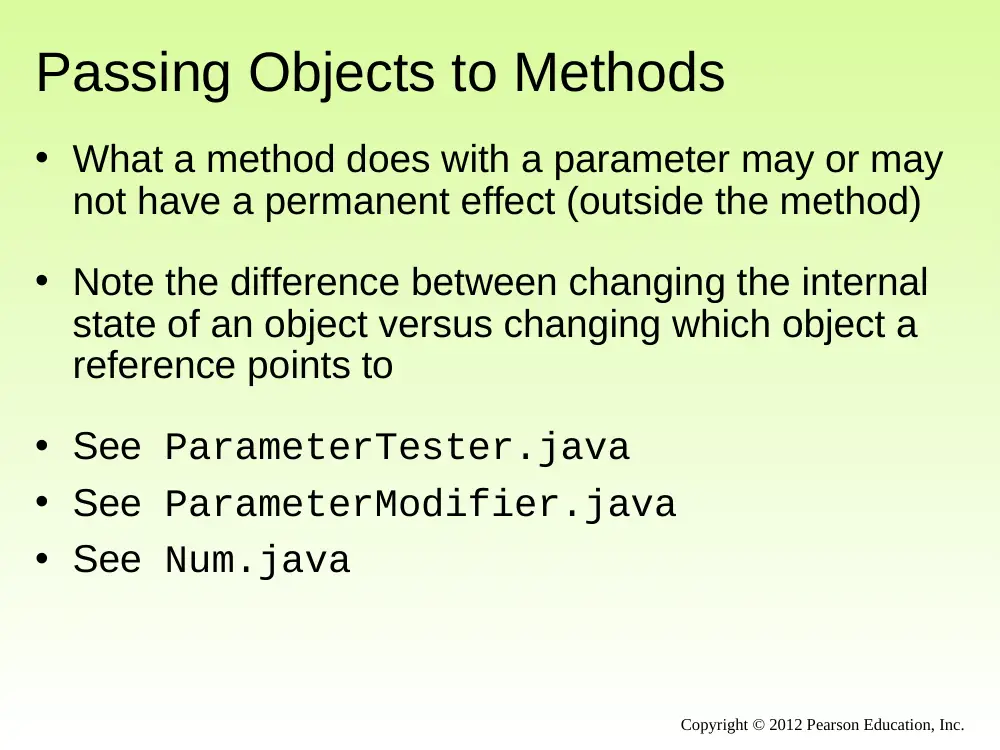
Passing Objects to Methods
• What a method does with a parameter may or may
not have a permanent effect (outside the method)
• Note the difference between changing the internal
state of an object versus changing which object a
reference points to
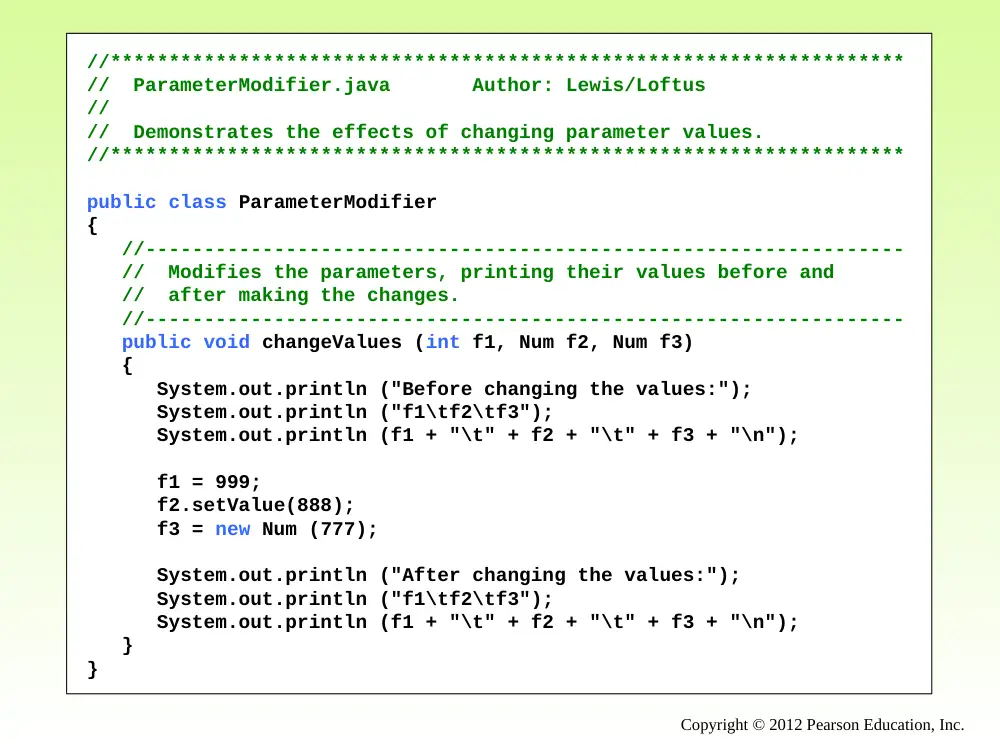
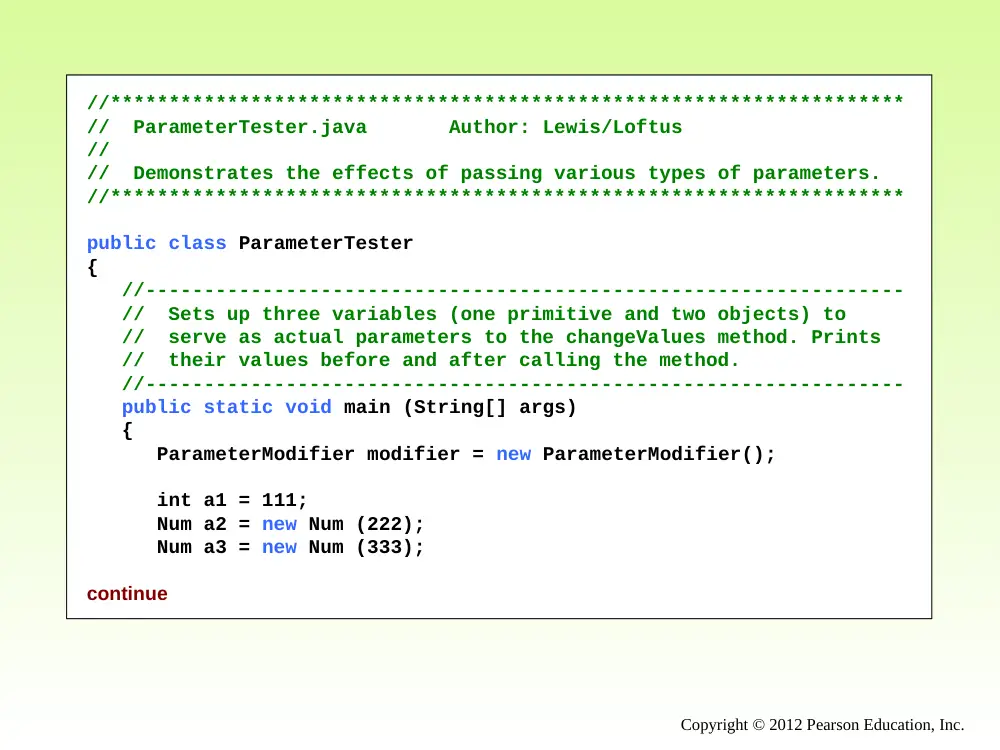
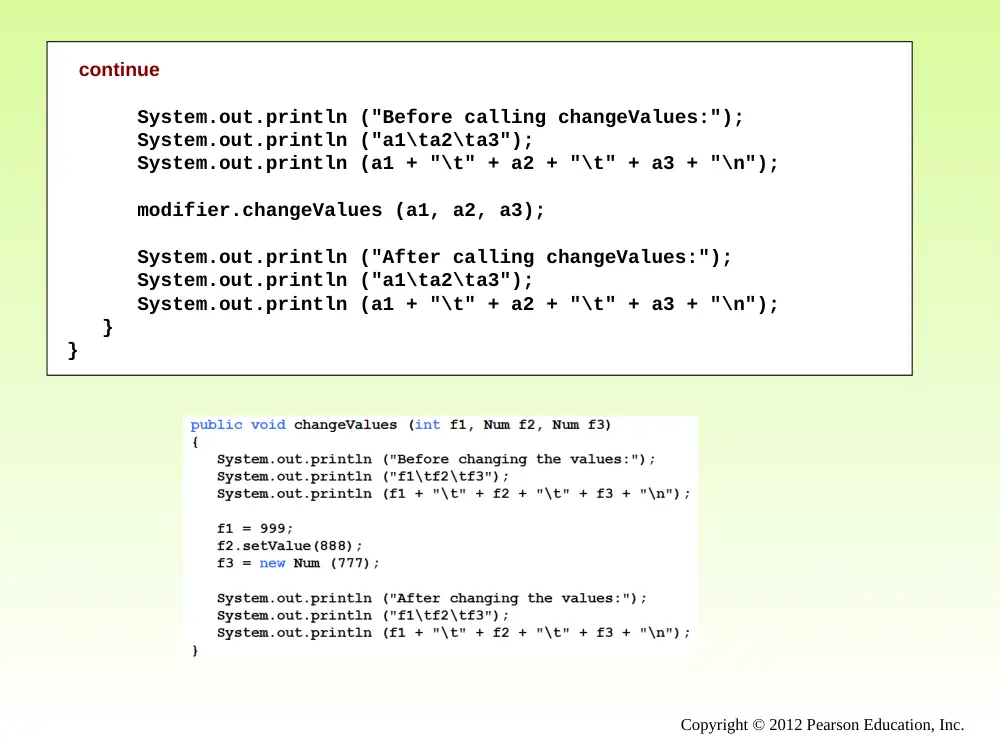
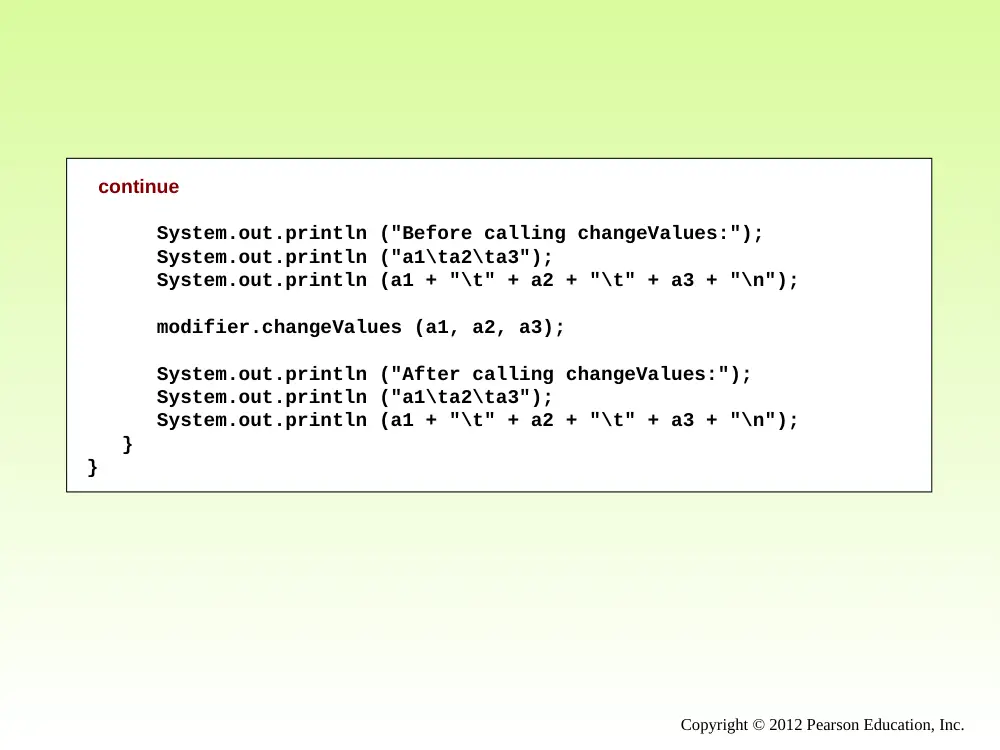
• See ParameterTester.java
• See ParameterModifier.java
• See Num.java
Copyright © 2012 Pearson Education, Inc.
Copyright © 2012 Pearson Education, Inc.
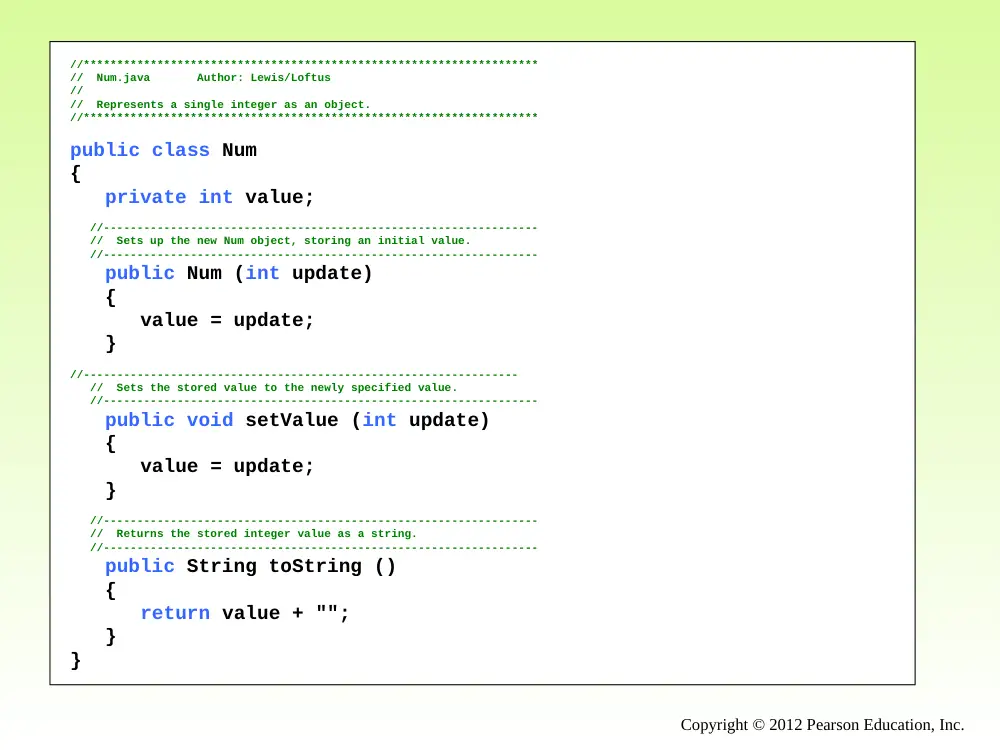
//********************************************************************
// Num.java Author: Lewis/Loftus
//
// Represents a single integer as an object.
//********************************************************************
public class Num
{
private int value;
//-----------------------------------------------------------------
// Sets up the new Num object, storing an initial value.
//-----------------------------------------------------------------
public Num (int update)
{
value = update;
}
//-----------------------------------------------------------------
// Sets the stored value to the newly specified value.
//-----------------------------------------------------------------
public void setValue (int update)
{
value = update;
}
//-----------------------------------------------------------------
// Returns the stored integer value as a string.
//-----------------------------------------------------------------
public String toString ()
{
return value + "";
}
}
Copyright © 2012 Pearson Education, Inc.
//********************************************************************
// ParameterModifier.java Author: Lewis/Loftus
//
// Demonstrates the effects of changing parameter values.
//********************************************************************
public class ParameterModifier
{
//-----------------------------------------------------------------
// Modifies the parameters, printing their values before and
// after making the changes.
//-----------------------------------------------------------------
public void changeValues (int f1, Num f2, Num f3)
{
System.out.println ("Before changing the values:");
System.out.println ("f1\tf2\tf3");
System.out.println (f1 + "\t" + f2 + "\t" + f3 + "\n");
f1 = 999;
f2.setValue(888);
f3 = new Num (777);
System.out.println ("After changing the values:");
System.out.println ("f1\tf2\tf3");
System.out.println (f1 + "\t" + f2 + "\t" + f3 + "\n");
}
}
Copyright © 2012 Pearson Education, Inc.
//********************************************************************
// ParameterTester.java Author: Lewis/Loftus
//
// Demonstrates the effects of passing various types of parameters.
//********************************************************************
public class ParameterTester
{
//-----------------------------------------------------------------
// Sets up three variables (one primitive and two objects) to
// serve as actual parameters to the changeValues method. Prints
// their values before and after calling the method.
//-----------------------------------------------------------------
public static void main (String[] args)
{
ParameterModifier modifier = new ParameterModifier();
int a1 = 111;
Num a2 = new Num (222);
Num a3 = new Num (333);
continue
Copyright © 2012 Pearson Education, Inc.
continue
System.out.println ("Before calling changeValues:");
System.out.println ("a1\ta2\ta3");
System.out.println (a1 + "\t" + a2 + "\t" + a3 + "\n");
modifier.changeValues (a1, a2, a3);
System.out.println ("After calling changeValues:");
System.out.println ("a1\ta2\ta3");
System.out.println (a1 + "\t" + a2 + "\t" + a3 + "\n");
}
}
Copyright © 2012 Pearson Education, Inc.
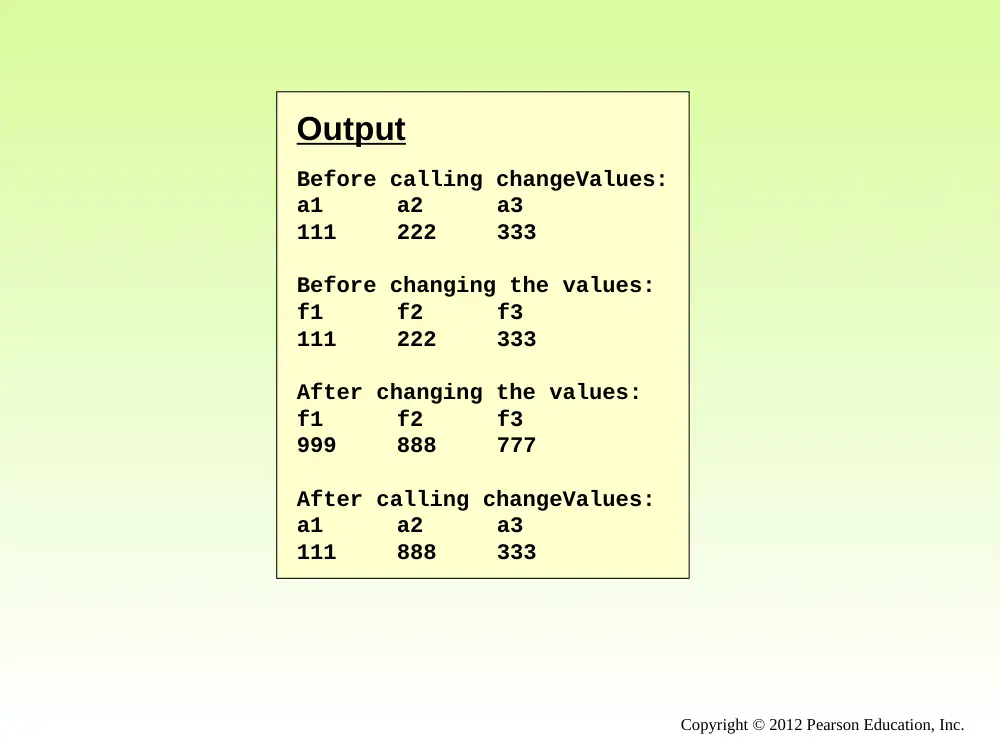
Output
Before calling changeValues:
a1
a2
a3
111
222
333
Before changing the values:
f1
f2
f3
111
222
333
After changing the values:
f1
f2
f3
999
888
777
After calling changeValues:
a1
a2
a3
111
888
333
Copyright © 2012 Pearson Education, Inc.
Method Overloading
• Let's look at one more important method design
issue: method overloading
• Method overloading is the process of giving a single
method name multiple definitions in a class
• If a method is overloaded, the method name is not
sufficient to determine which method is being called
• The signature of each overloaded method must be
unique
• The signature includes the number, type, and order
of the parameters
Copyright © 2012 Pearson Education, Inc.
Method Overloading
• The compiler determines which method is being
invoked by analyzing the parameters
float tryMe(int x)
{
return x + .375;
}
float tryMe(int x, float y)
{
return x*y;
}
result = tryMe(25, 4.32)
Invocation
Copyright © 2012 Pearson Education, Inc.
Method Overloading
• The println method is overloaded:
println (String s)
println (int i)
println (double d)
and so on...
• The following lines invoke different versions of the
println method:
System.out.println ("The total is:");
System.out.println (total);
Copyright © 2012 Pearson Education, Inc.
Overloading Methods
• The return type of the method is not part of the
signature
• That is, overloaded methods cannot differ only by
their return type
• Constructors can be overloaded
• Overloaded constructors provide multiple ways to
initialize a new object
Copyright © 2012 Pearson Education, Inc.
Outline
Software Development Activities
Identifying Classes and Objects
Static Variables and Methods
Class Relationships
Interfaces
Enumerated Types Revisited
Method Design
Testing
GUI Design and Layout
Copyright © 2012 Pearson Education, Inc.
Program Development
• The creation of software involves four basic
activities:
– establishing the requirements
– creating a design
– implementing the code
– testing the implementation
• These activities are not strictly linear – they overlap
and interact
Copyright © 2012 Pearson Education, Inc.
Requirements
• Software requirements specify the tasks that a
program must accomplish
– what to do, not how to do it
• Often an initial set of requirements is provided, but
they should be critiqued and expanded
• It is difficult to establish detailed, unambiguous, and
complete requirements
• Careful attention to the requirements can save
significant time and expense in the overall project
Copyright © 2012 Pearson Education, Inc.
Design
• A software design specifies how a program will
accomplish its requirements
• A software design specifies how the solution can be
broken down into manageable pieces and what
each piece will do
• An object-oriented design determines which
classes and objects are needed, and specifies how
they will interact
• Low level design details include how individual
methods will accomplish their tasks
Copyright © 2012 Pearson Education, Inc.
Implementation
• Implementation is the process of translating a
design into source code
• Novice programmers often think that writing code is
the heart of software development, but actually it
should be the least creative step
• Almost all important decisions are made during
requirements and design stages
• Implementation should focus on coding details,
including style guidelines and documentation
Copyright © 2012 Pearson Education, Inc.
Testing
• Testing attempts to ensure that the program will
solve the intended problem under all the constraints
specified in the requirements
• A program should be thoroughly tested with the goal
of finding errors
• Debugging is the process of determining the cause
of a problem and fixing it
• We revisit the details of the testing process later in
this chapter
Copyright © 2012 Pearson Education, Inc.
Outline
Software Development Activities
Identifying Classes and Objects
Static Variables and Methods
Class Relationships
Interfaces
Enumerated Types Revisited
Method Design
Testing
GUI Design and Layout
Copyright © 2012 Pearson Education, Inc.
Static Class Members
• Recall that a static method is one that can be
invoked through its class name
• For example, the methods of the Math class are
static:
result = Math.sqrt(25)
• Variables can be static as well
• Determining if a method or variable should be static
is an important design decision
Copyright © 2012 Pearson Education, Inc.
The static Modifier
• We declare static methods and variables using the
static modifier
• It associates the method or variable with the class
rather than with an object of that class
• Static methods are sometimes called class
methods and static variables are sometimes called
class variables
• Let's carefully consider the implications of each
Copyright © 2012 Pearson Education, Inc.
Static Variables
• Normally, each object has its own data space, but if
a variable is declared as static, only one copy of the
variable exists
private static float price;
• Memory space for a static variable is created when
the class is first referenced
• All objects instantiated from the class share its
static variables
• Changing the value of a static variable in one object
changes it for all others
Copyright © 2012 Pearson Education, Inc.
Static Methods
• Because it is declared as static, the cube method
can be invoked through the class name:
value = Helper.cube(4);
Copyright © 2012 Pearson Education, Inc.
public class Helper
{
public static int cube (int num)
{
return num * num * num;
}
}
Static Class Members
• The order of the modifiers can be interchanged, but
by convention visibility modifiers come first
• Recall that the main method is static – it is invoked
by the Java interpreter without creating an object
• Static methods cannot reference instance variables
because instance variables don't exist until an
object exists
• However, a static method can reference static
variables or local variables
Copyright © 2012 Pearson Education, Inc.
Static Class Members
• Static methods and static variables often work
together
• The following example keeps track of how many
Slogan objects have been created using a static
variable, and makes that information available
using a static method
• See SloganCounter.java
• See Slogan.java
Copyright © 2012 Pearson Education, Inc.
Copyright © 2012 Pearson Education, Inc.
//********************************************************************
// SloganCounter.java Author: Lewis/Loftus
//
// Demonstrates the use of the static modifier.
//********************************************************************
public class SloganCounter
{
//-----------------------------------------------------------------
// Creates several Slogan objects and prints the number of
// objects that were created.
//-----------------------------------------------------------------
public static void main (String[] args)
{
Slogan obj;
obj = new Slogan ("Remember the Alamo.");
System.out.println (obj);
obj = new Slogan ("Don't Worry. Be Happy.");
System.out.println (obj);
continue
Copyright © 2012 Pearson Education, Inc.
continue
obj = new Slogan ("Live Free or Die.");
System.out.println (obj);
obj = new Slogan ("Talk is Cheap.");
System.out.println (obj);
obj = new Slogan ("Write Once, Run Anywhere.");
System.out.println (obj);
System.out.println();
System.out.println ("Slogans created: " + Slogan.getCount());
}
}
Output
Remember the Alamo.
Don't Worry. Be Happy.
Live Free or Die.
Talk is Cheap.
Write Once, Run Anywhere.
Slogans created: 5
Copyright © 2012 Pearson Education, Inc.
//********************************************************************
// Slogan.java Author: Lewis/Loftus
//
// Represents a single slogan string.
//********************************************************************
public class Slogan
{
private String phrase;
private static int count = 0;
//-----------------------------------------------------------------
// Constructor: Sets up the slogan and counts the number of
// instances created.
//-----------------------------------------------------------------
public Slogan (String str)
{
phrase = str;
count++;
}
continue
Copyright © 2012 Pearson Education, Inc.
continue
//-----------------------------------------------------------------
// Returns this slogan as a string.
//-----------------------------------------------------------------
public String toString()
{
return phrase;
}
//-----------------------------------------------------------------
// Returns the number of instances of this class that have been
// created.
//-----------------------------------------------------------------
public static int getCount ()
{
return count;
}
}
Quick Check
Copyright © 2012 Pearson Education, Inc.
Why can't a static method reference an instance
variable?
Quick Check
Copyright © 2012 Pearson Education, Inc.
Why can't a static method reference an instance
variable?
Because instance data is created only when an
object is created.
You don't need an object to execute a static method.
And even if you had an object, which object's instance
data would be referenced? (remember, the method is
invoked through the class name)
Outline
Software Development Activities
Identifying Classes and Objects
Static Variables and Methods
Class Relationships
Interfaces
Enumerated Types Revisited
Method Design
Testing
GUI Design and Layout
Copyright © 2012 Pearson Education, Inc.
Class Relationships
• Classes in a software system can have various
types of relationships to each other
• Three of the most common relationships:
– Dependency: A uses B
– Aggregation: A has-a B
– Inheritance: A is-a B
• Let's discuss dependency and aggregation further
• Inheritance is discussed in detail in Chapter 9
Copyright © 2012 Pearson Education, Inc.
Dependency
• A dependency exists when one class relies on
another in some way, usually by invoking the
methods of the other
• We've seen dependencies in many previous
examples
• We don't want numerous or complex dependencies
among classes
• Nor do we want complex classes that don't depend
on others
• A good design strikes the right balance
Copyright © 2012 Pearson Education, Inc.
Dependency
• Some dependencies occur between objects of the
same class
• A method of the class may accept an object of the
same class as a parameter
• For example, the concat method of the String
class takes as a parameter another String object
str3 = str1.concat(str2);
Copyright © 2012 Pearson Education, Inc.
Dependency
• The following example defines a class called
RationalNumber
• A rational number is a value that can be
represented as the ratio of two integers
• Several methods of the RationalNumber class
accept another RationalNumber object as a
parameter
• See RationalTester.java
• See RationalNumber.java
Copyright © 2012 Pearson Education, Inc.
Copyright © 2012 Pearson Education, Inc.
//********************************************************************
// RationalTester.java Author: Lewis/Loftus
//
// Driver to exercise the use of multiple Rational objects.
//********************************************************************
public class RationalTester
{
//-----------------------------------------------------------------
// Creates some rational number objects and performs various
// operations on them.
//-----------------------------------------------------------------
public static void main (String[] args)
{
RationalNumber r1 = new RationalNumber (6, 8);
RationalNumber r2 = new RationalNumber (1, 3);
RationalNumber r3, r4, r5, r6, r7;
System.out.println ("First rational number: " + r1);
System.out.println ("Second rational number: " + r2);
continue
Copyright © 2012 Pearson Education, Inc.
continue
if (r1.isLike(r2))
System.out.println ("r1 and r2 are equal.");
else
System.out.println ("r1 and r2 are NOT equal.");
r3 = r1.reciprocal();
System.out.println ("The reciprocal of r1 is: " + r3);
r4 = r1.add(r2);
r5 = r1.subtract(r2);
r6 = r1.multiply(r2);
r7 = r1.divide(r2);
System.out.println ("r1 + r2: " + r4);
System.out.println ("r1 - r2: " + r5);
System.out.println ("r1 * r2: " + r6);
System.out.println ("r1 / r2: " + r7);
}
}
Output
First rational number: 3/4
Second rational number: 1/3
r1 and r2 are NOT equal.
The reciprocal of r1 is: 4/3
r1 + r2: 13/12
r1 - r2: 5/12
r1 * r2: 1/4
r1 / r2: 9/4
Copyright © 2012 Pearson Education, Inc.
//********************************************************************
// RationalNumber.java Author: Lewis/Loftus
//
// Represents one rational number with a numerator and denominator.
//********************************************************************
public class RationalNumber
{
private int numerator, denominator;
//-----------------------------------------------------------------
// Constructor: Sets up the rational number by ensuring a nonzero
// denominator and making only the numerator signed.
//-----------------------------------------------------------------
public RationalNumber (int numer, int denom)
{
if (denom == 0)
denom = 1;
// Make the numerator "store" the sign
if (denom < 0)
{
numer = numer * -1;
denom = denom * -1;
}
continue
Copyright © 2012 Pearson Education, Inc.
continue
numerator = numer;
denominator = denom;
reduce();
}
//-----------------------------------------------------------------
// Returns the numerator of this rational number.
//-----------------------------------------------------------------
public int getNumerator ()
{
return numerator;
}
//-----------------------------------------------------------------
// Returns the denominator of this rational number.
//-----------------------------------------------------------------
public int getDenominator ()
{
return denominator;
}
continue
Copyright © 2012 Pearson Education, Inc.
continue
//-----------------------------------------------------------------
// Returns the reciprocal of this rational number.
//-----------------------------------------------------------------
public RationalNumber reciprocal ()
{
return new RationalNumber (denominator, numerator);
}
//-----------------------------------------------------------------
// Adds this rational number to the one passed as a parameter.
// A common denominator is found by multiplying the individual
// denominators.
//-----------------------------------------------------------------
public RationalNumber add (RationalNumber op2)
{
int commonDenominator = denominator * op2.getDenominator();
int numerator1 = numerator * op2.getDenominator();
int numerator2 = op2.getNumerator() * denominator;
int sum = numerator1 + numerator2;
return new RationalNumber (sum, commonDenominator);
}
continue
Copyright © 2012 Pearson Education, Inc.
continue
//-----------------------------------------------------------------
// Subtracts the rational number passed as a parameter from this
// rational number.
//-----------------------------------------------------------------
public RationalNumber subtract (RationalNumber op2)
{
int commonDenominator = denominator * op2.getDenominator();
int numerator1 = numerator * op2.getDenominator();
int numerator2 = op2.getNumerator() * denominator;
int difference = numerator1 - numerator2;
return new RationalNumber (difference, commonDenominator);
}
//-----------------------------------------------------------------
// Multiplies this rational number by the one passed as a
// parameter.
//-----------------------------------------------------------------
public RationalNumber multiply (RationalNumber op2)
{
int numer = numerator * op2.getNumerator();
int denom = denominator * op2.getDenominator();
return new RationalNumber (numer, denom);
}
continue
Copyright © 2012 Pearson Education, Inc.
continue
//-----------------------------------------------------------------
// Divides this rational number by the one passed as a parameter
// by multiplying by the reciprocal of the second rational.
//-----------------------------------------------------------------
public RationalNumber divide (RationalNumber op2)
{
return multiply (op2.reciprocal());
}
//-----------------------------------------------------------------
// Determines if this rational number is equal to the one passed
// as a parameter. Assumes they are both reduced.
//-----------------------------------------------------------------
public boolean isLike (RationalNumber op2)
{
return ( numerator == op2.getNumerator() &&
denominator == op2.getDenominator() );
}
continue
Copyright © 2012 Pearson Education, Inc.
continue
//-----------------------------------------------------------------
// Returns this rational number as a string.
//-----------------------------------------------------------------
public String toString ()
{
String result;
if (numerator == 0)
result = "0";
else
if (denominator == 1)
result = numerator + "";
else
result = numerator + "/" + denominator;
return result;
}
continue
Copyright © 2012 Pearson Education, Inc.
continue
//-----------------------------------------------------------------
// Reduces this rational number by dividing both the numerator
// and the denominator by their greatest common divisor.
//-----------------------------------------------------------------
private void reduce ()
{
if (numerator != 0)
{
int common = gcd (Math.abs(numerator), denominator);
numerator = numerator / common;
denominator = denominator / common;
}
}
continue
Copyright © 2012 Pearson Education, Inc.
continue
//-----------------------------------------------------------------
// Computes and returns the greatest common divisor of the two
// positive parameters. Uses Euclid's algorithm.
//-----------------------------------------------------------------
private int gcd (int num1, int num2)
{
while (num1 != num2)
if (num1 > num2)
num1 = num1 - num2;
else
num2 = num2 - num1;
return num1;
}
}
Aggregation
• An aggregate is an object that is made up of other
objects
• Therefore aggregation is a has-a relationship
– A car has a chassis
• An aggregate object contains references to other
objects as instance data
• This is a special kind of dependency; the aggregate
relies on the objects that compose it
Copyright © 2012 Pearson Education, Inc.
Aggregation
• In the following example, a Student object is
composed, in part, of Address objects
• A student has an address (in fact each student has
two addresses)
• See StudentBody.java
• See Student.java
• See Address.java
Copyright © 2012 Pearson Education, Inc.
Copyright © 2012 Pearson Education, Inc.
//********************************************************************
// StudentBody.java Author: Lewis/Loftus
//
// Demonstrates the use of an aggregate class.
//********************************************************************
public class StudentBody
{
//-----------------------------------------------------------------
// Creates some Address and Student objects and prints them.
//-----------------------------------------------------------------
public static void main (String[] args)
{
Address school = new Address ("800 Lancaster Ave.", "Villanova",
"PA", 19085);
Address jHome = new Address ("21 Jump Street", "Lynchburg",
"VA", 24551);
Student john = new Student ("John", "Smith", jHome, school);
Address mHome = new Address ("123 Main Street", "Euclid", "OH",
44132);
Student marsha = new Student ("Marsha", "Jones", mHome, school);
System.out.println (john);
System.out.println ();
System.out.println (marsha);
}
}
Output
John Smith
Home Address:
21 Jump Street
Lynchburg, VA 24551
School Address:
800 Lancaster Ave.
Villanova, PA 19085
Marsha Jones
Home Address:
123 Main Street
Euclid, OH 44132
School Address:
800 Lancaster Ave.
Villanova, PA 19085
Copyright © 2012 Pearson Education, Inc.
//********************************************************************
// Student.java Author: Lewis/Loftus
//
// Represents a college student.
//********************************************************************
public class Student
{
private String firstName, lastName;
private Address homeAddress, schoolAddress;
//-----------------------------------------------------------------
// Constructor: Sets up this student with the specified values.
//-----------------------------------------------------------------
public Student (String first, String last, Address home,
Address school)
{
firstName = first;
lastName = last;
homeAddress = home;
schoolAddress = school;
}
continue
Copyright © 2012 Pearson Education, Inc.
continue
//-----------------------------------------------------------------
// Returns a string description of this Student object.
//-----------------------------------------------------------------
public String toString()
{
String result;
result = firstName + " " + lastName + "\n";
result += "Home Address:\n" + homeAddress + "\n";
result += "School Address:\n" + schoolAddress;
return result;
}
}
Copyright © 2012 Pearson Education, Inc.
//********************************************************************
// Address.java Author: Lewis/Loftus
//
// Represents a street address.
//********************************************************************
public class Address
{
private String streetAddress, city, state;
private long zipCode;
//-----------------------------------------------------------------
// Constructor: Sets up this address with the specified data.
//-----------------------------------------------------------------
public Address (String street, String town, String st, long zip)
{
streetAddress = street;
city = town;
state = st;
zipCode = zip;
}
continue
Copyright © 2012 Pearson Education, Inc.
continue
//-----------------------------------------------------------------
// Returns a description of this Address object.
//-----------------------------------------------------------------
public String toString()
{
String result;
result = streetAddress + "\n";
result += city + ", " + state + " " + zipCode;
return result;
}
}
Aggregation in UML
StudentBody
+ main (args : String[]) : void
+ toString() : String
Student
- firstName : String
- lastName : String
- homeAddress : Address
- schoolAddress : Address
+ toString() : String
- streetAddress : String
- city : String
- state : String
- zipCode : long
Address
Copyright © 2012 Pearson Education, Inc.