
ENV 200 Chapter 2, Fall 2013
Lebanese American University · Introduction To Enviromental Sciences · 72 pages
Showing the first 10 of 72 pages. Download the PDF to see all of it.
More ENV 200 files
Show the text of this chapter
Sustainability
Sustainability
• The capacity to endure
• Sustainability is a search for ecological
stability and human progress that can last
over the long term.
• Sustainable development is “meeting the
needs of the present without compromising
the ability of future generations to meet their
own needs.”
Sustainability
• Environmentally sustainable society as the
ultimate goal of sustainability; a society that
meets the current and future basic resource
needs of its people in a just and equitable
(fair) manner
Sustainability
Sustainability
• Three major components:
– Natural capital: supported by solar capital
• Natural resources
• Natural services
– Degradation of natural capital through human
activities
– Scientific solutions to environmental problems
Natural Capital
• Key component of sustainability
• The natural resources and natural services
that keep us and other forms of life alive and
support our economies
Natural Resources
• Resource: Anything obtained from the
environment to meet our needs and wants
• Natural Resources: Materials and energy in
nature that are essential or useful to humans
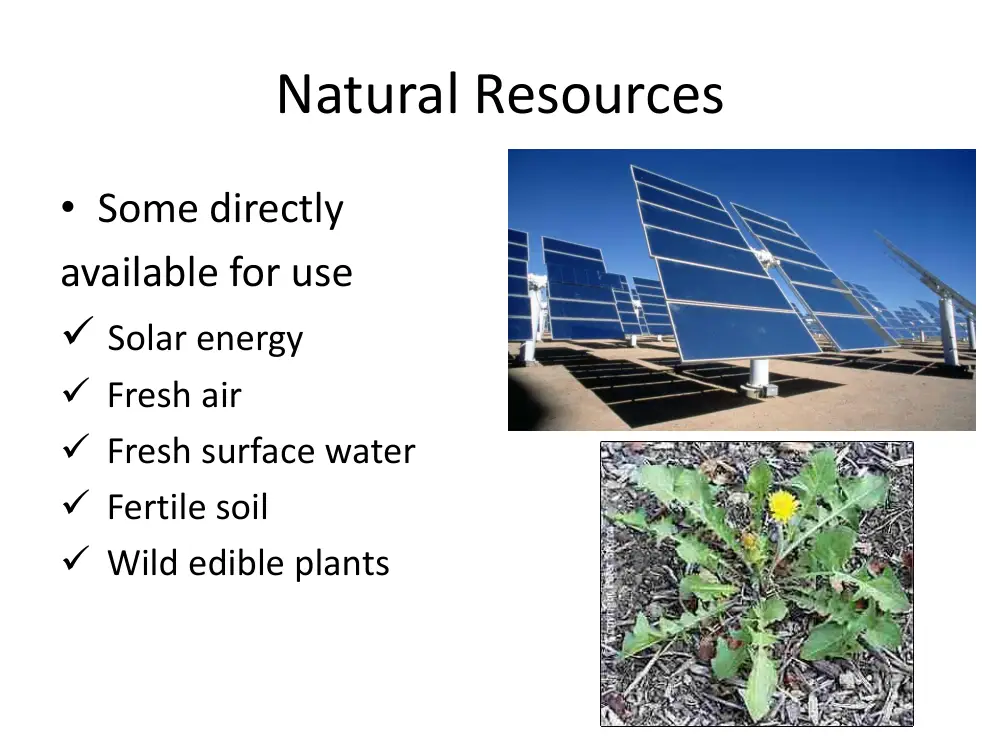
Natural Resources
• Some directly
available for use
Solar energy
Fresh air
Fresh surface water
Fertile soil
Wild edible plants
Natural Resources
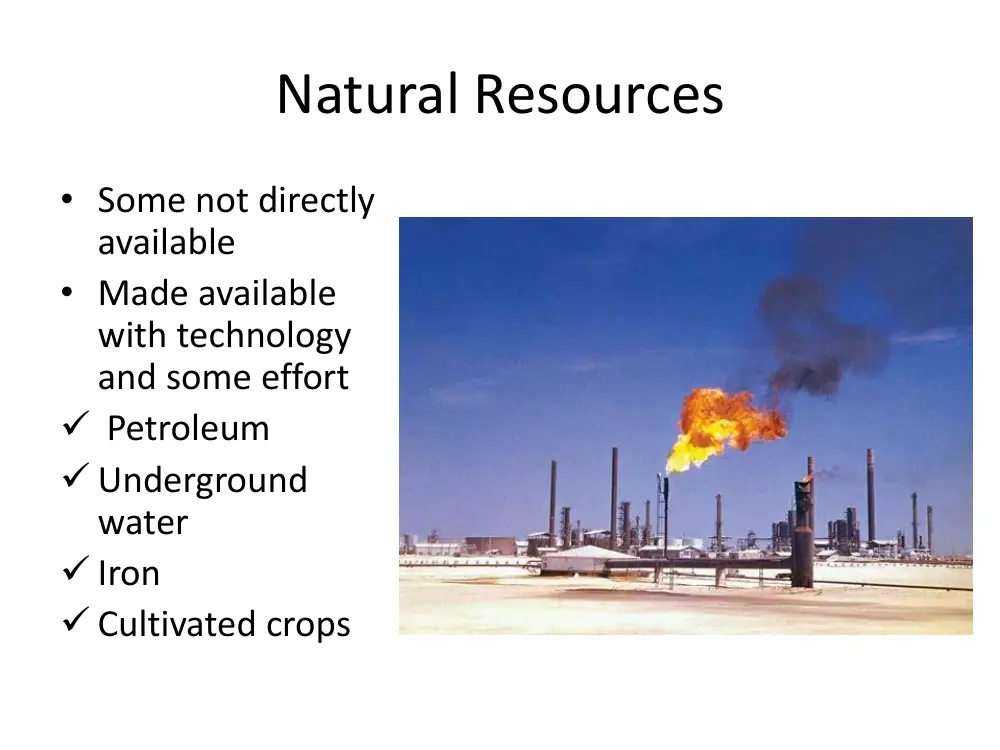
• Some not directly
available
• Made available
with technology
and some effort
Petroleum
Underground
water
Iron
Cultivated crops
Natural Resources
Classified by Renewability
Perpetual Resources
are renewed
continuously.
Solar energy expected
to last six billion years!!
Natural Resources
Classified by Renewability
• Renewable: replaced by natural processes in a
matter of hours to hundreds of years
– Fresh water
– Plant and animal populations
– Forests
• Non-renewable: finite; not replaceable
– Minerals (metals, nutrients)
Natural Resources
Continuum of Renewability
• Timescale of “renewability” varies
• Human timescales (100 years or less)
• Longer-than-human timescales: non-
renewable “for practical purposes”
Striped Bass:
Human timescale
Fossil Fuels:
Non-renewable in practice
Natural Resources
Renewable does not mean inexhaustible!!
• Renewable resources can be overexploited.
• “Used up” faster than can be replaced
• Degraded beyond ability of natural processes to
replace
Blue Crabs
Tropical Rainforest
Natural Resources
Renewable does not mean inexhaustible!!
Natural Resources
Renewable Resources
• Sustainable yield: the highest rate at which a
renewable resource can be used indefinitely
without reducing its available supply
• Environmental degradation: occurs when a
renewable resource’s natural replacement
rate is exceeded and the available supply
begins to shrink
Natural Resources
Non-renewable Resources
• Exist in fixed quantity or stock in the earth’s
crust
• Renewed by geological processes on a
timescale of millions to billions of years
• May be depleted faster than they are formed
Natural Resources
Non-renewable Resources
• Energy resources (coal, oil)
• Metallic mineral resources (copper, aluminum)
• Non-metallic mineral resources (salt, sand)
Natural Resources
Non-renewable does not mean rapidly
exhausted!!
Some non-renewable
resources can be reused
or recycled.
Natural Resources
Non-renewable does not mean rapidly
exhausted!!
Natural Resources
• Conservation: Management of natural
resources with the goal of minimizing resource
waste and sustaining resource supplies for the
current and future generation
Natural Services
• Natural Services: Functions of nature such as
purification of water and air; provided at no
cost by ecosystems
Natural Services
Nutrient Cycling
Solar Capital: energy from the sun;
supports natural capital
Ownership of Resources
• Three types of property or resource rights
– Private property: Individuals or firms own the
rights to land, minerals or other resources
– Common property: The rights to a certain
resource are held by large groups of individuals.
– Open access renewable resources: Owned by
nobody and available for use by anybody at little
or no charge.
Ownership of Resources
• Many common property and open access
renewable resources have been degraded!
• “If I do not use this resource, someone else
will. The little bit that I use or pollute is not
enough to matter and anyway, it’s a
renewable resource!”
• Problematic when many people think this way
• 1968: coined by Garrett Hardin, a biologist at
UC Santa Barbara
Tragedy of the Commons
Tragedy of the Commons
• Behavior that makes sense from the individual
point of view, when repeated by enough
individuals, ultimately proves disastrous to
society
Tragedy of the Commons
Each individual
• Is self-interested
• Behaves so as to advance his or her own self-
interest
• Gains financially or otherwise by consuming a
natural resource
• Sees little harm in doing so since the resource is
huge in size and his/her impact on the resource is
small
Tragedy of the Commons
• Tragedy occurs when each of the many
individuals with unrestricted access to a
natural resource consume and destroy the
resource – a disaster or tragedy to all.
Tragedy of the Commons
Tragedy of the Commons
• Plays a major role in causing most, if not all,
the resource, pollution and population
problems the world now faces
Tragedy of the Commons
• The cause of such environmental problems as
Air and water pollution
Global warming
Acid rain
Ozone depletion
Deforestation
Loss of biodiversity
Depletion of key energy resources
Solutions to the Tragedy of the
Commons
• How can the consumption of a resource by
individual members of a society be restrained
so as to avoid the destruction of the resource?
• How can behaviors that conserve the resource
be encouraged?
Solutions to the Tragedy of the
Commons
• Use shared resources at rates lower than their
estimated sustainable yields (reducing use or
regulating access to resource)
• Convert open access resources to private
ownership – Is it practical? What is to be
done with open oceans and the atmosphere?
Solutions to the Tragedy of the
Commons
• The use of government laws, regulations and
incentives to encourage pro-social behavior
• Programs of education that give people information
and try to change their attitudes
• Informal non-governmental social processes that
operate in small social groups and communities
• The use of moral, religious or ethical appeals
Solutions to the Tragedy of the
Commons
• Hardin advocates the first approach.
• Mutual coercion mutually agreed upon
• Only government laws, regulations and
incentives (including privatization) work
because they make pro-environmental
behavior in each individual’s best interest.
Living Sustainably
• Growing body of scientific evidence that we
are living unsustainably by wasting, depleting
and degrading the earth’s natural capital at an
exponentially accelerating rate
Living Sustainably
• “…Human activity is putting such a strain on
the natural functions of Earth that the ability
of the planet’s ecosystems to sustain future
generations can no longer be taken for
granted.”
Millennium Ecosystem Assessment,
United Nations, 2005
Living Sustainably
• Living off the earth’s natural income without
depleting or degrading the natural capital that
supplies it
Living Sustainably
• Protecting natural capital and living off the
income it provides = Natural income!
• Using renewable rather than non-renewable
resources
• Providing the human population with
adequate and equitable access to this natural
income for the foreseeable future
Living Sustainably
Making the shift to more sustainable societies and
economies through building social capital:
• Getting people with different views and values to talk
and listen to one another, find common ground
based on understanding and trust and work together
to solve environmental as well as other problems
• Nurturing openness, communication, cooperation
and hope
• Discouraging close-mindedness, polarization,
confrontation and fear
Living Sustainably
To live sustainably:
• Understand how life on Earth has survived and
adapted to major changes in environmental
conditions for billions of years
• Apply the lessons learned from nature to our
lifestyles and economies
Scientific Principles of Sustainability
Scientific Principles of Sustainability
Reliance on Solar Energy:
• The sun warms the planet.
• The sun supports photosynthesis, which
provides plants, us and most other animals
with food.
Scientific Principles of Sustainability
Biodiversity (Biological Diversity):
• The variety of organisms, their genes, and the
ecosystems in which they exist
• Biodiversity and the natural services they
provide allowed life to adapt to changing
environmental conditions throughout Earth’s
history.
Scientific Principles of Sustainability
Population Control:
• Competition for resources among different
species limits population growth.
Scientific Principles of Sustainability
Nutrient Cycling:
• Natural processes recycle nutrients (chemicals
that organisms need to stay alive and
reproduce).
• There is little or no waste in natural systems.
Scientific Principles of Sustainability
Nutrient Cycling
Scientific Principles of Sustainability
• Using the four scientific principles of
sustainability to guide our lifestyles and
economies could help us bring about an
environmental/ sustainability revolution.
Scientific Principles of Sustainability
Scientific Principles of Sustainability
• We have 50 to no more than 100 years to
make such changes.
• Everything you do, or you do not do, will play
a role in our collective choice of the path we
will choose.
YOUR DECISION MATTERS!!
I Matter….You Matter….We Matter
• Most social change results from individual
actions and individuals acting together (social
capital?) to bring about change.
• It takes only 5 to 10% of a community, a
country or the world to bring about major
social change.
• Significant social change can occur much more
quickly than people think.
I Matter….You Matter….We Matter
“Never doubt that a
small
group
of
thoughtful,
committed
citizens can change the
world. Indeed, it is the
only thing that ever
has.”
Margaret Mead
Anthropologist
Sustainable Societies and Economic
Growth
•
Economic development: Using economic
growth to improve living standards
•
Based on their degree of industrialization,
the world’s countries are divided into two
groups:
1. Developed countries
2. Developing countries
Developed Countries
• ca. 1.2 billion people
• Highly industrialized
• High per capita GDP PPP
• USA, Canada, Japan, Australia, New Zealand,
most of Europe
Developing Countries
• ca. 5.5 billion people
• Most in Africa, Asia and Latin America
• Middle-income, moderately developed: China,
India, Brazil, Turkey, Thailand, Mexico
• Low-income, least developed:
– 49 countries with 11% of the world’s population
– per capita GDP PPP steadily declining
– Angola, Congo, Belarus, Nigeria, Nicaragua
Developed and Developing Countries
Developed and Developing Countries