
ENV 200 Chapter 6, Fall 2013
Lebanese American University · Introduction To Enviromental Sciences · 28 pages

Showing the first 10 of 28 pages. Download the PDF to see all of it.
More ENV 200 files
Show the text of this chapter
The Ozone Layer
• Located in the stratosphere at 17 to 30 km
above sea level
• Contains much of the atmosphere’s small
amount of ozone
• Acts as a global sunscreen, keeping about
95% of the sun’s harmful UV radiation
(UV-A and UV-B) away
How is Ozone Formed?
• Through the interaction of oxygen gas (O2)
and ultraviolet radiation (UV) emitted by
the sun
3 O2 + UV ↔ 2 O3
Ozone Depletion
• Seasonal depletion (thinning) of ozone
concentrations in the stratosphere above
Antarctica and the Arctic
• Lower overall thinning everywhere except
over the tropics
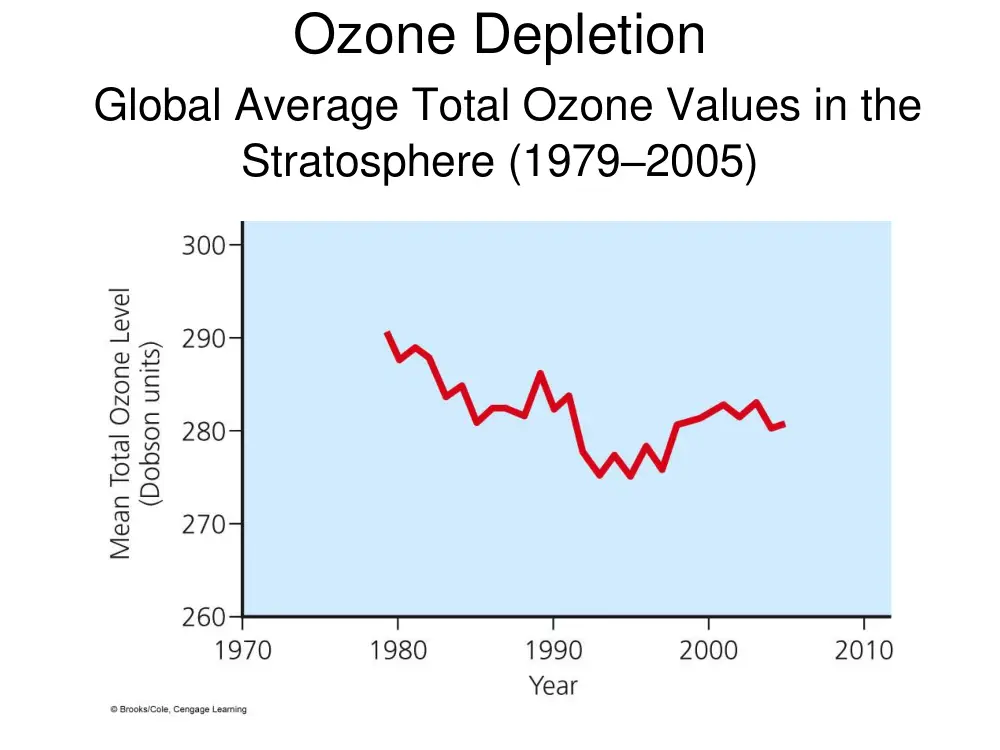
Ozone Depletion
Global Average Total Ozone Values in the
Stratosphere (1979–2005)
Ozone Depletion
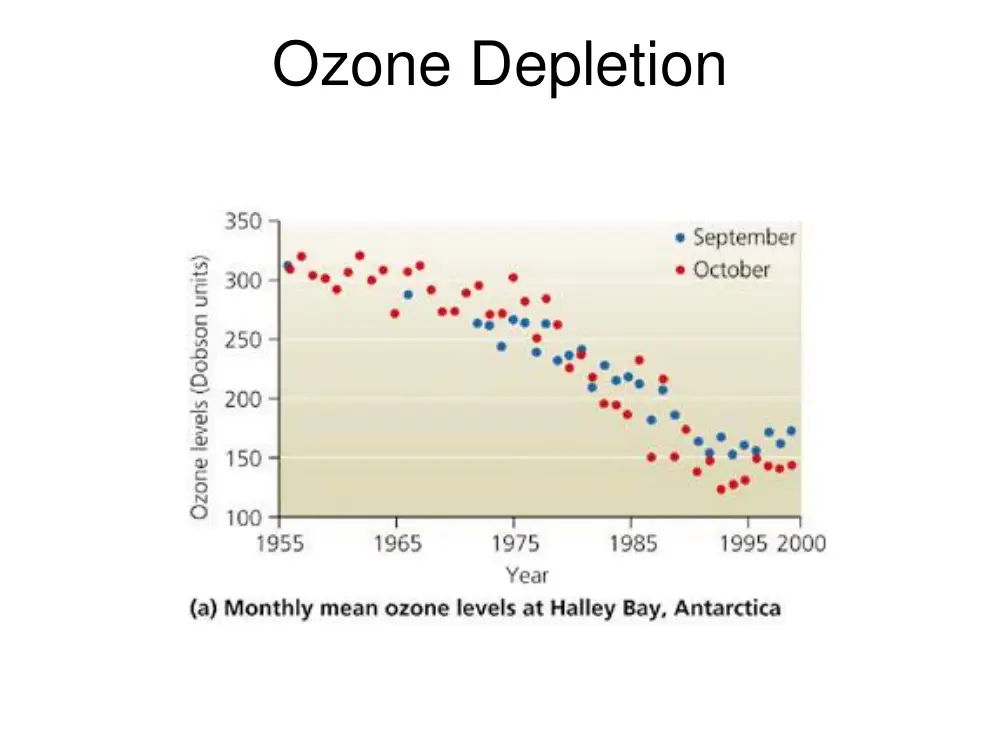
• Each year, 40 to 50% of the ozone in the upper
stratosphere over Antarctica (100% in some
places) disappears in October and November.
• When this seasonal thinning ends, huge masses
of ozone-depleted air above Antarctica flow
northward, lingering for a few weeks above
Australia, New Zealand, South Africa and South
America; raises damaging UV-B levels 3 – 20%!!
Ozone Depletion
Ozone Depletion
• Observed loss of ozone referred to as
“ozone hole”
• More accurately “ozone thinning” as ozone
depletion varies with altitude and location
Ozone Depletion
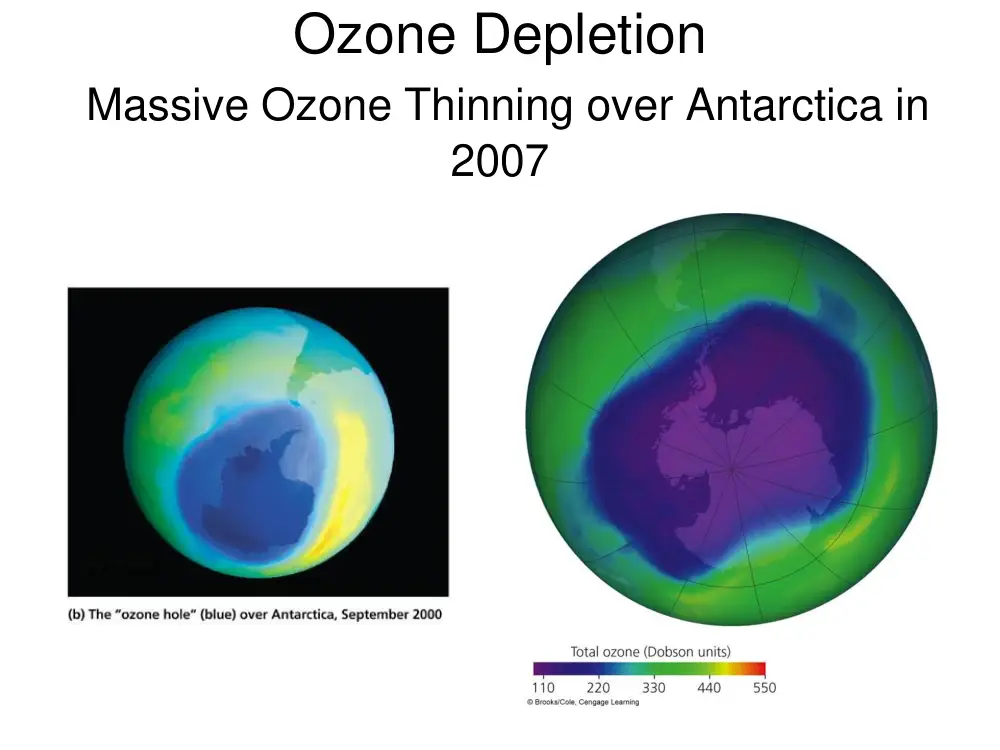
Massive Ozone Thinning over Antarctica in
2007
Ozone Depletion
• Similar, usually less severe thinning (11 to
38%; compared to ca. 50% over
Antarctica) over the Arctic from February
to June
Chlorofluorocarbons (CFCs)
• First CFC discovered in 1930 by Thomas
Midgley, Jr., a General Motors chemist
• Similar compounds later developed by
chemists to create a family of compounds
known as CFCs or Freons
Chlorofluorocarbons (CFCs)
• Thought to be dream chemicals because
they are
– chemically un-reactive.
– odorless.
– nonflammable.
– nontoxic.
– noncorrosive.
– inexpensive to manufacture.
Chlorofluorocarbons (CFCs)
• Uses of CFCs
– Coolants in air conditioners and refrigerators
– Propellants in aerosol spray cans
– Cleaners for electronic parts such as
computer chips
– Fumigants for granaries and ship cargo holds
– Also used to fill tiny bubbles in plastic foam
used for packaging and insulation
Ozone Depletion
• In 1974, Sherwood Rowland and Mario
Molina of the University of California,
Irvine, indicated that chlorofluorocarbons
(CFCs) and other ozone-depleting
chemicals were lowering the average
concentration of ozone in the
stratosphere!!
Ozone Depletion
• Other ozone-depleting chemicals include
– halons and hydrobromofluorocarbons
(HBFCs) used in fire extinguishers.
– methyl bromide, a widely used fumigant.
– hydrogen chloride emitted into the
stratosphere by space shuttles.
– some cleaning solvents such as carbon
tetrachloride.
Ozone Depletion
• Rowland and Molina 1974; Nobel Prize in
Chemistry 1995
– CFCs are persistent in the atmosphere; once in the
atmosphere, they remain there.
– CFCs rise into the stratosphere over 11-20 years.
– In the stratosphere, they break down under high-
energy UV radiation; Halogens produced accelerate
the breakdown of ozone to oxygen gas.
– Each CFC molecule can last 65-385 years,
depending on its type.
Ozone Depletion
Ozone Depletion
Ozone Depletion
• Arctic unlikely to develop the large-scale
ozone thinning found over the Antarctic
based on models
• Ozone depletion over the Arctic and
Antarctic predicted to be the worst
between 2010 and 2019!!
Ozone Depletion
• Ozone depletion in the stratosphere poses
a serious threat to
– humans.
– other animals.
– some primary producers (mostly plants).
Ozone Depletion
Why should we worry about ozone
depletion?
• Biologically damaging UV-A and UV-B
radiation will reach the earth, giving people
more eye cataracts, worse skin burns and
more skin cancer!!
• UV radiation may impair or destroy
phytoplankton, especially in Antarctic
waters!!
Simplified
food web in
the Antarctic
Ozone Depletion
Ozone Depletion
Ozone Depletion
What Shall We Do?
• Immediately stop producing ozone-
depleting chemicals
• According to models, even with immediate
and sustained action, 60 – 100 years for
recovery of the ozone layer
• Global warming in troposphere makes
stratosphere cooler; slower rate of ozone
repair
Ozone Depletion
What Shall We Do?
• Montreal Protocol (1987; 36 countries): Cut
emissions of CFCs but not other ozone-
depleting chemicals by about 35% between
1989 and 2000
• Copenhagen Protocol (1992; 93 countries):
Amendment that accelerates the phase-out of
key ozone depleting chemicals
• Ozone protocols now signed by 191 countries:
– Ozone levels to return to 1980 levels by 2068
– Ozone levels to return to 1950 levels by 2108
– Prevention is the key
Ozone Depletion
What Shall We Do?
• Substitutes for CFCs are available; more
are being developed.
• HCFC-22
– Most widely used substitute; causes some
ozone depletion
– Also warms the troposphere (10,000 times
more than carbon dioxide per molecule)
– To be phased out in 2020 in developed
countries and 2030 in developing countries