
NUT 468 Chapter 3, Spring 2017
Lebanese American University · Management System and Dietetics · 48 pages




Showing the first 10 of 48 pages. Download the PDF to see all of it.
More NUT 468 files
Show the text of this chapter
LEADERSHIP
NUT 468
CHARACTERISTICS OF
LEADERS
Managers & Leaders:
SAME???
Manager Vs. Leader
• The title of manager does not guarantee that the
person who holds the title will be a good leader
There is nothing inherent in the title of manager
that guarantees that the person who holds the
title will be a good leader
• Managers who are not good leaders are often
found within organizations
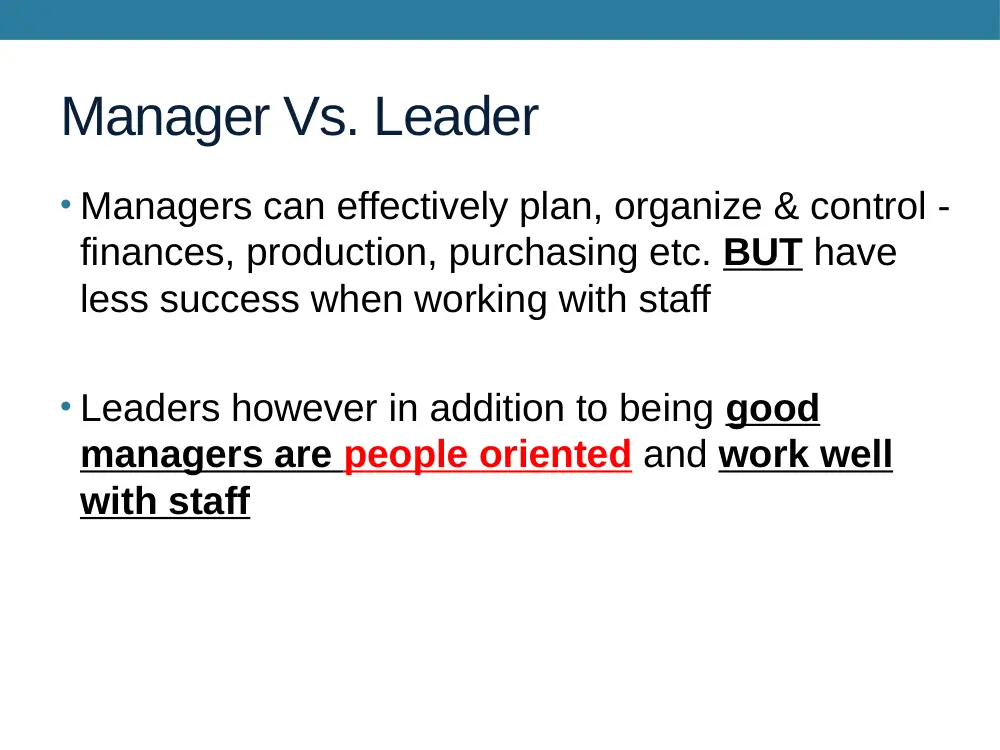
Manager Vs. Leader
• Managers can effectively plan, organize & control -
finances, production, purchasing etc. BUT have
less success when working with staff
• Leaders however in addition to being good
managers are people oriented and work well
with staff
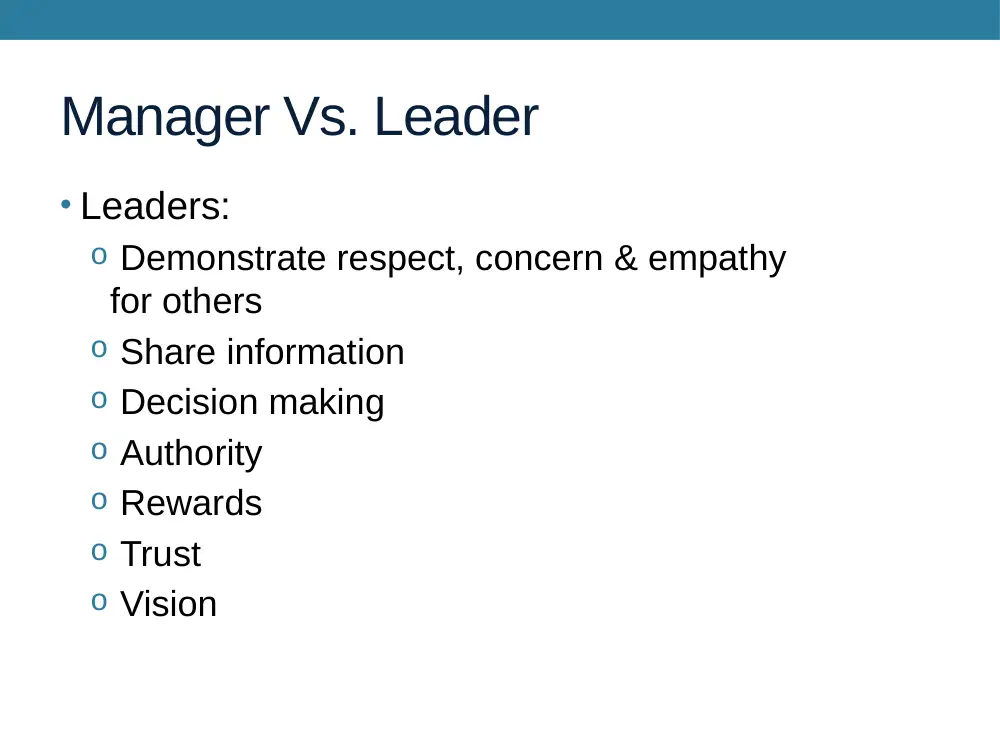
Manager Vs. Leader
• Leaders:
o Demonstrate respect, concern & empathy
for others
o Share information
o Decision making
o Authority
o Rewards
o Trust
o Vision
Manager Vs. Leader
How many types of
leaders exist?
Formal
Informal
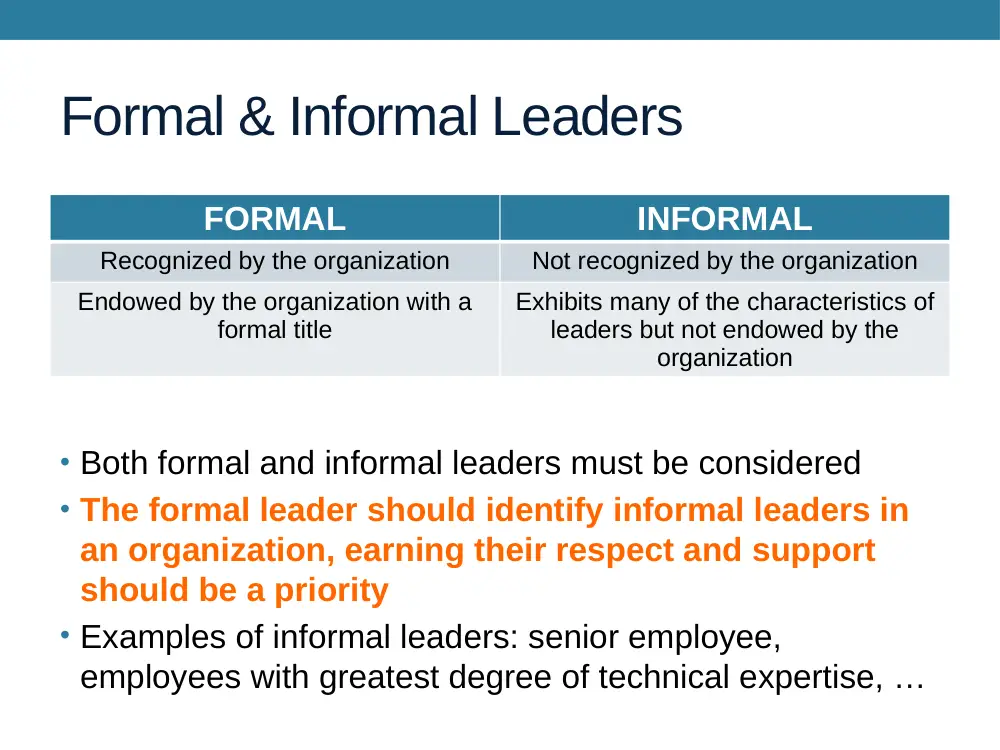
Formal & Informal Leaders
• Both formal and informal leaders must be considered
• The formal leader should identify informal leaders in
an organization, earning their respect and support
should be a priority
• Examples of informal leaders: senior employee,
employees with greatest degree of technical expertise, …
FORMAL
INFORMAL
Recognized by the organization
Not recognized by the organization
Endowed by the organization with a
formal title
Exhibits many of the characteristics of
leaders but not endowed by the
organization
Does everyone want
to become a leader?
Is every dietetic student’s dream scenario the
following?
Staff dietitian clinical dietitian clinical nutrition
manager
What are the
characteristics of
effective leaders?
Intelligence
Drive
Motivation
Integrity
Self Confidence
Expertise
Other Characteristics
Characteristics of Effective Leaders
Characteristics of Effective Leaders
Intelligence
• The ability to acquire & retain knowledge
• Respond quickly and successfully to a new
situation
Highly educated? Not all leaders are highly
educated, nor should they be
Characteristics of Effective Leaders
Drive
• Major trait of effective leaders that describes
their ambition, efforts, & risks they take in
order to succeed
• They need to achieve in order to feel
successful
• Ambitious and want to “fast track” their own
careers
• Willing to put effort into their work, to take
risks and stick with a task until there are
successful outcomes
Characteristics of Effective Leaders
Motivation
• A common trait in leaders essential to their
realization of a vision or goal and part of their
need to be a leader
• Leaders have motivation toward a vision and
want others to be able to see and follow that
vision
Leaders actively seek power effective leaders
seek social power
Characteristics of Effective Leaders
Integrity
• An essential leadership characteristic seen in a
leader’s reliability, fairness and credibility to
others
• Leader must demonstrate consistency between
what is said and what is done
• Trust must be earned
Characteristics of Effective Leaders
Self-Confidence
• Having enough confidence and security in oneself
to make decisions, take risks and admit to making
mistakes or saying I don’t know
• Self confidence and assertiveness help managers
who have these to move with ease in the
leadership role
• Demonstrates “grace under pressure”
Characteristic of Effective Leaders
Expertise
• Training and knowledge a leader must have in his
or her specific area/field
• Varies with the leader’s management position
• Management skills actually become the technical
skills for some jobs
Other Characteristics of Leaders
Qualities that are not essential yet but they
supplement & enhance the major leadership traits
described
• Charisma
• Leaders reflect their degree of personal magnetism and their ability
to attract others and to be followed – Examples such as Martin
Luther King
Other Characteristics of Leaders
• Creativity:
• Find solutions and new ways to get things done – look beyond
existing paradigms to get things done – not essential
• Flexibility:
• React to new changes and adapt well
• Make quick judgments and adjustments –becoming an essential
trait
Characteristics of Effective Leaders
MANAGER/LEADER
MANAGER/NONLEADER
Innovates
Administers
Develops
Maintains
Focuses on people
Focuses on systems and structure
Inspires trust
Relies on control
Has a long-term view
Has a short-term view
Asks what and why
Asks why and how
Looks at the horizon
Looks at the bottom line
Is an original
Is a copy
DIFFERENCES BETWEEN MANAGERS WITH AND WITHOUT
LEADERSHIP TRAITS
Source: From Reinventing Leadership by Bennis and Townsend, p. 6-7.
LEADERSHIP STYLES
Leadership Styles
• Leadership is partly a learned behavior and partly
a function of the personality of the leader
• Most leaders use a variety of leadership styles
which vary with the situation but with one of styles
that stays predominant
• Variation can be viewed on a continuum that
ranges from autocratic to consensus
management
Leadership Styles
• Continuum of Leadership Styles:
• Autocratic
• Participative
• Democratic
• Consensus
Leadership Styles
Example
A physician may have an autocratic style when
giving orders regarding the care of patients
and having these orders followed without
questions. When the same physician is asked
to chair the fundraising efforts of a building
committee for his favorite hospital, he may use
a participative leadership style to enhance
efforts of the committee
Autocratic Leadership
• Also called directive or command-and-control
leadership
• Individuals whose primary style is autocratic are often
labeled as “controlling” or “micro-managers”
• Being used with less frequency than in the past-
participative style is usually more effective
• Best exemplified by the military model where orders are
carried out when and as issued
Autocratic Leadership
• Leader takes total control, assumes full authority and
takes full responsibility for the area managed
• Makes decisions, communicates them to others and
expects them to carry out the decision without question
• Men seem to have more success using that model than
women
Autocratic Leadership
• Works best when used by a proven leader who has
earned the trust and support of subordinates
• Some workers are selling their time and do not feel
obligated or inclined to contribute their ideas
Autocratic style is then a good fit
• Unskilled workers may feel that it is the responsibility
of the manager to tell the worker what to do and how
to do it
• These workers only want to do what they are told to and to
receive fair compensation for their time and effort
Autocratic Leadership
• Most effective when used either in a crisis or in a
situation where there is a limited window of
opportunity
• This style is also used for making programmed
decisions: one that is made routinely and can be
made by one individual with information that is on
hand: i.e. call in a replacement dietitian for one
who has failed to report to work
Autocratic Leadership
Advantages
• Saves time
• One person moves forward without the necessity
of calling meetings and seeking the input of others
• Decisions are made rapidly
Disadvantages
• Leader makes many decisions in a vacuum
without taking advantage of the experience and
insights of others on the management team
• Alienate other members of the management team
Autocratic Leadership
Participative Leadership
• One of the most widely used leadership styles
• Manager gathers information necessary to take
action and then seeks the opinions of colleagues
and/or subordinates before doing anything
• The manager still “sets the agenda” and makes
the decision, but only after there has been input
from others
Participative Leadership
Advantages
• Less likely to make errors relative to insufficient
evidence or narrow perspectives
• Subordinates feel that what they have to say is
important and has been heard – gives them a
sense of ownership within the organization –
especially for middle managers or professionals
• Manager with such style is likely to be rewarded
with increased loyalty and support from staff
Participative Leadership
Disadvantages
• Managers are expected to use information and
ideas that are generated, otherwise staff will
learn to distrust the manager and will eventually
stop participating in the process
• Managers should be willing to share credit for
success with the staff
Participative Leadership
Disadvantages
• Takes time and energy loss of a degree of
efficiency
• When time constraints or confidentiality are
issues, staff participation in the management
process may be limited or eliminated
Democratic Leadership
• Decisions are made by the group rather than by the
manager alone
• Mainly used for policies and procedures, hiring of new
staff, development of marketing and strategic plans
and so on
• Will NOT be used for all decisions: routine decisions
will not be taken to the group, nor those that require
immediate attention or those that involve confidential
matters
Democratic Leadership
Advantages
• Increases the chance of reaching good
decisions and attaining positive outcomes
• When people agree with a decision, there is an
increased likelihood that they will actively work
to make its outcome successful partial
ownership of the outcome
Democratic Leadership
Disadvantages
• More time consuming than participative leadership
• If majority cannot agree on a course of action, no
action can be taken at all
• Some might not be in agreement, and they may
(consciously or unconsciously) work against the
implementation of the decision to justify his/her
position sabotage
Consensus Management
• Type most often associated with women managers
• Requires that decisions or plans be made by a
group and is based on ALL members working
together until agreement is reached
• Involves many people making compromises so that
each member of the group can be accommodated
because everyone must live with the decision
Consensus Management
Advantage
• Staff feel they are an integral and valued part of
the team; each voice is heard in a safe
environment and that what is said is important
Disadvantages
• Most time consuming of all styles
• Sometimes the group never reaches consensus
• To outsiders, the manager may seem unable to
make a decision
Transformational and Transforming
Leadership
Transformational Leadership
• Leadership type that transforms staff from rugged individuals
into team players: provides individuals with the support they
need to develop into workers who are willing and able to
contribute their input to the management process applies to
all but the autocratic style
Transforming Leadership
• One step further; it prepares the subordinates to take over
management functions and perhaps even become the
successor to the manager
• Democratic and consensus leadership styles can be a part of
transforming leadership
Self-Managed Teams
• Work groups that function without a designated
manager and involve the team members in
decision making and in working together to
manage themselves
• If consensus or democratic models worked in the
presence of a manager, it could work without an
identified leader
Do self-managed teams really
work??
Self-Managed Teams
• Work well on projects if the team is established to
address a problem or perform a task and knows
that it will be disbanded when the project is over
• Work well during transitional periods (between
managers)
• More difficult for self-managed teams to function in
day-to-day operations acting manager
(compensation?)
Self-Managed Teams
• Why democratic/consensus managers are not
hired:
• Newly hired managers usually have many
decisions to make in a short amount of time,
especially when they are replacing a position
that has been vacant for some time, or when
the previous manager did not perform well
• These styles require that a degree of trust be
established between the leader and the staff
before implementation
Self-Managed Teams
• Dynamic changes:
• If new member happens to be the new
manager, this will lead to a major adjustment by
the group and it will take time to accept the new
leader
• If new manager is from within the group, the
new manager will already be familiar with the
group processes and protocols and can move
more quickly toward the consensus model
What type of leader
are YOU?
http://www.nwlink.com/~donclark/leader/survstyl.html