
NUT 468 Chapter 8, Spring 2017
Lebanese American University · Management System and Dietetics · 39 pages


Showing the first 10 of 39 pages. Download the PDF to see all of it.
More NUT 468 files
Show the text of this chapter
Financial
Resources
(The Budgeting
Process &
Financial
Management)
NUT 468
Financial Resources
1.
Budgeting (Budgets, Process, Types, …)
a.
Definition
b.
Purpose of Budgeting
c.
Types of Budgets
d.
Operating Budgets
e.
Capital Budgets
2.
Financial Reports
a.
Operating Statement
b.
Profit & Loss Statement
c.
Balance Sheet
A-Budgeting Process
What is a budget???
A budget is the organization’s
business plan expressed in
financial terms. It should be based
on the mission, goals, and
objectives of the organization
Why do we create budgets???
Purpose of Creating a Budget
Budget helps set parameters for activities to be done
during the budget period
Gives managers guidance about what financial
resources are available to carry out their work
Allows managers to plan and think ahead about
certainties and risks associated with their decisions
Budgets also act as a control device for regulating
spending in an organization
Purpose of Creating a Budget
Budgets provide an objective set of criteria
Budgeting is synonymous with forecast, which
involves “forecasting” (predicting) what expenses,
revenues, … can be
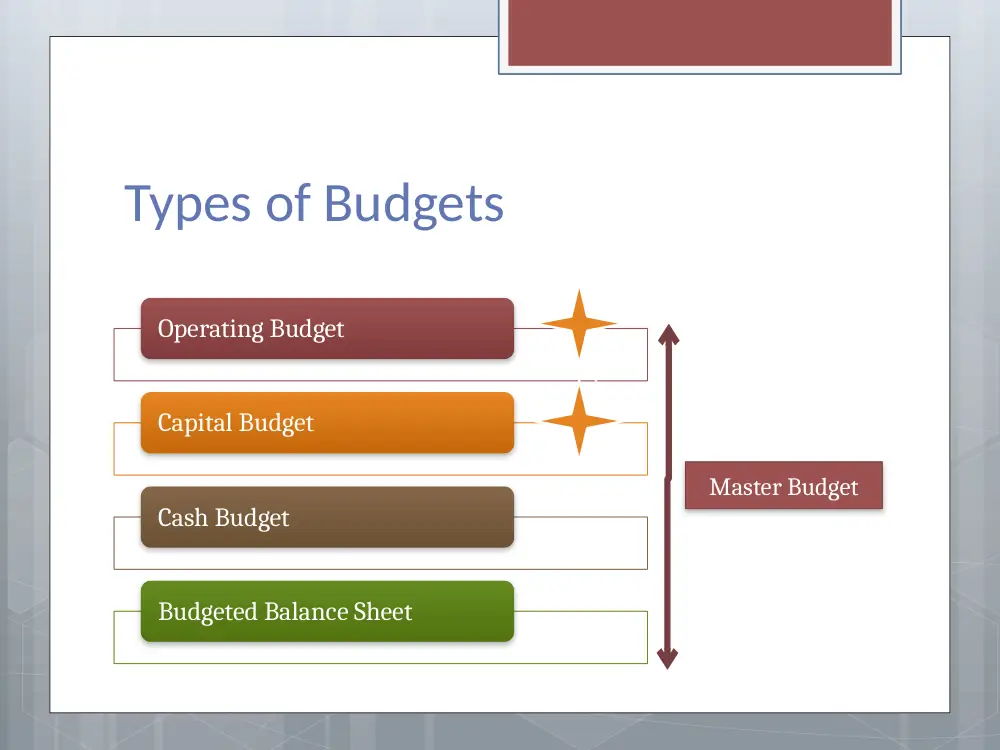
Types of Budgets
Operating Budget
Capital Budget
Cash Budget
Budgeted Balance Sheet
Master Budget
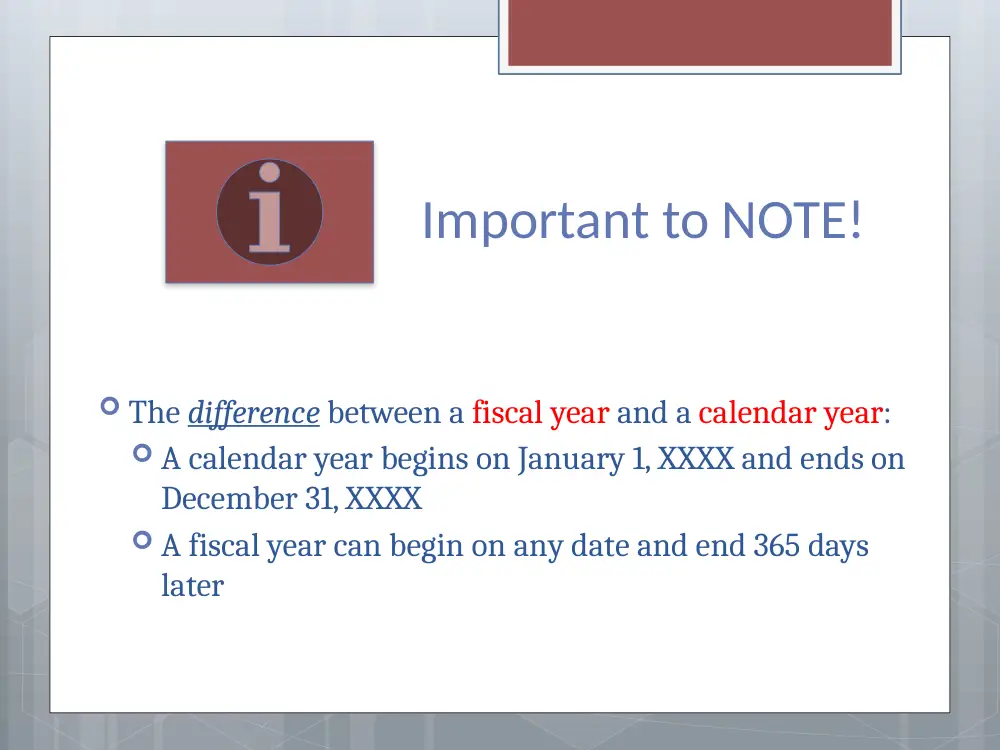
Important to NOTE!
The difference between a fiscal year and a calendar year:
A calendar year begins on January 1, XXXX and ends on
December 31, XXXX
A fiscal year can begin on any date and end 365 days
later
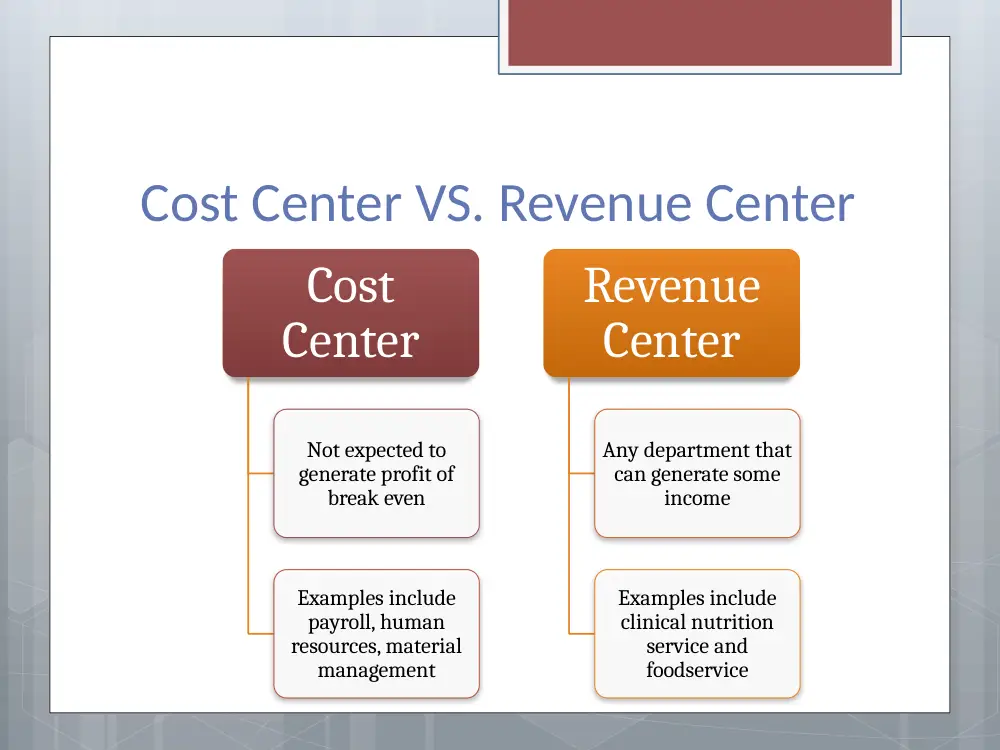
Cost Center VS. Revenue Center
Cost
Center
Not expected to
generate profit of
break even
Examples include
payroll, human
resources, material
management
Revenue
Center
Any department that
can generate some
income
Examples include
clinical nutrition
service and
foodservice
Once income exceeds cost by a substantial
amount, the revenue center is also considered a
profit center
Cost Center VS. Revenue Center
Reporting Periods
Some organizations use a calendar month as an
accounting period (that is twelve reporting
periods in a year)
Other organizations use four weeks blocks that
start on Sundays and end on Saturdays (that is
thirteen reporting periods a year)
I-Operating Budget
Operating budgets are those budgets that:
1.
Project the income of the organization
2.
Allocate the funds for the accomplishment of
work
They can be prepared for:
1.
Entire organization (Ex: Operating Budget of Rizk
Hospital)
2.
Separate departments (Ex: Dietetic Unit at Rizk
Hospital, Cardiology Unit, etc…)
I-Operating Budget
Operating budgets are normally prepared and
planned for a whole year
They do not carry over from year to year (ex: if the
manager at Rizk Hospital saves money this year
they can not carry it and spend it next year)
When preparing an operating budget it is in the
best interest of every manager to be as ACCURATE
as possible
I-Operating Budget- Types
Operating budgets are of TWO types:
1. Incremental
a.
Fixed
b.
Variable
2. Zero Based
a.
Fixed
b.
Variable
I-Operating Budget- Types
The typical procedure to prepare an operating budget
includes:
1.
Project revenues (volume of work to be done, price
of the product, anticipated price increase, …)
2.
Estimate labor needs and costs
3.
Estimate non-labor expenses
4.
Combine parts of the budget to project profit or
loss
I-Operating Budget- Preparation
I-Operating Budget- Preparation
A
B
C
D
E
F
A: Revenue budget makes up the Revenue part of the Operating Budget ONLY.
B, C, D, E, F: All these sections make up the Expenses part of the Operating Budget
Revenues
A: Revenue Budget
The projection of the income of an organization or a
department based on the sale of products (part of
operating budget)
Prepared only for revenue centers, not prepared for
departments that are solely cost centers
Thing to take into consideration:
1.
Prices and sales volume
2.
Money from non-sales sources
3.
Bad debts
Expenses
B: Expense Budget
Component of the operating budget that deals
with all anticipated costs, which can be further
divided into a number of sub-budgets
Expenses
C: Direct Labor Budget
Labor costs that are related to the actual
performance of work.
Example
1.
Base pay
2.
Overtime
3.
Pay in lieu of benefits
These are the projections that get written into the
labor budget
Expenses
D: Direct Material Budget
The estimate of cost for raw materials to be
used in the production of goods
This part of the operating budget is
computed for departments that produce a
tangible product
Expenses
E: Overhead Budget
General expenses associated with the
operation of a facility such as:
Rent
Taxes
Utilities
Repairs
Maintenance
Expenses
F: Other Operating Expenses
Part of the operating budget that encompasses all other
anticipated costs of operation such as:
1.
Telephone bills
2.
Copying charges
3.
Printing
4.
Office supplies
5.
Books
6.
Travel
7.
Journals
8.
Postage
9.
Fees
10.
Licenses
Expenses
F: Other Operating Expenses
This category basically covers everything else a
department plans to spend for operations
II-Capital Budget
Other part of the master budget
Investments in things like land, buildings, major pieces of
equipment are all considered CAPITAL expenditures
Examples of such items include:
Ovens
Dishwashers
Computer systems
Heavy machinery
Food processing plant
MRI machines
Radiology equipment
II-Capital Budget
These items are expected to last for a long time
Several organizations set a dollar value for capital
goods
Usually there is an organization-wide system for
allocation of funds
Managers write proposals to request funds
II-Capital Budget- Preparation
The preparation of the capital budget is a FIVE step
process
1.
Determine capital goods needed
2.
Prioritize items
a.
Most time/energy spent justifying most-needed items
3.
Estimate costs
a.
Cost is likely to change between time of budget
preparation and time of funding
b.
Probably too early to choose specific product
II-Capital Budget- Preparation
4.
Write budget request using organization-specific
format
a.
Justification usually most crucial part of
document
5.
Submit paperwork on time and in correct form
II-Capital Budget- Preparation
B-Financial Reports
1.
Operating Statement/performance report
2.
Profit & Loss Statement (P&L)
3.
Balance Sheet
Operating Statement
Also known as a performance report
Compares fiscal /actual performance to the budget
Information on the operating statement includes:
Budget for the accounting period
Amount budgeted from the beginning of the fiscal year
Should be generated promptly so that results can be
used to make adjustments
Example: increased membership revenues for health club
= more customers, more staff needed to maintain level of
service
Operating Statement
Prepared by the accounting department in an
organization
These are internal departmental tools used by
managers
Explanation required if
variance is 5% or more
Profit & Loss Statement (P&L)
P&L statement generally prepared by accounting
department
P&L normally prepared for the entire organization
Generally used as tools for upper management
Document used as a tool to report on organization’s
financial performance to:
Employees
Bankers
Stockholders
Investors
Profit & Loss Statement (P&L)
The document lists the following:
Controllable as well as uncontrollable revenues
Controllable as well as uncontrollable expenses
Net profits or losses
Generated as a year to date document or on an annual
basis
Document produced for an entire organization and not
a department on its own
Profit & Loss Statement (P&L)
P&L lists all revenues and expenses however these
values are NOT compared with the budgeted amounts
Balance Sheet
A financial report that summarizes an organization’s:
1.
Assets
2.
Liabilities
3.
Equity
It provides the user with a snapshot of the
organization’s financial status at a specific point in
time
Balance Sheet
What is an ASSET ?
An asset is a FUTURE BENEFIT obtained or
controlled by an entity as a result of a past
transaction
What is a LIABILITY ?
A liability is a FUTURE SACRIFICE of benefits
arising from present obligations of an entity to
transfer assets or provide services as a result of a past
transaction or event
What is EQUITY ?
Equity is the difference between TOTAL ASSETS and
TOTAL LIABILITIES
Balance Sheet
Balance sheets are used for:
Obtaining loans
Participating in mergers
Legal matters
Basic format of this tool is listing all of the assets and
liabilities of an organization
This report is prepared by the accounting department