
CSC 316 Project, Fall 2007
Notre Dame University–Louaize · Computers Security and Their Data · 3 pages
More CSC 316 files
Show the text of this project
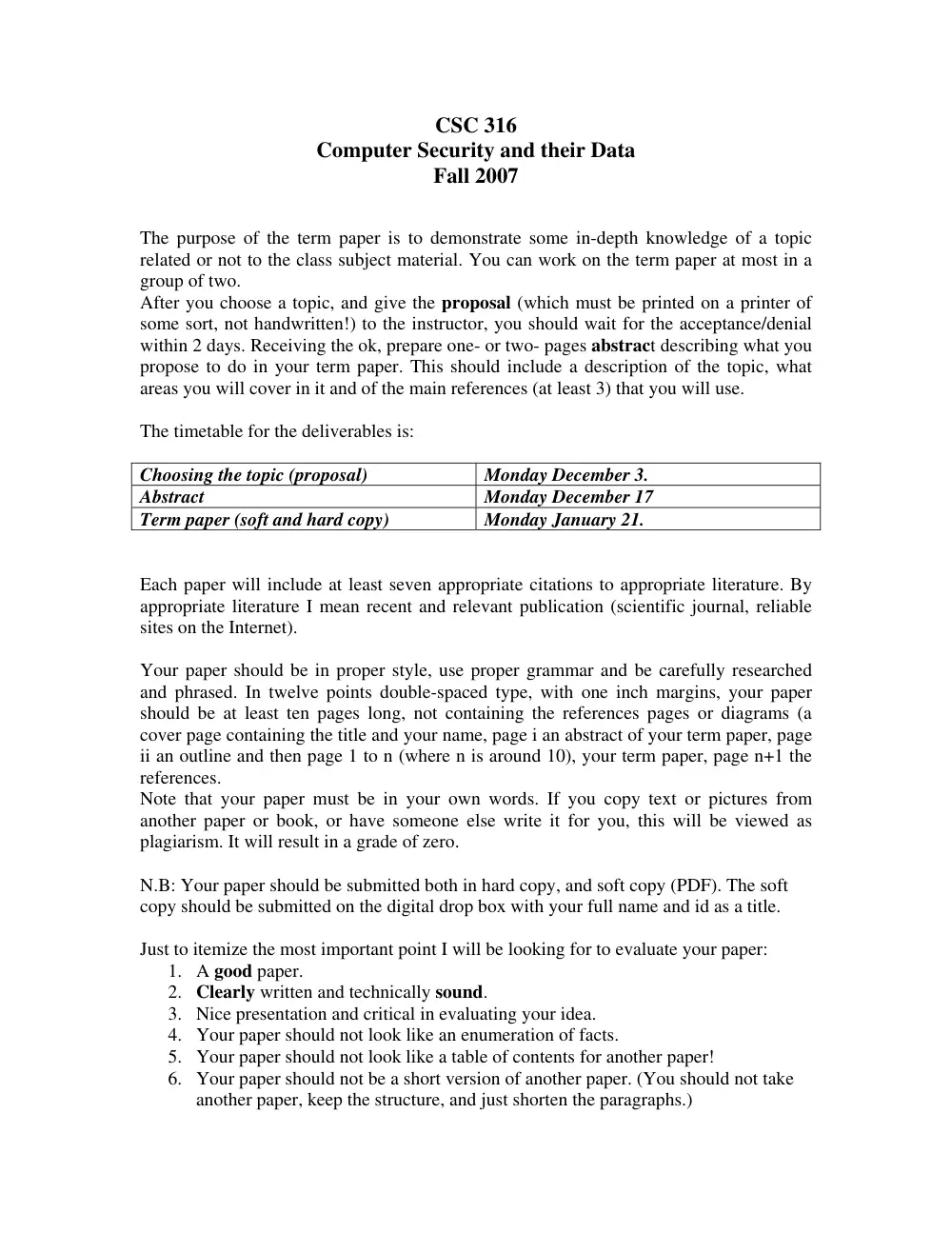
CSC 316
Computer Security and their Data
Fall 2007
The purpose of the term paper is to demonstrate some in-depth knowledge of a topic
related or not to the class subject material. You can work on the term paper at most in a
group of two.
After you choose a topic, and give the proposal (which must be printed on a printer of
some sort, not handwritten!) to the instructor, you should wait for the acceptance/denial
within 2 days. Receiving the ok, prepare one- or two- pages abstract describing what you
propose to do in your term paper. This should include a description of the topic, what
areas you will cover in it and of the main references (at least 3) that you will use.
The timetable for the deliverables is:
Choosing the topic (proposal)
Monday December 3.
Abstract
Monday December 17
Term paper (soft and hard copy)
Monday January 21.
Each paper will include at least seven appropriate citations to appropriate literature. By
appropriate literature I mean recent and relevant publication (scientific journal, reliable
sites on the Internet).
Your paper should be in proper style, use proper grammar and be carefully researched
and phrased. In twelve points double-spaced type, with one inch margins, your paper
should be at least ten pages long, not containing the references pages or diagrams (a
cover page containing the title and your name, page i an abstract of your term paper, page
ii an outline and then page 1 to n (where n is around 10), your term paper, page n+1 the
references.
Note that your paper must be in your own words. If you copy text or pictures from
another paper or book, or have someone else write it for you, this will be viewed as
plagiarism. It will result in a grade of zero.
N.B: Your paper should be submitted both in hard copy, and soft copy (PDF). The soft
copy should be submitted on the digital drop box with your full name and id as a title.
Just to itemize the most important point I will be looking for to evaluate your paper:
1. A good paper.
2. Clearly written and technically sound.
3. Nice presentation and critical in evaluating your idea.
4. Your paper should not look like an enumeration of facts.
5. Your paper should not look like a table of contents for another paper!
6. Your paper should not be a short version of another paper. (You should not take
another paper, keep the structure, and just shorten the paragraphs.)
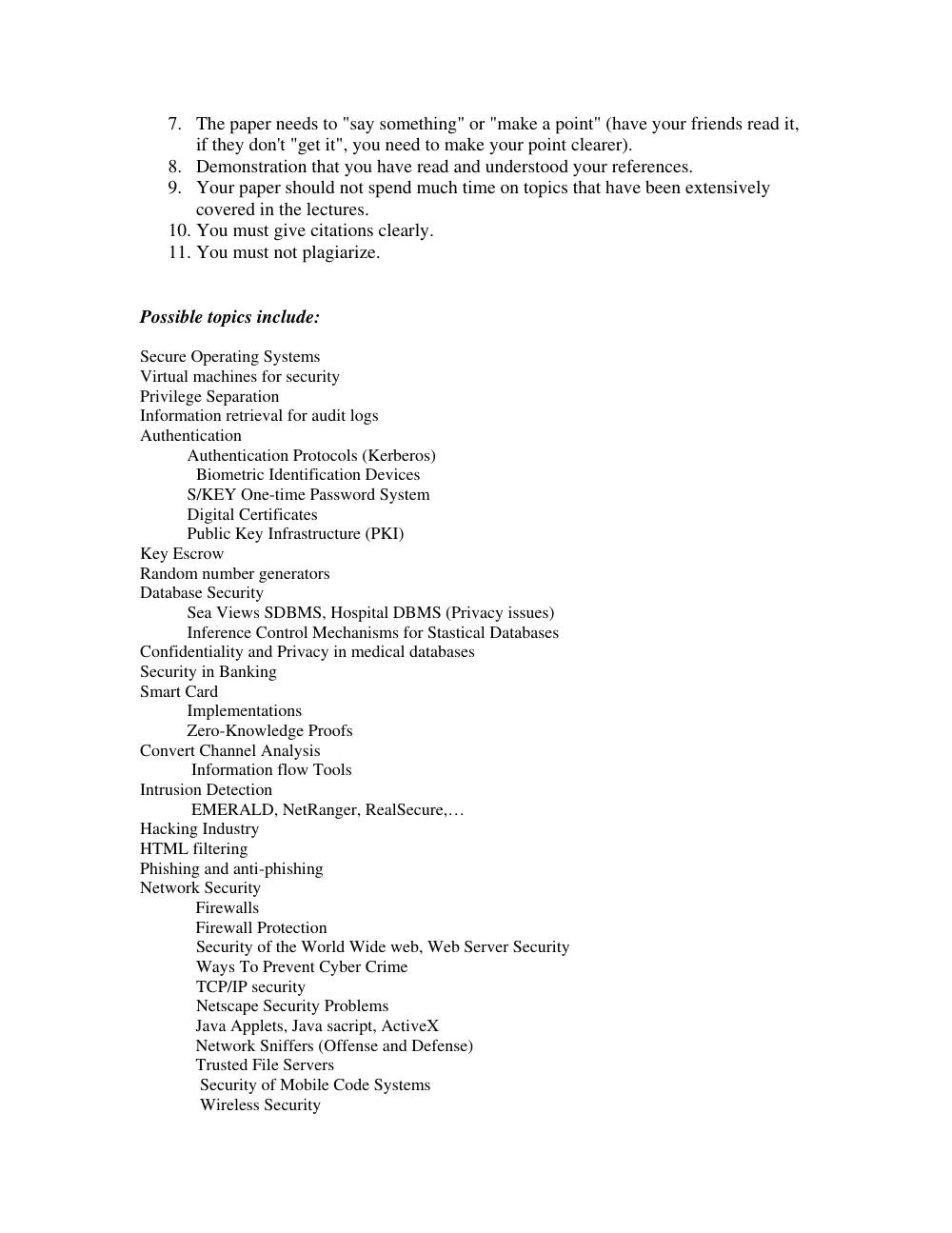
7. The paper needs to "say something" or "make a point" (have your friends read it,
if they don't "get it", you need to make your point clearer).
8. Demonstration that you have read and understood your references.
9. Your paper should not spend much time on topics that have been extensively
covered in the lectures.
10. You must give citations clearly.
11. You must not plagiarize.
Possible topics include:
Secure Operating Systems
Virtual machines for security
Privilege Separation
Information retrieval for audit logs
Authentication
Authentication Protocols (Kerberos)
Biometric Identification Devices
S/KEY One-time Password System
Digital Certificates
Public Key Infrastructure (PKI)
Key Escrow
Random number generators
Database Security
Sea Views SDBMS, Hospital DBMS (Privacy issues)
Inference Control Mechanisms for Stastical Databases
Confidentiality and Privacy in medical databases
Security in Banking
Smart Card
Implementations
Zero-Knowledge Proofs
Convert Channel Analysis
Information flow Tools
Intrusion Detection
EMERALD, NetRanger, RealSecure,…
Hacking Industry
HTML filtering
Phishing and anti-phishing
Network Security
Firewalls
Firewall Protection
Security of the World Wide web, Web Server Security
Ways To Prevent Cyber Crime
TCP/IP security
Netscape Security Problems
Java Applets, Java sacript, ActiveX
Network Sniffers (Offense and Defense)
Trusted File Servers
Security of Mobile Code Systems
Wireless Security
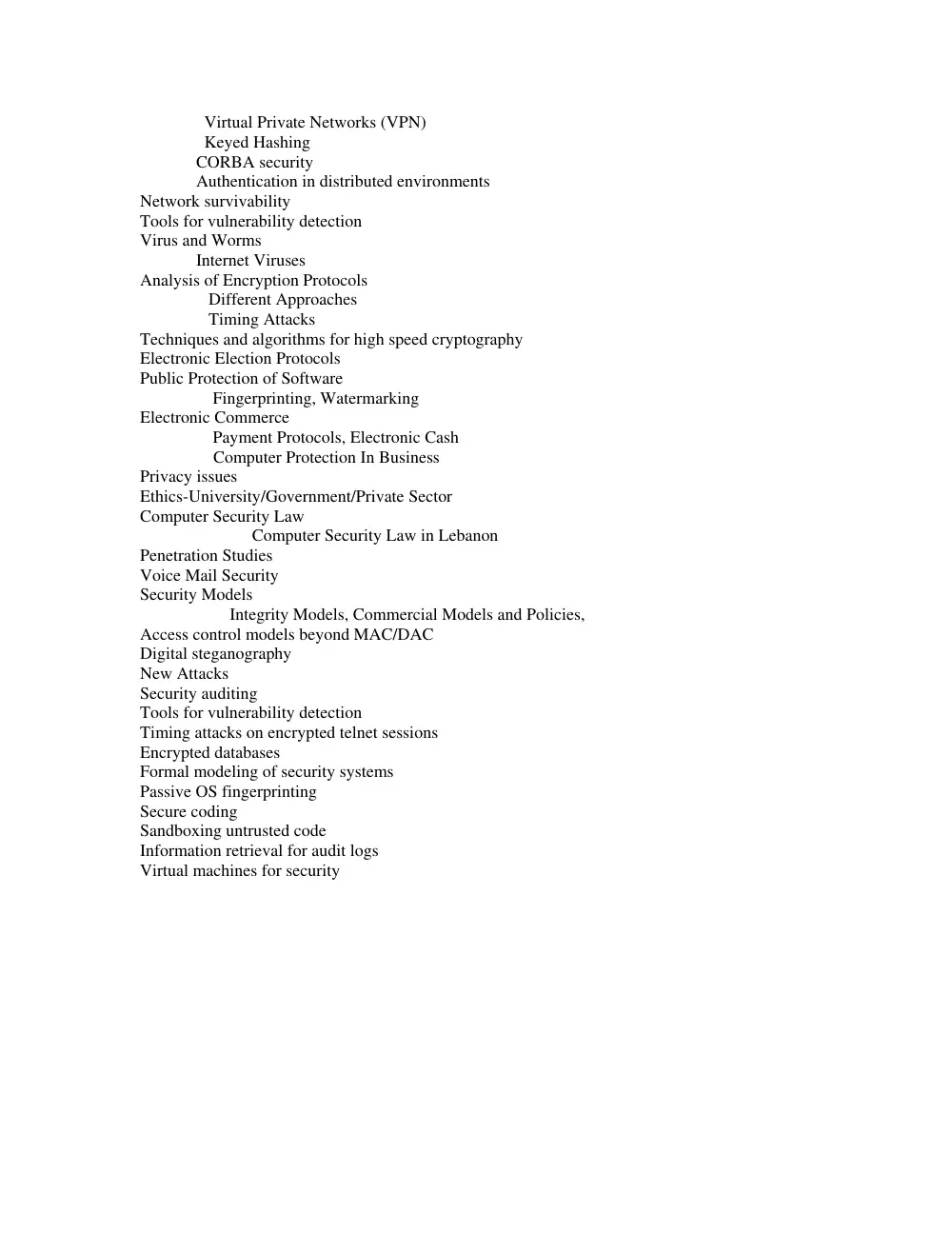
Virtual Private Networks (VPN)
Keyed Hashing
CORBA security
Authentication in distributed environments
Network survivability
Tools for vulnerability detection
Virus and Worms
Internet Viruses
Analysis of Encryption Protocols
Different Approaches
Timing Attacks
Techniques and algorithms for high speed cryptography
Electronic Election Protocols
Public Protection of Software
Fingerprinting, Watermarking
Electronic Commerce
Payment Protocols, Electronic Cash
Computer Protection In Business
Privacy issues
Ethics-University/Government/Private Sector
Computer Security Law
Computer Security Law in Lebanon
Penetration Studies
Voice Mail Security
Security Models
Integrity Models, Commercial Models and Policies,
Access control models beyond MAC/DAC
Digital steganography
New Attacks
Security auditing
Tools for vulnerability detection
Timing attacks on encrypted telnet sessions
Encrypted databases
Formal modeling of security systems
Passive OS fingerprinting
Secure coding
Sandboxing untrusted code
Information retrieval for audit logs
Virtual machines for security