
CSC 316 Chapter 2a, Fall 2007
Notre Dame University–Louaize · Computers Security and Their Data · 40 pages


Showing the first 10 of 40 pages. Download the PDF to see all of it.
More CSC 316 files
Show the text of this chapter
Chapter 2
Basic Encryption and
Decryption
csc316 computer security & their
data
2
Encryption / Decryption
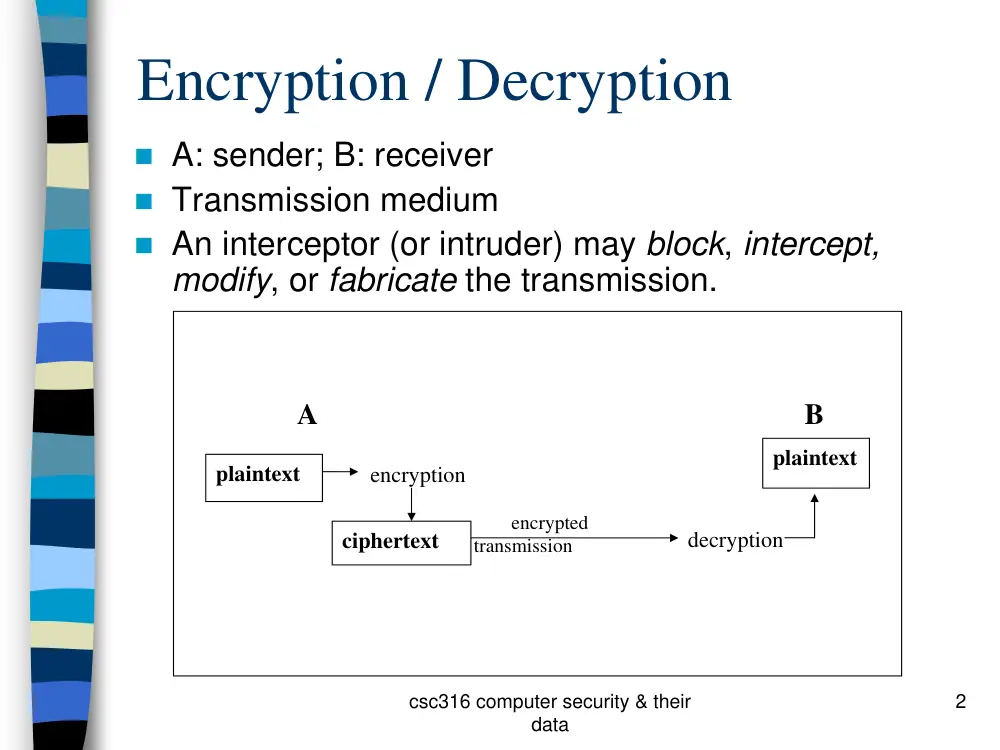
encrypted
transmission
A
B
plaintext
plaintext
ciphertext
encryption
decryption
� A: sender; B: receiver
� Transmission medium
� An interceptor (or intruder) may block, intercept,
modify, or fabricate the transmission.
csc316 computer security & their
data
3
Encryption / Decryption
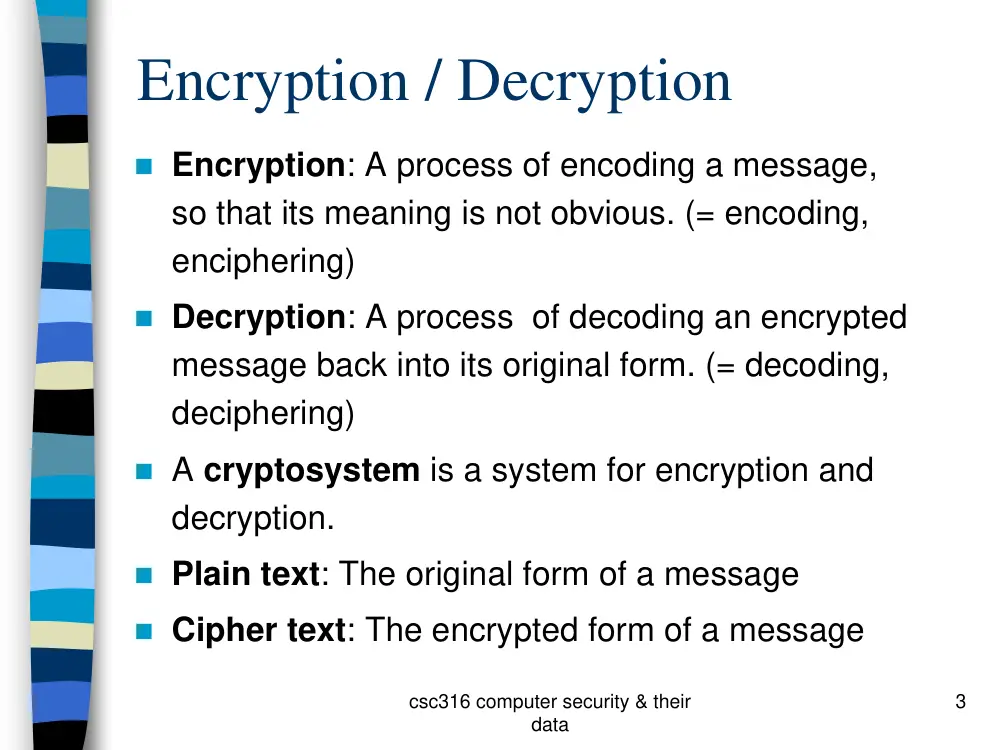
� Encryption: A process of encoding a message,
so that its meaning is not obvious. (= encoding,
enciphering)
� Decryption: A process of decoding an encrypted
message back into its original form. (= decoding,
deciphering)
� A cryptosystem is a system for encryption and
decryption.
� Plain text: The original form of a message
� Cipher text: The encrypted form of a message
csc316 computer security & their
data
4
Plaintext / ciphertext
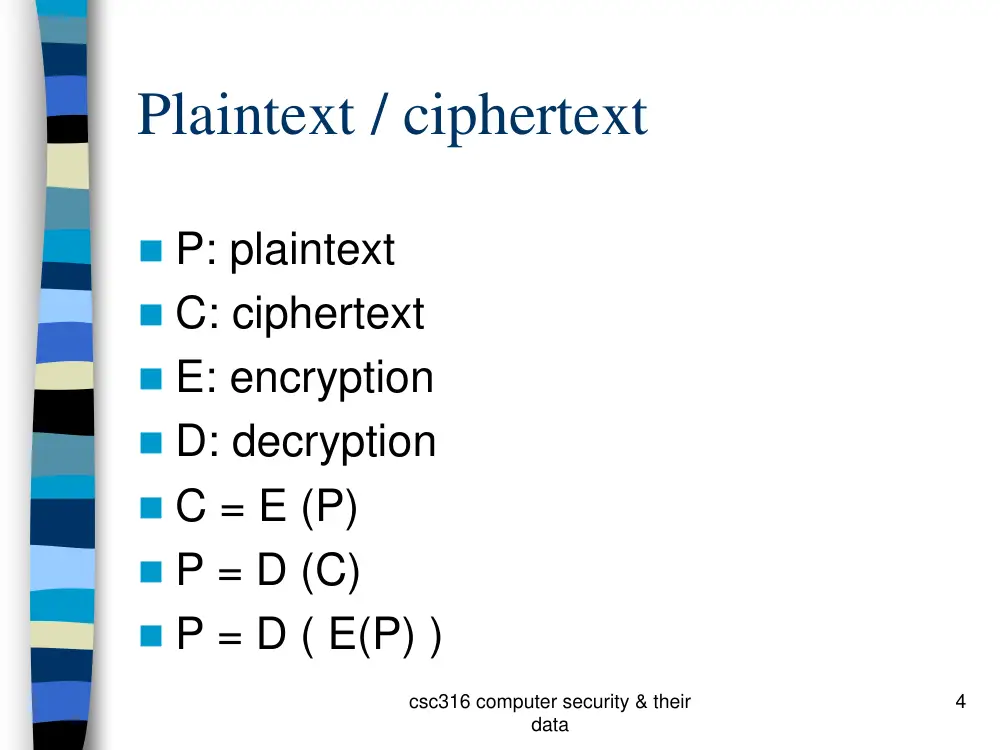
� P: plaintext
� C: ciphertext
� E: encryption
� D: decryption
� C = E (P)
� P = D (C)
� P = D ( E(P) )
csc316 computer security & their
data
5
Cryptosystems
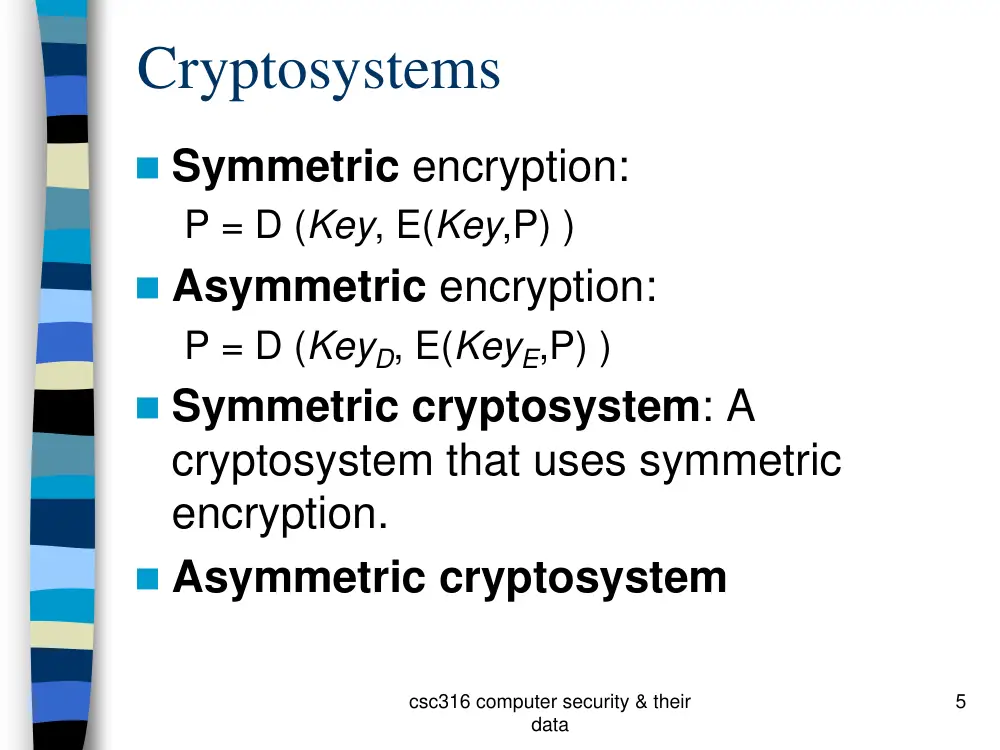
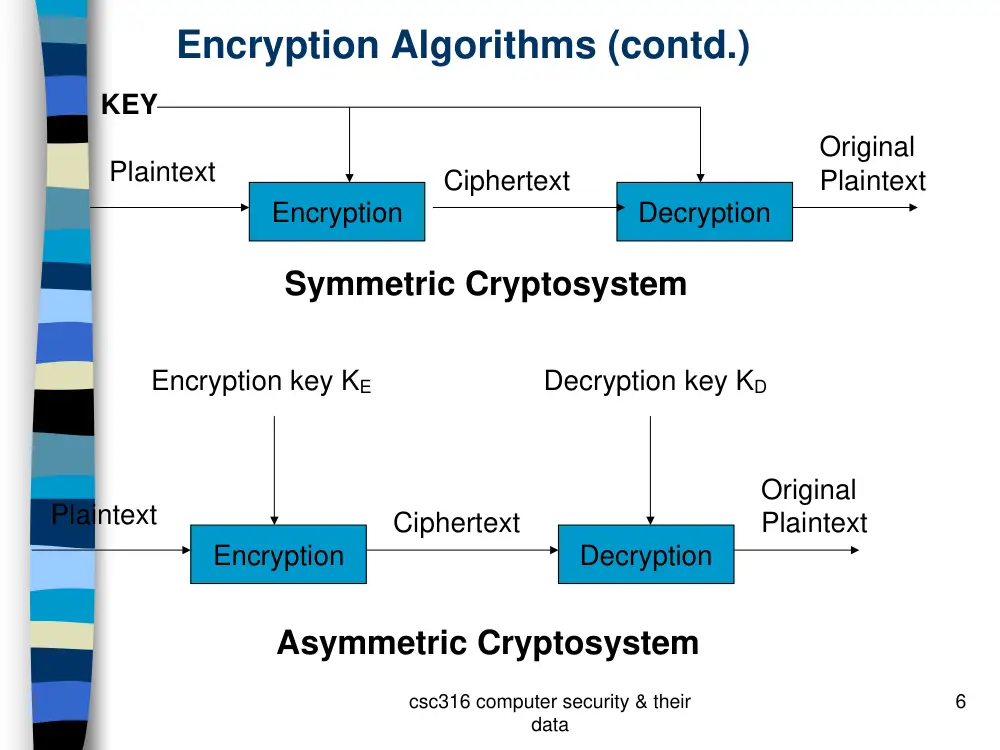
� Symmetric encryption:
P = D (Key, E(Key,P) )
� Asymmetric encryption:
P = D (KeyD, E(KeyE,P) )
� Symmetric cryptosystem: A
cryptosystem that uses symmetric
encryption.
� Asymmetric cryptosystem
csc316 computer security & their
data
6
Encryption Algorithms (contd.)
Encryption
Decryption
Plaintext
Ciphertext
Original
Plaintext
KEY
Encryption
Decryption
Plaintext
Ciphertext
Original
Plaintext
Encryption key KE
Decryption key KD
Symmetric Cryptosystem
Asymmetric Cryptosystem
csc316 computer security & their
data
7
Keys
� Use of a key provides additional
security.
� Exposure of the encryption algorithm
does not expose the future messages (
as long as the key(s) are kept secret).
csc316 computer security & their
data
8
Terminology
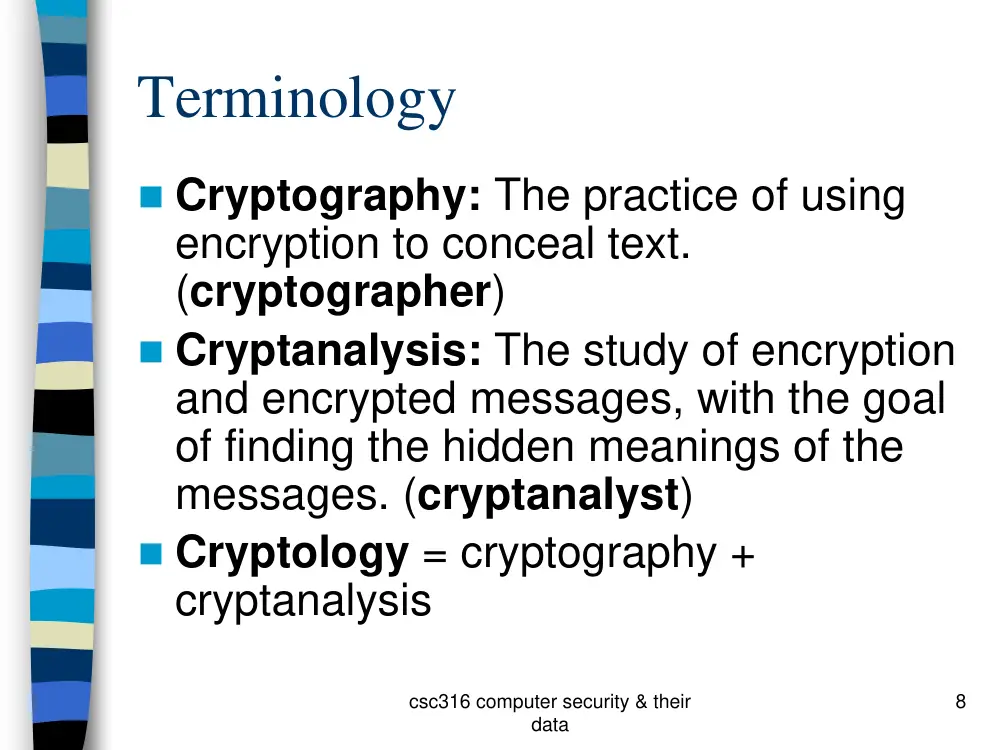
� Cryptography: The practice of using
encryption to conceal text.
(cryptographer)
� Cryptanalysis: The study of encryption
and encrypted messages, with the goal
of finding the hidden meanings of the
messages. (cryptanalyst)
� Cryptology = cryptography +
cryptanalysis
csc316 computer security & their
data
9
Cryptanalysis
�
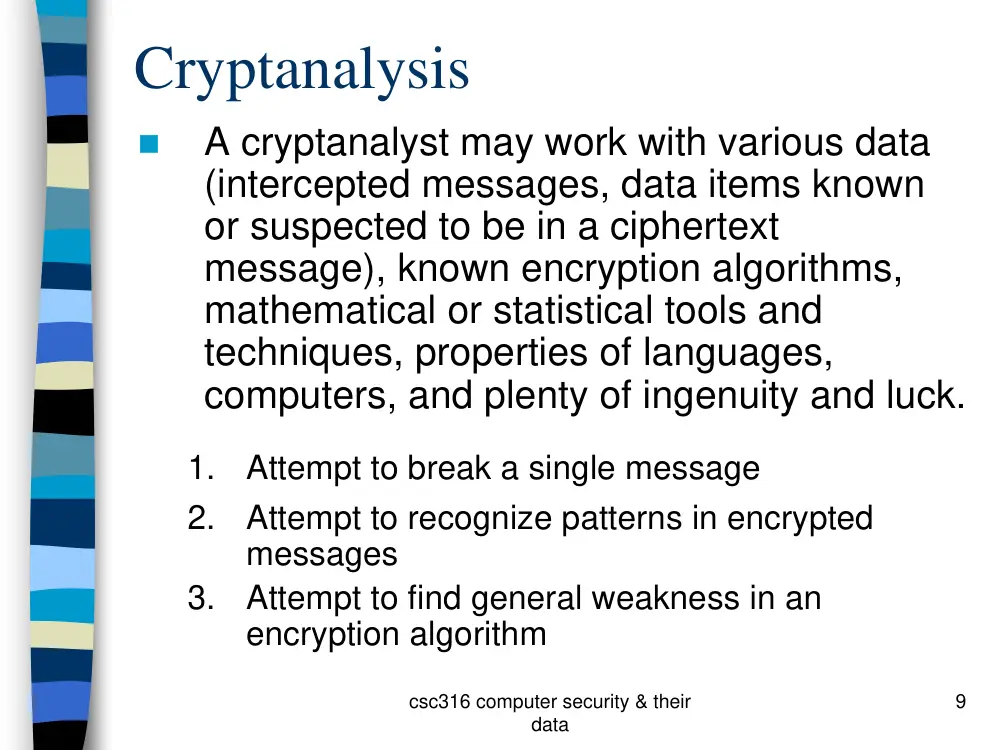
A cryptanalyst may work with various data
(intercepted messages, data items known
or suspected to be in a ciphertext
message), known encryption algorithms,
mathematical or statistical tools and
techniques, properties of languages,
computers, and plenty of ingenuity and luck.
1.
Attempt to break a single message
2.
Attempt to recognize patterns in encrypted
messages
3.
Attempt to find general weakness in an
encryption algorithm
csc316 computer security & their
data
10
Modular arithmetic
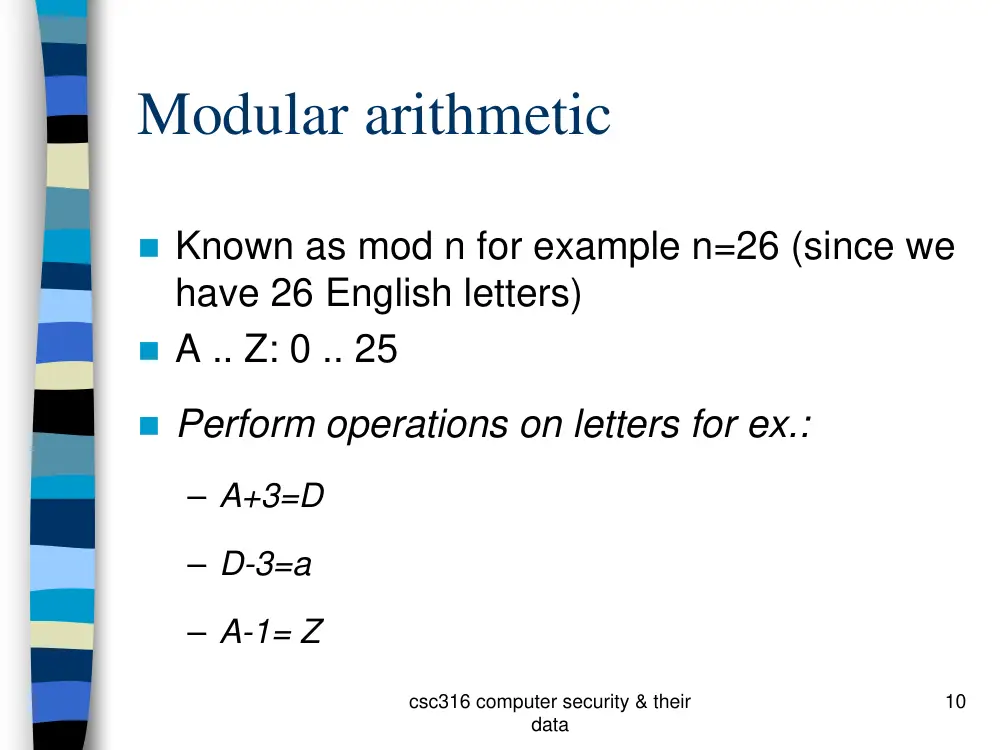
� Known as mod n for example n=26 (since we
have 26 English letters)
� A .. Z: 0 .. 25
� Perform operations on letters for ex.:
– A+3=D
– D-3=a
– A-1= Z
csc316 computer security & their
data
11
Two forms of encryption
� Substitutions
One letter is exchanged for another
For example: ABCaDEF
� Transpositions (= permutations)
The order of the letters is rearranged
For example: ABCaCBA
csc316 computer security & their
data
12
Simple Encryption Algorithms
� Substitution
– Monoalphabetic (Ceaser, Using a key,
Random)
– Polyalphabetic (two or more, Using a key,
Perfect)
� Permutation
– Simple
– Double
csc316 computer security & their
data
13
Ceaser Cipher
The Caesar Cipher
•
Each letter is translated to the letter a fixed number
of letters after it in the alphabet.
•
Uses a shift of 3
•
Plain text pi is used to obtain cipher text ci as
follows:
ci = E(pi ) = pi + 3
csc316 computer security & their
data
14
Ceaser Cipher
– Example
• Plain: This is the message
• Cipher: wklv lv wkh phvvdjh
b
a
z
y
w x
v
u
t
s
r
q
p
o
m n
l
k
j
i
h
g
f
e
d
K L M N O P Q R S T U V W X Y
J
B C D E F G H I
A
c
Z
csc316 computer security & their
data
15
Other monoalphabetic substitutions
� Using Shift (permutation)
– (lambda) = 25 – lambda
� Using a key
A key is a word that controls the ciphering.
Example: The key is (key)
Another Example Key is Juliette
JULIETABCDFGHKMNOPQRSVWXYZ
Note:
•
Use Large keys
•
Use Keys that contain letters from the end of the alphabet
L M N O P Q R S T U V W X
J
E Y A B C D F G H I
K
K L M N O P Q R S T U V W X Y
J
B C D E F G H I
A
Z
Z
csc316 computer security & their
data
16
Other monoalphabetic
substitutions
� Random monoalphabetic substitution
� Example
Note: Each letter should appear only once
D V K X P B O L F R M N C S U H E Y T G
W Z Q J
A
K L M N O P Q R S T U V W X Y
J
B C D E F G H I
A
I
Z
csc316 computer security & their
data
17
Cryptanalysis example
� Consider the following ciphertext:
WKLV PHVVDJH LV QRW WRR KDUG WR
EUHDN
Try to make cryptanalysis to conclude the
full or part of the original message
csc316 computer security & their
data
18
Comparaison of the security of
all monoalphabetic ciphering
� All easy to perform
� All unsecure enough
� In order of highest to lowest security
– Random (need to know all letters
substitutions)
– Using a key (need to know all the key)
– Ceaser or shift (need to know the size of
the shift)
csc316 computer security & their
data
19
Weakness of the security of all
monoalphabetic ciphering
� Blanks are not encrypted (blanks
remain blanks)
� As English has few small words, the two
and three letters words are easily
guessed after few trials
� The same two letters are encrypted as
same two other letters and not all two
letters are repeated.
csc316 computer security & their
data
20
Frequency distribution
� It shows the counts and relative
frequencies of letters in English.
� For example the frequencies of
Ceaser’s cipher are shifted three letters
from the normal distribution
� Frequencies in a sample cipher:
Compare the sample cipher against the
normal frequency distribution.
csc316 computer security & their
data
21
Frequency distribution
csc316 computer security & their
data
22
Another disadvantage of
monoalphabetic cipher
� It always has lot o peaks and valleys
and
� With comparison of the normal
distribution the exact substitution can be
guessed
� To solve this we have Polyalphabetic
cipher
csc316 computer security & their
data
23
Polyalphabetic substitutions
� By combining distributions that are high
with the ones that are low
� Using multiple substitution tables
� Example :One table for odd positions,
One table for even positions
csc316 computer security & their
data
24
Polyalphabetic substitutions
� EXAMPLE:
–
ABCDEFGHIJKLMNOPQRSTUVWXYZ
� S1:DEFGHIJKLMNOPQRSTUVWXYZABC
� S2: ZYXWVUTSRQPONMLKJIHGFEDCBA
– P= IMPOSSIBLE
– C= LNSLVHMYOV
csc316 computer security & their
data
25
Polyalphabetic substitutions
(Vigenère Tableaux)
� Table 2-1: p.51
� Example: p.50
� P= I am I exist that is certain
� Key: Secure
� C= aeocv pmunk zevej vitnr ar
� Exercise: Complete the encryption of the
following message
– Plain: BUT SOFT WAS LIGHT
– KEY: JULIETTE
csc316 computer security & their
data
26
csc316 computer security & their
data
27
Cryptanalysis of Polyalphabetic
cipher.
� Find the number of alphabets used
� Break cipher into chains that were
ciphered with the same alphabet
� Solve each piece as a monoalphabetic
substitution
– Two tools can help:
• Kasiski method
• Index of coincidence
csc316 computer security & their
data
28
Cryptanalysis of Polyalphabetic
substitutions (kasiski method)
� The Kasiski method: a method to find
the number of alphabets used for
encryption
� Works on duplicate fragments in the
ciphertext
� The distance between the repeated
patterns must be a multiple of the
keyword length
csc316 computer security & their
data
29
Kasiski Method
� Relies on regularity of English
� Not only letters but also groupings
– Ending: th, ing, ed, ion, tion, ation, etc.
– Beginning: im, in, un, re, etc.
– Patterns: eek, oot, our, etc.
csc316 computer security & their
data
30
Steps of The Kasiski Method
�
Identify all repeated patterns in the
ciphertext
�
For each pattern:
1. Write down the starting position
2. Compute the distance between successive
starting positions
3. The distance must be a multiple of key length
4. Determine all factors of difference (eg. 16 means
the key is either 1, or 2 or 4 or 8 characters long)
5. Divide the cipher into chains (based on key
length)
6. Columns in each chain must have been
encrypted using the SAME key character
7. Use frequency distribution to determine the letter
csc316 computer security & their
data
31
Index of coincidence
� A measure of the variation between
frequencies in a distribution
� To measure the nonuniformity of a
distribution
� To rate how well a particular distribution
matches the distribution of letters in English
csc316 computer security & their
data
32
Index of Coincidence
�
Measure of roughness (or the variance):
a measure of the size of the peaks and
valleys.
�
The var of a perfectly flat distribution = 0.
�
The variance can be estimated by counting
the number of pairs of identical letters and
dividing by the total number of pairs
possible
csc316 computer security & their
data
33
Index of Coincidence
� IC (index of coincidence): a way to
approximate variance from observed
data.
� 0.0384 (perfect) ≤ IC < 0.068 (English)
csc316 computer security & their
data
34
Combined use of IC with Kasiski
method
� All the chains from the Kasiski method,
if the key length was correct, should
have distributions close to 0.068.
csc316 computer security & their
data
35
Analyzing a polyalphabetic
cipher
1.
Use the Kasiski method to predict the
likely numbers of enciphering
alphabets.
2.
Compute the IC to validate the
predictions
3.
(When 1 and 2 show promises)
Generate chains and calculate IC’s for
each chains
csc316 computer security & their
data
36
The “Perfect” Substitution Cipher
� Use an infinite nonrepeating sequence
of alphabets
� A key with an infinite number of
nonrepeating digits
� Examples: one-time pads, the Vernam
cipher, …
csc316 computer security & their
data
37
Vernam Cipher
� Sample function:
c = ( p + random( ) ) mod 26
� Example: p.42
� Binary Vernam Cipher
p.43: How would you decipher a ciphertext
encrypted by Binary Vernam Cipher?
Ans.: p = (c – random( ) ) mod 26
Example (p.42): c = 19 (‘t’), random( ) = 76
p = (19-76) mod 26 = 21
csc316 computer security & their
data
38
Random Number Generators
� A pseudo-random number generator is a computer
program that generates numbers from a predictable,
repeating sequence.
� Example: The linear congruential random number
generator
ri+1 = (a * ri + b) mod n
Note: 12 is congruent to 2 (modulo 5), since (12-2)
mod 5 = 0
� Problem? Its dependability; probable word attack
csc316 computer security & their
data
39
Breakability of an encryption
� An encryption algorithm may be breakable,
meaning that given enough time and data, an
analyst could determine the algorithm.
� Suppose there exists 1030 possible
decipherments for a given cipher scheme. A
computer performs 1010 operations per
second. Finding the decipherment would
require 1020 seconds (or roughly 1012 years).
csc316 computer security & their
data
40
Summary
� Substitutions and permutations together
form a basis for the most widely used
encryption algorithms