
CSC 316 Chapter 2b, Fall 2007
Notre Dame University–Louaize · Computers Security and Their Data · 28 pages





Showing the first 10 of 28 pages. Download the PDF to see all of it.
More CSC 316 files
Show the text of this chapter
Chapter 2
Basic Encryption and Decryption (part B)
Transpositions (Permutations)
• P.52
• Transposition: an encryption in which the
letters of the message are rearranged
• Also known as permutations
• Compare the goals:
– Substitution confusion
– Transposition diffusion
Confusion vs Diffusion
• Confusion: making it difficult to determine how a
message and key were transformed into ciphertext.
• Diffusion: spreading the information from the
message or the key out widely across the
ciphertext
• See p.62 for more discussions.
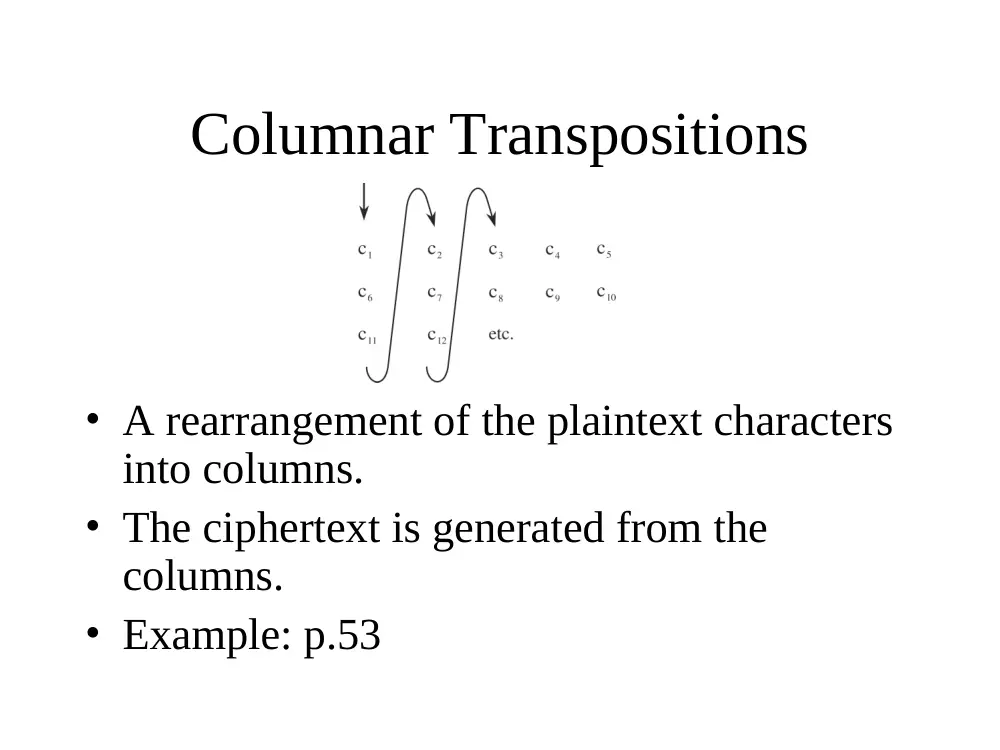
Columnar Transpositions
• A rearrangement of the plaintext characters
into columns.
• The ciphertext is generated from the
columns.
• Example: p.53
Complexity of Columnar
Transpositions
• Time: proportional to the length of the message,
that is, O(n) or at the order of function n.
• Space: depends on the length of the message.
• Output cannot be produced until all characters of
the message have been read.
• Initial delay varies, depending on the length of
the message. C.f., constant initial delay in the
previous (substitution) algorithms.
Digrams, Trigrams, & Other
Patterns
• Digrams: groups of two letters
• Trigrams: groups of three letters
• Table 2-2 (p.54): Most Frequent digrams an
Trigrams
Note: not counting digrams that consist of the last
letter of one word and the first letter of the next
word.
Cryptanalysis by Digram Analysis
1.
To compute the letter frequencies
o
Clue: The fact that all letters appear with their normal
frequencies implies that a transposition has been
performed.
o
(Same IC as monoalphabrtic 0.068 same distribution
graph as plaintext English)
2.
To find where in the ciphertext a pair of adjacent
columns lies (that is, to determine the width of a
row in the original table used for encryption)
o
The ‘moving window’ method: Fig. 2-5
(p.56)
The ‘moving window’ method
1.
Pick a window size, say n.
2.
Compare every Ci, 1 i n ,in the window to
Ci+n and determine if the two form a common
digram by checking their frequency.
3.
Do most of the digrams look reasonable?
Compute their mean and std. deviation
The ‘moving window’ method
Double transposition (P.51)
• Involves two columnar transpositions
• An example of product ciphers, in which
one encryption is applied to the result of
another
C = E2 (E1 (P) )
Fractionated Morse
•
A keyed monoalphabetic cipher
•
Uses Morse code as its base
•
Double encodings (P Morse code P’)
•
3 steps:
1.
Convert P to Morse code, using separator(s) between
letters and words.
2.
Divide the Morse code messages into blocks of 3
symbols.
3.
Each block of symbols is encoded as the letter
corresponding to that 3-symbol pattern
Stream versus Block Ciphers
• Stream ciphers: The plaintext characters are encoded by
the sender letter-by-letter as sent to the receiver.
– Example: substitution ciphers
• Block ciphers: Blocks of plaintext are encoded into
ciphertext before being sent.
– Example: columnar transposition
Stream Ciphers
+ Fast
+ Little storage space
+ Low error propagation, meaning that encoding
errors affect just one character in the ciphertext
- low diffusion, meaning that individual characters
in the ciphertext can be analyzed using frequency
distribution, digram analysis, IC and the Kasiski
method
- Susceptibility to malicious insertions and
modifications
Block Ciphers
- Slow
- Require more storage space
- Error propagation
+ High diffusion
+ High immunity to insertions
4 cryptanalysis cases & 5 approaches
1. Ciphertext only
Ciphertext-only attack
2. Full or partial plaintext
Known plaintext attack
Probable plaintext analysis
3. Ciphertext of any plaintext
Chosen plaintext attack
4. Algorithm + Ciphertext
Chosen ciphertext attack
Complete listing of examples of
cryptanalysis methods
• Brute Force
• Known Plaintext
• Chosen Plaintext
• Adaptive Chosen
Plaintext
• Ciphertext only
• Chosen Ciphertext
• Adaptive Chosen
Ciphertext
• Meet in the Middle
• Differential
Cryptanalysis
• Linear Cryptanalysis
• Differential Linear
Cryptanalysis
• Factoring
• Statistical
Data Encryption Standard (DES)
• 1976: officially adopted as a U.S. federal standard
• Was authorized for use on all public and private sector
unclassified communication
• Later became an international standard by the ISO
• The strength of DES comes from repeated application of
the two encryption techniques, substitution and
permutation, one on top of the other, for a total of 16
cycles.
• Product cipher:
C = E2 ( E1(P) )
• A secret key method
Chronology
•
1976 DES is approved as a standard
•
1977 DES is published as a FIPS standard FIPS PUB 46
•
1992 Biham and Shamir report the first theoretical attack with less complexity than
brute force (differential cryptanalysis). However, it requires an unrealistic 247
chosen plaintexts.
•
1993 DES is reaffirmed for the third time as FIPS 46-2
•
June1997 The DESCHALL Project breaks a message encrypted with DES for the
first time in public.
•
July1998 The EFF's DES cracker (Deep Crack) breaks a DES key in 56 hours.
•
January1999 DES key in 22 hours and 15 minutes.25 October
•
1999 DES is reaffirmed for the fourth time as FIPS 46-3, which specifies the
preferred use of Triple DES, with single DES permitted only in legacy systems.
•
2001 The Advanced Encryption Standard is published in FIPS 197
•
2002 The AES standard becomes effective
•
2004 The withdrawal of FIPS 46-3 (and a couple of related standards) is proposed
in the Federal Register [2]19 May2005NIST withdraws FIPS 46-315 March
•
2007 The FPGA based parallel machine of the University of Bochum and Kiel,
Germany, breaks DES in 6.4 days at $10,000 hardware cost
Data Encryption Standard (DES)
• 16 cycles of substitutions and permutations: Fig.10-7
(p.647)
• Steps in a single cycle: Fig. 647, Fig. 10-9
Operates on blocks of data: 64 bits per block
Splits a data block in half: left half, right half (32 bits)
Scrambles each half independently: shifted left, permuted
Combines the key with the right half: the result is then
combined with the left half
Swaps the two halves: T = right half; right half += key;
right half += left half; left half = T.
Data Encryption Standard (DES) (1 CYCLE)
Key Transformation
• 64-bit key, but only 56 of the bits are used (bits 8, 16, 24,
32, 40, 48, 56, 64 are parity bits)
• At each step, the key is split into two 28-bit halves.
• The halves are shifted by a specified number of digits
(Table 10-2, p.651), pasted together again, and then 48 of
these 56 bits are permuted as a key during this step (choice
permutation: Table 10-3 P. 651).
• How to combine a 32-bit right half with a 56-bit
key?
p.649: Fig. 10-11
Expansion permutation: The 32-bit half is
expanded to 48 bits by repeating certain bits
See Table 10-1 p.649
Permuted choices: The 56-bit key is reduced to
48 bits by choosing only certain bits
• Fig. 10-11: a detailed single cycle
Data Encryption Standard (DES)
Substitutions and S-boxes
• An S-box is a table in which 6 bits of data are replaced by
4 bits.
• The 48-bit input is divided into eight 6-bit blocks
8 S-boxes for substitutions (Table 10-4, p.652)
• Substitutions by S-boxes
S-box substitutions
•
Use Table 10-4
•
Input: Bj = 6 bits (b1 b2 b3 b4 b5 b6)
•
Output: a 4-bit binary number
•
Process:
1.
r = b1 b6
2.
c = b2 b3 b4 b5
3.
result = the value at (r, c) of the S-box j (Sj) of Table 3-
6.
4.
Convert the result to a binary number.
S-box substitutions
•
Example: p.650
Input = Bj = B7 = 010011b
r = 01b = 1
c = 1001b = 9
result = (r, c) = (1, 9) in S7 = 3 = 0011b
•
Suppose the Input = B4 = 101010b. What’s the output of
the substitution?
P-box permutations
• Permutations:
Initial permutation
Permutation in each cycle
Final inverse permutation
• inverse & final permutations: Table 3-8, 3-9, p.110
• Per-cycle permutation:
p.653: Table 10-5
Examples
Bit 1 bit 9
Bit 23 bit 11
Bit 19 ?
Bit 27 ?
Summary of DES Encryption
• Input = (64-bit data block, 64-bit key)
• process
64-bit key 56 bits
Initial permutation
16 cycles:
Key transformation (split, shift, permuted)
Data blocks substitution & permutation
Lj = Rj-1 ;
Rj = Lj-1 XOR f(Rj-1, kj)
S-boxes, P-boxes
Final permutation
• Output = 64-bit ciphertext
DES Decryption
• Encryption: (Lj-1 , Rj-1) (Lj , Rj)
Lj = Rj-1 ;
Rj = Lj-1 XOR f(Rj-1, kj)
• Decryption: (Lj , Rj) (Lj-1 , Rj-1)
Rj-1 = Lj
Lj-1 = Rj XOR f(Lj, kj)
• Reverse key transformation