
CSC 316 Chapter 1, Fall 2007
Notre Dame University–Louaize · Computers Security and Their Data · 16 pages
Showing the first 10 of 16 pages. Download the PDF to see all of it.
More CSC 316 files
Show the text of this chapter
Chapter 1
Introduction to
computer security
2
What is the security problem?
� Security is an increasingly prevalent
problem in computer science. Why?
– Increased connectivity
– Large number of valuable assets online
– Low threshold to access
– Sophisticated attack tools and strategies
available
– Others…
3
What does IT security means?
IT security is commonly defined to have two
aspects:
– Computer security which aims to preserve the
computing resources against abuse and
unauthorized use as well as to protect data from
accidental or deliberate damage, disclosure or
modification.
– Communication security which aims to protect
data during its transmission in computer networks
and distributed systems.
4
A security Paradox
� Organizations often choose not to
investigate or prosecute intruders:
– They don’t want to expose vulnerabilities in
their systems
– They want to protect their public image
– Intruders are sometimes viewed as mere
pranksters
– Sometimes electronic assets are not
viewed as valuable.
5
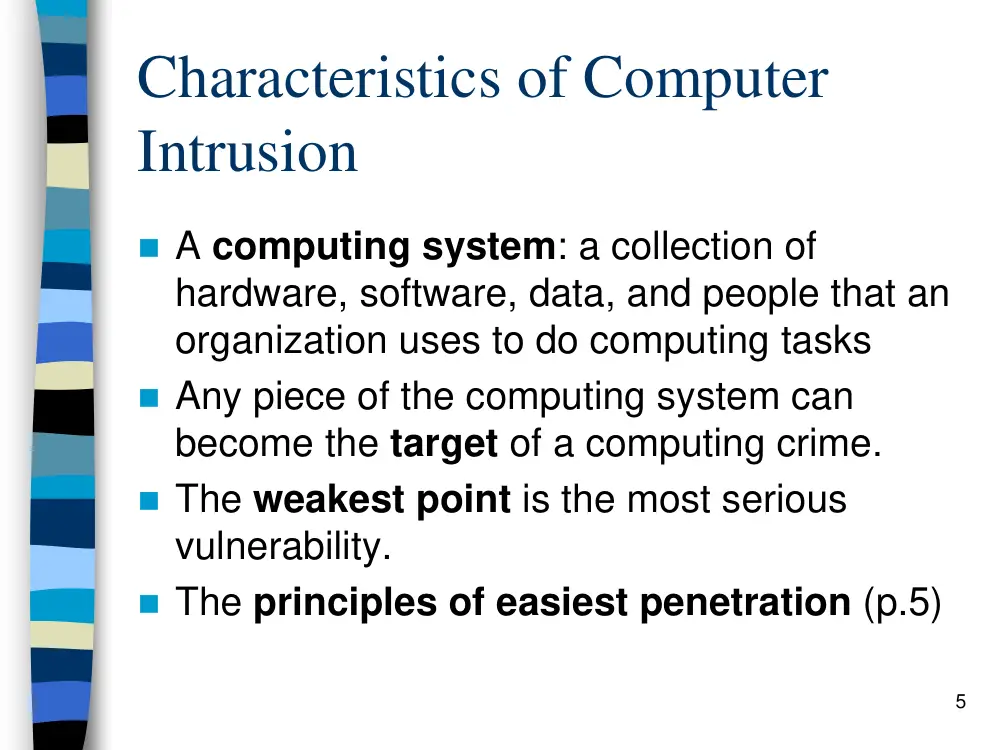
Characteristics of Computer
Intrusion
� A computing system: a collection of
hardware, software, data, and people that an
organization uses to do computing tasks
� Any piece of the computing system can
become the target of a computing crime.
� The weakest point is the most serious
vulnerability.
� The principles of easiest penetration (p.5)
6
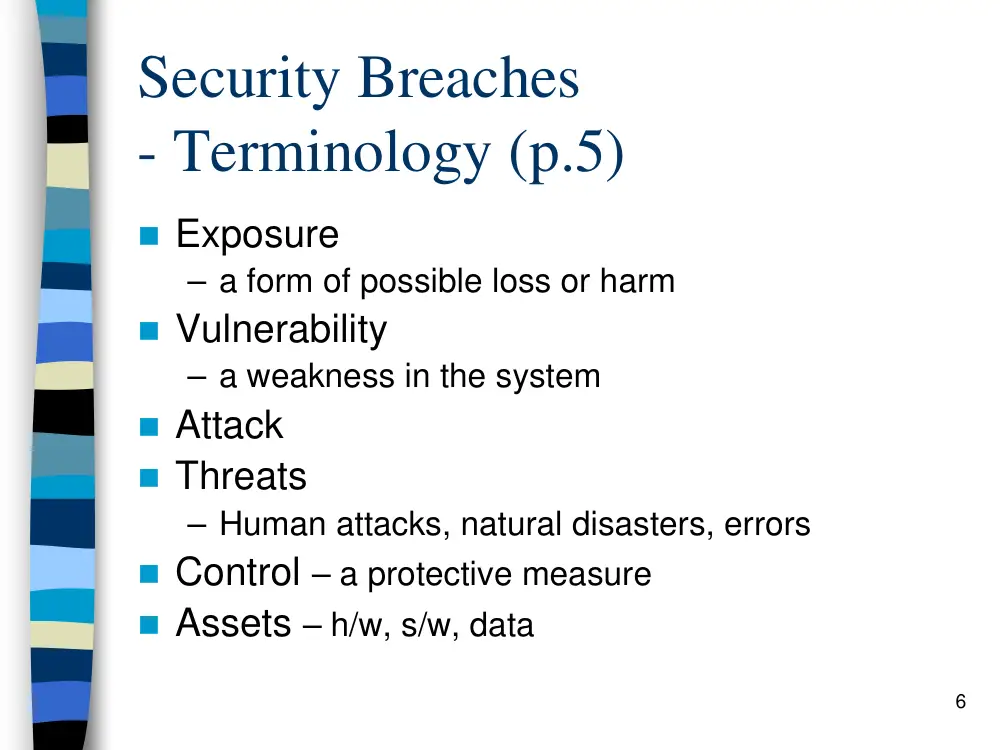
Security Breaches
- Terminology (p.5)
� Exposure
– a form of possible loss or harm
� Vulnerability
– a weakness in the system
� Attack
� Threats
– Human attacks, natural disasters, errors
� Control – a protective measure
� Assets – h/w, s/w, data
7
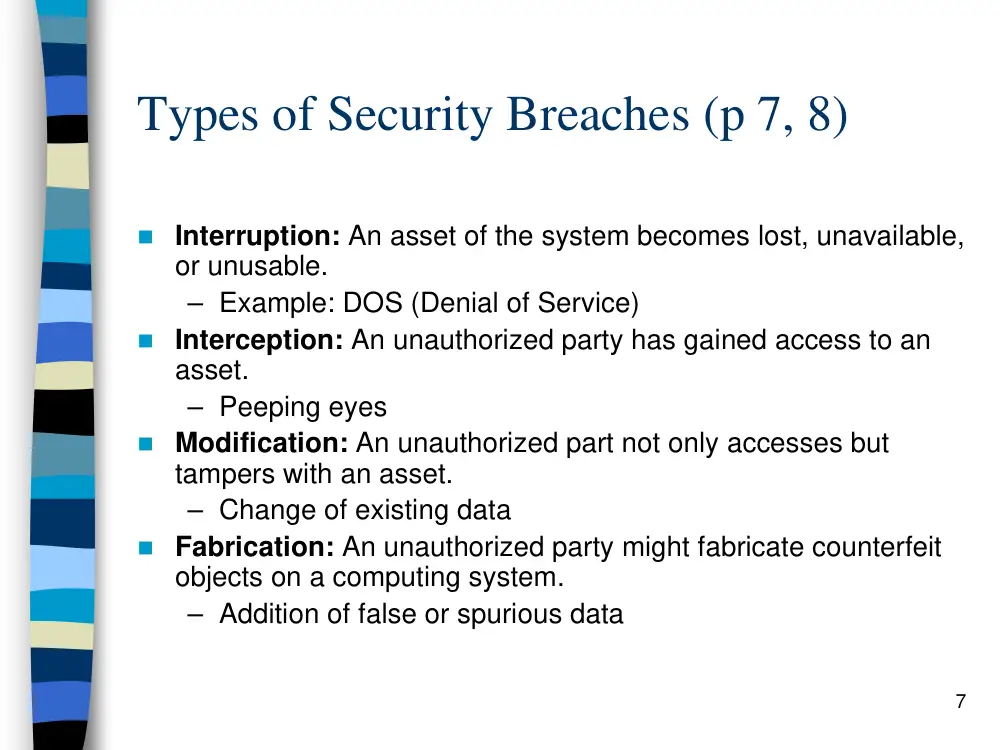
Types of Security Breaches (p 7, 8)
� Interruption: An asset of the system becomes lost, unavailable,
or unusable.
– Example: DOS (Denial of Service)
� Interception: An unauthorized party has gained access to an
asset.
– Peeping eyes
� Modification: An unauthorized part not only accesses but
tampers with an asset.
– Change of existing data
� Fabrication: An unauthorized party might fabricate counterfeit
objects on a computing system.
– Addition of false or spurious data
8
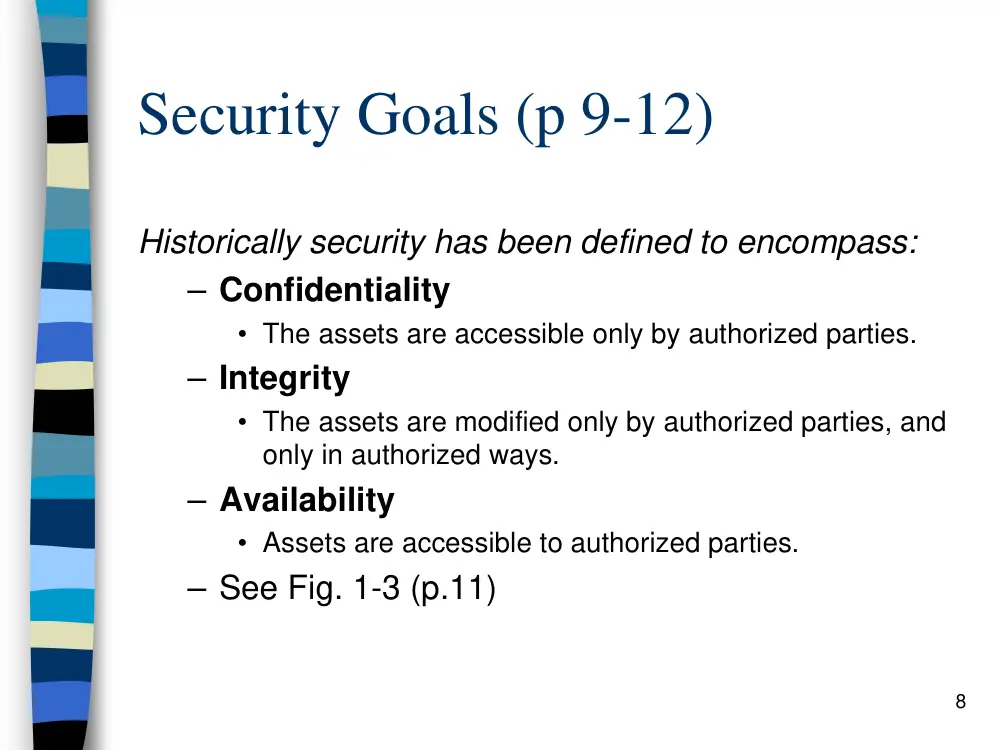
Security Goals (p 9-12)
Historically security has been defined to encompass:
– Confidentiality
• The assets are accessible only by authorized parties.
– Integrity
• The assets are modified only by authorized parties, and
only in authorized ways.
– Availability
• Assets are accessible to authorized parties.
– See Fig. 1-3 (p.11)
9
Security Goals (p 9-12)
Some experts (e.g. National Security
Agency NSA) typically add to this list:
– Authentication:to make sure that a party is really
the one which is claiming to be.
– Non Repudiation: to make sure that a party
cannot deny sending or receiving an asset if done.
10
Computing System
Vulnerabilities
� See Fig. 1-4 (p.13)
� Hardware vulnerabilities
� Software vulnerabilities
� Data vulnerabilities
� Human vulnerabilities ?
11
Software Vulnerabilities
� Destroyed (deleted) software
� Stolen (pirated) software
� Altered (but still run) software
– Logic bomb
– Trojan horse
– Virus
– Trapdoor
– Information leaks
12
Data Security
� The principle of adequate protection
(p.16)
� Fig. 1-5 (p.18)
– Confidentiality: preventing unauthorized
access
– Integrity: preventing unauthorized
modification (e.g., salami attack)
– Availability: preventing denial of authorized
access
13
Other Exposed Assets
� Storage media
� Networks
� Access
� Key people
14
People Involved in Computer
Crimes
� Amateurs
� Crackers
� Career Criminals
15
Methods of Defense
� Encryption
� Software controls
� Hardware controls
� Policies
� Physical controls
16
Principle of Effectiveness
� Controls must be used to be effective.
– Efficient
• Time, memory space, human activity, …
– Easy to use
– appropriate