
CSC 423 Chapter 02, Fall 2011
Notre Dame University–Louaize · Software Engineering · 19 pages · Dr. Maya Samaha
Showing the first 10 of 19 pages. Download the PDF to see all of it.
More CSC 423 files
Show the text of this chapter
1
Chapter 2
Process Models
2
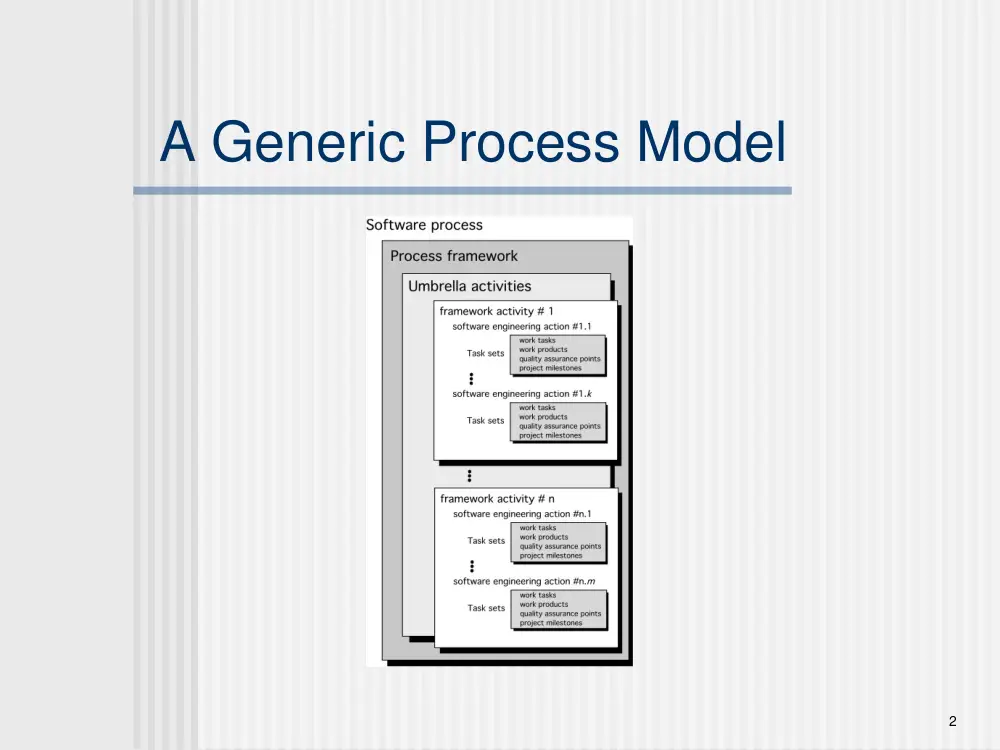
A Generic Process Model
3
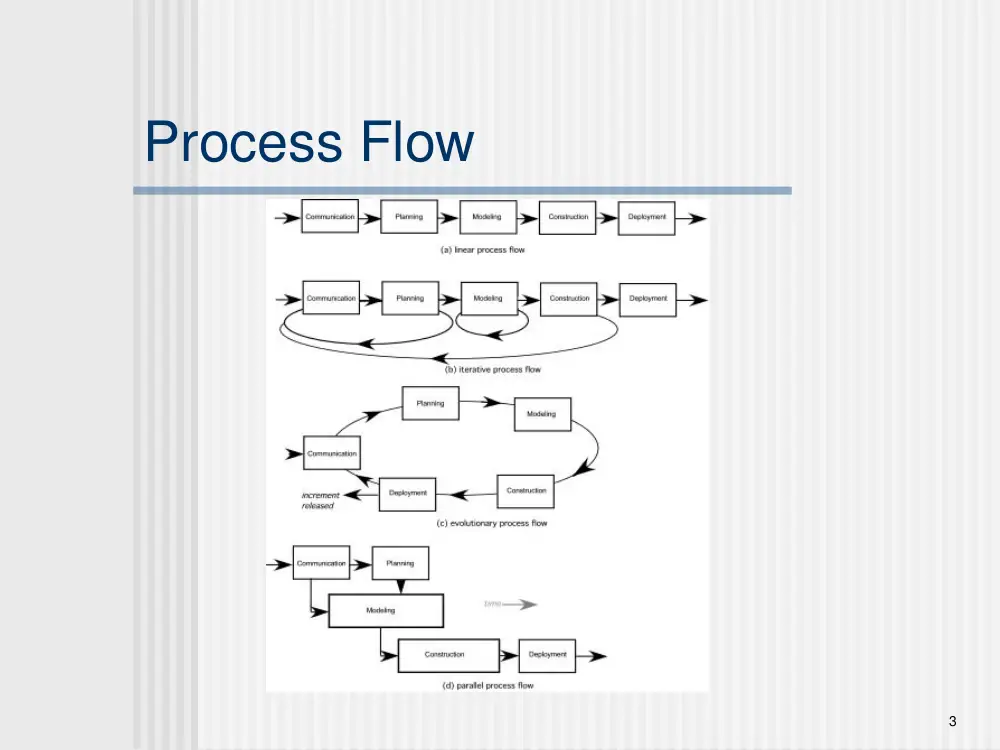
Process Flow
4
Identifying a Task Set
A task set defines the actual work to be done to
accomplish the objectives of a software
engineering action.
A list of the task to be accomplished
A list of the work products to be produced
A list of the quality assurance filters to be applied
5
Process Patterns
A process pattern
describes a process-related problem that is
encountered during software engineering work,
identifies the environment in which the problem has
been encountered, and
suggests one or more proven solutions to the
problem.
Stated in more general terms, a process pattern
provides you with a template [Amb98]—a
consistent method for describing problem
solutions within the context of the software
process.
6
Process Assessment and Improvement
Standard CMMI Assessment Method for Process Improvement
(SCAMPI) — provides a five step process assessment model that incorporates
five phases: initiating, diagnosing, establishing, acting and learning.
CMM-Based Appraisal for Internal Process Improvement (CBA IPI)
—provides a diagnostic technique for assessing the relative maturity of
a software organization; uses the SEI CMM as the basis for the
assessment [Dun01]
SPICE—The SPICE (ISO/IEC15504) standard defines a set of
requirements for software process assessment. The intent of the
standard is to assist organizations in developing an objective evaluation
of the efficacy of any defined software process. [ISO08]
ISO 9001:2000 for Software—a generic standard that applies to any
organization that wants to improve the overall quality of the products,
systems, or services that it provides. Therefore, the standard is directly
applicable to software organizations and companies. [Ant06]
7
Prescriptive Models
Prescriptive process models advocate an orderly
approach to software engineering
That leads to a few questions …
If prescriptive process models strive for structure and
order, are they inappropriate for a software world that
thrives on change?
Yet, if we reject traditional process models (and the order
they imply) and replace them with something less
structured, do we make it impossible to achieve
coordination and coherence in software work?
8
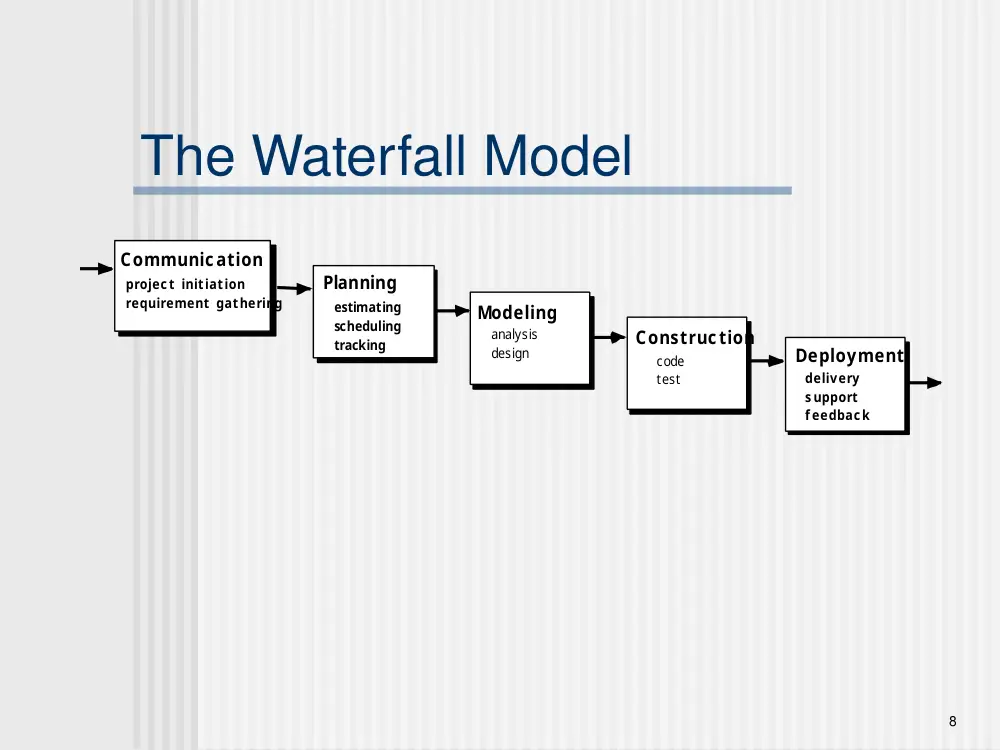
The Waterfall Model
Communication
Planning
Modeling
Construction
Deployment
analysis
design
code
test
project initiation
requirement gathering
estimating
scheduling
tracking
delivery
s upport
f eedback
9
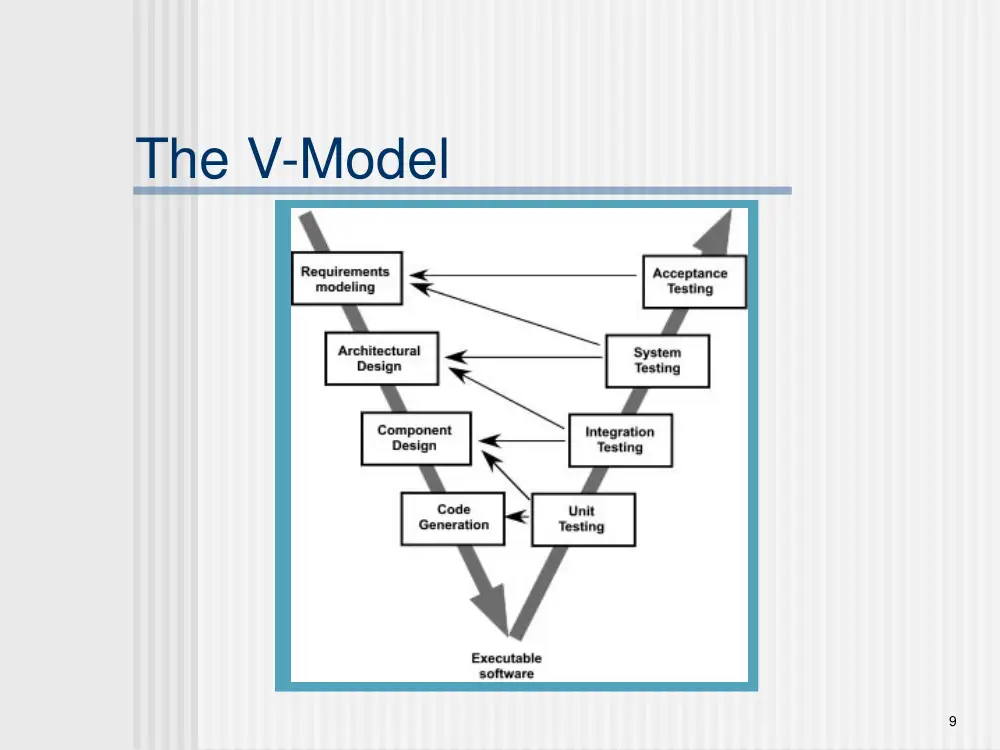
The V-Model
10
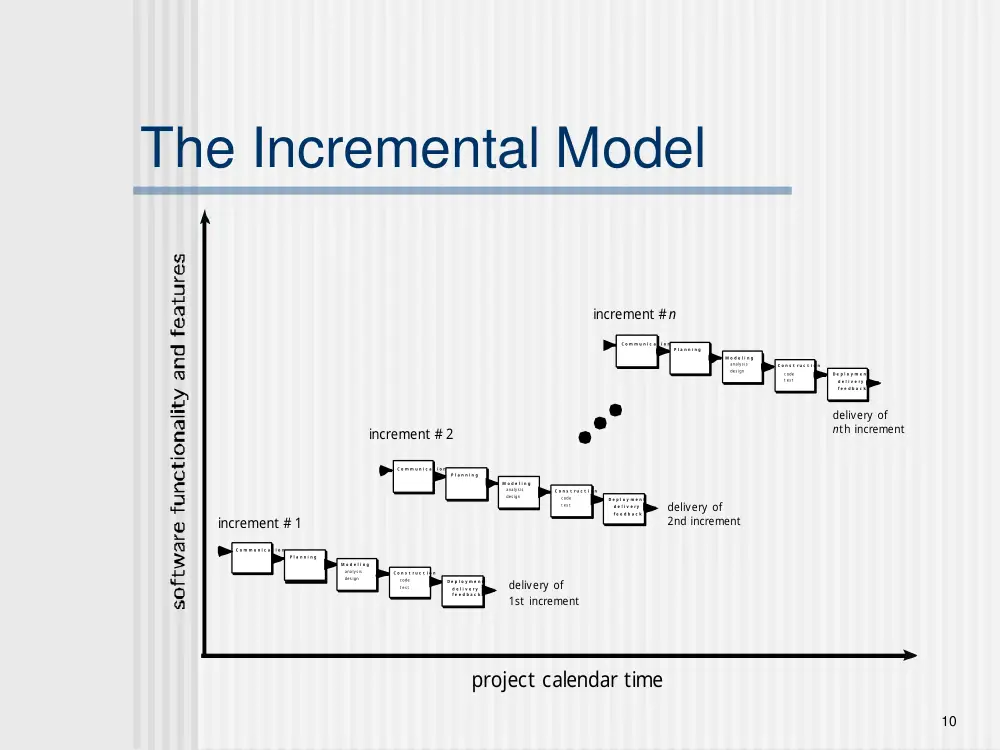
The Incremental Model
C o m m u n i c a t i o n
P l a n n i n g
M o d e l i n g
C o n s t r u c t i o n
D e p l o y m e n t
d e l i v e r y
f e e d b a c k
analys is
des ign
c ode
t es t
increment # 1
increment # 2
delivery of
1st increment
delivery of
2nd increment
delivery of
nth increment
increment # n
project calendar time
C o m m u n i c a t i o n
P l a n n i n g
M o d e l i n g
C o n s t r u c t i o n
D e p l o y m e n t
d e l i v e r y
f e e d b a c k
analys is
des ign
c ode
t es t
C o m m u n i c a t i o n
P l a n n i n g
M o d e l i n g
C o n s t r u c t i o n
D e p l o y m e n t
d e l i v e r y
f e e d b a c k
analy s is
des ign
c ode
t es t
11
Class Activity
In groups of 2, write your names on a
piece of paper:
Describe 3 increments for word-processing
software developed using the incremental
paradigm
12
Evolutionary Models: Prototyping
Construction
of prototype
Communication
Quick plan
Construction
of
prototype
Mode ling
Quick de sign
Delivery
& Feedback
Deployment
communication
Quick
plan
Modeling
Quick design
Construction
of prototype
Deployment
delivery &
feedback
13
Evolutionary Models: The Spiral
communication
planning
modeling
construction
deployment
delivery
feedback
start
analysis
design
code
test
estimation
scheduling
risk analysis
14
Evolutionary Models: Concurrent
Under review
Baselined
Done
Under
revision
Awaiting
changes
Under
development
none
Modeling activity
represents the state
of a software engineering
activity or task
15
The Unified Process (UP)
software increment
Release
Inception
Elaboration
construction
transition
production
inception
elaboration
Unified Process—a
“use-case driven,
architecture-centric,
iterative and
incremental” software
process closely
aligned with the
Unified Modeling
Language (UML)
16
UP Phases
Inception
Elaboration
Construction
Transition
Production
UP Phases
Workflows
Requirements
Analysis
Design
Implementation
Test
Iterations
#1
#2
#n-1
#n
Support
17
UP Work Products
Inception phase
Elaboration phase
Construction phase
Transition phase
Vision document
Initial use-case model
Initial project glossary
Initial business case
Initial risk assessment.
Project plan,
phases and iterations.
Business model,
if necessary.
One or more prototypes
Inc ept i o
n
Use-case model
Supplementary requirements
including non-functional
Analysis model
Software architecture
Description.
Executable architectural
prototype.
Preliminary design model
Revised risk list
Project plan including
iteration plan
adapted workflows
milestones
technical work products
Preliminary user manual
Design model
Software components
Integrated software
increment
Test plan and procedure
Test cases
Support documentation
user manuals
installation manuals
description of current
increment
Delivered software increment
Beta test reports
General user feedback
18
Personal Software Process (PSP)
Planning. This activity isolates requirements and develops both size and
resource estimates. In addition, a defect estimate (the number of defects projected
for the work) is made. All metrics are recorded on worksheets or templates.
Finally, development tasks are identified and a project schedule is created.
High-level design. External specifications for each component to be constructed
are developed and a component design is created. Prototypes are built when
uncertainty exists. All issues are recorded and tracked.
High-level design review. Formal verification methods (Chapter 21) are applied
to uncover errors in the design. Metrics are maintained for all important tasks
and work results.
Development. The component level design is refined and reviewed. Code is
generated, reviewed, compiled, and tested. Metrics are maintained for all
important tasks and work results.
Postmortem. Using the measures and metrics collected (this is a substantial
amount of data that should be analyzed statistically), the effectiveness of the
process is determined. Measures and metrics should provide guidance for
modifying the process to improve its effectiveness.
19
Team Software Process (TSP)
Build self-directed teams that plan and track their work,
establish goals, and own their processes and plans.
These can be pure software teams or integrated product
teams (IPT) of three to about 20 engineers.
Show managers how to coach and motivate their teams
and how to help them sustain peak performance.
Accelerate software process improvement by making
CMM Level 5 behavior normal and expected.
The Capability Maturity Model (CMM), a measure of the
effectiveness of a software process, is discussed in Chapter 30.
Provide improvement guidance to high-maturity
organizations.
Facilitate university teaching of industrial-grade team
skills.