
CSC 423 Chapter 25, Fall 2011
Notre Dame University–Louaize · Software Engineering · 15 pages · Dr. Maya Samaha

Showing the first 10 of 15 pages. Download the PDF to see all of it.
More CSC 423 files
Show the text of this chapter
1
Chapter 25
Process and Project Metrics
2
A Good Manager Measures
process
process
measurement
measurement
What do we
What do we
use as a
use as a
basis?
basis?
•
• size?
size?
•
• function?
function?
project metrics
project metrics
process metrics
process metrics
product
product
product metrics
product metrics
3
Why Do We Measure?
assess the status of an ongoing project
track potential risks
uncover problem areas before they go
“critical,”
adjust work flow or tasks,
evaluate the project team’s ability to
control quality of software work products.
4
Process Measurement
We measure the efficacy of a software process
indirectly.
That is, we derive a set of metrics based on the
outcomes that can be derived from the process.
Outcomes include
• measures of errors uncovered before release of the
software
• defects delivered to and reported by end-users
• work products delivered (productivity)
• human effort expended
• calendar time expended
• schedule conformance
• other measures.
We also derive process metrics by measuring the
characteristics of specific software engineering tasks.
5
Process Metrics Guidelines
Use common sense and organizational sensitivity when
interpreting metrics data.
Provide regular feedback to the individuals and teams who
collect measures and metrics.
Don’t use metrics to appraise individuals.
Work with practitioners and teams to set clear goals and
metrics that will be used to achieve them.
Never use metrics to threaten individuals or teams.
Metrics data that indicate a problem area should not be
considered “negative.” These data are merely an indicator for
process improvement.
Don’t obsess on a single metric to the exclusion of other
important metrics.
6
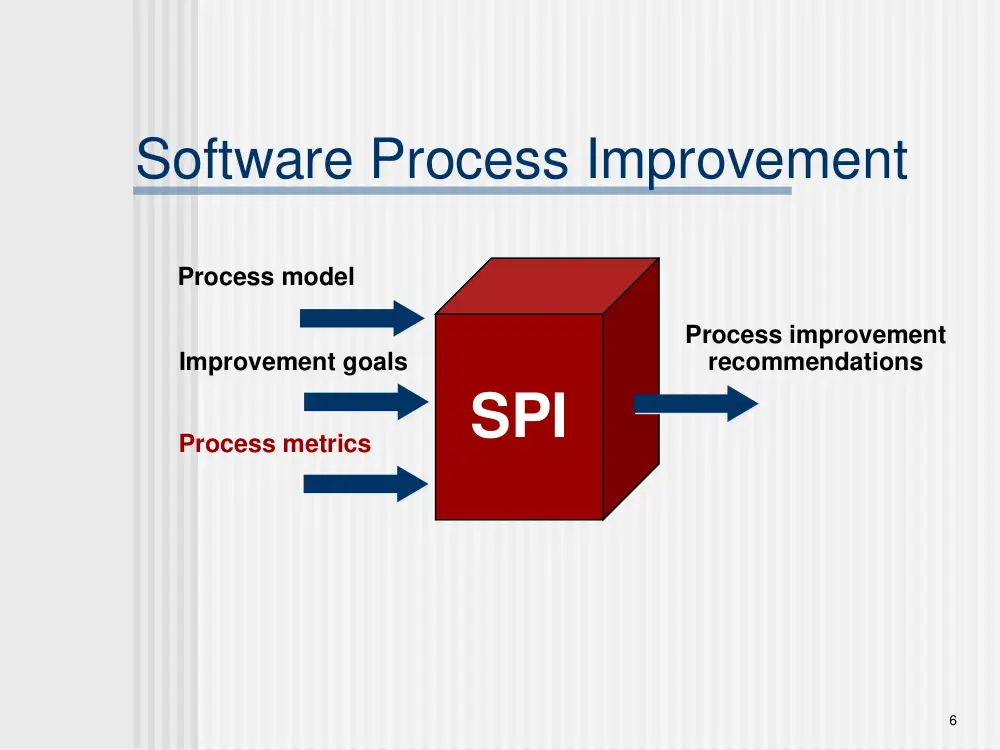
Software Process Improvement
SPI
Process model
Improvement goals
Process metrics
Process improvement
recommendations
7
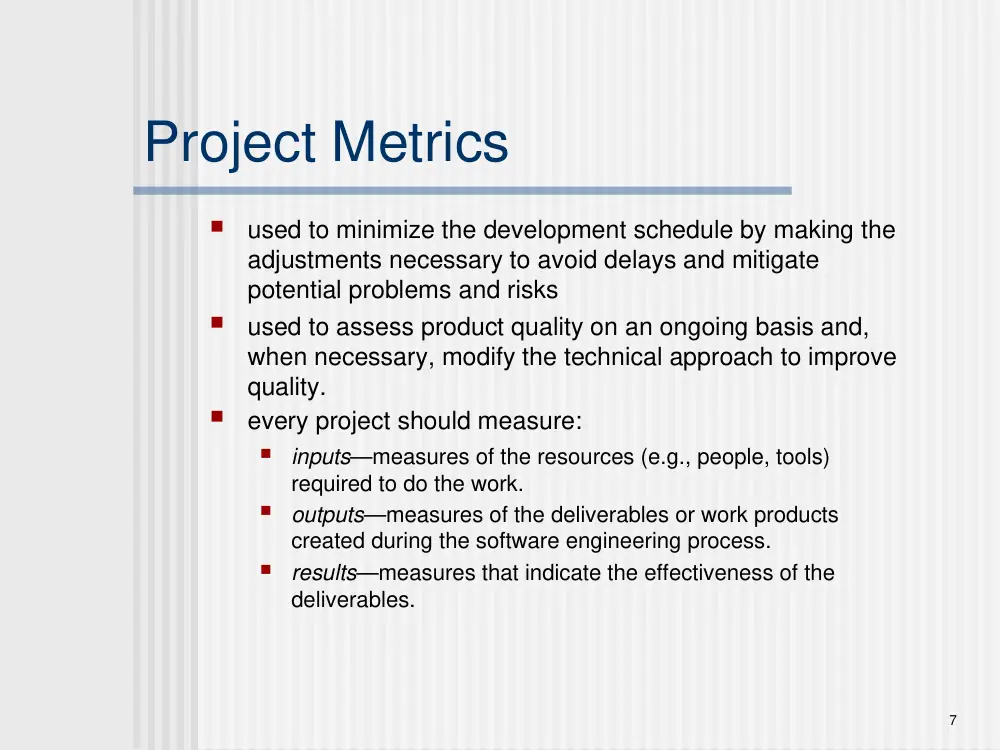
Project Metrics
used to minimize the development schedule by making the
adjustments necessary to avoid delays and mitigate
potential problems and risks
used to assess product quality on an ongoing basis and,
when necessary, modify the technical approach to improve
quality.
every project should measure:
inputs—measures of the resources (e.g., people, tools)
required to do the work.
outputs—measures of the deliverables or work products
created during the software engineering process.
results—measures that indicate the effectiveness of the
deliverables.
8
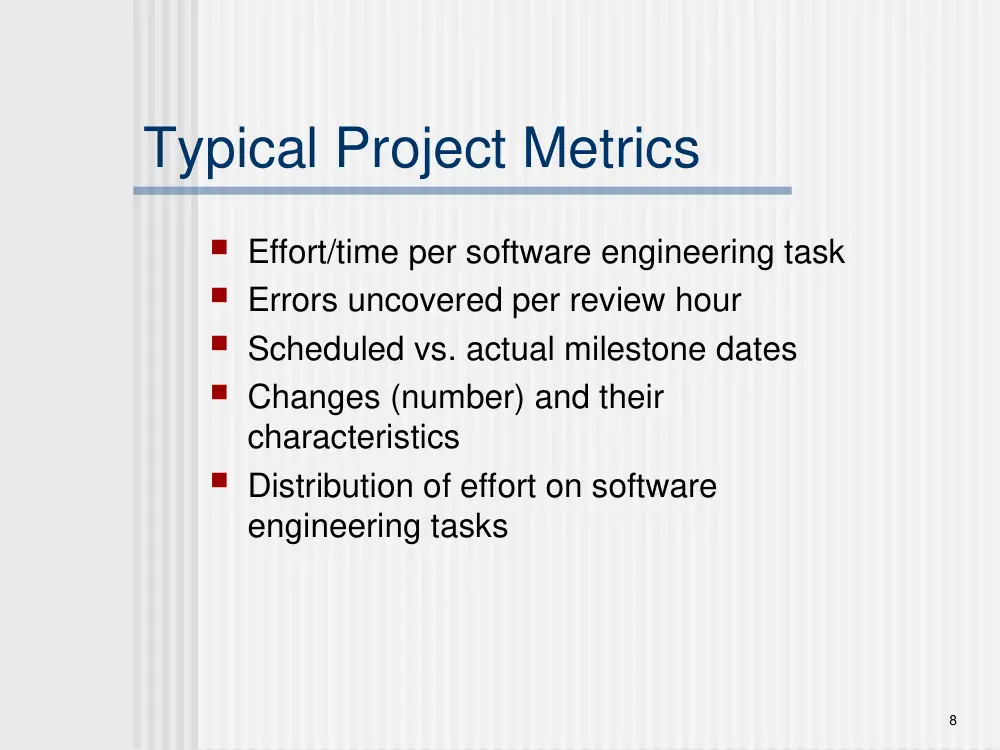
Typical Project Metrics
Effort/time per software engineering task
Errors uncovered per review hour
Scheduled vs. actual milestone dates
Changes (number) and their
characteristics
Distribution of effort on software
engineering tasks
9
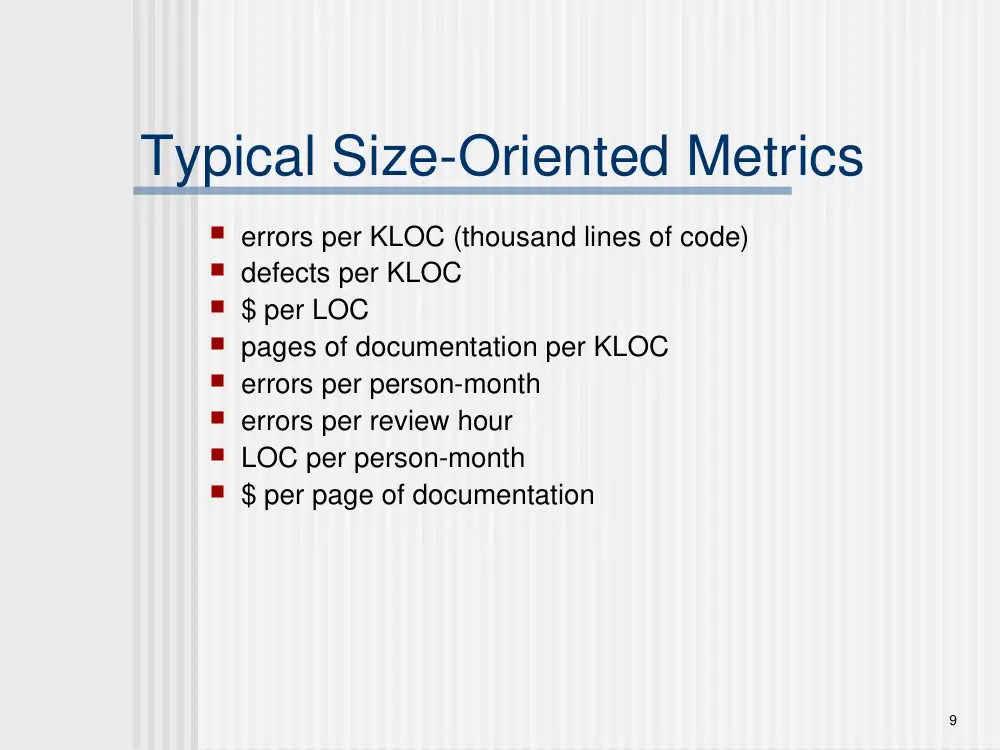
Typical Size-Oriented Metrics
errors per KLOC (thousand lines of code)
defects per KLOC
$ per LOC
pages of documentation per KLOC
errors per person-month
errors per review hour
LOC per person-month
$ per page of documentation
10
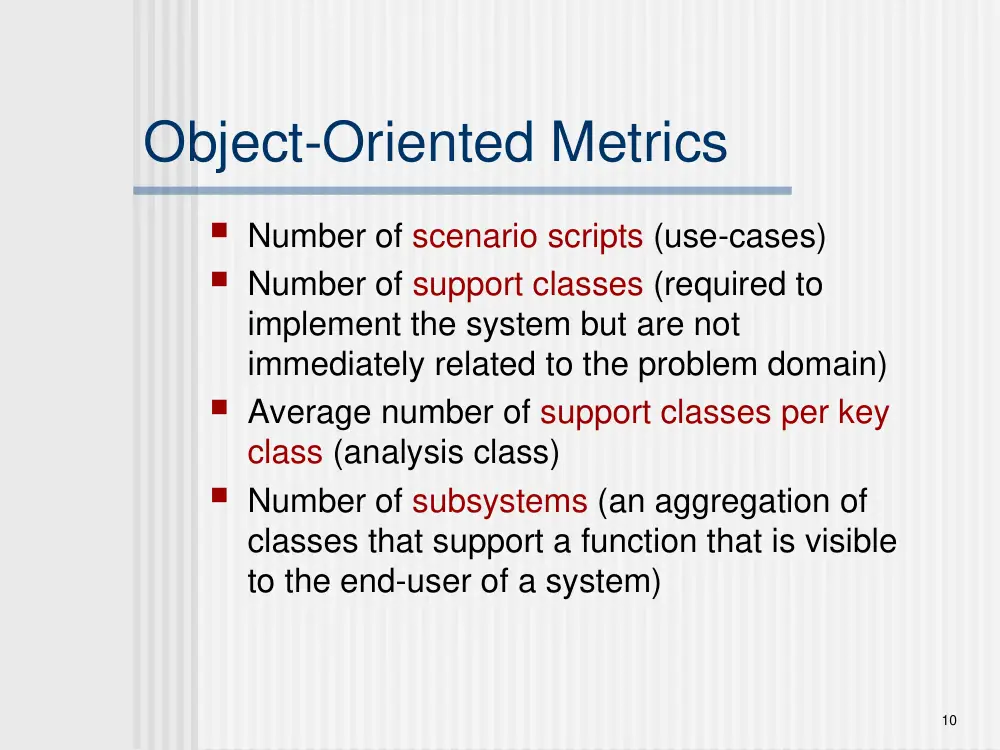
Object-Oriented Metrics
Number of scenario scripts (use-cases)
Number of support classes (required to
implement the system but are not
immediately related to the problem domain)
Average number of support classes per key
class (analysis class)
Number of subsystems (an aggregation of
classes that support a function that is visible
to the end-user of a system)
11
WebApp Project Metrics
Number of static Web pages (the end-user has no control over
the content displayed on the page)
Number of dynamic Web pages (end-user actions result in
customized content displayed on the page)
Number of internal page links (internal page links are pointers
that provide a hyperlink to some other Web page within the
WebApp)
Number of persistent data objects
Number of external systems interfaced
Number of static content objects
Number of dynamic content objects
Number of executable functions
Customization index, c= #of dynamic pages/(#of dynamic
pages+#of static pages)
12
Measuring Quality
Correctness — the degree to which a program
operates according to specification
Maintainability—the degree to which a program
is amenable to change
Integrity—the degree to which a program is
impervious to outside attack
Usability—the degree to which a program is
easy to use
Integrity=∑(1-(threat*(1-security))
13
Defect Removal Efficiency
where:
E is the number of errors found before
delivery of the software to the end-user
D is the number of defects found after
delivery.
DRE = E /(E + D)
14
Metrics for Small Organizations
time (hours or days) elapsed from the time a request is
made until evaluation is complete, tqueue.
effort (person-hours) to perform the evaluation, Weval.
time (hours or days) elapsed from completion of evaluation
to assignment of change order to personnel, teval.
effort (person-hours) required to make the change, Wchange.
time required (hours or days) to make the change, tchange.
errors uncovered during work to make change, Echange.
defects uncovered after change is released to the customer
base, Dchange.
15
Establishing a Metrics Program
Identify your business goals.
Identify what you want to know or learn.
Identify your subgoals.
Identify the entities and attributes related to your subgoals.
Formalize your measurement goals.
Identify quantifiable questions and the related indicators that
you will use to help you achieve your measurement goals.
Identify the data elements that you will collect to construct
the indicators that help answer your questions.
Define the measures to be used, and make these definitions
operational.
Identify the actions that you will take to implement the
measures.
Prepare a plan for implementing the measures.