
CSC 423 Chapter 03, Fall 2011
Notre Dame University–Louaize · Software Engineering · 27 pages · Dr. Maya Samaha
Showing the first 10 of 27 pages. Download the PDF to see all of it.
More CSC 423 files
Show the text of this chapter
1
Chapter 3
Agile Development
2
The Manifesto for
Agile Software Development
“We are uncovering better ways of developing
software by doing it and helping others do it.
Through this work we have come to value:
• Individuals and interactions over processes and
tools
• Working software over comprehensive
documentation
• Customer collaboration over contract
negotiation
• Responding to change over following a plan
That is, while there is value in the items on the
right, we value the items on the left more.”
Kent Beck et al
3
What is “Agility”?
Effective (rapid and adaptive) response to
change
Effective communication among all stakeholders
Drawing the customer onto the team
Organizing a team so that it is in control of the
work performed
Yielding …
Rapid, incremental delivery of software
4
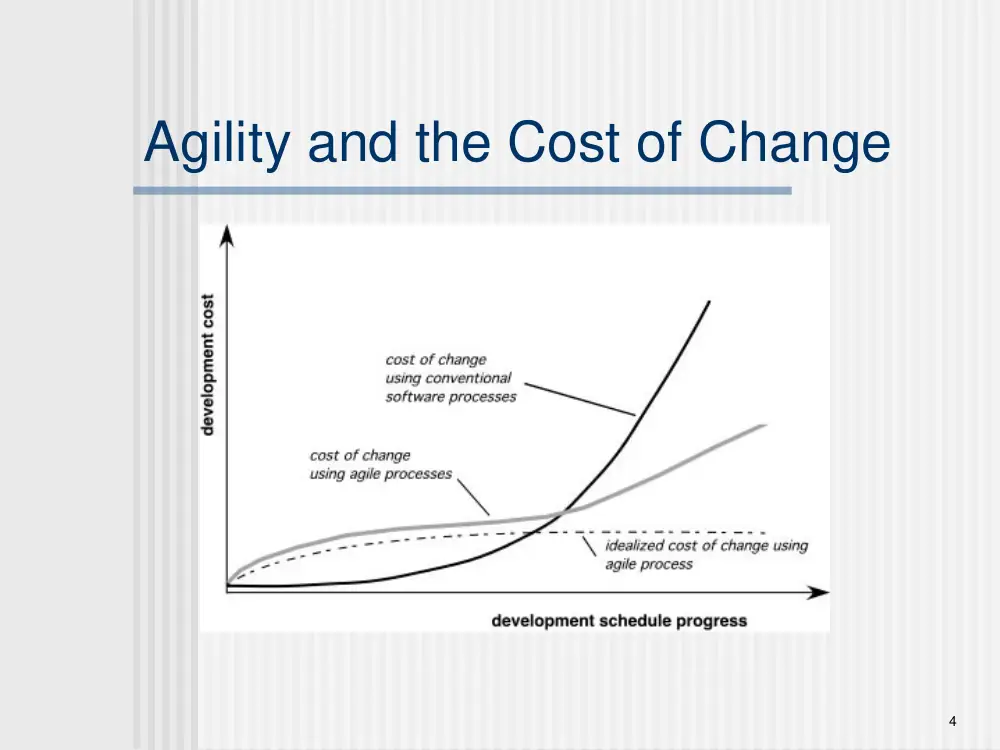
Agility and the Cost of Change
5
An Agile Process
Is driven by customer descriptions of what is
required (scenarios)
Recognizes that plans are short-lived
Develops software iteratively with a heavy
emphasis on construction activities
Delivers multiple ‘software increments’
Adapts as changes occur
6
Agility Principles - I
1. Our highest priority is to satisfy the customer through early
and continuous delivery of valuable software.
2. Welcome changing requirements, even late in development.
Agile processes harness change for the customer's competitive
advantage.
3. Deliver working software frequently, from a couple of weeks to
a couple of months, with a preference to the shorter timescale.
4. Business people and developers must work together daily
throughout the project.
5. Build projects around motivated individuals. Give them the
environment and support they need, and trust them to get the
job done.
6. The most efficient and effective method of conveying
information to and within a development team is face–to–face
conversation.
7
Agility Principles - II
7. Working software is the primary measure of progress.
8. Agile processes promote sustainable development. The
sponsors, developers, and users should be able to
maintain a constant pace indefinitely.
9. Continuous attention to technical excellence and good
design enhances agility.
10. Simplicity – the art of maximizing the amount of work
not done – is essential.
11. The best architectures, requirements, and designs
emerge from self–organizing teams.
12. At regular intervals, the team reflects on how to become
more effective, then tunes and adjusts its behavior
accordingly.
8
Human Factors
the process molds to the needs of the people and
team, not the other way around
key traits must exist among the people on an
agile team and the team itself:
Competence.
Common focus.
Collaboration.
Decision-making ability.
Fuzzy problem-solving ability.
Mutual trust and respect.
Self-organization.
9
Extreme Programming (XP)
The most widely used agile process, originally
proposed by Kent Beck
XP Planning
Begins with the creation of “user stories”
Agile team assesses each story and assigns a cost
Stories are grouped to for a deliverable increment
A commitment is made on delivery date
After the first increment “project velocity” is used to
help define subsequent delivery dates for other
increments
10
Example of User Stories:
As a user, I want to search for contacts so I can
message them.
As a customer, I want to search for product
items so I can buy them.
As an employer, I want to post a job on the
website so people can apply for it.
11
NOT User Stories:
Implement contact list view
ContactListView.java
Define the product table database schema
Automate the job posting algorithm
12
Example – User Story
As a job company, I can use my credit card so I
can pay for postings.(A job company can pay for posting
with a credit card.)
Note: Accept Visa, MasterCard, American
Express.
Test: (on the back of the story card)
Test with Visa, MasterCard and American Express (pass)
Test with Diner’s Club (fail)
Test with good, bad and missing card ID numbers.
Test with expired cards.
Test with over $100 and under $100.
13
Example – User Story & Test
As a Creator, I want to upload a video from my
local machine so that any users can view it.
Note: …
Test:
Click the “Upload” button.
• Specify a video file to upload.
• Check that .flv, .mov, .mp4, .avi, and .mpg extensions are supported.
• Check that other filetypes aren’t able to be uploaded.
• Check that files larger than 100MB results in an error.
• Check that movies longer than 10 mins result in an error.
Click “Upload Video”.
Check that progress is displayed in real time.
14
Class Activity
In groups of 2 on paper:
Write down 3 user stories for an online
music store
(such as the music part of iTunes)
15
Extreme Programming (XP)
XP Design
Follows the KIS principle
For difficult design problems, suggests the creation of “spike
solutions”—a design prototype
Encourages “refactoring”—an iterative refinement of the internal
program design
XP Coding
Recommends the construction of a unit test for a store before
coding commences
Encourages “pair programming”
XP Testing
All unit tests are executed daily
“Acceptance tests” are defined by the customer and executed to
assess customer visible functionality
16
Class Activity
In groups of 2, write your names on a
piece of paper:
Write three tests for banking software that manages
deposits at an ATM
E.g., “Ensure that the customer does not leave his or
her card in the machine”
17
Extreme Programming (XP)
unit test
continuous integration
acceptance testing
pair
programming
Release
user stories
values
acceptance test criteria
iteration plan
simple design
CRC cards
spike solutions
prototypes
refactoring
software increment
project velocity computed
18
Adaptive Software Development
Originally proposed by Jim Highsmith
ASD — distinguishing features
Mission-driven planning
Component-based focus
Uses “time-boxing” (See Chapter 24)
Explicit consideration of risks
Emphasizes collaboration for requirements gathering
Emphasizes “learning” throughout the process
19
Adaptive Software Development
adaptive cycle planning
uses mission statement
project constraints
basic requirements
time-boxed release plan
Requirements gathering
J AD
mini-specs
components implemented/ tested
focus groups for feedback
formal technical reviews
postmortems
software increment
adjustments for subsequent cycles
Release
20
Dynamic Systems Development Method
Promoted by the DSDM Consortium (www.dsdm.org)
DSDM—distinguishing features
Similar in most respects to XP and/or ASD
Nine guiding principles
•
Active user involvement is imperative.
•
DSDM teams must be empowered to make decisions.
•
The focus is on frequent delivery of products.
•
Fitness for business purpose is the essential criterion for acceptance of
deliverables.
•
Iterative and incremental development is necessary to converge on an accurate
business solution.
•
All changes during development are reversible.
•
Requirements are baselined at a high level
•
Testing is integrated throughout the life-cycle.
21
Dynamic Systems Development Method
DSDM Life Cycle (with permission of the DSDM consortium)
22
Scrum
Originally proposed by Schwaber and Beedle
Scrum—distinguishing features
Development work is partitioned into “packets”
Testing and documentation are on-going as the
product is constructed
Work occurs in “sprints” and is derived from a
“backlog” of existing requirements
Meetings are very short and sometimes conducted
without chairs
“demos” are delivered to the customer with the time-
box allocated
23
Scrum
Scrum Process Flow (used with permission)
24
Crystal
Proposed by Cockburn and Highsmith
Crystal—distinguishing features
Actually a family of process models that allow
“maneuverability” based on problem characteristics
Face-to-face communication is emphasized
Suggests the use of “reflection workshops” to
review the work habits of the team
25
Feature Driven Development
Originally proposed by Peter Coad et al
FDD—distinguishing features
Emphasis is on defining “features”
• a feature “is a client-valued function that can be
implemented in two weeks or less.”
Uses a feature template
• <action> the <result> <by | for | of | to> a(n) <object>
A features list is created and “plan by feature” is
conducted
Design and construction merge in FDD
26
Examples of features for an
e-commerce application:
Add the product to a shopping cart
Display the technical-specifications of the
product
Store the shipping-information for the customer
27
Feature Driven Development
Reprinted with permission of Peter Coad