
ENG 201 Lecture, Spring 2012
Notre Dame University–Louaize · Introduction to Engineering · 75 pages

Showing the first 10 of 75 pages. Download the PDF to see all of it.
More ENG 201 files
Show the text of this lab
10-0
CHAPTER 10
Force and Force-Related Parameters
10-1
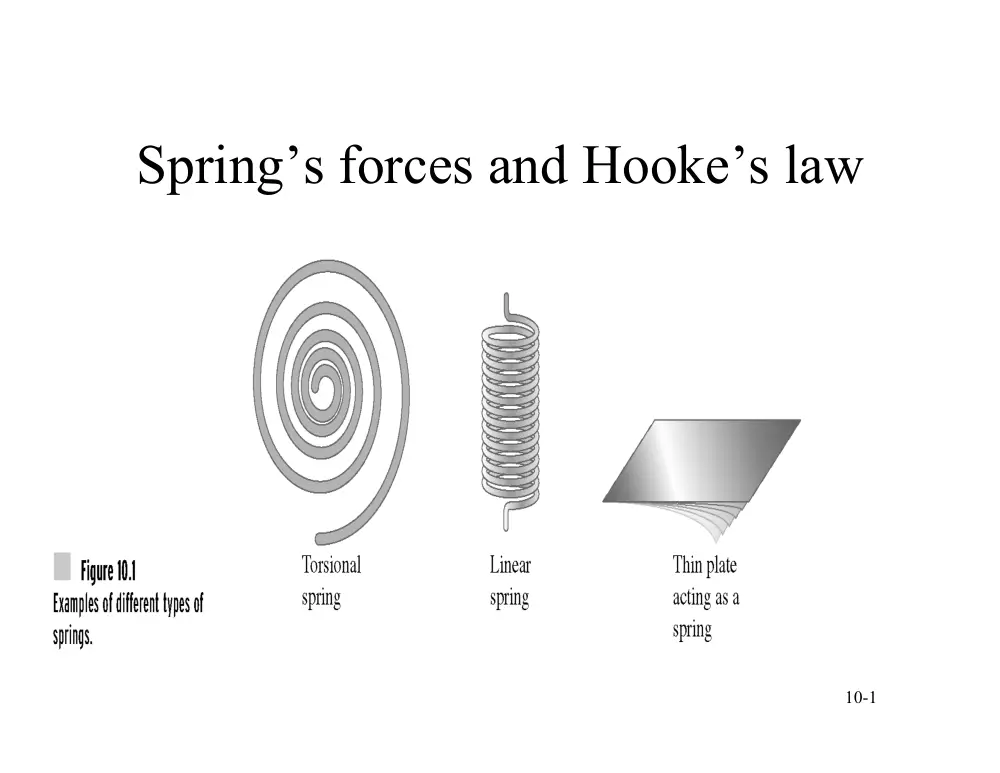
Spring’s forces and Hooke’s law
10-2
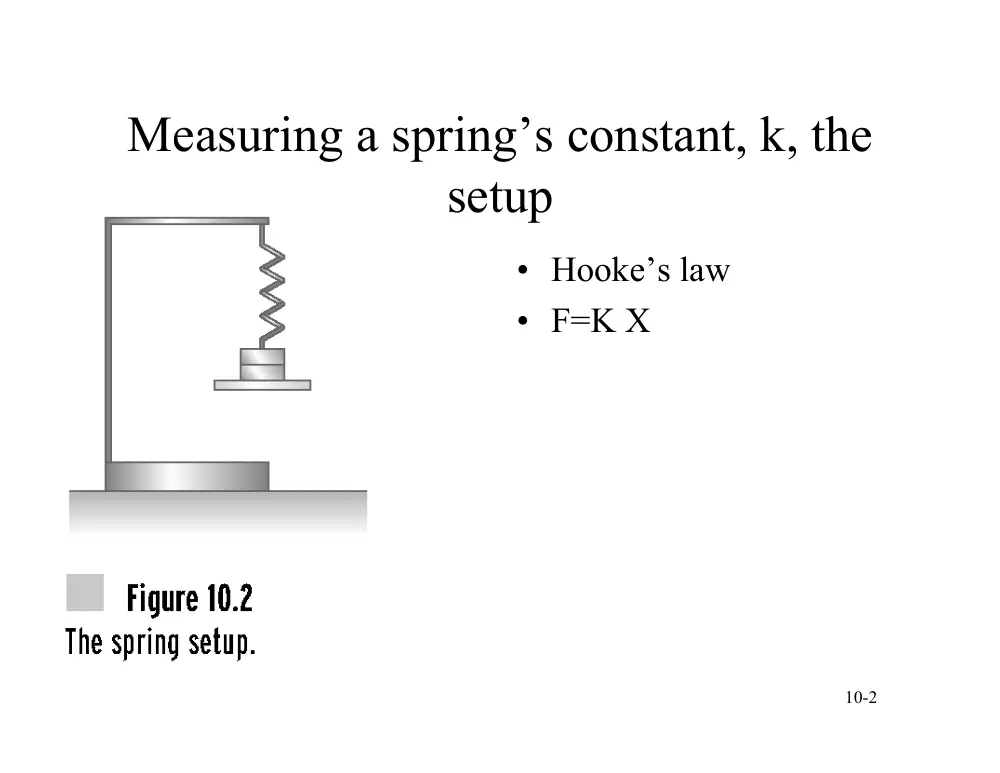
Measuring a spring’s constant, k, the
setup
• Hooke’s law
• F=K X
10-3
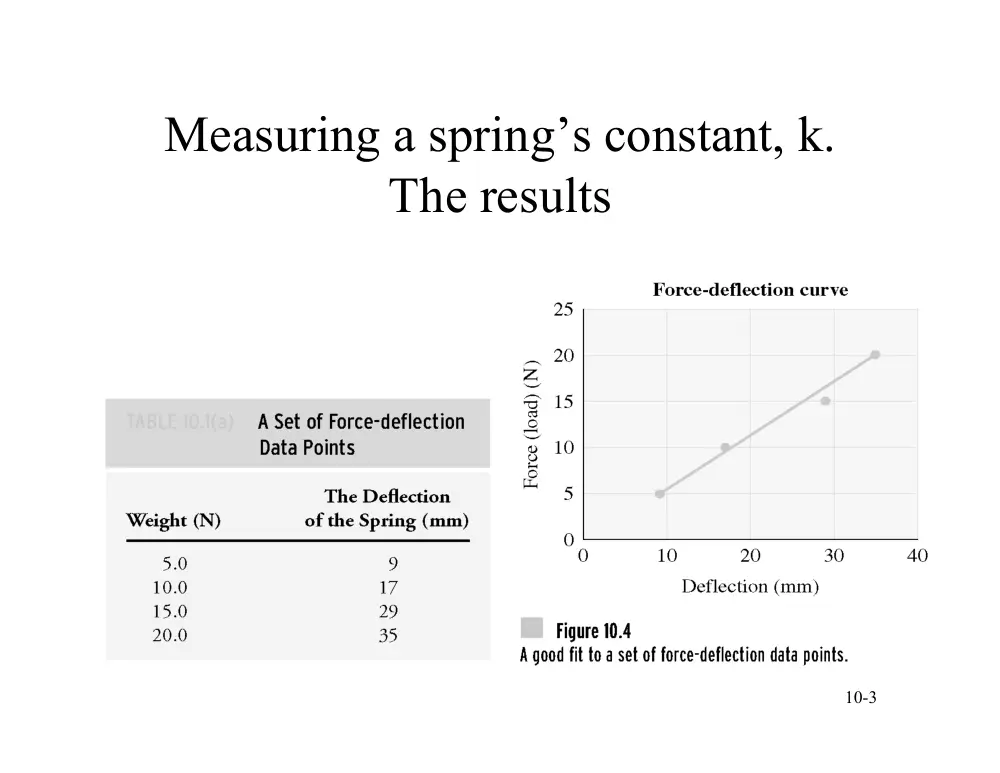
Measuring a spring’s constant, k.
The results
10-4
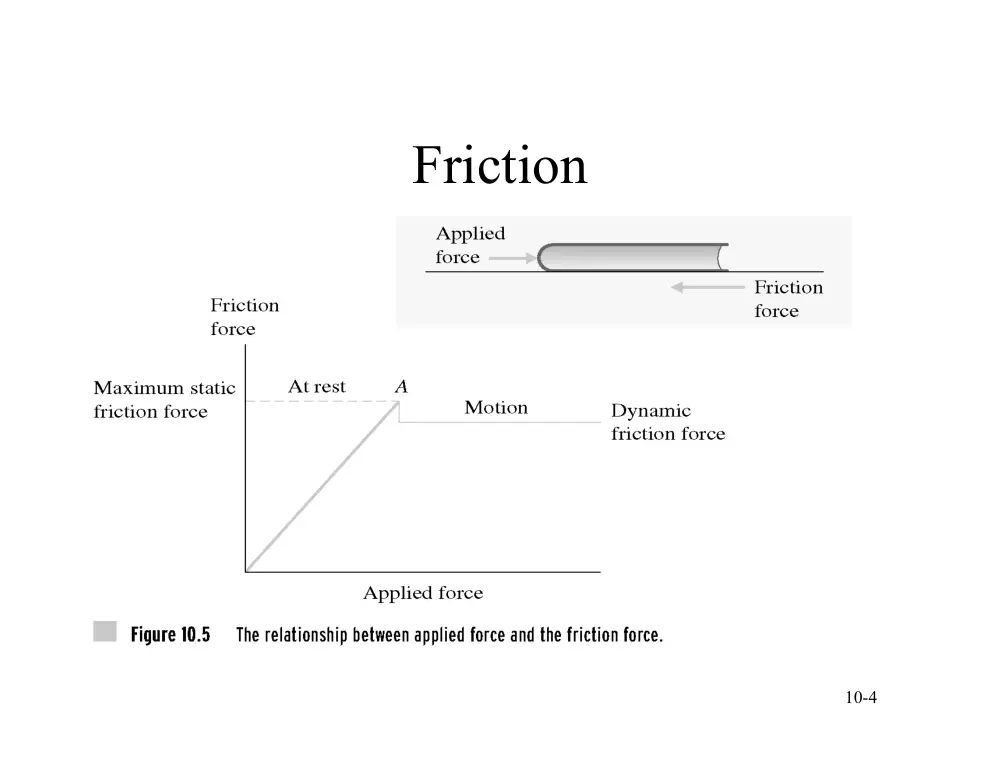
Friction
10-5
Friction
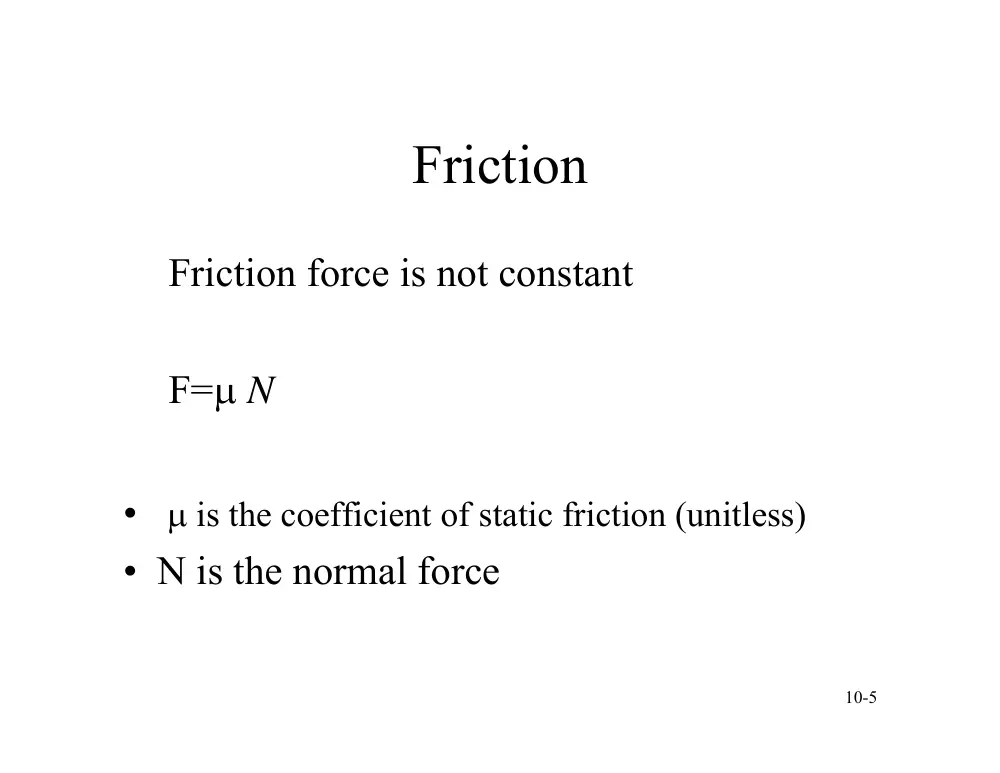
Friction force is not constant
F=μ N
•
μ is the coefficient of static friction (unitless)
• N is the normal force
10-6
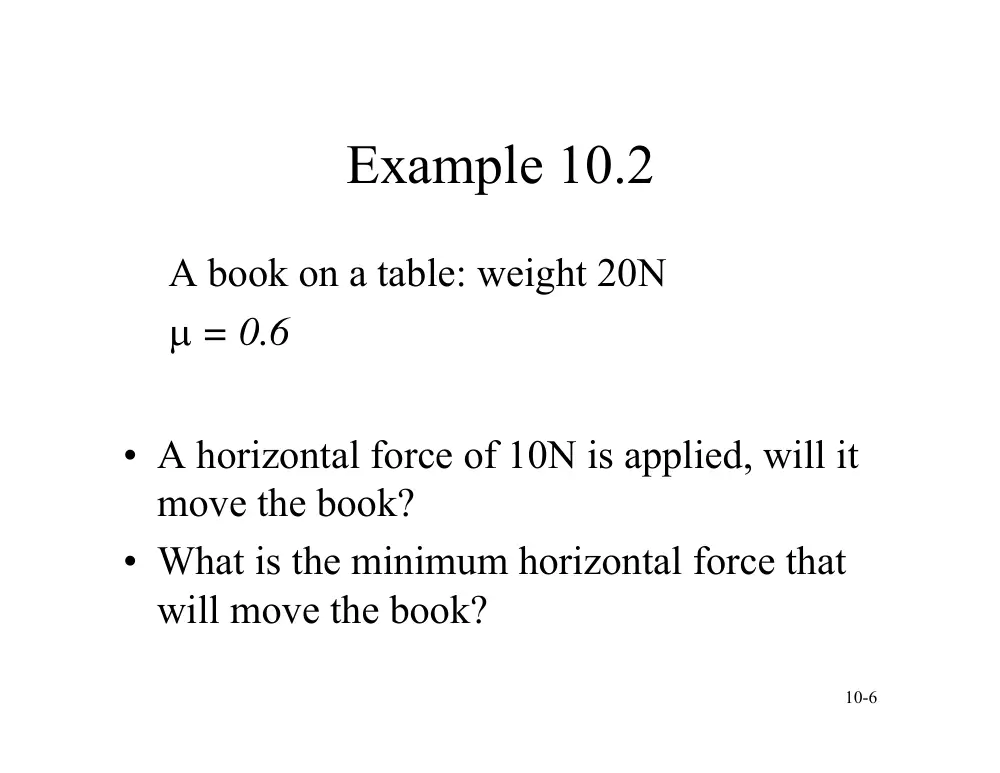
Example 10.2
A book on a table: weight 20N
μ = 0.6
• A horizontal force of 10N is applied, will it
move the book?
• What is the minimum horizontal force that
will move the book?
10-7
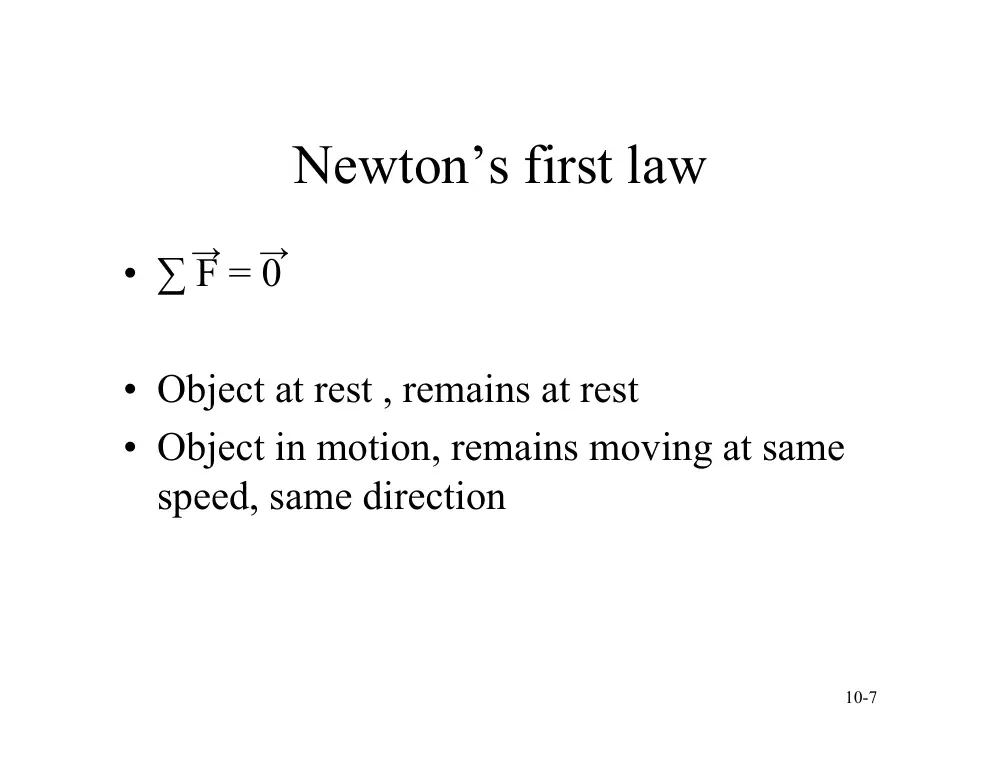
Newton’s first law
• ∑ F = 0
• Object at rest , remains at rest
• Object in motion, remains moving at same
speed, same direction
→ →
10-8
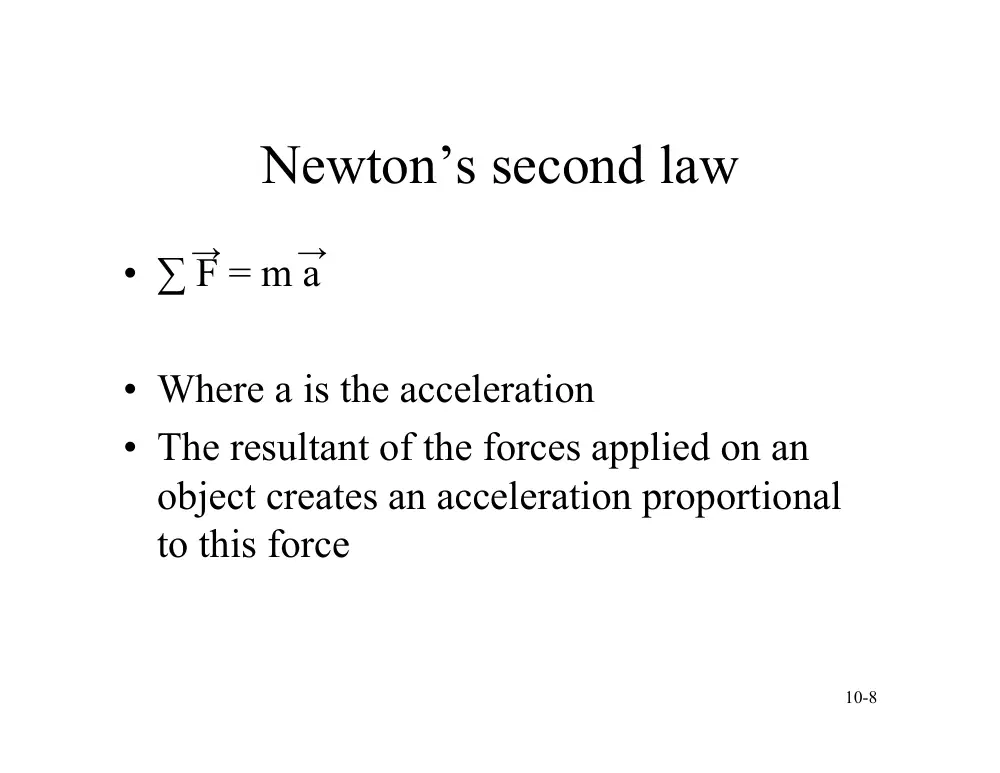
Newton’s second law
• ∑ F = m a
• Where a is the acceleration
• The resultant of the forces applied on an
object creates an acceleration proportional
to this force
→ →
10-9
Newton’s third law
• Forces of action and reaction have the same magnitude and
act on the same line, but in opposite directions
10-10
Newton’s law of gravitation
G m1m2
r2
F = ------------
10-11
• Weight on earth
G Mearthmobject
R2earth
W = -------------------
10-12
Example 10.3
• Determine the weight of an exploration
vehicle, mass = 250Kg
• On earth
• On moon (g=1.6 m/s2)
• On Mars (g=3.7 m/s2)
10-13
• On earth : 2450 N
• On moon : 400 N
• On Mars : 925 N
Example 10.3 - results
10-14
Example 10.4
• Space shuttle orbits Earth at altitudes from 250
Km to 965Km. Determine g
• If mass of astronaut = 70Kg, what is his weight in
orbit?
(Mass of Earth = 5.97 x 1024 Kg)
(Radius of Earth = 6378 km)
(G=6.673 x 10⁻¹¹ m3/kg.s2)
• Answer: (g=9.07 m/s2 to 7.38 m/s2)
10-15
Example 10.4 - solution
• Space shuttle orbits Earth at altitudes from 250
Km to 965Km. Determine g
• If mass of astronaut = 70Kg, what is his weight in
orbit?
(Mass of Earth = 5.97 x 1024 )
(Radius of Earth = 6378 km)
• Answer: (g=9.07 m/s2 to 7.38 m/s2)
10-16
Units of force
• 1 newton = 1 kg x 1 m/s2
• 1 lb = 1 slug x 1 ft/s2 (pound force)
• 1 lb = 4.448 N
10-17
Pressure and stress, forces acting
over an area
Pa = 1271 Pa Pb = 4289 Pa
10-18
Common units of pressure
• 1 Pa = 1 N/m2
• 1 psi (lb/in2) = 6894.7 Pa
• 1 lb/ft2 = 144 psi
10-19
Pascal’s Law
• P = ρ g h
10-20
Pascal’s Law
• P = ρ g h
• Pascal’s law is in close
relationship with the
buoyant force:
• FB = ρ V g
10-21
Example 10.5 – water tower
• Create a table showing the
relationship between height
and pressure (in psi) in a
water tower.
• What should be the height
of water to create a pressure
of 50 psi at the bottom of
the tower?
• Given: ρwater = 1.94 slugs/ft3
• g = 32.2 ft/s2
10-22
Example 10.5
• P(lb/ft2) = ρ g h = 1.94 (slug/ft3) x 32.2
(ft/s2) x h (ft)
(1lbf=1slug x 1ft/s2)
• Convert to lb/in2:
• P(lb/in2) = P(lb/ft2) /144
10-23
Example 10.5
10-24
Atmospheric pressure
10-25
Atmospheric pressure
• 1 atm = 101.3KPa
• 1 atm = 14.69 lb/in2 (psi)
• 1 atm = 760 mmHg = 29.92 inHg
10-26
Example 10.6
• Derive 1 atm in :
• mmHg (ρHg = 13550Kg/m3)
• Inches of Hg (1mm = 0.03937in)
• Meters of water
• Feet of water (1m = 3.28ft)
•
Answers : 762mmHg = 30inHg = 10.328mWater = 33.87ftWater
10-27
Absolute pressure and gauge
pressure
• Note: pressure gauges are the instruments
that measure pressure
• Pabsolute = Pgauge + Patmospheric
• If Pgauge is negative ==> vacuum
• If Pabsolute = 0 ==> absolute vacuum (this is
theoretical)
10-28
Example 10.7
• Pressure inside a car tire = 35.0 psi
• 1. Find absolute pressure if
– a) car at sea level
– b) car at elevation 1500m (use atmospheric pressure table;
Patm,1500=84.55 KPa)
– (1psi=6895Pa)
• 2. If you measure the pressure in your car tires at a station
in antelias (sea level) and you find that you have 35.0 psi.
what will this pressure be when you go to Faraya at 1500m
height?
• Ans: 1.a-342 325 Pa, 1.b-325 875 Pa, 2- 37.4 psi
10-29
Example 10.8
• A vacuum pressure gauge reads 200mmHg
vacuum in a container. What are gauge and
absolute pressures (in Pa)?
(1mmHg = 133.3Pa)
• Answers: Pgauge = -26 660Pa; Pabs = 74 665Pa
10-30
• Vapor pressure of a liquid
– Liquids with higher vapor pressure require a
higher pressure at their surface to stop them
from evaporating. Therefore they evaporate
faster than liquids with low vapor pressure.
• Blood pressure
– Systolic/diastolic blood pressures (pressure in
arteries when heart contracts/relaxes)
– Example: 115/75 mmHg = 15/10 KPa
10-31
Hydraulic systems
• If the liquid inside the cylinder is incompressible,
pressure is transmitted:
• P1= F1/A1 = F2/A2
10-32
Hydraulic systems
• Fluid volume displaced:
A1 L1 = A2 L2
• Speed of piston displacement:
V1 A1 =V2 A2
10-33
Example 10.9 (load =?)
10-34
Manually activated hydraulic system
10-35
Pump-driven hydraulic system
10-36
Stress in material
(intensity of force over an area)
10-37
Modulus of elasticity
• Young’s modulus, E (N/m2; lb/in2) =
computed from the slope of the stress-strain
curve when the material is in elastic
deformation.
• The larger E is, the larger the force required
to stretch or shorten the material by a
certain amount.
10-38
10-39
Modulus of elasticity
10-40
Hooke’s law in a material
• σ = E ε
• Where σ is normal stress (N/m2; lb/in2)
• E is the modulus of elasticity, or
Young’s modulus (N/m2; lb/in2)
•
ε is the normal strain
OR:
• F/A= E (x/L) (x is elongation)
• E = FL/(Ax)
(F in N, L in m, A in m2)
10-41
Elastic strength of a material
• The elastic strength of a material is the
maximum load a material can carry without
permanent deformation
(calculated on the elastic point on the graph)
10-42
Elastic point
10-43
Modulus of rigidity (shear modulus)
• The value of the modulus of rigidity shows
the resistance of a given material to shear or
twisting deformation.
10-44
10-45
10-46
Ductile and brittle material
• When subject to tensile force:
– A ductile material deforms significantly before
fracture
– A brittle material deforms little before fracture
NOTE: If the forces pull the body producing an elongation, it
is termed tensile force, if on the other hand the forces push
the body reducing its length, it is termed compressive
stresses.
10-47
Tensile strength
• The tensile strength (TS) = maximum
tensile load a material specimen can carry
without failure
• TS = tensile force max/original C.S. Area
(C.S. Area= cross-sectional area)
10-48
• Note: lower yield strength
10-49
10-50
Example 10.10
• Load = 4000N
• What type of material
carries the load safely?
10-51
Example 10.10-solution
σ = 4000N/(0.05m x
0.005m)
σ = 16 MPa
• Aluminium alloy of yield
strength 50 MPa can carry
the load safely
10-52
Factor of safety
• FS = Pmax/Pallowable
• Where Pallowable is the allowable or the
installed load and Pmax is the maximum load
or the load that can cause failure.
10-53
Example 10.11 - Shear modulus
calculation
10-54
Example 10.11
• Shear modulus : G = 32TL/πD4φ
• T = 3450 N
• L = 20 cm = 0.2m
• D = 5 cm = 0.05m
• φ = 0.015 rad
Answer: G = 75 GPa
10-55
Bulk Modulus of Compressibility
dP dP
-dV/V dρ/ρ
Where Ev is the modulus of compressibility (N/m2)
dP is the increase in pressure,
V is the original volume,
-dV is the decrease in volume,
dρ and ρ are the increase in density and the density.
Ev = ------- = -------
10-56
10-57
Example 10.13
• Given: 1m3 water, Ev,water = 2.24 x 10⁹ N/m2.
• What is the pressure that would decrease the
volume by 1%
• dP = Ev,water x 0.01 = 2.24 x 10⁷ N/m2
10-58
Moment, torque
M = distance x Force (cw)
10-59
• MA = d1 F (ccw)
• MB = d2 F (cw)
• MC = 0