
ENG 201 Syllabus, Spring 2012
Notre Dame University–Louaize · Introduction to Engineering · 3 pages · Dr. John Paul Daghfal
More ENG 201 files
Show the text of this lab
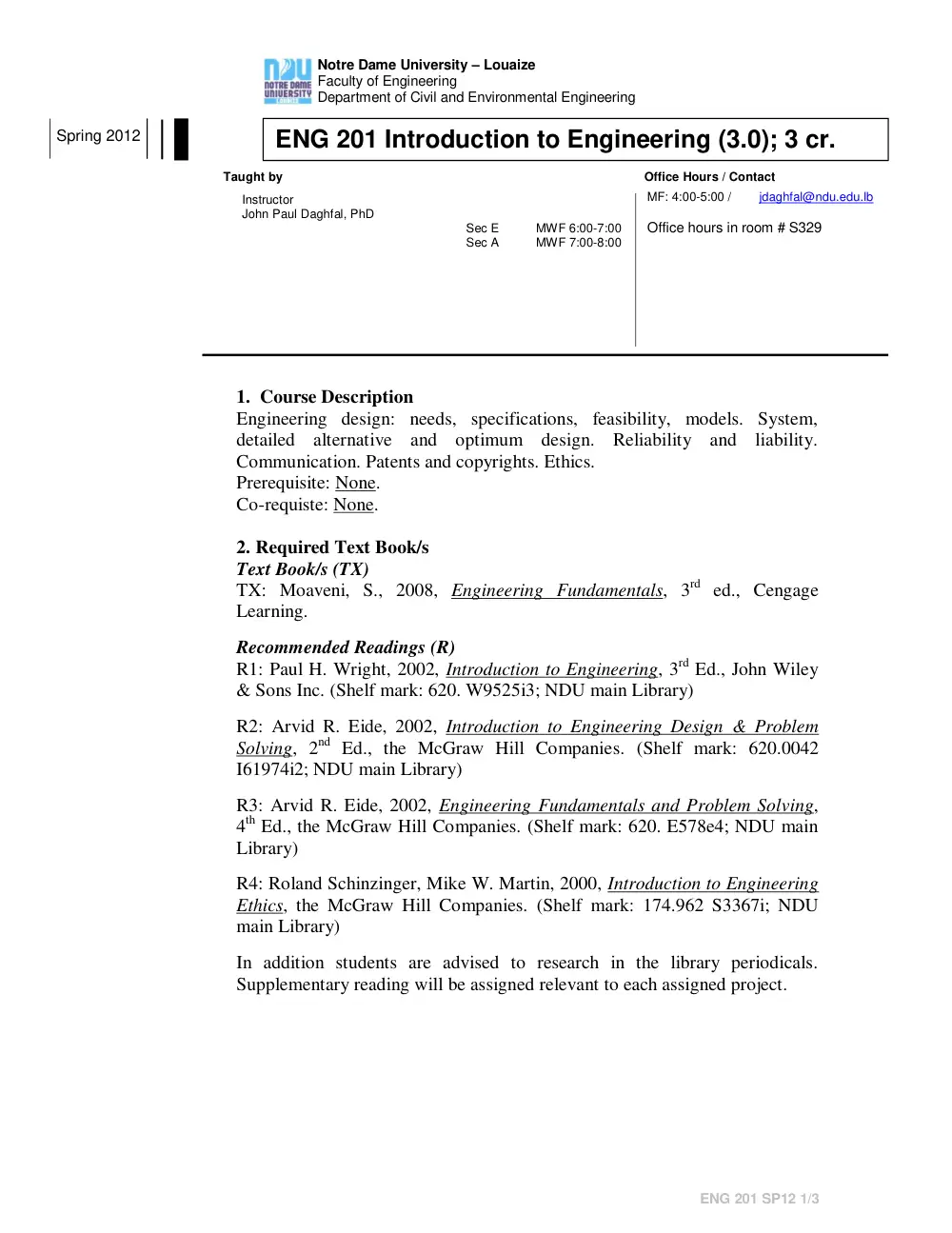
Taught by
Office Hours / Contact
ENG 201 SP12 1/3
MF: 4:00-5:00 /
jdaghfal@ndu.edu.lb
Office hours in room # S329
Notre Dame University – Louaize
Faculty of Engineering
Department of Civil and Environmental Engineering
ENG 201 Introduction to Engineering (3.0); 3 cr.
Instructor
John Paul Daghfal, PhD
Sec E
MWF 6:00-7:00
Sec A
MWF 7:00-8:00
Spring 2012
1. Course Description
Engineering design: needs, specifications, feasibility, models. System,
detailed alternative and optimum design. Reliability and liability.
Communication. Patents and copyrights. Ethics.
Prerequisite: None.
Co-requiste: None.
2. Required Text Book/s
Text Book/s (TX)
TX: Moaveni, S., 2008, Engineering Fundamentals, 3rd ed., Cengage
Learning.
Recommended Readings (R)
R1: Paul H. Wright, 2002, Introduction to Engineering, 3rd Ed., John Wiley
& Sons Inc. (Shelf mark: 620. W9525i3; NDU main Library)
R2: Arvid R. Eide, 2002, Introduction to Engineering Design & Problem
Solving, 2nd Ed., the McGraw Hill Companies. (Shelf mark: 620.0042
I61974i2; NDU main Library)
R3: Arvid R. Eide, 2002, Engineering Fundamentals and Problem Solving,
4th Ed., the McGraw Hill Companies. (Shelf mark: 620. E578e4; NDU main
Library)
R4: Roland Schinzinger, Mike W. Martin, 2000, Introduction to Engineering
Ethics, the McGraw Hill Companies. (Shelf mark: 174.962 S3367i; NDU
main Library)
In addition students are advised to research in the library periodicals.
Supplementary reading will be assigned relevant to each assigned project.
ENG 201 SP11 2/3
Spring 2012
ENG 201 Introduction to Engineering (3.0); 3 cr.
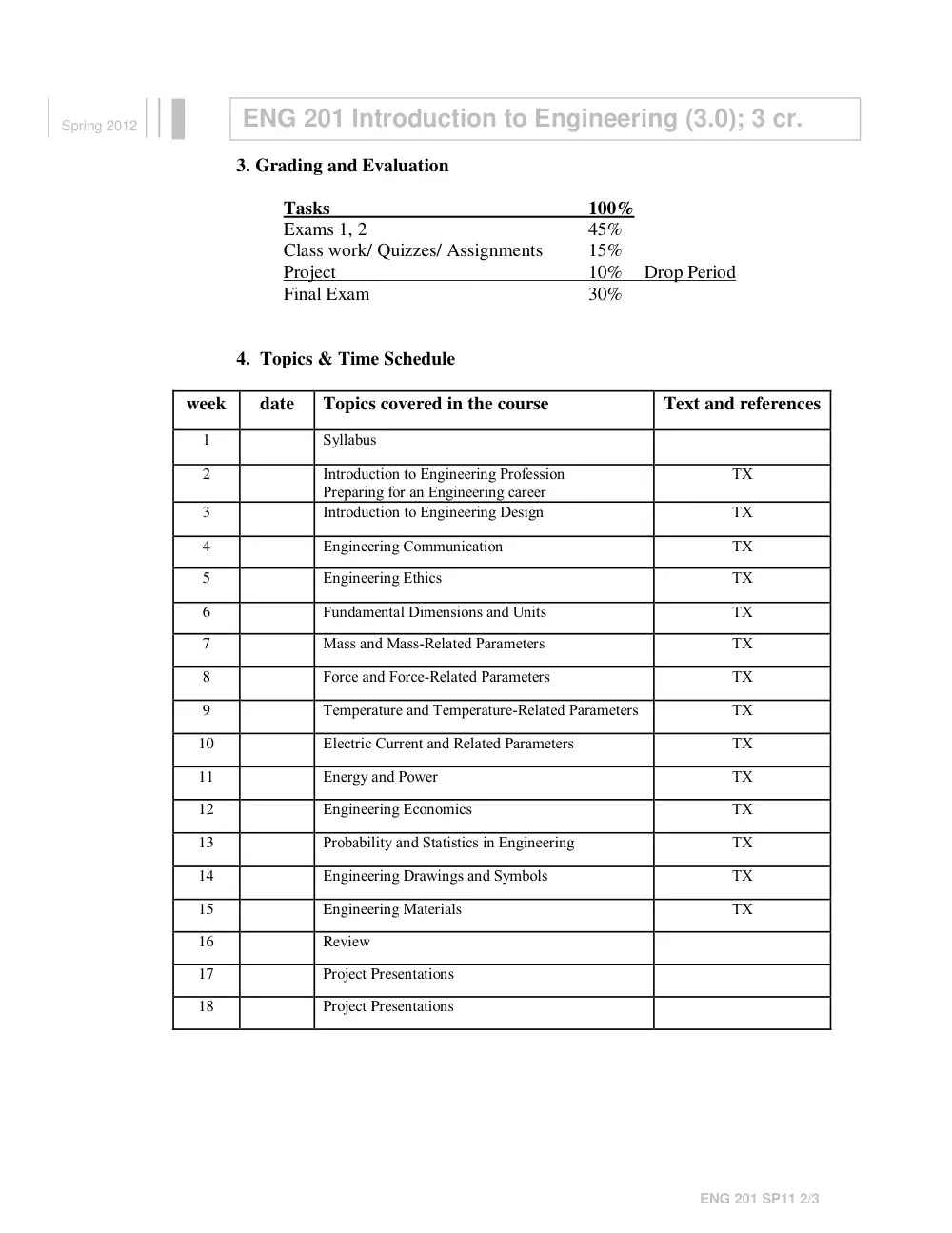
3. Grading and Evaluation
Tasks
100%
Exams 1, 2
45%
Class work/ Quizzes/ Assignments
15%
Project
10% Drop Period
Final Exam
30%
4. Topics & Time Schedule
week
date
Topics covered in the course
Text and references
1
Syllabus
2
Introduction to Engineering Profession
Preparing for an Engineering career
TX
3
Introduction to Engineering Design
TX
4
Engineering Communication
TX
5
Engineering Ethics
TX
6
Fundamental Dimensions and Units
TX
7
Mass and Mass-Related Parameters
TX
8
Force and Force-Related Parameters
TX
9
Temperature and Temperature-Related Parameters
TX
10
Electric Current and Related Parameters
TX
11
Energy and Power
TX
12
Engineering Economics
TX
13
Probability and Statistics in Engineering
TX
14
Engineering Drawings and Symbols
TX
15
Engineering Materials
TX
16
Review
17
Project Presentations
18
Project Presentations
ENG 201 SP11 3/3
Spring 2012
ENG 201 Introduction to Engineering (3.0); 3 cr.
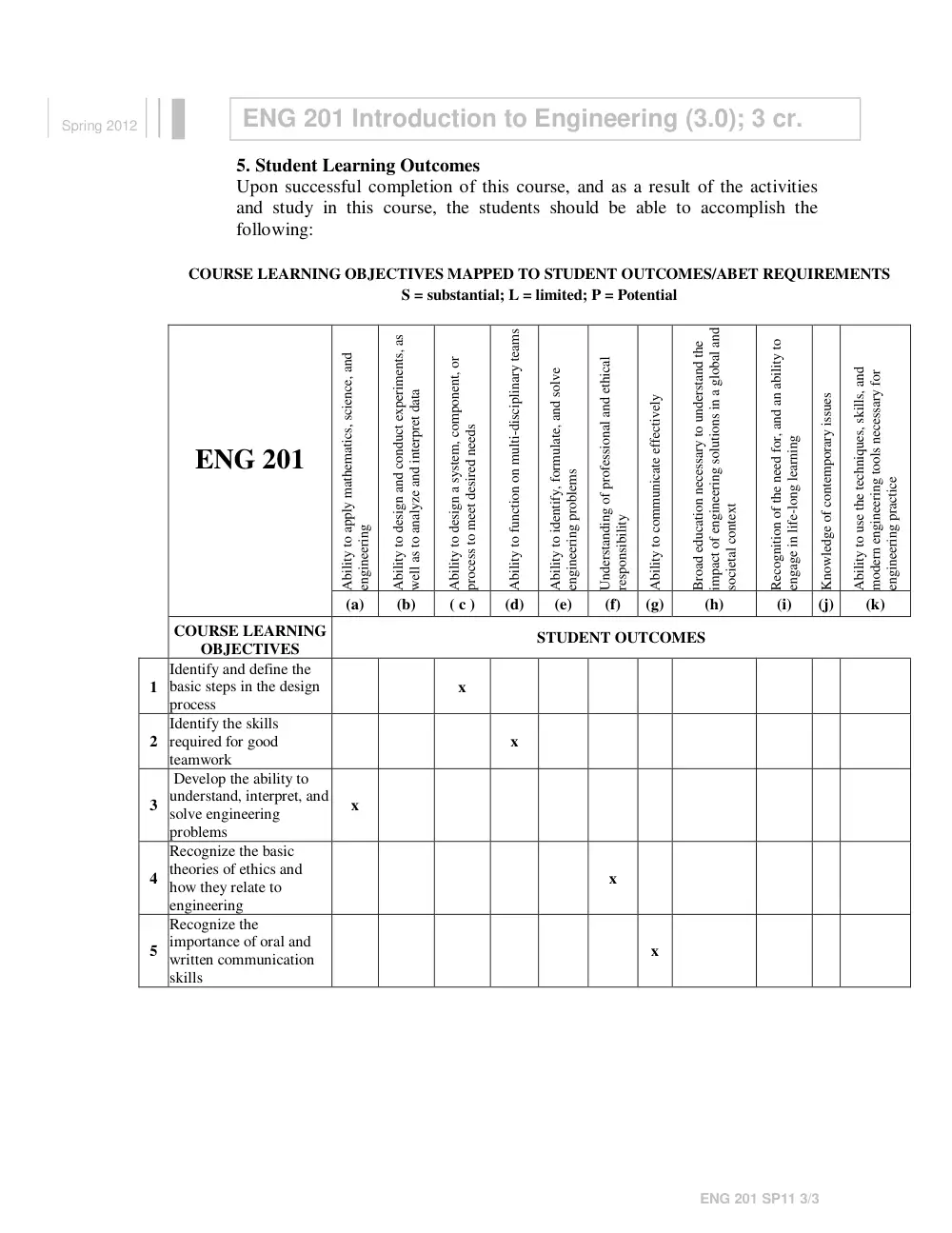
5. Student Learning Outcomes
Upon successful completion of this course, and as a result of the activities
and study in this course, the students should be able to accomplish the
following:
COURSE LEARNING OBJECTIVES MAPPED TO STUDENT OUTCOMES/ABET REQUIREMENTS
S = substantial; L = limited; P = Potential
ENG 201
Ability to apply mathematics, science, and
engineering
Ability to design and conduct experiments, as
well as to analyze and interpret data
Ability to design a system, component, or
process to meet desired needs
Ability to function on multi-disciplinary teams
Ability to identify, formulate, and solve
engineering problems
Understanding of professional and ethical
responsibility
Ability to communicate effectively
Broad education necessary to understand the
impact of engineering solutions in a global and
societal context
Recognition of the need for, and an ability to
engage in life-long learning
Knowledge of contemporary issues
Ability to use the techniques, skills, and
modern engineering tools necessary for
engineering practice
(a)
(b)
( c )
(d)
(e)
(f)
(g)
(h)
(i)
(j)
(k)
COURSE LEARNING
OBJECTIVES
STUDENT OUTCOMES
1
Identify and define the
basic steps in the design
process
x
2
Identify the skills
required for good
teamwork
x
3
Develop the ability to
understand, interpret, and
solve engineering
problems
x
4
Recognize the basic
theories of ethics and
how they relate to
engineering
x
5
Recognize the
importance of oral and
written communication
skills
x