
ENS 201 Chapter 21, Spring 2008
Notre Dame University–Louaize · Introduction to Environmental Science · 36 pages · Ms. Leila Khalaf

Showing the first 10 of 36 pages. Download the PDF to see all of it.
More ENS 201 files
Show the text of this chapter
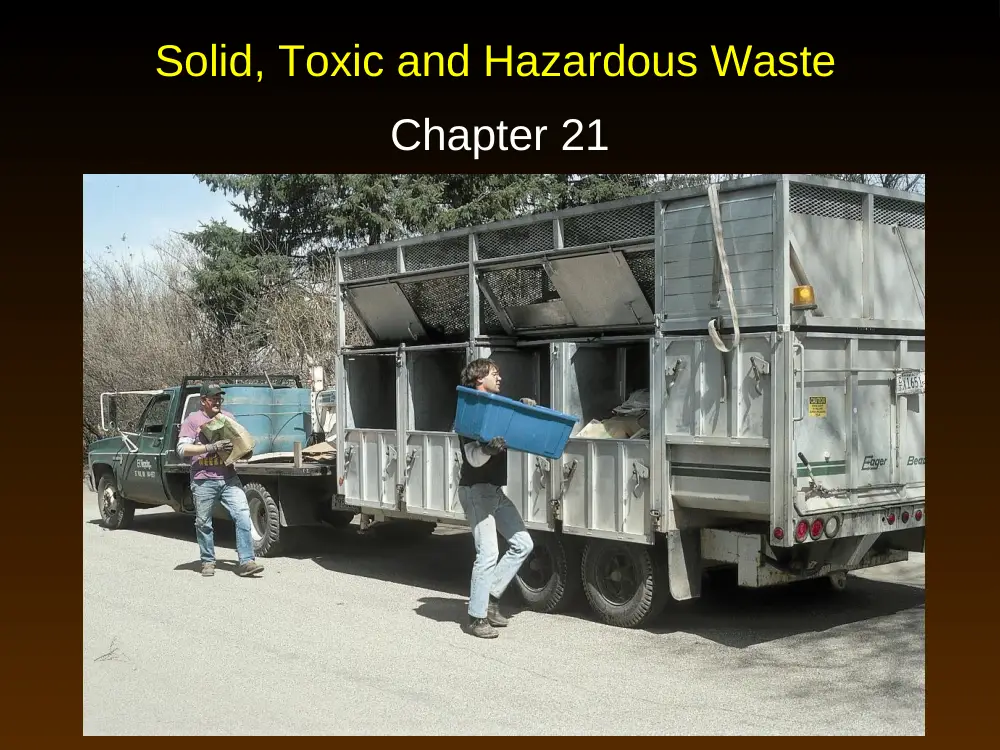
Solid, Toxic and Hazardous Waste
Chapter 21
Outline
•
Solid Waste: Sources/ types
•
Waste Disposal Methods
Open dumps
Sanitary landfills
Waste incineration
•
Shrinking the Waste Stream: Waste Reduction
Recycling, composting, demanufacturing…
•
Hazardous & Toxic Wastes
Hazardous Waste Management Options
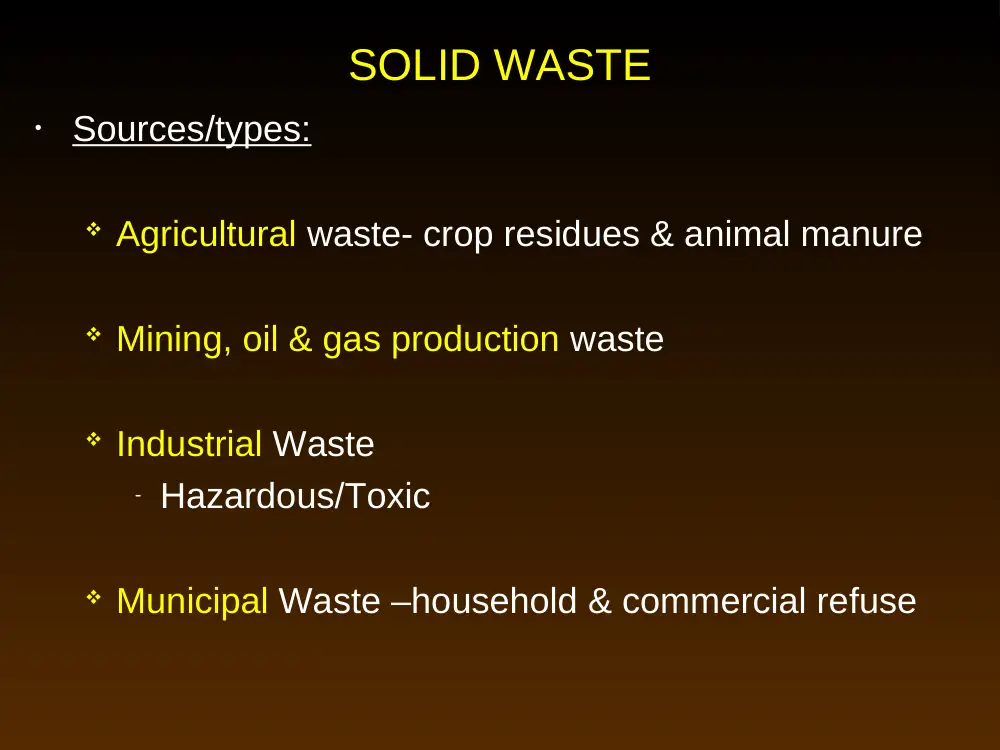
SOLID WASTE
•
Sources/types:
Agricultural waste- crop residues & animal manure
Mining, oil & gas production waste
Industrial Waste
- Hazardous/Toxic
Municipal Waste –household & commercial refuse
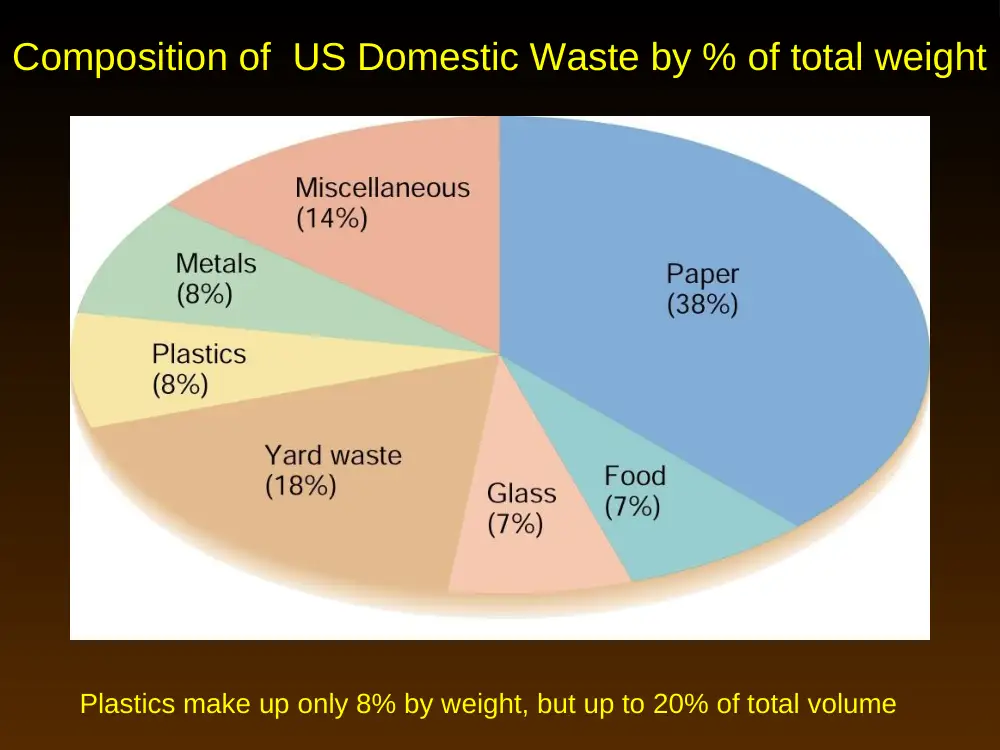
Composition of US Domestic Waste by % of total weight
Plastics make up only 8% by weight, but up to 20% of total volume
Waste Disposal
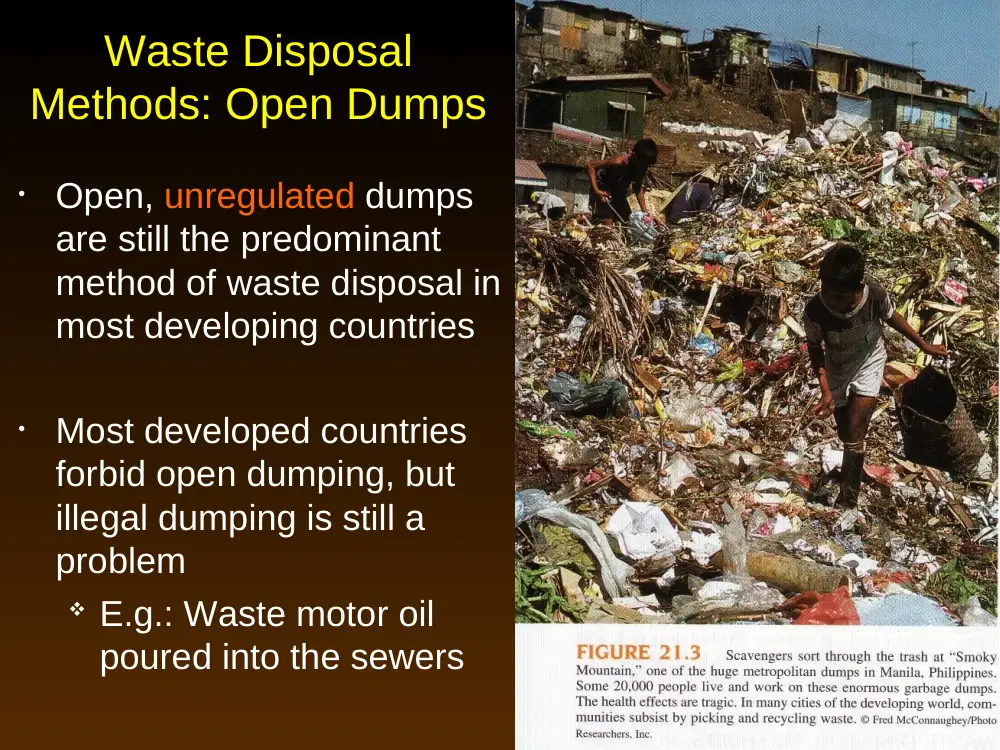
Methods: Open Dumps
•
Open, unregulated dumps
are still the predominant
method of waste disposal in
most developing countries
•
Most developed countries
forbid open dumping, but
illegal dumping is still a
problem
E.g.: Waste motor oil
poured into the sewers
•
Open dumps
Waste is left in giant piles exposed to the wind
& rain, as well as rats, flies & other vermin
Least desirable waste disposal method
•
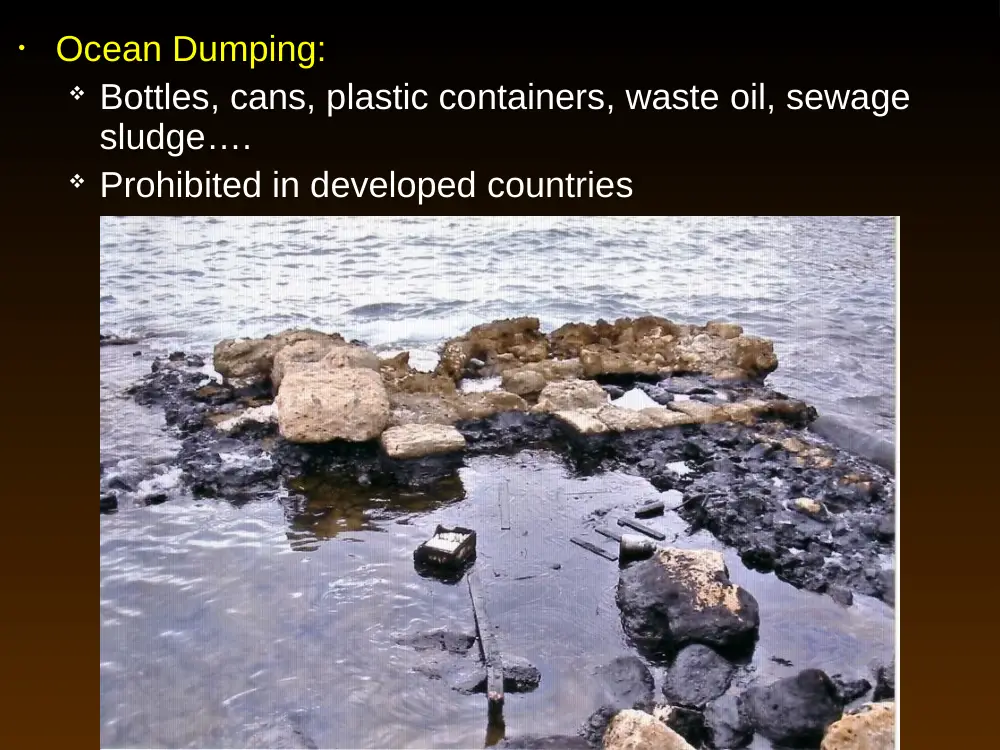
Ocean Dumping:
Bottles, cans, plastic containers, waste oil, sewage
sludge….
Prohibited in developed countries
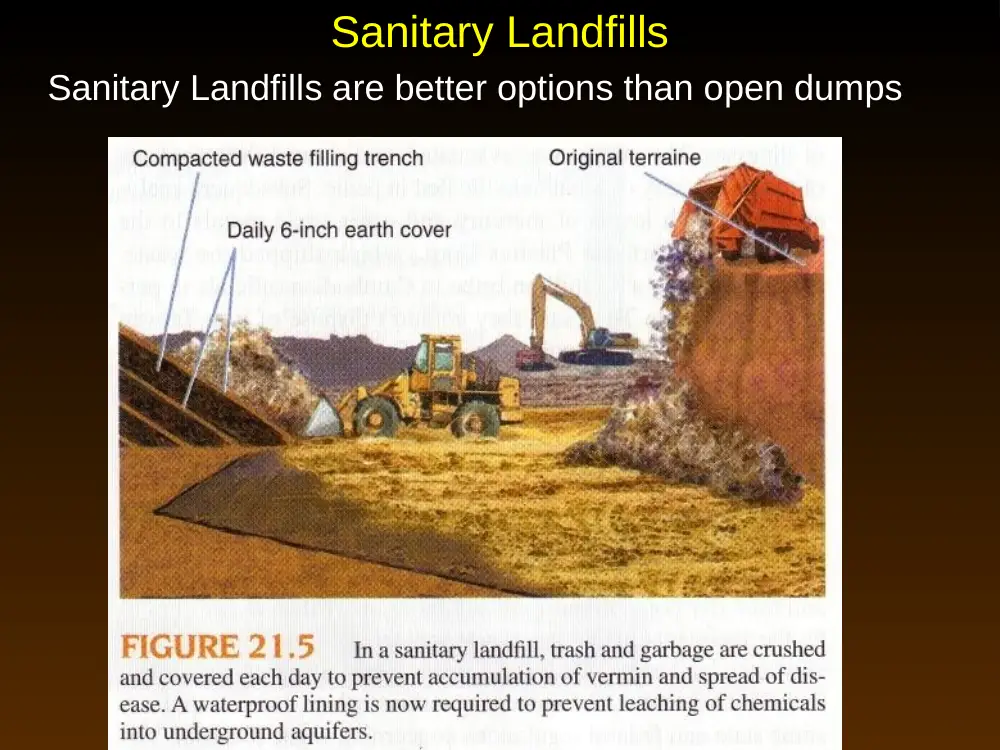
Sanitary Landfills
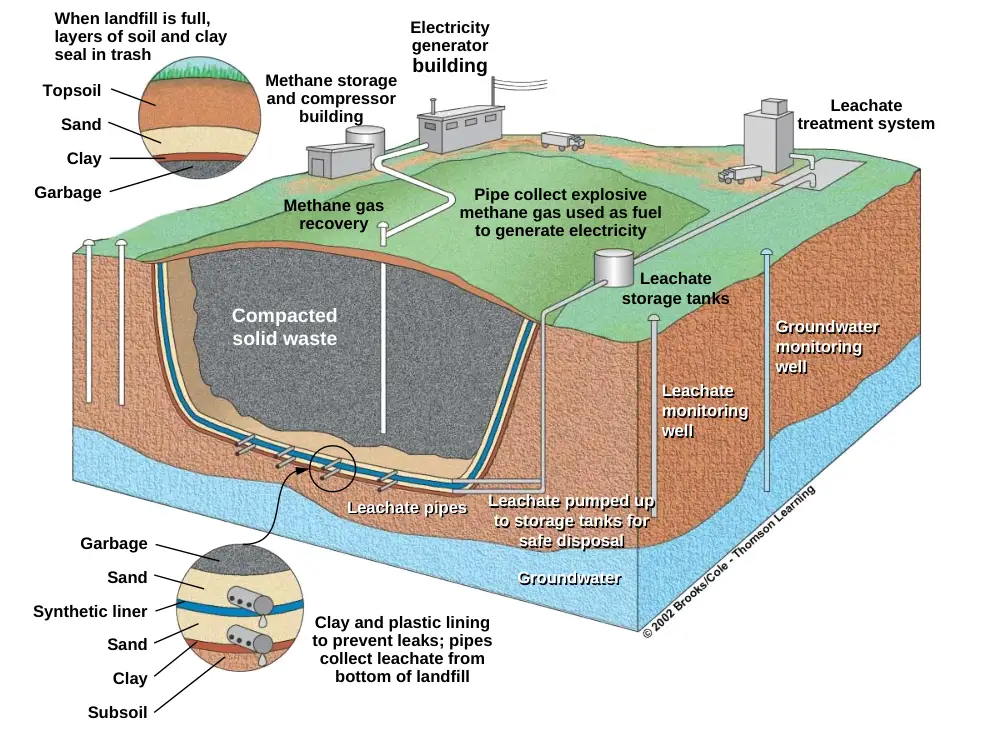
Sanitary Landfills are better options than open dumps
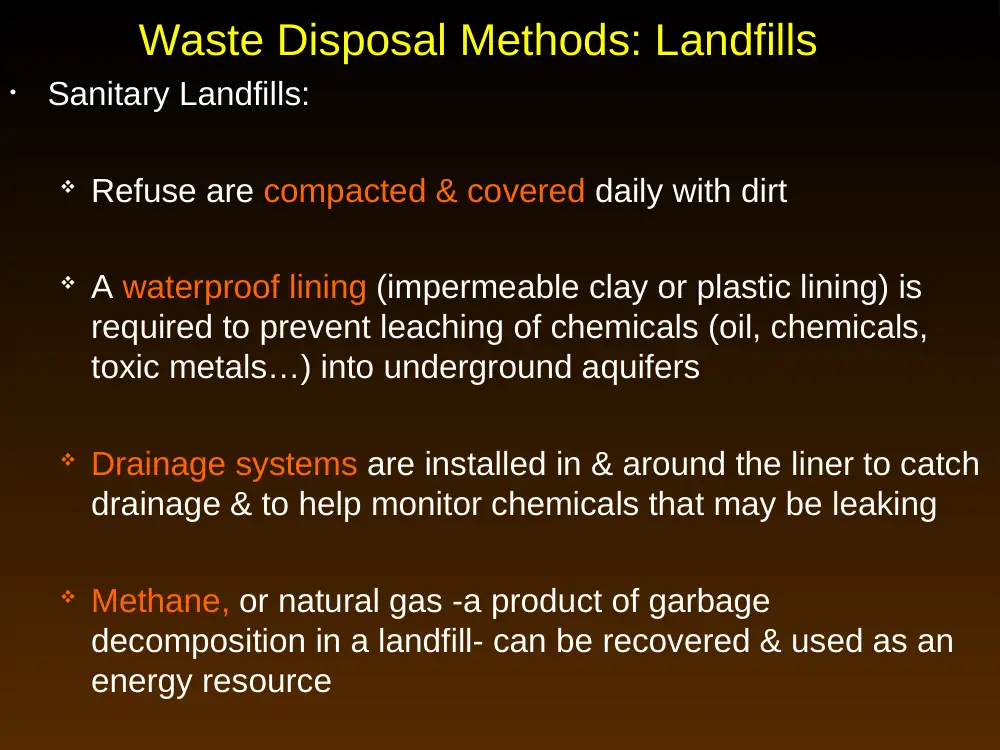
Waste Disposal Methods: Landfills
•
Sanitary Landfills:
Refuse are compacted & covered daily with dirt
A waterproof lining (impermeable clay or plastic lining) is
required to prevent leaching of chemicals (oil, chemicals,
toxic metals…) into underground aquifers
Drainage systems are installed in & around the liner to catch
drainage & to help monitor chemicals that may be leaking
Methane, or natural gas -a product of garbage
decomposition in a landfill- can be recovered & used as an
energy resource
Topsoil
Sand
Clay
Garbage
Garbage
Sand
Synthetic liner
Sand
Clay
Subsoil
When landfill is full,
layers of soil and clay
seal in trash
Methane storage
and compressor
building
Electricity
generator
building
Leachate
treatment system
Methane gas
recovery
Pipe collect explosive
methane gas used as fuel
to generate electricity
Compacted
solid waste
Leachate
storage tanks
Leachate
monitoring
well
Leachate
monitoring
well
Groundwater
Groundwater
Groundwater
monitoring
well
Groundwater
monitoring
well
Leachate pipes
Leachate pipes
Leachate pumped up
to storage tanks for
safe disposal
Leachate pumped up
to storage tanks for
safe disposal
Clay and plastic lining
to prevent leaks; pipes
collect leachate from
bottom of landfill
Landfills siting
•
Siting of new landfills must be considered with attention
Sites with less leaky geological foundations are in
favor of sites on highly permeable or faulted rock
formation
Away from rivers, lakes, floodplains, & aquifer
recharge zones
Landfills Problems
Historically, landfills have been a convenient & relatively
inexpensive waste-disposal option
•
Current problems:
Rising land prices & shipping fees, & increasingly
demanding landfill construction & maintenance
requirements =>
- Landfilling a more expensive disposal method
- Suitable landfill sites are becoming scarce
Increasingly, communities are rejecting new landfills
Old landfills are quickly reaching capacity & closing
Advantages
Disadvantages
No open dumping
Little odor
Low groundwater
pollution if sited
properly
Can be built
quickly
Low operating
costs
Can handle large
amounts of waste
Filled land can
be used for other
purposes
No shortage of
landfill space in
many areas
Noise and traffic
Dust
Air pollution from
toxic gases and
volatile organic
compounds
release
greenhouse
gases (methane
and CO2)
Groundwater
contamination
Slow
decomposition
of wastes
Encourages
waste production
Eventually leaks
and can
contaminate
groundwater
Waste Disposal Methods: Exporting Waste
Most industrialized nations have agreed to stop shipping
hazardous & toxic waste to less-developed countries
However
The practice still continues
•
“Garbage imperialism” also operates in wealthier
countries:
Poor neighborhoods & minority populations (e.g.,
Indian reservations) are much more likely than richer
ones to be the recipients of dumps, waste incinerators
& other locally unwanted land uses
Waste Disposal Methods: Incineration & Resource
Recovery
Incinerators: Specially designed burning plants capable of
burning thousands of tons of waste per day
Mass Burn Incineration- Everything smaller than sofas and
refrigerator is loaded into furnace
•
Advantages
Reduces disposal volume by 80-90%
Energy recovery- Heat derived from incinerated refuse is a
useful resource; it can be used to produce steam used for
heating buildings or generating electricity
Drawbacks of Incineration
•
Initial construction costs are high
•
Refuse must be sorted to remove recyclable & unburnable
materials before combustion
•
Creates air pollution problems
•
Incinerator ash (both fly ash & residual one) poses threat to
environmental health
High levels of toxic material (such as dioxins, lead, cadmium,
etc.): in fly ash more than residual one
Pollution control methods are not 100% effective
Residual ash must be disposed of properly
Shrinking the Waste Stream: Recycling
Producing less waste is better than struggling with disposal methods.
Best strategy is the 3Rs one: Reduce, Reuse, Recycle.
•
Recycling: reprocessing of discarded materials into new, useful
products
Some recycling reprocesses discarded materials for the same
purposes
- E.g.: aluminum cans & glass bottles are melted and recast into
new ones
Other processes turn old material into entirely new products
- Old tire road surfacing
- News paper cellulose insulation
- Kitchen waste soil amendment
- Steel cans automobiles and construction material
US Recycling Rates
Potential Problems of Recycling
•
Market prices fluctuation
E.g.: Newsprint: $160/ton in 1995 $42/ton in 2000
•
Contamination
Billions of PET plastic soft drink bottles many
items (carpet, plastic packaging…)
But
A single PVC bottle can ruin an entire truckload of
PET if melted together
Benefits of Recycling
Recycling is a much better alternative than burning or dumping
wastes
•
Saves money, energy, raw materials & land space
Pickup of recyclable: $40/ton
Disposal in landfill: $80/ton
•
Encourages individual awareness & responsibility for the
refuse produced
Japan has the most successful recycling program:
- 50% of all wastes are recycled
- Japanese families separate wastes into 7 categories!
•
Cuts waste volumes drastically & reduces pressure on
disposal systems
Benefits of Recycling
•
Reduces demand for raw resources, energy consumption & air
pollution
Recycling the print run of a single day issue of New York
Times would spare 75000 trees!!!
Recycling 1 ton of aluminum:
- Saves 4 tons of bauxite (aluminum ore)
- Saves ~ 1 ton of petroleum
- Keep out 35 kg of aluminum fluoride out of the air
•
Reduces litter from roadsides, rivers, oceans…
E.g.: In US each piece of litter picked up by crews costs 32
cents
Shrinking the Waste Stream: Composting
Biological degradation of organic material such as yard or
kitchen waste under aerobic conditions
- The organic compost nutrient-rich soil amendment that
Helps water retention
Slows soil erosion
Improves crop yields
A home compost pile is an easy environmentally friendly way to
dispose of organic wastes
To be successful, a community composting program must:
- Overcome siting problems
- Control odors
- Exclude toxic materials that can contaminate the compost &
make it unsuitable for use as a fertilizer on crops & lawns
Shrinking the Waste Stream
•
Demanufacturing
Disassembly & recycling of obsolete consumer
products, such as TV sets, personal computers,
refrigerators, washing machines, & air conditioners
•
Reuse
Cleaning & reusing materials in their present form
- Saves the cost & energy of remaking them into
something else
- Auto parts are regularly sold from junkyards
- Glass & plastic bottles are routinely returned to
beverage producers for washing & refilling
Shrinking the Waste Stream
•
Producing Less Waste
Excess packaging of food & consumer products is one of
our greatest sources of unnecessary waste
- Paper, plastic, glass, & metal packaging material make
up 50% of domestic trash by volume
- The use of photodegradable & biodegradable plastics
can reduce the volume of wastes but leaves toxic
residues in the environment
Too much emphasis on recycling ?
- Recycling is actually the third “R” in the waste
hierarchy. The two preferred methods are reduction &
reuse
Much of packaging is for marketing and has little to do with
product protection
Hazardous Waste
•
Legally, hazardous waste is any discarded liquid or solid
that contains substances known to be:
Fatal to humans or laboratory animals in low doses
Toxic, carcinogenic, mutagenic, or teratogenic to
humans or other life-forms
Ignitable with a flash point less than 60o C
Explosive or highly reactive
Toxic and hazardous wastes must be tracked
Hazardous Waste Management Options
•
Produce Less Waste
Avoid creating wastes in the first place
Recycle and Reuse
•
Convert to Less Hazardous Substances
Physical Treatment (Isolation of toxic substances)
Incineration
Chemical Processing (Transformation)
Bioremediation (Microorganisms)
Hazardous Waste Management Options
Inevitably there will be some material that cannot be
destroyed, transformed, or caused to vanish
Store Permanently
Retrievable Storage
- Can be inspected and periodically retrieved
Secure Landfills
- Modern, complex landfills with multiple liners and
other impervious layers and monitoring systems
Secure Landfills