
ENS 201 Chapter 3, Spring 2008
Notre Dame University–Louaize · Introduction to Environmental Science · 29 pages · Ms. Leila Khalaf
Showing the first 10 of 29 pages. Download the PDF to see all of it.
More ENS 201 files
Show the text of this chapter
Matter, Energy, and Life
Chapter 3
Outline:
• Basic Definitions of Organic Compounds
• Energy
Types
Laws of Thermodynamics
Solar energy
Photosynthesis & Respiration
• From Species to Ecosystems
Food Chains, Food Webs & Trophic Level
Ecological Pyramids
Material Cycles (Carbon Cycle)
Organic Compounds
Material making up biomolecules
Rings and chains of carbon backbones
Four major categories:
- Lipids (e.g., fats oils)
- Carbohydrates (e.g., glucose, starch, cellulose)
- Proteins (structural and functional roles)
- Nucleic Acids (stores of the genetic information)
ENERGY
• Energy: Ability to do work or to cause heat flow
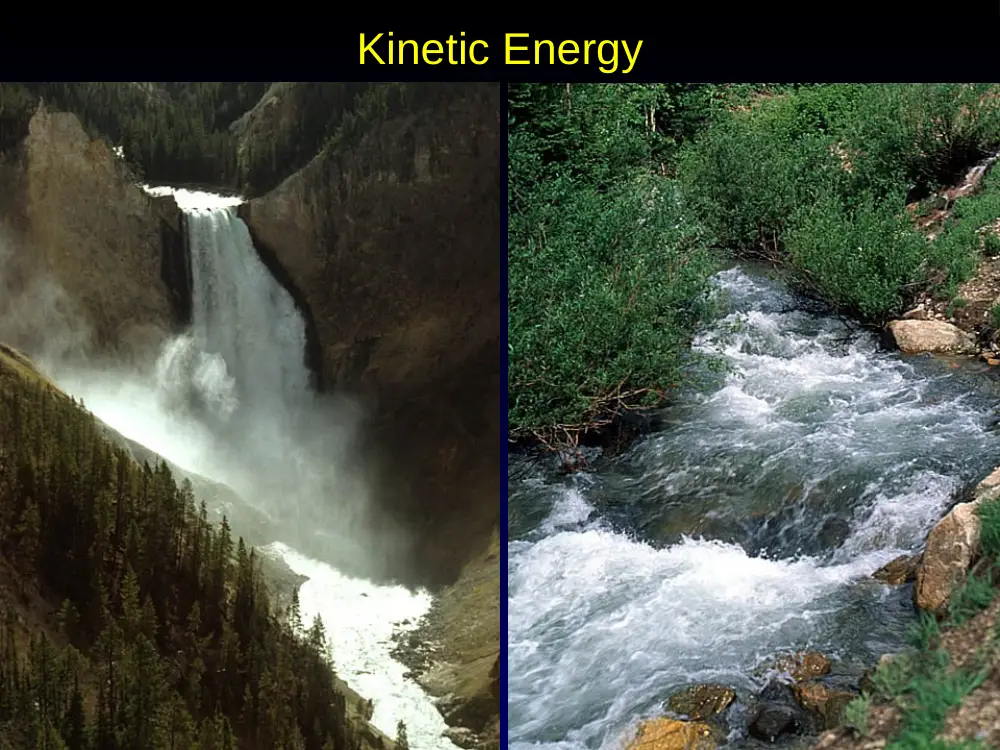
Kinetic: Energy in moving objects
Potential: Stored energy
- Chemical: Stored in food or fossil fuels
• Heat: Useless form of energy
Kinetic Energy
Thermodynamics and Energy Transfers
•
Thermodynamics: studies how energy is transferred in
natural processes
•
Energy
Must be supplied from an external source to keep
biological processes running
Flows in a one-way path through living systems
(accomplish work) & eventually into a low temperature
sink (e.g., outer space)
Can be stored temporarily in the chemical bonds
(chemical energy)
Laws of Thermodynamics
• First Law
Energy is neither created nor destroyed
Energy can be transferred or transformed but it is
always conserved
• Second Law
With each successive energy transfer
- Less energy is available to perform work
- Dissipated from a higher quality form
(chemical electrical…) to a lower quality form
(heat)
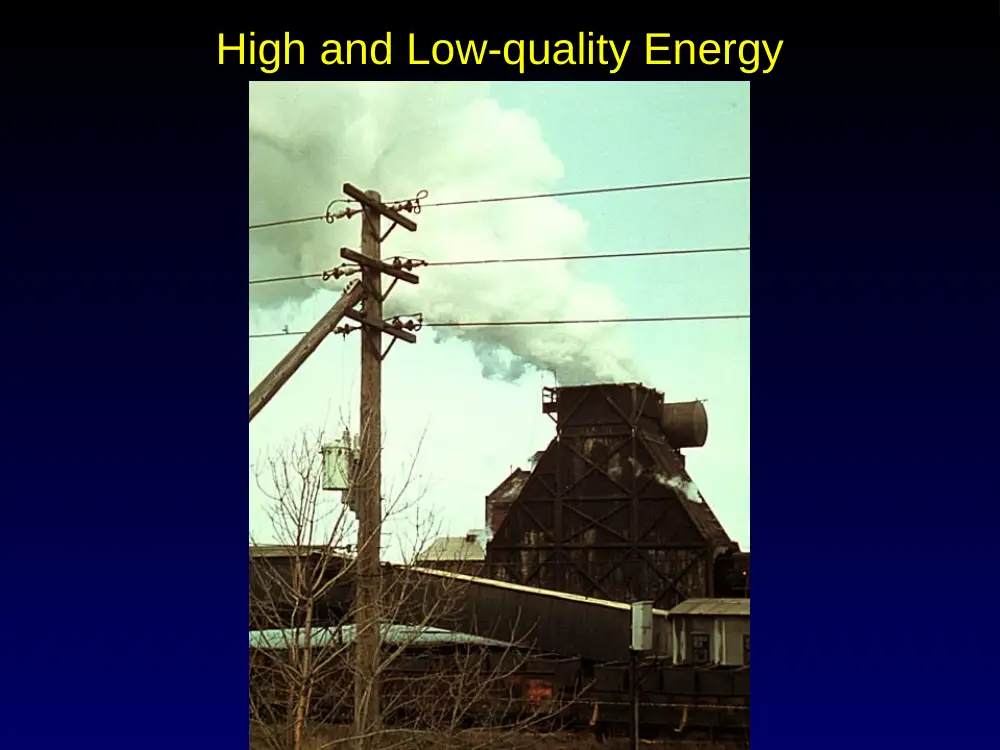
High and Low-quality Energy
Energy for Life: Warmth and light
• Ultimately, most organisms depend on the sun for
energy needed to carry out life processes
• Solar energy is essential for 2 reasons:
Warmth optimal temperature range for life
Photosynthesis
- Radiant energy transformed into useful, high-
quality chemical energy in the bonds of
organic molecules
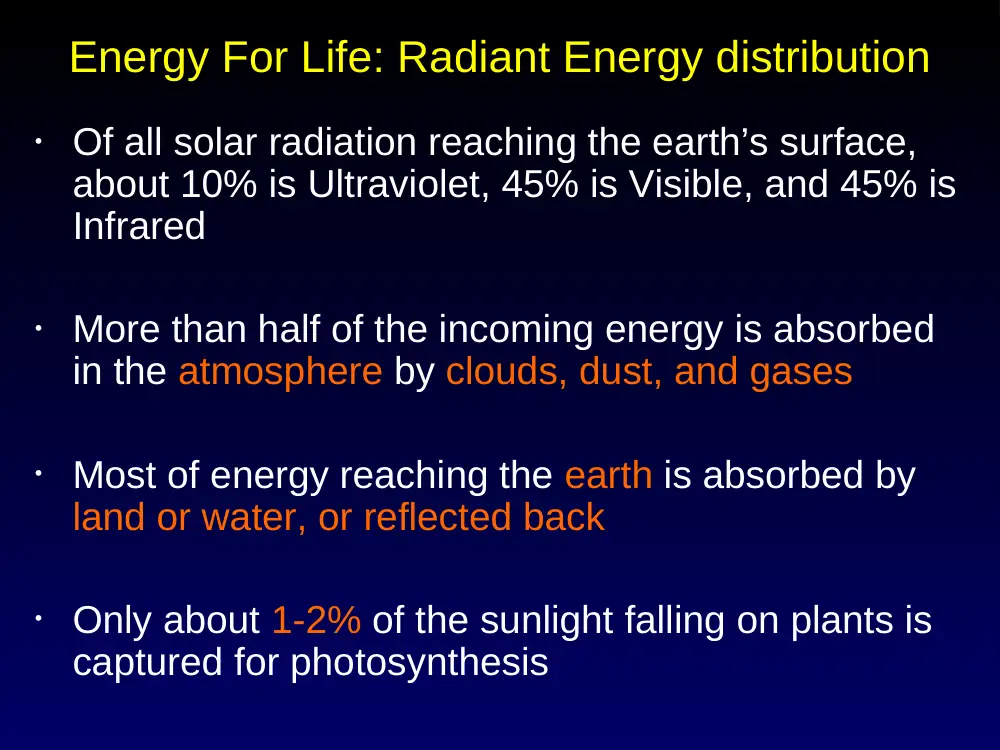
Energy For Life: Radiant Energy distribution
• Of all solar radiation reaching the earth’s surface,
about 10% is Ultraviolet, 45% is Visible, and 45% is
Infrared
• More than half of the incoming energy is absorbed
in the atmosphere by clouds, dust, and gases
• Most of energy reaching the earth is absorbed by
land or water, or reflected back
• Only about 1-2% of the sunlight falling on plants is
captured for photosynthesis
Energy for Life: Photosynthesis
• Occurs in organelles of green plant cells
called chloroplasts
• Water + Carbon dioxide + solar energy
Glucose (sugar) + Oxygen
6H20+6CO2 + solar energy = C6H12O6+6O2
• Water and carbon dioxide in the presence of
sunlight yields glucose (sugar) and oxygen
• Glucose serves as primary fuel for all
metabolic processes in cells
Energy for Life: Cellular Respiration
• Photosynthesis captures energy, while cellular
respiration releases energy.
Glucose (sugar) + Oxygen
Water + Carbon dioxide + Energy
C6H12O6 + 6O2 = 6H2O +6CO2 + energy
Energy exchange in ecosystems
Copyright © The McGraw-Hill Companies, Inc. Permission required for reproduction or display.
Sun
Photosynthesis
Respiration
Producers
Consumers and
decomposers
CO2
H2O
Carbon dioxide (CO2)
Water (H2O)
Heat (low-quality energy)
High-quality energy for work:
Biosynthesis
Movement
Membrane transport
Bioluminescence
Oxygen (O2)
Oxygen (O2)
Sugars (high-quality energy)
Nature of Ecology: from species to ecosystems
• Ecosystem organization:
Organisms Populations Communities
Ecosystems Biosphere
From Species to Ecosystems
• Species – Organisms of the same kind that are
genetically similar enough to breed in nature and
produce live, fertile offspring
• Population - All members of a species living in a given
area at the same time
• Community - All of the populations of organisms living
and interacting in a particular area
• Ecosystem - Biological community (biotic factors) and
its physical environment (abiotic factors)
Food Chains
•
Productivity
Amount of biomass (biological material) produced in a given
area during a given period of time
•
Primary Productivity = photosynthesis
Manufacture of biomass by green plants
The basis for almost all other growth in an ecosystem
•
Secondary Productivity
Manufacture of biomass by organisms eating plants
•
Food Chain - Linked feeding series in an ecosystem
Most consumers have multiple food sources
•
Food Web
Interconnected food chains
Each time an organism feeds, it becomes a
link in a food chain
03_12 Food web
Slide number: 1
Copyright © The McGraw-Hill Companies, Inc. Permission required for reproduction or display.
Harsh environments tend to have shorter food
chains
Trophic Levels
• Trophic Level - An organism’s feeding status in an
ecosystem:
Producers (plants)
Consumers
- Primary (herbivores)
- Secondary (carnivores)
- Tertiary (top carnivores)
Terrestrial food chains are relatively short
Aquatic food chains tend to be longer
Trophic Levels
•
Organisms can also be identified by the type of food they
consume:
Herbivores
(Plants)
{Deer, Bison}
Carnivores
(Meat)
{Wolves, Tigers}
Omnivores
(Plants/Meat)
{Human, Bear, Pig}
Scavengers (Carcasses)
{Hyena, Vultures, Crows}
Detritivores (Debris)
{Ants, beetles}
Decomposers
(All)
{fungi, Bacteria}
Ecological Pyramids
•
Due to Second Law of Thermodynamics, food chains often
form a pyramid
•
Biomass energy loss
Undigested
Used to carry out metabolic reactions necessary for life
Lost as heat
10% Rule (Energy / Biomass)
- 100 kg clover
10 kg rabbits
1 kg foxes
MATERIAL CYCLES
•
Elements of matter are recycled in the biosphere
•
E.g.: Carbon Cycle:
Begins with intake of CO2 during photosynthesis: Carbon
atoms are incorporated into glucose and then:
- Remain in plant material until death (incorporation)
- Eaten by predator
- Released by respiration
- Secreted (excretion of plants exudates)
- Returned to the environment after death via decomposers
CO2 in atmosphere
plus traces of CH4 and CO
03_17 Carbon cycle
Slide number: 2
Copyright © The McGraw-Hill Companies, Inc. Permission required for reproduction or display.
Carbon Cycle
CO2 in atmosphere
plus traces of CH4 and CO
Photosynthesis
(terrestrial
food chains)
Photosynthesis
(aquatic food
chains)
CO2 in
water
03_17 Carbon cycle
Slide number: 3
Copyright © The McGraw-Hill Companies, Inc. Permission required for reproduction or display.
Carbon Cycle
CO2 in atmosphere
plus traces of CH4 and CO
Photosynthesis
(terrestrial
food chains)
Respiration
and decomposition
Photosynthesis
(aquatic food
chains)
CO2 in
water
03_17 Carbon cycle
Slide number: 4
Copyright © The McGraw-Hill Companies, Inc. Permission required for reproduction or display.
Carbon Cycle
CO2 in atmosphere
plus traces of CH4 and CO
Burning of forests, fuelwood,
and organic debris
Photosynthesis
(terrestrial
food chains)
Respiration
and decomposition
Photosynthesis
(aquatic food
chains)
CO2 in
water
03_17 Carbon cycle
Slide number: 5
Copyright © The McGraw-Hill Companies, Inc. Permission required for reproduction or display.
Carbon Cycle
Combustion of fossil fuels
for vehicles, electricity,
and heat
CO2 in atmosphere
plus traces of CH4 and CO
Burning of forests, fuelwood,
and organic debris
Photosynthesis
(terrestrial
food chains)
Respiration
and decomposition
Photosynthesis
(aquatic food
chains)
CO2 in
water
03_17 Carbon cycle
Slide number: 6
Copyright © The McGraw-Hill Companies, Inc. Permission required for reproduction or display.
Carbon Cycle
Combustion of fossil fuels
for vehicles, electricity,
and heat
CO2 in atmosphere
plus traces of CH4 and CO
Burning of forests, fuelwood,
and organic debris
Photosynthesis
(terrestrial
food chains)
Respiration
and decomposition
Photosynthesis
(aquatic food
chains)
CO2 in
water
Organic sediments
Time
Time
Calcareous sediments
Time
Peat
Coal
Oil and gas
Limestone and dolomite
Copyright © The McGraw-Hill Companies, Inc. Permission required for reproduction or display.
Carbon Cycle