
MEN 201 Problems For Chapter 12 with Solutions, Spring 2012
Notre Dame University–Louaize · Engineering Mechanics- Dynamics · 144 pages · with solution
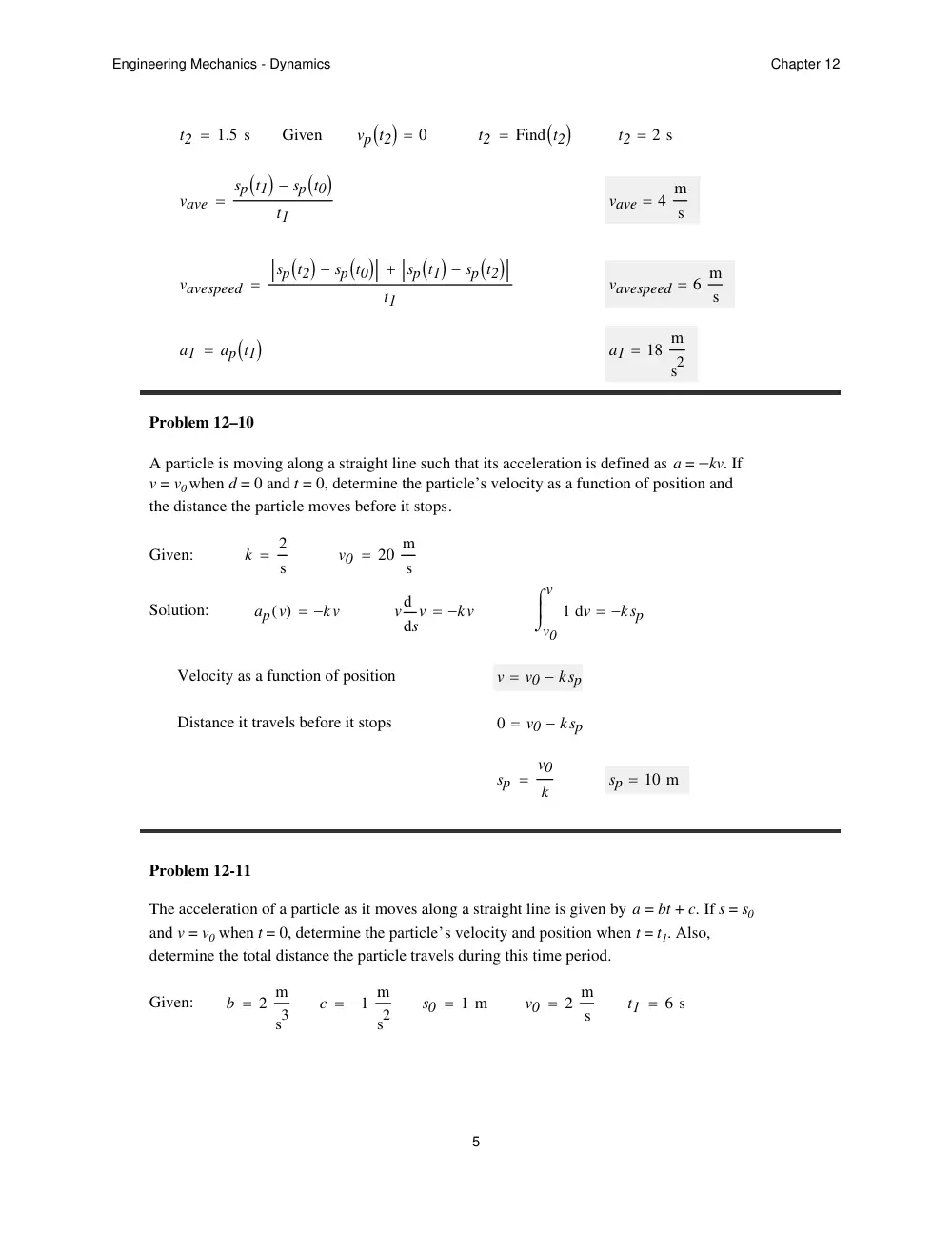
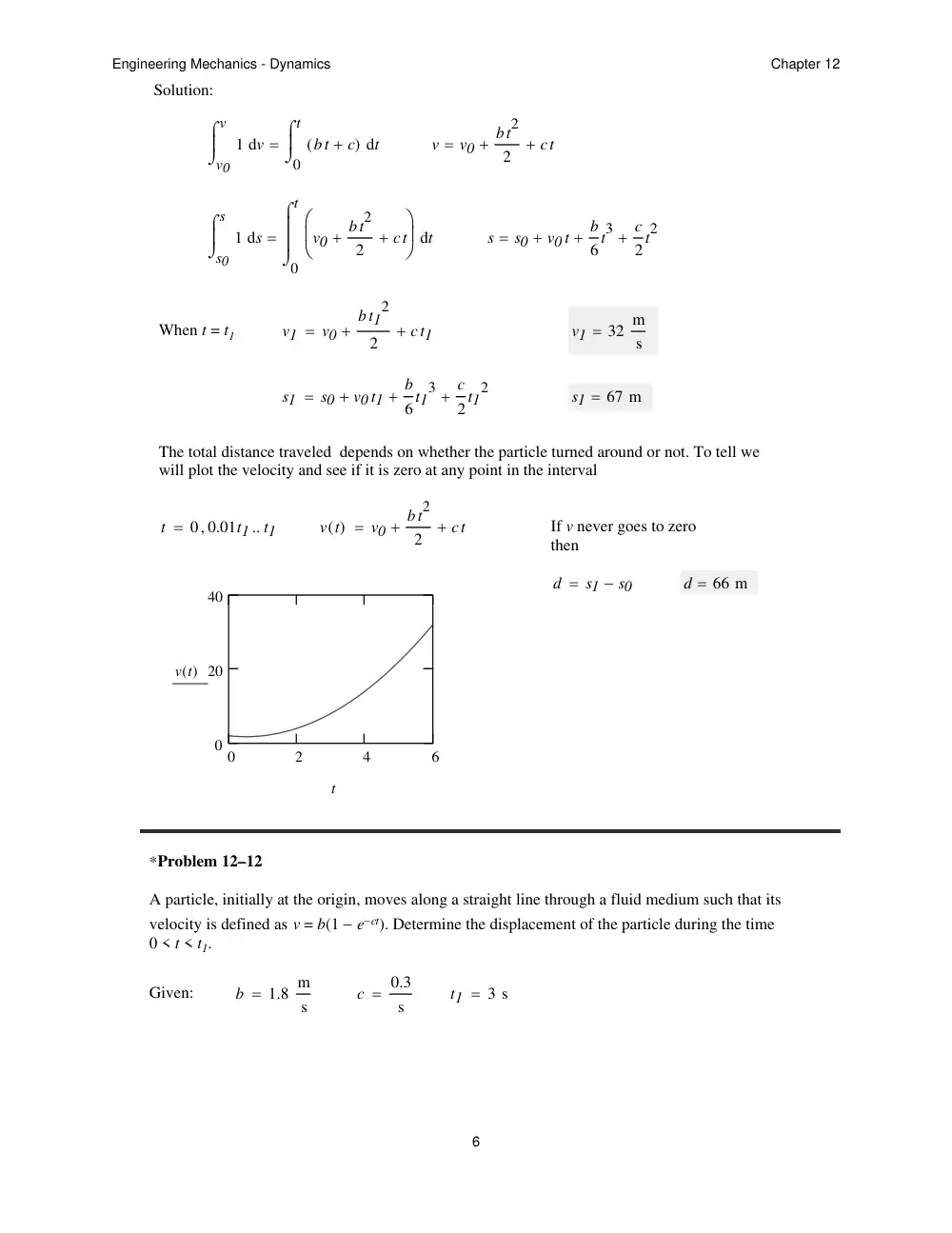
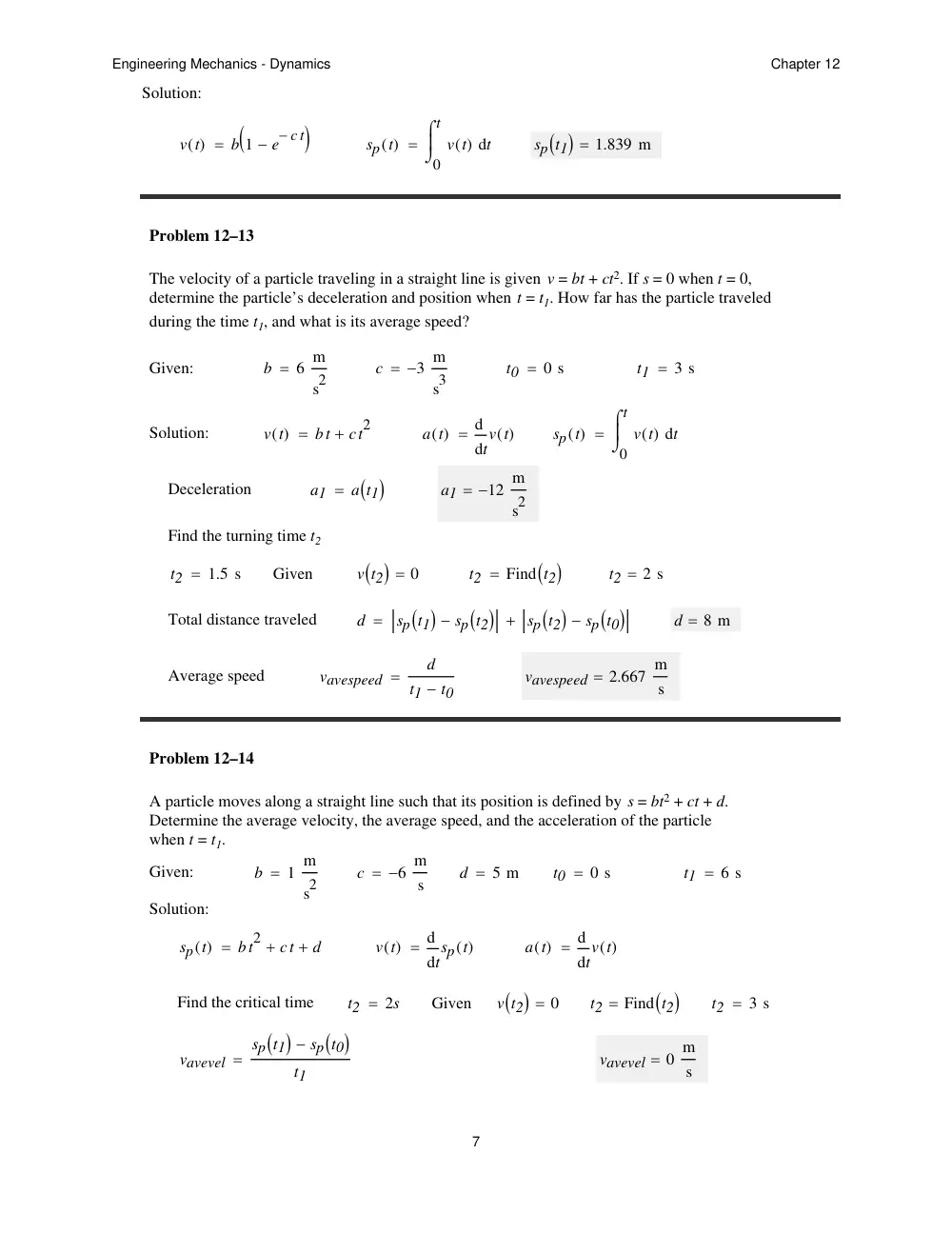
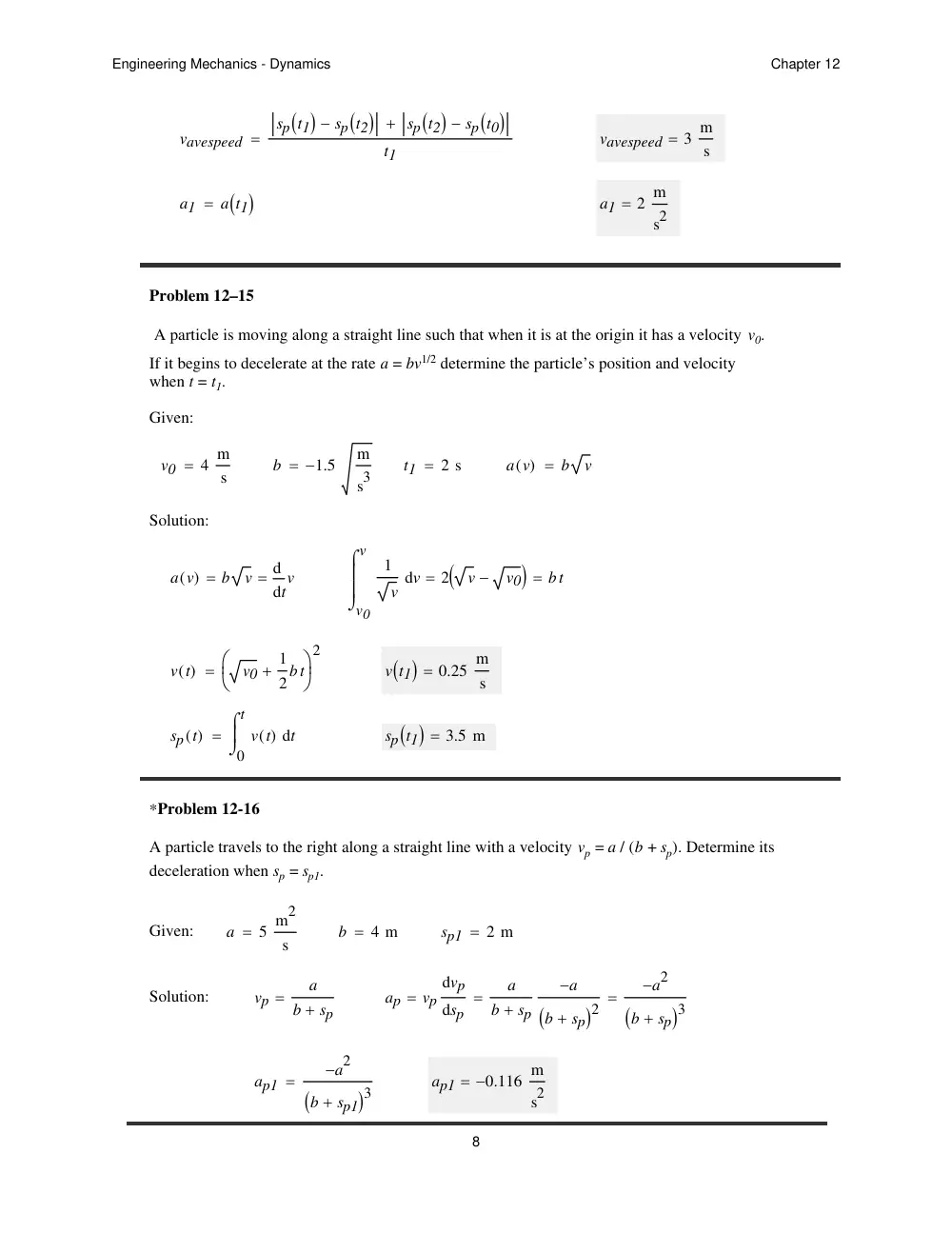
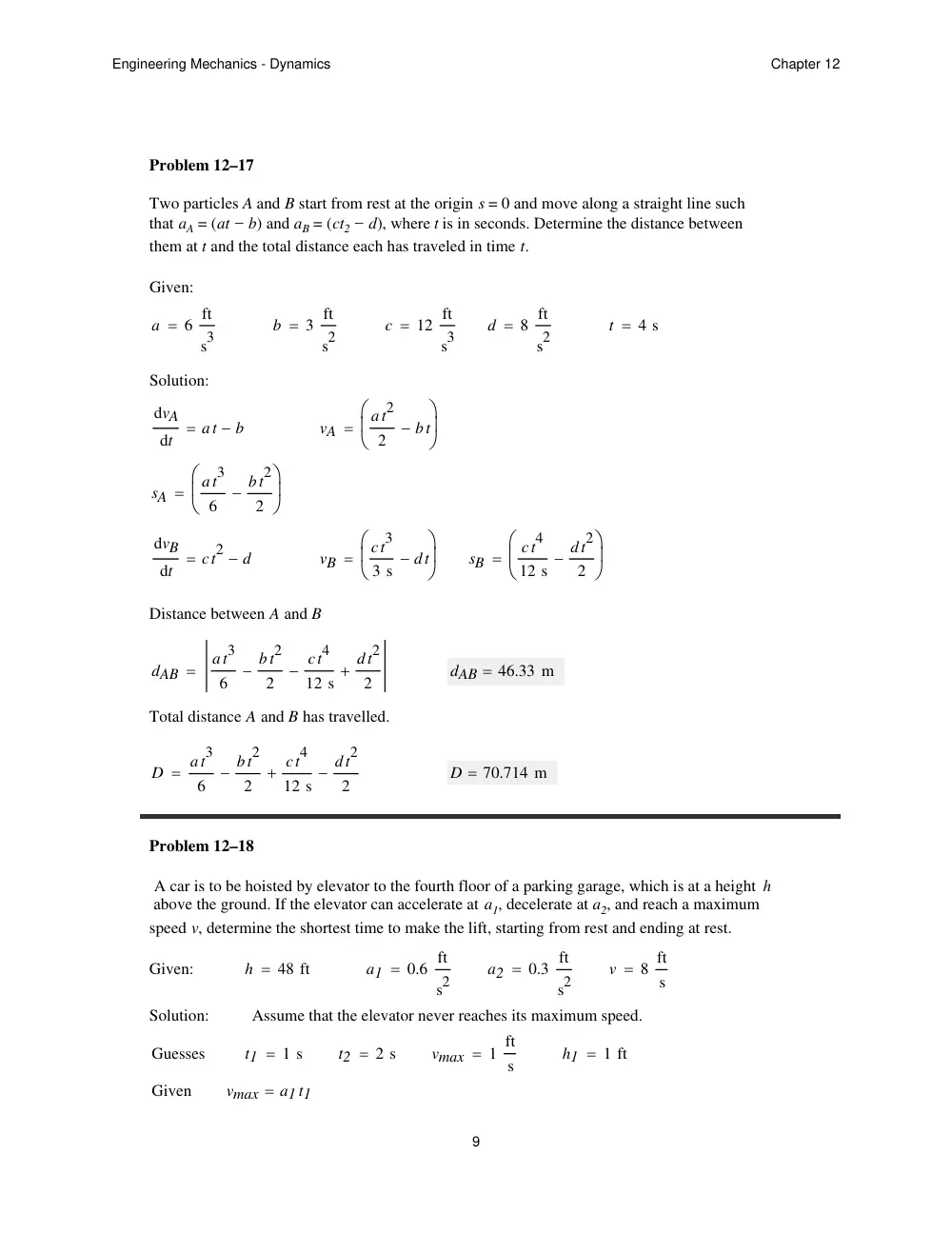

Showing the first 10 of 144 pages. Download the PDF to see all of it.
More MEN 201 files
- Problems For Chapter 15 with Solutions · Spring 2012Chapter · with solutionView
- Problems For Chapter 19 with Solutions · Spring 2012Chapter · with solutionView
- Problems For Chapter 17 with Solutions · Spring 2012Chapter · with solutionView
- Problems For Chapter 20 with Solutions · Spring 2012Chapter · with solutionView
- Problems For Chapter 16 with Solutions · Spring 2012Chapter · with solutionView
- Problems For Chapter 14 with Solutions · Spring 2012Chapter · with solutionView
- Problems For Chapter 13 with Solutions · Spring 2012Chapter · with solutionView
- Problems For Chapter 18 with Solutions · Spring 2012Chapter · with solutionView
Show the text of this chapter
Engineering Mechanics - Dynamics
Chapter 12
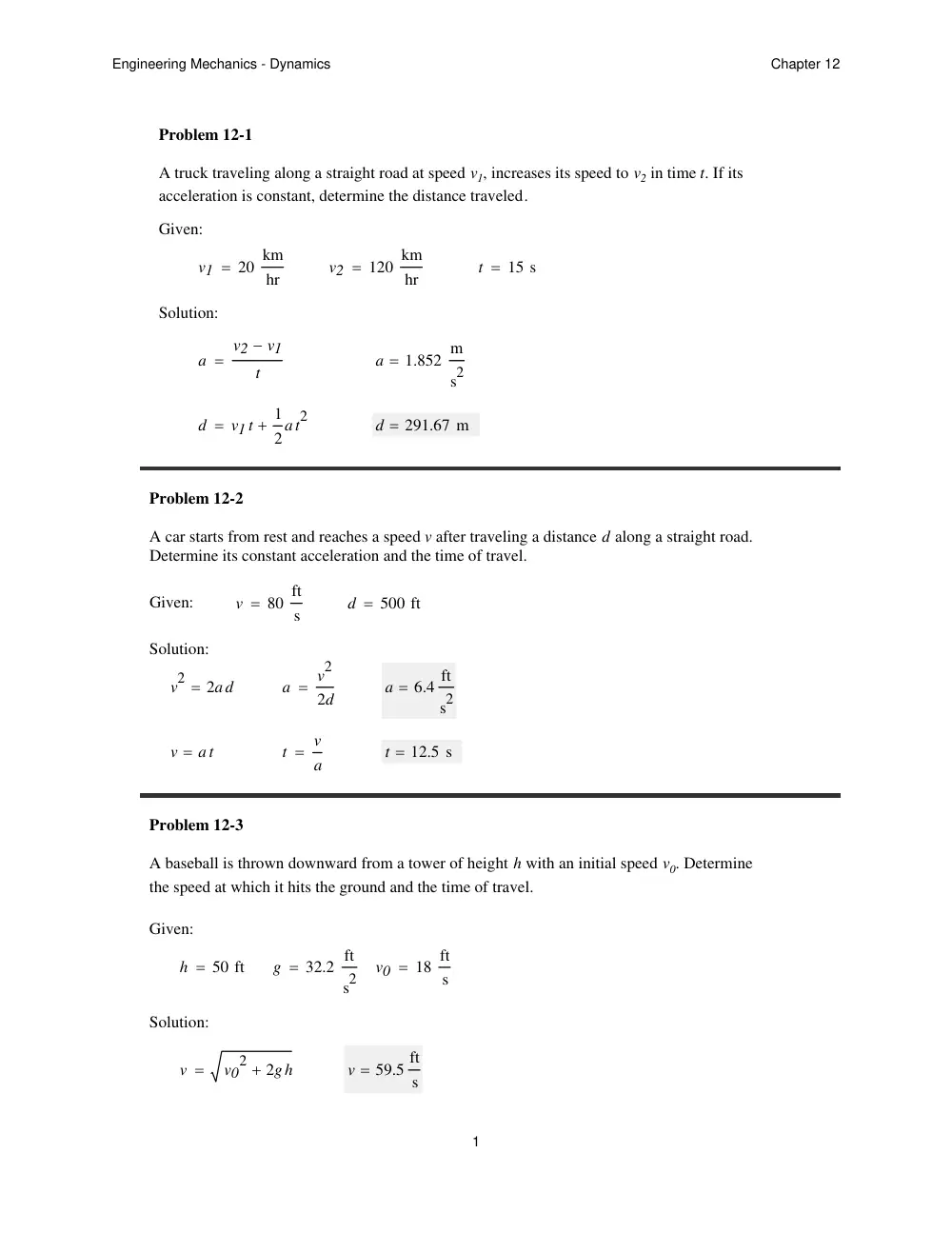
Problem 12-1
A truck traveling along a straight road at speed v1, increases its speed to v2 in time t. If its
acceleration is constant, determine the distance traveled.
Given:
v1
20 km
hr
=
v2
120 km
hr
=
t
15 s
=
Solution:
a
v2
v1
−
t
=
a
1.852 m
s2
=
d
v1 t
1
+ 2at2
=
d
291.67 m
=
Problem 12-2
A car starts from rest and reaches a speed v after traveling a distance d along a straight road.
Determine its constant acceleration and the time of travel.
Given:
v
80 ft
s
=
d
500 ft
=
Solution:
v2
= 2ad
a
v2
= 2d
a
6.4 ft
s2
=
v
= at
t
v
= a
t
12.5 s
=
Problem 12-3
A baseball is thrown downward from a tower of height h with an initial speed v0. Determine
the speed at which it hits the ground and the time of travel.
Given:
h
= 50 ft
g
32.2 ft
s2
=
v0
18 ft
s
=
Solution:
v
v0
2
+ 2gh
=
v
59.5 ft
s
=
1
Engineering Mechanics - Dynamics
Chapter 12
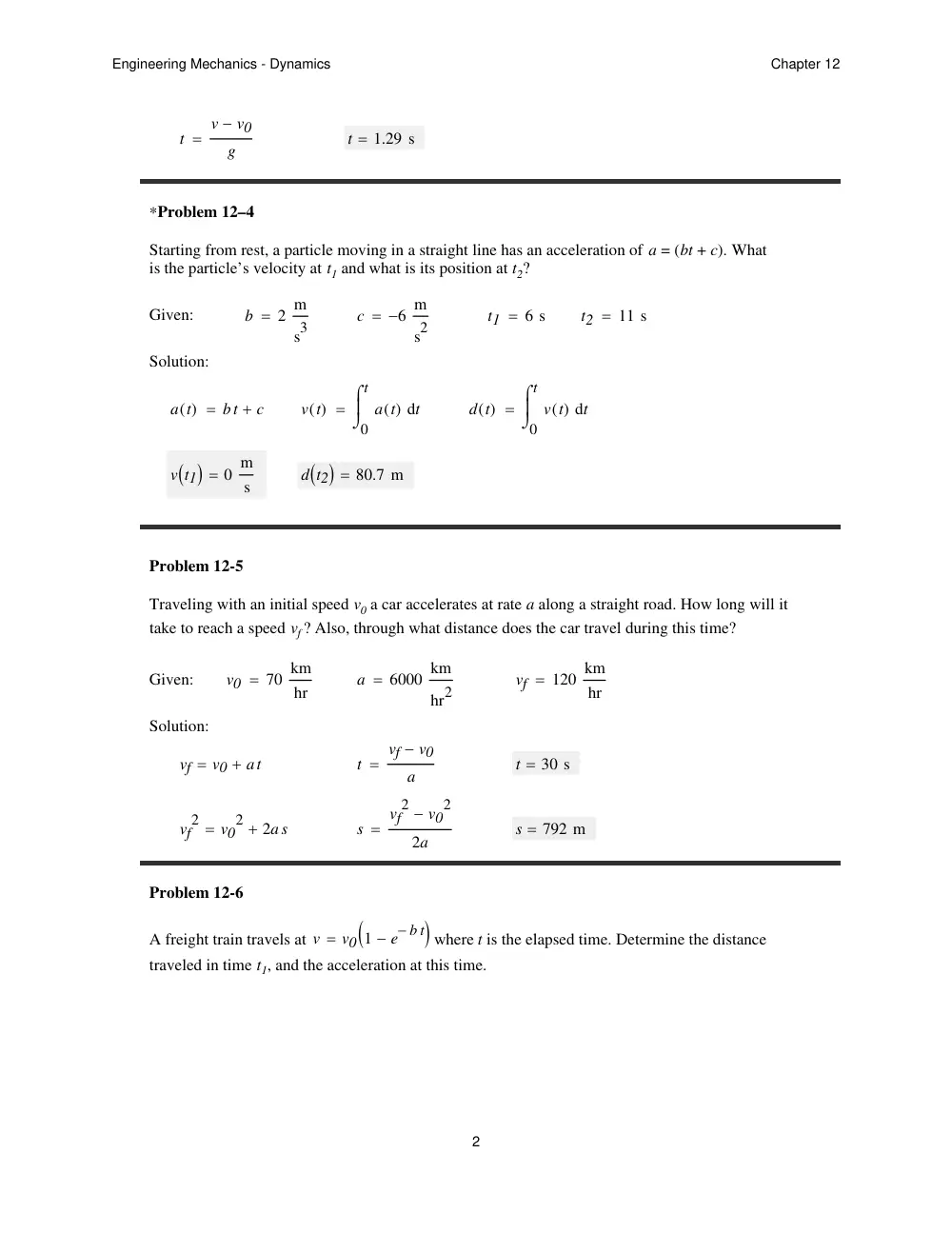
t
v
v0
−
g
=
t
1.29 s
=
*Problem 12–4
Starting from rest, a particle moving in a straight line has an acceleration of a = (bt + c). What
is the particle’s velocity at t1 and what is its position at t2?
Given:
b
2 m
s3
=
c
−6
m
s2
=
t1
= 6 s
t2
11 s
=
Solution:
a t( )
bt
+ c
=
v t( )
0
t
t
a t( )
⌠
⎮⌡
d
=
d t( )
0
t
t
v t( )
⌠
⎮⌡
d
=
v t1
( )
0 m
s
=
d t2
( )
80.7 m
=
Problem 12-5
Traveling with an initial speed v0 a car accelerates at rate a along a straight road. How long will it
take to reach a speed vf ? Also, through what distance does the car travel during this time?
Given:
v0
70 km
hr
=
a
6000 km
hr2
=
vf
120 km
hr
=
Solution:
vf
v0
+ at
=
t
vf
v0
−
a
=
t
30 s
=
vf
2
v0
2
+ 2as
=
s
vf
2
v0
2
−
2a
=
s
792 m
=
Problem 12-6
A freight train travels at v
v0 1
e b
−
t
( −
)
=
where t is the elapsed time. Determine the distance
traveled in time t1, and the acceleration at this time.
2
Engineering Mechanics - Dynamics
Chapter 12
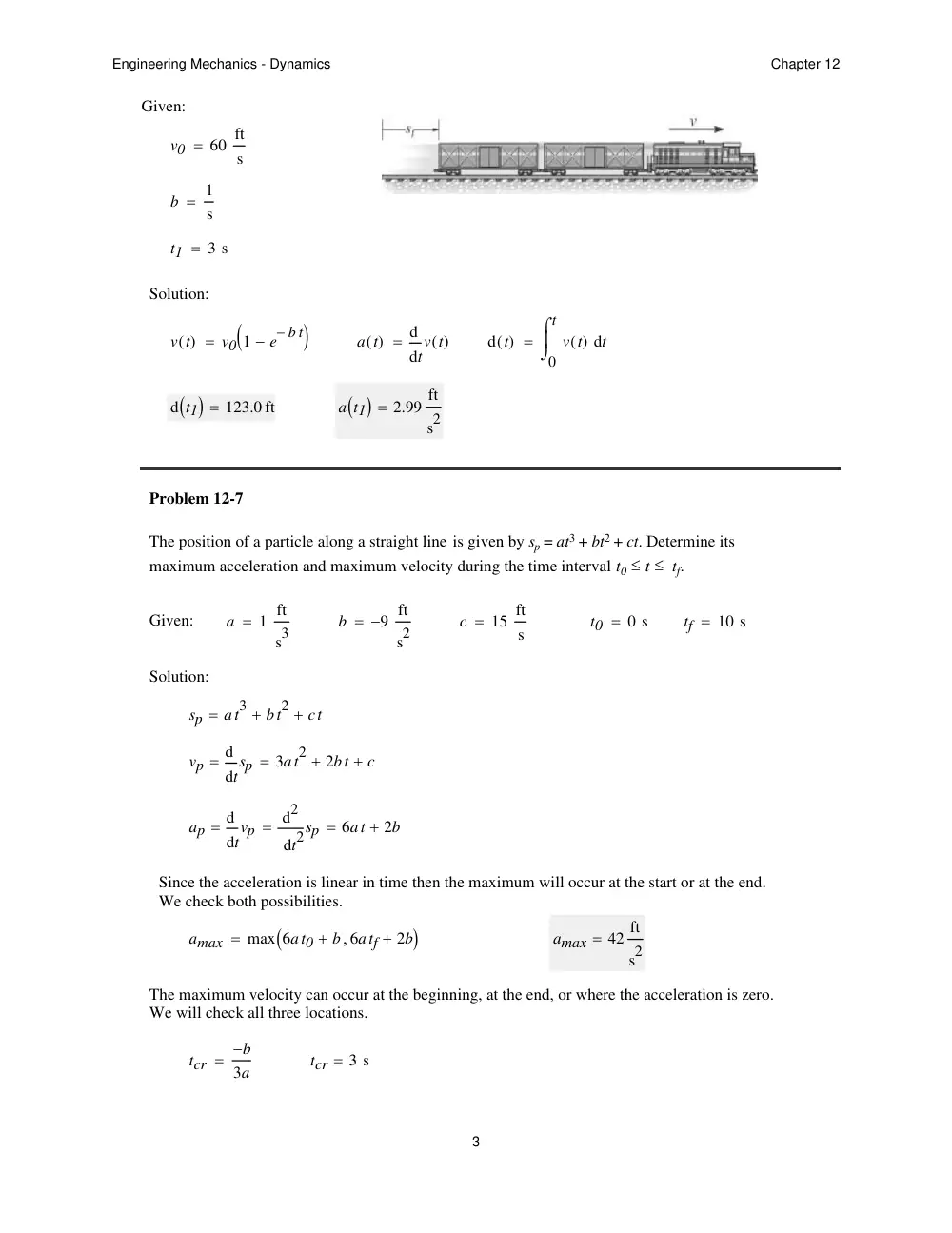
v0
60 ft
s
=
b
1
s
=
t1
3 s
=
Solution:
v t( )
v0 1
e b
−
t
( −
)
=
a t( )
t
d v t( )
d
=
d t( )
0
t
t
v t( )
⌠
⎮⌡
d
=
d t1
( )
= 123.0 ft
a t1
( )
2.99 ft
s2
=
Problem 12-7
The position of a particle along a straight line is given by sp = at3 + bt2 + ct. Determine its
maximum acceleration and maximum velocity during the time interval t0 ≤ t ≤ tf.
Given:
a
1 ft
s3
=
b
−9
ft
s2
=
c
15 ft
s
=
t0
= 0 s
tf
10 s
=
Solution:
sp
at3
+ bt2
+ ct
=
vp
t
d sp
d
=
3at2
+ 2bt
+ c
=
ap
t
d vp
d
=
2t
sp
d
d
2
=
6at
+ 2b
=
Since the acceleration is linear in time then the maximum will occur at the start or at the end.
We check both possibilities.
amax
max 6at0
+ b
6atf
+ 2b
,
(
)
=
amax
42 ft
s2
=
The maximum velocity can occur at the beginning, at the end, or where the acceleration is zero.
We will check all three locations.
tcr
−b
= 3a
tcr
3 s
=
3
Given:
Engineering Mechanics - Dynamics
Chapter 12
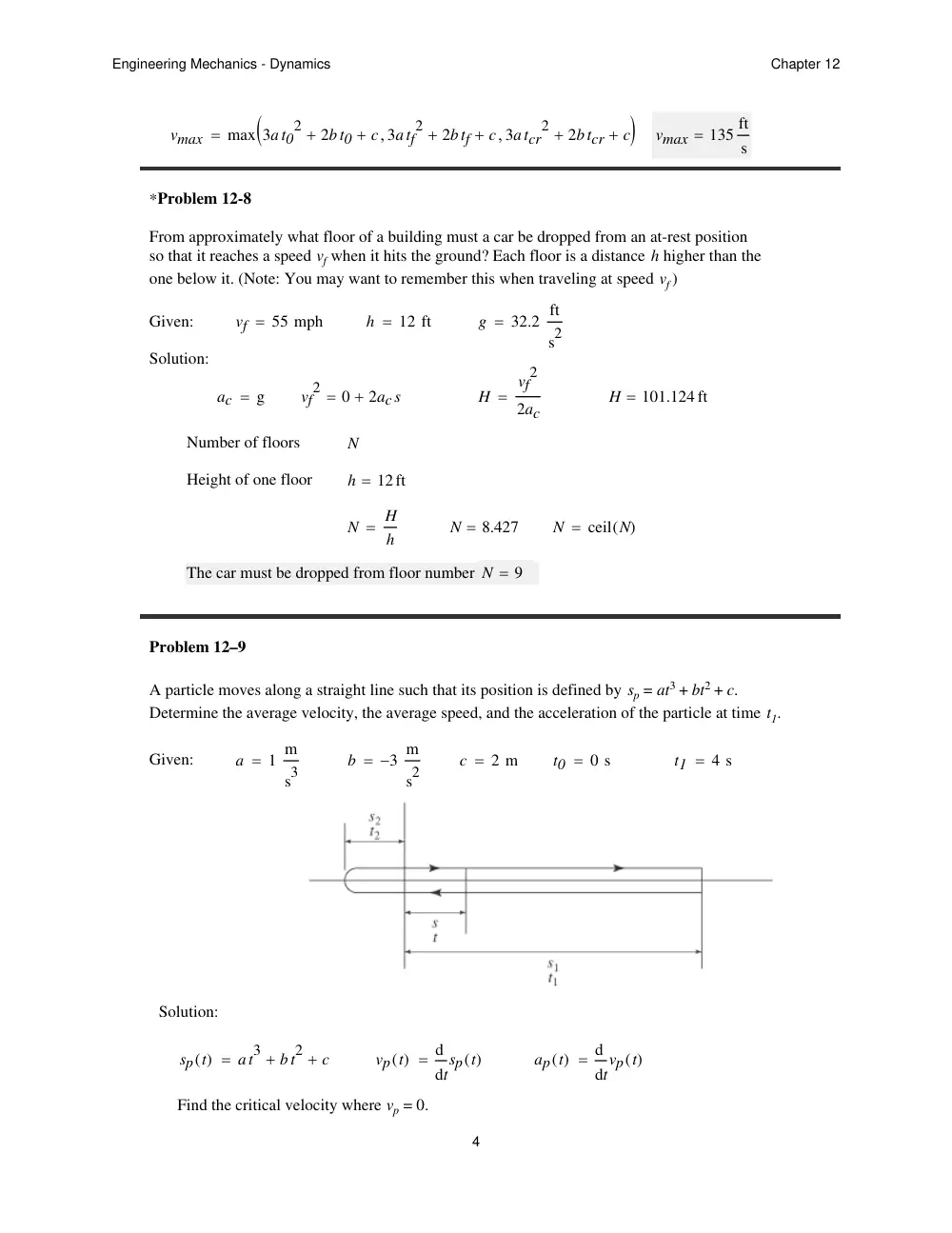
vmax
max 3at0
2
+ 2bt0
+ c
3atf
2
+ 2btf
+ c
,
3atcr
2
+ 2btcr
+ c
,
(
)
=
vmax
135 ft
s
=
*Problem 12-8
From approximately what floor of a building must a car be dropped from an at-rest position
so that it reaches a speed vf when it hits the ground? Each floor is a distance h higher than the
one below it. (Note: You may want to remember this when traveling at speed vf )
Given:
vf
= 55 mph
h
= 12 ft
g
32.2 ft
s2
=
Solution:
ac
= g
vf
2
0
+ 2ac s
=
H
vf
2
2ac
=
H
101.124 ft
=
Number of floors
N
Height of one floor
h
12ft
=
N
H
= h
N
= 8.427
N
ceil N
( )
=
The car must be dropped from floor number N
9
=
Problem 12–9
A particle moves along a straight line such that its position is defined by sp = at3 + bt2 + c.
Determine the average velocity, the average speed, and the acceleration of the particle at time t1.
Given:
a
1 m
s3
=
b
−3
m
s2
=
c
= 2 m
t0
= 0 s
t1
4 s
=
Solution:
sp t( )
at3
+ bt2
+ c
=
vp t( )
t
sp t( )
d
d
=
ap t( )
t
vp t( )
d
d
=
Find the critical velocity where vp = 0.
4
Engineering Mechanics - Dynamics
Chapter 12
t2
= 1.5 s
Given
vp t2
( )
= 0
t2
Find t2
( )
=
t2
2 s
=
vave
sp t1
( )
sp t0
( )
−
t1
=
vave
4 m
s
=
vavespeed
sp t2
( )
sp t0
( )
−
sp t1
( )
sp t2
( )
−
+
t1
=
vavespeed
6 m
s
=
a1
ap t1
( )
=
a1
18 m
s2
=
Problem 12–10
A particle is moving along a straight line such that its acceleration is defined as a = −kv. If
v = v0 when d = 0 and t = 0, determine the particle’s velocity as a function of position and
the distance the particle moves before it stops.
Given:
k
2
= s
v0
20 m
s
=
Solution:
ap v
( )
k
= − v
v
s
v
d
d
k
− v
=
v0
v
1 v
⌠
⎮⌡
d
k
− sp
=
Velocity as a function of position
v
v0
− ksp
=
Distance it travels before it stops
0
v0
− ksp
=
sp
v0
k
=
sp
10 m
=
Problem 12-11
The acceleration of a particle as it moves along a straight line is given by a = bt + c. If s = s0
and v = v0 when t = 0, determine the particle’s velocity and position when t = t1. Also,
determine the total distance the particle travels during this time period.
Given:
b
2 m
s3
=
c
−1
m
s2
=
s0
= 1 m
v0
2 m
s
=
t1
6 s
=
5
Engineering Mechanics - Dynamics
Chapter 12
v0
v
1 v
⌠
⎮⌡
d
0
t
t
bt
+ c
(
)
⌠
⎮⌡
d
=
v
v0
bt2
2
+
+ ct
=
s0
s
1 s
⌠
⎮⌡
d
0
t
t
v0
bt2
2
+
+ ct
⎛⎜
⎝
⎞⎟
⎠
⌠
⎮
⎮
⌡
d
=
s
s0
+ v0 t
b
+ 6t3
c
+ 2t2
=
When t = t1
v1
v0
bt1
2
2
+
+ ct1
=
v1
32 m
s
=
s1
s0
+ v0 t1
b
6t1
3
+
c
2t1
2
+
=
s1
67 m
=
The total distance traveled depends on whether the particle turned around or not. To tell we
will plot the velocity and see if it is zero at any point in the interval
t
0 0.01t1
,
.. t1
=
v t( )
v0
bt2
2
+
+ ct
=
If v never goes to zero
then
0
2
4
6
0
20
40
v t( )
t
d
s1
− s0
=
d
66 m
=
*Problem 12–12
A particle, initially at the origin, moves along a straight line through a fluid medium such that its
velocity is defined as v = b(1 − e−ct). Determine the displacement of the particle during the time
0 < t < t1.
Given:
b
1.8 m
s
=
c
0.3
s
=
t1
3 s
=
6
Solution:
Engineering Mechanics - Dynamics
Chapter 12
v t( )
b 1
e c
−
t
( −
)
=
sp t( )
0
t
t
v t( )
⌠
⎮⌡
d
=
sp t1
( )
1.839 m
=
Problem 12–13
The velocity of a particle traveling in a straight line is given v = bt + ct2. If s = 0 when t = 0,
determine the particle’s deceleration and position when t = t1. How far has the particle traveled
during the time t1, and what is its average speed?
Given:
b
6 m
s2
=
c
−3
m
s3
=
t0
= 0 s
t1
3 s
=
Solution:
v t( )
bt
+ ct2
=
a t( )
t
v t( )
d
d
=
sp t( )
0
t
t
v t( )
⌠
⎮⌡
d
=
Deceleration
a1
a t1
( )
=
a1
−12
m
s2
=
Find the turning time t2
t2
= 1.5 s
Given
v t2
( )
= 0
t2
Find t2
( )
=
t2
2 s
=
Total distance traveled
d
sp t1
( )
sp t2
( )
−
sp t2
( )
sp t0
( )
−
+
=
d
8 m
=
Average speed
vavespeed
d
t1
− t0
=
vavespeed
2.667 m
s
=
Problem 12–14
A particle moves along a straight line such that its position is defined by s = bt2 + ct + d.
Determine the average velocity, the average speed, and the acceleration of the particle
when t = t1.
Given:
b
1 m
s2
=
c
−6
m
s
=
d
= 5 m
t0
= 0 s
t1
6 s
=
Solution:
sp t( )
bt2
+ ct
+ d
=
v t( )
t
sp t( )
d
d
=
a t( )
t
v t( )
d
d
=
Find the critical time
t2
= 2s
Given
v t2
( )
= 0
t2
Find t2
( )
=
t2
3 s
=
vavevel
sp t1
( )
sp t0
( )
−
t1
=
vavevel
0 m
s
=
7
Solution:
Engineering Mechanics - Dynamics
Chapter 12
vavespeed
sp t1
( )
sp t2
( )
−
sp t2
( )
sp t0
( )
−
+
t1
=
vavespeed
3 m
s
=
a1
a t1
( )
=
a1
2 m
s2
=
Problem 12–15
A particle is moving along a straight line such that when it is at the origin it has a velocity v0.
If it begins to decelerate at the rate a = bv1/2 determine the particle’s position and velocity
when t = t1.
Given:
v0
4 m
s
=
b
−1.5
m
s3
=
t1
= 2 s
a v
( )
b
v
=
Solution:
a v
( )
b
v
=
t
d v
d
=
v0
v
v
1
v
⌠
⎮
⎮⌡
d
2
v
v0
−
(
)
=
bt
=
v t( )
v0
1
+ 2bt
⎛⎜⎝
⎞⎟⎠
2
=
v t1
( )
0.25 m
s
=
sp t( )
0
t
t
v t( )
⌠
⎮⌡
d
=
sp t1
( )
3.5 m
=
*Problem 12-16
A particle travels to the right along a straight line with a velocity vp = a / (b + sp). Determine its
deceleration when sp = sp1.
Given:
a
5 m2
s
=
b
= 4 m
sp1
2 m
=
Solution:
vp
a
b
+ sp
=
ap
vp
dvp
dsp
=
a
b
sp
+
a
−
b
( + sp
)2
=
a2
−
b
( + sp
)3
=
ap1
a2
−
b
( + sp1
)3
=
ap1
−0.116
m
s2
=
8
Engineering Mechanics - Dynamics
Chapter 12
Problem 12–17
Two particles A and B start from rest at the origin s = 0 and move along a straight line such
that aA = (at − b) and aB = (ct2 − d), where t is in seconds. Determine the distance between
them at t and the total distance each has traveled in time t.
Given:
a
6 ft
s3
=
b
3 ft
s2
=
c
12 ft
s3
=
d
8 ft
s2
=
t
4 s
=
Solution:
dvA
dt
at
− b
=
vA
at2
2
− bt
⎛⎜
⎝
⎞⎟
⎠
=
sA
at3
6
bt2
− 2
⎛⎜
⎝
⎞⎟
⎠
=
dvB
dt
ct2
− d
=
vB
ct3
3 s
− dt
⎛⎜
⎝
⎞⎟
⎠
=
sB
ct4
12 s
dt2
− 2
⎛⎜
⎝
⎞⎟
⎠
=
Distance between A and B
dAB
at3
6
bt2
2
−
ct4
− 12 s
dt2
2
+
=
dAB
46.33 m
=
Total distance A and B has travelled.
D
at3
6
bt2
2
−
ct4
+ 12 s
dt2
2
−
=
D
70.714 m
=
Problem 12–18
A car is to be hoisted by elevator to the fourth floor of a parking garage, which is at a height h
above the ground. If the elevator can accelerate at a1, decelerate at a2, and reach a maximum
speed v, determine the shortest time to make the lift, starting from rest and ending at rest.
Given:
h
= 48 ft
a1
0.6 ft
s2
=
a2
0.3 ft
s2
=
v
8 ft
s
=
Solution:
Assume that the elevator never reaches its maximum speed.
Guesses
t1
= 1 s
t2
= 2 s
vmax
1 ft
s
=
h1
1 ft
=
Given
vmax
a1 t1
=
9
Engineering Mechanics - Dynamics
Chapter 12
h1
1
2a1 t1
2
=
0
vmax
a2 t2
− t1
(
)
−
=
h
h1
vmax t2
− t1
(
)
+
1
2a2 t2
− t1
(
)2
−
=
t1
t2
vmax
h1
⎛
⎜
⎜
⎜
⎜
⎝
⎞
⎟
⎟
⎟
⎟
⎠
Find t1 t2
,
, vmax
, h1
(
)
=
t2
21.909 s
=
Since vmax
4.382 ft
s
=
< v
8 ft
s
=
then our original assumption is correct.
Problem 12-19
A stone A is dropped from rest down a well, and at time t1 another stone B is
dropped from rest. Determine the distance between the stones at a later time t2.
Given:
d
= 80 ft
t1
= 1 s
t2
= 2 s
g
32.2 ft
s2
=
Solution:
aA
= g
vA
= gt
sA
g
2t2
=
aB
= g
vB
g t
( − t1
)
=
sB
g
2 t
( − t1
)2
=
At time t2
sA2
g
2t2
2
=
sA2
64.4 ft
=
sB2
g
2 t2
− t1
(
)2
=
sB2
16.1 ft
=
d
sA2
− sB2
=
d
48.3 ft
=
*Problem 12-20
A stone A is dropped from rest down a well, and at time t1 another stone B is dropped from rest.
Determine the time interval between the instant A strikes the water and the instant B strikes the
water. Also, at what speed do they strike the water?
10
Engineering Mechanics - Dynamics
Chapter 12
Given:
d
= 80 ft
t1
= 1 s
g
32.2 ft
s2
=
Solution:
aA
= g
vA
= gt
sA
g
2t2
=
aB
= g
vB
g t
( − t1
)
=
sB
g
2 t
( − t1
)2
=
Time to hit for each particle
tA
2d
g
=
tA
2.229 s
=
tB
2d
g
+ t1
=
tB
3.229 s
=
Δt
tB
− tA
=
Δt
1 s
=
Speed
vA
= gtA
vB
= vA
vA
71.777 ft
s
=
vB
71.777 ft
s
=
Problem 12–21
A particle has an initial speed v0. If it experiences a deceleration a = bt, determine the
distance traveled before it stops.
Given:
v0
27 m
s
=
b
−6
m
s3
=
Solution:
a t( )
= bt
v t( )
b t2
2
+ v0
=
sp t( )
b t3
6
+ v0 t
=
t
2v0
−b
=
t
= 3 s
sp t( )
54 m
=
Problem 12-22
The acceleration of a rocket traveling upward is given by ap = b + c sp. Determine the rocket’s
velocity when sp = sp1 and the time needed to reach this altitude. Initially, vp = 0 and sp = 0 when t = 0.
11
Engineering Mechanics - Dynamics
Chapter 12
Given:
b
6 m
s2
=
c
0.02 1
s2
=
sp1
2000 m
=
Solution:
ap
b
+ csp
=
vp
dvp
dsp
=
0
vp
vp
vp
⌠
⎮⌡
d
0
sp
sp
b
( + csp
)
⌠
⎮⌡
d
=
vp
2
2
bsp
c
2sp
2
+
=
vp
dsp
dt
=
2bsp
csp
2
+
=
vp1
2bsp1
csp1
2
+
=
vp1
322.49 m
s
=
t
0
sp
sp
1
2bsp
csp
2
+
⌠⎮
⎮
⎮⌡
d
=
t1
0
sp1
sp
1
2bsp
csp
2
+
⌠⎮
⎮
⎮⌡
d
=
t1
19.274 s
=
Problem 12-23
The acceleration of a rocket traveling upward is given by ap = b + c sp.
Determine the time needed for the rocket to reach an altitute sp1. Initially,
vp = 0 and sp = 0 when t = 0.
Given:
b
6 m
s2
=
c
0.02 1
s2
=
sp1
100 m
=
Solution:
ap
b
+ csp
=
vp
dvp
dsp
=
0
vp
vp
vp
⌠
⎮⌡
d
0
sp
sp
b
( + csp
)
⌠
⎮⌡
d
=
vp
2
2
bsp
c
2sp
2
+
=
vp
dsp
dt
=
2bsp
csp
2
+
=
vp1
2bsp1
csp1
2
+
=
vp1
37.417 m
s
=
12
Engineering Mechanics - Dynamics
Chapter 12
t
0
sp
sp
1
2bsp
csp
2
+
⌠⎮
⎮
⎮⌡
d
=
t1
0
sp1
sp
1
2bsp
csp
2
+
⌠⎮
⎮
⎮⌡
d
=
t1
5.624 s
=
*Problem 12–24
A particle is moving with velocity v0 when s = 0 and t = 0. If it is subjected to a deceleration of
a
k
= − v3
, where k is a constant, determine its velocity and position as functions of time.
Solution:
a
dv
= dt
k
− v3
=
v0
v
v
v 3
−
⌠
⎮
⌡
d
0
t
−k t
⌠
⎮⌡
d
=
1
−
2 v 2
−
v0
− 2
−
(
)
k
− t
=
v t( )
1
2kt
1
v0
2
+
=
ds
vdt
=
0
s
1 s
⌠
⎮⌡
d
0
t
t
1
2kt
1
v0
2
⎛
⎜
⎝
⎞
⎟
⎠
+
⌠⎮
⎮
⎮
⎮⌡
d
=
s t( )
1
k
2kt
1
v0
2
⎛
⎜
⎝
⎞
⎟
⎠
+
1
v0
−
⎡
⎢
⎣
⎤
⎥
⎦
=
Problem 12–25
A particle has an initial speed v0. If it experiences a deceleration a = bt, determine its velocity
when it travels a distance s1. How much time does this take?
Given:
v0
27 m
s
=
b
−6
m
s3
=
s1
10 m
=
Solution:
a t( )
= bt
v t( )
b t2
2
+ v0
=
sp t( )
b t3
6
+ v0 t
=
Guess
t1
= 1 s
Given
sp t1
( )
= s1
t1
Find t1
( )
=
t1
0.372 s
=
v t1
( )
26.6 m
s
=
13
Engineering Mechanics - Dynamics
Chapter 12
Problem 12-26
Ball A is released from rest at height h1 at the same time that a
second ball B is thrown upward from a distance h2 above the
ground. If the balls pass one another at a height h3 determine the
speed at which ball B was thrown upward.
Given:
h1
40 ft
=
h2
5 ft
=
h3
20 ft
=
g
32.2 ft
s2
=
Solution:
For ball A:
For ball B:
aA
= −g
aB
−g
=
vA
g
= − t
vB
g
− t
+ vB0
=
sA
−g
2
⎛⎜⎝
⎞⎟⎠
t2
+ h1
=
sB
−g
2
⎛⎜⎝
⎞⎟⎠
t2
+ vB0 t
+ h2
=
Guesses
t
= 1 s
vB0
2 ft
s
=
Given
h3
−g
2
⎛⎜⎝
⎞⎟⎠
t2
+ h1
=
h3
−g
2
⎛⎜⎝
⎞⎟⎠
t2
+ vB0 t
+ h2
=
t
⎛⎜vB0
⎝
⎞⎟
⎠
Find t vB0
( ,
)
=
t
= 1.115 s
vB0
31.403 ft
s
=
Problem 12–27
A car starts from rest and moves along a straight line with an acceleration a = k s−1/3.
Determine the car’s velocity and position at t = t1.
Given:
k
3
m4
s6
⎛⎜
⎜⎝
⎞⎟
⎟⎠
1
3
=
t1
6 s
=
14
Engineering Mechanics - Dynamics
Chapter 12
Solution:
a
v
sp
v
d
d
=
ksp
1
−
3
=
0
v
v v
⌠
⎮⌡
d
v2
2
=
0
sp
s
ksp
1
−
3
⌠
⎮
⎮
⌡
d
=
3
2ksp
2
3
=
v
3ksp
1
3
=
t
sp
d
d
=
3kt
0
sp
sp
sp
1
−
3
⌠
⎮
⎮
⌡
d
=
3
2sp
2
3
=
sp t( )
2
3kt
3
⎛⎜⎝
⎞⎟⎠
3
2
=
sp t1
( )
41.6 m
=
v t( )
t
sp t( )
d
d
=
v t1
( )
10.39 m
s
=
*Problem 12-28
The acceleration of a particle along a straight line is defined by ap = b t + c. At t = 0, sp = sp0
and vp = vp0. When t = t1 determine (a) the particle's position, (b) the total distance traveled,
and (c) the velocity.
Given:
b
2 m
s3
=
c
−9
m
s2
=
sp0
= 1 m
vp0
10 m
s
=
t1
9 s
=
Solution:
ap
bt
+ c
=
vp
b
2
⎛⎜⎝
⎞⎟⎠
t2
+ ct
+ vp0
=
sp
b
6
⎛⎜⎝
⎞⎟⎠
t3
c
2
⎛⎜⎝
⎞⎟⎠
t2
+
+ vp0t
+ sp0
=
a ) The position
sp1
b
6
⎛⎜⎝
⎞⎟⎠
t1
3
c
2
⎛⎜⎝
⎞⎟⎠
t1
2
+
+ vp0t1
+ sp0
=
sp1
−30.5
m
=
b ) The total distance traveled - find the turning times
vp
b
2
⎛⎜⎝
⎞⎟⎠
t2
+ ct
+ vp0
=
0
=
t2
−c
c2
− 2bvp0
−
b
=
t2
1.298 s
=
15
Engineering Mechanics - Dynamics
Chapter 12
t3
−c
c2
− 2bvp0
+
b
=
t3
7.702 s
=
sp2
b
6
⎛⎜⎝
⎞⎟⎠
t2
3
c
2
⎛⎜⎝
⎞⎟⎠
t2
2
+
+ vp0t2
+ sp0
=
sp2
7.127 m
=
sp3
b
6
⎛⎜⎝
⎞⎟⎠
t3
3
c
2t3
2
+
+ vp0t3
+ sp0
=
sp3
−36.627
m
=
d
sp2
− sp0
sp2
− sp3
+
sp1
− sp3
+
=
d
56.009 m
=
c )
The velocity
vp1
b
2
⎛⎜⎝
⎞⎟⎠
t1
2
+ ct1
+ vp0
=
vp1
10 m
s
=
Problem 12–29
A particle is moving along a straight line such that its acceleration is defined as a = k s2. If
v = v0 when s = sp0 and t = 0, determine the particle’s velocity as a function of position.
Given:
k
4
1
ms2
=
v0
−100
m
s
=
sp0
10 m
=
Solution:
a
v
sp
v
d
d
=
ksp
2
=
v0
v
v v
⌠
⎮⌡
d
sp0
sp
sp
ksp
2
⌠
⎮
⌡
d
=
1
2 v2
v0
2
−
(
)
1
3k sp
3
sp0
3
−
(
)
=
v
v0
2
2
3k sp
3
sp0
3
−
(
)
+
=
Problem 12–30
A car can have an acceleration and a deceleration a. If it starts from rest, and can have a
maximum speed v, determine the shortest time it can travel a distance d at which point it
stops.
Given:
a
5 m
s2
=
v
60 m
s
=
d
1200 m
=
Solution:
Assume that it can reach maximum speed
Guesses
t1
= 1 s
t2
= 2 s
t3
= 3 s
d1
= 1 m
d2
2 m
=
Given
at1
= v
1
2at1
2
= d1
d2
d1
v t2
− t1
(
)
+
=
16
Engineering Mechanics - Dynamics
Chapter 12
d
d2
v t3
− t2
(
)
+
1
2a t3
− t2
(
)2
−
=
0
v
a t3
− t2
(
)
−
=
t1
t2
t3
d1
d2
⎛⎜
⎜
⎜
⎜
⎜
⎜⎝
⎞⎟
⎟
⎟
⎟
⎟
⎟⎠
Find t1 t2
,
, t3
, d1
, d2
(
)
=
t1
t2
t3
⎛⎜
⎜
⎜⎝
⎞⎟
⎟
⎟⎠
12
20
32
⎛
⎜
⎜
⎝
⎞
⎟
⎟
⎠
s
=
d1
d2
⎛
⎜
⎝
⎞
⎟
⎠
360
⎛⎜⎝840
⎞⎟⎠
m
=
t3
32 s
=
Problem 12-31
Determine the time required for a car to travel a distance d along a road if the car starts from
rest, reaches a maximum speed at some intermediate point, and then stops at the end of the
road. The car can accelerate at a1 and decelerate at a2.
Given:
d
= 1 km
a1
1.5 m
s2
=
a2
2 m
s2
=
Let t1 be the time at which it stops accelerating and t the total time.
Solution:
Guesses
t1
= 1 s
d1
= 1 m
t
= 3 s
v1
1 m
s
=
Given
d1
a1
2 t1
2
=
v1
= a1 t1
v1
a2 t
( − t1
)
=
d
d1
v1 t
( − t1
)
+
1
2a2 t
( − t1
)2
−
=
t1
t
v1
d1
⎛
⎜
⎜
⎜
⎜
⎝
⎞
⎟
⎟
⎟
⎟
⎠
Find t1 t,
, v1
, d1
(
)
=
t1
= 27.603 s
v1
41.404 m
s
=
d1
571.429 m
=
t
48.305 s
=
*Problem 12-32
When two cars A and B are next to one another, they are traveling in the same direction with
speeds vA0 and vB0 respectively. If B maintains its constant speed, while A begins to decelerate
at the rate aA, determine the distance d between the cars at the instant A stops.
17
Engineering Mechanics - Dynamics
Chapter 12
Solution:
Motion of car A:
−aA
= constant
0
vA0
− aAt
=
sA
vA0 t
1
− 2aAt2
=
t
vA0
aA
=
sA
vA0
2
2aA
=
Motion of car B:
aB
= 0
vB
= vB0
sB
= vB0 t
sB
vB0 vA0
aA
=
The distance between cars A and B is
d
sB
− sA
=
vB0 vA0
aA
vA0
2
2aA
−
=
2vB0 vA0
vA0
2
−
2aA
=
d
2vB0 vA0
vA0
2
−
2aA
=
Problem 12-33
If the effects of atmospheric resistance are accounted for, a freely falling body has an acceleration
defined by the equation a
g 1
( − cv2
)
=
, where the positive direction is downward. If the body is
released from rest at a very high altitude, determine (a) the velocity at time t1 and (b) the body’s
terminal or maximum attainable velocity as t →∞.
Given:
t1
= 5 s
g
9.81 m
s2
=
c
10 4
−
s2
m2
=
Solution:
(a)
a
dv
= dt
g 1
( − cv2
)
=
Guess
v1
1 m
s
=
Given
0
v1
v
1
1
cv2
−
⌠
⎮
⎮
⌡
d
0
t1
g t
⌠
⎮⌡
d
=
v1
Find v1
(
)
=
v1
45.461 m
s
=
18
Engineering Mechanics - Dynamics
Chapter 12
(b)
Terminal velocity means a = 0
0
g 1
cvterm
2
( −
)
=
vterm
1
c
=
vterm
100 m
s
=
Problem 12-34
As a body is projected to a high altitude above the earth’s surface, the variation of the acceleration
of gravity with respect to altitude y must be taken into account. Neglecting air resistance, this
acceleration is determined from the formula a = g
− [R2/(R+y)2], where g is the constant
gravitational acceleration at sea level, R is the radius of the earth, and the positive direction is
measured upward. If g = 9.81 m/s2 and R = 6356 km, determine the minimum initial velocity
(escape velocity) at which a projectile should be shot vertically from the earth’s surface so that it
does not fall back to the earth. Hint: This requires that v = 0 as y → ∞.
Solution:
g
9.81 m
s2
=
R
6356 km
=
vdv
= ady
g
− R2
R
+ y
(
)2 dy
=
v
0
v v
⌠
⎮⌡
d
g
− R2
0
∞
y
1
R
+ y
(
)2
⌠
⎮
⎮
⌡
d
=
v2
−
2
g
− R
=
v
2gR
=
v
11.2 km
s
=
Problem 12-35
Accounting for the variation of gravitational acceleration a with respect to altitude y (see
Prob. 12-34), derive an equation that relates the velocity of a freely falling particle to its
altitude. Assume that the particle is released from rest at an altitude y0 from the earth’s
surface. With what velocity does the particle strike the earth if it is released from rest at
an altitude y0. Use the numerical data in Prob. 12-34.
Solution:
g
9.81 m
s2
=
R
= 6356 km
y0
500 km
=
vdv
= ady
g
− R2
R
+ y
(
)2 dy
=
19
Engineering Mechanics - Dynamics
Chapter 12
0
v
v v
⌠
⎮⌡
d
g
− R2
y0
y
y
1
R
+ y
(
)2
⌠
⎮
⎮
⌡
d
=
v2
2
gR2
1
R
y
+
1
R
+ y0
−
⎛⎜⎝
⎞⎟⎠
=
gR2 y0
− y
(
)
R
+ y
(
) R
+ y0
(
)
=
v
2gR2 y0
− y
(
)
R
+ y
(
) R
+ y0
(
)
=
When it hits, y = 0
vearth
2gR y0
R
+ y0
=
vearth
3.016 km
s
=
*Problem 12-36
When a particle falls through the air, its initial acceleration a = g diminishes until it is
zero, and thereafter it falls at a constant or terminal velocity vf. If this variation of the
acceleration can be expressed as a = (g/vf
2)(v2
f − v2), determine the time needed for
the velocity to become v < vf. Initially the particle falls from rest.
Solution:
dv
dt
= a
g
vf
2 vf
2
− v2
(
)
=
0
v
v
1
vf
2
v2
−
⌠⎮
⎮
⎮⌡
d
g
vf
2
0
t
1 t
⌠
⎮⌡
d
=
1
2vf
ln
vf
v
+
vf
v
−
⎛⎜
⎝
⎞⎟
⎠
g
vf
2
⎛
⎜
⎝
⎞
⎟
⎠
t
=
t
vf
2g ln
vf
v
+
vf
v
−
⎛⎜
⎝
⎞⎟
⎠
=
Problem 12-37
An airplane starts from rest, travels a distance d down a runway, and after uniform acceleration,
takes off with a speed vr It then climbs in a straight line with a uniform acceleration aa until it
reaches a constant speed va. Draw the s-t, v-t, and a-t graphs that describe the motion.
Given:
d
= 5000 ft
vr
162 mi
hr
=
aa
3 ft
s2
=
va
220 mi
hr
=
Solution:
First find the acceleration and time on the runway and the time in the air
ar
vr
2
= 2d
ar
5.645 ft
s2
=
tr
vr
ar
=
tr
42.088 s
=
20
Engineering Mechanics - Dynamics
Chapter 12
ta
va
vr
−
aa
=
ta
28.356 s
=
The equations of motion
t1
0 0.01tr
,
.. tr
=
a1 t1
( )
ar
s2
ft
=
v1 t1
( )
art1
s
ft
=
s1 t1
( )
1
2art1
2 1
ft
=
t2
tr 1.01tr
,
tr
+ ta
..
=
a2 t2
( )
aa
s2
ft
=
v2 t2
( )
artr
aa t2
− tr
(
)
+
⎡⎣
⎤⎦
s
ft
=
s2 t2
( )
1
2artr
2
artr t2
− tr
(
)
+
1
2aa t2
− tr
(
)2
+
⎡⎢⎣
⎤⎥⎦
1
ft
=
The plots
0
10
20
30
40
50
60
70
80
0
5000
1 .104
1.5.104
Time in seconds
Distance in ft
s1 t1
( )
s2 t2
( )
t1 t2
,
0
10
20
30
40
50
60
70
80
0
200
400
Time in seconds
Velocity in ft/s
v1 t1
( )
v2 t2
( )
t1 t2
,
21
Engineering Mechanics - Dynamics
Chapter 12
0
10
20
30
40
50
60
70
80
0
2
4
6
Time in seconds
Acceleration in ft/s^2
a1 t1
( )
a2 t2
( )
t1 t2
,
Problem 12-38
The elevator starts from rest at the first floor of the building. It can accelerate at rate a1 and then
decelerate at rate a2. Determine the shortest time it takes to reach a floor a distance d above the
ground. The elevator starts from rest and then stops. Draw the a-t, v-t, and s-t graphs for the
motion.
Given:
a1
5 ft
s2
=
a2
2 ft
s2
=
d
40 ft
=
Solution:
Guesses
t1
= 1 s
t
2 s
=
d1
= 20 ft
vmax
1 ft
s
=
Given
vmax
= a1 t1
d1
1
2a1 t1
2
=
vmax
a2 t
( − t1
)
=
d
d1
vmax t
( − t1
)
+
1
2a2 t
( − t1
)2
−
=
t1
t
d1
vmax
⎛
⎜
⎜
⎜
⎜
⎝
⎞
⎟
⎟
⎟
⎟
⎠
Find t1 t,
, d1
, vmax
(
)
=
d1
= 11.429 ft
t1
= 2.138 s
vmax
10.69 ft
s
=
t
7.483 s
=
The equations of motion
ta
0 0.01t1
,
.. t1
=
td
t1 1.01t1
,
.. t
=
aa ta
( )
a1
s2
ft
=
ad td
( )
−a2
s2
ft
=
22
Engineering Mechanics - Dynamics
Chapter 12
va ta
( )
a1 ta
s
ft
=
vd td
( )
vmax
a2 td
− t1
(
)
−
⎡⎣
⎤⎦
s
ft
=
sa ta
( )
1
2a1 ta
2 1
ft
=
sd td
( )
d1
vmax td
− t1
(
)
+
1
2a2 td
− t1
(
)2
−
⎡⎢⎣
⎤⎥⎦
1
ft
=
The plots
0
1
2
3
4
5
6
7
8
5
0
5
Time in seconds
Acceleration in ft/s^2
aa ta
( )
ad td
( )
ta td
,
0
1
2
3
4
5
6
7
8
0
5
10
15
Time in seconds
Velocity in ft/s
va ta
( )
vd td
( )
ta td
,
23
Engineering Mechanics - Dynamics
Chapter 12
0
1
2
3
4
5
6
7
8
0
20
40
Time in seconds
Distance in ft
sa ta
( )
sd td
( )
ta td
,
Problem 12–39
If the position of a particle is defined as s = bt + ct2, construct the s–t, v–t, and a–t graphs for
0
≤ t
≤ T
.
Given:
b
= 5 ft
c
−3
ft
=
T
= 10 s
t
0 0.01T
,
.. T
=
Solution:
sp t( )
bt
+ ct2
(
) 1
ft
=
v t( )
b
+ 2ct
(
) s
ft
=
a t( )
(2c
) s2
ft
=
0
2
4
6
8
10
400
200
0
200
Time (s)
Displacement (ft)
sp t( )
t
0
2
4
6
8
10
100
50
0
50
Time (s)
Velocity (ft/s)
v t( )
t
24
Engineering Mechanics - Dynamics
Chapter 12
0
2
4
6
8
10
6.01
6.005
6
5.995
5.99
Time (s)
Acceleration (ft/s^2)
a t( )
t
*Problem 12-40
If the position of a particle is defined by sp = b sin(ct) + d, construct the s-t, v-t, and a-t graphs
for 0 ≤ t ≤ T.
Given:
b
= 2 m
c
π
5
1
s
=
d
= 4 m
T
= 10 s
t
0 0.01T
,
.. T
=
Solution:
sp t( )
bsin ct
(
)
+ d
(
) 1
m
=
vp t( )
bccos ct
(
) s
m
=
ap t( )
b
− c2 sin ct
(
)
s
m2
=
0
2
4
6
8
10
2
4
6
Time in seconds
Distance in m
sp t( )
t
25
Engineering Mechanics - Dynamics
Chapter 12
0
2
4
6
8
10
2
0
2
Time in seconds
Velocity in m/s
vp t( )
t
0
2
4
6
8
10
1
0
1
Time in seconds
Acceleration in m/s^2
ap t( )
t
Problem 12-41
The v-t graph for a particle moving through an electric field from one plate to another has the shape
shown in the figure. The acceleration and deceleration that occur are constant and both have a
magnitude a. If the plates are spaced smax apart, determine the maximum velocity vmax and the time tf
for the particle to travel from one plate to the other. Also draw the s-t graph. When t = tf/2 the
particle is at s = smax/2.
Given:
a
4 m
s2
=
smax
200 mm
=
Solution:
smax
2 1
2a
tf
2
⎛⎜⎝
⎞⎟⎠
2
⎡
⎢
⎣
⎤
⎥
⎦
=
26
Engineering Mechanics - Dynamics
Chapter 12
tf
4smax
a
=
tf
0.447 s
=
vmax
a
tf
2
=
vmax
0.894 m
s
=
The plots
t1
0 0.01tf
,
tf
.. 2
=
s1 t1
( )
1
2at1
2 1
m
=
t2
tf
2 1.01
tf
2
,
.. tf
=
s2 t2
( )
1
2a
tf
2
⎛⎜⎝
⎞⎟⎠
2
a
tf
2 t2
tf
− 2
⎛⎜⎝
⎞⎟⎠
+
1
2a t2
tf
− 2
⎛⎜⎝
⎞⎟⎠
2
−
⎡
⎢
⎣
⎤
⎥
⎦
1
m
=
0
0.05
0.1
0.15
0.2
0.25
0.3
0.35
0.4
0
0.1
0.2
Time in seconds
Distance in m
s1 t1
( )
s2 t2
( )
t1 t2
,
Problem 12-42
The v-t graph for a particle moving through an electric field from one plate to another has the shape
shown in the figure, where tf and vmax are given. Draw the s-t and a-t graphs for the particle. When
t = tf /2 the particle is at s = sc.
Given:
tf
0.2 s
=
vmax
10 m
s
=
sc
0.5 m
=
Solution:
a
2vmax
tf
=
a
100 m
s2
=
27
Engineering Mechanics - Dynamics
Chapter 12
The plots
t1
0 0.01tf
,
tf
.. 2
=
s1 t1
( )
1
2at1
2 1
m
=
a1 t1
( )
a s2
m
=
t2
tf
2 1.01
tf
2
,
.. tf
=
s2 t2
( )
1
2a
tf
2
⎛⎜⎝
⎞⎟⎠
2
a
tf
2 t2
tf
− 2
⎛⎜⎝
⎞⎟⎠
+
1
2a t2
tf
− 2
⎛⎜⎝
⎞⎟⎠
2
−
⎡
⎢
⎣
⎤
⎥
⎦
1
m
=
a2 t2
( )
−a
s2
m
=
0
0.05
0.1
0.15
0.2
0
0.5
1
Time in seconds
Distance in m
s1 t1
( )
s2 t2
( )
t1 t2
,
0
0.05
0.1
0.15
0.2
100
0
100
Time in seconds
Acceleration in m/s^2
a1 t1
( )
a2 t2
( )
t1 t2
,
Problem 12–43
A car starting from rest moves along a straight track with an acceleration as shown. Determine
the time t for the car to reach speed v.
28
Engineering Mechanics - Dynamics
Chapter 12
Given:
v
50 m
s
=
a1
8 m
s2
=
t1
10 s
=
Solution:
Assume that t > t1
Guess
t
12 s
=
Given
v
a1
t1
t1
2
2
a1 t
( − t1
)
+
=
t
= Find t( )
t
11.25 s
=
*Problem 12-44
A motorcycle starts from rest at s = 0 and travels along a straight road with the speed shown by the
v-t graph. Determine the motorcycle's acceleration and position when t = t4 and t = t5.
Given:
v0
5 m
s
=
t1
4 s
=
t2
10 s
=
t3
15 s
=
t4
8 s
=
t5
12 s
=
Solution:
At
t
= t4
Because t1
< t4
< t2
then
a4
dv
= dt
0
=
s4
1
2v0 t1
t4
− t1
(
)v0
+
=
s4
30 m
=
At
t
= t5
Because t2
< t5
< t3
then
a5
v0
−
t3
− t2
=
a5
−1
m
s2
=
29
Engineering Mechanics - Dynamics
Chapter 12
s5
1
2t1 v0
v0 t2
− t1
(
)
+
1
2v0 t3
− t2
(
)
+
1
2
t3
t5
−
t3
− t2
v0 t3
− t5
(
)
−
=
s5
48 m
=
Problem 12–45
From experimental data, the motion of a jet plane while traveling along a runway is defined by
the v–t graph shown. Construct the s-t and a-t graphs for the motion.
Given:
v1
80 m
s
=
t1
10 s
=
t2
40 s
=
Solution:
k1
v1
t1
=
k2
0 m
s2
=
τ1
0 0.01t1
,
.. t1
=
s1 τ1
(
)
1
2k1τ1
2
⎛⎜⎝
⎞⎟⎠
m
=
a1 τ1
(
)
k1
s2
m
=
τ2
t1 1.01t1
,
.. t2
=
s2 τ2
(
)
v1τ2
1
2k1 t1
2
−
⎛⎜⎝
⎞⎟⎠
m
=
a2 τ2
(
)
k2
s2
m
=
30
Engineering Mechanics - Dynamics
Chapter 12
0
5
10
15
20
25
30
35
40
0
1000
2000
3000
Time (s)
Position (m)
s1 τ1
(
)
s2 τ2
(
)
τ1 τ2
,
0
5
10
15
20
25
30
35
40
0
5
10
Time (s)
Acceleration (m/s^2)
a1 τ1
(
)
a2 τ2
(
)
τ1 τ2
,
Problem 12–46
A car travels along a straight road with the speed shown by the v–t graph. Determine the total
distance the car travels until it stops at t2. Also plot the s–t and a–t graphs.
Given:
t1
30 s
=
t2
48 s
=
v0
6 m
s
=
Solution:
k1
v0
t1
=
31
Engineering Mechanics - Dynamics
Chapter 12
k2
v0
t2
− t1
=
τ1
0 0.01t1
,
.. t1
=
s1 t( )
1
⎛⎜⎝2k1 t2
⎞⎟⎠
=
a1 t( )
= k1
a2 t( )
−k2
=
τ2
t1 1.01t1
,
.. t2
=
s2 t( )
s1 t1
( )
v0
+ k2 t1
(
) t
( − t1
)
+
k2
2 t2
t1
( − 2
)
−
⎡⎢⎣
⎤⎥⎦
=
d
s2 t2
( )
=
d
144 m
=
0
10
20
30
40
50
0
100
200
Time (s)
Distance (m)
s1 τ1
(
)
s2 τ2
(
)
τ1 τ2
,
0
10
20
30
40
50
0.4
0.2
0
0.2
Time (s)
Acceleration (m/s^2)
a1 τ1
(
)
a2 τ2
(
)
τ1 τ2
,
32
Engineering Mechanics - Dynamics
Chapter 12
The v–t graph for the motion of a train as it moves from station A to station B is shown. Draw
the a–t graph and determine the average speed and the distance between the stations.
Given:
t1
30 s
=
t2
90 s
=
t3
120 s
=
v1
40 ft
s
=
Solution:
τ1
0 0.01t1
,
.. t1
=
τ2
t1 1.01t1
,
.. t2
=
τ3
t2 1.01t2
,
.. t3
=
a1 t( )
v1
t1
s2
ft
=
a2 t( )
= 0
a3 t( )
v1
−
t3
t2
−
s2
ft
=
0
20
40
60
80
100
120
5 .105
0
5 .105
1 .106
Time (s)
Acceleration (ft/s^2)
a1 τ1
(
)
a2 τ2
(
)
a3 τ3
(
)
τ1 τ2
,
τ3
,
d
1
2v1 t1
v1 t2
− t1
(
)
+
1
2v1 t3
− t2
(
)
+
=
d
3600ft
=
speed
d
t3
=
speed
30 ft
s
=
33
Problem 12–47
Engineering Mechanics - Dynamics
Chapter 12
*Problem 12–48
The s–t graph for a train has been
experimentally determined. From the data,
construct the v–t and a–t graphs for the
motion; 0
≤ t
≤ t2
. For 0
≤ t
≤ t1
, the
curve is a parabola, and then it becomes
straight for t
≥ t1
.
Given:
t1
30 s
=
t2
40 s
=
s1
360 m
=
s2
600 m
=
Solution:
k1
s1
t1
2
=
k2
s2
s1
−
t2
− t1
=
τ1
0 0.01t1
,
.. t1
=
τ2
t1 1.01t1
,
.. t2
=
sp1 t( )
= k1 t2
v1 t( )
= 2k1 t
a1 t( )
2k1
=
sp2 t( )
sp1 t1
( )
k2 t
( − t1
)
+
=
v2 t( )
= k2
a2 t( )
0
=
0
5
10
15
20
25
30
35
40
0
10
20
30
Time (s)
Velocity (m/s)
v1 τ1
(
)
v2 τ2
(
)
τ1 τ2
,
34
Engineering Mechanics - Dynamics
Chapter 12
0
5
10
15
20
25
30
35
40
0
0.5
1
Time (s)
Acceleration (m/s^2)
a1 τ1
(
)
a2 τ2
(
)
τ1 τ2
,
Problem 12-49
The v-t graph for the motion of a car as if moves along a straight road is shown. Draw the
a-t graph and determine the maximum acceleration during the time interval 0 < t < t2. The car
starts from rest at s = 0.
Given:
t1
10 s
=
t2
30 s
=
v1
40 ft
s
=
v2
60 ft
s
=
Solution:
τ1
0 0.01t1
,
.. t1
=
a1 τ1
(
)
2v1
t1
2
⎛⎜
⎜⎝
⎞⎟
⎟⎠
τ1
s2
ft
=
τ2
t1 1.01t1
,
.. t2
=
a2 τ2
(
)
v2
v1
−
t2
t1
−
s2
ft
=
35
Engineering Mechanics - Dynamics
Chapter 12
0
5
10
15
20
25
30
0
5
10
Time in seconds
Acceleration in ft/s^2
a1 τ1
(
)
a2 τ2
(
)
τ1 τ2
,
amax
2
v1
t1
2
⎛⎜
⎜⎝
⎞⎟
⎟⎠
t1
=
amax
8 ft
s2
=
Problem 12-50
The v-t graph for the motion of a car as it moves along a straight road is shown. Draw the s-t
graph and determine the average speed and the distance traveled for the time interval 0 < t < t2.
The car starts from rest at s = 0.
Given:
t1
10 s
=
t2
30 s
=
v1
40 ft
s
=
v2
60 ft
s
=
Solution:
The graph
τ1
0 0.01t1
,
.. t1
=
s1 τ1
(
)
v1
t1
2
τ1
3
3
1
ft
=
τ2
t1 1.01t1
,
.. t2
=
s2 τ2
(
)
v1 t1
3
v1 τ2
− t1
(
)
+
v2
v1
−
t2
t1
−
τ2
− t1
(
)2
2
+
⎡⎢
⎢⎣
⎤⎥
⎥⎦
1
ft
=
36
Engineering Mechanics - Dynamics
Chapter 12
0
5
10
15
20
25
30
0
500
1000
1500
Time in seconds
Distance in ft
s1 τ1
(
)
s2 τ2