
MEN 201 Problems For Chapter 19 with Solutions, Spring 2012
Notre Dame University–Louaize · Engineering Mechanics- Dynamics · 34 pages · with solution

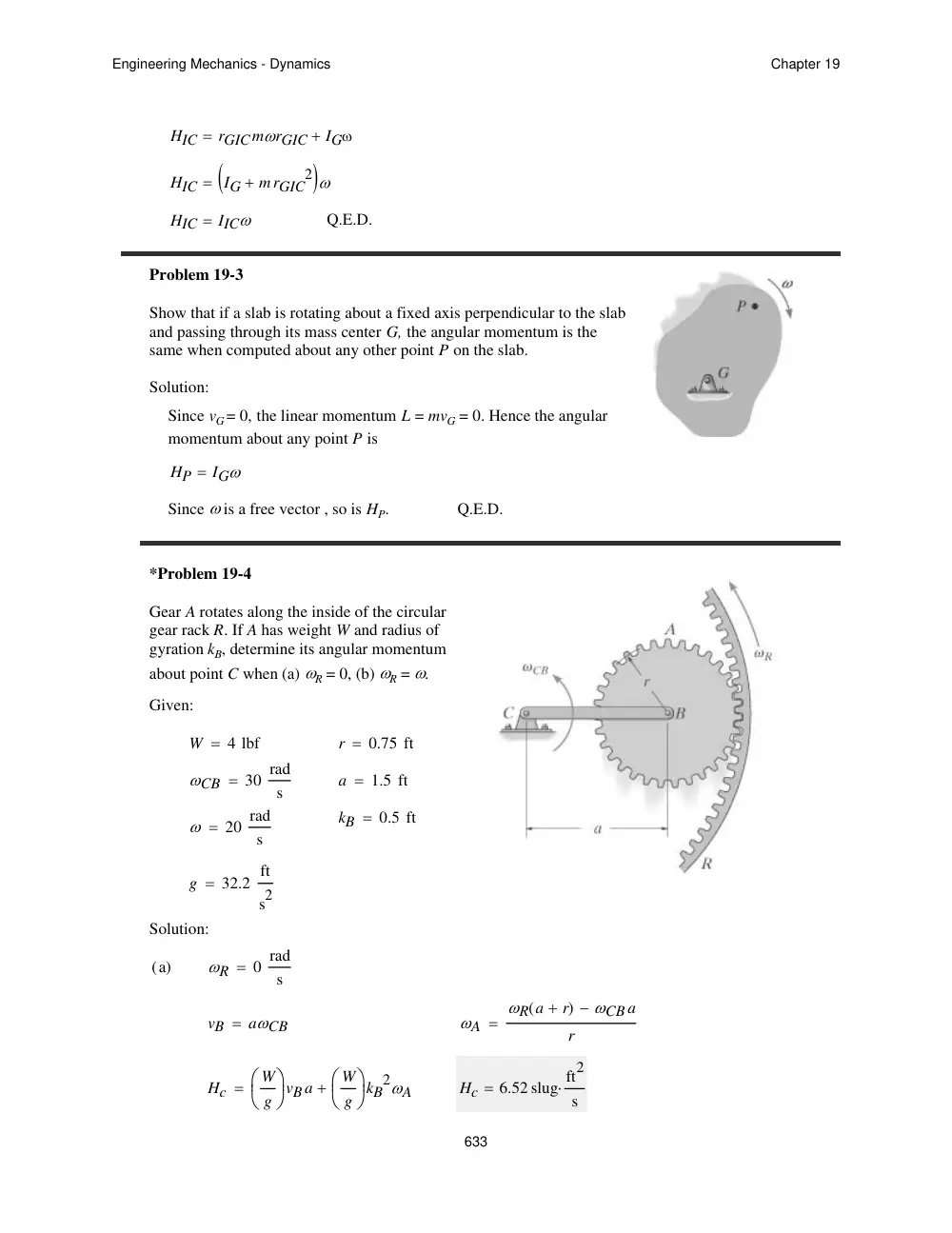
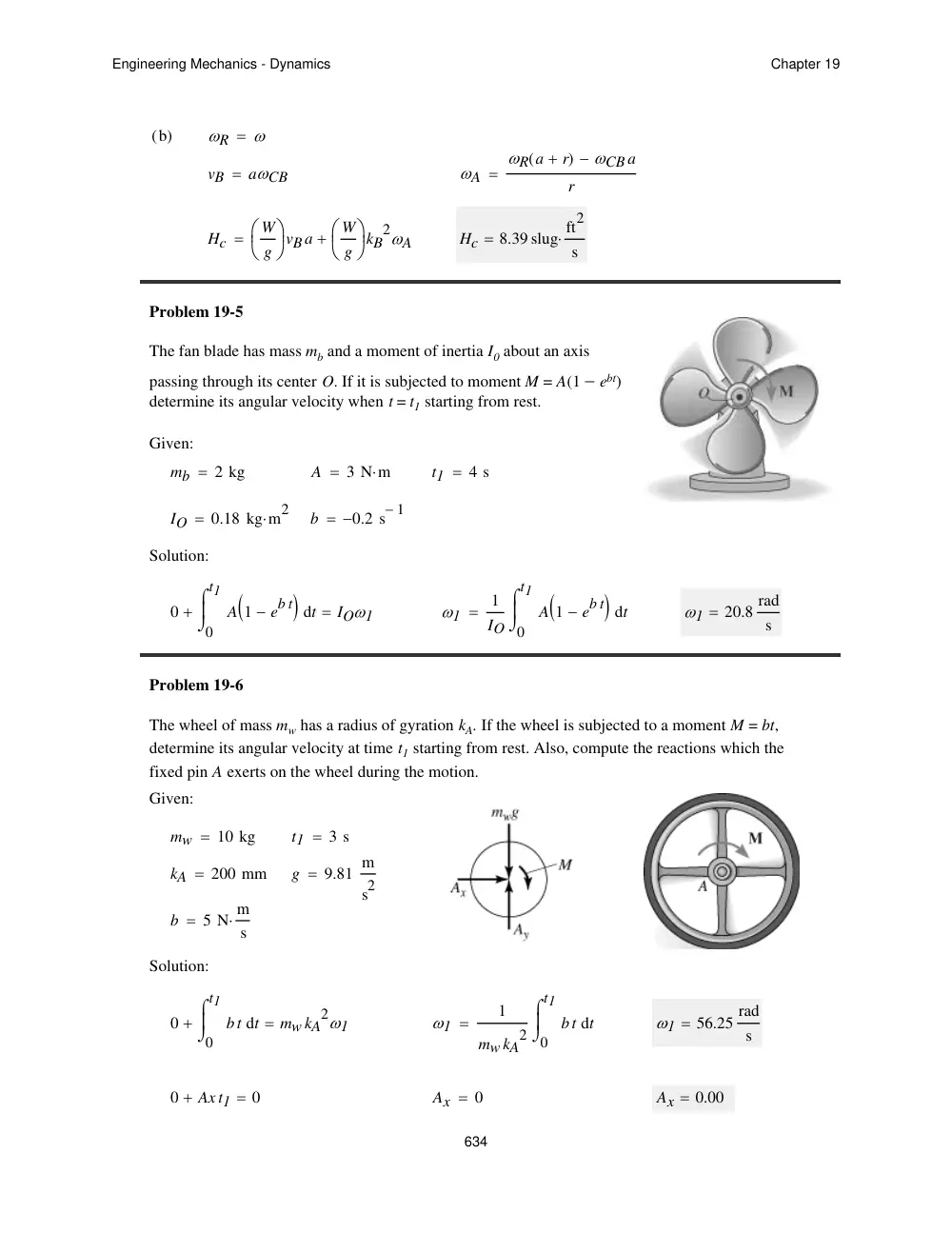

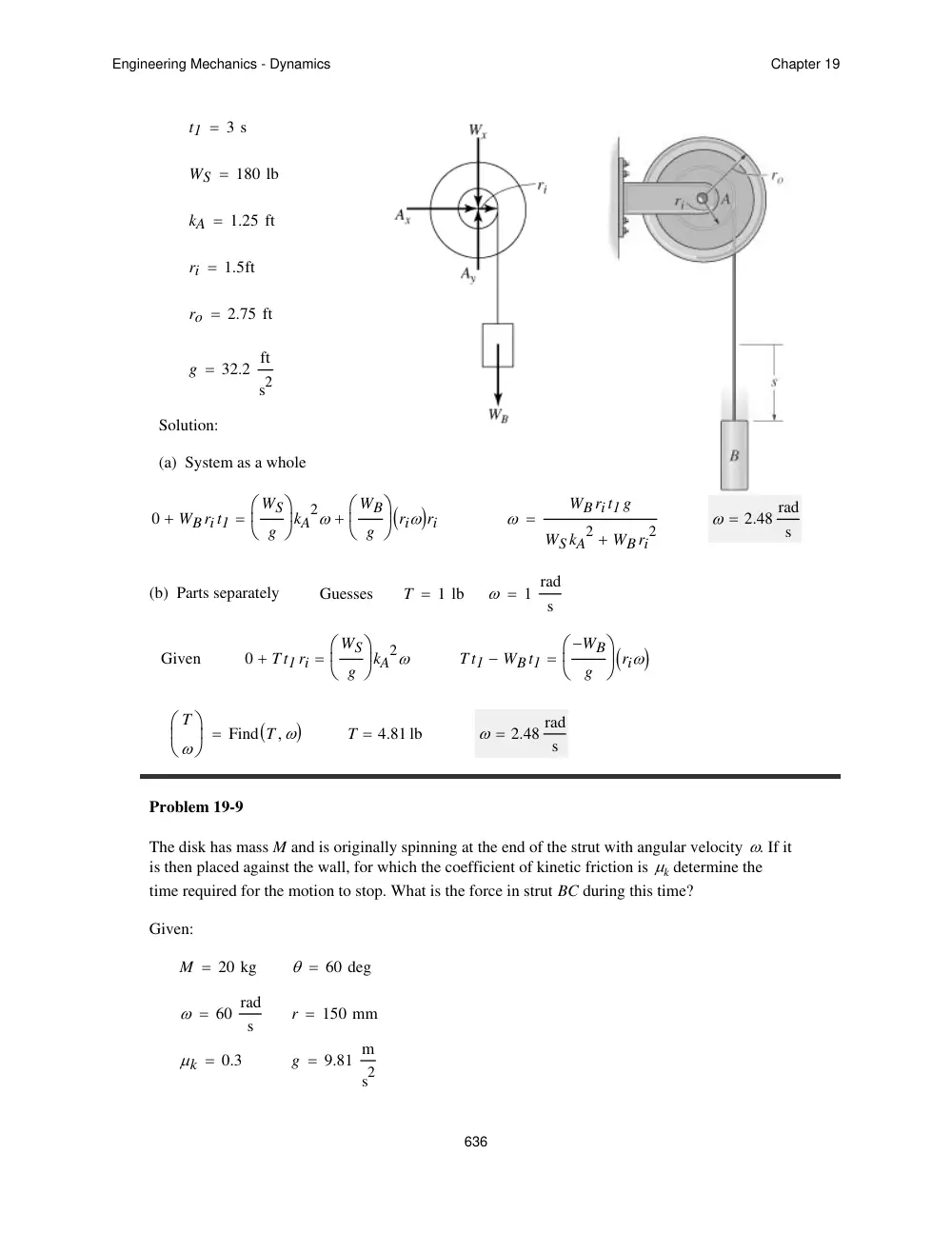


Showing the first 10 of 34 pages. Download the PDF to see all of it.
More MEN 201 files
- Problems For Chapter 14 with Solutions · Spring 2012Chapter · with solutionView
- Problems For Chapter 18 with Solutions · Spring 2012Chapter · with solutionView
- Problems For Chapter 16 with Solutions · Spring 2012Chapter · with solutionView
- Problems For Chapter 20 with Solutions · Spring 2012Chapter · with solutionView
- Problems For Chapter 15 with Solutions · Spring 2012Chapter · with solutionView
- Problems For Chapter 13 with Solutions · Spring 2012Chapter · with solutionView
- Problems For Chapter 12 with Solutions · Spring 2012Chapter · with solutionView
- Problems For Chapter 17 with Solutions · Spring 2012Chapter · with solutionView
Show the text of this chapter
Engineering Mechanics - Dynamics
Chapter 19
Problem 19-1
The rigid body (slab) has a mass m and is rotating with an angular velocity ω about an axis passing
through the fixed point O. Show that the momenta of all the particles composing the body can be
represented by a single vector having a magnitude mvG and acting through point P, called the center
of percussion, which lies at a distance rPG = k2
G / rGO from the mass center G. Here kG is the radius
of gyration of the body, computed about an axis perpendicular to the plane of motion and passing
through G.
Solution:
Ho
rGO
+ rPG
(
)mvG
=
rGO mvG
+ IGω
=
Where
IG
mkG
2
=
rGO mvG
+ rPGmvG
rGO mvG
mkG
2ω
+
=
rPG
kG
2ω
vG
=
kG
2
vG
vG
rGO
⎛⎜
⎝
⎞⎟
⎠
=
kG
2
rGO
=
Q.E.D
Problem 19-2
At a given instant, the body has a linear momentum L = mvG and
an angular momentum HG = IGω computed about its mass center.
Show that the angular momentum of the body computed about
the instantaneous center of zero velocity IC can be expressed as
HIC = IICω where IIC represents the body’s moment of inertia
computed about the instantaneous axis of zero velocity. As
shown, the IC is located at a distance rGIC away from the mass
center G.
Solution:
HIC
rGICmvG
+ IGω
=
Where
vG
ωrGIC
=
632
Engineering Mechanics - Dynamics
Chapter 19
HIC
rGICmωrGIC
+ IGω
=
HIC
IG
mrGIC
2
+
(
)ω
=
HIC
= IICω
Q.E.D.
Problem 19-3
Show that if a slab is rotating about a fixed axis perpendicular to the slab
and passing through its mass center G, the angular momentum is the
same when computed about any other point P on the slab.
Solution:
Since vG = 0, the linear momentum L = mvG = 0. Hence the angular
momentum about any point P is
HP
IGω
=
Since ω is a free vector , so is HP.
Q.E.D.
*Problem 19-4
Gear A rotates along the inside of the circular
gear rack R. If A has weight W and radius of
gyration kB, determine its angular momentum
about point C when (a) ωR = 0, (b) ωR = ω.
Given:
W
= 4 lbf
r
0.75 ft
=
ωCB
30 rad
s
=
a
1.5 ft
=
kB
= 0.5 ft
ω
20 rad
s
=
g
32.2 ft
s2
=
Solution:
a
( )
ωR
0 rad
s
=
vB
= aωCB
ωA
ωR a
+ r
(
)
ωCB a
−
r
=
Hc
W
g
⎛⎜⎝
⎞⎟⎠
vBa
W
g
⎛⎜⎝
⎞⎟⎠
kB
2ωA
+
=
Hc
6.52 slug ft2
⋅ s
=
633
Engineering Mechanics - Dynamics
Chapter 19
b
( )
ωR
ω
=
vB
= aωCB
ωA
ωR a
+ r
(
)
ωCB a
−
r
=
Hc
W
g
⎛⎜⎝
⎞⎟⎠
vBa
W
g
⎛⎜⎝
⎞⎟⎠
kB
2ωA
+
=
Hc
8.39 slug ft2
⋅ s
=
Problem 19-5
The fan blade has mass mb and a moment of inertia I0 about an axis
passing through its center O. If it is subjected to moment M = A(1 − ebt)
determine its angular velocity when t = t1 starting from rest.
Given:
mb
= 2 kg
A
3 N m
⋅
=
t1
4 s
=
IO
0.18 kg m2
⋅
=
b
−0.2
s 1
−
=
Solution:
0
0
t1
t
A 1
( − eb t
)
⌠
⎮⌡
d
+
= IOω1
ω1
1
IO
0
t1
t
A 1
( − eb t
)
⌠
⎮⌡
d
=
ω1
20.8 rad
s
=
Problem 19-6
The wheel of mass mw has a radius of gyration kA. If the wheel is subjected to a moment M = bt,
determine its angular velocity at time t1 starting from rest. Also, compute the reactions which the
fixed pin A exerts on the wheel during the motion.
Given:
mw
= 10 kg
t1
3 s
=
kA
= 200 mm
g
9.81 m
s2
=
b
5 N m
⋅ s
=
Solution:
0
0
t1
bt t
⌠
⎮⌡
d
+
mw kA
2ω1
=
ω1
1
mw kA
2
0
t1
bt t
⌠
⎮⌡
d
=
ω1
56.25 rad
s
=
0
+ Ax t1
= 0
Ax
= 0
Ax
0.00
=
634
Engineering Mechanics - Dynamics
Chapter 19
0
+ Ay t1
− mw gt1
= 0
Ay
= mw g
Ay
98.10 N
=
Problem 19-7
Disk D of weight W is subjected to counterclockwise moment M = bt. Determine the angular velocity
of the disk at time t2 after the moment is applied. Due to the spring the plate P exerts constant force
P on the disk. The coefficients of static and kinetic friction between the disk and the plate are μs and
μk respectively. Hint: First find the time needed to start the disk rotating.
Given:
W
= 10 lb
μs
0.3
=
b
10 lb ft
⋅ s
=
μk
0.2
=
t2
= 2 s
r
0.5 ft
=
P
= 100lb
g
32.2 ft
s2
=
Solution:
When motion begins
bt1
= μsP r
t1
μsP r
b
=
t1
1.50 s
=
At a later time we have
0
t1
t2
t
bt
− μk P r
(
)
⌠
⎮
⌡
d
+
W
g
⎛⎜⎝
⎞⎟⎠
r2
2 ω2
=
ω2
2g
W r2
t1
t2
t
bt
− μk P r
(
)
⌠
⎮
⌡
d
=
ω2
96.6 rad
s
=
*Problem 19-8
The cord is wrapped around the inner core of the spool. If block B of weight WB is suspended
from the cord and released from rest, determine the spool’s angular velocity when t = t1. Neglect
the mass of the cord. The spool has weight WS and the radius of gyration about the axle A is kA.
Solve the problem in two ways, first by considering the “system” consisting of the block and
spool, and then by considering the block and spool separately.
Given:
WB
5 lb
=
635
Engineering Mechanics - Dynamics
Chapter 19
t1
3 s
=
WS
180 lb
=
kA
1.25 ft
=
ri
1.5ft
=
ro
2.75 ft
=
g
32.2 ft
s2
=
Solution:
(a) System as a whole
0
+ WBri t1
WS
g
⎛⎜⎝
⎞⎟⎠
kA
2ω
WB
g
⎛⎜⎝
⎞⎟⎠
(riω
)ri
+
=
ω
WBri t1 g
WS kA
2
WBri
2
+
=
ω
2.48 rad
s
=
(b) Parts separately
Guesses
T
= 1 lb
ω
1 rad
s
=
Given
0
+ T t1 ri
WS
g
⎛⎜⎝
⎞⎟⎠
kA
2ω
=
T t1
− WBt1
WB
−
g
⎛⎜⎝
⎞⎟⎠
(riω
)
=
T
⎛⎜⎝ω
⎞⎟⎠
Find T ω
( ,
)
=
T
= 4.81 lb
ω
2.48 rad
s
=
Problem 19-9
The disk has mass M and is originally spinning at the end of the strut with angular velocity ω. If it
is then placed against the wall, for which the coefficient of kinetic friction is μk determine the
time required for the motion to stop. What is the force in strut BC during this time?
Given:
M
= 20 kg
θ
60 deg
=
ω
60 rad
s
=
r
150 mm
=
μk
= 0.3
g
9.81 m
s2
=
636
Engineering Mechanics - Dynamics
Chapter 19
Solution:
Initial Guess:
FCB
= 1 N
t
= 1 s
NA
1 N
=
Given
−M
r2
2
⎛⎜
⎝
⎞⎟
⎠
ω
+ μk NArt
0
=
FCB cos θ( )t
− NAt
0
=
FCB sin θ( )t
− M gt
+ μk NAt
0
=
FCB
NA
t
⎛⎜
⎜
⎜⎝
⎞⎟
⎟
⎟⎠
Find FCB NA
,
t,
(
)
=
NA
= 96.55 N
FCB
= 193 N
t
3.11 s
=
Problem 19-10
A flywheel has a mass M and radius of gyration kG about an axis of rotation passing through its
mass center. If a motor supplies a clockwise torque having a magnitude M = kt, determine the
flywheel’s angular veliocity at time t1. Initially the flywheel is rotating clockwise at angular
velocity ω0.
Given:
M
= 60 kg
kG
= 150 mm
k
5 N m
⋅
s
=
t1
= 3 s
ω0
2 rad
s
=
Solution:
M kG
2ω0
0
t1
kt t
⌠
⎮⌡
d
+
M kG
2ω1
=
ω1
ω0
1
M kG
2
0
t1
kt t
⌠
⎮⌡
d
+
=
ω1
18.7 rad
s
=
Problem 19-11
A wire of negligible mass is wrapped around the outer surface of the disk of mass M. If the
disk is released from rest, determine its angular velocity at time t.
637
Engineering Mechanics - Dynamics
Chapter 19
Given:
M
2 kg
=
t
3 s
=
r
80 mm
=
Solution:
0
+ M grt
3
2M r2ω
=
ω
2
3
g
r
⎛⎜⎝
⎞⎟⎠
t
=
ω
245 rad
s
=
*Problem 19-12
The spool has mass mS and radius of gyration kO. Block A has mass mA, and block B has mass mB.
If they are released from rest, determine the time required for block A to attain speed vA. Neglect
the mass of the ropes.
Given:
mS
= 30 kg
mB
= 10 kg
ro
0.3 m
=
kO
= 0.25 m
vA
2 m
s
=
g
9.81 m
s2
=
mA
= 25 kg
ri
0.18 m
=
Solution:
Guesses
t
= 1 s
vB
1 m
s
=
ω
1 rad
s
=
Given
vA
= ωro
vB
ωri
=
0
+ mAgt ro
− mBgtri
mAvAro
+ mBvBri
mS kO
2ω
+
=
t
vB
ω
⎛⎜
⎜
⎜⎝
⎞⎟
⎟
⎟⎠
Find t vB
,
, ω
(
)
=
vB
1.20 m
s
=
ω
6.67 rad
s
=
t
0.530 s
=
638
Engineering Mechanics - Dynamics
Chapter 19
Problem 19-13
The man pulls the rope off the reel with a constant force P in the direction shown. If the reel has
weight W and radius of gyration kG about the trunnion (pin) at A, determine the angular velocity
of the reel at time t starting from rest. Neglect friction and the weight of rope that is removed.
Given:
P
= 8 lb
t
= 3 s
g
32.2 ft
s2
=
W
= 250 lb
θ
60 deg
=
kG
= 0.8 ft
r
1.25 ft
=
Solution:
0
+ P rt
W
g
⎛⎜⎝
⎞⎟⎠
kG
2ω
=
ω
P rt g
W kG
2
=
ω
6.04 rad
s
=
Problem 19-14
Angular motion is transmitted from a driver wheel A to the driven wheel B by friction between the
wheels at C. If A always rotates at constant rate ωA and the coefficient of kinetic friction between
the wheels is μk, determine the time required for B to reach a constant angular velocity once the
wheels make contact with a normal force FN. What is the final angular velocity of wheel B?
Wheel B has mass mB and radius of gyration about its axis of rotation kG.
Given:
ωA
16 rad
s
=
mB
= 90 kg
a
= 40 mm
c
4 mm
=
μk
= 0.2
kG
= 120 mm
b
= 50 mm
FN
50 N
=
Solution:
Guesses
t
= 1 s
ωB
1 rad
s
=
Given
μk FN a
+ b
(
)t
mBkG
2ωB
=
ωB a
+ b
(
)
ωA
a
2
⎛⎜⎝
⎞⎟⎠
=
t
⎛⎜ωB
⎝
⎞⎟
⎠
Find t ωB
( ,
)
=
ωB
3.56 rad
s
=
t
5.12 s
=
639
Engineering Mechanics - Dynamics
Chapter 19
Problem 19-15
The slender rod of mass M rests on a smooth floor. If it is kicked so as to receive a horizontal
impulse I at point A as shown, determine its angular velocity and the speed of its mass center.
Given:
M
4 kg
=
l1
2 m
=
l2
1.75 m
=
I
8 N s
=
θ
60 deg
=
Solution:
Guesses
v
1 m
s
=
ω
1 rad
s
=
Given
I sin θ( ) l2
l1
− 2
⎛⎜⎝
⎞⎟⎠
1
12M l1
2ω
=
I
M v
=
ω
⎛⎜⎝ v
⎞⎟⎠
Find ω v
( ,
)
=
ω
3.90 rad
s
=
v
2.00 m
s
=
*Problem 19-16
A cord of negligible mass is wrapped around
the outer surface of the cylinder of weight W
and its end is subjected to a constant horizontal
force P. If the cylinder rolls without slipping at
A, determine its angular velocity in time t
starting from rest. Neglect the thickness of the
cord.
Given:
W
50 lb
=
P
2 lb
=
t
4 s
=
r
0.6 ft
=
640
Engineering Mechanics - Dynamics
Chapter 19
Solution:
0
P t 2r
(
)
+
1
2
W
g
⎛⎜⎝
⎞⎟⎠
r2
⎡⎢⎣
⎤⎥⎦
ω
W
g
⎛⎜⎝
⎞⎟⎠
(rω
)r
+
=
ω
4P t g
= 3rW
ω
11.4 rad
s
=
Problem 19-17
The drum has mass M, radius r, and radius of gyration kO. If the coefficients of static and kinetic
friction at A are μs and μk respectively, determine the drum's angular velocity at time t after it is
released from rest.
Given:
Given:
M
= 70 kg
μs
= 0.4
θ
30 deg
=
r
= 300mm
μk
= 0.3
g
9.81 m
s2
=
kO
= 125 mm
t
2 s
=
Solution:
Assume no slip
Guesses
Ff
= 1 N
FN
1 N
=
ω
1 rad
s
=
v
1 m
s
=
Fmax
1 N
=
Given
0
+ Ff rt
M kO
2ω
=
v
= ωr
Fmax
μsFN
=
M gsin θ( )t
− Ff t
= M v
FN t
− M gcos θ( )t
0
=
Ff
Fmax
FN
ω
v
⎛⎜
⎜
⎜
⎜
⎜
⎜⎝
⎞⎟
⎟
⎟
⎟
⎟
⎟⎠
Find Ff Fmax
,
, FN
, ω
, v
(
)
=
Ff
Fmax
FN
⎛⎜
⎜
⎜⎝
⎞⎟
⎟
⎟⎠
51
238
595
⎛
⎜
⎜
⎝
⎞
⎟
⎟
⎠
N
=
v
8.36 m
s
=
ω
27.9 rad
s
=
Since Ff
= 51 N
< Fmax
= 238 N
then our no-slip assumption is good.
Problem 19-18
The double pulley consists of two wheels which are attached to one another and turn at the same
rate. The pulley has mass mp and radius of gyration kO. If the block at A has mass mA, determine
641
Engineering Mechanics - Dynamics
Chapter 19
the speed of the block at time t after a constant force F is applied to the rope wrapped around the
inner hub of the pulley. The block is originally at rest. Neglect the mass of the rope.
Units Used:
kN
103 N
=
Given:
mp
= 15 kg
F
2 kN
=
kO
= 110 mm
ri
75 mm
=
mA
= 40 kg
ro
200 mm
=
t
3 s
=
Solution:
Guess
vA
1 m
s
=
ω
1 rad
s
=
Given
−F
ri t
+ mAgro t
−mp
kO
2ω
− mAvAro
=
vA
ωro
=
vA
⎛⎜ ω
⎝
⎞⎟
⎠
Find vA ω
,
(
)
=
ω
120.44 rad
s
=
vA
24.1 m
s
=
Problem 19-19
The spool has weight W and radius of gyration kO. A cord is wrapped around its inner hub and
the end subjected to a horizontal force P. Determine the spool’s angular velocity at time t starting
from rest. Assume the spool rolls without slipping.
Given:
W
= 30 lb
t
4 s
=
kO
= 0.45 ft
ri
0.3 ft
=
P
= 5 lb
ro
0.9 ft
=
Solution:
Guesses
ω
1 rad
s
=
vO
1 ft
s
=
Given
−P
ro
− ri
(
)t
W
−
g
⎛⎜⎝
⎞⎟⎠
vOro
W
g
⎛⎜⎝
⎞⎟⎠
kO
2ω
−
=
vO
ωro
=
vO
⎛⎜ ω
⎝
⎞⎟
⎠
Find vO ω
,
(
)
=
vO
3.49 m
s
=
ω
12.7 rad
s
=
*Problem 19-20
The two gears A and B have weights WA, WB and radii of gyration kA and kB respectively. If a motor
transmits a couple moment to gear B of M = M0 ( 1 − e-bt ), determine the angular velocity of gear A
642
Engineering Mechanics - Dynamics
Chapter 19
at time t, starting from rest.
Given:
WA
= 15 lb
WB
10 lb
=
rA
= 0.8 ft
rB
0.5 ft
=
kA
= 0.5 ft
kB
0.35 ft
=
M0
2 lb ft
⋅
=
b
0.5 s 1
−
=
t
5 s
=
Solution:
Guesses
ωA
1 rad
s
=
ωB
1 rad
s
=
ImpF
1 lb s⋅
=
Given
0
t
t
M0 1
e b
−
t
( −
)
⌠
⎮⌡
d
− ImpFrB
WB
g
⎛⎜⎝
⎞⎟⎠
kB
2ωB
=
ImpFrA
WA
g
⎛⎜⎝
⎞⎟⎠
kA
2ωA
=
ωArA
ωBrB
=
ωA
ωB
ImpF
⎛⎜
⎜
⎜⎝
⎞⎟
⎟
⎟⎠
Find ωA ωB
,
, ImpF
(
)
=
ImpF
= 6.89 lbs
ωB
75.7 rad
s
=
ωA
47.3 rad
s
=
Problem 19-21
Spool B is at rest and spool A is rotating at ω when the slack in the cord connecting them is
taken up. Determine the angular velocity of each spool immediately after the cord is jerked
tight by the spinning of spool A. The weights and radii of gyration of A and B are WA, kA, and
WB, kA, respectively.
643
Engineering Mechanics - Dynamics
Chapter 19
Given:
WA
= 30 lb
WB
15 lb
=
kA
= 0.8 ft
kB
0.6 ft
=
rA
= 1.2 ft
rB
0.4 ft
=
ω
6 rad
s
=
Solution:
Guesses
ωA
1 rad
s
=
ωB
1 rad
s
=
Imp
1 lb s⋅
=
Given
WA
g
⎛⎜⎝
⎞⎟⎠
kA
2ω
− Imp rA
WA
g
⎛⎜⎝
⎞⎟⎠
kA
2ωA
=
Imp rB
WB
g
⎛⎜⎝
⎞⎟⎠
kB
2ωB
=
ωArA
ωBrB
=
ωA
ωB
Imp
⎛⎜
⎜
⎜⎝
⎞⎟
⎟
⎟⎠
Find ωA ωB
,
, Imp
(
)
=
Imp
2.14 lb s⋅
=
ωA
ωB
⎛
⎜
⎝
⎞
⎟
⎠
1.70
⎛⎜⎝5.10
⎞⎟⎠
rad
s
=
Problem 19-22
Disk A of mass mA is mounted on arm BC, which has a negligible mass. If a torque of M = M0eat is
applied to the arm at C, determine the angular velocity of BC at time t starting from rest. Solve the
problem assuming that (a) the disk is set in a smooth bearing at B so that it rotates with curvilinear
translation, (b) the disk is fixed to the shaft BC, and (c) the disk is given an initial freely spinning
angular velocity ωDk prior to application of the torque.
644
Engineering Mechanics - Dynamics
Chapter 19
mA
= 4 kg
M0
5 N m
⋅
=
ωD
−80
rad
s
=
r
= 60 mm
a
0.5 s 1
−
=
b
= 250 mm
t
2 s
=
Solution:
Guess
ωBC
1 rad
s
=
a
( )
Given
0
t
t
M0 ea t
⌠
⎮⌡
d
mAωBC b2
=
ωBC
Find ωBC
(
)
=
ωBC
68.7 rad
s
=
b
( )
Given
0
t
t
M0 ea t
⌠
⎮⌡
d
mAωBC b2
mA
r2
2
⎛⎜
⎝
⎞⎟
⎠
ωBC
+
=
ωBC
Find ωBC
(
)
=
ωBC
66.8 rad
s
=
c
( )
Given
−mA
r2
2
⎛⎜
⎝
⎞⎟
⎠
ωD
0
t
t
M0 ea t
⌠
⎮⌡
d
+
mAωBC b2
mA
r2
2
⎛⎜
⎝
⎞⎟
⎠
ωD
−
=
ωBC
Find ωBC
(
)
=
ωBC
68.7 rad
s
=
Problem 19-23
The inner hub of the wheel rests on the horizontal track. If it does not slip at A, determine the speed
of the block of weight Wb at time t after the block is released from rest. The wheel has weight Ww
and radius of gyration kG. Neglect the mass of the pulley and cord.
Given:
Wb
= 10 lb
ri
1 ft
=
t
= 2 s
ro
2 ft
=
Ww
= 30 lb
g
32.2 ft
s2
=
kG
1.30 ft
=
Solution:
Guesses
vG
1 ft
s
=
vB
1 ft
s
=
T
= 1 lb
ω
1 rad
s
=
645
Given:
Engineering Mechanics - Dynamics
Chapter 19
Given
T t
− Wb t
Wb
−
g
⎛⎜⎝
⎞⎟⎠
vB
=
T ro
+ ri
(
)t
Ww
g
⎛⎜⎝
⎞⎟⎠
vGri
Ww
g
⎛⎜⎝
⎞⎟⎠
kG
2ω
+
=
vG
= ωri
vB
ω ri
+ ro
(
)
=
vG
vB
ω
T
⎛⎜
⎜
⎜
⎜
⎝
⎞⎟
⎟
⎟
⎟
⎠
Find vG vB
,
, ω
, T
(
)
=
T
= 4.73 lb
ω
11.3 rad
s
=
vG
11.3 ft
s
=
vB
34.0 ft
s
=
*Problem 19-24
If the hoop has a weight W and radius r and is
thrown onto a rough surface with a velocity vG
parallel to the surface, determine the amount of
backspin, ω0, it must be given so that it stops
spinning at the same instant that its forward
velocity is zero. It is not necessary to know the
coefficient of kinetic friction at A for the
calculation.
Solution:
W
g
⎛⎜⎝
⎞⎟⎠
vGr
W
g
⎛⎜⎝
⎞⎟⎠
r2ω0
−
0
=
ω0
vG
r
=
Problem 19-25
The rectangular plate of weight W is at rest on a smooth horizontal floor. If it is given the
horizontal impulses shown, determine its angular velocity and the velocity of the mass center.
646
Engineering Mechanics - Dynamics
Chapter 19
Given:
W
= 10 lb
d
0.5 ft
=
I1
= 20 lb s⋅
θ
60 deg
=
I2
= 5 lb s⋅
e
3
=
a
= 0.5 ft
f
4
=
b
= 2 ft
g
32.2 ft
s2
=
c
1 ft
=
Solution:
Guesses
vx
1 ft
s
=
vy
1 ft
s
=
ω
1 rad
s
=
Given
f
e2
f 2
+
⎛
⎜
⎝
⎞
⎟
⎠
I1
+ I2 cos θ( )
W
g
⎛⎜⎝
⎞⎟⎠
vx
=
e
e2
f 2
+
⎛
⎜
⎝
⎞
⎟
⎠
I1
− I2 sin θ( )
W
g
⎛⎜⎝
⎞⎟⎠
vy
=
f
e2
f 2
+
⎛
⎜
⎝
⎞
⎟
⎠
I1 a
I2 sin θ( ) b
− d
(
)
−
1
12
W
g
⎛⎜⎝
⎞⎟⎠
b2
+ c2
(
)ω
W
g
⎛⎜⎝
⎞⎟⎠
vx
c
2
⎛⎜⎝
⎞⎟⎠
+
W
g
⎛⎜⎝
⎞⎟⎠
vy
b
2
⎛⎜⎝
⎞⎟⎠
+
=
vx
vy
ω
⎛⎜
⎜
⎜⎝
⎞⎟
⎟
⎟⎠
Find vx vy
,
, ω
(
)
=
vG
vx
vy
⎛
⎜
⎝
⎞
⎟
⎠
=
ω
−119
rad
s
=
vG
59.6
⎛⎜⎝24.7
⎞⎟⎠
ft
s
=
vG
64.5 ft
s
=
Problem 19-26
The ball of mass m and radius r rolls along an inclined plane for which the coefficient of static
friction is μ. If the ball is released from rest, determine the maximum angle θ for the incline so that
it rolls without slipping at A.
647
Engineering Mechanics - Dynamics
Chapter 19
Solution:
Nt
− mgcos θ( )t
= 0
N
mgcos θ( )
=
μNrt
2
= 5mr2ω
t
2ωr
5μgcos θ( )
=
mgsin θ( )t
− μNt
= mrω
t
rω
g sin θ( )
− μ cos θ( )
(
)
=
Thus
2ωr
5μgcos θ( )
rω
g sin θ( )
− μ cos θ( )
(
)
=
θ
atan 7μ
2
⎛⎜⎝
⎞⎟⎠
=
Problem 19-27
The spool has weight Ws and radius of gyration kO. If the block B has weight Wb and a force P is
applied to the cord, determine the speed of the block at time t starting from rest. Neglect the mass
of the cord.
Given:
Ws
= 75lb
t
5s
=
648
Engineering Mechanics - Dynamics
Chapter 19
kO
= 1.2ft
ro
2ft
=
Wb
= 60lb
ri
0.75ft
=
P
25lb
=
Solution:
Guess
vB
1 ft
s
=
ω
1 rad
s
=
Given
−P
ro t
+ Wb ri t
Wb
−
g
⎛⎜⎝
⎞⎟⎠
vBri
Ws
g
⎛⎜⎝
⎞⎟⎠
kO
2ω
−
=
vB
ωri
=
vB
⎛⎜ ω
⎝
⎞⎟
⎠
Find vB ω
,
(
)
=
ω
5.68 rad
s
=
vB
4.26 ft
s
=
*Problem 19-28
The slender rod has a mass m and is suspended at its end A by a cord. If the rod receives a
horizontal blow giving it an impulse I at its bottom B, determine the location y of the point P
about which the rod appears to rotate during the impact.
Solution:
FΔt
mvcm
=
mΔt
Iω
=
I y
I'ω
=
I y
m l2
12
y
l
⎛⎜⎝ − 2
⎞⎟⎠
2
+
⎡⎢
⎣
⎤⎥
⎦
ω
=
1
( )
I
mvcm
=
I
m l
2ω
=
2
( )
Divide Eqs (1) by (2)
yl
2
l2
12
y
l
⎛⎜⎝ − 2
⎞⎟⎠
2
+
⎡⎢
⎣
⎤⎥
⎦
=
y
3
4
33
+ 12
⎛⎜⎝
⎞⎟⎠
l
=
649
Engineering Mechanics - Dynamics
Chapter 19
Problem 19-29
A thin rod having mass M is balanced vertically as shown. Determine the height h at which it
can be struck with a horizontal force F and not slip on the floor. This requires that the
frictional force at A be essentially zero.
Given:
M
= 4 kg
L
0.8 m
=
Solution:
F t
Mω L
2
=
F t h
M L2
3 ω
=
Thus
Mω L
2 h
M L2
3 ω
=
h
2
= 3L
h
0.53 m
=
Problem 19-30
The square plate has a mass M and is suspended at its corner A by a cord. If it receives a horizontal
impulse I at corner B, determine the location y' of the point P about which the plate appears to rotate
during the impact.
Solution:
I a
2
1
= 6M a2ω
ω
6
2
I
M a
=
I
= M vG
vG
I
M
=
y'
vG
ω
=
y'
2
6 a
=
y
a
2
− y'
=
y
2
3 a
=
Problem 19-31
Determine the height h of the bumper of the pool table, so that when the pool ball of mass m strikes
it, no frictional force will be developed between the ball and the table at A. Assume the bumper
exerts only a horizontal force on the ball.
650
Engineering Mechanics - Dynamics
Chapter 19
Solution:
FΔt
= MΔv
FΔt h
7
= 5M r2Δω
Δv
rΔω
=
Thus
M rΔωh
7
= 5M r2Δω
h
7
5r
=
*Problem 19-32
The double pulley consists of two wheels which are attached to
one another and turn at the same rate. The pulley has a mass MC
and a radius of gyration kO. If the block at A has a mass MA and
the container at B has a mass MB, including its contents,
determine the speed of the container at time t after it is released
from rest.
Given:
MC
= 15 kg
kO
110 mm
=
MA
= 40 kg
r1
200 mm
=
MB
= 85 kg
r2
75 mm
=
t
3 s
=
Solution:
Guess
vA
1 m
s
=
vB
1 m
s
=
ω
1 rad
s
=
Given
MAgtr1
− MBgt r2
MAvAr1
+ MBvBr2
MC kO
2ω
+
=
vA
= ωr1
vB
ωr2
=
vA
vB
ω
⎛⎜
⎜
⎜⎝
⎞⎟
⎟
⎟⎠
Find vA vB
,
, ω
(
)
=
ω
21.2 rad
s
=
vA
4.23 m
s
=
vB
1.59 m
s
=
Problem 19-33
The crate has a mass Mc. Determine the constant speed v0 it acquires as it moves down the
conveyor. The rollers each have radius r, mass M, and are spaced distance d apart. Note that
friction causes each roller to rotate when the crate comes in contact with it.
651
Engineering Mechanics - Dynamics
Chapter 19
Solution:
Assume each roller is brought to the condition of roll without
slipping. In time t, the number of rollers affected is v0t/d.
Mc gsin θ( )t
− F t
0
=
F
Mc gsin θ( )
=
F t r
1
⎛⎜⎝2M r2
⎞⎟⎠
v0
r
v0
⎛⎜⎝ d t
⎞⎟⎠
=
v0
2gsin θ( )d
MC
M
=
Problem 19-34
Two wheels A and B have masses mA and mB and radii of gyration about their central vertical
axes of kA and kB respectively. If they are freely rotating in the same direction at ωA and ωΒ about
the same vertical axis, determine their common angular velocity after they are brought into
contact and slipping between them stops.
Solution:
mAkA
2ωA
mBkB
2ωB
+
mAkA
2
mBkB
2
+
(
)ω
=
ω
mAkA
2ωA
mBkB
2ωB
+
mAkA
2
mBkB
2
+
=
Problem 19-35
The Hubble Space Telescope is powered by two solar
panels as shown. The body of the telescope has a mass M1
and radii of gyration kx and ky, whereas the solar panels
can be considered as thin plates, each having a mass M2.
Due to an internal drive, the panels are given an angular
velocity of ω0j, measured relative to the telescope.
Determine the angular velocity of the telescope due to the
rotation of the panels. Prior to rotating the panels, the
telescope was originally traveling at vG = (vxi + vyj + vzk).
Neglect its orbital rotation.
652
Engineering Mechanics - Dynamics
Chapter 19
Units Used:
Mg
103kg
=
Given:
M1
= 11 Mg
ω0
0.6 rad
s
=
vx
−400
m
s
=
M2
54 kg
=
a
= 1.5 m
vy
250 m
s
=
kx
1.64 m
=
ky
= 3.85 m
b
= 6 m
vz
175 m
s
=
Solution:
Angular momentum is conserved.
Guess
ωT
1 rad
s
=
Given
0
2
1
⎛⎜⎝12M2 b2
⎞⎟⎠
ω0
− ωT
(
)
M1 ky
2
(
)ωT
−
=
ωT
Find ωT
(
)
=
ωT
0.00 rad
s
=
*Problem 19-36
The platform swing consists of a flat plate of weight Wp suspended by four rods of negligible
weight. When the swing is at rest, the man of weight Wm jumps off the platform when his center
of gravity G is at distance a from the pin at A. This is done with a horizontal velocity v, measured
relative to the swing at the level of G. Determine the angular velocity he imparts to the swing just
after jumping off.
Given:
Wp
= 200lb
a
10ft
=
Wm
= 150lb
b
11ft
=
v
5 ft
s
=
c
4ft
=
Solution:
Guess
ω
1 rad
s
=
Given
0
Wm
−
g
v
( − ωa
)a
Wp
g
c2
12
+ b2
⎛⎜
⎝
⎞⎟
⎠
ω
+
=
ω
Find ω
( )
=
ω
0.190 rad
s
=
653
Engineering Mechanics - Dynamics
Chapter 19
Problem 19-37
Each of the two slender rods and the disk have
the same mass m. Also, the length of each rod is
equal to the diameter d of the disk. If the
assembly is rotating with an angular velocity ω1
when the rods are directed outward, determine
the angular velocity of the assembly if by
internal means the rods are brought to an upright
vertical position.
Solution:
H1
H2
=
1
2m d
2
⎛⎜⎝
⎞⎟⎠
2
2 1
12md2
+
+ 2md2
⎡⎢
⎣
⎤⎥
⎦
ω1
1
2m d
2
⎛⎜⎝
⎞⎟⎠
2
2m d
2
⎛⎜⎝
⎞⎟⎠
2
+
⎡⎢
⎣
⎤⎥
⎦
ω2
=
ω2
11
3 ω1
=
Problem 19-38
The rod has a length L and mass m. A smooth
collar having a negligible size and one-fourth
the mass of the rod is placed on the rod at its
midpoint. If the rod is freely rotating with
angular velocity ω about its end and the collar
is released, determine the rod’s angular
velocity just before the collar flies off the rod.
Also, what is the speed of the collar as it
leaves the rod?
Solution:
H1
H2
=
1
3mL2ω
m
4
⎛⎜⎝
⎞⎟⎠
L
2
⎛⎜⎝
⎞⎟⎠
ω L
2
⎛⎜⎝
⎞⎟⎠
+
1
3mL2ω'
m
4
⎛⎜⎝
⎞⎟⎠
Lω' L
+
=
ω'
19
28ω
=
T1
+ V1
T2
+ V2
=
1
2
1
⎛⎜⎝3mL2
⎞⎟⎠
ω2
1
2
m
4
⎛⎜⎝
⎞⎟⎠
L
⎛⎜⎝2 ω
⎞⎟⎠
2
+
1
2
m
4
⎛⎜⎝
⎞⎟⎠
v'2
1
2
m
4
⎛⎜⎝
⎞⎟⎠
(Lω'
)2
+
1
2
1
⎛⎜⎝3mL2
⎞⎟⎠
ω'2
+
=
v'2
57
112L2 ω2
=
v''
= 0.985ωL
v''
57
112L2 ω2
L 19
⎛⎜⎝28ω
⎞⎟⎠
⎡⎢⎣
⎤⎥⎦
2
+
=
v''
95
98 ωL
=
654
Engineering Mechanics - Dynamics
Chapter 19
Problem 19-39
A man has a moment of inertia Iz about the z axis. He is originally at rest and standing on a small
platform which can turn freely. If he is handed a wheel which is rotating at angular velocity ω and has
a moment of inertia I about its spinning axis, determine his angular velocity if (a) he holds the wheel
upright as shown, (b) turns the wheel out θ = 90°, and (c) turns the wheel downward, θ = 180°.
Solution:
a
( )
0
+ Iω
IzωM
+ Iω
=
ωM
0
=
b
( )
0
+ Iω
IzωM
+ 0
=
ωM
I
Iz
ω
=
c
( )
0
+ Iω
IzωM
− Iω
=
ωM
2I
Iz
ω
=
* Problem 19-40
The space satellite has mass mss and moment of inertia Iz
, excluding the four solar panels A,B,C,
and D. Each solar panel has mass mp and can be approximated as a thin plate.If the satellite is
originally spinning about the z axis at aconstant rate ωz, when θ = 90°, determine the rate of spin
if all the panels are raised and reach the upward position, θ = 0°, at the same instsnt.
Given:
mss
= 125 kg
a
= 0.2 m
ωz
0.5 rad
s
=
Iz
0.940 kg m2
⋅
=
b
0.75 m
=
msp
= 20 kg
c
0.2 m
=
Solution:
Guess
ωz2
1 rad
s
=
Given
Iz
4
msp
12 b2
+ c2
(
)
msp a
b
⎛⎜⎝ + 2
⎞⎟⎠
2
+
⎡⎢
⎣
⎤⎥
⎦
⎡⎢ +
⎣
⎤⎥
⎦
ωz
Iz
4
msp
12 c2
+ msp a2
⎛⎜⎝
⎞⎟⎠
⎡⎢⎣ +
⎤⎥⎦
ωz2
=
ωz2
Find ωz2
(
)
=
ωz2
3.56 rad
s
=
655
Engineering Mechanics - Dynamics
Chapter 19
Problem 19-41
Rod ACB of mass mr supports the two disks each of mass md at its ends. If both disks are given
a clockwise angular velocity ωA1 = ωΒ1 = ω0 while the rod is held stationary and then released,
determine the angular velocity of the rod after both disks have stopped spinning relative to the rod
due to frictional resistance at the pins A and B. Motion is in the horizontal plane. Neglect friction
at pin C.
Given:
mr
2 kg
=
md
4 kg
=
ω0
5 rad
s
=
a
0.75 m
=
r
0.15 m
=
Solution:
2 1
⎛⎜⎝2md
⎞⎟⎠
r2ω0
2 1
⎛⎜⎝2md
⎞⎟⎠
r2
+ 2md a2
mr
12 2a
(
)2
+
⎡⎢⎣
⎤⎥⎦
ω2
=
ω2
md r2
md r2
+ 2md a2
mr
3
⎛⎜⎝
⎞⎟⎠
a2
+
ω0
=
ω2
0.0906 rad
s
=
Problem 19-42
Disk A has a weight WA. An inextensible cable is attached to the weight
W and wrapped around the disk.The weight is dropped distance h
before the slack is taken up. If the impact is perfectly elastic, i.e., e = 1,
determine the angular velocity of the disk just after impact.
Given:
WA
= 20 lb
h
2 ft
=
W
= 10 lb
r
0.5 ft
=
Solution:
v1
2gh
=
Guess
ω2
1 rad
s
=
v2
1 ft
s
=
656
Engineering Mechanics - Dynamics
Chapter 19
Given
W
g
⎛⎜⎝
⎞⎟⎠
v1 r
W
g
⎛⎜⎝
⎞⎟⎠
v2 r
WA
g
⎛⎜⎝
⎞⎟⎠
r2
2 ω2
+
=
v2
ω2 r
=
v2
ω2
⎛
⎜
⎝
⎞
⎟
⎠
Find v2 ω2
,
(
)
=
v2
5.67 ft
s
=
ω2
11.3 rad
s
=
Problem 19-43
A thin disk of mass m has an angular velocity ω1 while rotating on a smooth surface. Determine its
new angular velocity just after the hook at its edge strikes the peg P and the disk starts to rotate
about P without rebounding.
Solution:
H1
H2
=
1
⎛⎜⎝2mr2
⎞⎟⎠
ω1
1
2mr2
+ mr2
⎛⎜⎝
⎞⎟⎠
ω2
=
ω2
1
3ω1
=
*Problem 19-44
The pendulum consists of a slender rod AB of weight Wr and a
wooden block of weight Wb. A projectile of weight Wp is fired into
the center of the block with velocity v. If the pendulum is initially at
rest, and the projectile embeds itself into the block, determine the
angular velocity of the pendulum just after the impact.
Given:
Wr
= 5 lb
Wp
= 0.2 lb
v
1000 ft
s
=
g
32.2 ft
s2
=
Wb
= 10 lb
a
= 2 ft
b
1 ft
=
Solution:
Wp
g
⎛⎜⎝
⎞⎟⎠
v a
b
⎛⎜⎝ + 2
⎞⎟⎠
Wr
g
⎛⎜⎝
⎞⎟⎠
a2
3
⎛⎜
⎝
⎞⎟
⎠
Wb
g
⎛⎜⎝
⎞⎟⎠
b2
6
⎛⎜
⎝
⎞⎟
⎠
+
Wb
g
⎛⎜⎝
⎞⎟⎠
a
b
⎛⎜⎝ + 2
⎞⎟⎠
2
+
Wp
g
⎛⎜⎝
⎞⎟⎠
a
b
⎛⎜⎝ + 2
⎞⎟⎠
2
+
⎡⎢
⎣
⎤⎥
⎦
ω2
=
ω2
Wp v a
b
⎛⎜⎝ + 2
⎞⎟⎠
Wr
a2
3
Wb
b2
6
+
Wb a
b
⎛⎜⎝ + 2
⎞⎟⎠
2
+
Wp a
b
⎛⎜⎝ + 2
⎞⎟⎠
2
+
=
ω2
6.94 rad
s
=
657
Engineering Mechanics - Dynamics
Chapter 19
Problem 19-45
The pendulum consists of a slender rod AB of mass M1 and a disk of mass M2. It is released
from rest without rotating. When it falls a distance d, the end A strikes the hook S, which
provides a permanent connection. Determine the angular velocity of the pendulum after it has
rotated 90°. Treat the pendulum’s weight during impact as a nonimpulsive force.
Given:
M1
= 2kg
r
0.2m
=
M2
= 5kg
l
0.5m
=
d
0.3m
=
Solution:
v1
2gd
=
IA
M1
l2
3
M2
r2
2
+
M2 l
( + r
)2
+
=
Guesses
ω2
1 rad
s
=
ω3
1 rad
s
=
Given
M1 v1
l
2
M2 v1 l
( + r
)
+
= IAω2
1
2IAω2
2
1
2IAω3
2
M1 g l
2
−
M2 g l
( + r
)
−
=
ω2
ω3
⎛
⎜
⎝
⎞
⎟
⎠
Find ω2 ω3
,
(
)
=
ω2
3.57 rad
s
=
ω3
6.46 rad
s
=
Problem 19-46
A horizontal circular platform has a
weight W1 and a radius of gyration kz
about the z axis passing through its center
O. The platform is free to rotate about the
z axis and is initially at rest. A man having
a weight W2 begins to run along the edge
in a circular path of radius r. If he has a
speed v and maintains this speed relative
to the platform, determine the angular
velocity of the platform. Neglect friction.
658
Engineering Mechanics - Dynamics
Chapter 19
Given:
W1
= 300 lb
v
4 ft
s
=
W2
150 lb
=
kz
= 8 ft
r
10 ft
=
Solution:
M vr
Iω
=
ω
W2 v
r
W1 kz
2
=
W2
g vr
W1
g kz
2ω
=
ω
0.312 rad
s
=
Problem 19-47
The square plate has a weight W and is
rotating on the smooth surface with a
constant angular velocity ω0. Determine
the new angular velocity of the plate just
after its corner strikes the peg P and the
plate starts to rotate about P without
rebounding.
Solution:
W
g
⎛⎜⎝
⎞⎟⎠
a2
6
⎛⎜
⎝
⎞⎟
⎠
ω0
W
g
⎛⎜⎝
⎞⎟⎠
2a2
3
⎛⎜
⎝
⎞⎟
⎠
ω
=
ω
1
4ω0
=
*Problem 19-48
Two children A and B, each having a mass M1, sit
at the edge of the merry-go-round which is rotating
with angular velocity ω. Excluding the children, the
merry-go-round has a mass M2 and a radius of
gyration kz. Determine the angular velocity of the
merry-go-round if A jumps off horizontally in
the −n direction with a speed v, measured with
respect to the merry-go-round.What is the
merry-go-round’s angular velocity if B then jumps
off horizontally in the +t direction with a speed v,
measured with respect to the merry-go-round?
Neglect friction and the size of each child.
659
Engineering Mechanics - Dynamics
Chapter 19
Given:
M1
= 30 kg
kz
0.6 m
=
M2
= 180 kg
a
0.75 m
=
ω
2 rad
s
=
v
2 m
s
=
Solution:
a
( )
Guess
ω2
1 rad
s
=
Given
M2 kz
2
+ 2M1 a2
(
)ω
M2 kz
2
+ M1 a2
(
)ω2
=
ω2
Find ω2
(
)
=
ω2
2.41 rad
s
=
b
( )
Guess
ω3
1 rad
s
=
Given
M2 kz
2
+ M1 a2
(
)ω2
M2 kz
2ω3
M1 v
( + ω3 a
)a
+
=
ω3
Find ω3
(
)
=
ω3
1.86 rad
s
=
Problem 19-49
A bullet of mass mb having velocity v is fired into the edge of the disk of mass md as shown.
Determine the angular velocity of the disk of mass md just after the bullet becomes embedded in it.
Also, calculate how far θ the disk will swing until it stops. The disk is originally at rest.
Given:
mb
= 7 gm
md
= 5 kg
φ
30 deg
=
v
800 m
s
=
r
0.2 m
=
Solution:
Guesses ω
1 rad
s
=
θ
10 deg
=
Given
mb vcos φ( )r
3
= 2md r2ω
−md
gr
1
2
3
⎛⎜⎝2md r2
⎞⎟⎠
ω2
+
−md
grcos θ( )
=
ω
⎛⎜⎝ θ
⎞⎟⎠
Find ω θ
( ,
)
=
ω
3.23 rad
s
=
θ
32.8 deg
=
660
Engineering Mechanics - Dynamics
Chapter 19
Problem 19-50
The two disks each have weight W. If they are released from rest when θ = θ1 , determine the
maximum angle θ2 after they collide and rebound from each other. The coefficient of restitution
is e. When θ = 0° the disks hang so that they just touch one another.
Given:
g
32.2 ft
s2
=
W
10 lb
=
θ1
30 deg
=
e
0.75
=
r
1 ft
=
Solution:
Guesses
ω1
1 rad
s
=
ω2
1 rad
s
=
θ2
10deg
=
Given
−W
rcos θ1
(
)
1
2
3
2
W
g r2
⎛⎜⎝
⎞⎟⎠
ω1
2
− W r
=
erω1
rω2
=
−W
r
1
2
3
2
W
g r2
⎛⎜⎝
⎞⎟⎠
ω2
2
+
−W
rcos θ2
(
)
=
ω1
ω2
θ2
⎛⎜
⎜
⎜⎝
⎞⎟
⎟
⎟⎠
Find ω1 ω2
,
, θ2
(
)
=
ω1
ω2
⎛
⎜
⎝
⎞
⎟
⎠
2.40
⎛⎜⎝1.80
⎞⎟⎠
rad
s
=
θ2
22.4 deg
=
Problem 19-51
The rod AB of weight W is released from
rest in the vertical position. If the coefficient
of restitution between the floor and the
cushion at B is e, determi