
MEN 201 Problems For Chapter 15 with Solutions, Spring 2012
Notre Dame University–Louaize · Engineering Mechanics- Dynamics · 94 pages · with solution


Showing the first 10 of 94 pages. Download the PDF to see all of it.
More MEN 201 files
- Problems For Chapter 14 with Solutions · Spring 2012Chapter · with solutionView
- Problems For Chapter 19 with Solutions · Spring 2012Chapter · with solutionView
- Problems For Chapter 17 with Solutions · Spring 2012Chapter · with solutionView
- Problems For Chapter 20 with Solutions · Spring 2012Chapter · with solutionView
- Problems For Chapter 16 with Solutions · Spring 2012Chapter · with solutionView
- Problems For Chapter 13 with Solutions · Spring 2012Chapter · with solutionView
- Problems For Chapter 12 with Solutions · Spring 2012Chapter · with solutionView
- Problems For Chapter 18 with Solutions · Spring 2012Chapter · with solutionView
Show the text of this chapter
Engineering Mechanics - Dynamics
Chapter 15
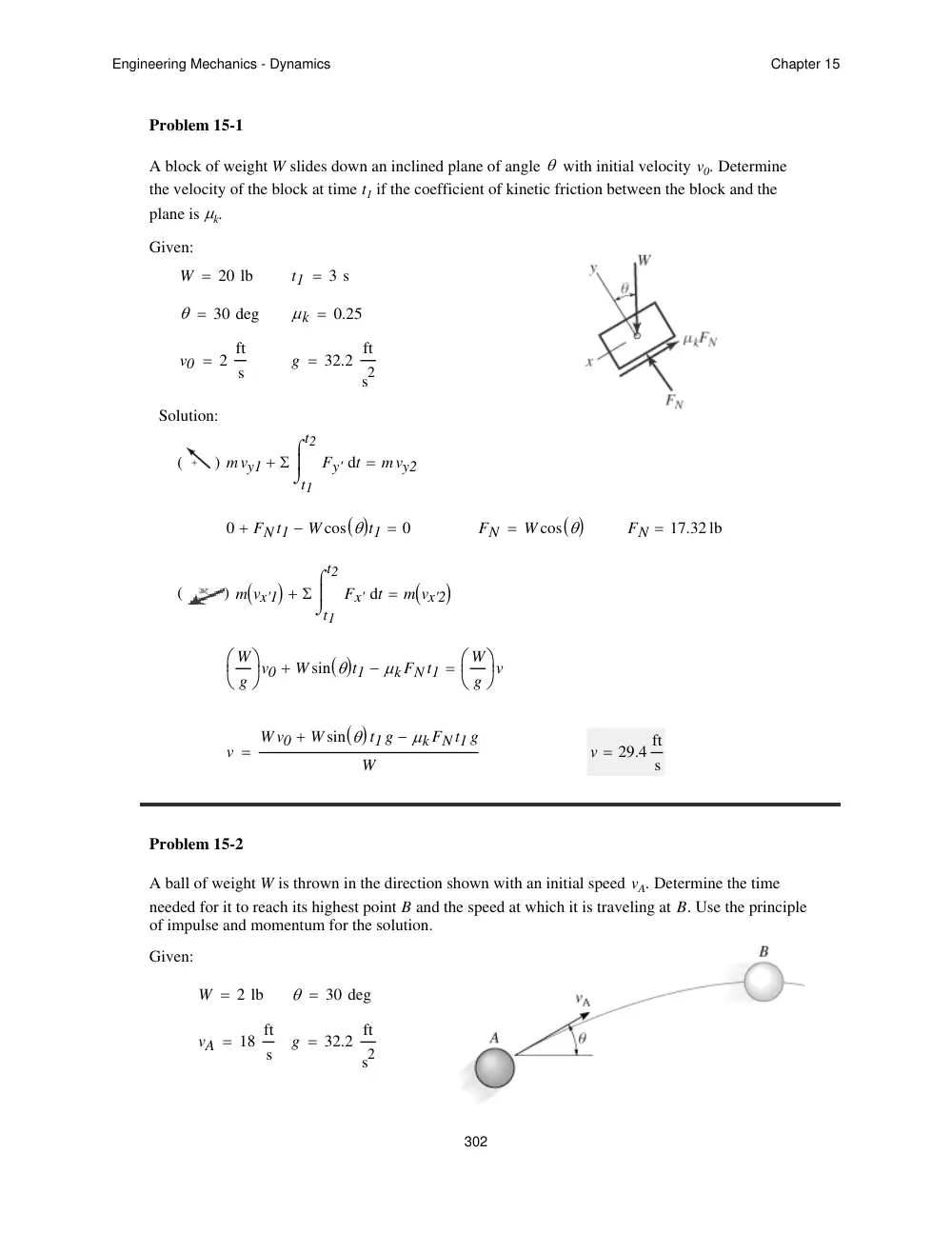
Problem 15-1
A block of weight W slides down an inclined plane of angle θ with initial velocity v0. Determine
the velocity of the block at time t1 if the coefficient of kinetic friction between the block and the
plane is μk.
Given:
W
= 20 lb
t1
3 s
=
θ
= 30 deg
μk
0.25
=
v0
2 ft
s
=
g
32.2 ft
s2
=
Solution:
(
) mvy1
Σ
t1
t2
t
Fy'
⌠
⎮
⌡
d
+
mvy2
=
0
+ FN t1
− W cos θ( )t1
= 0
FN
= W cos θ( )
FN
17.32 lb
=
(
) m vx'1
(
)
Σ
t1
t2
t
Fx'
⌠
⎮
⌡
d
+
m vx'2
(
)
=
W
g
⎛⎜⎝
⎞⎟⎠
v0
+ W sin θ( )t1
− μk FN t1
W
g
⎛⎜⎝
⎞⎟⎠
v
=
v
W v0
W sin θ( ) t1 g
− μk FN t1 g
+
W
=
v
29.4 ft
s
=
Problem 15-2
A ball of weight W is thrown in the direction shown with an initial speed vA. Determine the time
needed for it to reach its highest point B and the speed at which it is traveling at B. Use the principle
of impulse and momentum for the solution.
Given:
W
= 2 lb
θ
30 deg
=
vA
18 ft
s
=
g
32.2 ft
s2
=
302
Engineering Mechanics - Dynamics
Chapter 15
Solution:
W
g
⎛⎜⎝
⎞⎟⎠
vAsin θ( )
− W t
W
g
⎛⎜⎝
⎞⎟⎠
0
=
t
vAsin θ( )
g
=
t
0.280 s
=
W
g
⎛⎜⎝
⎞⎟⎠
vAcos θ( )
+ 0
W
g
⎛⎜⎝
⎞⎟⎠
vx
=
vx
= vAcos θ( )
vx
15.59 ft
s
=
Problem 15-3
A block of weight W is given an initial velocity v0 up a smooth slope of angle θ. Determine the
time it will take to travel up the slope before it stops.
Given:
W
5 lb
=
v0
10 ft
s
=
θ
45 deg
=
g
32.2 ft
s2
=
Solution:
W
g
⎛⎜⎝
⎞⎟⎠
v0
− W sin θ( )t
= 0
t
v0
gsin θ( )
=
t
0.439 s
=
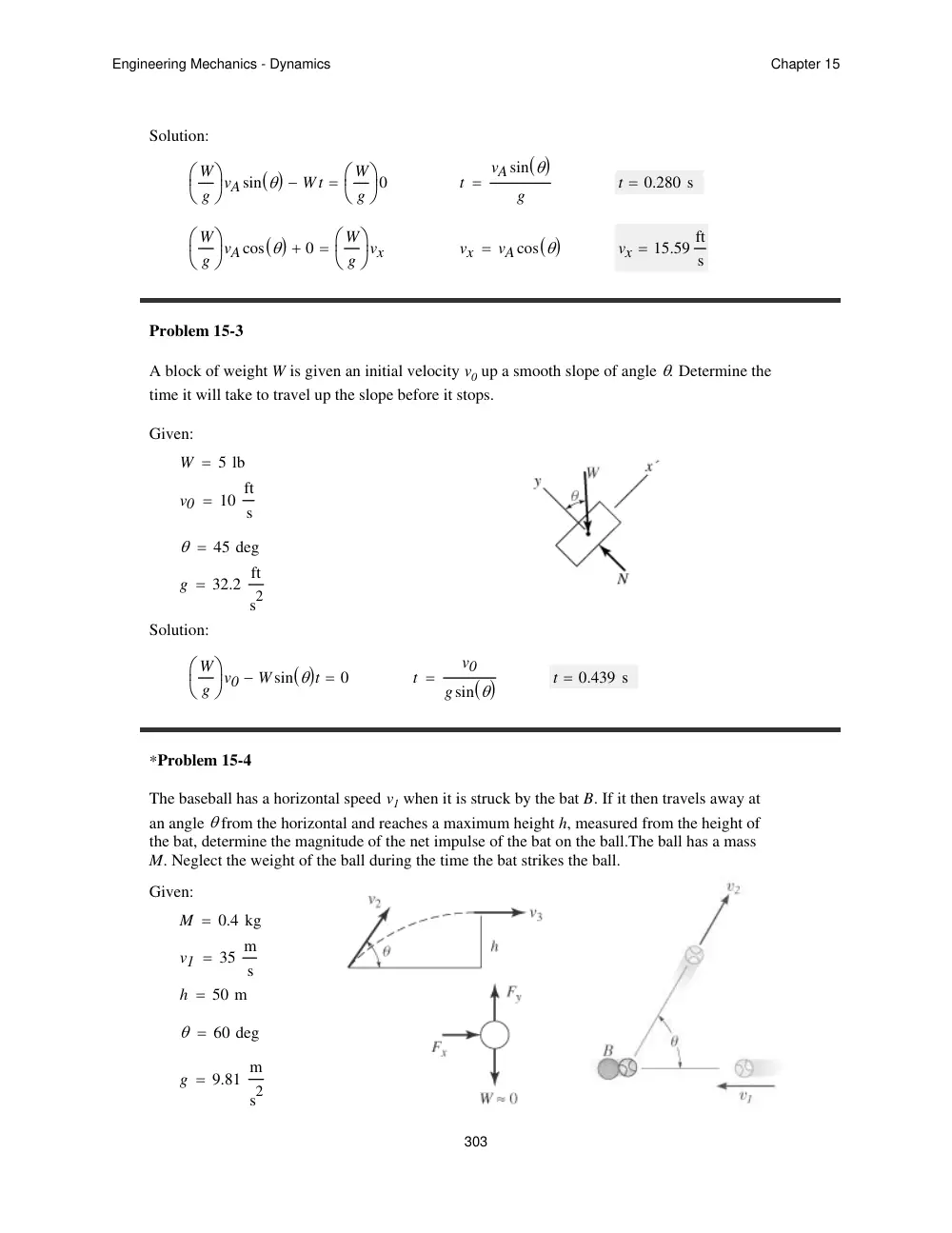
*Problem 15-4
The baseball has a horizontal speed v1 when it is struck by the bat B. If it then travels away at
an angle θ from the horizontal and reaches a maximum height h, measured from the height of
the bat, determine the magnitude of the net impulse of the bat on the ball.The ball has a mass
M. Neglect the weight of the ball during the time the bat strikes the ball.
Given:
M
0.4 kg
=
v1
35 m
s
=
h
50 m
=
θ
60 deg
=
g
9.81 m
s2
=
303
Engineering Mechanics - Dynamics
Chapter 15
Solution:
Guesses
v2
20 m
s
=
Impx
= 1 N s⋅
Impy
10 N s⋅
=
Given
1
2M v2 sin θ( )
(
)2
= M gh
−M
v1
+ Impx
= M v2 cos θ( )
0
+ Impy
M v2 sin θ( )
=
v2
Impx
Impy
⎛⎜
⎜
⎜⎝
⎞⎟
⎟
⎟⎠
Find v2 Impx
,
, Impy
(
)
=
v2
36.2 m
s
=
Impx
Impy
⎛
⎜
⎝
⎞
⎟
⎠
21.2
⎛⎜⎝12.5
⎞⎟⎠
N s⋅
=
Impx
Impy
⎛
⎜
⎝
⎞
⎟
⎠
24.7 N s⋅
=
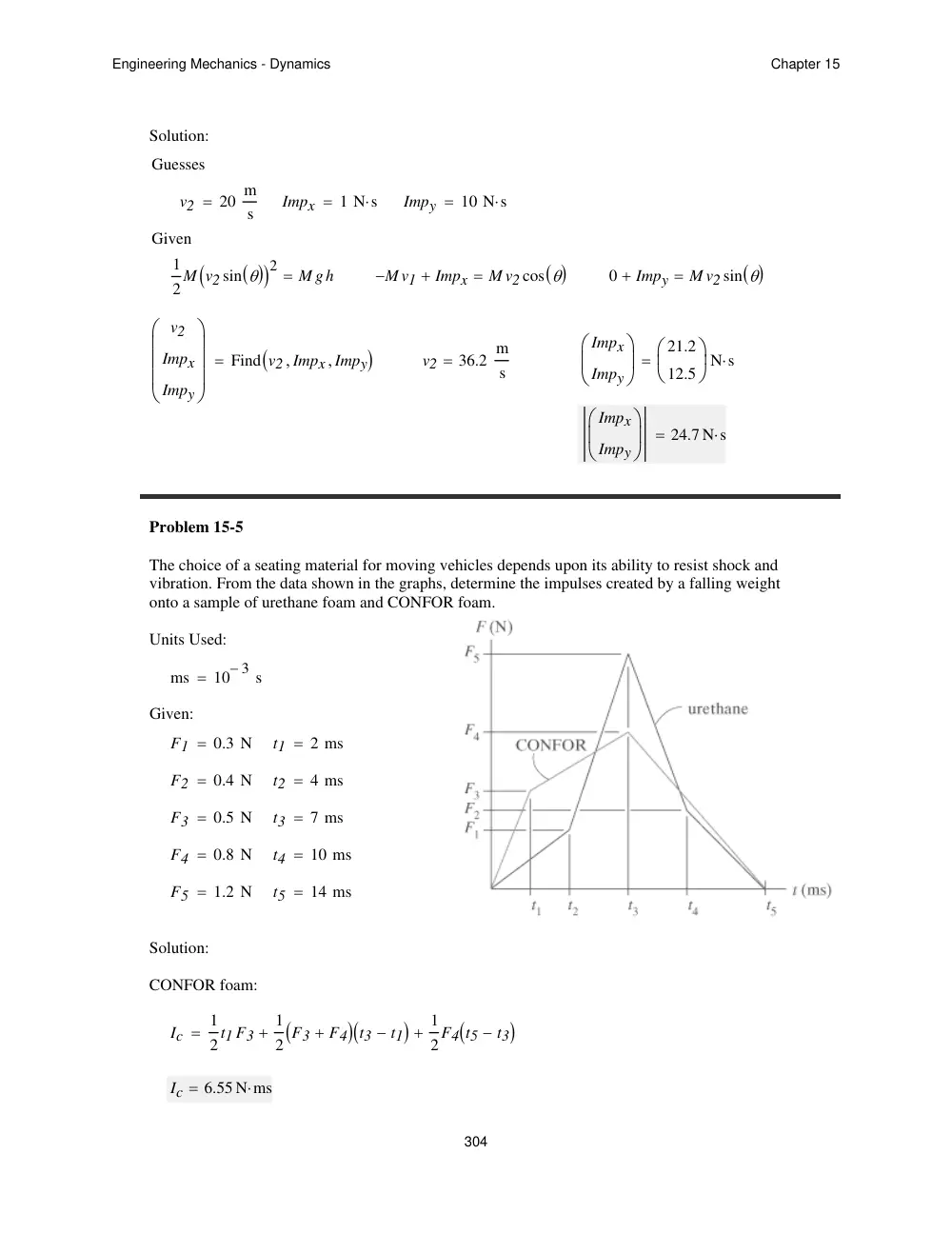
Problem 15-5
The choice of a seating material for moving vehicles depends upon its ability to resist shock and
vibration. From the data shown in the graphs, determine the impulses created by a falling weight
onto a sample of urethane foam and CONFOR foam.
Units Used:
ms
10 3
−
s
=
Given:
F1
= 0.3 N
t1
2 ms
=
F2
= 0.4 N
t2
4 ms
=
F3
= 0.5 N
t3
7 ms
=
F4
= 0.8 N
t4
10 ms
=
F5
= 1.2 N
t5
14 ms
=
Solution:
CONFOR foam:
Ic
1
2t1 F3
1
2 F3
+ F4
(
) t3
− t1
(
)
+
1
2F4 t5
− t3
(
)
+
=
Ic
6.55 N ms
⋅
=
304
Engineering Mechanics - Dynamics
Chapter 15
Urethane foam:
IU
1
2t2 F1
1
2 F5
+ F1
(
) t3
− t2
(
)
+
1
2 F5
+ F2
(
) t4
− t3
(
)
+
1
2 t5
− t4
(
)F2
+
=
IU
6.05 N ms
⋅
=
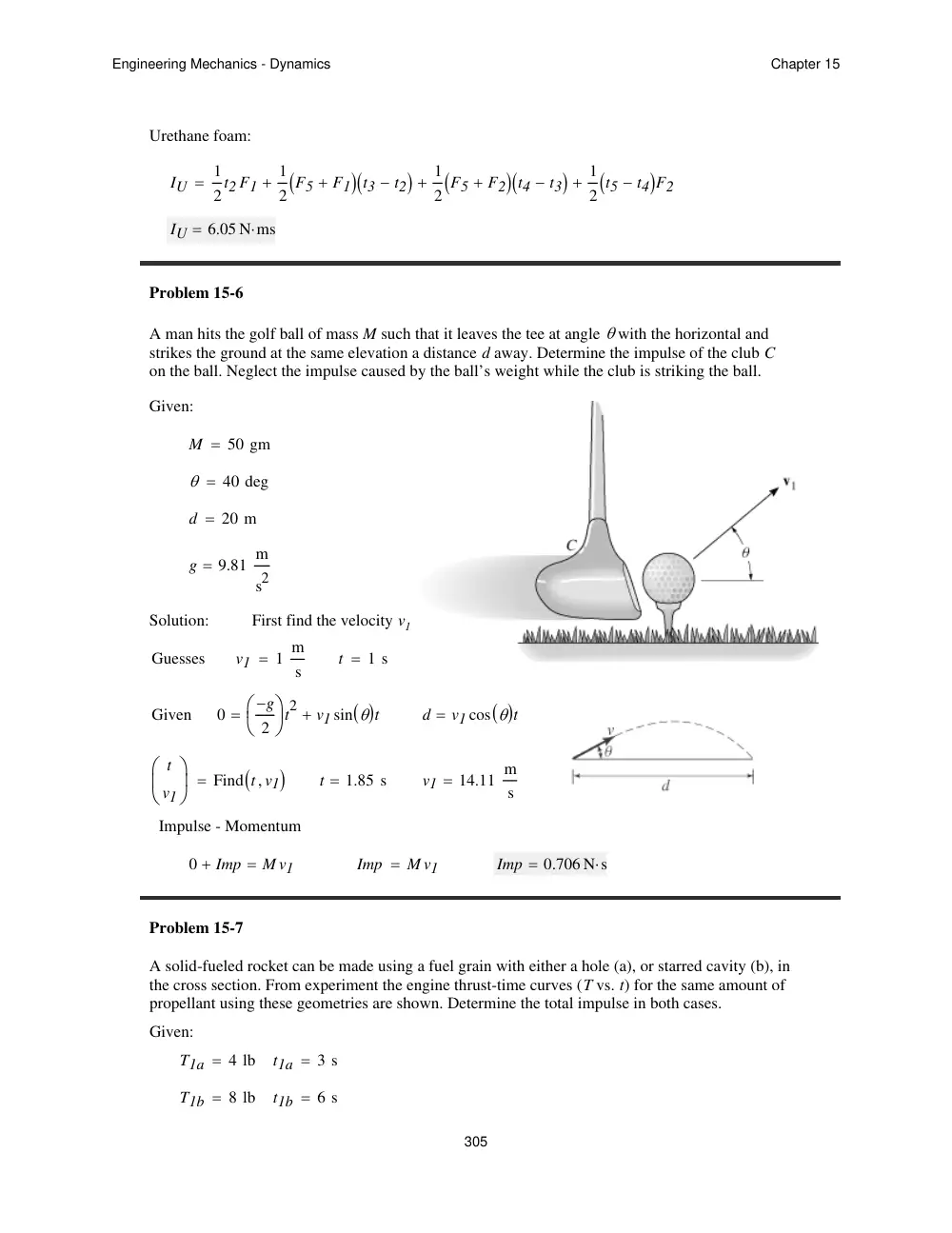
Problem 15-6
A man hits the golf ball of mass M such that it leaves the tee at angle θ with the horizontal and
strikes the ground at the same elevation a distance d away. Determine the impulse of the club C
on the ball. Neglect the impulse caused by the ball’s weight while the club is striking the ball.
Given:
M
50 gm
=
θ
40 deg
=
d
20 m
=
g
9.81 m
s2
=
Solution:
First find the velocity v1
Guesses
v1
1 m
s
=
t
1 s
=
Given
0
−g
2
⎛⎜⎝
⎞⎟⎠
t2
+ v1 sin θ( )t
=
d
v1 cos θ( )t
=
t
⎛⎜v1
⎝
⎞⎟
⎠
Find t v1
( ,
)
=
t
= 1.85 s
v1
14.11 m
s
=
Impulse - Momentum
0
+ Imp
= M v1
Imp
= M v1
Imp
0.706 N s⋅
=
Problem 15-7
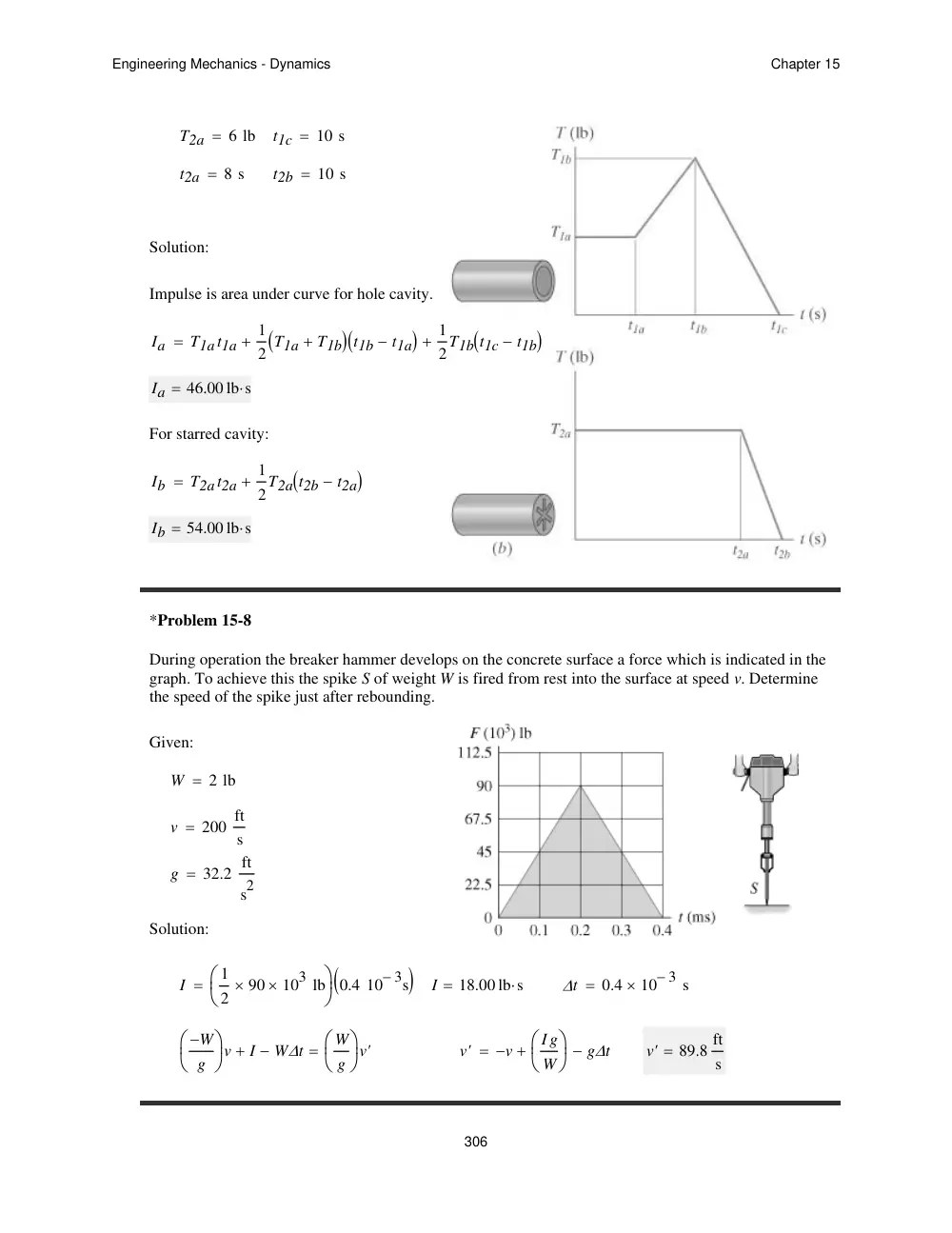
A solid-fueled rocket can be made using a fuel grain with either a hole (a), or starred cavity (b), in
the cross section. From experiment the engine thrust-time curves (T vs. t) for the same amount of
propellant using these geometries are shown. Determine the total impulse in both cases.
Given:
T1a
= 4 lb
t1a
3 s
=
T1b
= 8 lb
t1b
6 s
=
305
Engineering Mechanics - Dynamics
Chapter 15
T2a
= 6 lb
t1c
10 s
=
t2a
= 8 s
t2b
10 s
=
Solution:
Impulse is area under curve for hole cavity.
Ia
T1at1a
1
2 T1a
+ T1b
(
) t1b
− t1a
(
)
+
1
2T1b t1c
− t1b
(
)
+
=
Ia
46.00 lb s⋅
=
For starred cavity:
Ib
T2at2a
1
2T2a t2b
− t2a
(
)
+
=
Ib
54.00 lb s⋅
=
*Problem 15-8
During operation the breaker hammer develops on the concrete surface a force which is indicated in the
graph. To achieve this the spike S of weight W is fired from rest into the surface at speed v. Determine
the speed of the spike just after rebounding.
Given:
W
2 lb
=
v
200 ft
s
=
g
32.2 ft
s2
=
Solution:
I
1
2
× 90
× 103
lb
⎛⎜⎝
⎞⎟⎠
0.4 10 3
− s
(
)
=
I
= 18.00 lb s⋅
Δt
0.4
10 3
−
s
×
=
−W
g
⎛⎜⎝
⎞⎟⎠
v
+ I
− WΔt
W
g
⎛⎜⎝
⎞⎟⎠
v'
=
v'
−v
I g
W
⎛⎜⎝
⎞⎟⎠
+
− gΔt
=
v'
89.8 ft
s
=
306
Engineering Mechanics - Dynamics
Chapter 15
Problem 15-9
The jet plane has a mass M and a horizontal velocity v0 when t = 0. If both engines provide a
horizontal thrust which varies as shown in the graph, determine the plane’s velocity at time t1.
Neglect air resistance and the loss of fuel during the motion.
Units Used:
Mg
103 kg
=
kN
103 N
=
Given:
M
250 Mg
=
v0
100 m
s
=
t1
15 s
=
a
200 kN
=
b
2 kN
s2
=
Solution:
M v0
0
t1
t
a
+ bt2
⌠
⎮⌡
d
+
M v1
=
v1
v0
1
M
0
t1
t
a
+ bt2
⌠
⎮⌡
d
+
=
v1
121.00 m
s
=
Problem 15-10
A man kicks the ball of mass M such
that it leaves the ground at angle θ with
the horizontal and strikes the ground at
the same elevation a distance d away.
Determine the impulse of his foot F on
the ball. Neglect the impulse caused by
the ball’s weight while it’s being kicked.
Given:
M
= 200 gm
d
15 m
=
θ
= 30 deg
g
9.81 m
s2
=
307
Engineering Mechanics - Dynamics
Chapter 15
Solution:
First find the velocity vA
Guesses
vA
1 m
s
=
t
1 s
=
Given
0
−g
2
⎛⎜⎝
⎞⎟⎠
t2
+ vAsin θ( )t
=
d
vAcos θ( )t
=
t
⎛⎜vA
⎝
⎞⎟
⎠
Find t vA
( ,
)
=
t
= 1.33 s
vA
13.04 m
s
=
Impulse - Momentum
0
+ I
= M vA
I
= M vA
I
2.61 N s⋅
=
Problem 15-11
The particle P is acted upon by its weight W and forces F1 = (ai + btj + ctk) and F2 = dt2i. If the
particle originally has a velocity of v1 = (v1xi+v1yj+v1zk), determine its speed after time t1.
Given:
W
= 3 lb
g
32.2 ft
s2
=
v1x
3 ft
s
=
a
5 lb
=
v1y
1 ft
s
=
b
2 lb
s
=
v1z
6 ft
s
=
c
1 lb
s
=
t1
= 2 s
d
1 lb
s2
=
Solution:
mv1
0
t1
t
F1
+ F2
− W k
(
)
⌠
⎮⌡
d
+
= mv2
v2
v1
1
m
0
t1
t
F1
+ F2
− W k
(
)
⌠
⎮⌡
d
+
=
v2x
v1x
g
W
0
t1
t
a
+ dt2
⌠
⎮⌡
d
+
=
v2x
138.96 ft
s
=
v2y
v1y
g
W
0
t1
bt t
⌠
⎮⌡
d
+
=
v2y
43.93 ft
s
=
308
Engineering Mechanics - Dynamics
Chapter 15
v2z
v1z
g
W
0
t1
t
ct
− W
⌠
⎮⌡
d
+
=
v2z
−36.93
ft
s
=
v2
v2x
2
v2y
2
+
v2z
2
+
=
v2
150.34 ft
s
=
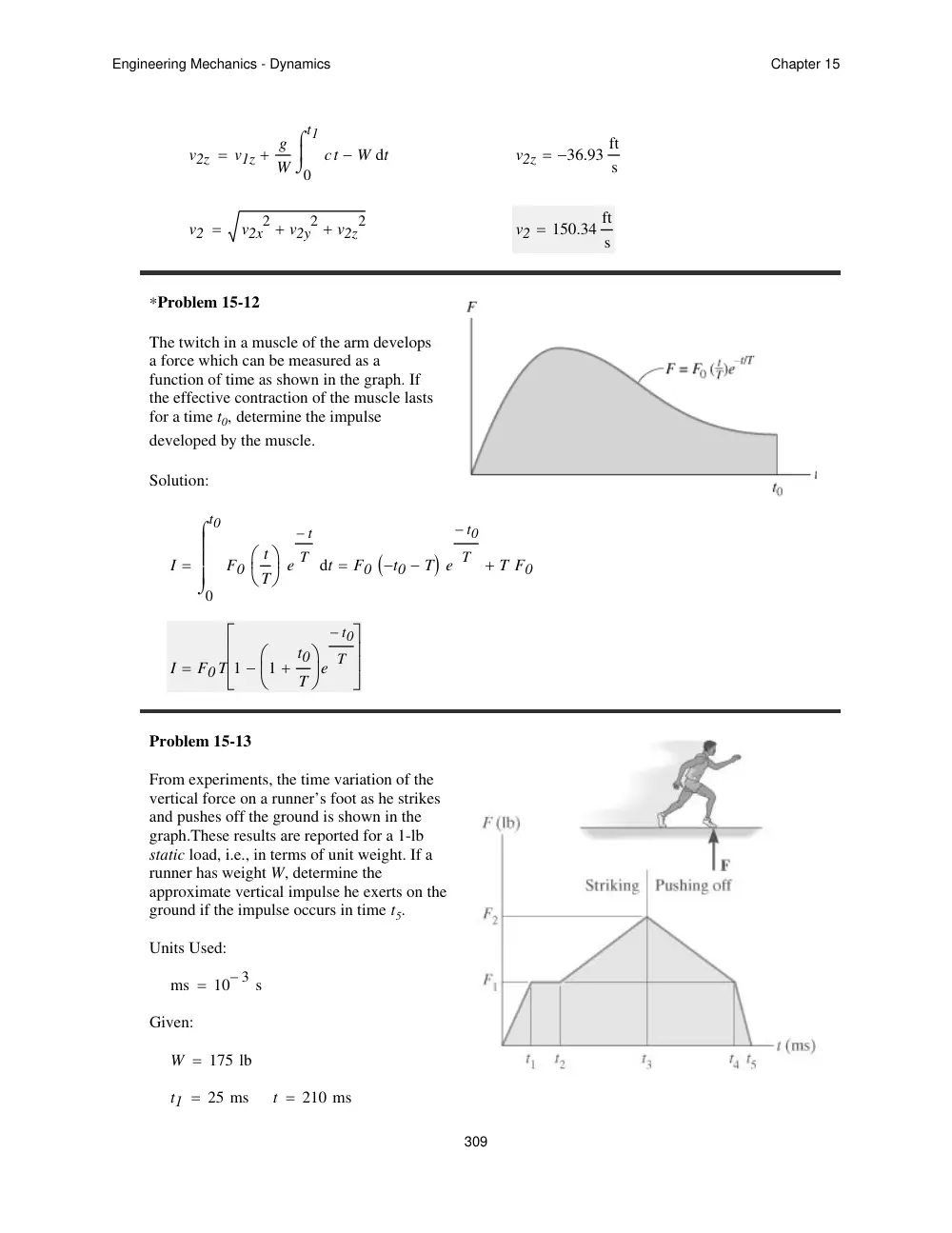
*Problem 15-12
The twitch in a muscle of the arm develops
a force which can be measured as a
function of time as shown in the graph. If
the effective contraction of the muscle lasts
for a time t0, determine the impulse
developed by the muscle.
Solution:
I
0
t0
t
F0
t
T
⎛⎜⎝
⎞⎟⎠
e
t
−
T
⌠⎮
⎮
⎮⌡
d
=
F0
−t0
− T
(
) e
t0
−
T
+ T F0
=
I
F0 T 1
1
t0
⎛⎜⎝ + T
⎞⎟⎠
e
t0
−
T
−
⎡⎢
⎢⎣
⎤⎥
⎥⎦
=
Problem 15-13
From experiments, the time variation of the
vertical force on a runner’s foot as he strikes
and pushes off the ground is shown in the
graph.These results are reported for a 1-lb
static load, i.e., in terms of unit weight. If a
runner has weight W, determine the
approximate vertical impulse he exerts on the
ground if the impulse occurs in time t5.
Units Used:
ms
10 3
−
s
=
Given:
W
175 lb
=
t1
= 25 ms
t
210 ms
=
309
Engineering Mechanics - Dynamics
Chapter 15
t2
= 50 ms
t3
125 ms
=
t4
= 200 ms
t5
210 ms
=
F2
= 3.0 lb
F1
1.5 lb
=
Solution:
Area
1
2t1 F1
F1 t2
− t1
(
)
+
F1 t4
− t2
(
)
+
1
2 t5
− t4
(
)F1
+
1
2 F2
− F1
(
) t4
− t2
(
)
+
=
Imp
Area W
lb
=
Imp
70.2 lb s⋅
=
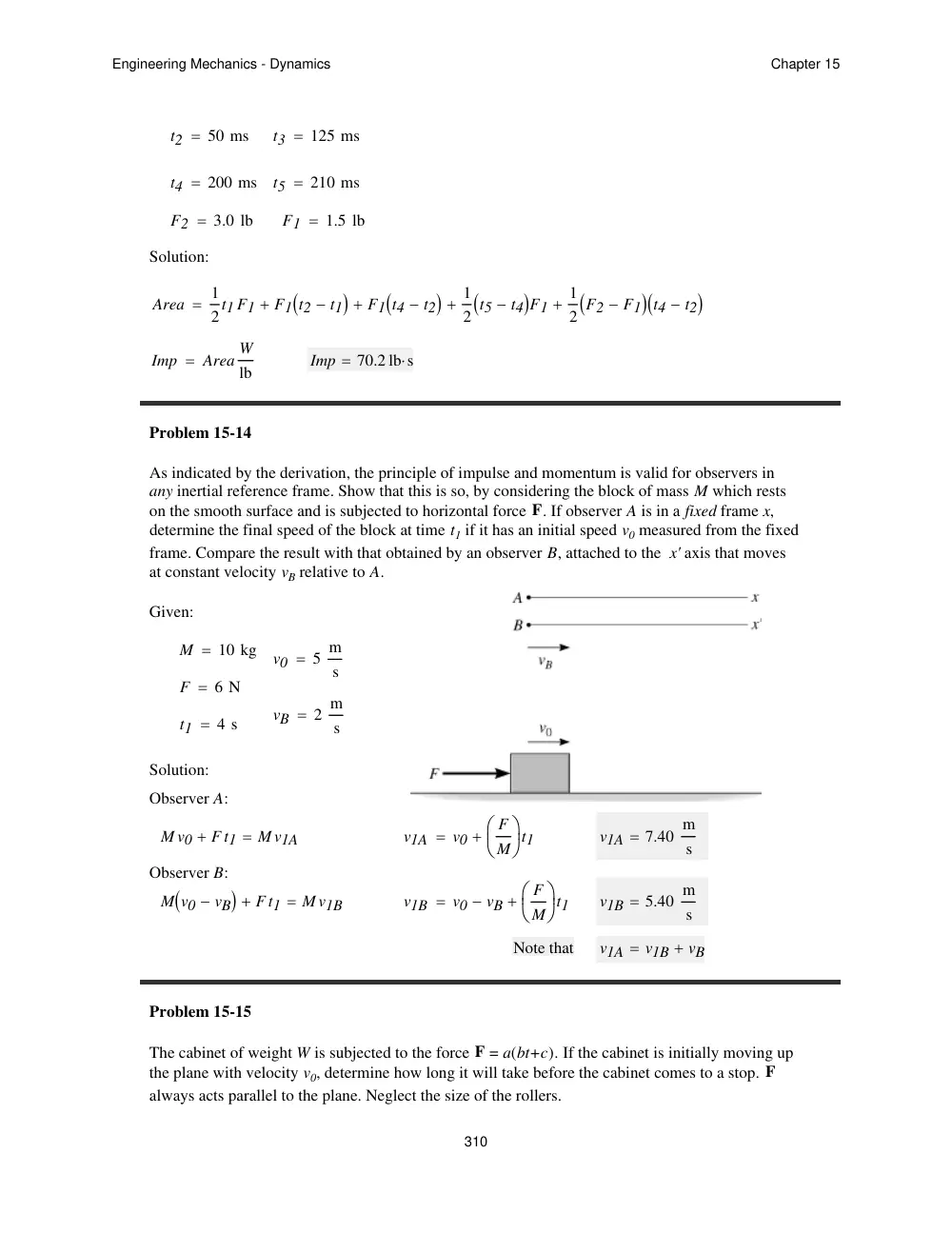
Problem 15-14
As indicated by the derivation, the principle of impulse and momentum is valid for observers in
any inertial reference frame. Show that this is so, by considering the block of mass M which rests
on the smooth surface and is subjected to horizontal force F. If observer A is in a fixed frame x,
determine the final speed of the block at time t1 if it has an initial speed v0 measured from the fixed
frame. Compare the result with that obtained by an observer B, attached to the x' axis that moves
at constant velocity vB relative to A.
Given:
M
= 10 kg
v0
5 m
s
=
F
6 N
=
vB
2 m
s
=
t1
4 s
=
Solution:
Observer A:
M v0
+ F t1
= M v1A
v1A
v0
F
M
⎛⎜⎝
⎞⎟⎠
t1
+
=
v1A
7.40 m
s
=
Observer B:
M v0
− vB
(
)
+ F t1
= M v1B
v1B
v0
− vB
F
M
⎛⎜⎝
⎞⎟⎠
t1
+
=
v1B
5.40 m
s
=
Note that
v1A
v1B
+ vB
=
Problem 15-15
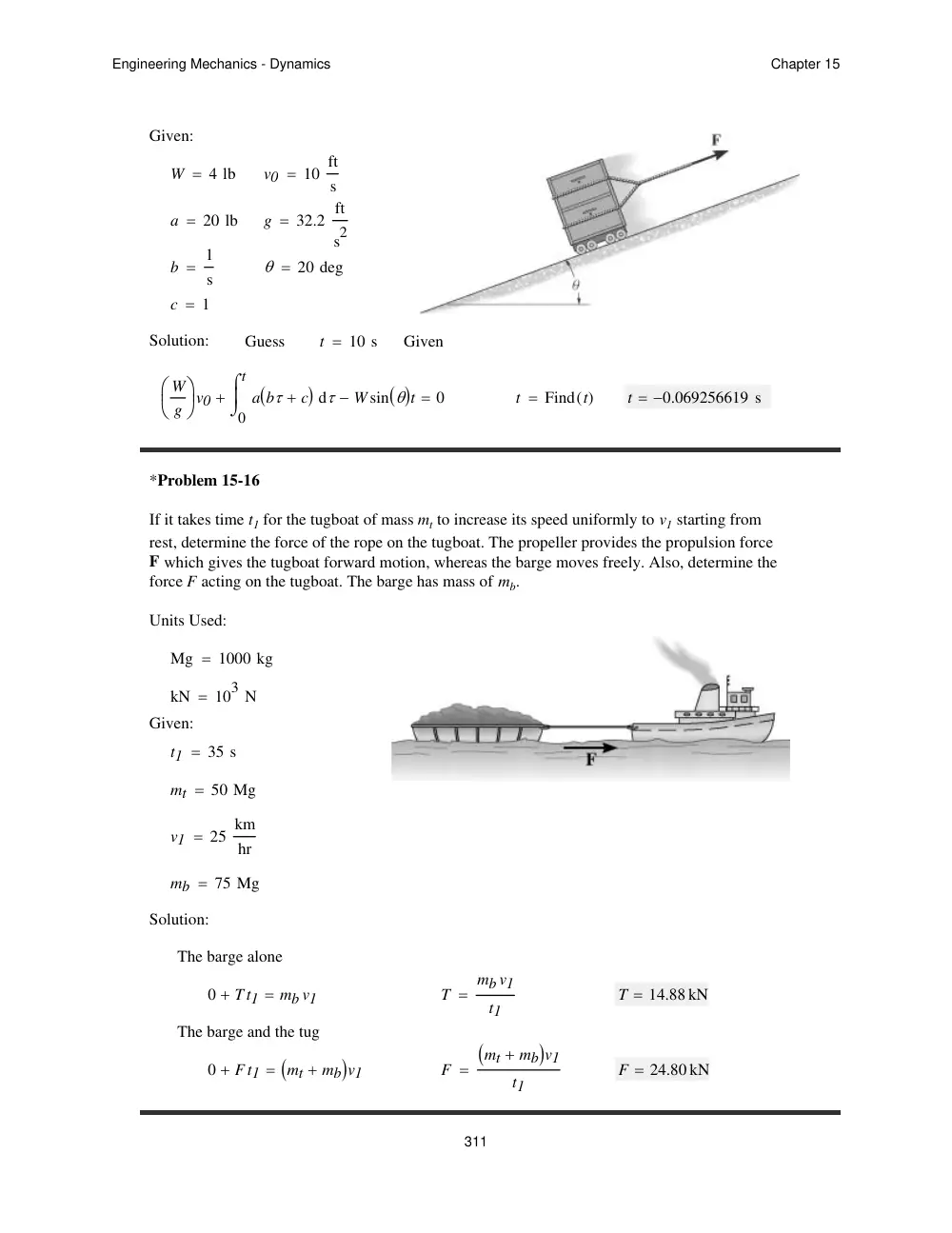
The cabinet of weight W is subjected to the force F = a(bt+c). If the cabinet is initially moving up
the plane with velocity v0, determine how long it will take before the cabinet comes to a stop. F
always acts parallel to the plane. Neglect the size of the rollers.
310
Engineering Mechanics - Dynamics
Chapter 15
Given:
W
= 4 lb
v0
10 ft
s
=
a
= 20 lb
g
32.2 ft
s2
=
b
1
= s
θ
20 deg
=
c
1
=
Solution:
Guess
t
= 10 s
Given
W
g
⎛⎜⎝
⎞⎟⎠
v0
0
t
τ
a bτ
+ c
(
)
⌠
⎮⌡
d
+
− W sin θ( )t
= 0
t
= Find t( )
t
−0.069256619
s
=
*Problem 15-16
If it takes time t1 for the tugboat of mass mt to increase its speed uniformly to v1 starting from
rest, determine the force of the rope on the tugboat. The propeller provides the propulsion force
F which gives the tugboat forward motion, whereas the barge moves freely. Also, determine the
force F acting on the tugboat. The barge has mass of mb.
Units Used:
Mg
1000 kg
=
kN
103 N
=
Given:
t1
35 s
=
mt
50 Mg
=
v1
25 km
hr
=
mb
75 Mg
=
Solution:
The barge alone
0
+ T t1
= mb v1
T
mb v1
t1
=
T
14.88 kN
=
The barge and the tug
0
+ F t1
mt
+ mb
(
)v1
=
F
mt
+ mb
(
)v1
t1
=
F
24.80 kN
=
311
Engineering Mechanics - Dynamics
Chapter 15
Problem 15-17
When the ball of weight W is fired, it leaves the ground at an angle θ from the horizontal and strikes
the ground at the same elevation a distance d away. Determine the impulse given to the ball.
Given:
W
0.4 lb
=
d
130 ft
=
θ
40 deg
=
g
32.2 ft
s2
=
Solution:
Guesses
v0
1 ft
s
=
t
= 1 s
Imp
1 lb s⋅
=
Given
v0 cos θ( )t
= d
−1
2 gt2
+ v0 sin θ( )t
= 0
Imp
W
g
⎛⎜⎝
⎞⎟⎠
v0
=
v0
t
Imp
⎛⎜
⎜
⎜⎝
⎞⎟
⎟
⎟⎠
Find v0 t,
, Imp
(
)
=
v0
65.2 ft
s
=
t
= 2.6 s
Imp
0.810 lb s⋅
=
Problem 15-18
The uniform beam has weight W. Determine the average tension in each of the two cables AB
and AC if the beam is given an upward speed v in time t starting from rest. Neglect the mass of
the cables.
Units Used:
kip
103 lb
=
Given:
W
= 5000 lb
g
32.2 ft
s2
=
v
8 ft
s
=
a
3 ft
=
t
= 1.5 s
b
4 ft
=
312
Engineering Mechanics - Dynamics
Chapter 15
Solution:
0
− W t
2
b
a2
b2
+
⎛
⎜
⎝
⎞
⎟
⎠
FABt
+
W
g
⎛⎜⎝
⎞⎟⎠
v
=
FAB
W
g v
+ W t
⎛⎜⎝
⎞⎟⎠
a2
b2
+
2bt
⎛
⎜
⎝
⎞
⎟
⎠
=
FAB
3.64 kip
=
Problem 15-19
The block of mass M is moving downward at speed v1 when it is a distance h from the sandy
surface. Determine the impulse of the sand on the block necessary to stop its motion. Neglect
the distance the block dents into the sand and assume the block does not rebound. Neglect the
weight of the block during the impact with the sand.
Given:
M
5 kg
=
v1
2 m
s
=
h
8 m
=
g
9.81 m
s2
=
Solution:
Just before impact
v2
v1
2
+ 2gh
=
v2
12.69 m
s
=
Collision
M v2
− I
= 0
I
= M v2
I
63.4 N s⋅
=
*Problem 15-20
The block of mass M is falling downward at speed v1
when it is a distance h from the sandy surface. Determine
the average impulsive force acting on the block by the sand
if the motion of the block is stopped in time Δt once the
block strikes the sand. Neglect the distance the block dents
into the sand and assume the block does not rebound.
Neglect the weight of the block during the impact with the
sand.
313
Engineering Mechanics - Dynamics
Chapter 15
Given:
M
5 kg
=
v1
2 m
s
=
h
8 m
=
Δt
= 0.9 s
g
9.81 m
s2
=
Solution:
Just before impact
v2
v1
2
+ 2gh
=
v2
12.69 m
s
=
Collision
M v2
− FΔt
= 0
F
M v2
Δt
=
F
70.5 N
=
Problem 15-21
A crate of mass M rests against a stop block s, which prevents the crate from moving down
the plane. If the coefficients of static and kinetic friction between the plane and the crate are μs
and μk respectively, determine the time needed for the force F to give the crate a speed v up
the plane. The force always acts parallel to the plane and has a magnitude of F = at. Hint: First
determine the time needed to overcome static friction and start the crate moving.
Given:
M
= 50 kg
θ
= 30 deg
g
9.81 m
s2
=
v
2 m
s
=
μs
0.3
=
μk
= 0.2
a
300 N
s
=
Solution:
Guesses
t1
= 1 s
NC
= 1 N
t2
1 s
=
Given
NC
− M gcos θ( )
0
=
at1
− μsNC
− M gsin θ( )
0
=
t1
t2
t
at
− M gsin θ( )
− μk NC
(
)
⌠
⎮
⌡
d
M v
=
t1
t2
NC
⎛⎜
⎜
⎜⎝
⎞⎟
⎟
⎟⎠
Find t1 t2
,
, NC
(
)
=
t1
= 1.24 s
t2
1.93 s
=
314
Engineering Mechanics - Dynamics
Chapter 15
Problem 15-22
The block of weight W has an initial velocity v1 in the direction shown. If a force F = {f1i + f2j} acts
on the block for time t, determine the final speed of the block. Neglect friction.
Given:
W
= 2 lb
a
= 2 ft
f1
0.5 lb
=
v1
10 ft
s
=
b
= 2 ft
f2
0.2 lb
=
g
32.2 ft
s2
=
c
= 5 ft
t
5 s
=
Solution:
θ
atan
b
c
a
−
⎛⎜⎝
⎞⎟⎠
=
Guesses
v2x
1 ft
s
=
v2y
1 ft
s
=
Given
W
g
⎛⎜⎝
⎞⎟⎠
v1
sin θ( )
−
⎛⎜⎝ cos θ( )
⎞⎟⎠
f1
f2
⎛
⎜
⎝
⎞
⎟
⎠
t
+
W
g
⎛⎜⎝
⎞⎟⎠
v2x
v2y
⎛
⎜
⎝
⎞
⎟
⎠
=
v2x
v2y
⎛
⎜
⎝
⎞
⎟
⎠
Find v2x v2y
,
(
)
=
v2x
v2y
⎛
⎜
⎝
⎞
⎟
⎠
34.7
⎛⎜⎝24.4
⎞⎟⎠
ft
s
=
v2x
v2y
⎛
⎜
⎝
⎞
⎟
⎠
42.4 ft
s
=
Problem 15-23
The tennis ball has a horizontal speed v1 when it is struck by the racket. If it then travels away
at angle θ from the horizontal and reaches maximum altitude h, measured from the height of the
racket, determine the magnitude of the net impulse of the racket on the ball. The ball has mass
M. Neglect the weight of the ball during the time the racket strikes the ball.
Given:
v1
15 m
s
=
θ
25 deg
=
h
10 m
=
M
180 gm
=
g
9.81 m
s2
=
315
Engineering Mechanics - Dynamics
Chapter 15
Solution:
Free flight
v2 sin θ( )
2gh
=
v2
2gh
sin θ( )
=
v2
33.14 m
s
=
Impulse - momentum
−M
v1
+ Ix
= M v2 cos θ( )
Ix
M v2 cos θ( )
+ v1
(
)
=
Ix
8.11 N s⋅
=
0
+ Iy
= M v2 sin θ( )
Iy
= M v2 sin θ( )
Iy
2.52 N s⋅
=
I
Ix
2
Iy
2
+
=
I
8.49 N s⋅
=
*Problem 15-24
The slider block of mass M is moving to the right with speed v when it is acted upon by the
forces F1 and F2. If these loadings vary in the manner shown on the graph, determine the speed
of the block at t = t3. Neglect friction and the mass of the pulleys and cords.
Given:
M
40 kg
=
v
1.5 m
s
=
t3
6 s
=
t2
4 s
=
t1
2 s
=
P1
10 N
=
P2
20 N
=
P3
30 N
=
P4
40 N
=
Solution:
The impulses acting on the block are found from the areas under the graph.
I
4 P3 t2
P1 t3
− t2
(
)
+
⎡⎣
⎤⎦
P1 t1
P2 t2
− t1
(
)
+
P4 t3
− t2
(
)
+
⎡⎣
⎤⎦
−
=
M v
+ I
= M v3
v3
v
I
+ M
=
v3
12.00 m
s
=
316
Engineering Mechanics - Dynamics
Chapter 15
Problem 15-25
Determine the velocities of blocks A and B at time t after they are released from rest. Neglect
the mass of the pulleys and cables.
Given:
WA
2 lb
=
WB
4 lb
=
t
2 s
=
g
32.2 ft
s2
=
Solution:
2sA
+ 2sB
L
=
vA
−vB
=
Block A
0
2T
− WA
(
)t
+
WA
g vA
=
Block B
0
2T
− WB
(
)t
+
WB
g
−( vA
)
=
Combining
WB
− WA
(
)t
WB
WA
+
g
⎛⎜⎝
⎞⎟⎠
vA
=
vA
WB
WA
−
WB
WA
+
⎛⎜
⎝
⎞⎟
⎠
gt
=
vB
−vA
=
vA
vB
⎛
⎜
⎝
⎞
⎟
⎠
21.47
⎛⎜⎝−21.47
⎞⎟⎠
ft
s
=
Problem 15-26
The package of mass M is released from rest at A. It slides down the smooth plane which is
inclined at angle θ onto the rough surface having a coefficient of kinetic friction of μk. Determine
the total time of travel before the package stops sliding. Neglect the size of the package.
Given:
M
= 5 kg
h
3 m
=
θ
= 30 deg
g
9.81 m
s2
=
μk
0.2
=
317
Engineering Mechanics - Dynamics
Chapter 15
Solution:
On the slope
v1
2gh
=
v1
7.67 m
s
=
t1
v1
gsin θ( )
=
t1
1.56 s
=
On the flat
M v1
− μk M gt2
= 0
t2
v1
μk g
=
t2
3.91 s
=
t
t1
+ t2
=
t
5.47 s
=
Problem 15-27
Block A has weight WA and block B has weight WB. If B is moving downward with a velocity
vB0 at t = 0, determine the velocity of A when t = t1. Assume that block A slides smoothly.
Given:
WA
10 lb
=
WB
3 lb
=
vB0
3 ft
s
=
t1
1 s
=
g
32.2 ft
s2
=
Solution:
sA
+ 2sB
= L
vA
2
= − vB
Guess
vA1
1 ft
s
=
T
1 lb
=
Given
Block A
WA
g
⎛⎜⎝
⎞⎟⎠
2vB0
+ T t1
WA
g
⎛⎜⎝
⎞⎟⎠
vA1
=
Block B
WB
−
g
⎛⎜⎝
⎞⎟⎠
vB0
+ 2T t1
− WBt1
WB
−
g
⎛⎜⎝
⎞⎟⎠
vA1
2
⎛⎜⎝
⎞⎟⎠
=
vA1
⎛⎜ T
⎝
⎞⎟
⎠
Find vA1 T
,
(
)
=
T
= 1.40 lb
vA1
10.49 ft
s
=
318
Engineering Mechanics - Dynamics
Chapter 15
*Problem 15-28
Block A has weight WA and block B has weight WB. If B is moving downward with a velocity
vB1 at t = 0, determine the velocity of A when t = t1. The coefficient of kinetic friction
between the horizontal plane and block A is μk.
Given:
WA
10 lb
=
WB
3 lb
=
vB1
3 ft
s
=
μk
0.15
=
t1
1 s
=
g
32.2 ft
s2
=
Solution:
sA
+ 2sB
= L
vA
2
= − vB
Guess
vA2
1 ft
s
=
T
1 lb
=
Given
Block A
WA
g
⎛⎜⎝
⎞⎟⎠
2vB1
+ T t1
− μk WAt1
WA
g
⎛⎜⎝
⎞⎟⎠
vA2
=
Block B
WB
−
g
⎛⎜⎝
⎞⎟⎠
vB1
+ 2T t1
− WBt1
WB
−
g
vA2
2
⎛⎜⎝
⎞⎟⎠
=
vA2
⎛⎜ T
⎝
⎞⎟
⎠
Find vA2 T
,
(
)
=
T
= 1.50 lb
vA2
6.00 ft
s
=
Problem 15-29
A jet plane having a mass M takes off from an aircraft carrier such that the engine thrust varies as
shown by the graph. If the carrier is traveling forward with a speed v, determine the plane’s airspeed
after time t.
Units Used:
Mg
103 kg
=
kN
103 N
=
319
Engineering Mechanics - Dynamics
Chapter 15
Given:
M
= 7 Mg
t1
2 s
=
v
40 km
hr
=
t2
5 s
=
F1
= 5 kN
t
5 s
=
F2
15 kN
=
Solution:
The impulse exerted on the plane is equal
to the area under the graph.
M v
1
+ 2F1 t1
1
2 F1
+ F2
(
) t2
− t1
(
)
+
M v1
=
v1
v
1
2M F1 t1
F1
+ F2
(
) t2
− t1
(
)
+
⎡⎣
⎤⎦
+
=
v1
16.11 m
s
=
Problem 15-30
The motor pulls on the cable at A with a force F = a + bt2. If the crate of weight W is originally at rest
at t = 0, determine its speed at time t = t2. Neglect the mass of the cable and pulleys. Hint: First find
the time needed to begin lifting the crate.
Given:
W
17 lb
=
a
30 lb
=
b
1 lb
s2
=
t2
4 s
=
Solution:
1
2 a
( + bt12
)
− W
0
=
t1
2W
− a
b
=
t1
2.00 s
=
1
2
t1
t2
t
a
+ bt2
⌠
⎮
⌡
d
W t2
− t1
(
)
−
W
g
⎛⎜⎝
⎞⎟⎠
v2
=
v2
g
2W
t1
t2
t
a
+ bt2
⌠
⎮
⌡
d
g t2
− t1
(
)
−
=
v2
10.10 ft
s
=
320
Engineering Mechanics - Dynamics
Chapter 15
Problem 15-31
The log has mass M and rests on the ground for which the coefficients of static and kinetic
friction are μs and μk respectively. The winch delivers a horizontal towing force T to its cable at A
which varies as shown in the graph. Determine the speed of the log when t = t2. Originally the
tension in the cable is zero. Hint: First determine the force needed to begin moving the log.
Given:
M
= 500 kg
t1
3 s
=
μs
= 0.5
T1
1800 N
=
μk
= 0.4
g
9.81 m
s2
=
t2
5 s
=
Solution:
To begin motion we need
2T1
t0
2
t1
2
⎛⎜
⎜⎝
⎞⎟
⎟⎠
= μsM g
t0
μsM g
2T1
t1
=
t0
2.48 s
=
Impulse - Momentum
0
t0
t1
t
2T1
t
t1
⎛⎜⎝
⎞⎟⎠
2
⌠⎮
⎮
⎮⌡
d
+
2T1 t2
− t1
(
)
+
μk M g t2
− t0
(
)
−
M v2
=
v2
1
M
t0
t1
t
2T1
t
t1
⎛⎜⎝
⎞⎟⎠
2
⌠⎮
⎮
⎮⌡
d
2T1 t2
− t1
(
)
+
μk M g t2
− t0
(
)
−
⎡⎢
⎢
⎢
⎣
⎤⎥
⎥
⎥
⎦
=
v2
7.65 m
s
=
*Problem 15-32
A railroad car having mass m1 is coasting with speed v1 on a horizontal track. At the same time
another car having mass m2 is coasting with speed v2 in the opposite direction. If the cars meet
and couple together, determine the speed of both cars just after the coupling. Find the difference
between the total kinetic energy before and after coupling has occurred, and explain qualitatively
what happened to this energy.
Units used: Mg
= 103 kg
kJ
103 J
=
Given:
m1
= 15 Mg
m2
12 Mg
=
321
Engineering Mechanics - Dynamics
Chapter 15
v1
1.5 m
s
=
v2
0.75 m
s
=
Solution:
m1 v1
− m2 v2
m1
+ m2
(
)v
=
v
m1 v1
m2 v2
−
m1
+ m2
=
v
0.50 m
s
=
T1
1
2m1 v1
2
1
2m2 v2
2
+
=
T1
20.25 kJ
=
T2
1
2 m1
+ m2
(
) v2
=
T2
3.38 kJ
=
ΔT
T2
− T1
=
ΔT
−16.88
kJ
=
−ΔT
T1
100
= 83.33
% loss
The energy is dissipated as noise, shock, and heat during the coupling.
Problem 15-33
Car A has weight WA and is traveling to the right at speed vA Meanwhile car B of weight WB is
traveling at speed vB to the left. If the cars crash head-on and become entangled, determine their
common velocity just after the collision. Assume that the brakes are not applied during collision.
Given:
WA
= 4500 lb
WB
3000 lb
=
vA
3 ft
s
=
vB
6 ft
s
=
g
32.2 ft
s2
=
Solution:
WA
g
⎛⎜⎝
⎞⎟⎠
vA
WB
g
⎛⎜⎝
⎞⎟⎠
vB
−
WA
WB
+
g
⎛⎜⎝
⎞⎟⎠
v
=
v
WAvA
WBvB
−
WA
+ WB
=
v
−0.60
ft
s
=
Problem 15-34
The bus B has weight WB and is traveling to the right at speed vB. Meanwhile car A of weight WA is
traveling at speed vA to the left. If the vehicles crash head-on and become entangled, determine their
common velocity just after the collision. Assume that the vehicles are free to roll during collision.
322
Engineering Mechanics - Dynamics
Chapter 15
Given:
WB
= 15000 lb
vB
5 ft
s
=
WA
3000 lb
=
vA
4 ft
s
=
g
32.2 ft
s2
=
Solution:
WB
g
⎛⎜⎝
⎞⎟⎠
vB
WA
g
⎛⎜⎝
⎞⎟⎠
vA
−
WB
WA
+
g
⎛⎜⎝
⎞⎟⎠
v
=
v
WBvB
WAvA
−
WB
+ WA
=
v
3.50 ft
s
=
Positive means to the right,
negative means to the left.
Problem 15-35
The cart has mass M and rolls freely down the slope. When it reaches the bottom, a spring
loaded gun fires a ball of mass M1 out the back with a horizontal velocity vbc measured relative
to the cart. Determine the final velocity of the cart.
Given:
M
= 3 kg
h
1.25 m
=
M1
= 0.5 kg
g
9.81 m
s2
=
vbc
0.6 m
s
=
Solution:
v1
2gh
=
M
+ M1
(
)v1
M vc
M1 vc
− vbc
(
)
+
=
vc
v1
M1
M
M1
+
⎛⎜
⎝
⎞⎟
⎠
vbc
+
=
vc
5.04 m
s
=
323
Engineering Mechanics - Dynamics
Chapter 15
*Problem 15-36
Two men A and B, each having weight Wm, stand on the cart of weight Wc. Each runs with speed v
measured relative to the cart. Determine the final speed of the cart if (a) A runs and jumps off, then
B runs and jumps off the same end, and (b) both run at the same time and jump off at the same time.
Neglect the mass of the wheels and assume the jumps are made horizontally.
Given:
Wm
160 lb
=
Wc
200 lb
=
v
3 ft
s
=
g
32.2 ft
s2
=
Solution:
mm
Wm
g
=
mc
Wc
g
=
(a) A jumps first
0
−mm
v
( − vc
)
mm
+ mc
(
)vc1
+
=
vc1
mmv
mc
+ 2mm
=
vc1
0.923 ft
s
=
And then B jumps
mm
+ mc
(
)vc1
−mm
v
( − vc2
)
+ mc vc2
=
vc2
mmv
mm
+ mc
(
)vc1
+
mm
+ mc
=
vc2
2.26 ft
s
=
(b) Both men jump at the same time
0
2
− mm v
( − vc3
)
+ mc vc3
=
vc3
2mmv
2mm
+ mc
=
vc3
1.85 ft
s
=
Problem 15-37
A box of weight W1 slides from
rest down the smooth ramp onto
the surface of a cart of weight W2.
Determine the speed of the box at
the instant it stops sliding on the
cart. If someone ties the cart to the
ramp at B, determine the horizontal
impulse the box will exert at C in
order to stop its motion. Neglect
friction on the ramp and neglect the
size of the box.
324
Engineering Mechanics - Dynamics
Chapter 15
Given:
W1
= 40 lb
W2
= 20 lb
h
= 15 ft
g
32.2 ft
s2
=
Solution:
v1
2gh
=
W1
g v1
W1
W2
+
g
⎛⎜⎝
⎞⎟⎠
v2
=
v2
W1
W1
W2
+
⎛⎜
⎝
⎞⎟
⎠
v1
=
v2
20.7 ft
s
=
W1
g
⎛⎜⎝
⎞⎟⎠
v1
− Imp
= 0
Imp
W1
g
⎛⎜⎝
⎞⎟⎠
v1
=
Imp
38.6 lb s⋅
=
Problem 15-38
A boy of weight W1 walks forward over the surface of
the cart of weight W2 with a constant speed v relative to
the cart. Determine the cart’s speed and its displacement
at the moment he is about to step off. Neglect the mass
of the wheels and assume the cart and boy are originally
at rest.
Given:
W1
= 100 lb
W2
= 60 lb
v
3 ft
s
=
d
6 ft
=
Solution:
0
W1
g
⎛⎜⎝
⎞⎟⎠
vc
+ v
(
)
W2
g
⎛⎜⎝
⎞⎟⎠
vc
+
=
vc
W1
W1
+ W2
−
v
=
vc
−1.88
ft
s
=
Assuming that the boy walks the distance d
t
d
= v
sc
= vc t
sc
−3.75
ft
=
Problem 15-39
The barge B has weight WB and supports an automobile weighing Wa. If the barge is not tied to the
pier P and someone drives the automobile to the other side of the barge for unloading, determine how
far the barge moves away from the pier. Neglect the resistance of the water.
325
Engineering Mechanics - Dynamics
Chapter 15
Given:
WB
30000 lb
=
Wa
3000 lb
=
d
200 ft
=
g
32.2 ft
s2
=
Solution:
mB
WB
g
=
ma
Wa
g
=
v is the velocity of the car relative to the barge. The answer is independent of the
acceleration so we will do the problem for a constant speed.
mBvB
ma v
( + vB
)
+
= 0
vB
−ma
v
mB
+ ma
=
t
d
= v
sB
−vB
t
=
sB
ma d
ma
+ mB
=
sB
18.18 ft
=
*Problem 15-40
A bullet of weight W1 traveling at speed v1 strikes the wooden block of weight W2 and exits the
other side at speed v2 as shown. Determine the speed of the block just after the bullet exits the
block, and also determine how far the block slides before it stops. The coefficient of kinetic
friction between the block and the surface is μk.
Given:
W1
= 0.03 lb
a
3 ft
=
b
= 4 ft
W2
10 lb
=
c
5 ft
=
v1
1300 ft
s
=
d
12 ft
=
v2
50 ft
s
=
μk
0.5
=
Solution:
W1
g
⎛⎜⎝
⎞⎟⎠
v1
d
c2
d2
+
⎛
⎜
⎝
⎞
⎟
⎠
W2
g
⎛⎜⎝
⎞⎟⎠
vB
W1
g
⎛⎜⎝
⎞⎟⎠
v2
b
a2
b2
+
⎛
⎜
⎝
⎞
⎟
⎠
+
=
326
Engineering Mechanics - Dynamics
Chapter 15
vB
W1
W2
v1 d
c2
d2
+
v2 b
a2
b2
+
−
⎛
⎜
⎝
⎞
⎟
⎠
=
vB
3.48 ft
s
=
1
2
W2
g
⎛⎜⎝
⎞⎟⎠
vB
2
− μk W2 d
= 0
d
vB
2
2gμk
=
d
0.38 ft
=
Problem 15-41
A bullet of weight W1 traveling at v1 strikes the wooden block of weight W2 and exits the other side at
v2 as shown. Determine the speed of the block just after the bullet exits the block. Also, determine the
average normal force on the block if the bullet passes through it in time Δt, and the time the block
slides before it stops. The coefficient of kinetic friction between the block and the surface is μk.
Units Used:
ms
10 3
−
s
=
Given:
W1
= 0.03 lb
a
3 ft
=
W2
= 10 lb
b
4 ft
=
μk
= 0.5
c
5 ft
=
Δt
= 1 ms
d
12 ft
=
v1
1300 ft
s
=
v2
50 ft
s
=
Solution:
W1
g v1
d
c2
d2
+
⎛
⎜
⎝
⎞
⎟
⎠
W2
g vB
W1
g v2
b
a2
b2
+
⎛
⎜
⎝
⎞
⎟
⎠
+
=
vB
W1
W2
v1 d
c2
d2
+
v2 b
a2
b2
+
−
⎛
⎜
⎝
⎞
⎟
⎠
=
vB
3.48 ft
s
=
W1
−
g
v1
c
c2
d2
+
⎛
⎜
⎝
⎞
⎟
⎠
N
− W2
(
)Δt
+
W1
g v2
a
a2
b2
+
⎛
⎜
⎝
⎞
⎟
⎠
=
N
W1
gΔt
v2 a
a2
b2
+
v1 c
c2
d2
+
+
⎛
⎜
⎝
⎞
⎟
⎠
+ W2
=
N
503.79 lb
=
W2
g
⎛⎜⎝
⎞⎟⎠
vB
− μk W2 t
= 0
t
vB
gμk
=
t
0.22 s
=
327
Engineering Mechanics - Dynamics
Chapter 15
Problem 15-42
The man M has weight WM and jumps onto the boat B which has weight WB. If he has a
horizontal component of velocity v relative to the boat, just before he enters the boat, and the
boat is traveling at speed vB away from the pier when he makes the jump, determine the resulting
velocity of the man and boat.
Given:
WM
= 150 lb
vB
2 ft
s
=
WB
200 lb
=
g
32.2 ft
s2
=
v
3 ft
s
=
Solution:
WM
g
v
( + vB
)
WB
g vB
+
WM
WB
+
g
⎛⎜⎝
⎞⎟⎠
v'
=
v'
WM v
WM
+ WB
(
)vB
+
WM
+ WB
=
v'
3.29 ft
s
=
Problem 15-43
The man M has weight WM and jumps onto the boat B which is originally at rest. If he has a horizontal
component of velocity v just before he enters the boat, determine the weight of the boat if it has
velocity v' once the man enters it.
Given:
WM
150 lb
=
v
3 ft
s
=
v'
2 ft
s
=
g
32.2 ft
s2
=
Solution:
WM
g
⎛⎜⎝
⎞⎟⎠
v
WM
WB
+
g
⎛⎜⎝
⎞⎟⎠
v'
=
WB
v
− v'
v'
⎛⎜⎝
⎞⎟⎠
WM
=
WB
75.00 lb
=
328
Engineering Mechanics - Dynamics
Chapter 15
*Problem 15-44
A boy A having weight WA and a girl B having weight WB stand motionless at the ends of the
toboggan, which has weight Wt. If A walks to B and stops, and both walk back together to the
original position of A (both positions measured on the toboggan), determine the final position of
the toboggan just after the motion stops. Neglect friction.
Given:
WA
80 lb
=
WB
65 lb
=
Wt
20 lb
=
d
4 ft
=
Solution:
The center of mass doesn’t move during the motion since there is no friction and
therefore no net horizontal force
WBd
WA
+ WB
+ Wt
(
)d'
=
d'
WBd
WA
+ WB
+ Wt
=
d'
1.58 ft
=
Problem 15-45
The projectile of weight W is fired from ground level with initial velocity vA in the direction
shown. When it reaches its highest point B it explodes into two fragments of weight W/2. If one
fragment travels vertically upward at speed v1, determine the distance between the fragments
after they strike the ground. Neglect the size of the gun.
Given:
W
10 lb
=
vA
80 ft
s
=
v1
12 ft
s
=
θ
60 deg
=
g
32.2 ft
s2
=
Solution:
At the top
v
vAcos θ( )
=
329
Engineering Mechanics - Dynamics
Chapter 15
Explosion
W
g
⎛⎜⎝
⎞⎟⎠
v
0
W
2g
⎛⎜⎝
⎞⎟⎠
v2x
+
=
v2x
= 2v
v2x
80.00 ft
s
=
0
W
2g
⎛⎜⎝
⎞⎟⎠
v1
W
2g
⎛⎜⎝
⎞⎟⎠
v2y
−
=
v2y
= v1
v2y
12.00 ft
s
=
Kinematics
h
(vAsin θ( )
)2
2g
=
h
= 74.53 ft
Guess
t
1 s
=
Given
0
−g
2
⎛⎜⎝
⎞⎟⎠
t2
− v2yt
+ h
=
t
= Find t( )
t
1.81 s
=
d
= v2xt
d
144.9 ft
=
Problem 15-46
The projectile of weight W is fired from ground level with an initial velocity vA in the direction
shown. When it reaches its highest point B it explodes into two fragments of weight W/2. If
one fragment is seen to travel vertically upward, and after they fall they are a distance d apart,
determine the speed of each fragment just after the explosion. Neglect the size of the gun.
Given:
W
= 10 lb
θ
60 deg
=
vA
80 ft
s
=
g
32.2 ft
s2
=
d
150 ft
=
Solution:
h
(vAsin θ( )
)2
2g
=
Guesses
v1
1 ft
s
=
v2x
1 ft
s
=
v2y
1 ft
s
=
t
1 s
=
Given
W
g
⎛⎜⎝
⎞⎟⎠
vAcos θ( )
W
2g
⎛⎜⎝
⎞⎟⎠
v2x
=
0
W
2g
⎛⎜⎝
⎞⎟⎠
v1
W
2g
⎛⎜⎝
⎞⎟⎠
v2y
+
=
d
= v2xt
0
h
1
− 2gt2
+ v2yt
=
330
Engineering Mechanics - Dynamics
Chapter 15
v1
v2x
v2y
t
⎛
⎜
⎜
⎜
⎜
⎝
⎞
⎟
⎟
⎟
⎟
⎠
Find v1 v2x
,
, v2y
t,
(
)
=
t
1.87 s
=
v1
v2x
v2y
⎛⎜
⎜
⎜⎝
⎞⎟
⎟
⎟⎠
9.56
80.00
9.56
−
⎛
⎜
⎜
⎝
⎞
⎟
⎟
⎠
ft
s
=
v1
9.56 ft
s
=
v2x
v2y
⎛
⎜
⎝
⎞
⎟
⎠
80.57 ft
s
=
Problem 15-47
The winch on the back of the jeep A is turned on and pulls in the tow rope at speed vrel. If
both the car B of mass MB and the jeep A of mass MA are free to roll, determine their velocities
at the instant they meet. If the rope is of length L, how long will this take?
Units Used:
Mg
103 kg
=
Given:
MA
= 2.5 Mg
vrel
2 m
s
=
MB
= 1.25 Mg
L
5 m
=
Solution:
Guess
vA
1 m
s
=
vB
1 m
s
=
Given
0
MAvA
+ MBvB
=
vA
− vB
vrel
=
vA
vB
⎛
⎜
⎝
⎞
⎟
⎠
Find vA vB
,
(
)
=
t
L
vrel
=
t
2.50 s
=
vA
vB
⎛
⎜
⎝
⎞
⎟
⎠
0.67
⎛⎜⎝−1.33
⎞⎟⎠
m
s
=
*Problem 15-48
The block of mass Ma is held at rest on the
smooth inclined plane by the stop block at A.
If the bullet of mass Mb is traveling at speed
v when it becomes embedded in the block of
mass Mc, determine the distance the block
will slide up along the plane before
momentarily stopping.
331
Engineering Mechanics - Dynamics
Chapter 15
Given:
Ma
= 10 kg
v
300 m
s
=
Mb
10 gm
=
θ
30 deg
=
Mc
10 kg
=
Solution:
Conservation of Linear Momentum: If we consider the block and the bullet as a system,
then from the FBD, the impulsive force F caused by the impact is internal to the system.
Therefore, it will cancel out. Also, the weight of the bullet and the block are nonimpulsive
forces. As the result, linear momentum is conserved along the x axis
Mb vbx
Mb
+ Ma
(
)vx
=
Mb vcos θ( )
Mb
+ Ma
(
)vx
=
vx
Mb v
cos θ( )
Mb
Ma
+
⎛⎜⎝
⎞⎟⎠
=
vx
0.2595 m
s
=
Conservation of Energy: The datum is set at the block’s initial position. When the block and
th