
MEN 201 Problems For Chapter 14 with Solutions, Spring 2012
Notre Dame University–Louaize · Engineering Mechanics- Dynamics · 60 pages · with solution
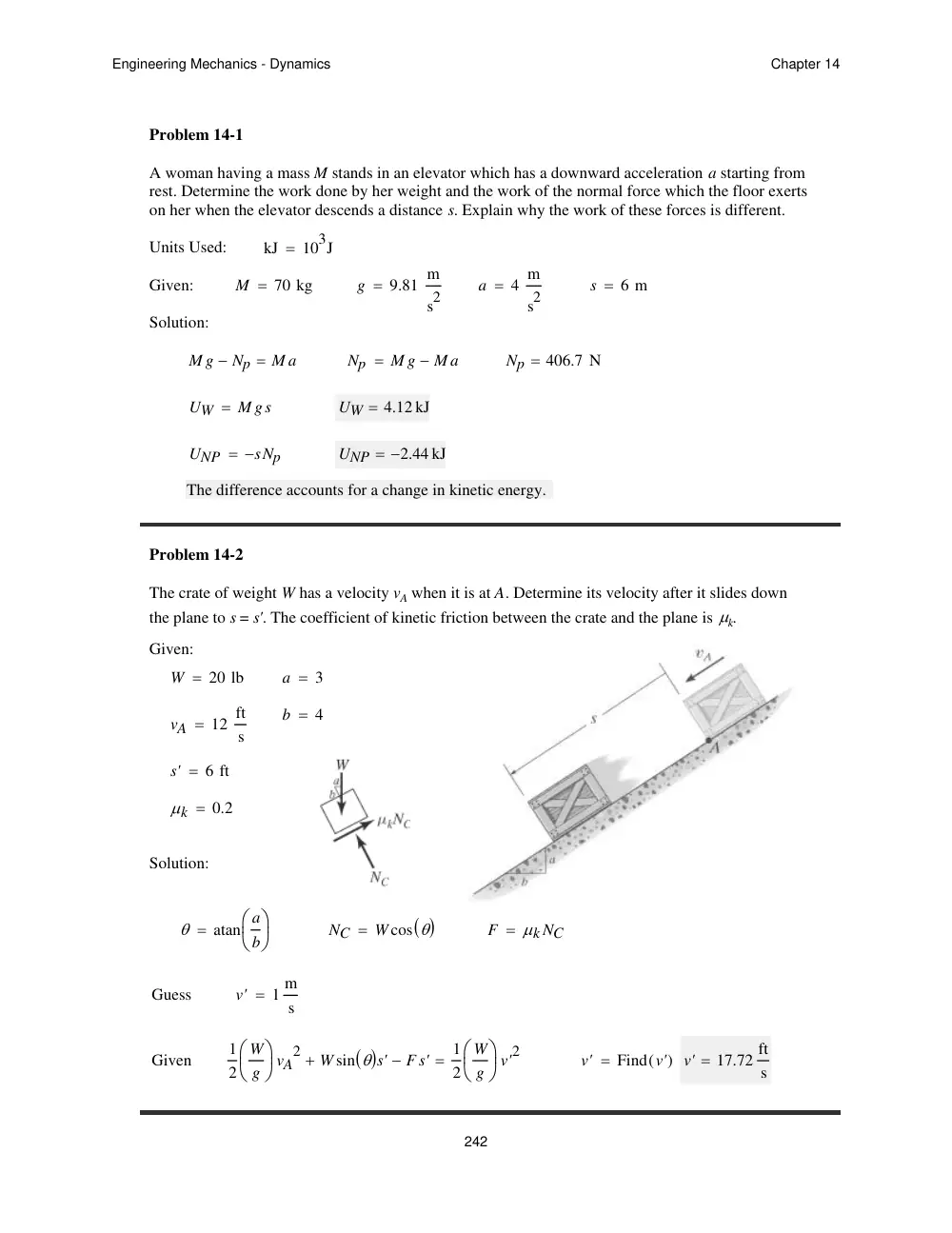
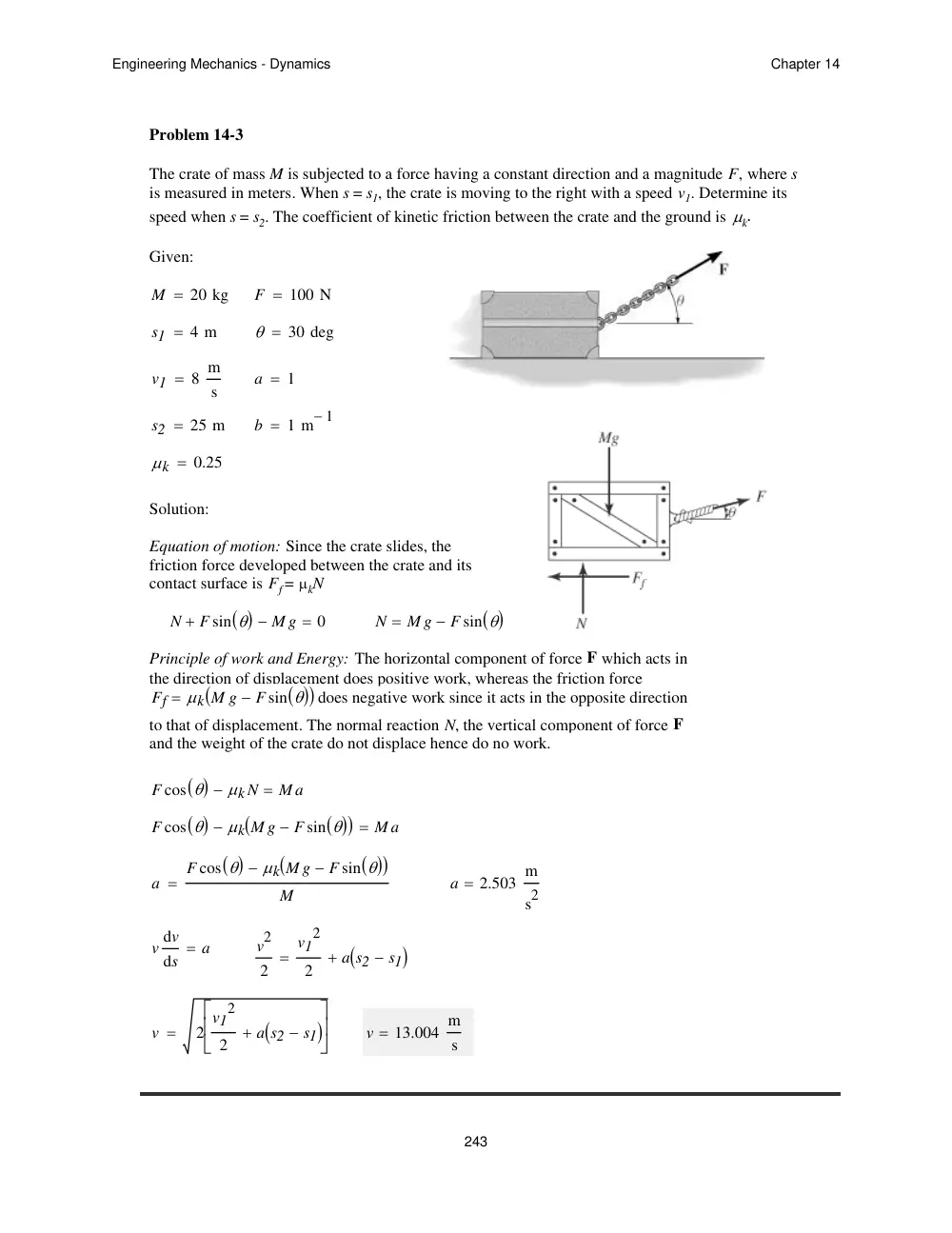

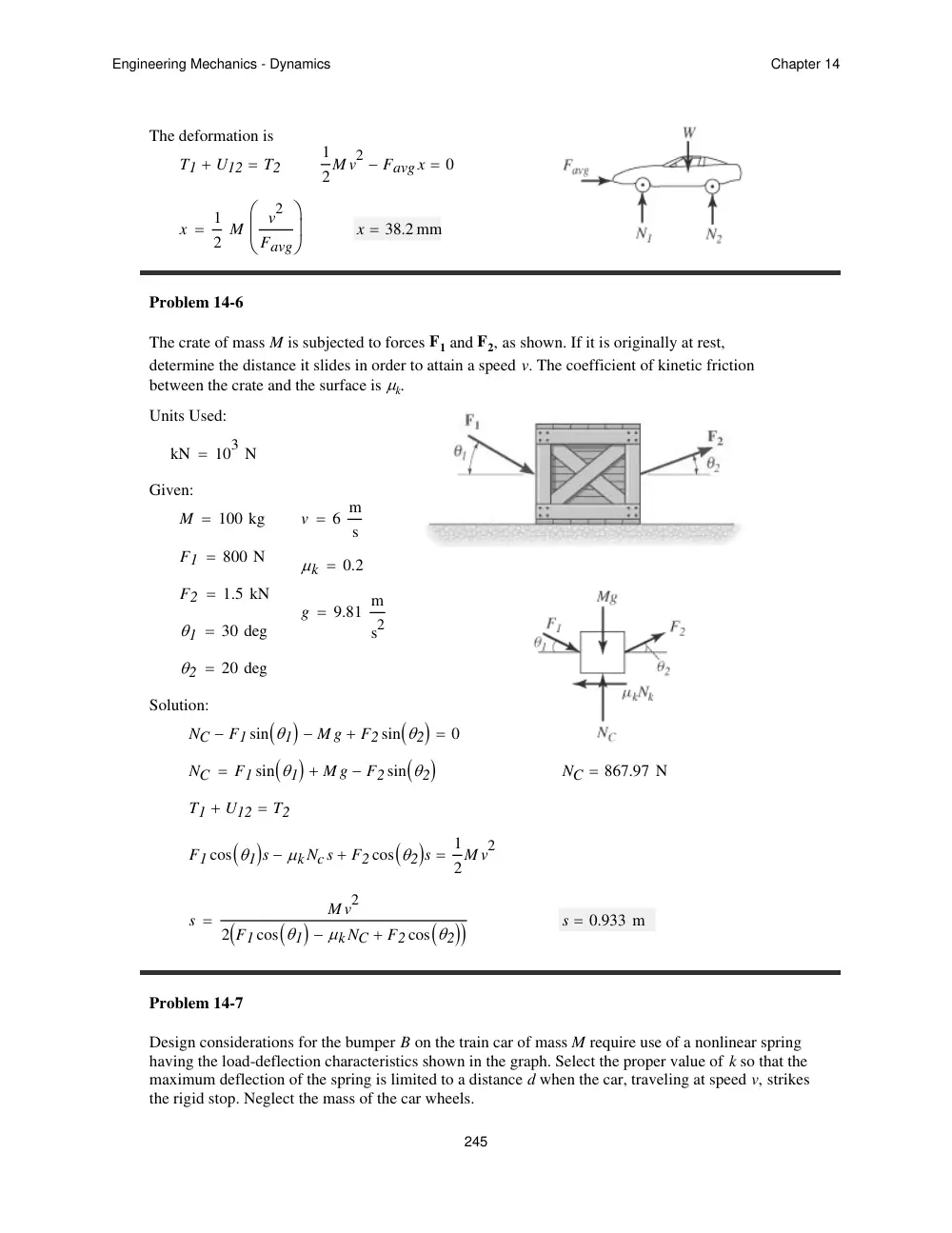
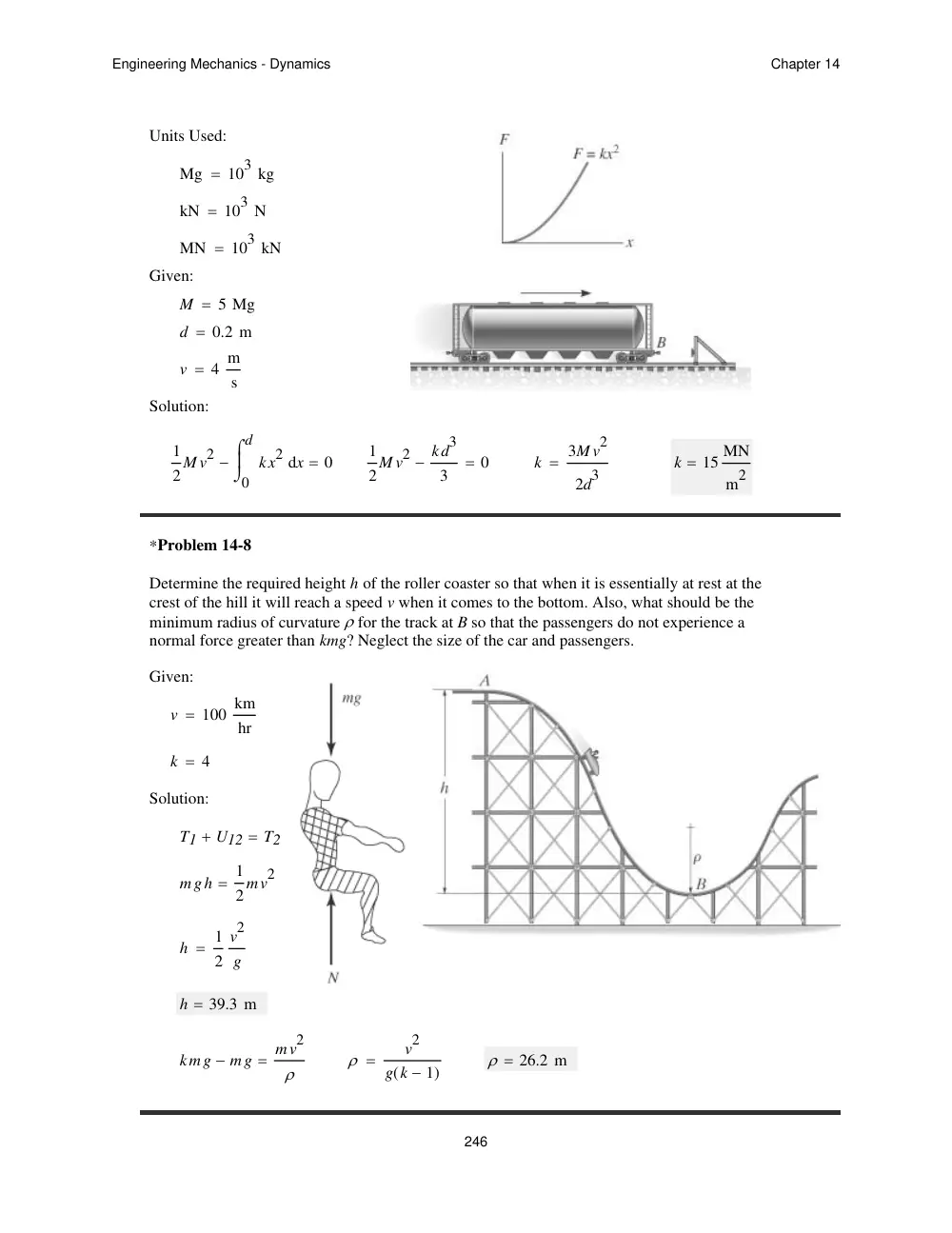
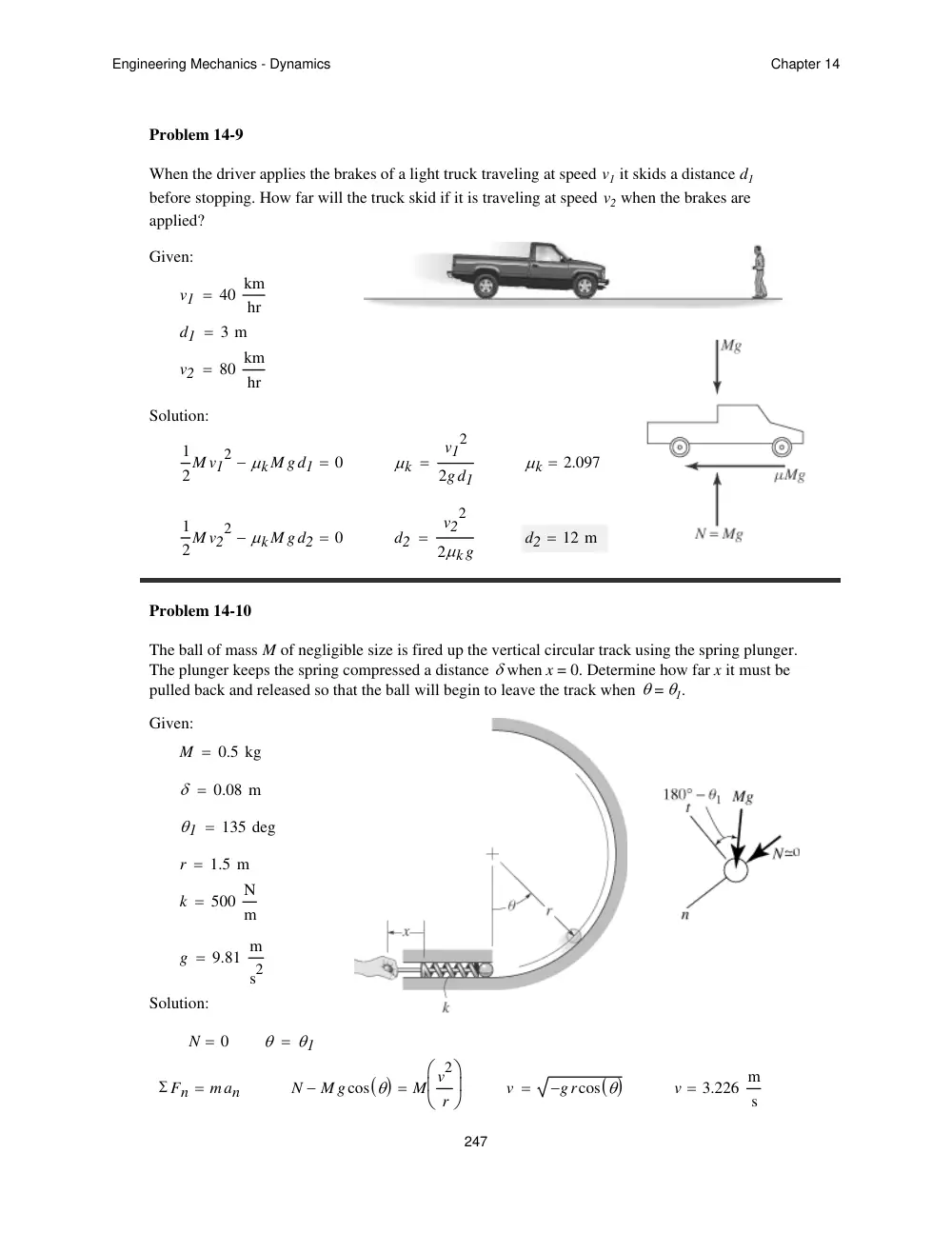
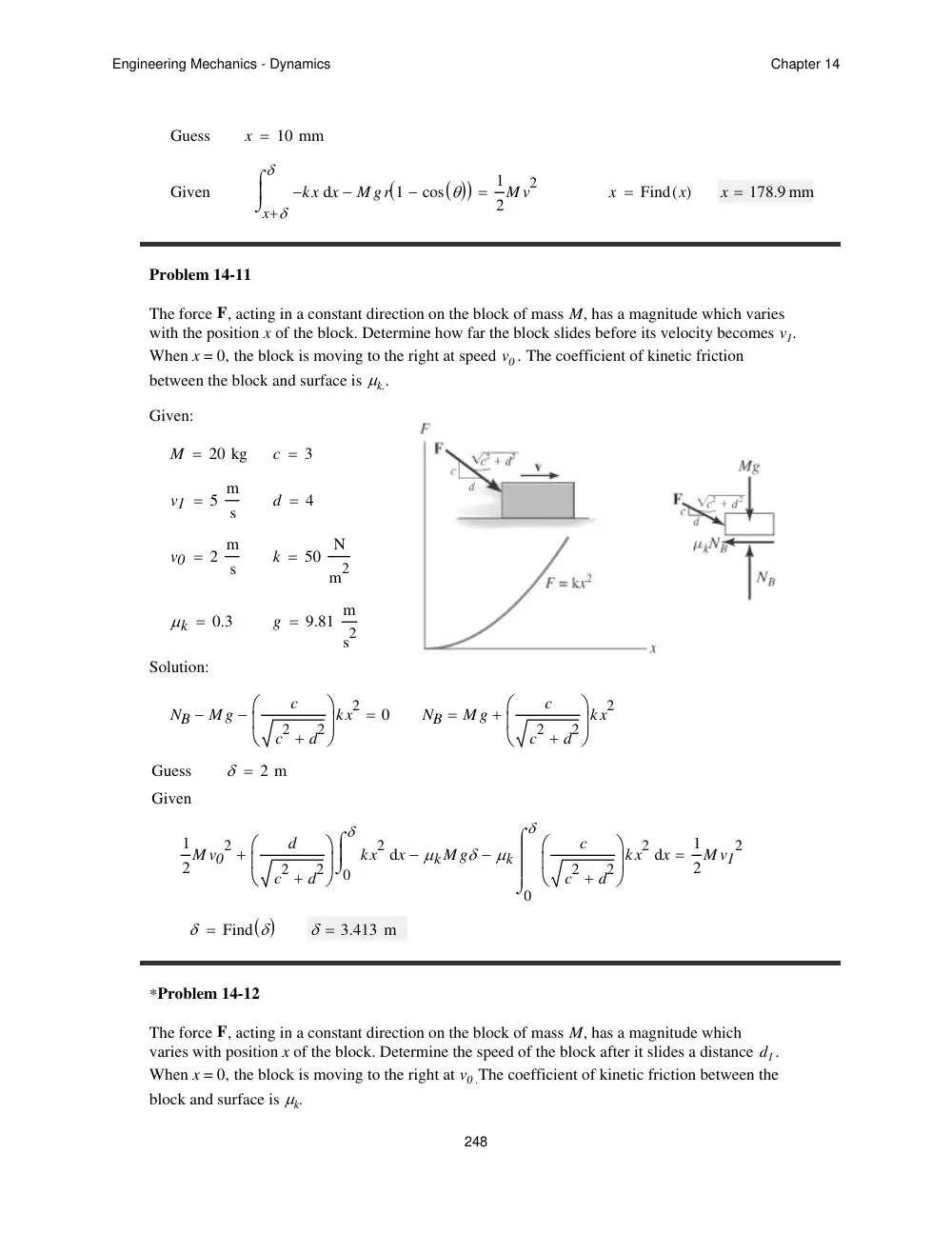
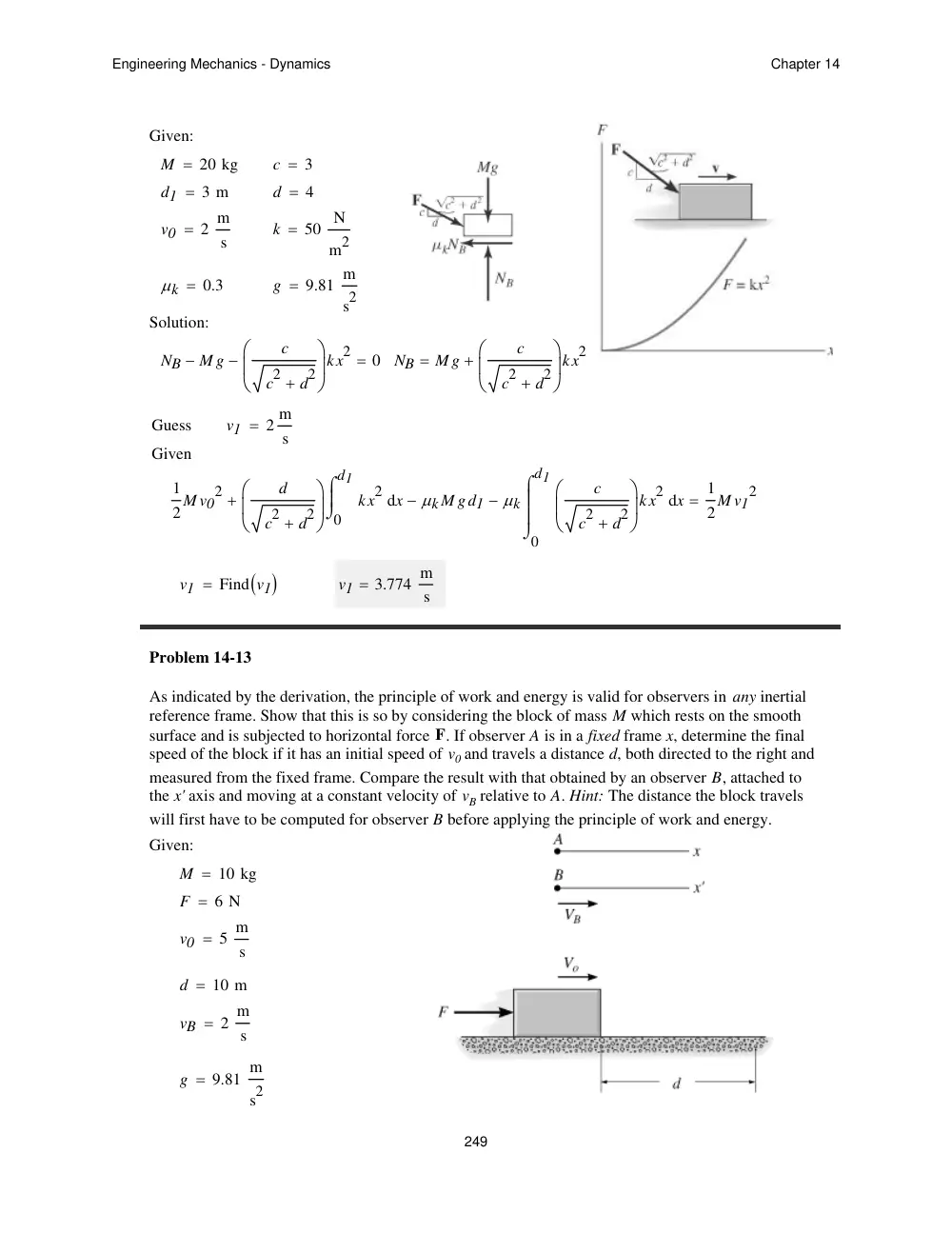
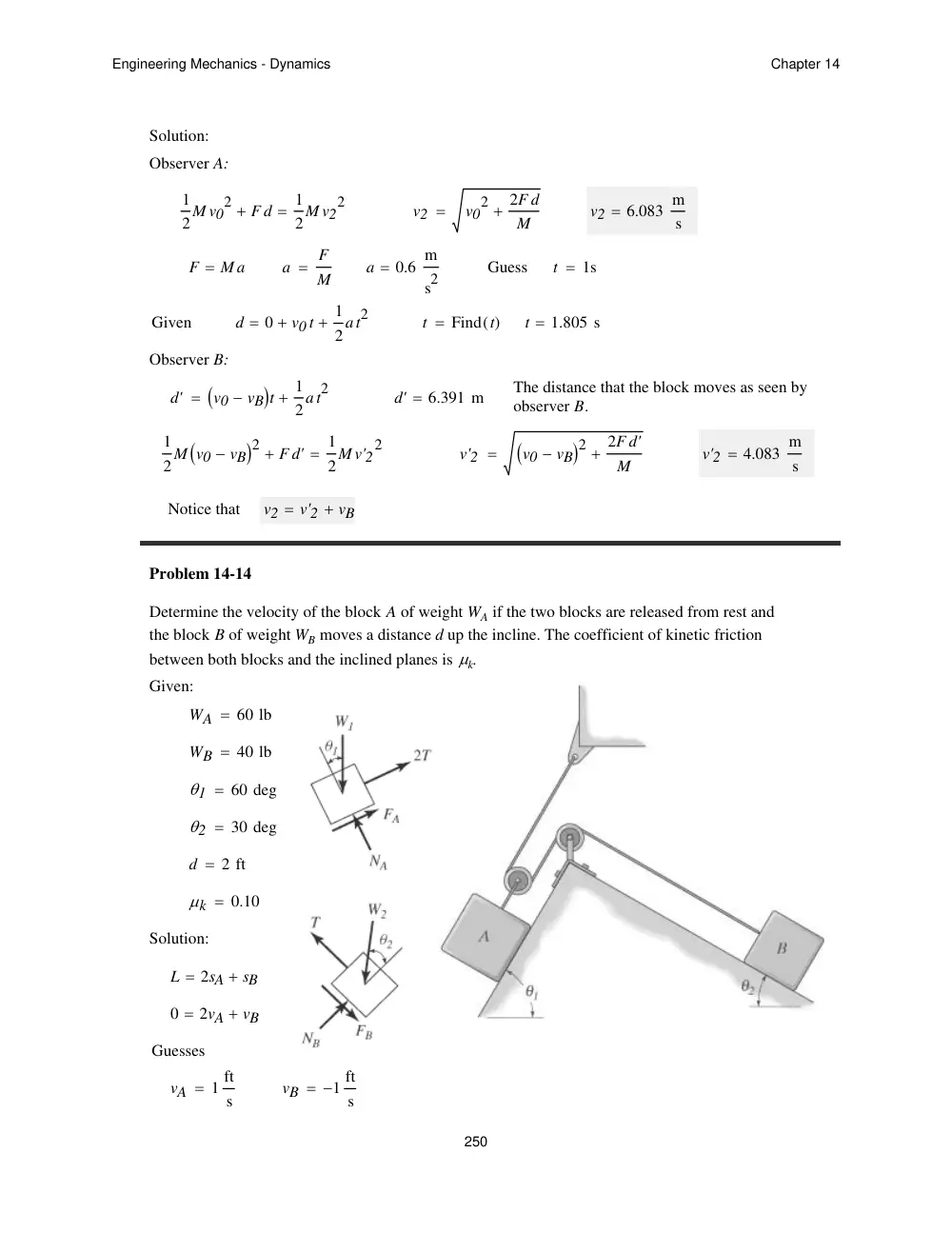
Showing the first 10 of 60 pages. Download the PDF to see all of it.
More MEN 201 files
- Problems For Chapter 15 with Solutions · Spring 2012Chapter · with solutionView
- Problems For Chapter 19 with Solutions · Spring 2012Chapter · with solutionView
- Problems For Chapter 17 with Solutions · Spring 2012Chapter · with solutionView
- Problems For Chapter 20 with Solutions · Spring 2012Chapter · with solutionView
- Problems For Chapter 16 with Solutions · Spring 2012Chapter · with solutionView
- Problems For Chapter 13 with Solutions · Spring 2012Chapter · with solutionView
- Problems For Chapter 12 with Solutions · Spring 2012Chapter · with solutionView
- Problems For Chapter 18 with Solutions · Spring 2012Chapter · with solutionView
Show the text of this chapter
Engineering Mechanics - Dynamics
Chapter 14
Problem 14-1
A woman having a mass M stands in an elevator which has a downward acceleration a starting from
rest. Determine the work done by her weight and the work of the normal force which the floor exerts
on her when the elevator descends a distance s. Explain why the work of these forces is different.
Units Used:
kJ
103J
=
Given:
M
= 70 kg
g
9.81 m
s2
=
a
4 m
s2
=
s
6 m
=
Solution:
M g
− Np
= M a
Np
M g
− M a
=
Np
406.7 N
=
UW
= M gs
UW
4.12 kJ
=
UNP
s
= − Np
UNP
−2.44
kJ
=
The difference accounts for a change in kinetic energy.
Problem 14-2
The crate of weight W has a velocity vA when it is at A. Determine its velocity after it slides down
the plane to s = s'. The coefficient of kinetic friction between the crate and the plane is μk.
Given:
W
= 20 lb
a
3
=
b
= 4
vA
12 ft
s
=
s'
6 ft
=
μk
0.2
=
Solution:
θ
atan a
b
⎛⎜⎝
⎞⎟⎠
=
NC
= W cos θ( )
F
μk NC
=
Guess
v'
1 m
s
=
Given
1
2
W
g
⎛⎜⎝
⎞⎟⎠
vA
2
+ W sin θ( )s'
− F s'
1
2
W
g
⎛⎜⎝
⎞⎟⎠
v'2
=
v'
Find v'
(
)
=
v'
17.72 ft
s
=
242
Engineering Mechanics - Dynamics
Chapter 14
Problem 14-3
The crate of mass M is subjected to a force having a constant direction and a magnitude F, where s
is measured in meters. When s = s1, the crate is moving to the right with a speed v1. Determine its
speed when s = s2. The coefficient of kinetic friction between the crate and the ground is μk.
Given:
M
= 20 kg
F
100 N
=
s1
= 4 m
θ
30 deg
=
v1
8 m
s
=
a
1
=
s2
= 25 m
b
1 m 1
−
=
μk
0.25
=
Solution:
Equation of motion: Since the crate slides, the
friction force developed between the crate and its
contact surface is Ff = μkN
N
+ F sin θ( )
− M g
= 0
N
M g
− F sin θ( )
=
Principle of work and Energy: The horizontal component of force F which acts in
the direction of displacement does positive work, whereas the friction force
Ff
μk M g
− F sin θ( )
(
)
=
does negative work since it acts in the opposite direction
to that of displacement. The normal reaction N, the vertical component of force F
and the weight of the crate do not displace hence do no work.
F cos θ( )
− μk N
M a
=
F cos θ( )
μk M g
− F sin θ( )
(
)
−
M a
=
a
F cos θ( )
μk M g
− F sin θ( )
(
)
−
M
=
a
2.503 m
s2
=
v dv
ds
= a
v2
2
v1
2
2
a s2
− s1
(
)
+
=
v
2
v1
2
2
a s2
− s1
(
)
+
⎡
⎢
⎣
⎤
⎥
⎦
=
v
13.004 m
s
=
243
Engineering Mechanics - Dynamics
Chapter 14
*Problem 14-4
The “air spring” A is used to protect the support structure B and prevent damage to the
conveyor-belt tensioning weight C in the event of a belt failure D. The force developed by the
spring as a function of its deflection is shown by the graph. If the weight is W and it is
suspended a height d above the top of the spring, determine the maximum deformation of the
spring in the event the conveyor belt fails. Neglect the mass of the pulley and belt.
Given:
W
= 50 lb
k
8000 lb
ft2
=
d
1.5 ft
=
Solution:
T1
+ U
T2
=
0
W d
( + δ
)
+
0
δ
x
kx2
⌠
⎮⌡
d
−
0
=
Guess
δ
1 in
=
Given
W d
( + δ
)
k δ3
3
⎛⎜
⎝
⎞⎟
⎠
−
= 0
δ
= Find δ( )
δ
3.896 in
=
Problem 14-5
A car is equipped with a bumper B designed to absorb collisions. The bumper is mounted to the car
using pieces of flexible tubing T. Upon collision with a rigid barrier at A, a constant horizontal force F
is developed which causes a car deceleration kg (the highest safe deceleration for a passenger without
a seatbelt). If the car and passenger have a total mass M and the car is initially coasting with a speed
v, determine the magnitude of F needed to stop the car and the deformation x of the bumper tubing.
Units Used:
Mm
103 kg
=
kN
103 N
=
Given:
M
1.5 103 kg
=
v
1.5 m
s
=
k
3
=
Solution:
The average force needed to decelerate the car is
Favg
= M kg
Favg
44.1 kN
=
244
Engineering Mechanics - Dynamics
Chapter 14
The deformation is
T1
+ U12
= T2
1
2M v2
− Favg x
0
=
x
1
2 M
v2
Favg
⎛
⎜
⎝
⎞
⎟
⎠
=
x
38.2 mm
=
Problem 14-6
The crate of mass M is subjected to forces F1 and F2, as shown. If it is originally at rest,
determine the distance it slides in order to attain a speed v. The coefficient of kinetic friction
between the crate and the surface is μk.
Units Used:
kN
103 N
=
Given:
M
= 100 kg
v
6 m
s
=
F1
= 800 N
μk
0.2
=
F2
1.5 kN
=
g
9.81 m
s2
=
θ1
30 deg
=
θ2
20 deg
=
Solution:
NC
F1 sin θ1
(
)
−
− M g
F2 sin θ2
(
)
+
0
=
NC
F1 sin θ1
(
)
M g
F2 sin θ2
(
)
−
+
=
NC
867.97 N
=
T1
+ U12
T2
=
F1 cos θ1
(
)s
− μk Nc s
F2 cos θ2
(
)s
+
1
2M v2
=
s
M v2
2 F1 cos θ1
(
)
− μk NC
F2 cos θ2
(
)
+
(
)
=
s
0.933 m
=
Problem 14-7
Design considerations for the bumper B on the train car of mass M require use of a nonlinear spring
having the load-deflection characteristics shown in the graph. Select the proper value of k so that the
maximum deflection of the spring is limited to a distance d when the car, traveling at speed v, strikes
the rigid stop. Neglect the mass of the car wheels.
245
Engineering Mechanics - Dynamics
Chapter 14
Units Used:
Mg
103 kg
=
kN
103 N
=
MN
103 kN
=
Given:
M
5 Mg
=
d
0.2 m
=
v
4 m
s
=
Solution:
1
2M v2
0
d
x
kx2
⌠
⎮⌡
d
−
= 0
1
2M v2
kd3
3
−
= 0
k
3M v2
2d3
=
k
15 MN
m2
=
*Problem 14-8
Determine the required height h of the roller coaster so that when it is essentially at rest at the
crest of the hill it will reach a speed v when it comes to the bottom. Also, what should be the
minimum radius of curvature ρ for the track at B so that the passengers do not experience a
normal force greater than kmg? Neglect the size of the car and passengers.
Given:
v
100 km
hr
=
k
4
=
Solution:
T1
+ U12
T2
=
mgh
1
2mv2
=
h
1
2
v2
g
=
h
39.3 m
=
kmg
− mg
mv2
ρ
=
ρ
v2
g k
− 1
(
)
=
ρ
26.2 m
=
246
Engineering Mechanics - Dynamics
Chapter 14
Problem 14-9
When the driver applies the brakes of a light truck traveling at speed v1 it skids a distance d1
before stopping. How far will the truck skid if it is traveling at speed v2 when the brakes are
applied?
Given:
v1
40 km
hr
=
d1
3 m
=
v2
80 km
hr
=
Solution:
1
2M v1
2
− μk M gd1
= 0
μk
v1
2
2gd1
=
μk
2.097
=
1
2M v2
2
− μk M gd2
= 0
d2
v2
2
2μk g
=
d2
12 m
=
Problem 14-10
The ball of mass M of negligible size is fired up the vertical circular track using the spring plunger.
The plunger keeps the spring compressed a distance δ when x = 0. Determine how far x it must be
pulled back and released so that the ball will begin to leave the track when θ = θ1.
Given:
M
0.5 kg
=
δ
0.08 m
=
θ1
135 deg
=
r
1.5 m
=
k
500 N
m
=
g
9.81 m
s2
=
Solution:
N
= 0
θ
θ1
=
ΣFn
= man
N
− M gcos θ( )
M v2
r
⎛⎜
⎝
⎞⎟
⎠
=
v
g
− rcos θ( )
=
v
3.226 m
s
=
247
Engineering Mechanics - Dynamics
Chapter 14
Guess
x
10 mm
=
Given
x δ
+
δ
x
k
− x
⌠
⎮⌡
d
M gr 1
( − cos θ( )
)
−
1
= 2M v2
x
Find x
( )
=
x
178.9 mm
=
Problem 14-11
The force F, acting in a constant direction on the block of mass M, has a magnitude which varies
with the position x of the block. Determine how far the block slides before its velocity becomes v1.
When x = 0, the block is moving to the right at speed v0 . The coefficient of kinetic friction
between the block and surface is μk..
Given:
M
= 20 kg
c
3
=
v1
5 m
s
=
d
4
=
v0
2 m
s
=
k
50 N
m2
=
μk
= 0.3
g
9.81 m
s2
=
Solution:
NB
− M g
c
c2
d2
+
⎛
⎜
⎝
⎞
⎟
⎠
kx2
−
= 0
NB
M g
c
c2
d2
+
⎛
⎜
⎝
⎞
⎟
⎠
kx2
+
=
Guess
δ
2 m
=
Given
1
2M v0
2
d
c2
d2
+
⎛
⎜
⎝
⎞
⎟
⎠ 0
δ
x
kx2
⌠
⎮⌡
d
+
− μk M gδ
μk
0
δ
x
c
c2
d2
+
⎛
⎜
⎝
⎞
⎟
⎠
kx2
⌠
⎮
⎮
⌡
d
−
1
2M v1
2
=
δ
= Find δ( )
δ
3.413 m
=
*Problem 14-12
The force F, acting in a constant direction on the block of mass M, has a magnitude which
varies with position x of the block. Determine the speed of the block after it slides a distance d1 .
When x = 0, the block is moving to the right at v0 .The coefficient of kinetic friction between the
block and surface is μk.
248
Engineering Mechanics - Dynamics
Chapter 14
Given:
M
= 20 kg
c
3
=
d1
= 3 m
d
4
=
v0
2 m
s
=
k
50 N
m2
=
μk
= 0.3
g
9.81 m
s2
=
Solution:
NB
− M g
c
c2
d2
+
⎛
⎜
⎝
⎞
⎟
⎠
kx2
−
= 0
NB
M g
c
c2
d2
+
⎛
⎜
⎝
⎞
⎟
⎠
kx2
+
=
Guess
v1
2 m
s
=
Given
1
2M v0
2
d
c2
d2
+
⎛
⎜
⎝
⎞
⎟
⎠ 0
d1
x
kx2
⌠
⎮⌡
d
+
− μk M gd1
μk
0
d1
x
c
c2
d2
+
⎛
⎜
⎝
⎞
⎟
⎠
kx2
⌠
⎮
⎮
⌡
d
−
1
2M v1
2
=
v1
Find v1
(
)
=
v1
3.774 m
s
=
Problem 14-13
As indicated by the derivation, the principle of work and energy is valid for observers in any inertial
reference frame. Show that this is so by considering the block of mass M which rests on the smooth
surface and is subjected to horizontal force F. If observer A is in a fixed frame x, determine the final
speed of the block if it has an initial speed of v0 and travels a distance d, both directed to the right and
measured from the fixed frame. Compare the result with that obtained by an observer B, attached to
the x' axis and moving at a constant velocity of vB relative to A. Hint: The distance the block travels
will first have to be computed for observer B before applying the principle of work and energy.
Given:
M
10 kg
=
F
6 N
=
v0
5 m
s
=
d
10 m
=
vB
2 m
s
=
g
9.81 m
s2
=
249
Engineering Mechanics - Dynamics
Chapter 14
Solution:
Observer A:
1
2M v0
2
+ F d
1
2M v2
2
=
v2
v0
2
2F d
M
+
=
v2
6.083 m
s
=
F
= M a
a
F
= M
a
0.6 m
s2
=
Guess
t
1s
=
Given
d
0
+ v0 t
1
+ 2at2
=
t
= Find t( )
t
1.805 s
=
Observer B:
The distance that the block moves as seen by
observer B.
d'
v0
− vB
(
)t
1
+ 2at2
=
d'
6.391 m
=
1
2M v0
− vB
(
)2
+ F d'
1
2M v'2
2
=
v'2
v0
− vB
(
)2
2F d'
M
+
=
v'2
4.083 m
s
=
Notice that
v2
v'2
+ vB
=
Problem 14-14
Determine the velocity of the block A of weight WA if the two blocks are released from rest and
the block B of weight WB moves a distance d up the incline. The coefficient of kinetic friction
between both blocks and the inclined planes is μk.
Given:
WA
60 lb
=
WB
40 lb
=
θ1
60 deg
=
θ2
30 deg
=
d
2 ft
=
μk
0.10
=
Solution:
L
2sA
+ sB
=
0
2vA
+ vB
=
Guesses
vA
1 ft
s
=
vB
−1
ft
s
=
250
Engineering Mechanics - Dynamics
Chapter 14
Given
0
2vA
+ vB
=
WA
d
2
⎛⎜⎝
⎞⎟⎠
sin θ1
(
)
WBdsin θ2
(
)
−
μk WAcos θ1
(
) d
2
−
−μk
WBcos θ2
(
)d
+
...
1
2g WAvA
2
WBvB
2
+
(
)
=
vA
vB
⎛
⎜
⎝
⎞
⎟
⎠
Find vA vB
,
(
)
=
vB
−1.543
ft
s
=
vA
0.771 ft
s
=
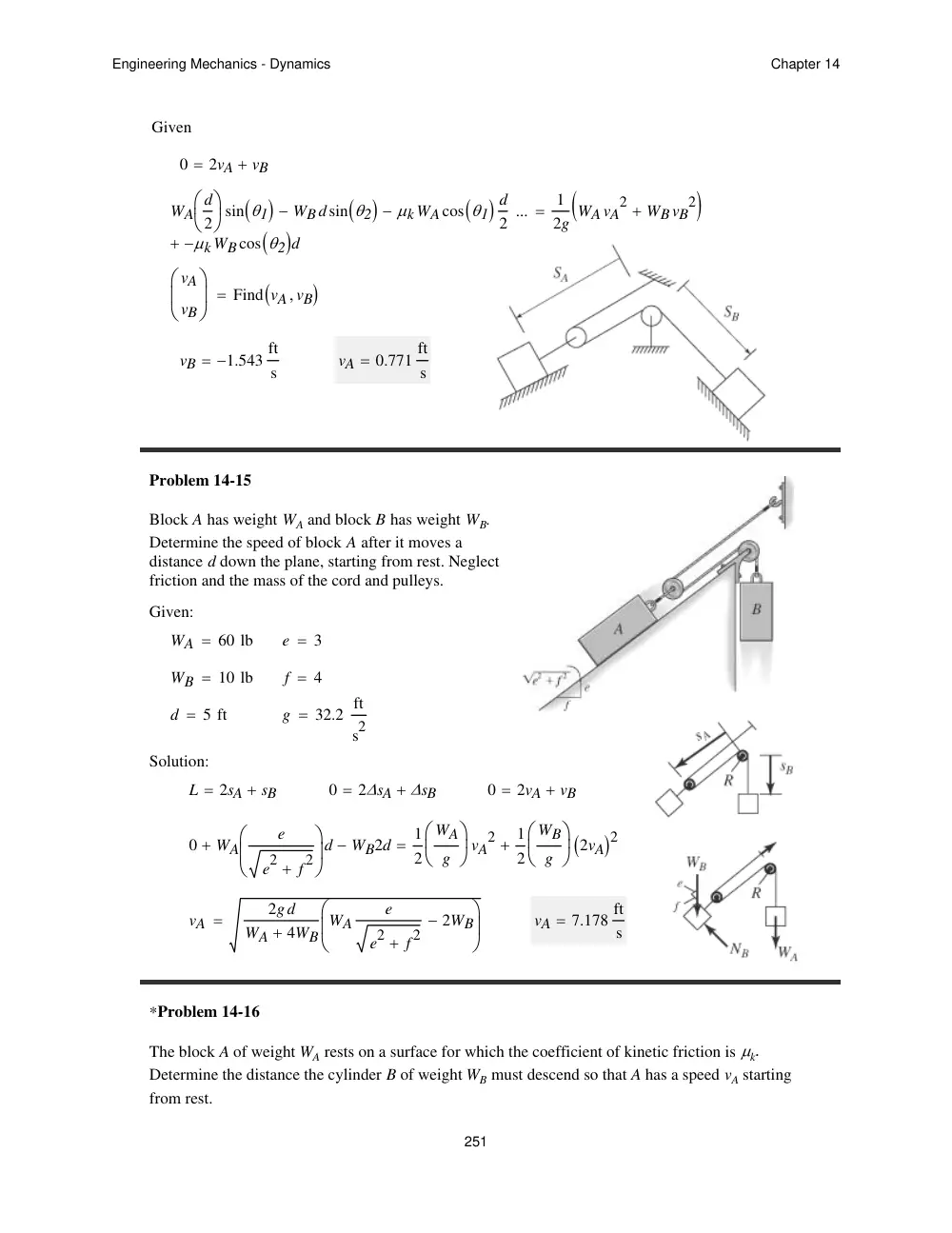
Problem 14-15
Block A has weight WA and block B has weight WB.
Determine the speed of block A after it moves a
distance d down the plane, starting from rest. Neglect
friction and the mass of the cord and pulleys.
Given:
WA
= 60 lb
e
3
=
WB
= 10 lb
f
4
=
d
= 5 ft
g
32.2 ft
s2
=
Solution:
L
2sA
+ sB
=
0
2ΔsA
+ ΔsB
=
0
2vA
+ vB
=
0
WA
e
e2
f 2
+
⎛
⎜
⎝
⎞
⎟
⎠
d
+
− WB2d
1
2
WA
g
⎛⎜⎝
⎞⎟⎠
vA
2
1
2
WB
g
⎛⎜⎝
⎞⎟⎠
(2vA
)2
+
=
vA
2gd
WA
+ 4WB
WA
e
e2
f 2
+
− 2WB
⎛
⎜
⎝
⎞
⎟
⎠
=
vA
7.178 ft
s
=
*Problem 14-16
The block A of weight WA rests on a surface for which the coefficient of kinetic friction is μk.
Determine the distance the cylinder B of weight WB must descend so that A has a speed vA starting
from rest.
251
Engineering Mechanics - Dynamics
Chapter 14
Given:
WA
3 lb
=
WB
8 lb
=
μk
0.3
=
vA
5 ft
s
=
Solution:
L
sA
+ 2sB
=
Guesses
d
1 ft
=
Given
WBd
− μk WA2d
1
2g WAvA
2
WB
vA
2
⎛⎜⎝
⎞⎟⎠
2
+
⎡
⎢
⎣
⎤
⎥
⎦
=
d
Find d
( )
=
d
0.313 ft
=
Problem 14-17
The block of weight W slides down the inclined plane for which the coefficient of kinetic friction
is μk. If it is moving at speed v when it reaches point A, determine the maximum deformation of
the spring needed to momentarily arrest the motion.
Given:
W
= 100 lb
a
3 m
=
b
= 4 m
v
10 ft
s
=
d
10 ft
=
k
200 lb
ft
=
μk
0.25
=
Solution:
N
b
a2
b2
+
⎛
⎜
⎝
⎞
⎟
⎠
W
=
N
80lb
=
Initial Guess
dmax
5 m
=
252
Engineering Mechanics - Dynamics
Chapter 14
Given
1
2
W
g
⎛⎜⎝
⎞⎟⎠
v2
μk N d
( + dmax
)
−
1
2kdmax
2
−
W d
( + dmax
)
a
a2
b2
+
⎛
⎜
⎝
⎞
⎟
⎠
+
0
=
dmax
Find dmax
(
)
=
dmax
2.56 ft
=
Problem 14-18
The collar has mass M and rests on the smooth rod. Two springs are attached to it and the ends of the
rod as shown. Each spring has an uncompressed length l. If the collar is displaced a distance s = s'
and released from rest, determine its velocity at the instant it returns to the point s = 0.
Given:
M
= 20 kg
k
50 N
m
=
s'
0.5 m
=
k'
100 N
m
=
l
1 m
=
d
0.25 m
=
Solution:
1
2ks'2
1
+ 2k' s'2
1
2M vc
2
=
vc
k
+ k'
M
⋅s'
=
vc
1.37 m
s
=
Problem 14-19
The block of mass M is subjected to a force having a constant direction and a magnitude F = k/(a+bx).
When x = x1, the block is moving to the left with a speed v1. Determine its speed when x = x2. The
coefficient of kinetic friction between the block and the ground is μk .
Given:
M
= 2 kg
b
1 m 1
−
=
x2
= 12 m
g
9.81 m
s2
=
k
= 300 N
x1
= 4 m
θ
30 deg
=
a
= 1
v1
8 m
s
=
μk
0.25
=
253
Engineering Mechanics - Dynamics
Chapter 14
Solution:
NB
− M g
k
a
bx
+
⎛⎜⎝
⎞⎟⎠
sin θ( )
−
= 0
NB
M g
ksin θ( )
a
+ bx
+
=
U
x1
x2
x
kcos θ( )
a
bx
+
⌠⎮
⎮⌡
d
μk
x1
x2
x
M g
ksin θ( )
a
+ bx
+
⌠⎮
⎮⌡
d
−
=
U
173.177 N m
⋅
=
1
2M v1
2
+ U
1
2M v2
2
=
v2
v1
2
2U
+ M
=
v2
15.401 m
s
=
*Problem 14-20
The motion of a truck is arrested using a bed of loose stones AB and a set of crash barrels BC. If
experiments show that the stones provide a rolling resistance Ft per wheel and the crash barrels
provide a resistance as shown in the graph, determine the distance x the truck of weight W penetrates
the barrels if the truck is coasting at speed v0 when it approaches A. Neglect the size of the truck.
Given:
Ft
= 160 lb
d
50 ft
=
W
= 4500 lb
k
1000 lb
ft3
=
v0
60 ft
s
=
g
32.2 ft
s2
=
Solution:
1
2
W
g
⎛⎜⎝
⎞⎟⎠
v0
2
− 4Ft d
k x4
4
−
0
=
x
2W v0
2
kg
16Ft d
k
−
⎛
⎜
⎝
⎞
⎟
⎠
1
4
=
x
5.444 ft
=
Problem 14-21
The crash cushion for a highway barrier consists of a nest of barrels filled with an
impact-absorbing material. The barrier stopping force is measured versus the vehicle penetration
into the barrier. Determine the distance a car having weight W will penetrate the barrier if it is
originally traveling at speed v0 when it strikes the first barrel.
254
Engineering Mechanics - Dynamics
Chapter 14
Units Used:
kip
103 lb
=
Given:
W
4000 lb
=
v0
55 ft
s
=
g
32.2 ft
s2
=
Solution:
1
2
W
g
⎛⎜⎝
⎞⎟⎠
v0
2
− Area
0
=
Area
1
2
W
g
⎛⎜⎝
⎞⎟⎠
v0
2
=
Area
187.888 kip ft
⋅
=
We must produce this much work with the
barrels.
Assume that 5 ft < x < 15 ft
Area
(2 ft
) 9 kip
(
)
(3 ft
) 18 kip
(
)
+
x
− 5 ft
(
) 27 kip
(
)
+
=
x
Area
72 kip ft
⋅
−
27 kip
+ 5 ft
=
x
= 9.292 ft
Check that the assumption is corrrect!
Problem 14-22
The collar has a mass M and is supported on the rod having a coefficient of kinetic friction
μk. The attached spring has an unstretched length l and a stiffness k. Determine the speed
of the collar after the applied force F causes it to be displaced a distance s = s1 from point
A. When s = 0 the collar is held at rest.
Given:
M
= 30 kg
μk
0.4
=
a
= 0.5 m
θ
45 deg
=
F
= 200 N
s1
1.5 m
=
l
0.2 m
=
g
9.81 m
s2
=
k
50 N
m
=
255
Engineering Mechanics - Dynamics
Chapter 14
Solution:
Guesses
NC
= 1 N
v
1 m
s
=
Given
NC
− M g
+ F sin θ( )
0
=
F cos θ( )s1
− μk NC s1
1
2k a
− l
(
)2
+
1
2k s1
+ a
− l
(
)2
−
1
2M v2
=
NC
⎛⎜ v
⎝
⎞⎟
⎠
Find NC v
,
(
)
=
NC
= 152.9 N
v
1.666 m
s
=
Problem 14-23
The block of weight W is released from rest at A and slides down the smooth circular surface
AB. It then continues to slide along the horizontal rough surface until it strikes the spring.
Determine how far it compresses the spring before stopping.
Given:
W
= 5 lb
μk
0.2
=
a
= 3 ft
θ
90 deg
=
b
= 2 ft
k
40 lb
ft
=
Solution:
Guess
d
1 ft
=
Given
W a
μk W b
+ d
(
)
−
1
− 2kd2
0
=
d
Find d
( )
=
d
0.782 ft
=
*Problem 14-24
The block has a mass M and moves within the smooth vertical slot. If it starts from rest when
the attached spring is in the unstretched position at A, determine the constant vertical force F
which must be applied to the cord so that the block attains a speed vB when it reaches sB.
Neglect the size and mass of the pulley. Hint: The work of F can be determined by finding the
difference Δl in cord lengths AC and BC and using UF = F Δl.
Given:
M
= 0.8 kg
l
0.4 m
=
vB
2.5 m
s
=
b
0.3 m
=
256
Engineering Mechanics - Dynamics
Chapter 14
sB
= 0.15 m
k
100 N
m
=
Solution:
Δl
l2
+ b2
l
( − sB
)2
+ b2
−
=
Guess
F
1 N
=
Given
FΔl
− M gsB
1
2ksB
2
−
1
2M vB
2
=
F
Find F
( )
=
F
43.9 N
=
Problem 14-25
The collar has a mass M and is moving at speed v1 when x = 0 and a force of F is applied
to it. The direction θ of this force varies such that θ = ax, where θ is clockwise, measured
in degrees. Determine the speed of the collar when x = x1. The coefficient of kinetic friction
between the collar and the rod is μk.
Given:
M
= 5 kg
v1
8 m
s
=
F
60 N
=
g
9.81 m
s2
=
μk
0.3
=
x1
= 3 m
a
10 deg
m
=
Solution:
N
F sin θ( )
+ M g
=
Guess
v
5 m
s
=
Given
1
2M v1
2
0
x1
x
F cos ax
(
)
⌠
⎮⌡
d
+
μk
0
x1
x
F sin ax
(
)
+ M g
⌠
⎮⌡
d
−
1
2M v2
=
v
Find v
( )
=
v
10.47 m
s
=
257
Engineering Mechanics - Dynamics
Chapter 14
Problem 14-26
Cylinder A has weight WA and block B has weight WB. Determine the distance A must descend from
rest before it obtains speed vA. Also, what is the tension in the cord supporting block A? Neglect the
mass of the cord and pulleys.
Given:
WA
= 60 lb
vA
8 ft
s
=
WB
= 10 lb
g
32.2 ft
s2
=
Solution:
L
2sA
+ sB
=
0
2vA
+ vB
=
System
0
+ WAd
− WB2d
1
2
WA
g
⎛⎜⎝
⎞⎟⎠
vA
2
1
2
WB
g
⎛⎜⎝
⎞⎟⎠
(2vA
)2
+
=
d
WA
4WB
+
2g
⎛⎜⎝
⎞⎟⎠
vA
2
WA
− 2WB
=
d
2.484 ft
=
Block A alone
0
+ WAd
− T d
1
2
WA
g
⎛⎜⎝
⎞⎟⎠
vA
2
=
T
WA
WAvA
2
2gd
−
=
T
36lb
=
Problem 14-27
The conveyor belt delivers crate each of mass M to the ramp at A such that the crate’s velocity is vA,
directed down along the ramp. If the coefficient of kinetic friction between each crate and the ramp is
μk, determine the speed at which each crate slides off the ramp at B. Assume that no tipping occurs.
Given:
M
12 kg
=
vA
2.5 m
s
=
μk
0.3
=
g
9.81 m
s2
=
θ
30 deg
=
a
3 m
=
258
Engineering Mechanics - Dynamics
Chapter 14
Solution:
Nc
M gcos θ( )
=
1
2M vA
2
(M ga
)sin θ( )
+
− μk Nc a
1
2M vB
2
=
vB
vA
2
(2ga
)sin θ( )
+
(2μk g
)cos θ( )a
−
=
vB
4.52 m
s
=
*Problem 14-28
When the skier of weight W is at point A he has a speed vA. Determine his speed when he reaches
point B on the smooth slope. For this distance the slope follows the cosine curve shown. Also, what is
the normal force on his skis at B and his rate of increase in speed? Neglect friction and air resistance.
Given:
W
150 lb
=
vA
5 ft
s
=
a
50 ft
=
b
100 ft
=
d
35 ft
=
Solution:
y x
( )
a
( )cos π x
b
⎛⎜⎝
⎞⎟⎠
=
y' x
( )
x
y x
( )
d
d
=
y'' x
( )
x
y' x
( )
d
d
=
ρ x
( )
1
y' x
( )2
( +
)
3
y'' x
( )
=
θB
atan y' d
( )
(
)
=
ρB
ρ d
( )
=
Guesses
FN
= 1 lb
v'
1 ft
s2
=
vB
1 ft
s
=
Given
1
2
W
g
⎛⎜⎝
⎞⎟⎠
vA
2
W y 0 ft
(
)
y d
( )
−
(
)
+
1
2
W
g
⎛⎜⎝
⎞⎟⎠
vB
2
=
FN
W cos θB
(
)
−
W
g
⎛⎜⎝
⎞⎟⎠
vB
2
ρB
=
−W
sin θB
(
)
W
g
⎛⎜⎝
⎞⎟⎠
v'
=
259
Engineering Mechanics - Dynamics
Chapter 14
vB
FN
v'
⎛⎜
⎜
⎜⎝
⎞⎟
⎟
⎟⎠
Find vB FN
,
, v'
(
)
=
vB
42.2 ft
s
=
FN
= 50.6 lb
v'
26.2 ft
s2
=
Problem 14-29
When the block A of weight W1 is released from rest it lifts the two weights B and C each of
weight W2. Determine the maximum distance A will fall before its motion is momentarily
stopped. Neglect the weight of the cord and the size of the pulleys.
Given:
W1
12 lb
=
W2
15 lb
=
a
4 ft
=
Solution:
Guess
y
10 ft
=
Given
W1 y
2W2
a2
+ y2
− a
(
)
−
= 0
y
Find y
( )
=
y
3.81 ft
=
Problem 14-30
The catapulting mechanism is used to propel slider A of mass M to the right along the smooth track.
The propelling action is obtained by drawing the pulley attached to rod BC rapidly to the left by
means of a piston P. If the piston applies constant force F to rod BC such that it moves it a distance
d, determine the speed attained by the slider if it was originally at rest. Neglect the mass of the
pulleys, cable, piston, and rod BC.
Units Used:
kN
103 N
=
Given:
M
= 10 kg
F
= 20 kN
d
0.2 m
=
Solution:
0
+ F d
1
= 2M v2
v
2F d
M
=
v
28.284 m
s
=
260
Engineering Mechanics - Dynamics
Chapter 14
Problem 14-31
The collar has mass M and slides along the smooth rod. Two springs are attached to it and the ends
of the rod as shown. If each spring has an uncompressed length L and the collar has speed v0
when s = 0, determine the maximum compression of each spring due to the back-and-forth
(oscillating) motion of the collar.
Given:
M
= 20 kg
a
0.25 m
=
L
= 1 m
kA
50 N
m
=
v0
2 m
s
=
kB
100 N
m
=
Solution:
1
2M v0
2
1
2 kA
+ kB
(
) d2
−
= 0
d
M
kA
+ kB
v0
=
d
0.73 m
=
*Problem 14-32
The cyclist travels to point A, pedaling until he reaches speed vA. He then coasts freely up the curved
surface. Determine the normal force he exerts on the surface when he reaches point B. The total mass
of the bike and man is M. Neglect friction, the mass of the wheels, and the size of the bicycle.
Units Used:
kN
103 N
=
Given:
vA
8 m
s
=
M
75 kg
=
a
4 m
=
Solution:
When
y
= x
2
y
a
=
y
a
= 4
y
1 m
=
1
2M vA
2
− M g y
1
2M vB
2
=
vB
vA
2
− 2g y
=
vB
6.662 m
s
=
Now find the radius of curvature
x
y
+
a
=
1
2
x
dx
1
2
y
dy
+
0
=
261
Engineering Mechanics - Dynamics
Chapter 14
y'
y
x
= −
y''
y
x
x
y
d
d
−
2x2
x
y
=
When
y
= x
y'
= −1
y''
1
y
=
Thus
ρ
1
( + y'2
)
3
y''
=
ρ
8 y
=
ρ
2.828 m
=
NB
M gcos 45 deg
(
)
−
M
vB
2
ρ
⎛
⎜
⎝
⎞
⎟
⎠
=
NB
M gcos 45 deg
(
)
M
vB
2
ρ
⎛
⎜
⎝
⎞
⎟
⎠
+
=
NB
1.697 kN
=
Problem 14-33
The cyclist travels to point A, pedaling until
he reaches speed vA. He then coasts freely up
the curved surface. Determine how high he
reaches up the surface before he comes to a
stop. Also, what are the resultant normal
force on the surface at this point and his
acceleration? The total mass of the bike and
man is M. Neglect friction, the mass of the
wheels, and the size of the bicycle.
Given:
vA
4 m
s
=
M
= 75 kg
a
4 m
=
Solution:
1
2M vA
2
− M g y
= 0
y
vA
2
2g
=
y
0.815 m
=
x
a
y
−
(
)2
=
x
1.203 m
=
y'
y
x
= −
θ
atan
( y'
)
=
θ
39.462 deg
=
NB
− M gcos θ( )
= 0
NB
= M gcos θ( )
NB
568.03 N
=
M gsin θ( )
= M at
at
= gsin θ( )
at
6.235 m
s2
=
262
Engineering Mechanics - Dynamics
Chapter 14
Problem 14-34
The block of weight W is pressed against the spring so as to compress it a distance δ when
it is at A. If the plane is smooth, determine the distance d, measured from the wall, to
where the block strikes the ground. Neglect the size of the block.
Given:
W
= 10 lb
e
4 ft
=
δ
= 2 ft
f
3 ft
=
k
100 lb
ft
=
g
9.81 m
s2
=
Solution:
θ
atan
f
e
⎛⎜⎝
⎞⎟⎠
=
Guesses
vB
1 ft
s
=
t
= 1 s
d
1 ft
=
Given
1
2kδ2
− W f
1
2
W
g
⎛⎜⎝
⎞⎟⎠
vB
2
=
d
= vBcos θ( )t
0
f
+ vBsin θ( )t
g
2
⎛⎜⎝
⎞⎟⎠
t2
−
=
vB
t
d
⎛⎜
⎜
⎜⎝
⎞⎟
⎟
⎟⎠
Find vB t,
, d
(
)
=
vB
33.08 ft
s
=
t
= 1.369 s
d
36.2 ft
=
Problem 14-35
The man at the window A wishes to throw a sack of mass M onto the ground. To do this he allows it
to swing from rest at B to point C, when he releases the cord at θ = θ1. Determine the speed at which
it strikes the ground and the distance R.
Given:
θ1
30 deg
=
h
16 m
=
L
8 m
=
g
9.81 m
s2
=
M
30 kg
=
Solution:
0
M gL cos θ1
(
)
+
1
2M vC
2
=
vC
2gL cos θ1
(
)
=
vC
11.659 m
s
=
263
Engineering Mechanics - Dynamics
Chapter 14
0
+ M gh
1
2M vD
2
=
vD
2gh
=
vD
17.718 m
s
=
Free Flight
Guess
t
= 2 s
R
1 m
=
Given
0
−g
2
⎛⎜⎝
⎞⎟⎠
t2
vC sin θ1
(
)t
+
+ h
L cos θ1
(
)
−
=
R
vC cos θ1
(
)t
L 1
sin θ1
(
)
( +
)
+
=
t
⎛⎜⎝R
⎞⎟⎠
Find t R
( ,
)
=
t
= 2.078 s
R
33.0 m
=
*Problem 14-36
A block of weight W rests on the smooth semicylindrical surface. An elastic cord having a
stiffness k is attached to the block at B and to the base of the semicylinder at point C. If the
block is released from rest at A(θ = 0°), determine the unstretched length of the cord so the
block begins to leave the semicylinder at the instant θ = θ1. Neglect the size of the block.
Given:
W
2 lb
=
k
2 lb
ft
=
θ1
45 deg
=
a
1.5 ft
=
g
9.81 m
s2
=
Solution:
Guess
δ
= 1 ft
v1
1 ft
s
=
Given
W sin θ1
(
)
W
g
⎛⎜⎝
⎞⎟⎠
v1
2
a
=
1
2k πa
− δ
(
)2
1
2k
π
( − θ1
)a
− δ
⎡⎣
⎤⎦
2
−
W asin θ1
(
)
−
W
g
⎛⎜⎝
⎞⎟⎠
v1
2
2
=
v1
⎛⎜ δ
⎝
⎞⎟
⎠
Find v1 δ
,
(
)
=
v1
5.843 ft
s
=
δ
2.77 ft
=
264
Engineering Mechanics - Dynamics
Chapter 14
Problem 14-37
A rocket of mass m is fired vertically from the surface of the earth, i.e., at r = r1. Assuming that
no mass is lost as it travels upward, determine the work it must do against gravity to reach a
distance r2. The force of gravity is F = GMem/r2 (Eq. 13-1), where Me is the mass of the earth
and r the distance between the rocket and the center of the earth.
Solution:
F
G
Me m
r2
⎛
⎜
⎝
⎞
⎟
⎠
=
U12
r
F
⌠
⎮
⌡
d
=
−G
Me m
r1
r2
r
1
r2
⌠
⎮
⎮
⌡
d
=
U12
GMe m 1
r2
1
r1
−
⎛⎜⎝
⎞⎟⎠
=
Problem 14-38
The spring has a stiffness k and an unstretched length l0. As shown, it is confined by the
plate and wall using cables so that its length is l. A block of weight W is given a speed vA when
it is at A, and it slides down the incline having a coefficient of kinetic friction μk. If it strikes the
plate and pushes it forward a distance l1 before stopping, determine its speed at A. Neglect the
mass of the plate and spring.
Given:
W
= 4 lb
d
3 ft
=
l0
= 2 ft
k
50 lb
ft
=
l
= 1.5 ft
μk
0.2
=
l1
= 0.25 ft
a
= 3
b
4
=
Solution:
θ
atan a
b
⎛⎜⎝
⎞⎟⎠
=
Guess
vA
1 ft
s
=
265
Engineering Mechanics - Dynamics
Chapter 14
Given
1
2
W
g
⎛⎜⎝
⎞⎟⎠
vA
2
W sin θ( )
− μk cos θ( )
(
) d
( + l1
)
+
1
2k l0
− l
+ l1
(
)2
l0
− l
(
)2
−
⎡⎣
⎤⎦
−
0
=
vA
Find vA
(
)
=
vA
5.80 ft
s
=
Problem 14-39
The “flying car” is a ride at an amusement park which consists of a car having wheels that roll along
a track mounted inside a rotating drum. By design the car cannot fall off the track, however motion
of the car is developed by applying the car’s brake, thereby gripping the car to the track and allowing
it to move with a constant speed of the track, vt. If the rider applies the brake when going from B to
A and then releases it at the top of the drum, A, so that the car coasts freely down along the track to
B (θ = π rad), determine the speed of the car at B and the normal reaction which the drum exerts on
the car at B. Neglect friction during the motion from A to B. The rider and car have a total mass M
and the center of mass of the car and rider moves along a circular path having a radius r.
Units Used:
kN
103 N
=
Given:
M
250 kg
=
r
8 m
=
vt
3 m
s
=
Solution:
1
2M vt
2
+ Mg2r
1
2M vB
2
=
vB
vt
2
+ 4gr
=
vB
18.0 m
s
=
NB
− M g
M
vB
2
r
⎛
⎜
⎝
⎞
⎟
⎠
=
NB
M g
vB
2
r
+
⎛
⎜
⎝
⎞
⎟
⎠
=
NB
12.5 kN
=
266
Engineering Mechanics - Dynamics
Chapter 14
*Problem 14-40
The skier starts from rest at A and travels down the ramp. If friction and air resistance can be
neglected, determine his speed vB when he reaches B. Also, find the distance d to where he strikes
the ground at C, if he makes the jump traveling horizontally at B. Neglect the skier’s size. He has a
mass M.
Given:
M
= 70 kg
h1
50 m
=
θ
= 30 deg
h2
4 m
=
Solution:
Guesses
vB
1 m
s
=
t
= 1 s
d
1 m
=
Given
M g h1
− h2
(
)
1
2M vB
2
=
vBt
= dcos θ( )
−h2
− dsin θ( )
−1
2 gt2
=
vB
t
d
⎛⎜
⎜
⎜⎝
⎞⎟
⎟
⎟⎠
Find vB t,
, d
(
)
=
t
= 3.753 s
vB
30.0 m
s
=
d
130.2 m
=
Problem 14-41
A spring having a stiffness k is compressed a distance δ. The stored energy in the spring is used
to drive a machine which requires power P. Determine how long the spring can supply energy at
the required rate.
Units Used:
kN
103 N
=
Given:
k
5 kN
m
=
δ
= 400 mm
P
90 W
=
Solution:
U12
1
= 2kδ2
= P t
t
1
2 k δ2
P
⎛⎜
⎝
⎞⎟
⎠
=
t
4.44 s
=
Problem 14-42
Determine the power input for a motor necessary to lift a weight W at a constant rate v.
The efficiency of the motor is ε.
Given:
W
= 300 lbf
v
5 ft
s
=
ε
0.65
=
267
Engineering Mechanics - Dynamics
Chapter 14
Solution:
P
W v
ε
=
P
4.20 hp
=
Problem 14-43
An electrically powered train car draws a power P. If the car has weight W and starts from
rest, determine the maximum speed it attains in time t. The mechanical efficiency is ε.
Given:
P
= 30 kW
W
= 40000 lbf
t
= 30 s
ε
0.8
=
Solution:
εP
= F v
W
g
t
d v
⎛⎜⎝d
⎞⎟⎠
v
=
0
v
v v
⌠
⎮⌡
d
0
t
t
εP g
W
⌠⎮
⎮⌡
d
=
v
2εP gt
W
=
v
29.2 ft
s
=
*Problem 14-44
A truck has a weight W and an engine which transmits a power P to all the wheels.
Assuming that the wheels do not slip on the ground, determine the angle θ of the largest
incline the truck can climb at a constant speed v.
Given:
W
25000 lbf
=
v
50 ft
s
=
P
350 hp
=
Solution:
F
= W sin θ( )
P
W sin θ( )v
=
θ
asin
P
W v
⎛⎜⎝
⎞⎟⎠
=
θ
8.86 deg
=
Problem 14-45
An automobile having mass M travels up a slope at constant speed v. If mechanical friction and
wind resistance are neglected, determine the power developed by the engine if the automobile has
efficiency ε.
Units Used:
Mg
103 kg
=
268
Engineering Mechanics - Dynamics
Chapter 14
Given:
M
= 2 Mg
v
100 km
hr
=
θ
= 7 deg
ε
0.65
=
Solution:
P
= M gsin θ( )v
P
66.419 kW
=
Peng
P
ε
=
Peng
102.2 kW
=
Problem 14-46
The escalator steps move with a constant speed
v. If the steps are of height h and length l,
determine the power of a motor needed to lift
an average mass M per step.There are n steps.
Given:
M
= 150 kg
h
125 mm
=
n
= 32
l
250 mm
=
v
0.6 m
s
=
d
nh
=
Solution:
θ
atan h
l
⎛⎜⎝
⎞⎟⎠
=
P
= nMgvsin θ( )
P
12.63 kW
=
Problem 14-47
If the escalator in Prob. 14−46 is not
moving, determine the constant speed
at which a man having a mass M must
walk up the steps to generate power
P—the same amount that is needed to
power a standard light bulb.
Given:
M
= 80 kg
h
125 mm
=
n
= 32
l
250 mm
=
v
0.6 m
s
=
P
100 W
=
269
Engineering Mechanics - Dynamics
Chapter 14
Solution:
θ
atan h
l
⎛⎜⎝
⎞⎟⎠
=
P
= F vsin θ( )
v
P
M gsin θ( )
=
v
0.285 m
s
=
*Problem 14-48
An electric streetcar has a weight W and accelerates along a horizontal straight road from rest
such that the power is always P. Determine how far it must travel to reach a speed of v.
Given:
W
= 15000 lbf
v
40 ft
s
=
P
100 hp
=
Solution:
P
= F v
W
g
⎛⎜⎝
⎞⎟⎠
av
=
W
g
⎛⎜⎝
⎞⎟⎠
v2
sc
v
d
⎛⎜d
⎝
⎞⎟
⎠
=
Guess
d
1 ft
=
Given
0
d
sc
P
⌠
⎮⌡
d
0
v
v
W
g
⎛⎜⎝
⎞⎟⎠
v2
⌠⎮
⎮⌡
d
=
d
Find d
( )
=
d
180.8 ft
=
Problem 14-49
The crate of weight W is given speed v in time t1 starting
from rest. If the acceleration is constant, determine the
power that must be supplied to the motor when t = t2.
The motor has an efficiency ε. Neglect the mass of the
pulley and cable.
Given:
W
= 50 lbf
t2
2 s
=
v
10 ft
s
=
ε
0.76
=
t1
= 4 s
g
32.2 ft
s2
=
Solution:
a
v
t1
=
a
2.5 ft
s2
=
v2
= at2
v2
5 ft
s
=
270
Engineering Mechanics - Dynamics
Chapter 14
F
− W
W
g
⎛⎜⎝
⎞⎟⎠
a
=
F
W
W
g
⎛⎜⎝
⎞⎟⎠
a
+
=
F
53.882 lbf
=
P
= F v2
P
= 0.49 hp
Pmotor
P
ε
=
Pmotor
0.645 hp
=
Problem 14-50
A car has a mass M and accelerates along a horizontal straight road from rest such that the
power is always a constant amount P. Determine how far it must travel to reach a speed of v.
Solution:
Power: Since the