
MEN 201 Problems For Chapter 17 with Solutions, Spring 2012
Notre Dame University–Louaize · Engineering Mechanics- Dynamics · 87 pages · with solution


Showing the first 10 of 87 pages. Download the PDF to see all of it.
More MEN 201 files
- Problems For Chapter 14 with Solutions · Spring 2012Chapter · with solutionView
- Problems For Chapter 19 with Solutions · Spring 2012Chapter · with solutionView
- Problems For Chapter 16 with Solutions · Spring 2012Chapter · with solutionView
- Problems For Chapter 20 with Solutions · Spring 2012Chapter · with solutionView
- Problems For Chapter 15 with Solutions · Spring 2012Chapter · with solutionView
- Problems For Chapter 13 with Solutions · Spring 2012Chapter · with solutionView
- Problems For Chapter 12 with Solutions · Spring 2012Chapter · with solutionView
- Problems For Chapter 18 with Solutions · Spring 2012Chapter · with solutionView
Show the text of this chapter
Engineering Mechanics - Dynamics
Chapter 17
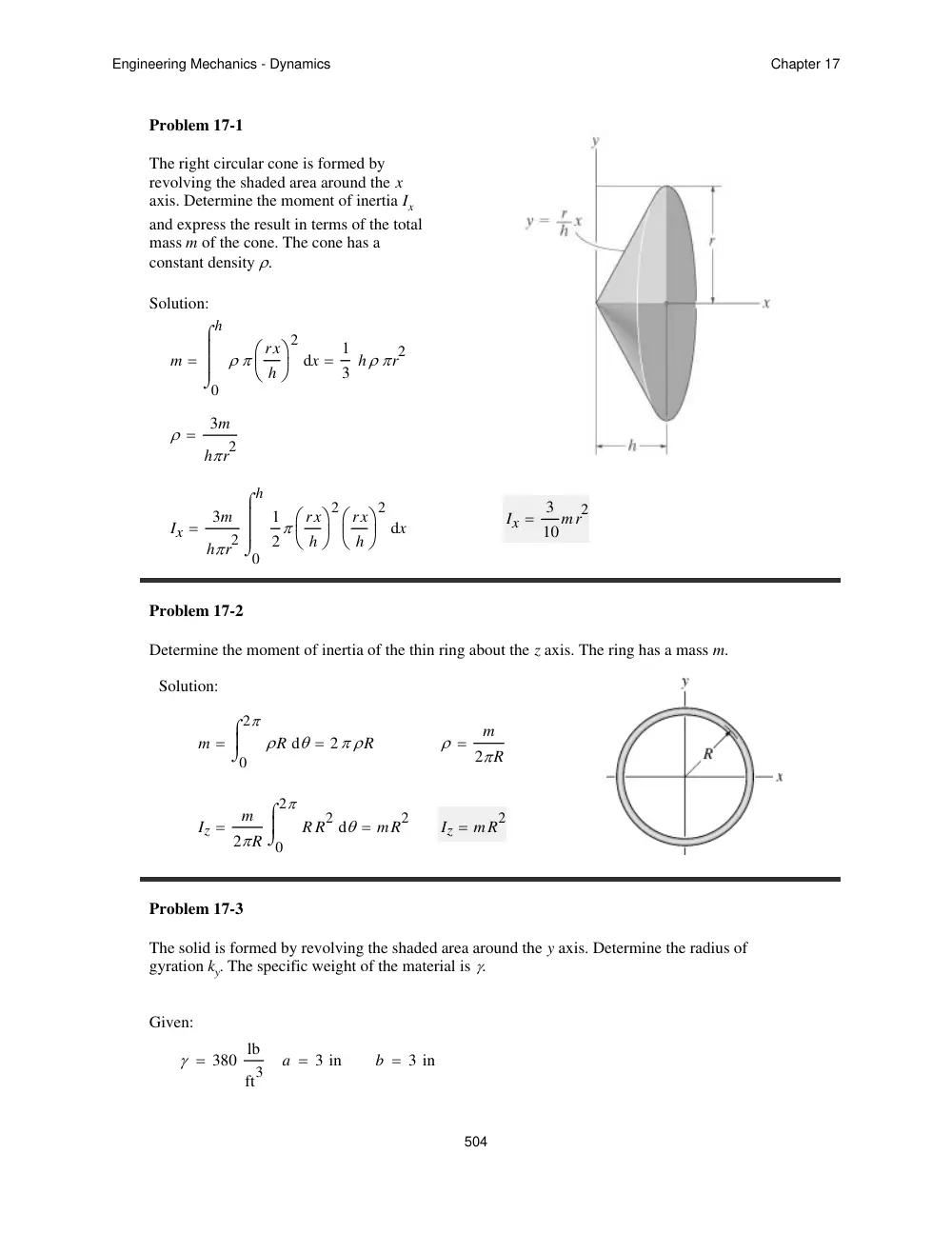
Problem 17-1
The right circular cone is formed by
revolving the shaded area around the x
axis. Determine the moment of inertia Ix
and express the result in terms of the total
mass m of the cone. The cone has a
constant density ρ.
Solution:
m
0
h
x
ρ π
rx
h
⎛⎜⎝
⎞⎟⎠
2
⌠
⎮
⎮
⌡
d
=
1
3 hρ πr2
=
ρ
3m
hπr2
=
Ix
3
= 10mr2
Ix
3m
hπr2
0
h
x
1
2π
rx
h
⎛⎜⎝
⎞⎟⎠
2
rx
h
⎛⎜⎝
⎞⎟⎠
2
⌠
⎮
⎮
⌡
d
=
Problem 17-2
Determine the moment of inertia of the thin ring about the z axis. The ring has a mass m.
Solution:
m
0
2π
θ
ρR
⌠
⎮⌡
d
=
= 2π ρR
ρ
m
2πR
=
Iz
m
2πR
0
2π
θ
R R2
⌠
⎮⌡
d
=
= mR2
Iz
mR2
=
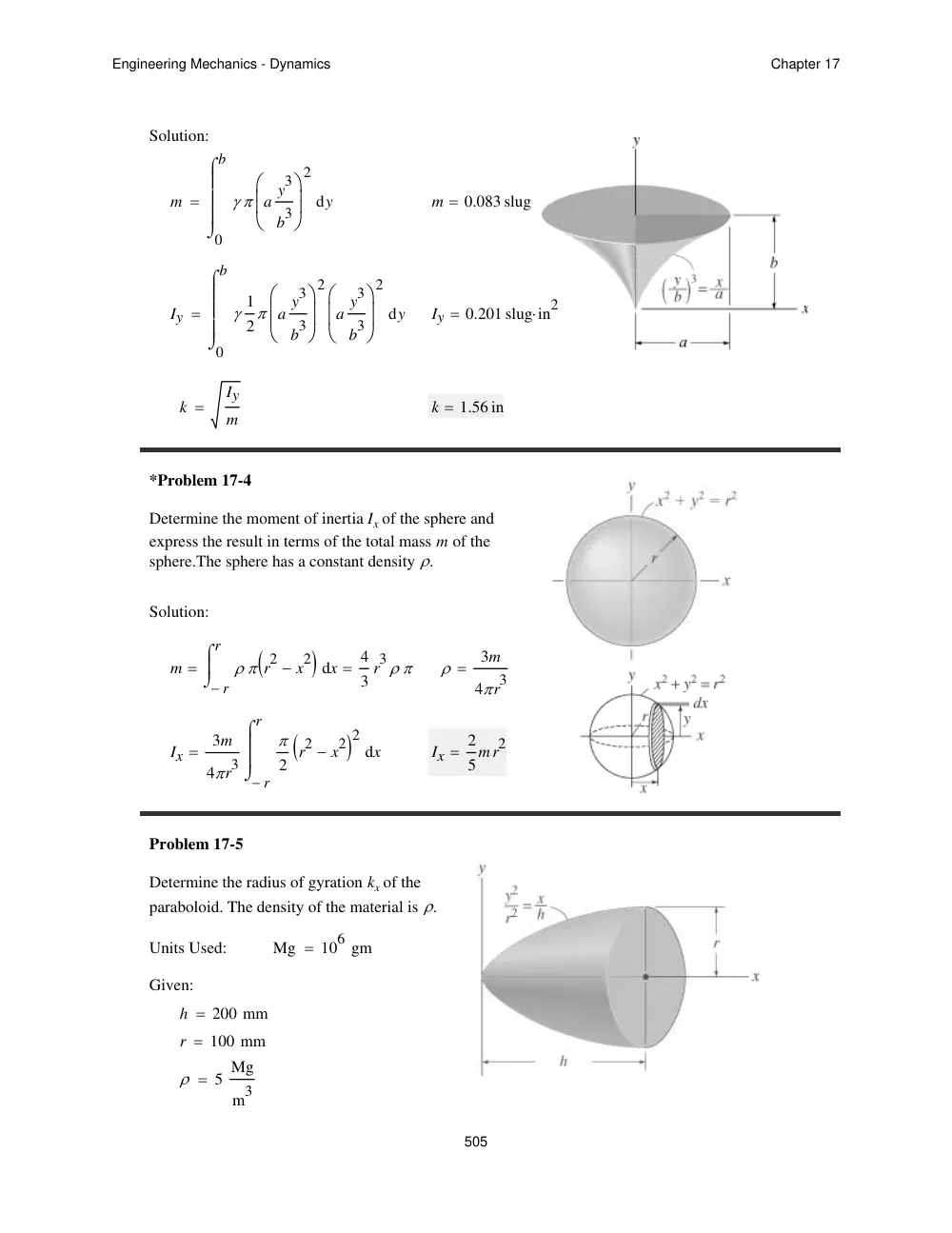
Problem 17-3
The solid is formed by revolving the shaded area around the y axis. Determine the radius of
gyration ky. The specific weight of the material is γ.
Given:
γ
380 lb
ft3
=
a
= 3 in
b
3 in
=
504
Engineering Mechanics - Dynamics
Chapter 17
Solution:
m
0
b
y
γ π a y3
b3
⎛⎜
⎜⎝
⎞⎟
⎟⎠
2
⌠
⎮
⎮
⎮
⌡
d
=
m
0.083 slug
=
Iy
0
b
y
γ 1
2π a y3
b3
⎛⎜
⎜⎝
⎞⎟
⎟⎠
2
a y3
b3
⎛⎜
⎜⎝
⎞⎟
⎟⎠
2
⌠
⎮
⎮
⎮
⌡
d
=
Iy
0.201 slug in2
⋅
=
k
Iy
m
=
k
1.56 in
=
*Problem 17-4
Determine the moment of inertia Ix of the sphere and
express the result in terms of the total mass m of the
sphere.The sphere has a constant density ρ.
Solution:
m
r
−
r
x
ρ π r2
− x2
(
)
⌠
⎮⌡
d
=
4
= 3 r3 ρ π
ρ
3m
4πr3
=
Ix
3m
4πr3
r
−
r
x
π
2 r2
− x2
(
)
2
⌠
⎮
⎮⌡
d
=
Ix
2
5mr2
=
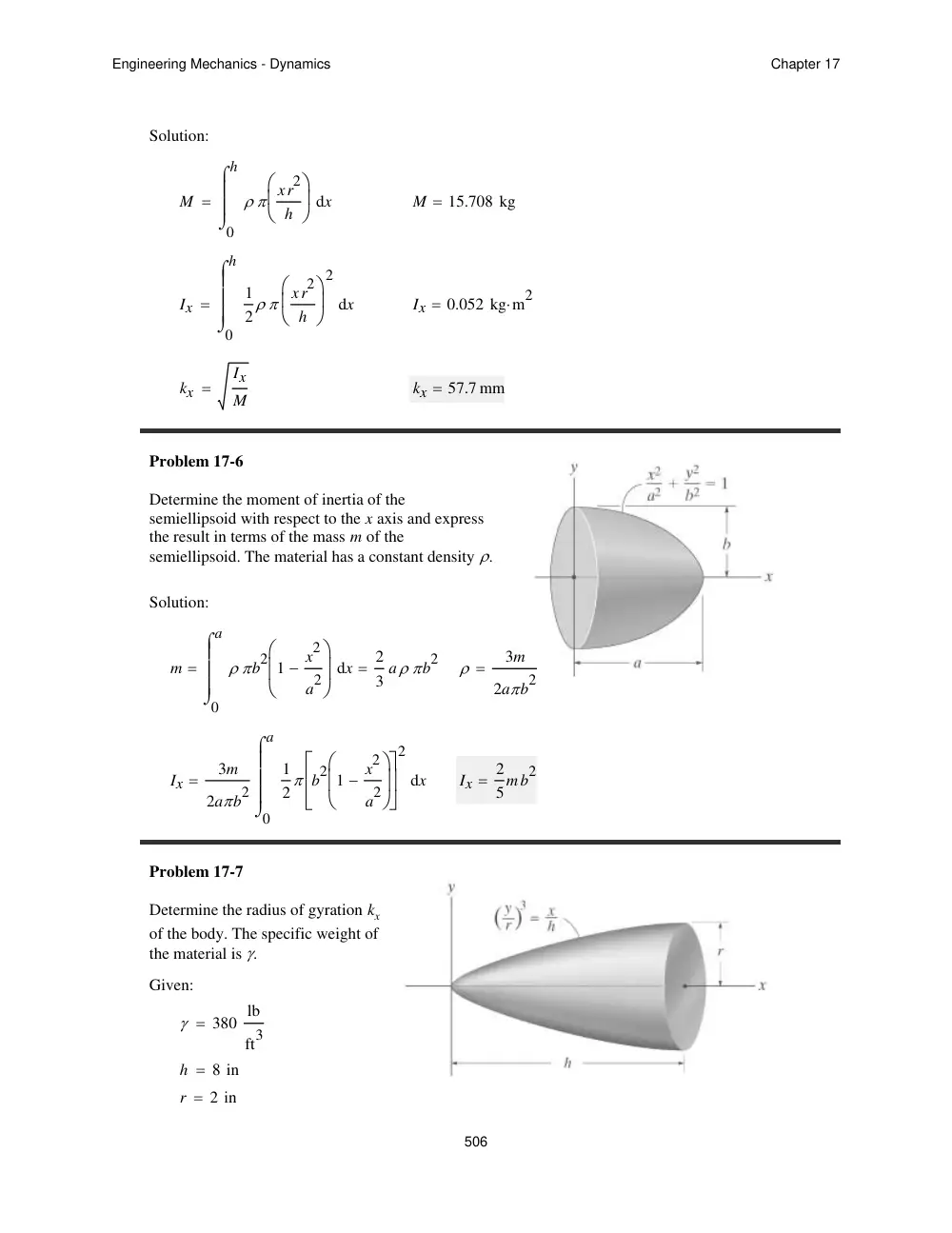
Problem 17-5
Determine the radius of gyration kx of the
paraboloid. The density of the material is ρ.
Units Used:
Mg
106 gm
=
Given:
h
200 mm
=
r
100 mm
=
ρ
5 Mg
m3
=
505
Engineering Mechanics - Dynamics
Chapter 17
Solution:
M
0
h
x
ρ π xr2
h
⎛⎜
⎝
⎞⎟
⎠
⌠
⎮
⎮
⌡
d
=
M
15.708 kg
=
Ix
0
h
x
1
2ρ π
xr2
h
⎛⎜
⎝
⎞⎟
⎠
2
⌠⎮
⎮
⎮⌡
d
=
Ix
0.052 kg m2
⋅
=
kx
Ix
M
=
kx
57.7 mm
=
Problem 17-6
Determine the moment of inertia of the
semiellipsoid with respect to the x axis and express
the result in terms of the mass m of the
semiellipsoid. The material has a constant density ρ.
Solution:
m
0
a
x
ρ πb2 1
x2
a2
⎛⎜ −
⎜⎝
⎞⎟
⎟⎠
⌠⎮
⎮
⎮⌡
d
=
2
= 3 aρ πb2
ρ
3m
2aπb2
=
Ix
3m
2aπb2
0
a
x
1
2π b2 1
x2
a2
⎛⎜ −
⎜⎝
⎞⎟
⎟⎠
⎡⎢
⎢⎣
⎤⎥
⎥⎦
2
⌠
⎮
⎮
⎮
⌡
d
=
Ix
2
5mb2
=
Problem 17-7
Determine the radius of gyration kx
of the body. The specific weight of
the material is γ.
Given:
γ
380 lb
ft3
=
h
8 in
=
r
2 in
=
506
Engineering Mechanics - Dynamics
Chapter 17
Solution:
M
0
h
x
γ π r x
h
⎛⎜⎝
⎞⎟⎠
1
3
⎡
⎢
⎢
⎣
⎤
⎥
⎥
⎦
2
⌠
⎮
⎮
⎮
⎮⌡
d
=
M
0.412 slug
=
Ix
0
h
x
1
2γ π r x
h
⎛⎜⎝
⎞⎟⎠
1
3
⎡
⎢
⎢
⎣
⎤
⎥
⎥
⎦
4
⌠
⎮
⎮
⎮
⎮⌡
d
=
Ix
0.589 slug in2
⋅
=
kx
Ix
M
=
kx
1.20 in
=
*Problem 17-8
Determine the moment of inertia of the ellipsoid with respect to the x axis and express the result
in terms of the mass m of the ellipsoid. The material has a constant density ρ.
Solution:
m
a
−
a
x
ρ πb2 1
x2
a2
⎛⎜ −
⎜⎝
⎞⎟
⎟⎠
⌠⎮
⎮
⎮⌡
d
=
4
3 aρ πb2
=
ρ
3m
4aπb2
=
Ix
3m
4aπb2
a
−
a
x
1
2π b2 1
x2
a2
⎛⎜ −
⎜⎝
⎞⎟
⎟⎠
⎡⎢
⎢⎣
⎤⎥
⎥⎦
2
⌠
⎮
⎮
⎮
⌡
d
=
Ix
2
5mb2
=
Problem 17-9
Determine the moment of inertia of the homogeneous pyramid of mass m with respect to the z
axis.The density of the material is ρ. Suggestion: Use a rectangular plate element having a volume
of dV = (2x)(2y) dz.
507
Engineering Mechanics - Dynamics
Chapter 17
Solution:
x
a h
− z
(
)
2h
=
m
0
h
z
ρ a h
− z
(
)
h
⎡⎢⎣
⎤⎥⎦
2
⌠
⎮
⎮
⌡
d
=
1
3 hρa2
=
ρ
3m
ha2
=
Iz
3m
ha2
0
h
z
1
6
a h
− z
(
)
h
⎡⎢⎣
⎤⎥⎦
4
⌠
⎮
⎮
⌡
d
=
Iz
1
10ma2
=
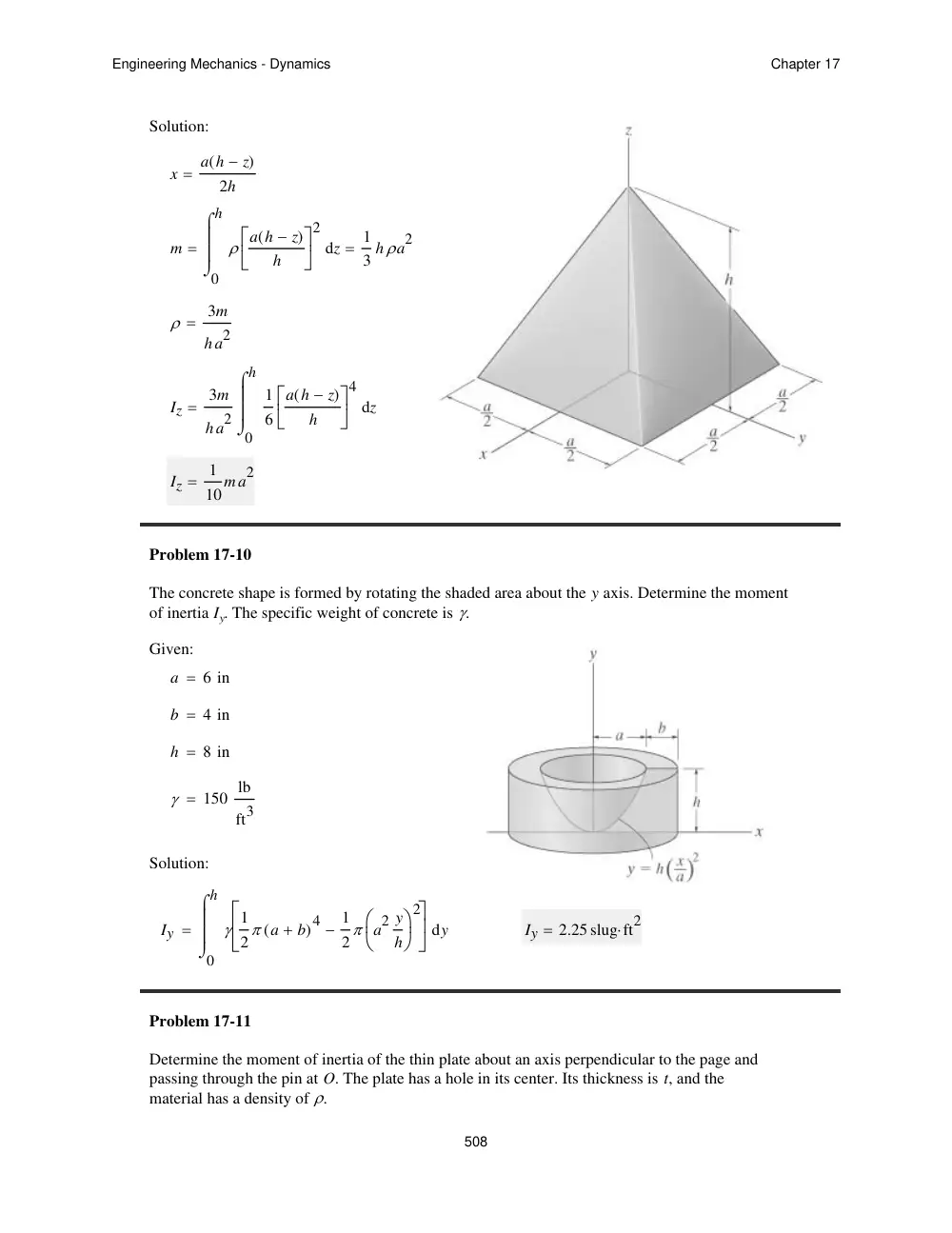
Problem 17-10
The concrete shape is formed by rotating the shaded area about the y axis. Determine the moment
of inertia Iy. The specific weight of concrete is γ.
Given:
a
6 in
=
b
4 in
=
h
8 in
=
γ
150 lb
ft3
=
Solution:
Iy
0
h
y
γ 1
2π a
+ b
(
)4
1
2π a2 y
h
⎛⎜⎝
⎞⎟⎠
2
−
⎡⎢
⎣
⎤⎥
⎦
⌠
⎮
⎮
⌡
d
=
Iy
2.25 slug ft2
⋅
=
Problem 17-11
Determine the moment of inertia of the thin plate about an axis perpendicular to the page and
passing through the pin at O. The plate has a hole in its center. Its thickness is t, and the
material has a density of ρ.
508
Engineering Mechanics - Dynamics
Chapter 17
Given:
a
1.40 m
=
r
150 mm
=
t
50 mm
=
ρ
50 kg
m3
=
Solution:
IO
ρa2t 2a2
3
⎛⎜
⎝
⎞⎟
⎠
ρ πr2t r2
2
⎛⎜
⎝
⎞⎟
⎠
ρ πr2t
2a
2
⎛⎜⎝
⎞⎟⎠
2
+
⎡
⎢
⎣
⎤
⎥
⎦
−
=
IO
6.227 kg m2
⋅
=
*Problem 17-12
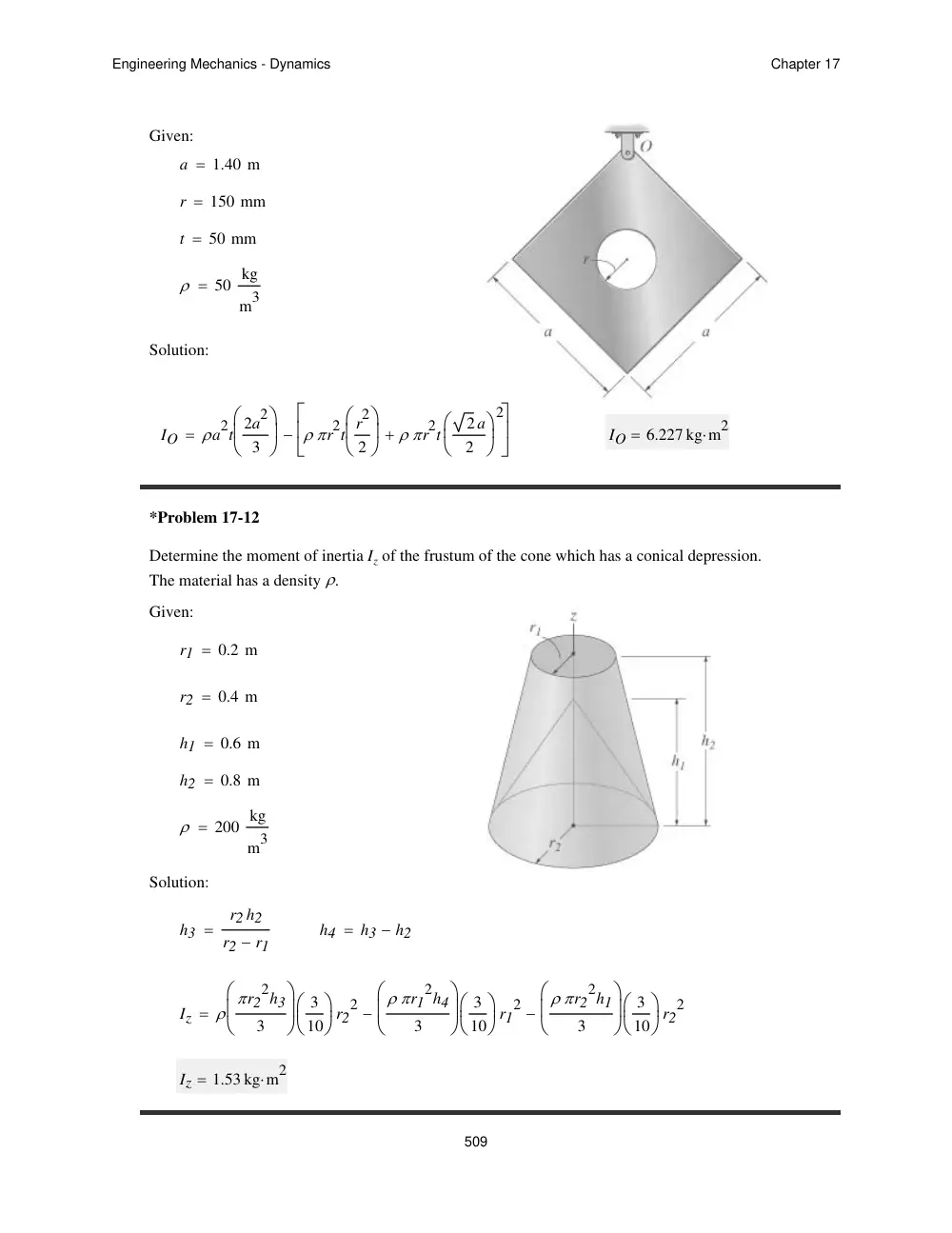
Determine the moment of inertia Iz of the frustum of the cone which has a conical depression.
The material has a density ρ.
Given:
r1
0.2 m
=
r2
0.4 m
=
h1
0.6 m
=
h2
0.8 m
=
ρ
200 kg
m3
=
Solution:
h3
r2 h2
r2
− r1
=
h4
h3
− h2
=
Iz
ρ
πr2
2h3
3
⎛
⎜
⎝
⎞
⎟
⎠
3
10
⎛⎜⎝
⎞⎟⎠
r2
2
ρ πr1
2h4
3
⎛
⎜
⎝
⎞
⎟
⎠
3
10
⎛⎜⎝
⎞⎟⎠
r1
2
−
ρ πr2
2h1
3
⎛
⎜
⎝
⎞
⎟
⎠
3
10
⎛⎜⎝
⎞⎟⎠
r2
2
−
=
Iz
1.53 kg m2
⋅
=
509
Engineering Mechanics - Dynamics
Chapter 17
Problem 17-13
Determine the moment of inertia of the assembly
about an axis which is perpendicular to the page
and passes through the center of mass G. The
material has a specific weight γ.
Given:
a
= 0.5 ft
r1
1 ft
=
b
= 0.25 ft
r2
2 ft
=
c
= 1 ft
γ
90 lb
ft3
=
Solution:
IG
1
2γ πc r2
+ a
(
)4
1
2γ π c
− b
(
) r2
4
−
1
2γ πbr1
4
−
=
IG
118slug ft2
⋅
=
Problem 17-14
Determine the moment of inertia of the assembly about an axis which is perpendicular to the
page and passes through point O. The material has a specific weight γ.
Given:
a
0.5 ft
=
b
0.25 ft
=
c
1 ft
=
r1
1 ft
=
r2
2 ft
=
γ
90 lb
ft3
=
Solution:
IO
3
2γ πc r2
+ a
(
)4
1
2γ π c
− b
(
) r2
4
γ π c
− b
(
) r2
2 r2
+ a
(
)2
+
⎡⎢⎣
⎤⎥⎦
−
1
2γ πbr1
4
γ πbr1
2 r2
+ a
(
)2
+
⎡⎢⎣
⎤⎥⎦
−
+
...
=
IO
283slug ft2
⋅
=
510
Engineering Mechanics - Dynamics
Chapter 17
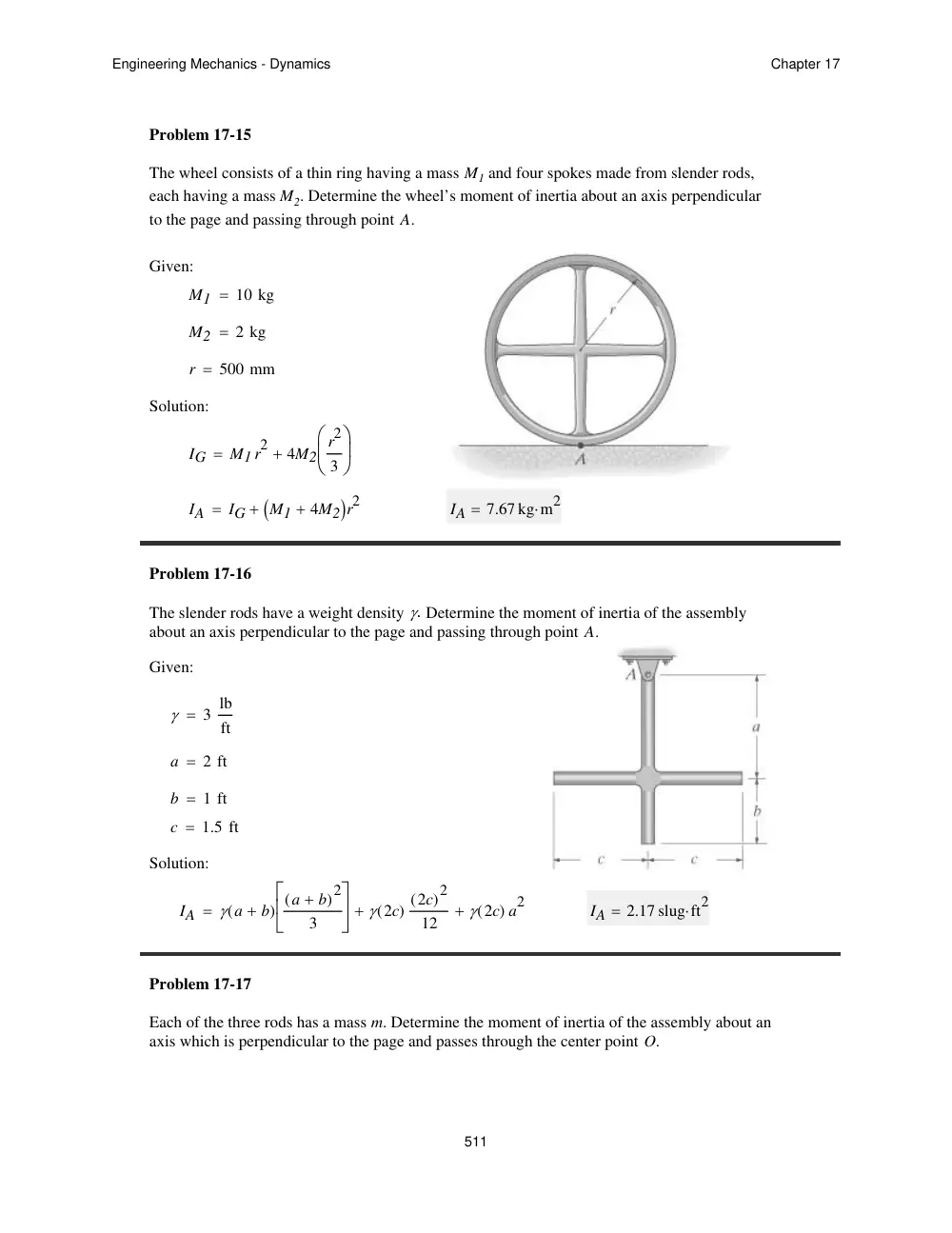
Problem 17-15
The wheel consists of a thin ring having a mass M1 and four spokes made from slender rods,
each having a mass M2. Determine the wheel’s moment of inertia about an axis perpendicular
to the page and passing through point A.
Given:
M1
10 kg
=
M2
2 kg
=
r
500 mm
=
Solution:
IG
M1 r2
4M2
r2
3
⎛⎜
⎝
⎞⎟
⎠
+
=
IA
IG
M1
+ 4M2
(
)r2
+
=
IA
7.67 kg m2
⋅
=
Problem 17-16
The slender rods have a weight density γ. Determine the moment of inertia of the assembly
about an axis perpendicular to the page and passing through point A.
Given:
γ
3 lb
ft
=
a
2 ft
=
b
1 ft
=
c
1.5 ft
=
Solution:
IA
γ a
+ b
(
)
a
+ b
(
)2
3
⎡⎢
⎣
⎤⎥
⎦
γ 2c
(
)
(2c
)2
12
+
γ 2c
(
) a2
+
=
IA
2.17 slug ft2
⋅
=
Problem 17-17
Each of the three rods has a mass m. Determine the moment of inertia of the assembly about an
axis which is perpendicular to the page and passes through the center point O.
511
Engineering Mechanics - Dynamics
Chapter 17
Solution:
I0
3 1
12ma2
m
a
( )sin 60 deg
(
)
3
⎡⎢⎣
⎤⎥⎦
2
+
⎡⎢
⎣
⎤⎥
⎦
=
I0
1
2ma2
=
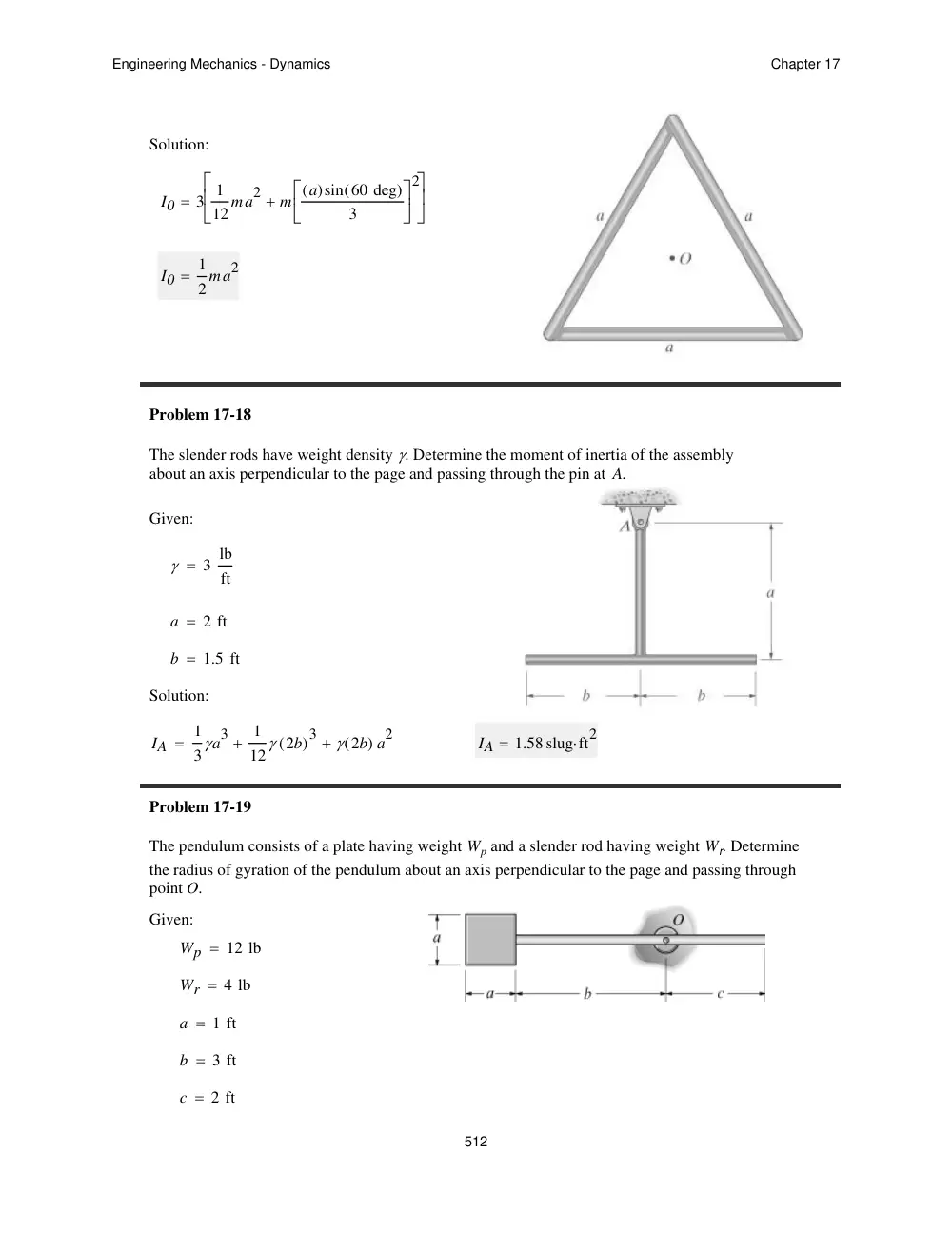
Problem 17-18
The slender rods have weight density γ. Determine the moment of inertia of the assembly
about an axis perpendicular to the page and passing through the pin at A.
Given:
γ
3 lb
ft
=
a
2 ft
=
b
1.5 ft
=
Solution:
IA
1
3γa3
1
12γ 2b
(
)3
+
γ 2b
(
) a2
+
=
IA
1.58 slug ft2
⋅
=
Problem 17-19
The pendulum consists of a plate having weight Wp and a slender rod having weight Wr. Determine
the radius of gyration of the pendulum about an axis perpendicular to the page and passing through
point O.
Given:
Wp
12 lb
=
Wr
4 lb
=
a
1 ft
=
b
3 ft
=
c
2 ft
=
512
Engineering Mechanics - Dynamics
Chapter 17
Solution:
IO
1
3
b
b
c
+
⎛⎜⎝
⎞⎟⎠
Wrb2
1
3
c
b
c
+
⎛⎜⎝
⎞⎟⎠
Wrc2
+
1
+ 6Wp a2
Wp b
a
⎛⎜⎝ + 2
⎞⎟⎠
2
+
=
IO
4.921 slug ft2
⋅
=
kO
IO
Wr
+ Wp
=
kO
3.146 ft
=
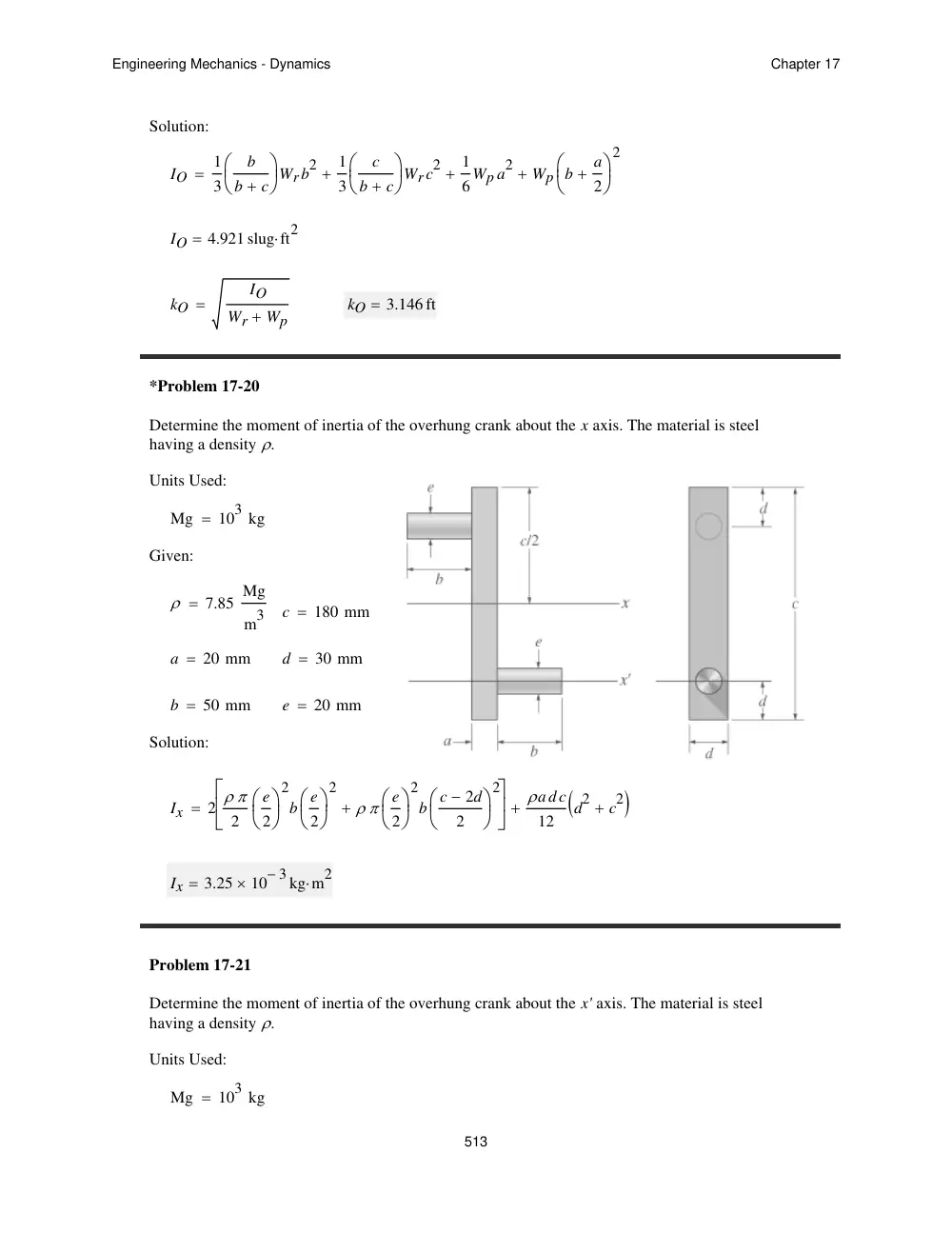
*Problem 17-20
Determine the moment of inertia of the overhung crank about the x axis. The material is steel
having a density ρ.
Units Used:
Mg
103 kg
=
Given:
ρ
7.85 Mg
m3
=
c
180 mm
=
a
= 20 mm
d
30 mm
=
b
= 50 mm
e
20 mm
=
Solution:
Ix
2 ρ π
2
e
2
⎛⎜⎝
⎞⎟⎠
2
b e
2
⎛⎜⎝
⎞⎟⎠
2
ρ π
e
2
⎛⎜⎝
⎞⎟⎠
2
b c
− 2d
2
⎛⎜⎝
⎞⎟⎠
2
+
⎡⎢
⎣
⎤⎥
⎦
ρadc
12
d2
+ c2
(
)
+
=
Ix
3.25
10 3
−
×
kg m2
⋅
=
Problem 17-21
Determine the moment of inertia of the overhung crank about the x' axis. The material is steel
having a density ρ.
Units Used:
Mg
103 kg
=
513
Engineering Mechanics - Dynamics
Chapter 17
Given:
ρ
7.85 Mg
m3
=
a
20 mm
=
b
50 mm
=
c
180 mm
=
d
30 mm
=
e
20 mm
=
Solution:
Ix
2 ρ π
2
e
2
⎛⎜⎝
⎞⎟⎠
2
b e
2
⎛⎜⎝
⎞⎟⎠
2
ρ π
e
2
⎛⎜⎝
⎞⎟⎠
2
b c
− 2d
2
⎛⎜⎝
⎞⎟⎠
2
+
⎡⎢
⎣
⎤⎥
⎦
ρadc
12
d2
+ c2
(
)
+
=
Ix'
Ix
2ρ π
e
2
⎛⎜⎝
⎞⎟⎠
2
b
+ ρadc
⎡⎢
⎣
⎤⎥
⎦
c
− 2d
2
⎛⎜⎝
⎞⎟⎠
2
+
=
Ix'
7.19
10 3
−
×
kg m2
⋅
=
Problem 17-22
Determine the moment of inertia of the solid steel assembly about the x axis. Steel has specific
weight γst.
Given:
a
0.25 ft
=
b
2 ft
=
c
3 ft
=
γst
490 lb
ft3
=
Solution:
Ix
1
2π 2a
(
)2c 2a
(
)2
3
10
1
3π 2a
(
)2 2b
(
) 2a
(
)2
+
3
10
1
3πa2ba2
−
⎡⎢⎣
⎤⎥⎦
γst
=
Ix
5.644 slug ft2
⋅
=
514
Engineering Mechanics - Dynamics
Chapter 17
Problem 17-23
The pendulum consists of two slender rods AB and OC which have a
mass density ρ1. The thin plate has a mass density ρ2. Determine the
location y' of the center of mass G of the pendulum, then calculate the
moment of inertia of the pendulum about an axis perpendicular to the
page and passing through G.
Given:
ρ1
3 kg
m
=
a
= 0.4 m
c
0.1 m
=
ρ2
12 kg
m2
=
b
= 1.5 m
r
0.3 m
=
Solution:
y'
ρ1 b b
2
⎛⎜⎝
⎞⎟⎠
ρ2π r2
− c2
(
) b
+ r
(
)
+
ρ1 b
+ 2a
(
)
ρ2π r2
− c2
(
)
+
=
y'
0.888 m
=
IO
1
12ρ1 2a
(
)3
1
+ 3ρ1 b3
ρ2
2
⎛⎜⎝
⎞⎟⎠
πr4
+
ρ2πr2 r
( + b
)2
+
ρ2
2
⎛⎜⎝
⎞⎟⎠
πc4
ρ2πc2 r
( + b
)2
+
⎡⎢⎣
⎤⎥⎦
−
=
IG
IO
ρ1 2a
+ b
(
)
ρ2π r2
− c2
(
)
+
⎡⎣
⎤⎦y'2
−
=
IG
5.61 kg m2
⋅
=
*Problem 17-24
Determine the greatest possible acceleration of the race car of mass M so that its front tires do
not leave the ground or the tires slip on the track. The coefficients of static and kinetic friction
are μs and μk respectively. Neglect the mass of the tires. The car has rear-wheel drive and the
front tires are free to roll.
Given:
M
= 975 kg
μs
0.8
=
a
= 1.82 m
μk
0.6
=
b
= 2.20 m
g
9.81 m
s2
=
h
0.55 m
=
515
Engineering Mechanics - Dynamics
Chapter 17
Solution:
First assume that the rear wheels
are on the verge of slipping
FB
μsNB
=
Guesses
NA
= 1 N
NB
= 1 N
aG
1 m
s2
=
Given
μsNB
= M aG
NA
+ NB
− M g
0
=
−NA
a
NB b
− a
(
)
+
− μsNBh
0
=
NA
NB
aG1
⎛⎜
⎜
⎜⎝
⎞⎟
⎟
⎟⎠
Find NA NB
,
, aG
(
)
=
NA
NB
⎛
⎜
⎝
⎞
⎟
⎠
326
−
⎛⎜⎝9891
⎞⎟⎠
N
=
aG1
8.12 m
s2
=
Next assume that the front wheels lose contact with the ground
NA
0
=
Guesses
NB
= 1 N
FB
= 1 N
aG
1 m
s2
=
Given
FB
= M aG
NB
− M g
= 0
NB b
− a
(
)
− FBh
0
=
NB
FB
aG2
⎛⎜
⎜
⎜⎝
⎞⎟
⎟
⎟⎠
Find NB FB
,
, aG
(
)
=
NB
FB
⎛
⎜
⎝
⎞
⎟
⎠
9565
⎛⎜⎝6608
⎞⎟⎠
N
=
aG2
6.78 m
s2
=
Choose the critical case
aG
min aG1 aG2
,
(
)
=
aG
6.78 m
s2
=
Problem 17-25
Determine the greatest possible acceleration of the race car of mass M so that its front tires do
not leave the ground nor the tires slip on the track. The coefficients of static and kinetic
friction are μs and μk respectively. Neglect the mass of the tires. The car has four-wheel drive.
Given:
M
= 975 kg
μs
0.8
=
a
= 1.82 m
μk
0.6
=
b
= 2.20 m
g
9.81 m
s2
=
h
0.55 m
=
516
Engineering Mechanics - Dynamics
Chapter 17
Solution:
First assume that all wheels are on
the verge of slipping
FA
μsNA
=
FB
μsNB
=
Guesses
NA
= 1 N
NB
= 1 N
aG
1 m
s2
=
Given
μsNB
+ μsNA
= M aG
NA
+ NB
− M g
0
=
−NA
a
NB b
− a
(
)
+
− μsNBh
− μsNAh
0
=
NA
NB
aG1
⎛⎜
⎜
⎜⎝
⎞⎟
⎟
⎟⎠
Find NA NB
,
, aG
(
)
=
NA
NB
⎛
⎜
⎝
⎞
⎟
⎠
261
−
⎛⎜⎝9826
⎞⎟⎠
N
=
aG1
7.85 m
s2
=
Next assume that the front wheels lose contact with the ground
NA
0
=
Guesses
NB
= 1 N
FB
= 1 N
aG
1 m
s2
=
Given
FB
= M aG
NB
− M g
= 0
NB b
− a
(
)
− FBh
0
=
NB
FB
aG2
⎛⎜
⎜
⎜⎝
⎞⎟
⎟
⎟⎠
Find NB FB
,
, aG
(
)
=
NB
FB
⎛
⎜
⎝
⎞
⎟
⎠
9565
⎛⎜⎝6608
⎞⎟⎠
N
=
aG2
6.78 m
s2
=
Choose the critical case
aG
min aG1 aG2
,
(
)
=
aG
6.78 m
s2
=
Problem 17-26
The bottle of weight W rests on the check-out conveyor at a
grocery store. If the coefficient of static friction is μs, determine
the largest acceleration the conveyor can have without causing
the bottle to slip or tip. The center of gravity is at G.
Given:
W
2 lb
=
μs
0.2
=
517
Engineering Mechanics - Dynamics
Chapter 17
b
8 in
=
c
1.5 in
=
g
32.2 ft
s2
=
Solution:
Assume that bottle tips before slipping
x
c
=
Guesses
aG
1 ft
s2
=
FB
= 1 lb
NB
= 1 lb
Fmax
1 lb
=
Given
FB
W
g
⎛⎜⎝
⎞⎟⎠
aG
=
NB
− W
0
=
FBb
− NBx
= 0
Fmax
μsNB
=
aGt
FB
NB
Fmax
⎛
⎜
⎜
⎜
⎜
⎝
⎞
⎟
⎟
⎟
⎟
⎠
Find aG FB
,
, NB
, Fmax
(
)
=
FB
NB
Fmax
⎛⎜
⎜
⎜⎝
⎞⎟
⎟
⎟⎠
0.375
2
0.4
⎛
⎜
⎜
⎝
⎞
⎟
⎟
⎠
lb
=
aGt
6.037 ft
s2
=
If FB
= 0.375 lb
< Fmax
= 0.4 lb
then we have the correct answer.
If FB
= 0.375 lb
> Fmax
= 0.4 lb
then we know that slipping occurs first. If this is the case,
FB
μsNB
=
Given
FB
W
g
⎛⎜⎝
⎞⎟⎠
aG
=
NB
− W
= 0
FBb
− NBx
0
=
aGs
NB
x
⎛⎜
⎜
⎜⎝
⎞⎟
⎟
⎟⎠
Find aG NB
,
, x
(
)
=
NB
= 2lb
x
= 1.6 in
aGs
6.44 ft
s2
=
As a check, we should have x
= 1.6 in
< c
= 1.5 in
if slipping occurs first
In either case, the answer is
aG
min aGs aGt
,
(
)
=
aG
6.037 ft
s2
=
Problem 17-27
The assembly has mass ma and is hoisted using the boom and pulley system. If the winch at B
518
Engineering Mechanics - Dynamics
Chapter 17
draws in the cable with acceleration a, determine the compressive force in the hydraulic cylinder
needed to support the boom. The boom has mass mb and mass center at G.
Units Used:
Mg
103 kg
=
kN
103 N
=
Given:
ma
8 Mg
=
mb
2 Mg
=
a
2 m
s2
=
b
4 m
=
c
2 m
=
d
6 m
=
e
1 m
=
f
2 m
=
θ
60 deg
=
g
9.81 m
s2
=
Solution:
2T
− ma g
ma
a
2
=
T
1
2 ma g
ma
a
2
+
⎛⎜⎝
⎞⎟⎠
=
T
43.24 kN
=
2
− T b
+ c
+ d
(
)
mb g b
+ c
(
)
−
+ FCDb
⎡⎣
⎤⎦cos θ( )
0
=
FCD
2T b
+ c
+ d
(
)
mb g b
+ c
(
)
+
b
=
FCD
289kN
=
*Problem 17-28
The jet aircraft has total mass M and a center of mass at G. Initially at take-off the engines
provide thrusts 2T and T'. Determine the acceleration of the plane and the normal reactions on
the nose wheel and each of the two wing wheels located at B. Neglect the mass of the wheels
and, due to low velocity, neglect any lift caused by the wings.
Units Used:
Mg
103 kg
=
519
Engineering Mechanics - Dynamics
Chapter 17
kN
103 N
=
Given:
b
= 2.5 m
M
22 Mg
=
c
= 2.3 m
T
2 kN
=
d
= 3 m
T'
1.5 kN
=
e
= 6 m
g
9.81 m
s2
=
f
1.2 m
=
Solution:
Guesses
aG
1 m
s2
=
By
= 1 kN
Ay
1 kN
=
Given
T'
+ 2T
= M aG
2By
+ Ay
− M g
0
=
−T'
b
− 2T c
− M gd
Ay d
+ e
(
)
+
−M
aG f
=
aG
By
Ay
⎛⎜
⎜
⎜⎝
⎞⎟
⎟
⎟⎠
Find aG By
,
, Ay
(
)
=
aG
0.250 m
s2
=
Ay
By
⎛
⎜
⎝
⎞
⎟
⎠
72.6
⎛⎜⎝71.6
⎞⎟⎠
kN
=
Problem 17-29
The lift truck has mass mt and mass center at G. If it
lifts the spool of mass ms with acceleration a,
determine the reactions of each of the four wheels on
the ground. The loading is symmetric. Neglect the
mass of the movable arm CD.
Given:
a
3 m
s2
=
d
0.4 m
=
b
= 0.75 m
e
0.7 m
=
c
= 0.5 m
g
9.81 m
s2
=
mt
= 70 kg
ms
120 kg
=
520
Engineering Mechanics - Dynamics
Chapter 17
Guesses
NA
= 1 N
NB
1 N
=
Given
2 NA
+ NB
(
)
mt
+ ms
(
)g
−
msa
=
2
− NA b
+ c
(
)
+ msge
+ mt gc
−ms
ae
=
NA
NB
⎛
⎜
⎝
⎞
⎟
⎠
Find NA NB
,
(
)
=
NA
NB
⎛
⎜
⎝
⎞
⎟
⎠
568
⎛⎜⎝544
⎞⎟⎠
N
=
Problem 17-30
The lift truck has mass mt and mass center at G. Determine the largest upward acceleration of the
spool of mass ms so that no reaction of the wheels on the ground exceeds Fmax.
Given:
mt
= 70 kg
b
0.75 m
=
ms
= 120 kg
c
0.5 m
=
Fmax
= 600 N
d
0.4 m
=
g
9.81 m
s2
=
e
0.7 m
=
Solution:
Assume
NA
Fmax
=
Guesses
a
1 m
s2
=
NB
1 N
=
521
Solution:
Engineering Mechanics - Dynamics
Chapter 17
2 NA
+ NB
(
)
mt
+ ms
(
)g
−
msa
=
2
− NA b
+ c
(
)
+ msge
+ mt gc
−ms
ae
=
a
⎛⎜NB
⎝
⎞⎟
⎠
Find a NB
( ,
)
=
NA
NB
⎛
⎜
⎝
⎞
⎟
⎠
600
⎛⎜⎝569.529
⎞⎟⎠
N
=
a
3.96 m
s2
=
Check: Since NB
= 570 N
< Fmax
= 600 N
then our assumption is good.
Problem 17-31
The door has weight W and center of gravity at G. Determine how far the door moves in time t
starting from rest, if a man pushes on it at C with a horizontal force F. Also, find the vertical
reactions at the rollers A and B.
Given:
W
= 200 lb
c
5 ft
=
t
= 2 s
d
12 ft
=
F
= 30 lb
e
6 ft
=
b
= 3 ft
g
32.2 ft
s2
=
Solution:
Guesses
a
1 ft
s2
=
NA
= 1 lb
NB
1 lb
=
Given
F
W
g
⎛⎜⎝
⎞⎟⎠
a
=
NA
+ NB
− W
0
=
F c
− b
(
)
+ NBe
− NAe
0
=
522
Given
Engineering Mechanics - Dynamics
Chapter 17
a
NA
NB
⎛⎜
⎜
⎜⎝
⎞⎟
⎟
⎟⎠
Find a NA
,
, NB
(
)
=
a
4.83 ft
s2
=
NA
NB
⎛
⎜
⎝
⎞
⎟
⎠
105.0
⎛⎜⎝ 95.0
⎞⎟⎠
lb
=
d
1
= 2at2
d
9.66 ft
=
*Problem 17-32
The door has weight W and center of gravity at G. Determine the constant force F that must be
applied to the door to push it open a distance d to the right in time t, starting from rest. Also, find the
vertical reactions at the rollers A and B.
Given:
W
= 200 lb
c
5 ft
=
t
= 5 s
d
12 ft
=
d
= 12 ft
e
6 ft
=
b
= 3 ft
g
32.2 ft
s2
=
Solution:
a
2 d
t2
⎛⎜
⎝
⎞⎟
⎠
=
a
0.96 ft
s2
=
Guesses
F
= 1 lb
NA
= 1 lb
NB
1 lb
=
Given
F
W
g
⎛⎜⎝
⎞⎟⎠
a
=
NA
+ NB
− W
0
=
F c
− b
(
)
+ NBe
− NAe
0
=
F
NA
NB
⎛⎜
⎜
⎜⎝
⎞⎟
⎟
⎟⎠
Find F NA
,
, NB
(
)
=
F
NA
NB
⎛⎜
⎜
⎜⎝
⎞⎟
⎟
⎟⎠
5.96
100.99
99.01
⎛
⎜
⎜
⎝
⎞
⎟
⎟
⎠
lb
=
Problem 17-33
The fork lift has a boom with mass M1 and a mass center at G. If the vertical acceleration of the
boom is aG, determine the horizontal and vertical reactions at the pin A and on the short link BC
when the load M2 is lifted.
523
Engineering Mechanics - Dynamics
Chapter 17
Units Used:
Mg
= 103 kg
kN
103 N
=
Given:
M1
= 800 kg
a
1 m
=
b
= 2 m
M2
1.25 Mg
=
c
1.5 m
=
d
= 1.25 m
aG
4 m
s2
=
Solution:
Guesses
Ax
= 1 N
FCB
1 N
=
Ay
1 N
=
Given
−FCB
+ Ax
0
=
Ay
M1
+ M2
(
)g
−
M1
+ M2
(
)aG
=
FCB c
− M1 ga
M2 g a
+ b
(
)
−
M1 aGa
M2 aG a
+ b
(
)
+
=
Ax
Ay
FCB
⎛⎜
⎜
⎜⎝
⎞⎟
⎟
⎟⎠
Find Ax Ay
,
, FCB
(
)
=
Ax
Ay
FCB
⎛⎜
⎜
⎜⎝
⎞⎟
⎟
⎟⎠
41.9
28.3
41.9
⎛
⎜
⎜
⎝
⎞
⎟
⎟
⎠
kN
=
Problem 17-34
The pipe has mass M and is being towed behind the truck. If the acceleration of the truck is at,
determine the angle θ and the tension in the cable. The coefficient of kinetic friction between the pipe
524
Engineering Mechanics - Dynamics
Chapter 17
and the ground is μk.
Units Used:
kN
103 N
=
Given:
M
= 800 kg
r
0.4 m
=
at
0.5 m
s2
=
φ
45 deg
=
μk
= 0.1
g
9.81 m
s2
=
Solution:
Guesses
θ
= 10 deg
NC
= 1 N
T
1 N
=
Given
T cos φ( )
− μk NC
M at
=
T sin φ( )
− M g
+ NC
0
=
T sin φ
( − θ
)r
− μk NC r
0
=
θ
NC
T
⎛⎜
⎜
⎜⎝
⎞⎟
⎟
⎟⎠
Find θ NC
,
, T
(
)
=
NC
= 6.771 kN
T
= 1.523 kN
θ
18.608 deg
=
Problem 17-35
The pipe has mass M and is being towed behind a truck. Determine the acceleration of the truck and
the tension in the cable. The coefficient of kinetic friction between the pipe and the ground is μk.
525
Engineering Mechanics - Dynamics
Chapter 17
Units Used:
kN
103 N
=
Given:
M
= 800 kg
r
0.4 m
=
θ
= 30 deg
φ
45 deg
=
μk
= 0.1
g
9.81 m
s2
=
Solution:
Guesses
at
1 m
s2
=
NC
1 N
=
T
1 N
=
Given
T cos φ( )
− μk NC
M at
=
T sin φ( )
− M g
+ NC
0
=
T sin φ
( − θ
)r
− μk NC r
0
=
at
NC
T
⎛⎜
⎜
⎜⎝
⎞⎟
⎟
⎟⎠
Find at NC
,
, T
(
)
=
NC
= 6.164 kN
T
= 2.382 kN
at
1.335 m
s2
=
*Problem 17-36
The pipe has a mass M and is held in place on the truck bed using the two boards A and B.
Determine the acceleration of the truck so that the pipe begins to lose contact at A and the bed
of the truck and starts to pivot about B. Assume board B will not slip on the bed of the truck,
and the pipe is smooth. Also, what force does board B exert on the pipe during the
acceleration?
526
Engineering Mechanics - Dynamics
Chapter 17
Units Used:
kN
103 N
=
Given:
M
460 kg
=
a
0.5 m
=
b
0.3 m
=
c
0.4 m
=
d
0.1 m
=
g
9.81 m
s2
=
Solution:
θ
asin b
a
⎛⎜⎝
⎞⎟⎠
=
Guesses
NBx
= 1 N
NBy
= 1 N
at
1 m
s2
=
Given
NBx
= M at
NBy
− M g
= 0
NBx a
( ) cos θ( )
− NBy b
0
=
NBx
NBy
at
⎛⎜
⎜
⎜⎝
⎞⎟
⎟
⎟⎠
Find NBx NBy
,
, at
(
)
=
NBx
NBy
⎛
⎜
⎝
⎞
⎟
⎠
3.384
⎛⎜⎝4.513
⎞⎟⎠
kN
=
at
7.36 m
s2
=
NBx
NBy
⎛
⎜
⎝
⎞
⎟
⎠
5.64 kN
=
Problem 17-37
The drop gate at the end of the trailer has mass M and mass center at G. If it is supported by
the cable AB and hinge at C, determine the tension in the cable when the truck begins to
accelerate at rate a. Also, what are the horizontal and vertical components of reaction at the
hinge C?
Given:
kN
103 N
=
M
1.25
× 103 kg
=
a
5 m
s2
=
θ
30 deg
=
527
Engineering Mechanics - Dynamics
Chapter 17
b
= 1.5 m
φ
45 deg
=
c
= 1 m
g
9.81 m
s2
=
Solution:
Guesses
T
= 1 N
Cx
= 1 N
Cy
1 N
=
Given
T
− cos φ
( − θ
)
+ Cx
−M
a
=
T
− sin φ
( − θ
)
− M g
+ Cy
0
=
T sin θ( ) b
+ c
(
)
− M gbcos φ( )
M absin φ( )
=
T
Cx
Cy
⎛⎜
⎜
⎜⎝
⎞⎟
⎟
⎟⎠
Find T Cx
,
, Cy
(
)
=
T
Cx
Cy
⎛⎜
⎜
⎜⎝
⎞⎟
⎟
⎟⎠
15.708
8.923
16.328
⎛
⎜
⎜
⎝
⎞
⎟
⎟
⎠
kN
=
Problem 17-38
The sports car has mass M and a center of mass at G. Determine the shortest time it takes for it to
reach speed v, starting from rest, if the engine only drives the rear wheels, whereas the front wheels
are free rolling. The coefficient of static friction between the wheels and the road is μs. Neglect the
mass of the wheels for the calculation. If driving power could be supplied to all four wheels, what
would be the shortest time for the car to reach a speed of v?
Given:
M
1.5
× 103 kg
=
v
80 km
hr
=
μs
0.2
=
b
1.25 m
=
c
0.75 m
=
d
0.35 m
=
g
9.81 m
s2
=
528
Engineering Mechanics - Dynamics
Chapter 17
(a) Rear wheel drive only
Guesses
NA
= 1 N
NB
= 1 N
aG
1 m
s2
=
Given
NA
+ NB
− M g
= 0
μsNB
M aG
=
M gc
NA b
+ c
(
)
−
M aGd
=
NA
NB
aG
⎛⎜
⎜
⎜⎝
⎞⎟
⎟
⎟⎠
Find NA NB
,
, aG
(
)
=
NA
NB
⎛
⎜
⎝
⎞
⎟
⎠
5.185
103
×
9.53
103
×
⎛⎜
⎜⎝
⎞⎟
⎟⎠
N
=
aG
1.271 m
s2
=
trw
v
aG
=
trw
17.488 s
=
(b) Four wheel drive
Guesses
NA
= 1 N
NB
= 1 N
aG
1 m
s2
=
Given
NA
+ NB
− M g
= 0
μsNB
+ μsNA
M aG
=
M gc
NA b
+ c
(
)
−
M aGd
=
NA
NB
aG
⎛⎜
⎜
⎜⎝
⎞⎟
⎟
⎟⎠
Find NA NB
,
, aG
(
)
=
NA
NB
⎛
⎜
⎝
⎞
⎟
⎠
5.003
103
×
9.712
103
×
⎛⎜
⎜⎝
⎞⎟
⎟⎠
N
=
aG
1.962 m
s2
=
trw
v
aG
=
trw
11.326 s
=
Problem 17-39
The crate of mass m is supported on a cart of negligible mass. Determine the maximum force
P that can be applied a distance d from the cart bottom without causing the crate to tip on the
cart.
529
Solution:
Engineering Mechanics - Dynamics
Chapter 17
Solution:
Require Nc to act at corner B
for tipping.
P d
mg b
2
⎛⎜⎝
⎞⎟⎠
−
maG
h
2
⎛⎜⎝
⎞⎟⎠
=
P
maG
=
P d
mg b
2
⎛⎜⎝
⎞⎟⎠
−
P h
2
⎛⎜⎝
⎞⎟⎠
=
Pmax
mgb
2 d
h
⎛⎜⎝ − 2
⎞⎟⎠
=
*Problem 17-40
The car accelerates uniformly from rest to speed v in time t. If it has weight W and a center of
gravity at G, determine the normal reaction of each wheel on the pavement during the motion.
Power is developed at the front wheels, whereas the rear wheels are free to roll. Neglect the
mass of the wheels and take the coefficients of static and kinetic friction to be μs and μk
respectively.
Given:
a
2.5 ft
=
v
88 ft
s
=
μk
0.2
=
t
= 15 s
b
4 ft
=
W
= 3800 lb
c
3 ft
=
μs
= 0.4
g
32.2 ft
s2
=
Solution:
Assume no slipping
aG
v
= t
aG
5.867 ft
s2
=
Guesses
NB
= 1 lb
NA
= 1 lb
FA
1 lb
=
Given
2NB
+ 2NA
− W
0
=
2FA
W
g
⎛⎜⎝
⎞⎟⎠
aG
=
2
− NB b
+ c
(
)
+ W c
W
−
g
⎛⎜⎝
⎞⎟⎠
aGa
=
530
Engineering Mechanics - Dynamics
Chapter 17
NA
NB
FA
⎛⎜
⎜
⎜⎝
⎞⎟
⎟
⎟⎠
Find NA NB
,
, FA
(
)
=
NA
NB
⎛
⎜
⎝
⎞
⎟
⎠
962
⎛⎜⎝938
⎞⎟⎠
lb
=
FA
346lb
=
Fmax
= μsNA
Fmax
385lb
=
Check: Our no-slip assumption is true if FA
= 346lb
< Fmax
= 385lb
Problem 17-41
Block A has weight W1 and the platform has weight W2. Determine the normal force exerted
by block A on B. Neglect the weight of the pulleys and bars of the triangular frame.
Given:
W1
50 lb
=
W2
10 lb
=
P
100 lb
=
Solution:
P
W1
+ W2
(
)
−
W1
W2
+
g
⎛⎜⎝
⎞⎟⎠
aG
=
aG
g
P
− 1 W1
1 W2
−
W1
W2
+
⎛⎜
⎝
⎞⎟
⎠
=
aG
21.47 ft
s2
=
Guesses
R
= 25 lb
T
22 lb
=
Given
2T
+ R
− W1
W1
g
⎛⎜⎝
⎞⎟⎠
aG
=
2T
− R
− W2
W2
g
⎛⎜⎝
⎞⎟⎠
aG
=
R
⎛⎜⎝T
⎞⎟⎠
Find R T
,
(
)
=
R
= 33.3 lb
T
25lb
=
Problem 17-42
The car of mass M shown has been “raked” by increasing the height of its center of mass to h
This was done by raising the springs on the rear axle. If the coefficient of kinetic friction
531
Engineering Mechanics - Dynamics
Chapter 17
between the rear wheels and the ground is μk , show that the car can accelerate slightly faster
than its counterpart for which h = 0. Neglect the mass of the wheels and driver and assume
the front wheels at B are free to roll while the rear wheels slip.
Units Used:
Mg
= 103 kg
kN
103 N
=
Given:
M
= 1.6 Mg
a
1.6 m
=
μk
= 0.3
b
1.3 m
=
h
= 0.2 m
g
9.81 m
s2
=
h1
0.4 m
=
Solution:
In the raised position
Guesses
aG
1 m
s2
=
NA
= 4 N
NB
5 N
=
Given
μk NA
M aG
=
NA
+ NB
− M g
0
=
−M
ga
NB a
+ b
(
)
+
−M
aG h
( + h1
)
=
aGr
NA
NB
⎛⎜
⎜
⎜⎝
⎞⎟
⎟
⎟⎠
Find aG NA
,
, NB
(
)
=
aGr
1.41 m
s2
=
In the lower (regular) position
Given
μk NA
= M aG
NA
+ NB
− M g
= 0
−M
ga
NB a
+ b
(
)
+
−M
aGh1
=
aGl
NA
NB
⎛⎜
⎜
⎜⎝
⎞⎟
⎟
⎟⎠
Find aG NA
,
, NB
(
)
=
aGl
1.38 m
s2
=
Thus the advantage in the raised position is
aGr
− aGl
0.03 m
s2
=
532
Engineering Mechanics - Dynamics
Chapter 17
Problem 17-43
The forklift and operator have combined weight W and center of mass at G. If the forklift is used to
lift the concrete pipe of weight Wp determine the maximum vertical acceleration it can give to the
pipe so that it does not tip forward on its front wheels.
Given:
W
= 10000 lb
b
= 5 ft
d
6 ft
=
Wp
= 2000 lb
c
= 4 ft
g
32.2 ft
s2
=
Solution:
It is required that NB = 0
Wp b
− W c
Wp
− g
ab
=
a
W c
Wp b
−
Wp
⎛⎜
⎝
⎞⎟
⎠
g
b
=
a
96.6 ft
s2
=
*Problem 17-44
The forklift and operator have combined weight W and center of mass at G. If the forklift is used
to lift the concrete pipe of weight Wp determine the normal reactions on each of its four wheels if
the pipe is given upward acceleration a.
533
Engineering Mechanics - Dynamics
Chapter 17
Units Used:
kip
103 lb
=
Given:
Wp
2000 lb
=
W
10000 lb
=
a
4 ft
s2
=
b
5 ft
=
c
4 ft
=
d
6 ft
=
g
9.81 m
s2
=
Solution:
Guesses
NA
1 lb
=
NB
1 lb
=
Given
2NA
+ 2NB
− W
− Wp
Wp
g
⎛⎜⎝
⎞⎟⎠
a
=
2NAb
W b
+ c
(
)
−
2NB b
+ c
+ d
(
)
+
0
=
NA
NB
⎛
⎜
⎝
⎞
⎟
⎠
Find NA NB
,
(
)
=
NA
NB
⎛
⎜
⎝
⎞
⎟
⎠
4.686
⎛⎜⎝1.438
⎞⎟⎠
kip
=
534
Engineering Mechanics - Dynamics
Chapter 17
Problem 17-45
The van has weight Wv and center of gravity at Gv. It carries fixed load Wl which has center of
gravity at Gl. If the van is traveling at speed v, determine the distance it skids before stopping. The
brakes cause all the wheels to lock or skid. The coefficient of kinetic friction between the wheels
and the pavement isμk.. Compare this distance with that of the van being empty. Neglect the mass of
the wheels.
Given:
Wv
= 4500 lb
b
2 ft
=
Wl
= 800 lb
c
3 ft
=
v
40 ft
s
=
d
4 ft
=
μk
= 0.3
e
6 ft
=
f
= 2 ft
g
32.2 ft
s2
=
Solution:
Loaded
Guesses
NA
= 1 lb
NB
= 1 lb
a
1 ft
s2
=
Given
NA
+ NB
− Wv
− Wl
0
=
μk NA
+ NB
(
)
Wv
Wl
+
g
⎛⎜⎝
⎞⎟⎠
a
=
−NB
f
+ b
+ c
(
)
Wl b
+ c
(
)
+
+ Wv c
Wl
g
⎛⎜⎝
⎞⎟⎠
ae
Wv
g
⎛⎜⎝
⎞⎟⎠
ad
+
=
NA
NB
a
⎛⎜
⎜
⎜⎝
⎞⎟
⎟
⎟⎠
Find NA NB
,
, a
(
)
=
NA
NB
⎛
⎜
⎝
⎞
⎟
⎠
3777
⎛⎜⎝1523
⎞⎟⎠
lb
=
a
9.66 ft
s2
=
dl
v2
= 2a
dl
82.816 ft
=
Unloaded
Wl
0 lb
=
Guesses
NA
= 1 lb
NB
= 1 lb
a
1 ft
s2
=
Given
NA
+ NB
− Wv
− Wl
0
=
535
Engineering Mechanics - Dynamics
Chapter 17
μk NA
+ NB
(
)
Wv
Wl
+
g
⎛⎜⎝
⎞⎟⎠
a
=
−NB
f
+ b
+ c
(
)
Wl b
+ c
(
)
+
+ Wv c
Wl
g
⎛⎜⎝
⎞⎟⎠
ae
Wv
g
⎛⎜⎝
⎞⎟⎠
ad
+
=
NA
NB
a
⎛⎜
⎜
⎜⎝
⎞⎟
⎟
⎟⎠
Find NA NB
,
, a
(
)
=
NA
NB
⎛
⎜
⎝
⎞
⎟
⎠
3343
⎛⎜⎝1157
⎞⎟⎠
lb
=
a
9.66 ft
s2
=
dul
v2
2a
=
dul
82.816 ft
=
The distance is the same in both cases although the forces on the tires are different.
Problem 17-46
The “muscle car” is designed to do a “wheeley”, i.e., to be able to lift its front wheels off the
ground in the manner shown when it accelerates. If the car of mass M1 has a center of mass
at G, determine the minimum torque that must be developed at both rear wheels in order to do
this. Also, what is the smallest necessary coefficient of static friction assuming the
thick-walled rear wheels do not slip on the pavement? Neglect the mass of the wheels.
Units Used:
Mg
103 kg
=
kN
103 N
=
Given:
M1
1.35 Mg
=
a
1.10 m
=
b
1.76 m
=
c
0.67 m
=
d
0.31 m
=
g
9.81 m
s2
=
Solution:
Guesses
aG
1 m
s2
=
FA
= 1 N
NA
= 1 N
M
= 1 Nm
μs
0.1
=
536
Engineering Mechanics - Dynamics
Chapter 17
Given
FA
M1 aG
=
NA
− M1 g
0
=
M1 ga
M1 aGc
=
−M
+ FAd
0
=
FA
μsNA
=
aG
FA
NA
M
μs
⎛⎜
⎜
⎜
⎜
⎜
⎜⎝
⎞⎟
⎟
⎟
⎟
⎟
⎟⎠
Find aG FA
,
, NA
, M
, μs
(
)
=
FA
NA
⎛
⎜
⎝
⎞
⎟
⎠
21.7
⎛⎜⎝13.2
⎞⎟⎠
kN
=
M
6.74 kN m
⋅
=
μs
= 1.642
aG
16.11 m
s2
=
Problem 17-47
The bicycle and rider have a mass M with center of mass located at G. If the coefficient of
kinetic friction at the rear tire is μB, determine the normal reactions at the tires A and B, and
the deceleration of the rider, when the rear wheel locks for braking. What is the normal
reaction at the rear wheel when the bicycle is traveling at constant velocity and the brakes are
not applied? Neglect the mass of the wheels.
Given:
M
= 80 kg
μB
0.8
=
a
= 0.55 m
b
0.4 m
=
c
1.2 m
=
Solution:
Deceleration:
Guesses
aG
1 m
s2
=
NB
= 1 N
NA
1 N
=
Given
μBNB
= M aG
NA
+ NB
− M g
0
=
−NB
a
+ b
(
)
+ M ga
M aGc
=
537
Engineering Mechanics - Dynamics
Chapter 17
aG
NB
NA
⎛⎜
⎜
⎜⎝
⎞⎟
⎟
⎟⎠
Find aG NB
,
, NA
(
)
=
NA
NB
⎛
⎜
⎝
⎞
⎟
⎠
559
⎛⎜⎝226
⎞⎟⎠
N
=
aG
2.26 m
s2
=
Equilibrium
Given
NA
+ NB
− M g
0
=
−NB
a
+ b
(
)
+ M ga
0
=
NA
NB
⎛
⎜
⎝
⎞
⎟
⎠
Find NA NB
,
(
)
=
NA
NB
⎛
⎜
⎝
⎞
⎟
⎠
330
⎛⎜⎝454
⎞⎟⎠
N
=
*Problem 17-48
The bicycle and rider have a mass M with center of mass located at G. Determine the minimum
coefficient of kinetic friction between the road and the wheels so that the rear wheel B starts to lift
off the ground when the rider applies the brakes to the front wheel. Neglect the mass of the wheels.
Given:
M
80 kg
=
a
0.55 m
=
b
0.4 m
=
c
1.2 m
=
Solution:
NB
0
=
Guesses
aG
1 m
s2
=
μk
0.1
=
NA
1 N
=
Given
μk NA
M aG
=
NA
− M g
0
=
M ga
M aGc
=
538
Engineering Mechanics - Dynamics
Chapter 17
aG
μk
NA
⎛⎜
⎜
⎜⎝
⎞⎟
⎟
⎟⎠
Find aG μk
,
, NA
(
)
=
NA
785 N
=
aG
4.50 m
s2
=
μk
0.458
=
Problem 17-49
The dresser has a weight W and is pushed along the
floor. If the coefficient of static friction at A and B is μs
and the coefficient of kinetic friction is μk , determine the
smallest horizontal force P needed to cause motion. If
this force is increased slightly, determine the acceleration
of the dresser. Also, what are the normal reactions at A
and B when it begins to move?
Given:
W
80 lb
=
μs
0.3
=
μk
0.2
=
a
1.5 ft
=
b
2.5 ft
=
c
4ft
=
Solution:
Impending Motion
Guesses
P
1 lb
=
NA
= 1 lb
NB
1 lb
=
Given
NA
+ NB
− W
0
=
μsNA
+ μsNB
− P
0
=
P c
+ W a
NA 2a
(
)
−
0
=
539
Engineering Mechanics - Dynamics
Chapter 17
P
NA
NB
⎛⎜
⎜
⎜⎝
⎞⎟
⎟
⎟⎠
Find P NA
,
, NB
(
)
=
NA
NB
⎛
⎜
⎝
⎞
⎟
⎠
72
⎛⎜⎝ 8
⎞⎟⎠
lb
=
P
24lb
=
Motion
Guesses
aG
1 ft
s2
=
Given
NA
+ NB
− W
= 0
μk NA
+ μk NB
− P
−W
g
⎛⎜⎝
⎞⎟⎠
aG
=
P c
− b
(
)
μk NA
+ NB
(
)b
+
+ NBa
− NAa
0
=
NA
NB
aG
⎛⎜
⎜
⎜⎝
⎞⎟
⎟
⎟⎠
Find NA NB
,
, aG
(
)
=
NA
NB
⎛
⎜
⎝
⎞
⎟
⎠
65.3
⎛⎜⎝14.7
⎞⎟⎠
lb
=
aG
3.22 ft
s2
=
Problem 17-50
The dresser has a weight W and is pushed along the
floor. If the coefficient of static friction at A and B is μs
and the coefficient of kinetic friction is μk , determine the
maximum horizontal force P that can be applied without
causing the dresser to tip over.
Given:
W
80 lb
=
μs
0.3
=
μk
0.2
=
a
1.5 ft
=
b
2.5 ft
=
c
4 ft
=
Solution:
Dresser slides before tipping occurs
Guesses
NA
1 lb
=