
BUSS 230 Final, Fall 2002
American University of Beirut · Managerial Economics · 6 pages

More BUSS 230 files
Show the text of this final exam
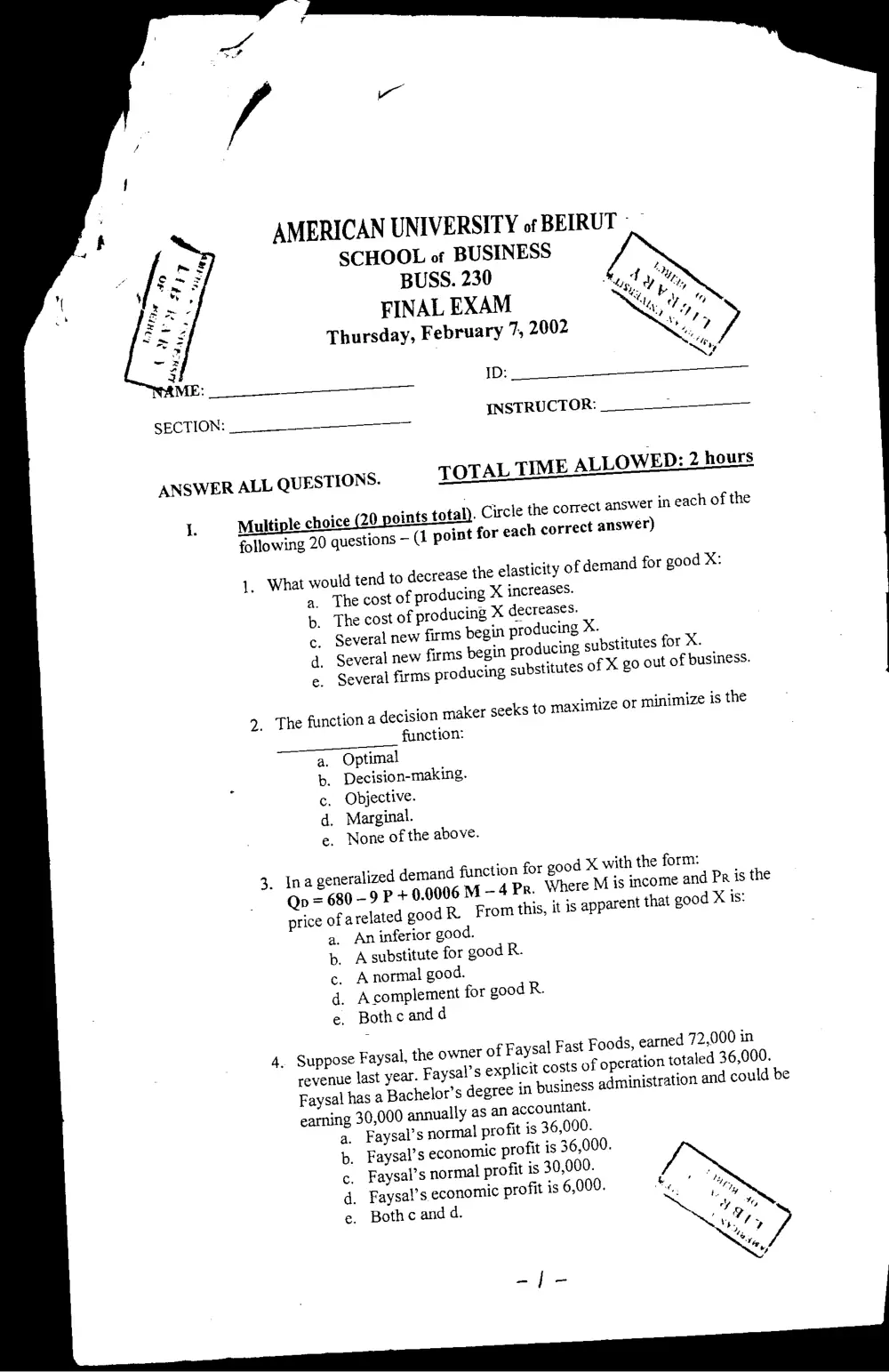
AMERICAN UNIVERSITY of BEIRUT
SCHOOL of BUSINESS
BUSS. 230
FINAL EXAM
Thursday, February 7, 2002
ID:
INSTRUCTOR: :
ANSWER ALL QUESTIONS. TOTAL TIME ALLOWED: 2 hours
ints total). Circle the correct answer in each of the
1 Multiple choice (20 po
(1 point for each correct answer)
following 20 questions —
1, What would tend to decrease the elasticity of deman
a. The cost of producing X increases.
b. The cost of producing X decreases.
c. Several new firms begin producing X.
d. Several new firms begin producin:
e. Several firms producing substitutes 0
d for good X:
2. The function a decisio
function:
a. Optimal
b. Decision-making.
c. Objective.
d. Marginal.
e. None of the above.
ood X with the form:
P+ 0.0006 M —4 Pr. Where M is income and Pr is the
3. Ina generaliz
From this, it is apparent that good X is:
Qn = 680-9
price of arelated good R.
a. An inferior good.
b. A substitute for good R.
c. Anormal good.
4. Acomplement for good R.
e. Bothcandd
sal Fast Foods, earned 72,000 in
otaled 36,000.
ion and could be
4. Suppose Faysal, the owner of Fay
revenue last year. Faysal’s explicit costs of operation t
Faysal has a Bachelor’s degree in business administrat
earning 30,000 annually as an accountant.
a. Faysal’s normal profit is 36,000.
b. Faysal’s economic profit is 36,000.
c. Faysal’s normal profit is 30,000.
d. Faysal’s economic profit is 6,000.
e. Bothc and d.
-|-
@ Problems
ia.
eaos
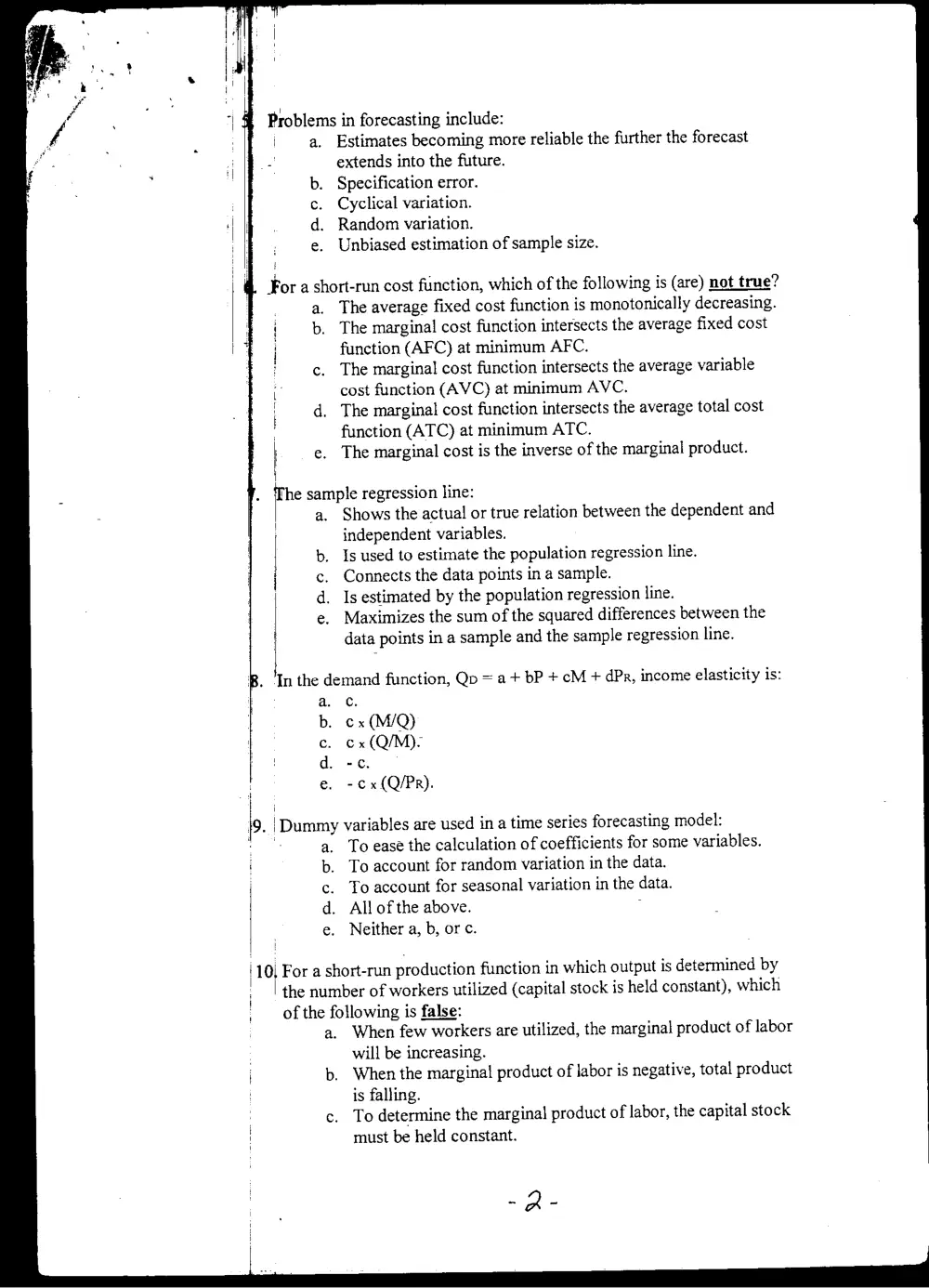
in forecasting include:
Estimates becoming more reliable the further the forecast
extends into the future.
Specification error.
Cyclical variation.
Random variation.
Unbiased estimation of sample size.
For a short-run cost function, which of the following is (are) not true?
a.
b.
H
c.
d.
€.
a.
ene gs
eae oe
9. ' Dummy
4
ge BosP
The average fixed cost function is monotonically decreasing.
The marginal cost function intersects the average fixed cost
function (AFC) at minimum AFC.
The marginal cost function intersects the average variable
cost function (AVC) at minimum AVC.
The marginal cost function intersects the average total cost
function (ATC) at minimum ATC.
The marginal cost is the inverse of the marginal product.
|
¥. ‘The sample regression line:
Shows the actual or true relation between the dependent and
independent variables.
Is used to estimate the population regression line.
Connects the data points in a sample.
Is estimated by the population regression line.
Maximizes the sum of the squared differences between the
data points in a sample and the sample regression line.
B. ‘In the demand function, Qo = at bP + cM + dP, income elasticity is:
c.
Cx (M/Q)
c x (Q/M)-
-~C.
- ¢ x (Q/PR).
variables are used in a time series forecasting model:
To ease the calculation of coefficients for some variables.
To account for random variation in the data.
To account for seasonal variation in the data.
All of the above. .
Neither a, b, or c.
110) For a short-run production function in which output is determined by
a.
the number of workers utilized (capital stock is held constant), which
of the following is false:
When few workers are utilized, the marginal product of labor
will be increasing.
When the marginal product of labor is negative, total product
is falling.
To determine the marginal product of labor, the capital stock
must be held constant.
-2Q-
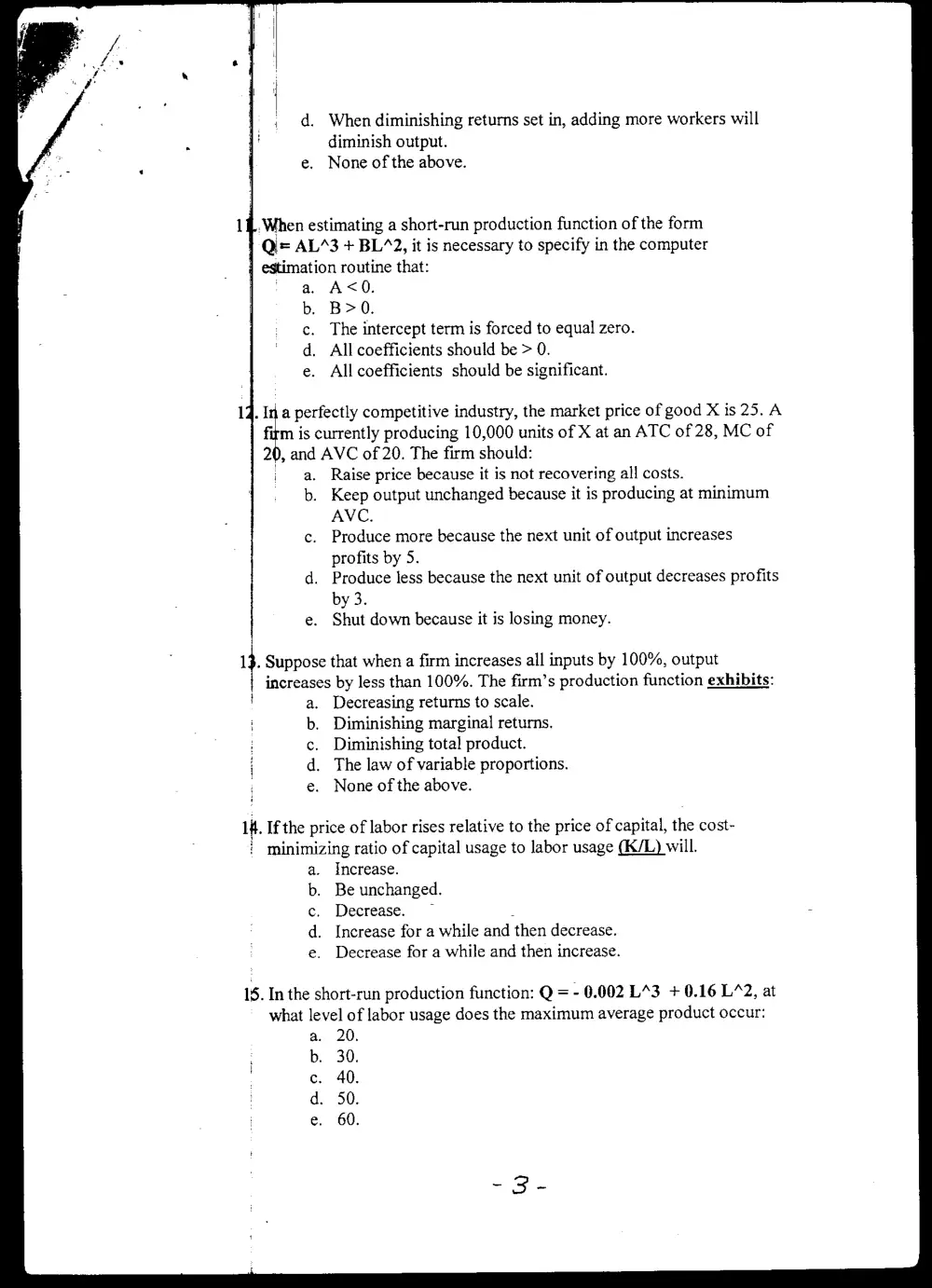
d. When diminishing returns set in, adding more workers will
diminish output.
e. None of the above.
1, When estimating a short-run production function of the form
Q= AL‘3 + BL“2, it is necessary to specify in the computer
‘ estimation routine that:
A<0.
B>0.
. The intercept term is forced to equal zero.
. All coefficients should be > 0.
All coefficients should be significant.
firm is currently producing 10,000 units of X at an ATC of 28, MC of
20, and AVC of 20. The firm should:
i . Raise price because it is not recovering all costs.
. Keep output unchanged because it is producing at minimum
AVC.
Produce more because the next unit of output increases
profits by 5.
. Produce less because the next unit of output decreases profits
by 3.
Shut down because it is losing money.
. fr perfectly competitive industry, the market price of good X is 25. A
i Suppose that when a firm increases all inputs by 100%, output
increases by less than 100%. The firm’s production function exhibits:
Decreasing returns to scale.
i . Diminishing marginal returns.
i . Diminishing total product.
. The law of variable proportions.
None of the above.
3
H
14. If the price of labor rises relative to the price of capital, the cost-
! minimizing ratio of capital usage to labor usage (K/L) will.
Increase.
Be unchanged.
Decrease.
. Increase for a while and ‘then decrease.
Decrease for a while and then increase.
15. In the short-run production function: Q = - 0.002 L*3 + 0.16 L“2, at
what level of labor usage does the maximum average product occur:
20.
. 30.
40.
. 50.
60.
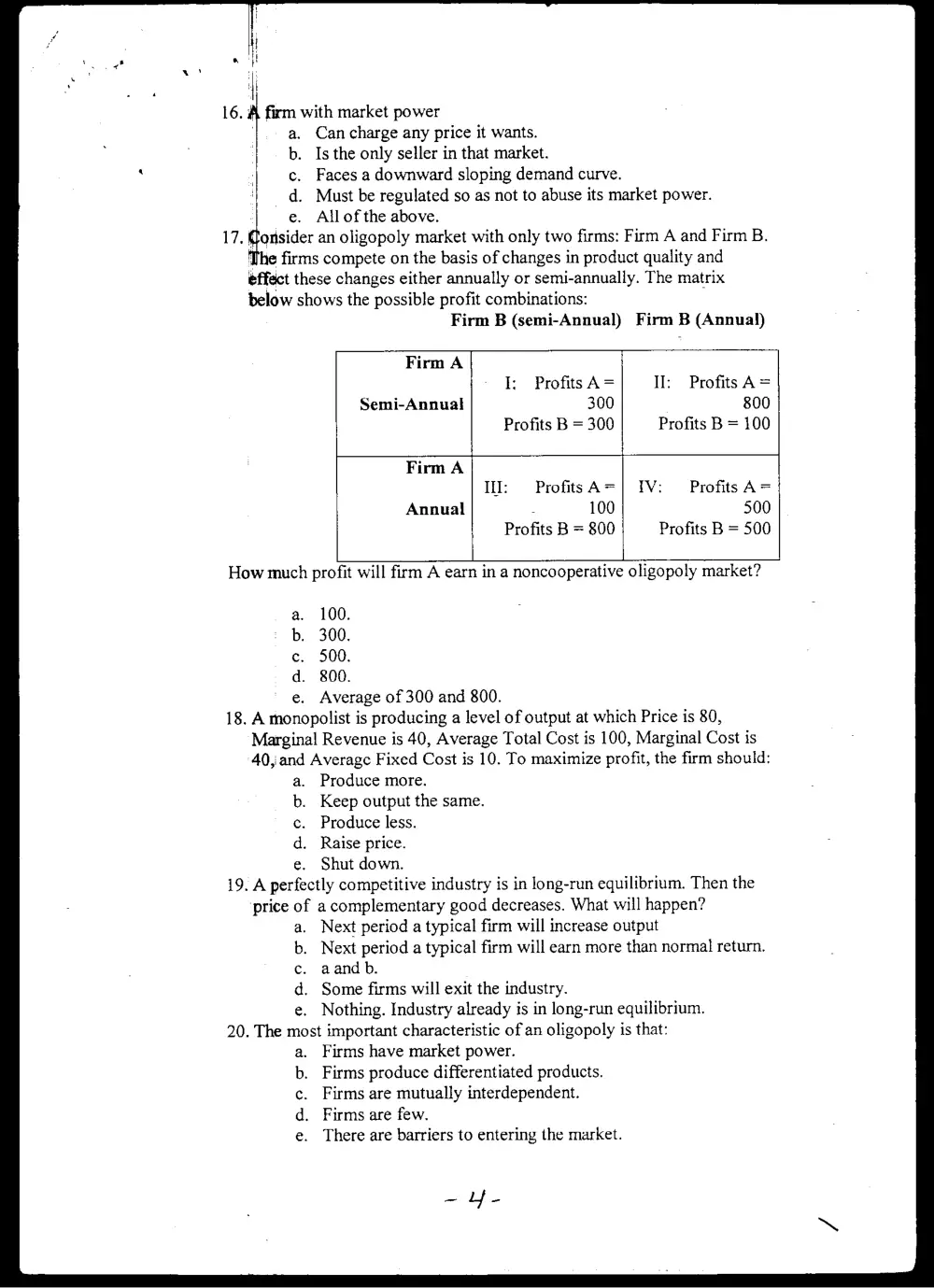
. A firm with market power
; a. Can charge any price it wants.
b. Is the only seller in that market.
c. Faces a downward sloping demand curve.
1 d. Must be regulated so as not to abuse its market power.
e. Allofthe above.
‘onsider an oligopoly market with only two firms: Firm A and Firm B.
‘The firms compete on the basis of changes in product quality and
effect these changes either annually or semi-annually. The matrix
below shows the possible profit combinations:
Firm B (semi-Annual) Firm B (Annual)
Firm A
I: Profits A= II: Profits A=
Semi-Annual 300 800
Profits B = 300 Profits B = 100
Firm A
Ill: Profits A= | IV: Profits A=
Annual - 100 500
Profits B = 800 Profits B = 500
How much profit will firm A earn in a noncooperative oligopoly market?
100.
300.
500.
. 800.
e. Average of 300 and 800.
18. A monopolist is producing a level of output at which Price is 80,
Marginal Revenue is 40, Average Total Cost is 100, Marginal Cost is
40,iand Average Fixed Cost is 10. To maximize profit, the firm should:
a. Produce more.
b. Keep output the same.
c. Produce less.
d. Raise price.
e. Shut down.
19. A perfectly competitive industry is in long-run equilibrium. Then the
price of a complementary good decreases. What will happen?
a. Next period a typical firm will increase output
b. Next period a typical firm will earn more than normal return.
c. aandb.
d. Some firms will exit the industry.
e. Nothing. Industry already is in long-run equilibrium.
20. The most important characteristic of an oligopoly is that:
. Firms have market power.
. Firms produce differentiated products.
. Firms are mutually interdependent.
. Firms are few.
There are barriers to entering the market.
~L-
1
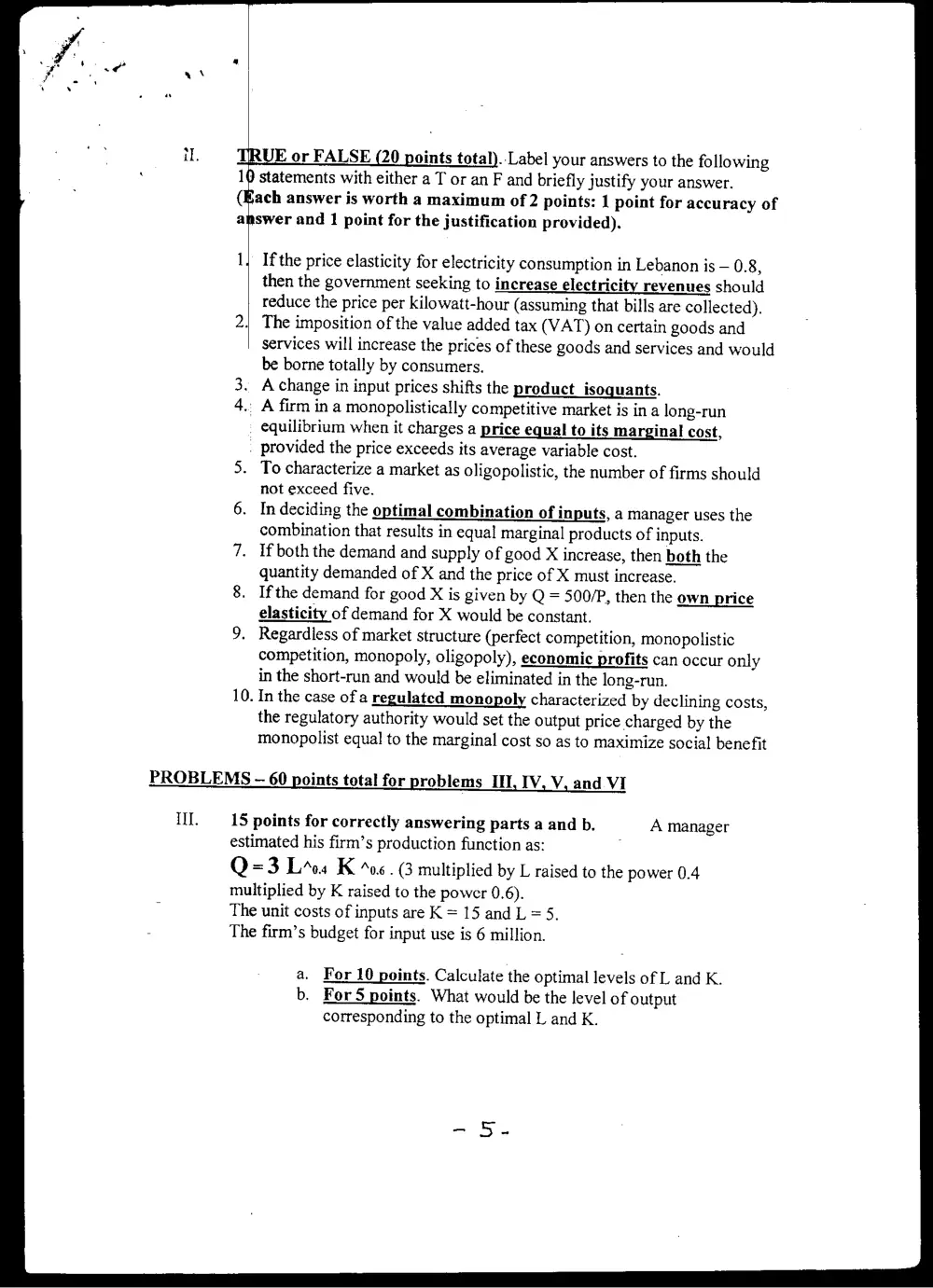
statements with either a T or an F and briefly justify your answer.
ach answer is worth a maximum of 2 points: 1 point for accuracy of
UE or FALSE (20 points total).-Label your answers to the following
i
(
answer and 1 point for the justification provided).
Ifthe price elasticity for electricity consumption in Lebanon is — 0.8,
then the government seeking to increase electricity revenues should
reduce the price per kilowatt-hour (assuming that bills are collected),
The imposition of the value added tax (VAT) on certain goods and
services will increase the prices of these goods and services and would
be borne totally by consumers.
. Achange in input prices shifts the product _isoquants.
. A firm in a monopolistically competitive market is in a long-run
equilibrium when it charges a price equal to its marginal cost,
. provided the price exceeds its average variable cost.
. To characterize a market as oligopolistic, the number of firms should
not exceed five.
. In deciding the optimal combination of inputs, a manager uses the
combination that results in equal marginal products of inputs.
. Ifboth the demand and supply of good X increase, then both the
quantity demanded of X and the price of X must increase.
. Ifthe demand for good X is given by Q = 500/P, then the own price
elasticity of demand for X would be constant.
. Regardless of market structure (perfect competition, monopolistic
competition, monopoly, oligopoly), economic profits can occur only
in the short-run and would be eliminated in the long-run.
. In the case of a regulated monopoly characterized by declining costs,
the regulatory authority would set the output price charged by the
monopolist equal to the marginal cost so as to maximize social benefit
PROBLEMS -— 60 points total for problems TH, IV, V, and VI
HI.
15 points for correctly answering parts a and b. A manager
estimated his firm’s production function as: ,
Q=3 Los K “06. (3 multiplied by L raised to the power 0.4
multiplied by K raised to the power 0.6).
The unit costs of inputs are K = 15 and L = 5,
The firm’s budget for input use is 6 million.
a. For 10 points. Calculate the optimal levels of L and K.
b. For 5 points. What would be the level of output
corresponding to the optimal L and K.
15 points for correctly answering parts a, b, and c. Basic Metals, Inc.,
manufactures copper wires used in electronic products. It has estimated
the demand and cost schedules it faces as follows:
Price Quantity Variable cost
(S/Kg.) _(Kg./period) _ (S/Kg.)
25 0
18 1,000
16 2,000
14 3,000
12 4,000
10 5,000
8 6,000
6 7,000
4 8,000
2 9,000
Fixed costs are estimated at $14,000 per period.
a. For 5 points. Determine the Marginal revenue and marginal cost
schedules of Basic Metals, Inc.
b. For 5 points. Determine the profit-maximizing output and Price.
' Calculate the resulting total profits.
. For5 points. Suppose the government decides to sell copper (from its
extensive stockpile) to anyone who desires it at $6/Kg. How does this
affect Basic Metals’ profit-maximizing output, price and profits?
V. 15 points for correctly answering parts a, b, and c. Best Product, Inc.,
is a monopolist. It estimates the demand function for its product as:
Q=60-04P+6M4+2A
Where Q = quantity of units sold; P = price per.unit; M = per
capita disposable income (in thousands); and A = advertising
expenditures (in hundreds).
Best Product’s average variable cost function is:
AVC = Q’2-10Q + 60
~6-