
BUSS 230 Final, Spring 2008
American University of Beirut · Managerial Economics · 2 pages

More BUSS 230 files
Show the text of this final exam
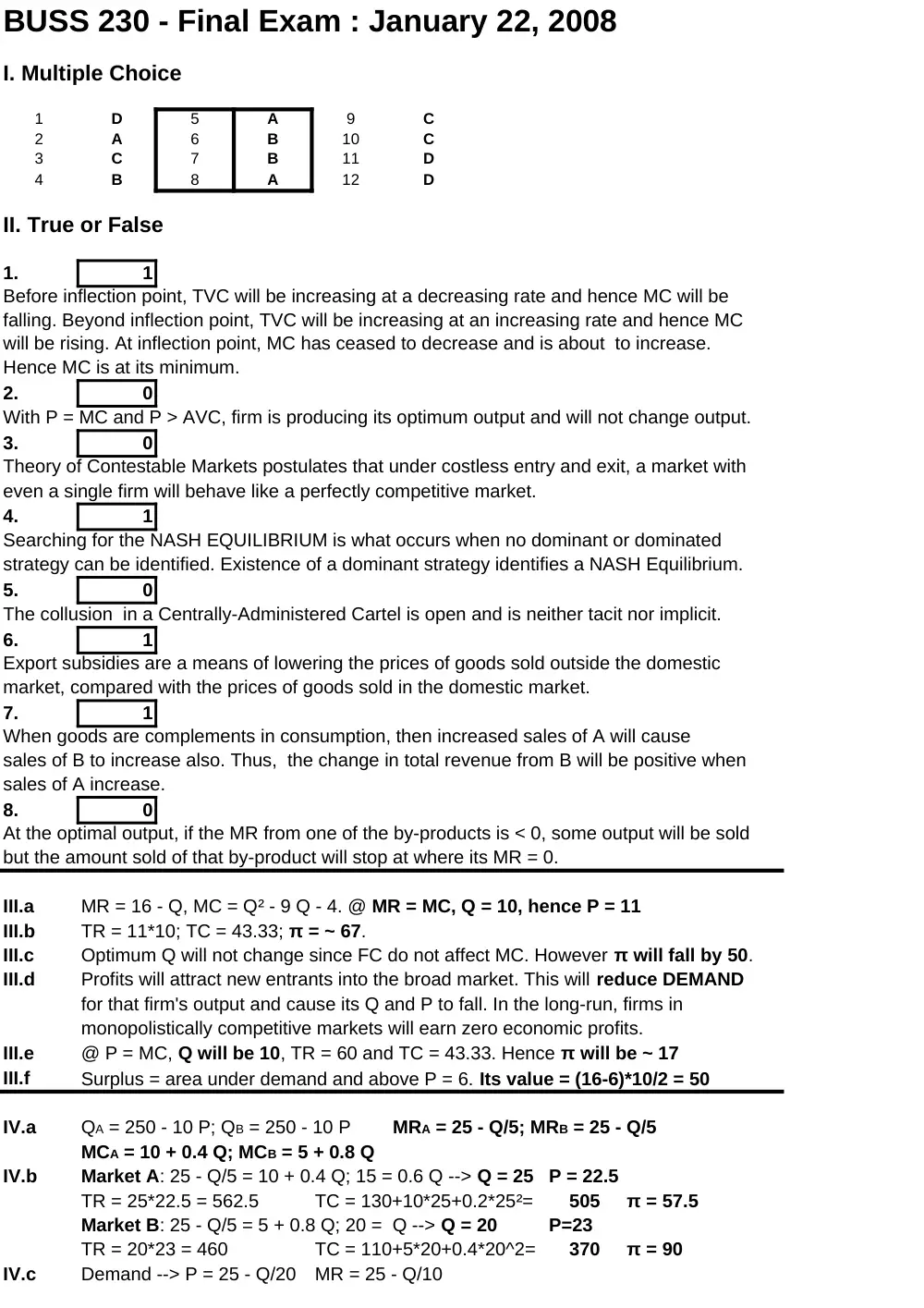
BUSS 230 - Final Exam : January 22, 2008
I. Multiple Choice
1
D
5
A
9
C
2
A
6
B
10
C
3
C
7
B
11
D
4
B
8
A
12
D
II. True or False
1.
1
Before inflection point, TVC will be increasing at a decreasing rate and hence MC will be
falling. Beyond inflection point, TVC will be increasing at an increasing rate and hence MC
will be rising. At inflection point, MC has ceased to decrease and is about to increase.
Hence MC is at its minimum.
2.
0
With P = MC and P > AVC, firm is producing its optimum output and will not change output.
3.
0
Theory of Contestable Markets postulates that under costless entry and exit, a market with
even a single firm will behave like a perfectly competitive market.
4.
1
Searching for the NASH EQUILIBRIUM is what occurs when no dominant or dominated
strategy can be identified. Existence of a dominant strategy identifies a NASH Equilibrium.
5.
0
The collusion in a Centrally-Administered Cartel is open and is neither tacit nor implicit.
6.
1
Export subsidies are a means of lowering the prices of goods sold outside the domestic
market, compared with the prices of goods sold in the domestic market.
7.
1
When goods are complements in consumption, then increased sales of A will cause
sales of B to increase also. Thus, the change in total revenue from B will be positive when
sales of A increase.
8.
0
At the optimal output, if the MR from one of the by-products is < 0, some output will be sold
but the amount sold of that by-product will stop at where its MR = 0.
III.a
III.b
III.c
III.d
for that firm's output and cause its Q and P to fall. In the long-run, firms in
monopolistically competitive markets will earn zero economic profits.
III.e
III.f
IV.a
IV.b
P = 22.5
TR = 25*22.5 = 562.5
505
π = 57.5
P=23
TR = 20*23 = 460
TC = 110+5*20+0.4*20^2=
370
π = 90
IV.c
Demand --> P = 25 - Q/20
MR = 25 - Q/10
MR = 16 - Q, MC = Q² - 9 Q - 4. @ MR = MC, Q = 10, hence P = 11
TR = 11*10; TC = 43.33; π = ~ 67.
Optimum Q will not change since FC do not affect MC. However π will fall by 50.
Profits will attract new entrants into the broad market. This will reduce DEMAND
@ P = MC, Q will be 10, TR = 60 and TC = 43.33. Hence π will be ~ 17
Surplus = area under demand and above P = 6. Its value = (16-6)*10/2 = 50
QA = 250 - 10 P; QB = 250 - 10 P
MRA = 25 - Q/5; MRB = 25 - Q/5
MCA = 10 + 0.4 Q; MCB = 5 + 0.8 Q
Market A: 25 - Q/5 = 10 + 0.4 Q; 15 = 0.6 Q --> Q = 25
TC = 130+10*25+0.2*25²=
Market B: 25 - Q/5 = 5 + 0.8 Q; 20 = Q --> Q = 20
Q =
45.4545
V.a
V.b
Firm 1 will adopt its dominant startegy while Firm 2 will select the strategy that will
result in the higher payoff corresponding to Firm 1's expected strategy. Both firms
V.c
PAYOFFS
Firm 1
Firm2
Advertise
4
2
Firm 2
Advertise
Do not Advertise
7
-2
Firm1
Do not Advertise
Advertise
2
4
Firm 2
Do not Advertise
6
5
V.d
For Firm 1, the payoffs corresponding to advertising (4,7) dominate the payoffs for
not advertising (2,6). Firm 1 therefore has a dominant strategy of advertising and will
adopt it. Firm 2 cannot isentify a dominant strategy but knows that Firm1 will adopt
its dominant strategy of advertising and, thus, also adopts a strategy of advertising.
VI a.
Writing the inverse demand functions: Pb = 240 - Qb/10 and Pv = 200 - Qv/8.
Therefore MRb = 240 - Qb/5 and MRv = 200 - Qv/4.
Writing the inverse MR functions: Qb = 1200 - 5MRb and Qv = 800 - 4MRv.
The sum of the MRs therefore is: Q = 2000 - 9MR
MR = 2000/9 - Q/9. At Q=1325,
MR = 75
With MRb = 75, Qb = 1200 - 5 x 75 (from inverse MRb equation)
Qb = 825
With MRv = 75, Qv = 800 - 4X 75 (from inverse MRv equation)
Qv = 500
V b.
Setting the sum of MRs equal to MC: 2000/9 - Q/9 = 45 + 5Q/100
and (2000 - 9*45)/9 = 100 Q/900 + 45 Q/900
Profit maximizing Q is:
1100
At Q = 1100, MR = 100 = MRb = MRv
Qb = 700
Qv = 400
V c.
The respective prices are obtained from the respective demand functions.
Pb = 240 -700/10
Pb = 170
Pv = 200 - 400/8
Pv = 150
Vd.
Higher price is charged in market with less elastic demand.
∑MC = MCA + MCB --> (-25 + 2.5 MCA) + ( -6.25 + 1.25 MCB) = -31.25 + 3.75 MC
∑MC = 31.25/3.75 + Q/3.75. Optimum QT where: 31.25/3.75 + Q/3.75 = 25 - Q/10
Only Firm 1 has a dominant strategy, and that is to ADVERTISE
will adopt strategies of Advertising.