
BUSS 230 Final, Spring 2005
American University of Beirut · Managerial Economics · 6 pages

More BUSS 230 files
Show the text of this final exam
ir of. Kawar
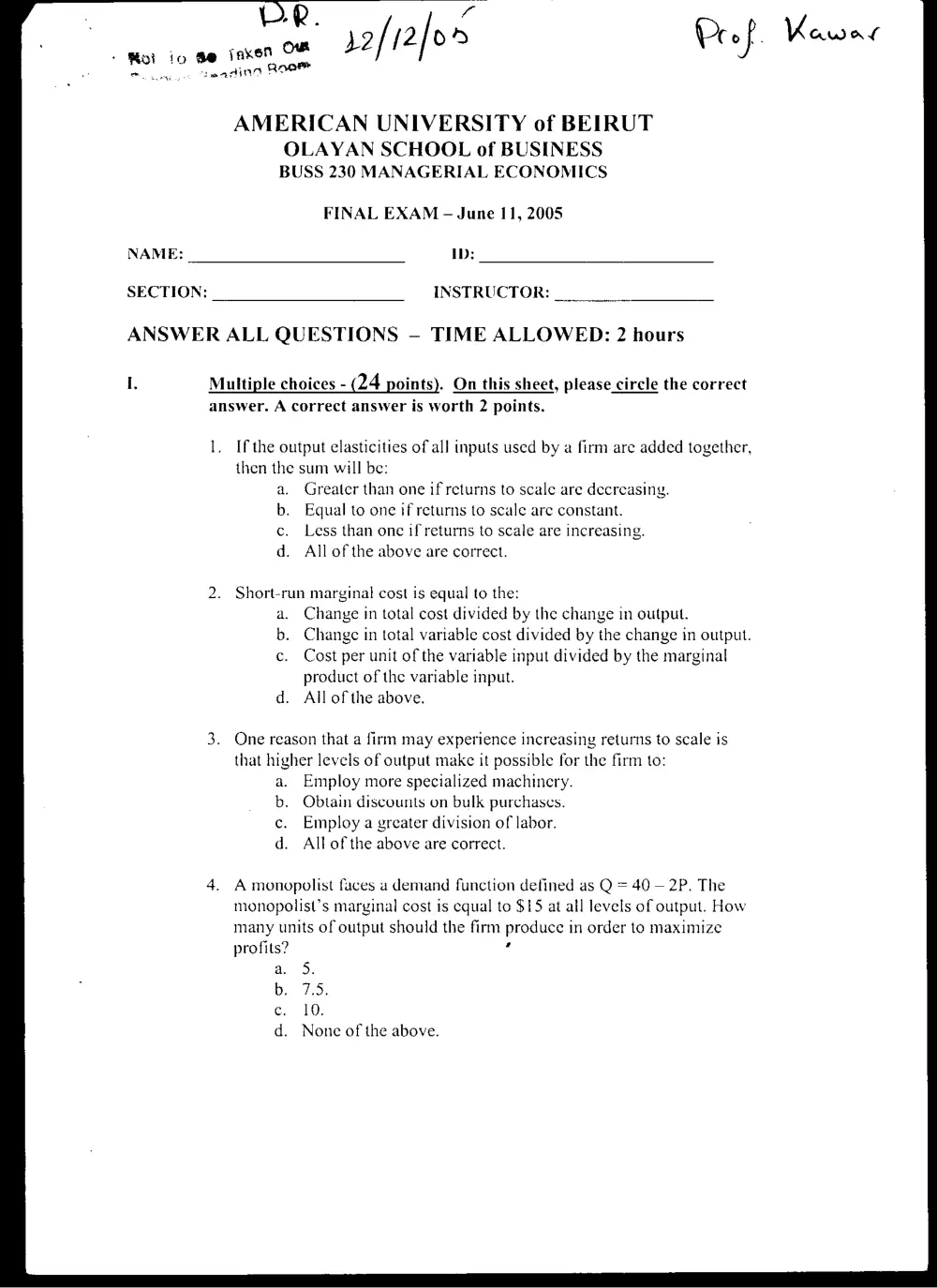
AMERICAN UNIVERSITY of BEIRUT
OLAYAN SCHOOL of BUSINESS
BUSS 230 MANAGERIAL ECONOMICS
FINAL EXAM - June 11, 2005
NAME: ID:
SECTION: INSTRUCTOR:
ANSWER ALL QUESTIONS — TIME ALLOWED: 2 hours
Multiple choices - (24 points). On this sheet, please circle the correct
answer. A correct answer is worth 2 points.
I. Ifthe output elasticities of all inputs used by a firm are added together,
then the sum will be:
a. Greater than one if returns to scale are decreasing.
b. Equal to one if returns to scale are constant.
c. Less than one if returns to scale are increasing.
d. All ofthe above are correct.
Short-run marginal cost is equal to the:
a. Change in total cost divided by the change in output.
b. Change in total variable cost divided by the change in output.
c. Cost per unit of the variable input divided by the marginal
product of the variable input.
d. Ail of the above.
One reason that a firm may experience increasing returns to scale is
that higher levels of output make it possible for the firm to:
a. Employ more specialized machinery.
b. Obtain discounts on bulk purchases.
c. Employ a greater division of labor.
d. All ofthe above are correct.
A monopolist faces a demand function defined as Q = 40 — 2P. The
monopolist’s marginal cost is equal to $15 at all levels of output. How
many units of output should the firm produce in order to maximize
profits? ’
a. 5.
b. 7.5.
c. 10.
d. None of the above.
An imperfectly competitive firm is producing a level of output at
which marginal cost is equal to marginal revenue while at the same
time marginal revenue is less than average variable cost, and price is
equal to average total cost. The firm should:
a. Shut down.
b. Continue to operate but decrease output.
c. Continue to operate but increase output.
d. None of the above is correct.
When a perfectly competitive industry is in long-run equilibrium, all
firms in the industry:
a. Earn zero economic profil.
b. Produce a level of output where short-run marginal cost is
equal to short-run average total cost.
Produce a level of output where long-run marginal cost is
equal to long-run average cost.
Experience all of the above.
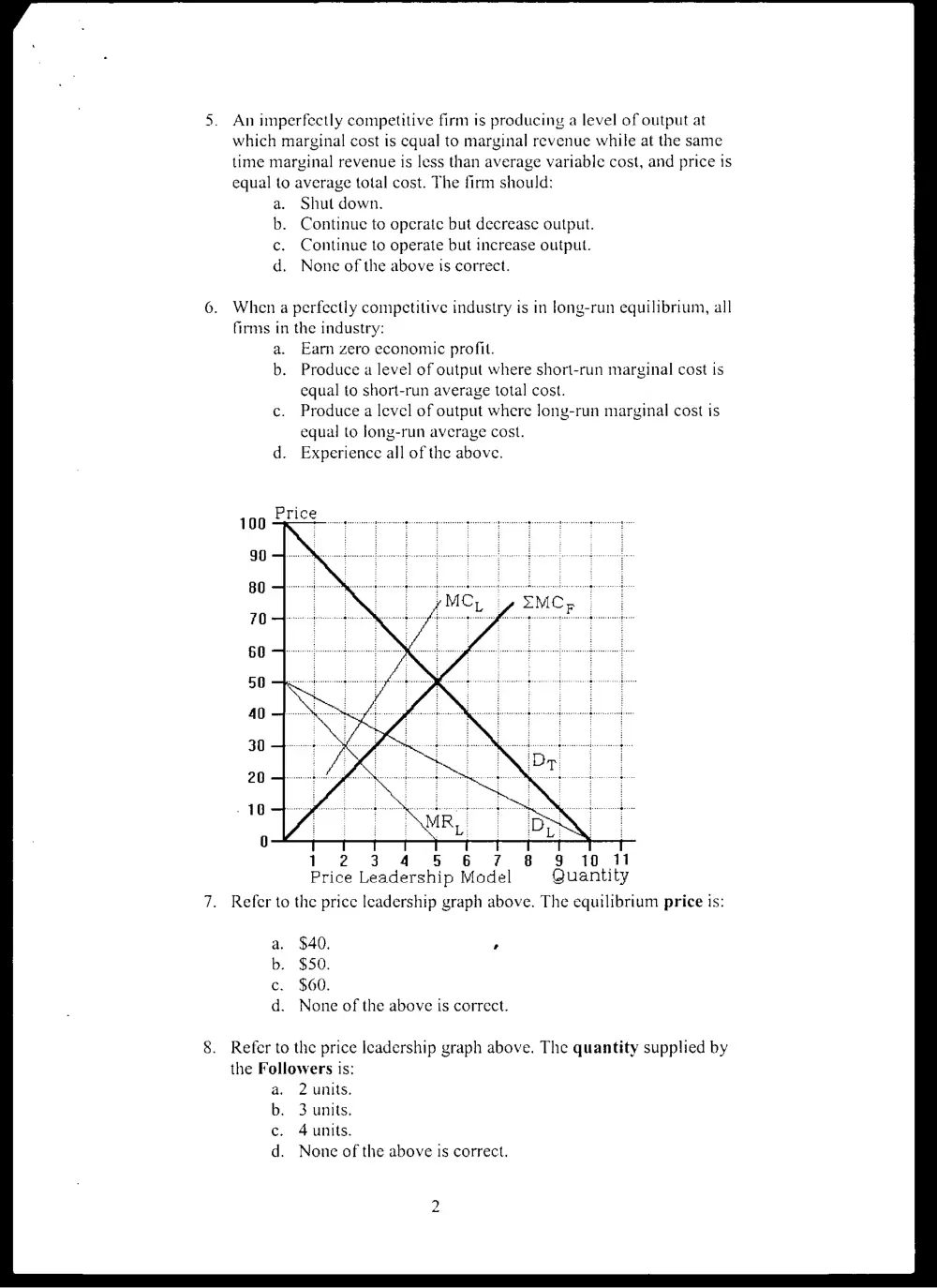
12 3 4 5 7 8 9 10 11
Price Leadership Model Quantity
7. Refer to the price leadership graph above. The equilibrium price is:
$40.
$50.
$60.
None of the above is correct.
8. Refer to the price Icadership graph above. The quantity supplied by
the Followers is:
a. 2 units.
b. 3 units.
c. 4 units.
d. None of the above is correct.
9. Oligopolistic firms can carn positive economic profits
a. In the short-run but not in the long run.
b. In the short-run and in the long run.
c. Inthe long run but not in the short-run.
d. Inneither the short-run or in the long run.
10. If the fully allocated cost of a product is $10, and the price elasticity of
demand for the product is —2, then the optimal markup would be:
a. 10%,
b. 50%.
c. 100%.
d. 200%.
_ A firm produces watches at a constant Marginal Cost of $10 and sells
them on two different markets (A and B). Demand in market A is Qa =
80 — 2P. Demand in market B is Qs = 50 — P. What price should be
charged for the watches in market B to optimize the firm’s profits?
a. $20.
b. $30.
c. $40.
d. $50.
Which of the following situations is not an example of price
discrimination?
a. Charging less for regular gasoline sold at a service station
than for premium gasoline.
b. Charging less for a child’s admission to an amusement park
than for an adult’s admission.
Charging more for making a long-distance telephone call
during the day than it does late at night.
Charging more for evening performance at the movies than
for afternoon performance.
’
The rest of the exam should be answered on your BLUE book.
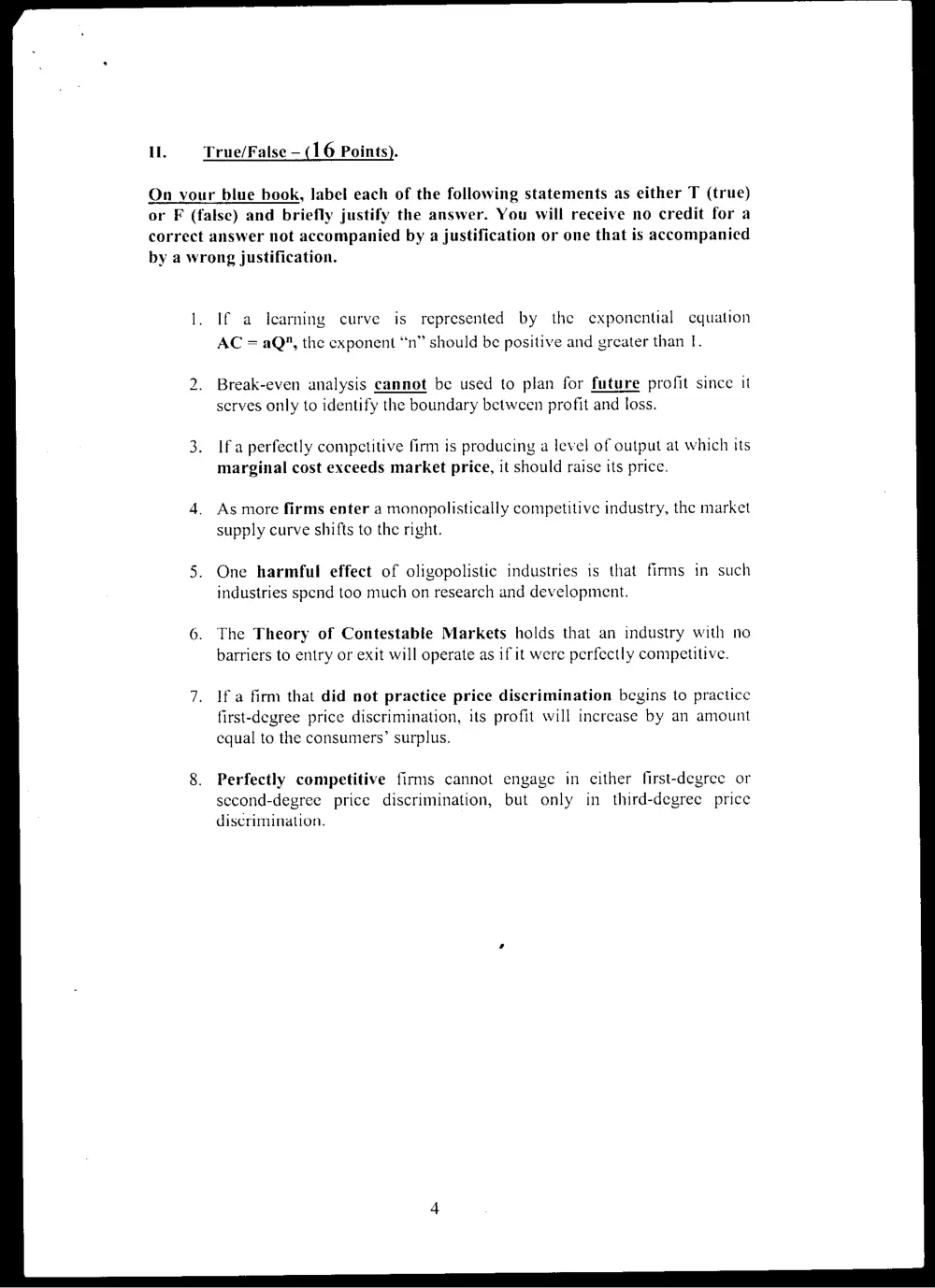
Il. True/False — (16 Points).
Qn _ your blue book, label each of the following statements as either T (true)
or F (false) and briefly justify the answer. You will receive no credit for a
correct answer not accompanied by a justification or one that is accompanied
by a wrong justification.
If a lcarmning curve is represented by the exponential equation
AC = aQ’*, the exponent “n” should be positive and greater than 1.
Break-even analysis cannot be used to plan for future profit since it
serves only to identify the boundary between profit and loss.
Ifa perfectly competitive firm is producing a level of output at which its
marginal cost exceeds market price, it should raise its price.
As more firms enter a monopolistically competitive industry, the market
supply curve shifts to the right.
One harmful effect of oligopolistic industries is that firms in such
industries spend too much on research and development.
The Theory of Contestabie Markets holds that an industry with no
barriers to entry or exit will operate as if it were perfectly competitive.
If a firm that did not practice price discrimination begins to practice
first-degree price discrimination, its profit will increase by an amount
equal to the consumers’ surplus.
Perfectly competitive firms cannot engage in cither first-degree or
second-degree price discrimination, but only in third-degree price
discrimination.
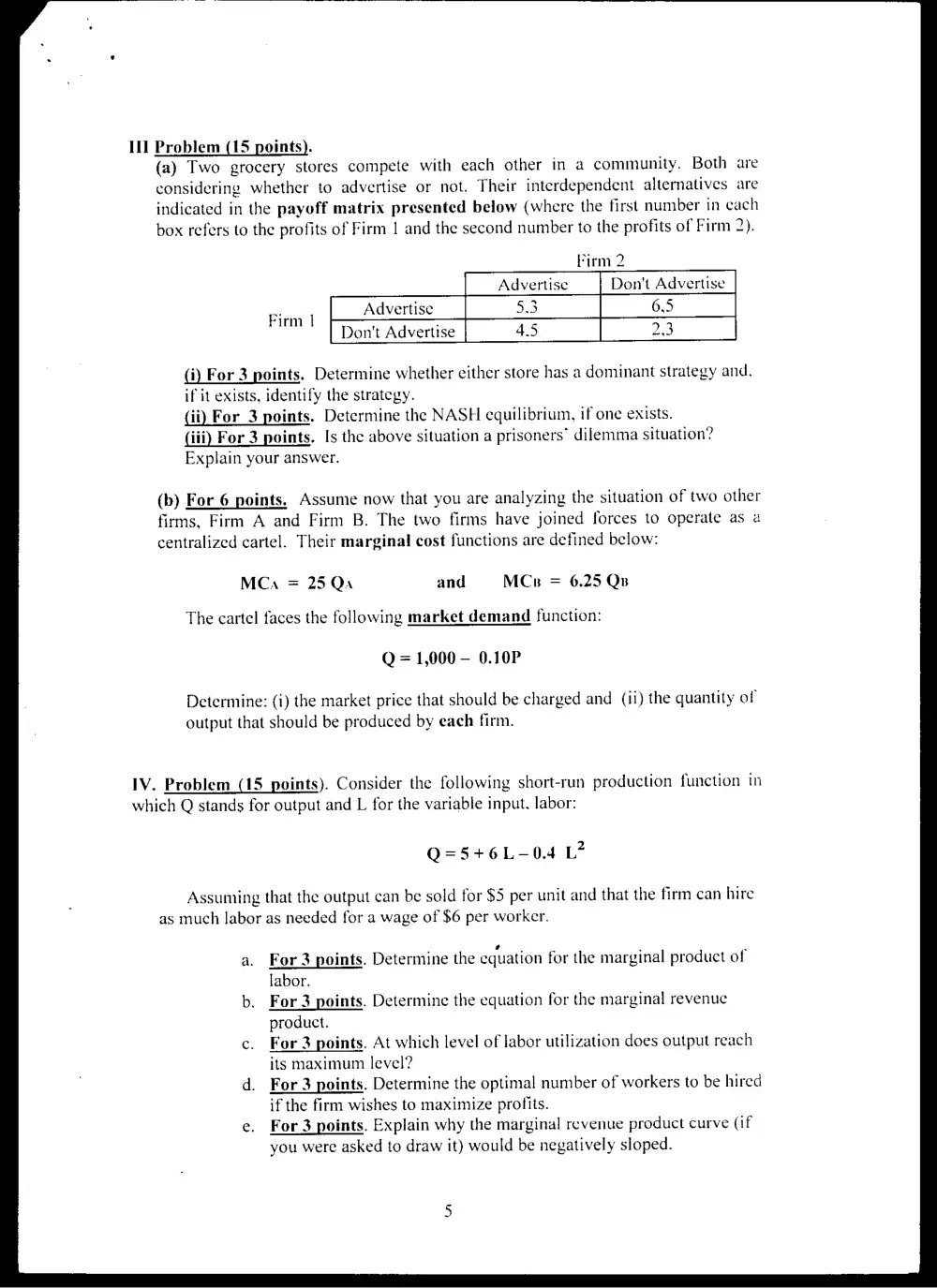
ILI Problem (15 points).
(a) Two grocery stores compete with each other in a community. Both are
considering whether to advertise or not. Their interdependent alternatives are
indicated in the payoff matrix presented below (where the first number in cach
box refers to the profits of Firm | and the second number to the profits of Firm 2).
Firm 2
Advertise Don't Advertise
Firm | Advertise 5.3 6.5
Don't Advertise 4.5 23
(i) For 3 points. Determine whether either store has a dominant strategy and.
if it exists, identify the strategy.
(ii) For 3 points. Determine the NASH equilibrium, if one exists.
(iii) For 3 points, Is the above situation a prisoners’ dilemma situation?
Explain your answer.
(b) For 6 points, Assume now that you are analyzing the situation of two other
firms, Firm A and Firm B. The two firms have joined forces to operate as a
centralized cartel. Their marginal cost functions are defined below:
MCa = 25Qa and MCs = 6.25 Qu
The cartel faces the following market demand function:
Q = 1,000 — 0.10P
Determine: (i) the market price that should be charged and (ii) the quantity of
output that should be produced by each firm.
IV. Problem (15 points). Consider the following short-run production function in
which Q stands for output and L for the variable input. labor:
Q=5+6L-04 L?
Assuming that the output can be sold for $5 per unit and that the firm can hire
as much labor as needed for a wage of $6 per worker.
a. For 3 points. Determine the equation for the marginal product of
labor.
b. For3 points. Determine the equation for the marginal revenue
product.
c. For3 points. At which level of labor utilization does output reach
its maximum level?
d. For 3 points. Determine the optimal number of workers to be hired
if the firm wishes to maximize profits.
e. For3 points. Explain why the marginal revenue product curve (if
you were asked to draw it) would be negatively sloped.
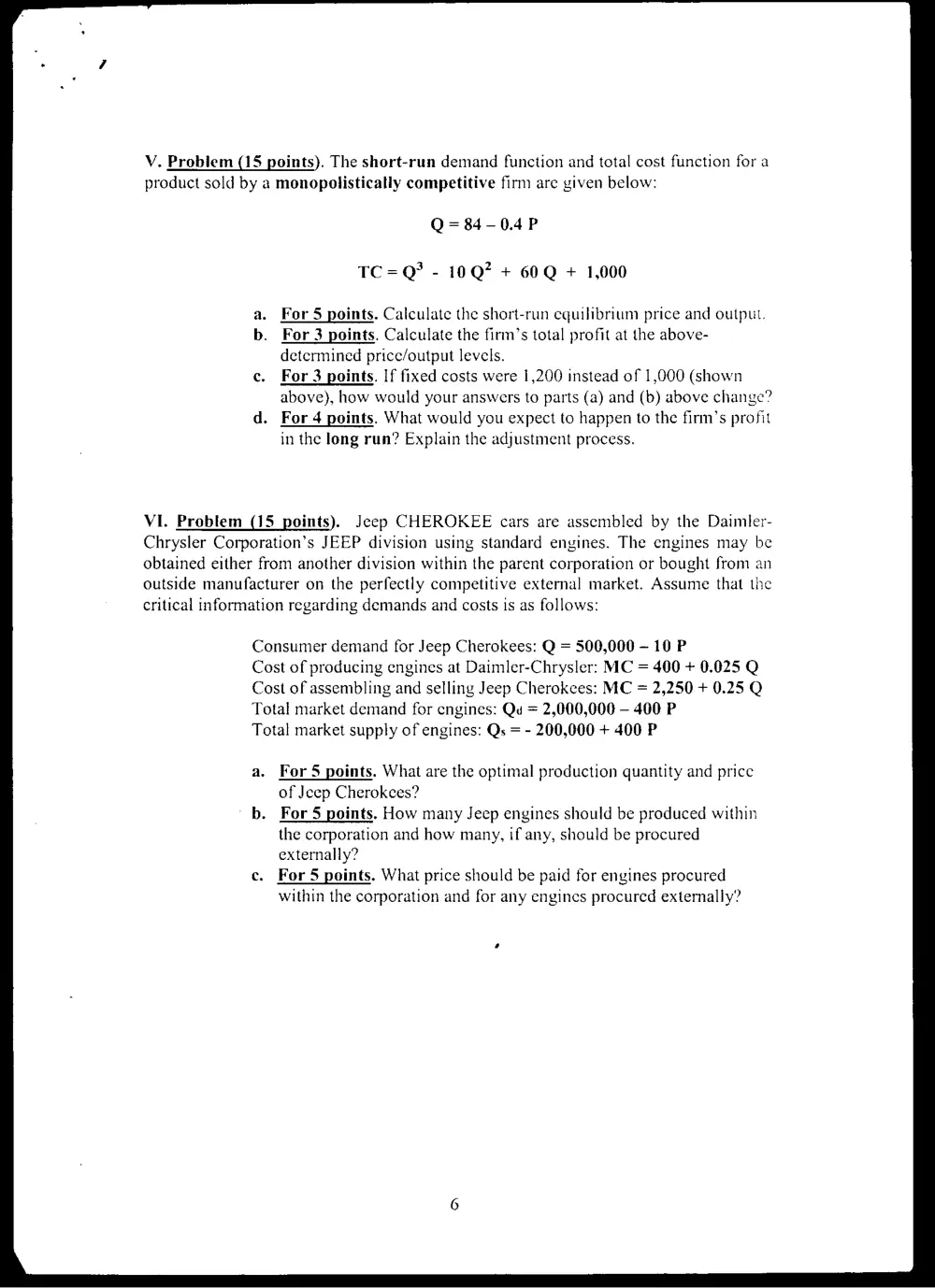
V. Problem (15 points). The short-run demand function and total cost function for a
product sold by a monopolisticatly competitive firm are given below:
Q=84-0.4P
TC=Q - 10Q? + 60Q + 1,000
a. For 5 points. Calculate the short-run equilibrium price and output.
b. For 3 points. Calculate the firm’s total profit at the above-
determined pricc/output levels.
c. For 3 points. If fixed costs were 1,200 instead of 1,000 (shown
above), how would your answers to parts (a) and (b) above change?
d. For 4 points. What would you expect to happen to the firm’s profit
in the long run? Explain the adjustment process.
VI. Problem (15 points). Jeep CHEROKEE cars are assembled by the Daimler-
Chrysler Corporation’s JEEP division using standard engines. The engines may be
obtained either from another division within the parent corporation or bought from an
outside manufacturer on the perfectly competitive external market. Assume that the
critical information regarding demands and costs is as follows:
Consumer demand for Jeep Cherokees: Q = 500,000 — 10 P
Cost of producing engines at Daimler-Chrysler: MC = 400 + 0.025 Q
Cost of assembling and selling Jeep Cherokees: MC = 2,250 + 0.25 Q
Total market demand for engines: Qu = 2,000,000 — 400 P
Total market supply of engines: Qs = - 200,000 + 400 P
a. For 5 points. What are the optimal production quantity and price
of Jeep Cherokces?
b. For 5 points. How many Jeep engines should be produced within
the corporation and how many, if any, should be procured
externally?
c. For 5 points. What price should be paid for engines procured
within the corporation and for any engines procured externally?