
BUSS 230 Final, Spring 2004
American University of Beirut · Managerial Economics · 6 pages


More BUSS 230 files
Show the text of this final exam
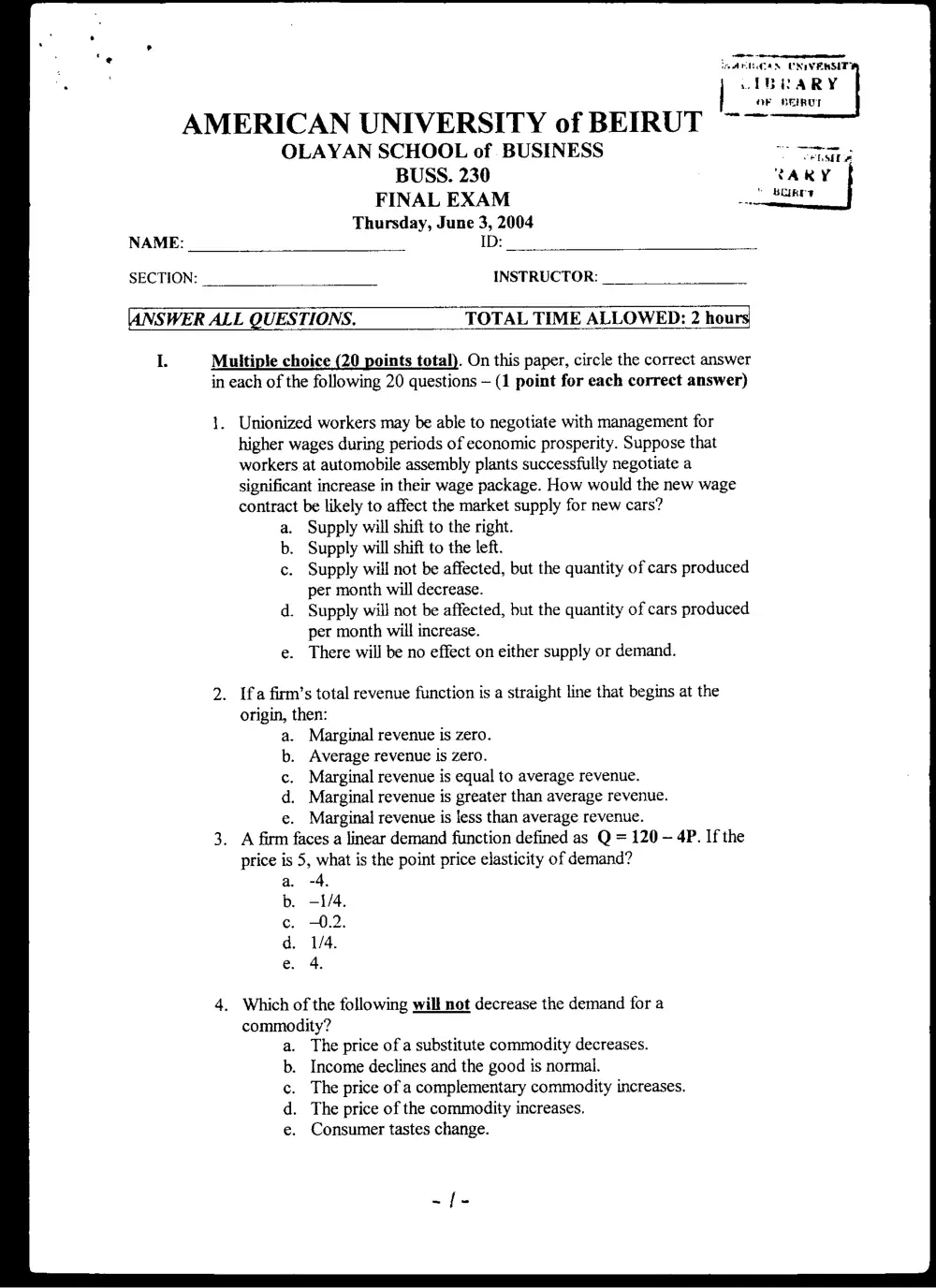
isAPICAN UNIVERSITY
| u-IBRARY
AMERICAN UNIVERSITY of BEIRUT ~~——
OLAYAN SCHOOL of BUSINESS ..
BUSS. 230
FINAL EXAM
Thursday, June 3, 2004
NAME: ID:
SECTION: INSTRUCTOR:
[4NSWER ALL QUESTIONS. TOTAL TIME ALLOWED: 2 hours
I. Multiple choice (20 points total). On this paper, circle the correct answer
in each of the following 20 questions — (1 point for each correct answer)
1. Unionized workers may be able to negotiate with management for
higher wages during periods of economic prosperity. Suppose that
workers at automobile assembly plants successfully negotiate a
significant increase in their wage package. How would the new wage
contract be likely to affect the market supply for new cars?
a. Supply will shift to the right.
b. Supply will shift to the left.
c. Supply will not be affected, but the quantity of cars produced
per month will decrease.
d. Supply will not be affected, but the quantity of cars produced
per month will increase.
e. There will be no effect on either supply or demand.
. Ifa firm’s total revenue function is a straight line that begins at the
origin, then:
a. Marginal revenue is zero.
b. Average revenue is zero.
c. Marginal revenue is equal to average revenue.
d. Marginal revenue is greater than average revenue.
e. Marginal revenue is less than average revenue.
. A firm faces a linear demand function defined as Q = 120 — 4P. Ifthe
price is 5, what is the point price elasticity of demand?
a. -4.
. —1/4.
0.2.
1/4.
b.
C.
d.
e. 4.
. Which of the following will net decrease the demand for a
commodity?
. The price of a substitute commodity decreases.
. Income declines and the good is normal.
. The price of a complementary commodity increases.
. The price of the commodity increases.
. Consumer tastes change.
~{-
5. Multiple regression analysis is used when:
a.
b.
c
There are not enough data to carry out simple linear
regression analysis.
The dependent variable depends on more than one
independent variable.
One or more of the assumptions of simple linear regression
are not correct.
. The relation between the dependent variable and the
independent variables cannot be described by a linear
function.
The regression has to be estimated in several tries.
6. The root-mean-square error is a measure of:
Sample dispersion.
Moving average variability.
Exponential smoothing reliability.
. Forecast accuracy.
Auto-correlation of the deviations.
7. The marginal product of labor is equal to:
a.
b.
Cc.
d.
e.
The additional labor required for producing one additional
unit of output.
The average product of labor when the average product is at a
The additional output produced by hiring one more unit of
labor.
The slope of a ray drawn from the origin to a point on the
total product curve.
All of the above are correct.
8. Ifthe output elasticities of all inputs used by a firm are summed.
together, then the total:
Will be greater than one if returns to scale are decreasing.
. Will be equal to one if returns to scale are constant.
Will be less than one if returns to scale are increasing.
. Will always exceed one in the long run.
Will always exceed one in the short run.
9. Learning curves represent the relationship between:
a
Average variable cost and the number of units produced per
time period.
. Average variable cost and the cumulative number of units
produced.
Total cost and the application of new technology.
. Average variable cost and the rate of increase in technology.
The speed at which labor can be trained on the job.
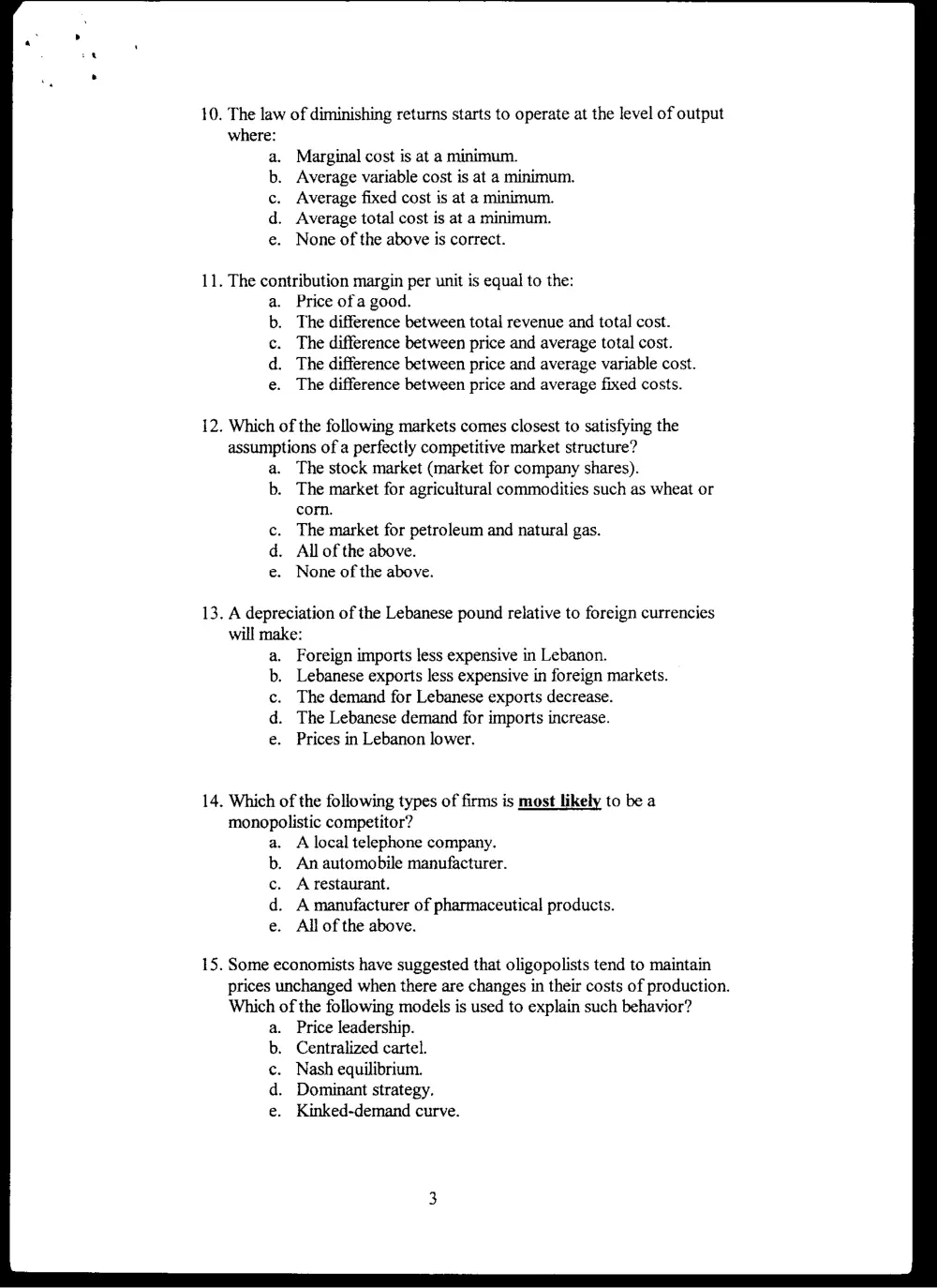
10. The law of diminishing returns starts to operate at the level of output
where:
. Marginal cost is at a minimum.
. Average variable cost is at a minimum.
Average fixed cost is at a minimum.
. Average total cost is at a minimum.
. None of the above is correct.
. The contribution margin per unit is equal to the:
Price of a good.
The difference between total revenue and total cost.
The difference between price and average total cost.
. The difference between price and average variable cost.
The difference between price and average fixed costs.
. Which of the following markets comes closest to satisfying the
assumptions of a perfectly competitive market structure?
a. The stock market (market for company shares).
b. The market for agricultural commodities such as wheat or
corn.
c. The market for petroleum and natural gas.
d. All of the above.
e. None of the above.
. A depreciation of the Lebanese pound relative to foreign currencies
will make:
Foreign imports less expensive in Lebanon.
Lebanese exports less expensive in foreign markets.
The demand for Lebanese exports decrease.
. The Lebanese demand for imports increase.
Prices in Lebanon lower.
. Which of the following types of firms is most likely to be a
monopolistic competitor?
A local telephone company.
. An automobile manufacturer.
A restaurant.
. A manufacturer of pharmaceutical products.
All of the above.
. Some economists have suggested that oligopolists tend to maintain
prices unchanged when there are changes in their costs of production.
Which of the following models is used to explain such behavior?
Price leadership.
. Centralized cartel.
. Nash equilibrium.
. Dominant strategy.
Kinked-demand curve.
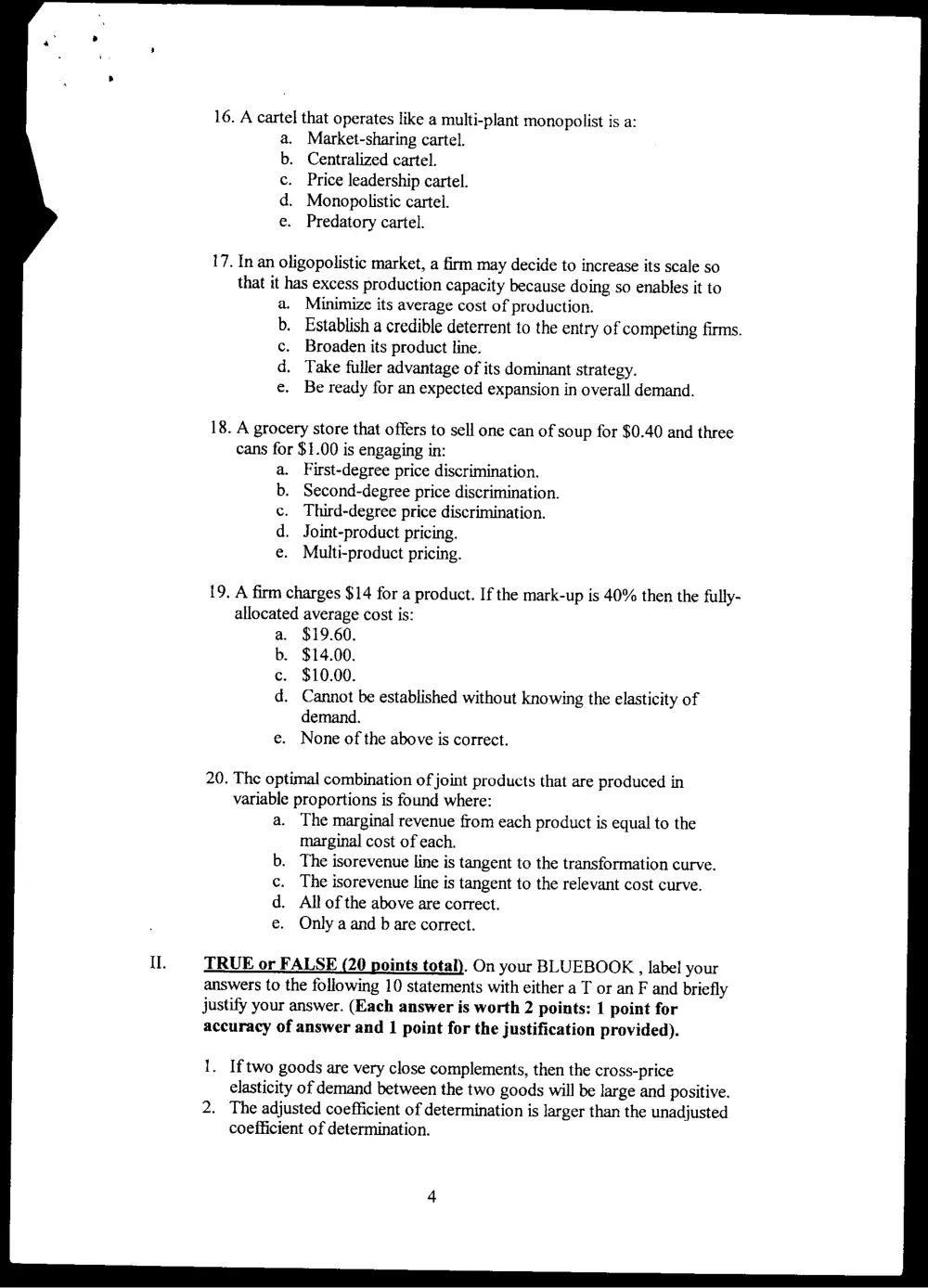
- A cartel that operates like a multi-plant monopolist is a:
. Market-sharing cartel.
. Centralized cartel.
. Price leadership cartel.
. Monopolistic cartel.
Predatory cartel.
. In an oligopolistic market, a firm may decide to increase its scale so
that it has excess production capacity because doing so enables it to
. Minimize its average cost of production.
. Establish a credible deterrent to the entry of competing firms.
. Broaden its product line.
. Take fuller advantage of its dominant strategy.
. Be ready for an expected expansion in overall demand.
. A grocery store that offers to sell one can of soup for $0.40 and three
cans for $1.00 is engaging in:
First-degree price discrimination.
Second-degree price discrimination.
. Third-degree price discrimination.
. Joint-product pricing.
Multi-product pricing.
. A firm charges $14 for a product. If the mark-up is 40% then the fully-
allocated average cost is:
$19.60.
. $14.00.
. $10.00.
. Cannot be established without knowing the elasticity of
demand.
e. None of the above is correct.
. The optimal combination of joint products that are produced in
variable proportions is found where:
a. The marginal revenue from each product is equal to the
marginal cost of each.
. The isorevenue line is tangent to the transformation curve.
. The isorevenue line is tangent to the relevant cost curve.
. All of the above are correct.
Only a and b are correct.
TRUE or FALSE (20 points total). On your BLUEBOOK , label your
answers to the following 10 statements with either a T or an F and briefly
justify your answer. (Each answer is worth 2 points: 1 point for
accuracy of answer and 1 point for the justification provided).
1. Iftwo goods are very close complements, then the cross-price
elasticity of demand between the two goods will be large and positive.
2. The adjusted coefficient of determination is larger than the unadjusted
coefficient of determination.
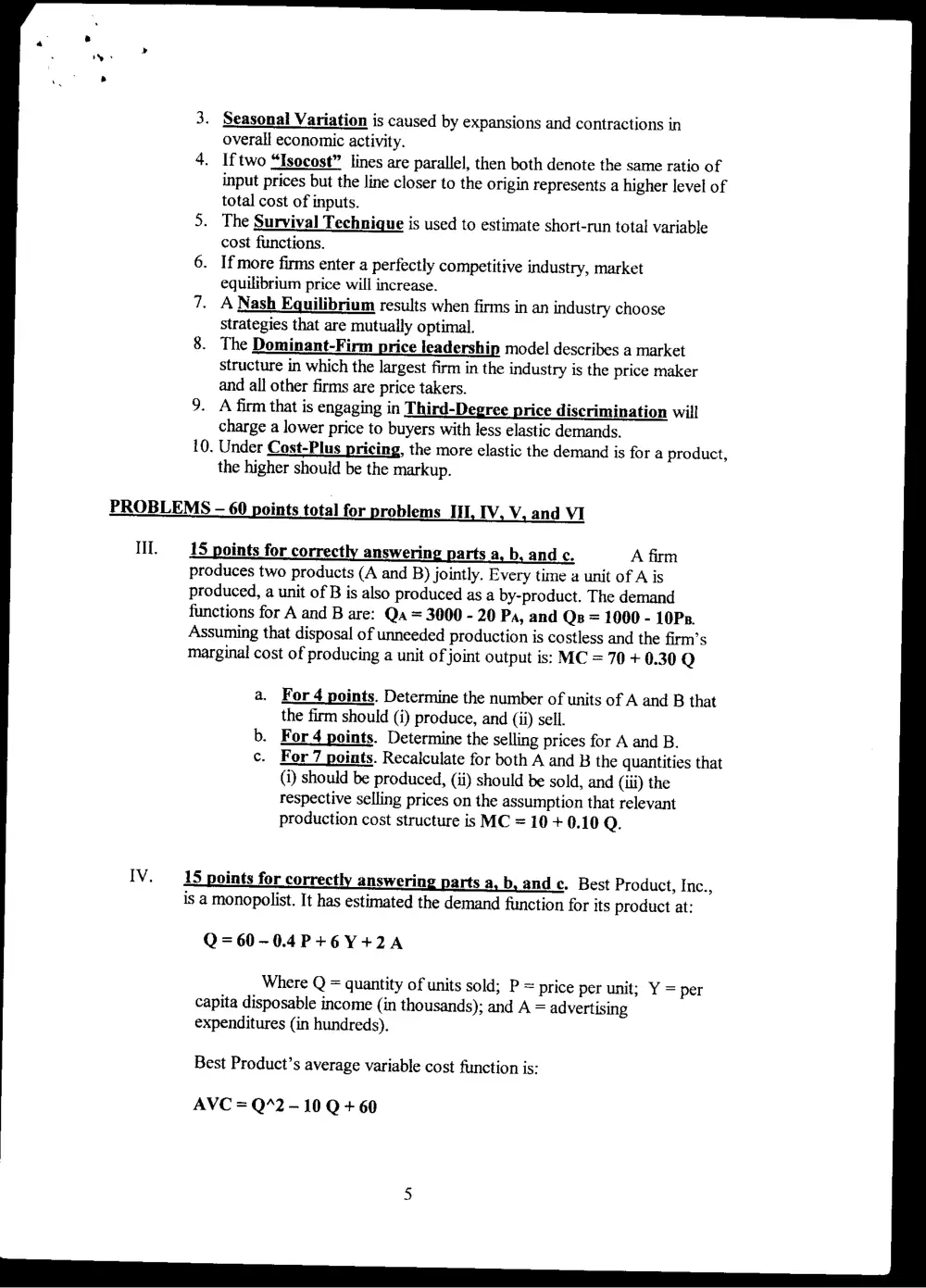
. Seasonal Variation is caused by expansions and contractions in
overall economic activity.
. Iftwo “Isocost” lines are parallel, then both denote the same ratio of
input prices but the line closer to the origin represents a higher level of
total cost of inputs.
. The Survival Technique is used to estimate short-run total variable
cost functions.
. Ifmore firms enter a perfectly competitive industry, market
equilibrium price will increase.
. A Nash Equilibrium results when firms in an industry choose
strategies that are mutually optimal.
- The Dominant-Firm price leadership model describes a market
structure in which the largest firm in the industry is the price maker
and all other firms are price takers.
9. A firm that is engaging in Third-Degree price discrimination will
charge a lower price to buyers with less elastic demands.
10. Under Cost-Plus pricing, the more elastic the demand is for a product,
the higher should be the markup.
PROBLEMS - 60 points total for problems THI, IV, V, and VI
Ill. 15 points for correctly answering parts a, b, and c. A firm
produces two products (A and B) jointly. Every time a unit of A is
produced, a unit of B is also produced as a by-product. The demand
functions for A and B are: Qa = 3000 - 20 Pa, and Qs = 1000 - 10Ps.
Assuming that disposal of unneeded production is costless and the firm’s
marginal cost of producing a unit of joint output is: MC = 70 + 0.30 Q
a. For 4 points. Determine the number of units of A and B that
the firm should (i) produce, and (ii) sell.
b. For 4 points. Determine the selling prices for A and B.
c. For 7 points. Recalculate for both A and B the quantities that
(i) should be produced, (ii) should be sold, and (iii) the
respective selling prices on the assumption that relevant
production cost structure is MC = 10 + 0.10 Q.
15 points for correctly answering parts a b, and c. Best Product, Inc.,
is a monopolist. It has estimated the demand function for its product at:
Q=60-0.4P+6Y+2A
Where Q = quantity of units sold; P = price per unit; Y = per
capita disposable income (in thousands); and A = advertising
expenditures (in hundreds).
Best Product’s average variable cost function is:
AVC = Q’2- 10 Q +60
Assuming Y = 3 (thousand) and A = 3 (hundred) for the period under
consideration and that Total Fixed Costs = 1000:
a. For6 points. Derive the Marginal Cost and Marginal Revenue
functions.
b. For 6 points. Calculate the profit-maximizing price and output levels
for Best Product. What would total profits be at the maximizing
price/output combination? ShumaGvURpTUEEEaE
c. For3 points. If Total Fixed Costs were 1200, what would be the
profit-maximizing price/output combination and what would total
profits be?
V. 15 points for correctly answering parts a, b, and c.
Mountainbrute Motorcycles, Inc., produces its very popular outdoor
motorcycle at two separate plants. The production cost structures of the
two are as follows: Plant A: TCa = 1,000 + 10 Qa + 0.005 Qa‘2,
and Plant B: TCs = 1,500 + 4 Qp+ 0.015Qn%2. Assuming that the
market demand for the motorcycles sold by the firm is given by :
Q = 4,000 — 125P:
a. For5 points. Determine the optimum output and prices for the
motorcycles produced by Mountainbrute Motorcycles.
b. For5 points. How many motorcycles should be produced at each
plant in order to maximize profits?
c. For 5 points. What would be the effect on profits if production was
equally divided between the plants?
VI. 15 points for correctly answering parts a, b, and c. Optima
Computers is organized along functional lines into a division that
manufactures computer chips, and a division that uses such chips to
assemble and sell PCs used in homes and businesses. Assuming that the
cost structures are as follows: TCchips = 500,000 + 15Qc+ 0.0005Qc“%2,
and TCassembly&Sales = 300,000 + 10Qaes. Assuming further that the
Assembly&Sales Division has the option of procuring the chips it needs on
the open market at a price of 50/chip, and the market demand for Optima’s
computers has been estimated at: Q = 100,000 «@1,000P:
a. For 5 points. Calculate Optima’s best output and price for the finished
product
b. For 5 points. Calculate the price for chips that the Assembly& Sales
Division should pay to the Chip Division.
c. For 5 points. Calculate the best output of the Chips Division and the
distribution of its sales within the firm and outside.