
BUSS 230 Final, Fall 2007
American University of Beirut · Managerial Economics · 7 pages



More BUSS 230 files
Show the text of this final exam
AMERICAN UNIVERSITY of BEIRUT
OLAYAN SCHOOL of BUSINESS
BUSS 230 – Managerial Economics- Fall Semester 2006/07
FINAL EXAM – January 18, 2007
NAME: __________________________ ID: ____________________________
SECTION: _______________________ INSTRUCTOR: ___________________
ANSWER ALL QUESTIONS – TIME ALLOWED: 2 hours
I.
Multiple choice - (
24
points)
. On this sheet, please circle the correct
answer. A correct answer is worth 2 points.
1.
Which of the following is not an assumption associated with the definition of a
production function?
A.
Technology remains constant
B.
Both inputs and outputs are measured in monetary units
C.
The function shows the maximum level of output possible with a given
combination of inputs
D.
All units of the inputs are homogeneous
2.
The combination of inputs is optimal
A.
at points of tangency between isoquants and isocosts.
B.
if the marginal revenue product is equal to the marginal resource cost
for all inputs.
C.
if the marginal rate of technical substitution between every pair of
inputs is equal to the ratio of the prices of those inputs.
D.
All of the above are correct.
3.
Short-run marginal cost is equal to
A.
the change in total cost divided by the change in output.
B.
the change in total variable cost divided by the change in output.
C.
the cost per unit of the variable input divided by the marginal product
of the variable input.
D.
all of the above.
Page 1 of 7
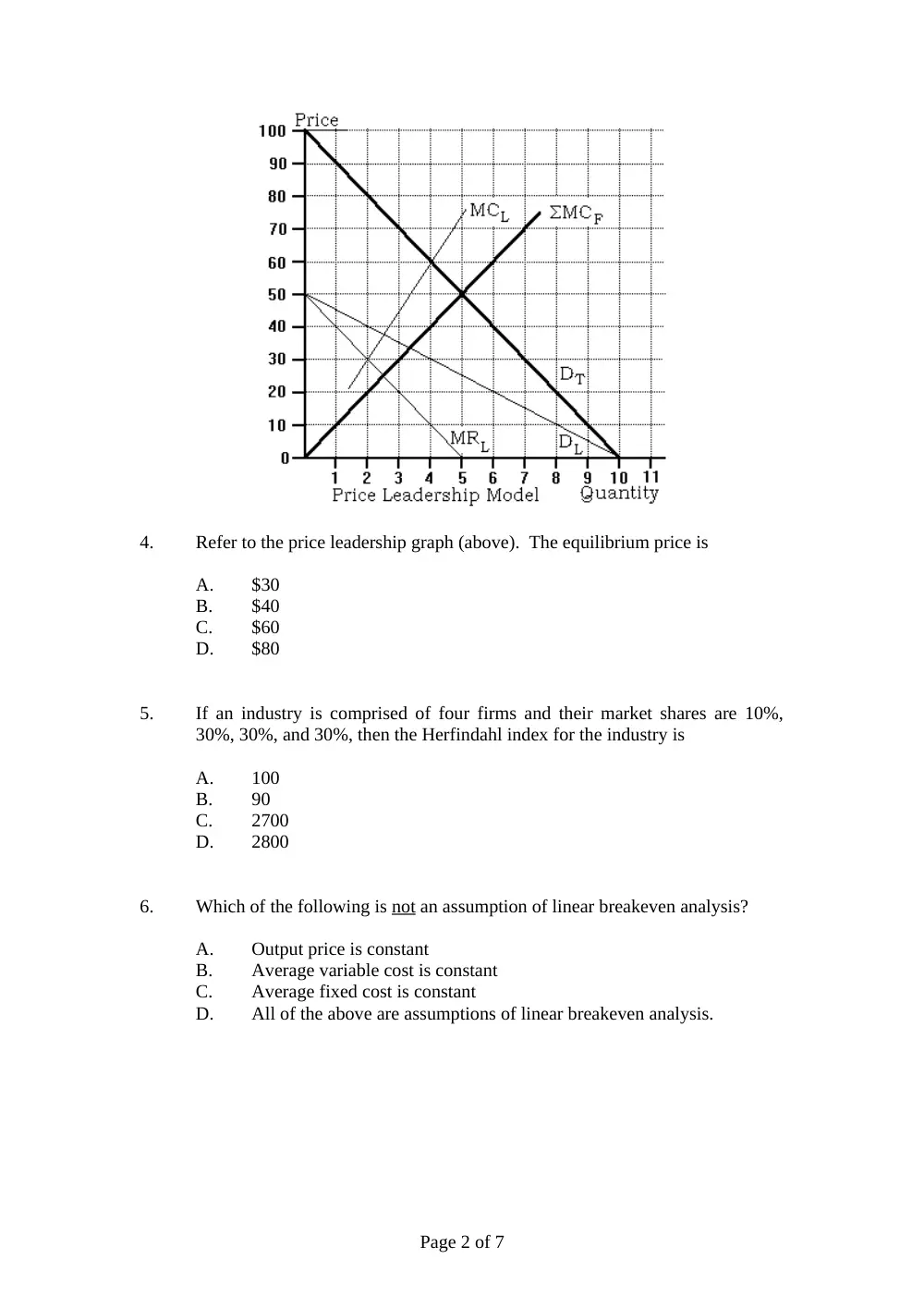
4.
Refer to the price leadership graph (above). The equilibrium price is
A.
$30
B.
$40
C.
$60
D.
$80
5.
If an industry is comprised of four firms and their market shares are 10%,
30%, 30%, and 30%, then the Herfindahl index for the industry is
A.
100
B.
90
C.
2700
D.
2800
6.
Which of the following is not an assumption of linear breakeven analysis?
A.
Output price is constant
B.
Average variable cost is constant
C.
Average fixed cost is constant
D.
All of the above are assumptions of linear breakeven analysis.
Page 2 of 7
7.
A perfectly competitive firm is selling 90 units of output per week at a price of
$10. Average total cost is $13, average variable cost is $9, and marginal cost is
$11. From this information, it is clear that the firm
A.
can increase its profit by producing more output per week.
B.
can increase its profit by producing less output per week.
C.
can increase its profit by charging a price above $10.
D.
None of the above is correct.
8.
A monopolist produces 18,000 units of output and charges $16 per unit. Its
marginal revenue is $10, its marginal cost is $9 and rising, its average total
cost is $12, and its average variable cost is $11. The monopolist should
A.
increase output, which will result in an increase in the firm's positive
economic profit.
B.
increase output, which will reduce the firm's economic losses.
C.
shut down, which will reduce the firm's economic losses.
D.
decrease output, which will result in an increase in the firm's positive
economic profit.
9.
In game theory, a dominant strategy refers to a choice
A.
that is the best response to the strategy selected by another player.
B.
that is the best response regardless of the strategy selected by another
player.
C.
that results in the player receiving a higher payoff than any other
players.
D.
All of the above are correct.
10.
In repeated games, a strategy that involves attacking players that attack you
and cooperating with players that cooperate with you is a
A.
dominant strategy.
B.
Nash equilibrium.
C.
prisoners’ dilemma.
D.
tit-for-tat strategy.
Page 3 of 7
11.
An imperfectly competitive firm produces two products (A and B) with
interrelated demand functions. Consumers view these products as substitutes.
If the firm increases the number of units of A sold from 150 to 151, total
revenue from the sale of A (without taking into account the interdependence of
A and B) will increase from $1,500 to $1,505. Taking into account the
interdependence between A and B, the marginal revenue from the sale of one
additional unit of A must be
A.
$5.
B.
greater than $5.
C.
less than $5.
D.
This question cannot be answered without additional information.
12.
A firm practices first degree price discrimination. The demand for the firm's
product is defined as QD = 20 - 2P. If the firm maximizes profit by selling 4
units of output, and the product is infinitely divisible, what is the firm's total
revenue?
A.
$32
B.
$36
C.
$40
D.
None of the above is correct.
THE REST OF THE EXAM MUST BE ANSWERED ON THE BLUE BOOK.
Page 4 of 7
II. True/False – (
16
Points in total; 2 points each)
.
On your blue book, label each of the following statements as either True
or False and briefly justify the answer. You will receive no credit for a
correct answer not accompanied by a justification or one that is
accompanied by an incorrect justification.
1.
The average product and the marginal product of the variable input are equal
at the level of output that corresponds to the maximum point on the marginal
product curve.
2.
The law of diminishing returns is reflected in the downward-sloping portion of
the short-run marginal cost curve.
3.
Suppose that the average fixed cost of a certain product is $80 and the average
variable cost is $70. If the market price is $60, then the firm should shut down.
4.
A cartel is an organization that may arise in all forms of market structures.
5.
If a market is perfectly competitive, then the market demand curve must be
infinitely price elastic.
6.
The short-run supply curve for a monopolistically competitive firm is identical
to the upward-sloping portion of the firm's marginal cost curve above average
variable cost.
7.
The optimal level of output of products that are jointly produced in fixed
proportions occurs where the marginal cost of production is equal to the
vertical summation of the marginal revenues of the individual products.
8.
A firm that is engaging in third-degree price discrimination will charge a
lower price to buyers with less elastic demand curves.
Page 5 of 7
PROBLEMS (Show all calculations)
III. Problem (15 points).
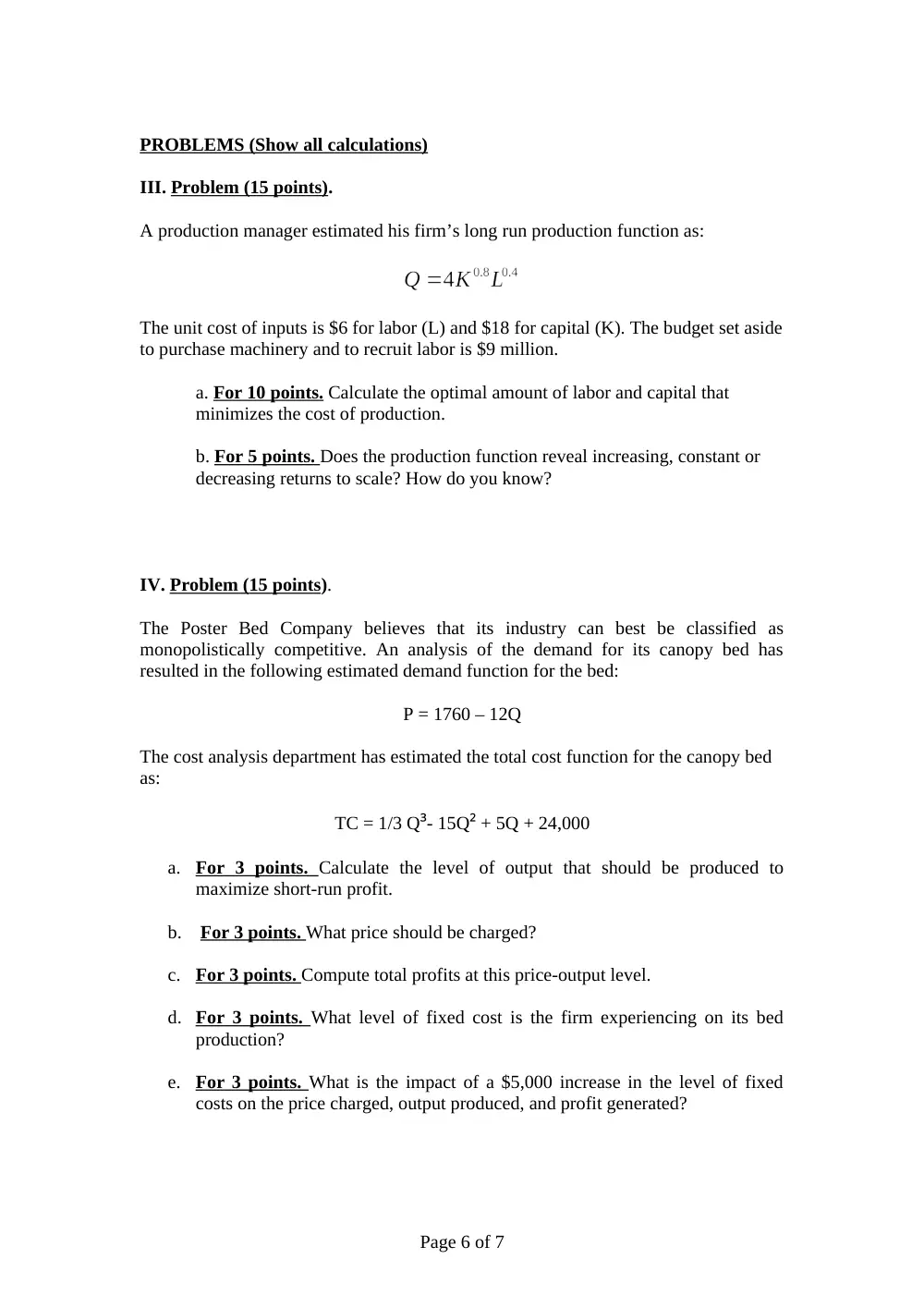
A production manager estimated his firm’s long run production function as:
The unit cost of inputs is $6 for labor (L) and $18 for capital (K). The budget set aside
to purchase machinery and to recruit labor is $9 million.
a. For 10 points. Calculate the optimal amount of labor and capital that
minimizes the cost of production.
b. For 5 points. Does the production function reveal increasing, constant or
decreasing returns to scale? How do you know?
IV. Problem (
15 points
).
The Poster Bed Company believes that its industry can best be classified as
monopolistically competitive. An analysis of the demand for its canopy bed has
resulted in the following estimated demand function for the bed:
P = 1760 – 12Q
The cost analysis department has estimated the total cost function for the canopy bed
as:
TC = 1/3 Q³- 15Q² + 5Q + 24,000
a.
For 3 points.
Calculate the level of output that should be produced to
maximize short-run profit.
b. For 3 points. What price should be charged?
c.
For 3 points.
Compute total profits at this price-output level.
d. For 3 points.
What level of fixed cost is the firm experiencing on its bed
production?
e.
For 3 points.
What is the impact of a $5,000 increase in the level of fixed
costs on the price charged, output produced, and profit generated?
Page 6 of 7
V. Problem
( 15 points
).
Two grocery stores compete against each other in a community. Both are considering
their advertising strategies. Their interdependent alternatives are described by the
payoff matrix of profits given below (where the first number in each box refers to the
payoff of Firm 1 and the second number to the payoff of Firm 2):
a.
For 4 points. Determine whether each firm has a dominant strategy
and, if it does, identify the strategy.
b.
For 4 points. Determine the Nash equilibrium.
c.
For 4 points
. Is this a prisoners’ dilemma situation? Explain your
answer.
d.
For 3 points.
In your own words, clearly explain the term ‘Nash
Equilibrium’.
VI. Problem (15 points).
BAYUPI Ltd produces computers using one X4 processor per computer. The X4
processors may be obtained only from another division of the corporation as there is
no external market. Assume that demand and cost functions are as follows:
Consumer demand for BAYUPI computers: Q = 8000 – 10 P
Marginal cost of producing X4 processors at BAYUPI: MC = 3 + 0.03 Q
Marginal cost of assembling and selling BAYUPI computers (excluding the
cost of processors): MC = 2 + 0.25 Q
a. For 5 points. What is the optimal output and price of BAYUPI computers?
b. For 2 points. How many X4 processors should be produced?
c. For 4 points. How much is the transfer price of X4 processors?
d. For 4 points. If an external perfectly competitive market for X4
processors existed and the market price was $60, how many X4 processors
will BAYUPI Ltd produce?
Page 7 of 7
Firm 2
Advertise
Don't Advertise
Advertise
(1, 2)
(4, -4)
Don't Advertise
(-2, 4)
(3, 3)
Firm 1