
BUSS 230 Final, Fall 2007
American University of Beirut · Managerial Economics · 7 pages


More BUSS 230 files
Show the text of this final exam
AMERICAN UNIVERSITY of BEIRUT
OLAYAN SCHOOL of BUSINESS
BUSS 230 – Managerial Economics- Spring Semester 2006-07
FINAL EXAM – June 13, 2007
NAME: __________________________ ID: ____________________________
SECTION: _______________________ INSTRUCTOR: ___________________
ANSWER ALL QUESTIONS – TIME ALLOWED: 2 hours
I.
Multiple choice - (
24
points)
. On this sheet, please circle the correct
answer. A correct answer is worth 2 points.
1.
In the short-run:
A. At least one input is fixed
B. At least one input is variable
C. All inputs are variable
D. None of the above
2.
The vertical distance between the average variable cost and the average total
cost:
A. Increases with quantity
B. Decreases with quantity
C. Remains fixed with quantity
D. Depends on the production function
3.
In the long-run:
A. All inputs are fixed
B. All inputs are variable
C. At least one input is variable
D. None of the above
4.
Under the dominant-firm price leadership model,
A.
all firms but the dominant firm are price takers.
B.
the dominant firm acts as the residual monopolistic supplier.
C.
the demand curve faced by the dominant firm is flatter than the market
demand curve.
D.
All of the above are correct.
Page 1 of 7
5.
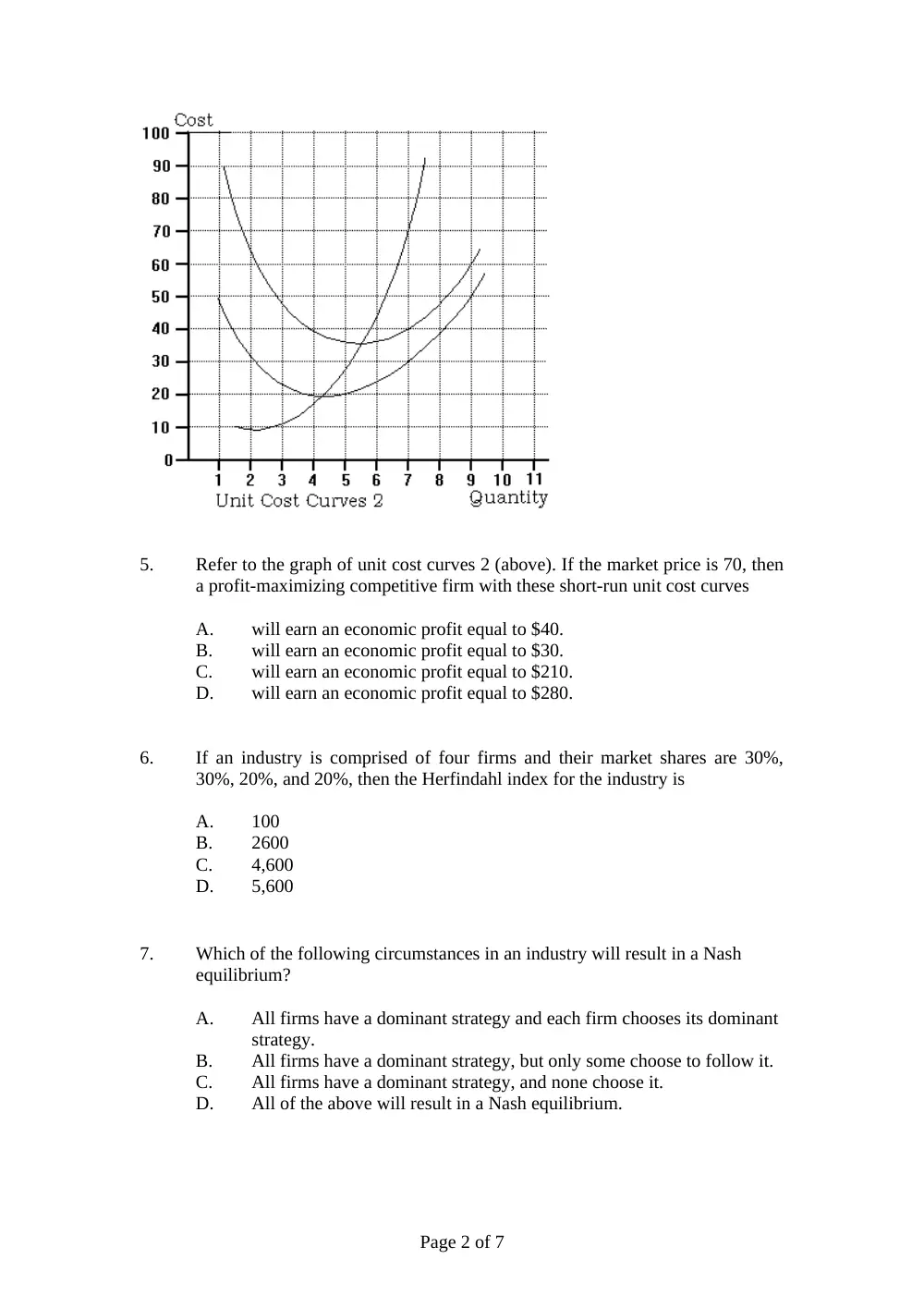
Refer to the graph of unit cost curves 2 (above). If the market price is 70, then
a profit-maximizing competitive firm with these short-run unit cost curves
A.
will earn an economic profit equal to $40.
B.
will earn an economic profit equal to $30.
C.
will earn an economic profit equal to $210.
D.
will earn an economic profit equal to $280.
6.
If an industry is comprised of four firms and their market shares are 30%,
30%, 20%, and 20%, then the Herfindahl index for the industry is
A.
100
B.
2600
C.
4,600
D.
5,600
7.
Which of the following circumstances in an industry will result in a Nash
equilibrium?
A.
All firms have a dominant strategy and each firm chooses its dominant
strategy.
B.
All firms have a dominant strategy, but only some choose to follow it.
C.
All firms have a dominant strategy, and none choose it.
D.
All of the above will result in a Nash equilibrium.
Page 2 of 7
8.
Refer to the competitive market graph (above). If market price is equal to $70
A.
the market will be in equilibrium.
B.
there will be a shortage of 3 units.
C.
there will be a surplus of 3 units.
D.
None of the above is correct.
9.
A firm produces a product at a fixed marginal cost of $2 and sells the product
on two different markets (A and B). The demand on market A is QA = 10 - P.
The demand on market B is QB = 20 - P. What price should the firm charge
on market B?
A.
4
B.
6
C.
9
D.
None of the above is correct.
10.
If the external market for an intermediate product is perfectly competitive,
then the transfer price should be set equal to
A.
the market price of the final product.
B.
the competitive market price of the intermediate product.
C.
the marginal cost of the final product.
D.
None of the above is correct.
Page 3 of 7
11.
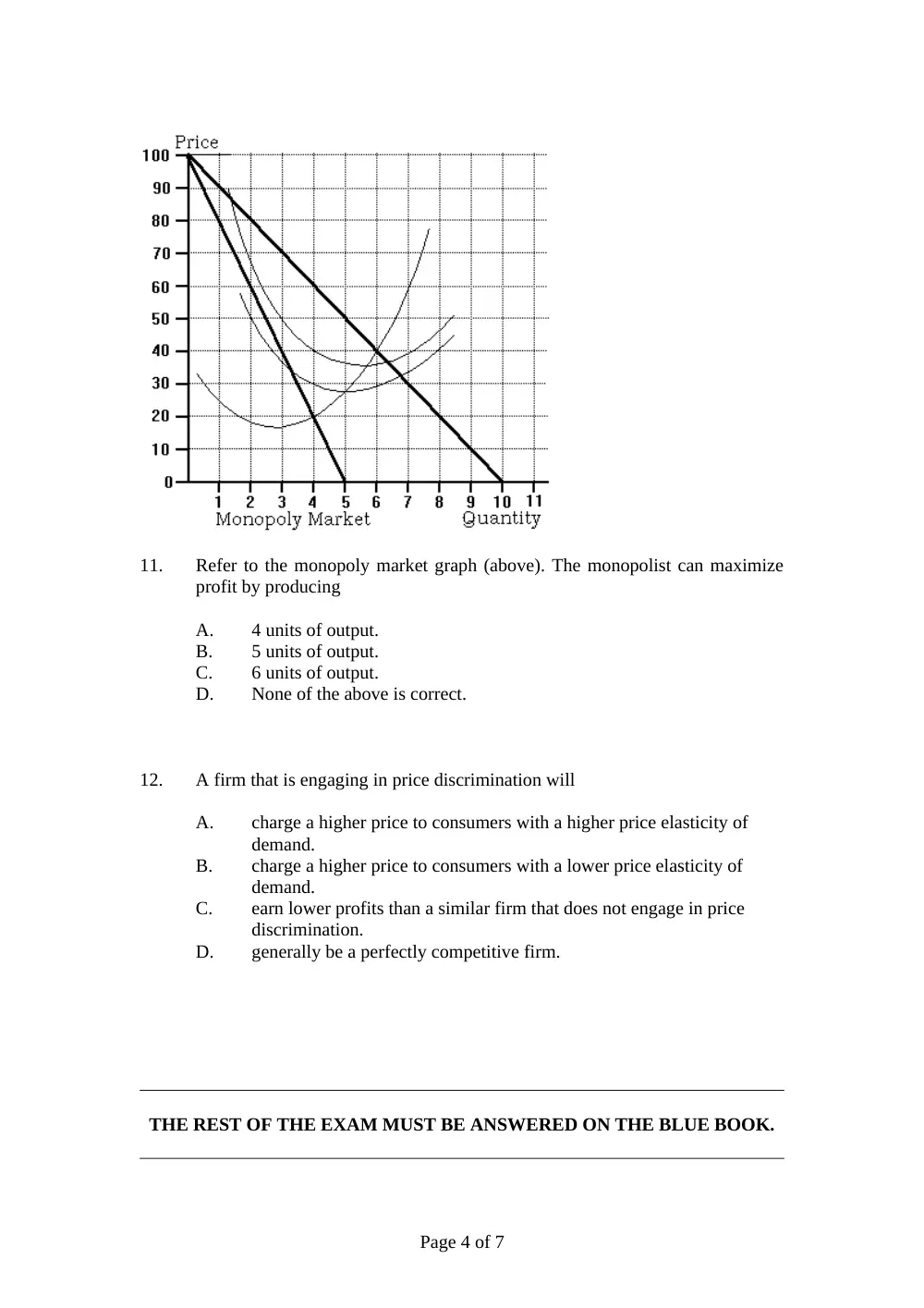
Refer to the monopoly market graph (above). The monopolist can maximize
profit by producing
A.
4 units of output.
B.
5 units of output.
C.
6 units of output.
D.
None of the above is correct.
12.
A firm that is engaging in price discrimination will
A.
charge a higher price to consumers with a higher price elasticity of
demand.
B.
charge a higher price to consumers with a lower price elasticity of
demand.
C.
earn lower profits than a similar firm that does not engage in price
discrimination.
D.
generally be a perfectly competitive firm.
THE REST OF THE EXAM MUST BE ANSWERED ON THE BLUE BOOK.
Page 4 of 7
II. True/False – (
16
Points)
. On your BLUE BOOK , label your answers to
the following statements as either True or False and briefly justify your answer.
You will receive one point if you correctly indicate whether the statement is True
or False and one point for providing a correct explanation.
1.
If large and small firms operate in the same industry we must have
constant returns to scale.
2.
Higher operating leverage allows an increase in variable cost and a
reduction in fixed cost.
3.
A market structure is defined in terms of the number and size of buyers
and sellers on a market, the type of product traded on the market, the
mobility of resources, and the amount of knowledge economic agents have
about market conditions.
4.
If in a perfectly competitive industry firms are producing 16,000 units per
day, but can only sell 14,000 units per day at the current market price of
$30, then the market equilibrium price must be greater than $30.
5.
The prisoners' dilemma refers to a situation in which both players
cooperate in determining a strategy.
6.
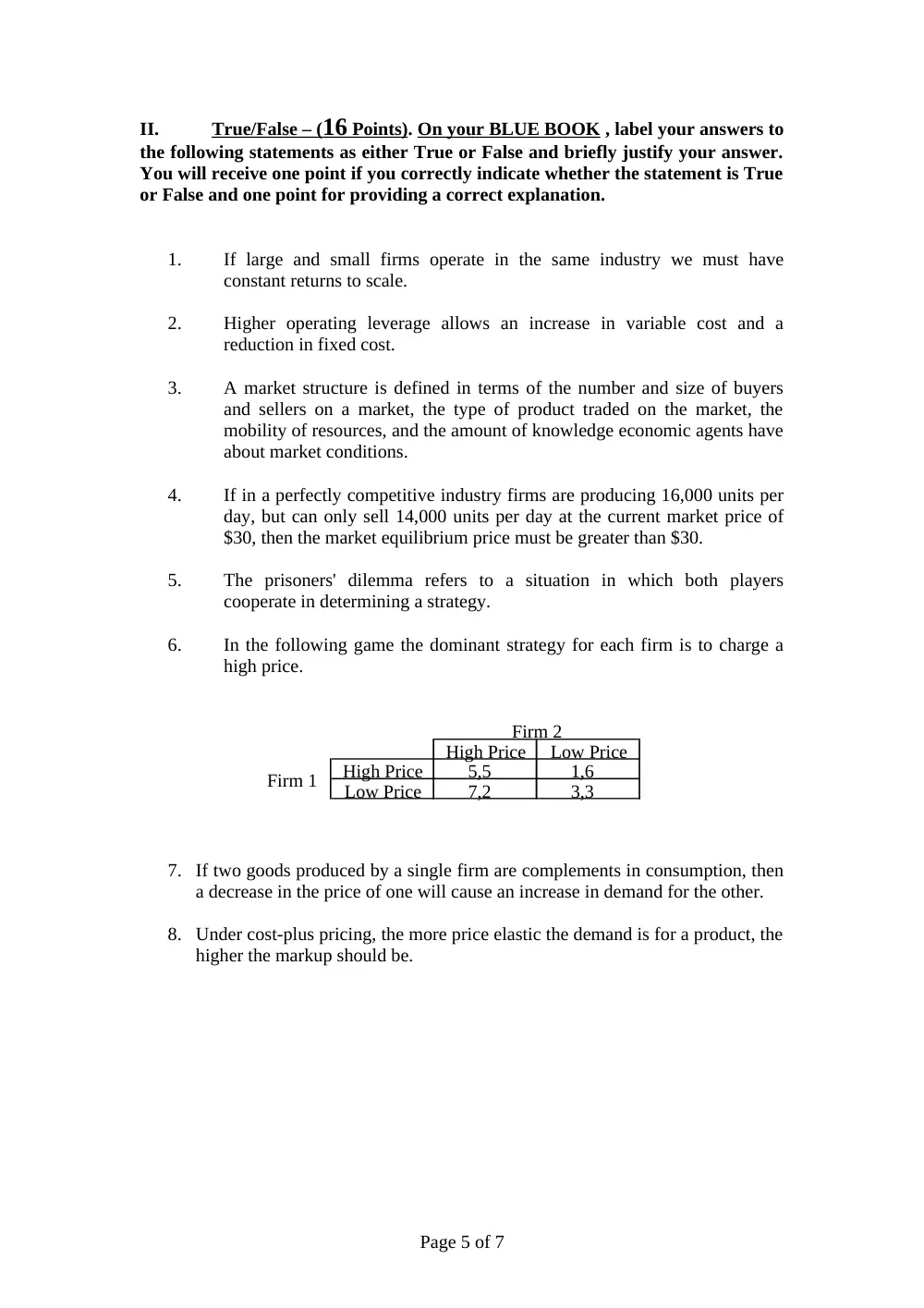
In the following game the dominant strategy for each firm is to charge a
high price.
7. If two goods produced by a single firm are complements in consumption, then
a decrease in the price of one will cause an increase in demand for the other.
8. Under cost-plus pricing, the more price elastic the demand is for a product, the
higher the markup should be.
Page 5 of 7
Firm 2
High Price
Low Price
High Price
5,5
1,6
Low Price
7,2
3,3
Firm 1
PROBLEMS (Show all calculations)
III. Problem (15 points).
Wings Airlines has an evening flight from Beirut to Dubai with an average of 80
passengers and a return flight the next afternoon with an average of 50 passengers.
The charge for the plane remaining in Dubai overnight is $1200 but would be zero in
Beirut.
The airline is contemplating eliminating the night flight out of Beirut and replacing it
with a morning flight. The estimated number of passengers is 70 in the morning flight
and 50 in the return afternoon flight.
The one-way ticket for any flight is $200. The operating cost of the plane for each
flight is $11,000. For the duration of each of the above scenarios, the fixed costs
associated with the plane are $3000 whether it flies or not.
(a) For 4 points. What are the current profits of Wings from one round trip
Beirut-Dubai leaving in the evening and coming back the next afternoon?
(b) For 4 points. What would be the profits of Wings from one round trip
Beirut-Dubai leaving and coming back in the same day?
(c) For 2 points. Should Wings continue with the evening flight or shift to the
morning flight? Explain your answer.
(d) For 5 points. Should the airline remain in business in the short-run?
Explain your answer.
IV. Problem (
15 points
).
The market demand curve for a product is given below:
Q = 250 - 0.5P
(a)
For 5 points. Assume that the market is supplied by a monopolist with
a constant marginal cost equal to $100. Calculate the equilibrium price
and quantity.
(b)
For 5 points. Now assume that the market is supplied by perfectly
competitive firms and that the market supply curve is perfectly elastic
at a price equal to $100. Calculate the equilibrium price and quantity.
(c)
For 5 points. Based on your answers in parts (a) and (b) show
graphically the amount of deadweight loss that arises if we move from
a perfectly competitive market to a monopoly.
Page 6 of 7
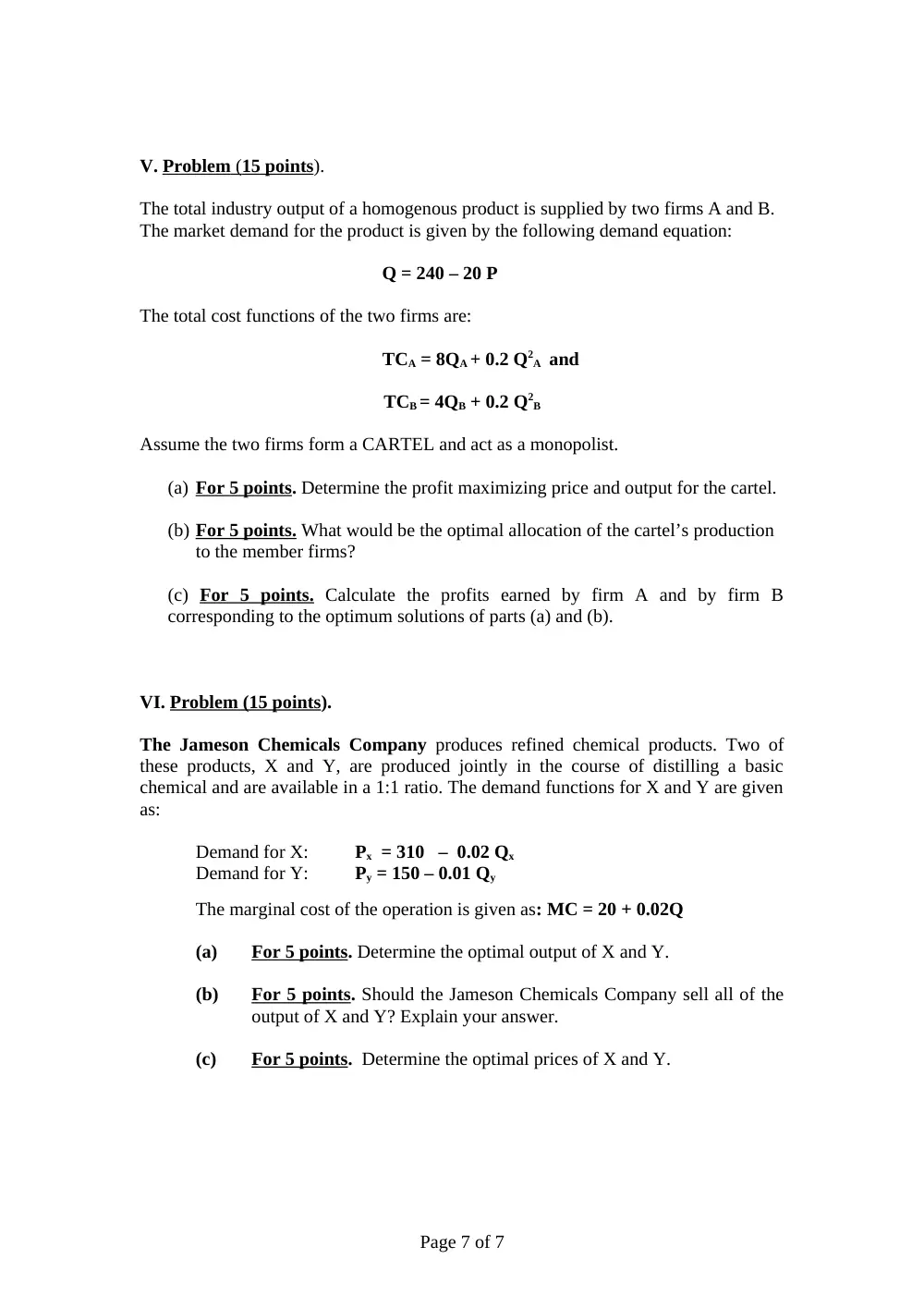
V. Problem
( 15 points
).
The total industry output of a homogenous product is supplied by two firms A and B.
The market demand for the product is given by the following demand equation:
Q = 240 – 20 P
The total cost functions of the two firms are:
TCA = 8QA + 0.2 Q2
A and
TCB = 4QB + 0.2 Q2
B
Assume the two firms form a CARTEL and act as a monopolist.
(a) For 5 points
. Determine the profit maximizing price and output for the cartel.
(b) For 5 points.
What would be the optimal allocation of the cartel’s production
to the member firms?
(c) For 5 points. Calculate the profits earned by firm A and by firm B
corresponding to the optimum solutions of parts (a) and (b).
VI. Problem (15 points).
The Jameson Chemicals Company produces refined chemical products. Two of
these products, X and Y, are produced jointly in the course of distilling a basic
chemical and are available in a 1:1 ratio. The demand functions for X and Y are given
as:
Demand for X: Px = 310 – 0.02 Qx
Demand for Y: Py = 150 – 0.01 Qy
The marginal cost of the operation is given as: MC = 20 + 0.02Q
(a)
For 5 points. Determine the optimal output of X and Y.
(b)
For 5 points. Should the Jameson Chemicals Company sell all of the
output of X and Y? Explain your answer.
(c)
For 5 points. Determine the optimal prices of X and Y.
Page 7 of 7