
BUSS 230 Final, Fall 2003
American University of Beirut · Managerial Economics · 7 pages

More BUSS 230 files
Show the text of this final exam
C—
aN,
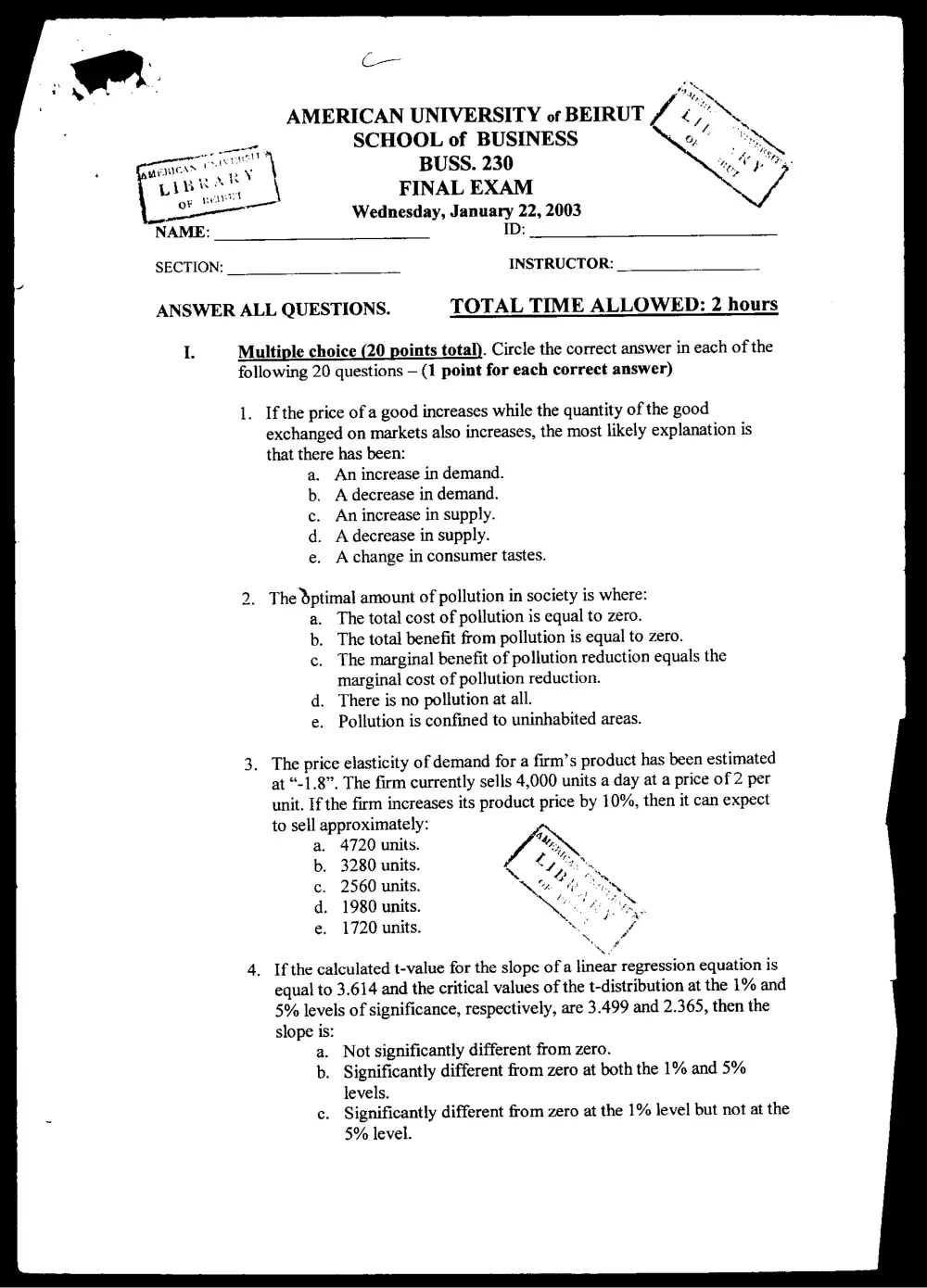
AMERICAN UNIVERSITY of BEIRUT / oN
SCHOOL of BUSINESS a
BUSS. 230
FINAL EXAM
Wednesday, January 22, 2003
ID:
SECTION: INSTRUCTOR:
ANSWER ALL QUESTIONS. TOTAL TIME ALLOWED: 2 hours
L Multiple choice (20 points total). Circle the correct answer in each of the
following 20 questions — (1 point for each correct answer)
1. Ifthe price of a good increases while the quantity of the good
exchanged on markets also increases, the most likely explanation is
that there has been:
. An increase in demand.
. A decrease in demand.
. An increase in supply.
. A decrease in supply.
. Achange in consumer tastes.
. The Sptimal amount of pollution in society is where:
. The total cost of pollution is equal to zero.
. The total benefit from pollution is equal to zero.
. The marginal benefit of pollution reduction equals the
marginal cost of pollution reduction.
. There is no pollution at all.
Pollution is confined to uninhabited areas.
. The price elasticity of demand for a firm’s product has been estimated
at “-1.8”. The firm currently sells 4,000 units a day at a price of 2 per
unit. If the firm increases its product price by 10%, then it can expect
to sell approximately:
a. 4720 units.
b. 3280 units.
c. 2560 units.
d. 1980 units.
e. 1720 units.
NS
_ If the calculated t-value for the slope of a linear regression equation is
equal to 3.614 and the critical values of the t-distribution at the 1% and
5% levels of significance, respectively, are 3.499 and 2.365, then the
slope is:
a. Not significantly different from zero.
b. Significantly different from zero at both the 1% and 5%
levels.
Significantly different from zero at the 1% level but not at the
5% level.
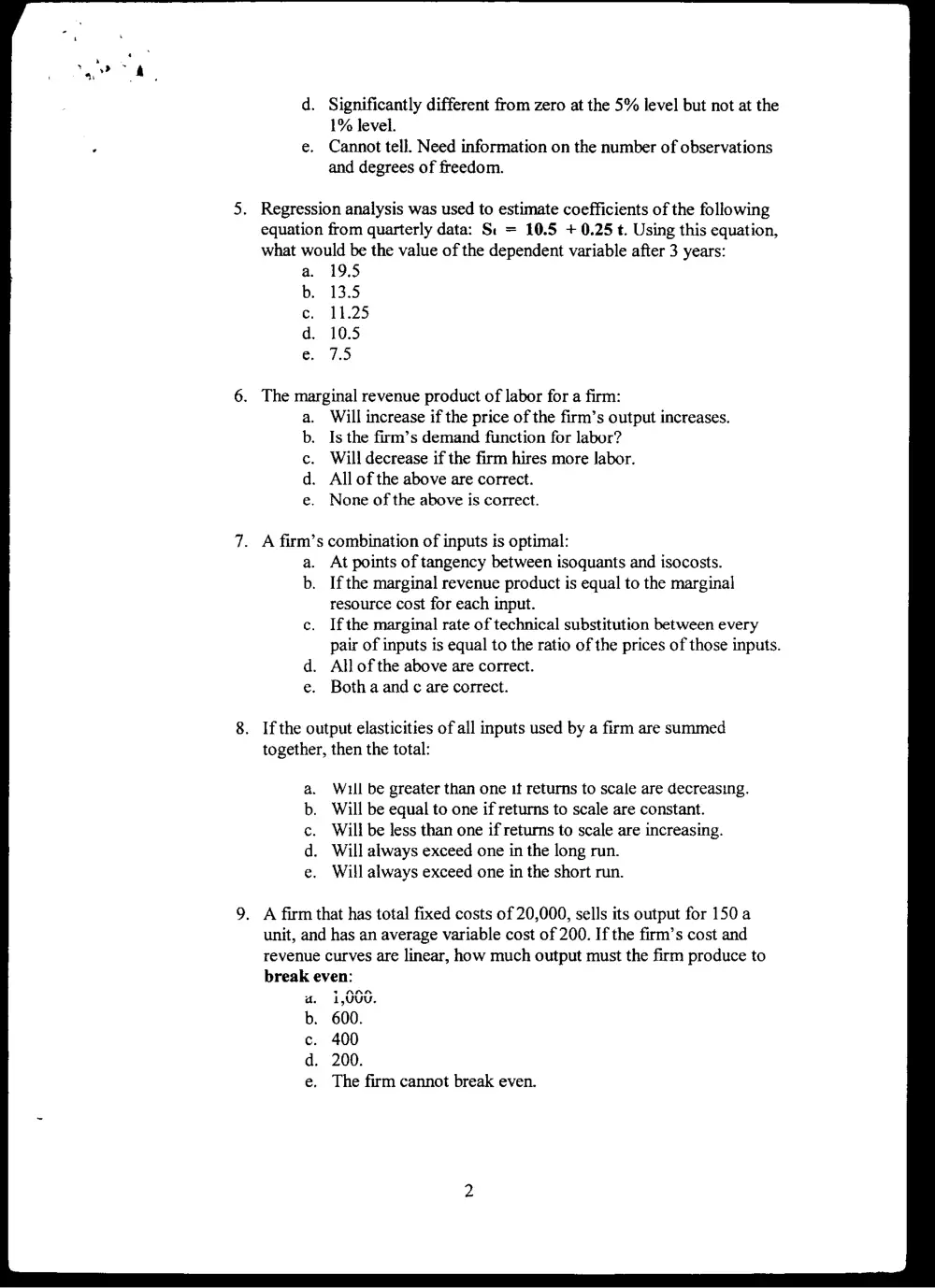
. Significantly different from zero at the 5% level but not at the
1% level.
Cannot tell. Need information on the number of observations
and degrees of freedom.
. Regression analysis was used to estimate coefficients of the following
equation from quarterly data: Si = 10.5 + 0.25 t. Using this equation,
what would be the value of the dependent variable after 3 years:
19.5
13.5
11.25
. 10.5
7.5
. The marginal revenue product of labor for a firm:
a. Will increase if the price of the firm’s output increases.
b. Is the firm’s demand function for labor?
c. Will decrease if the firm hires more labor.
d. All ofthe above are correct.
e. None of the above is correct.
. A firm’s combination of inputs is optimal:
a. At points of tangency between isoquants and isocosts.
b. Ifthe marginal revenue product is equal to the marginal
resource cost for each input.
c. Ifthe marginal rate of technical substitution between every
pair of inputs is equal to the ratio of the prices of those inputs.
d. Allofthe above are correct.
e. Botha and ¢ are correct.
. Ifthe output elasticities of all inputs used by a firm are summed
together, then the total:
Wul be greater than one 1f returns to scale are decreasing.
Will be equal to one if returns to scale are constant.
. Will be less than one if returns to scale are increasing.
. Will always exceed one in the long run.
Will always exceed one in the short run.
. A firm that has total fixed costs of 20,000, sells its output for 150a
unit, and has an average variable cost of 200. If the firm’s cost and
revenue curves are linear, how much output must the firm produce to
break even:
. AAR
1,000,
. 600.
. 400
. 200.
The firm cannot break even.
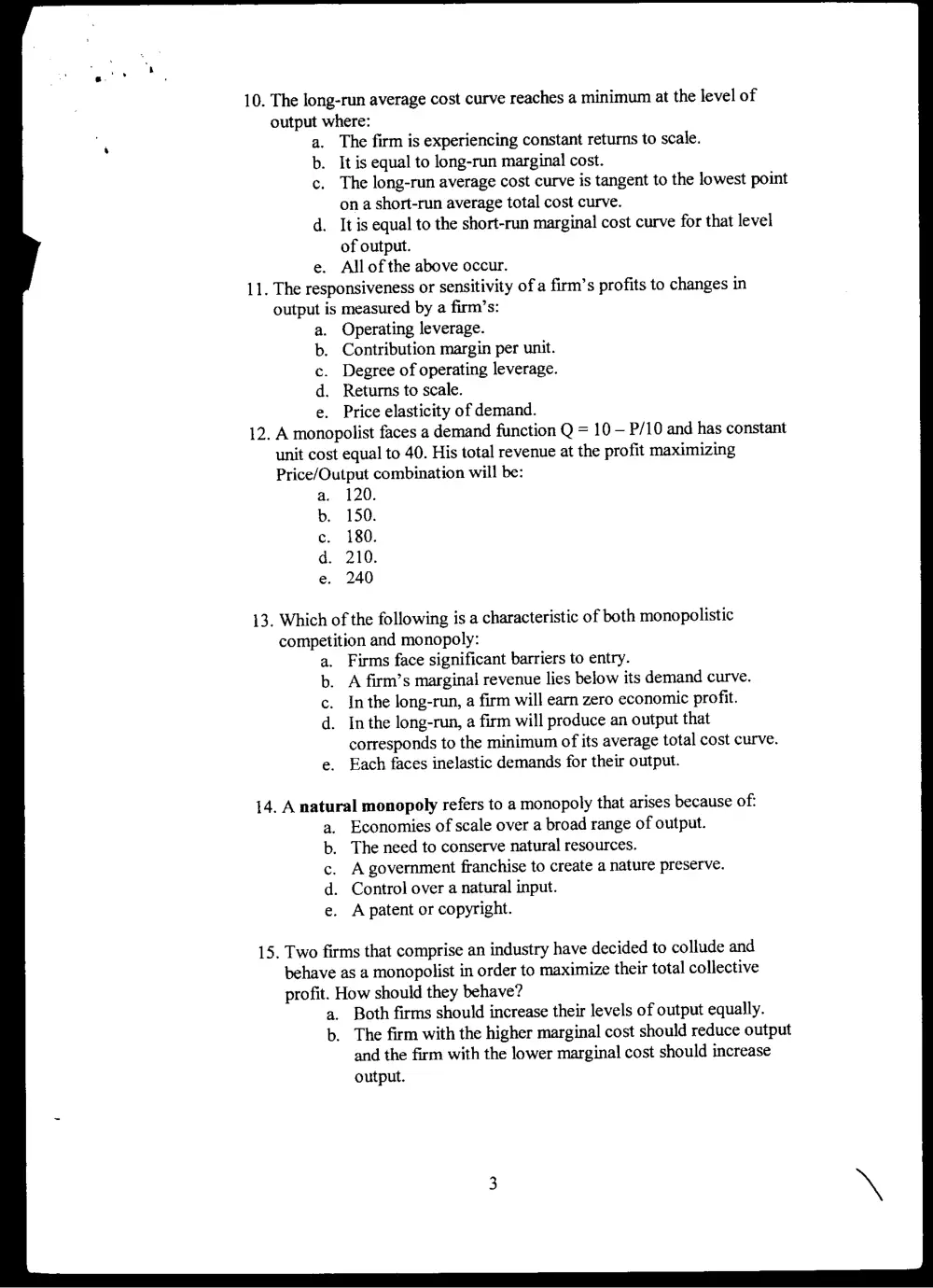
10. The long-run average cost curve reaches a minimum at the level of
output where:
a. The firm is experiencing constant returns to scale.
b. It is equal to long-run marginal cost.
c. The long-run average cost curve is tangent to the lowest point
ona short-run average total cost curve.
d. It is equal to the short-run marginal cost curve for that level
of output.
e. Allofthe above occur.
11. The responsiveness or sensitivity of a firm’s profits to changes in
output is measured by a firm’s:
a. Operating leverage.
b. Contribution margin per unit.
c. Degree of operating leverage.
d. Returns to scale.
e. Price elasticity of demand.
12. A monopolist faces a demand function Q = 10 — P/10 and has constant
unit cost equal to 40. His total revenue at the profit maximizing
Price/Output combination will be:
120.
150.
. 180.
. 210.
240
13. Which of the following is a characteristic of both monopolistic
competition and monopoly:
a. Firms face significant barriers to entry.
b. A firm’s marginal revenue lies below its demand curve.
c. Inthe long-run, a firm will earn zero economic profit.
d. Inthe long-run, a firm will produce an output that
corresponds to the minimum of its average total cost curve.
e. Each faces inelastic demands for their output.
14. A natural monopoly refers to a monopoly that arises because of:
Economies of scale over a broad range of output.
The need to conserve natural resources.
A government franchise to create a nature preserve.
Control over a natural input.
A patent or copyright.
15. Two firms that comprise an industry have decided to collude and
behave as a monopolist in order to maximize their total collective
profit. How should they behave?
a. Both firms should increase their levels of output equally.
b. The firm with the higher marginal cost should reduce output
and the firm with the lower marginal cost should increase
output.
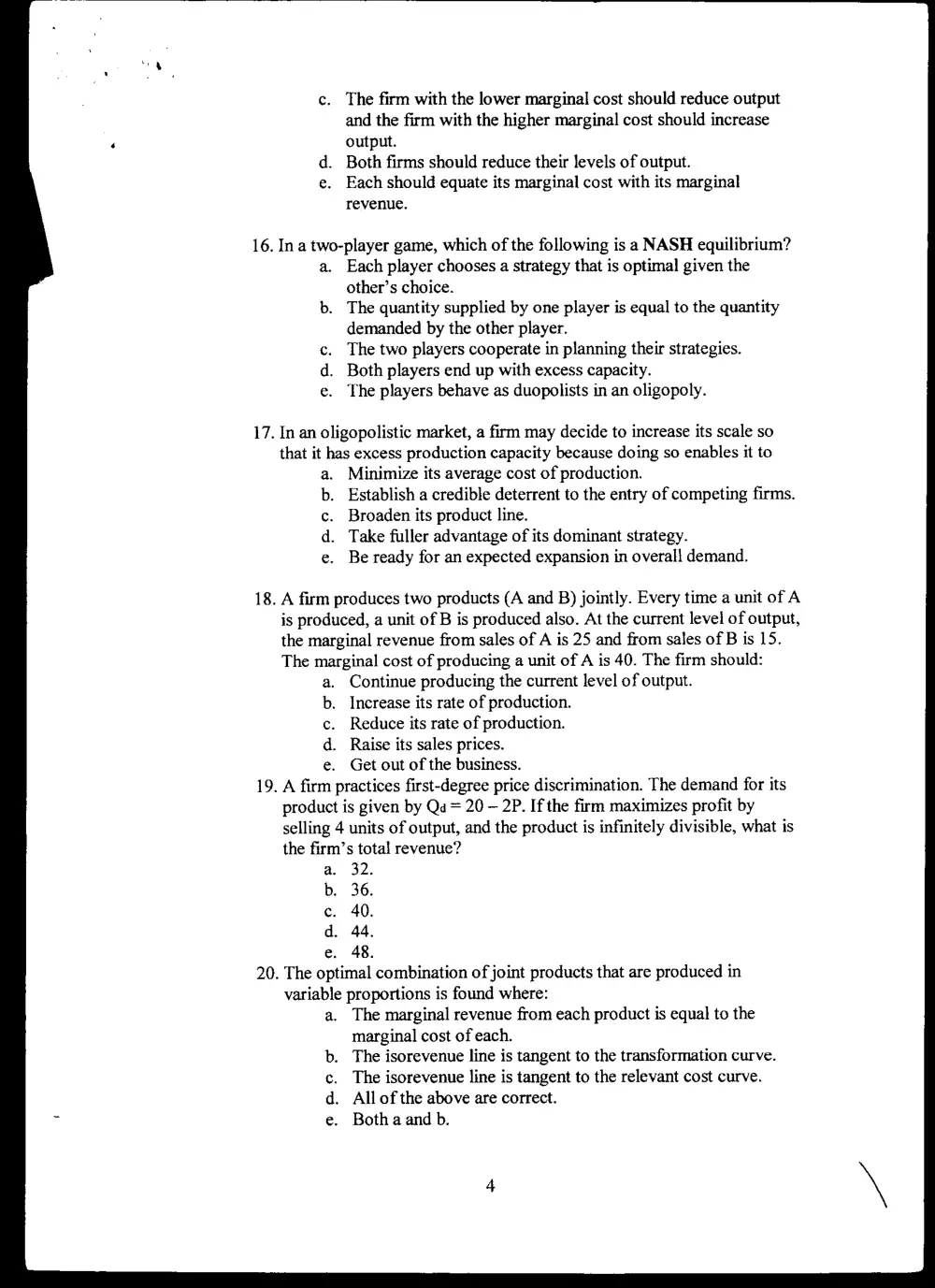
The firm with the lower marginal cost should reduce output
and the firm with the higher marginal cost should increase
output.
. Both firms should reduce their levels of output.
Each should equate its marginal cost with its marginal
revenue.
16. In a two-player game, which of the following is a NASH equilibrium?
a. Each player chooses a strategy that is optimal given the
other’s choice.
b. The quantity supplied by one player is equal to the quantity
demanded by the other player.
c. The two players cooperate in planning their strategies.
d. Both players end up with excess capacity.
e. The players behave as duopolists in an oligopoly.
17. In an oligopolistic market, a firm may decide to increase its scale so
that it has excess production capacity because doing so enables it to
. Minimize its average cost of production.
._ Establish a credible deterrent to the entry of competing firms.
. Broaden its product line.
. Take fuller advantage of its dominant strategy.
Be ready for an expected expansion in overall! demand.
. A firm produces two products (A and B) jointly. Every time a unit of A
is produced, a unit of B is produced also. At the current level of output,
the marginal revenue from sales of A is 25 and from sales of B is 15.
The marginal cost of producing a unit of A is 40. The firm should:
a. Continue producing the current level of output.
b. Increase its rate of production.
c. Reduce its rate of production.
d. Raise its sales prices.
e. Get out of the business.
. A firm practices first-degree price discrimination. The demand for its
product is given by Qu = 20 — 2P. If the firm maximizes profit by
selling 4 units of output, and the product is infinitely divisible, what is
the firm’s total revenue?
a. 32.
b. 36.
c. 40.
d. 44.
e. 48.
. The optimal combination of joint products that are produced in
variable proportions is found where:
a. The marginal revenue from each product is equal to the
marginal cost of each.
. The isorevenue line is tangent to the transformation curve.
. The isorevenue line is tangent to the relevant cost curve.
. All ofthe above are correct.
Both a and b.
TRUE or FALSE (20 points total). Label your answers to the following
10 statements with either a T or an F and briefly justify your answer.
(Each answer is worth a maximum of 2 points: 1 point for accuracy of
answer and 1 point for the justification provided).
1. The price elasticity of demand is the same as the slope of a demand
curve.
2. Heteroscedasticity refers to a violation of the assumption that the mean
of the error terms is zero.
. The use of a linear trend equation to forecast future values of a variable
is based on the assumption of a constant amount of change per time
period.
. Ifa firm is experiencing increasing returns to scale, then a doubling of
output will require more than a doubling of inputs.
. The minimum short-run average total cost occurs at a level of output
that is greater than that at which average variable cost is at a minimum.
. The supply curve of a perfectly competitive firm is identical to the
portion of its marginal cost curve that is above its average total cost
curve.
. A profit-maximizing monopolist will never produce a quantity that
corresponds to a point on the inelastic portion of his demand curve.
. The dominant-firm price leadership model describes a market structure
in which the dominant firm is the price maker and all other firms are
price takers.
9. Dumping occurs when a firm charges a higher price for a product on
foreign markets than in its domestic market.
10. Under cost-plus pricing, the more elastic the demand is for a product,
the higher should be the markup.
PROBLEMS — 60 points total for problems THT, IV, V. and VI
1.
15 points for correctly answering parts a, b,c, d, and ¢. A
market has only two sellers (Firm A and Firm B) who are trying to decide
ona pricing strategy. If both firms charge a high price, then each will
experience a 10% increase in profits. If both charge a low price, then each
will experience a 5% decrease in profits. If Firm A charges a low price
while the other charges a high price, then Firm A will experience a 6%
increase in profits while its competitor will expericnce a 2% decrease in
profits. If Firm B charges a low price while its competitor charges a high
price, then Firm B will experience a 7% increase in profits while its
competitor will experience a 3% decrease in profits.
a. For3 points. Construct a payoff matrix of the outcomes.
b. For points. Determine whether each of the firms has a
dominant strategy and, if it does, identify the strategy.
c. For 3 points. Determine the optimal strategy for each firm.
d. For 3 points. Determine the NASH equilibrium.
e. For 3 points. Is this a prisoners’ dilemma situation? What is
your reasoning?
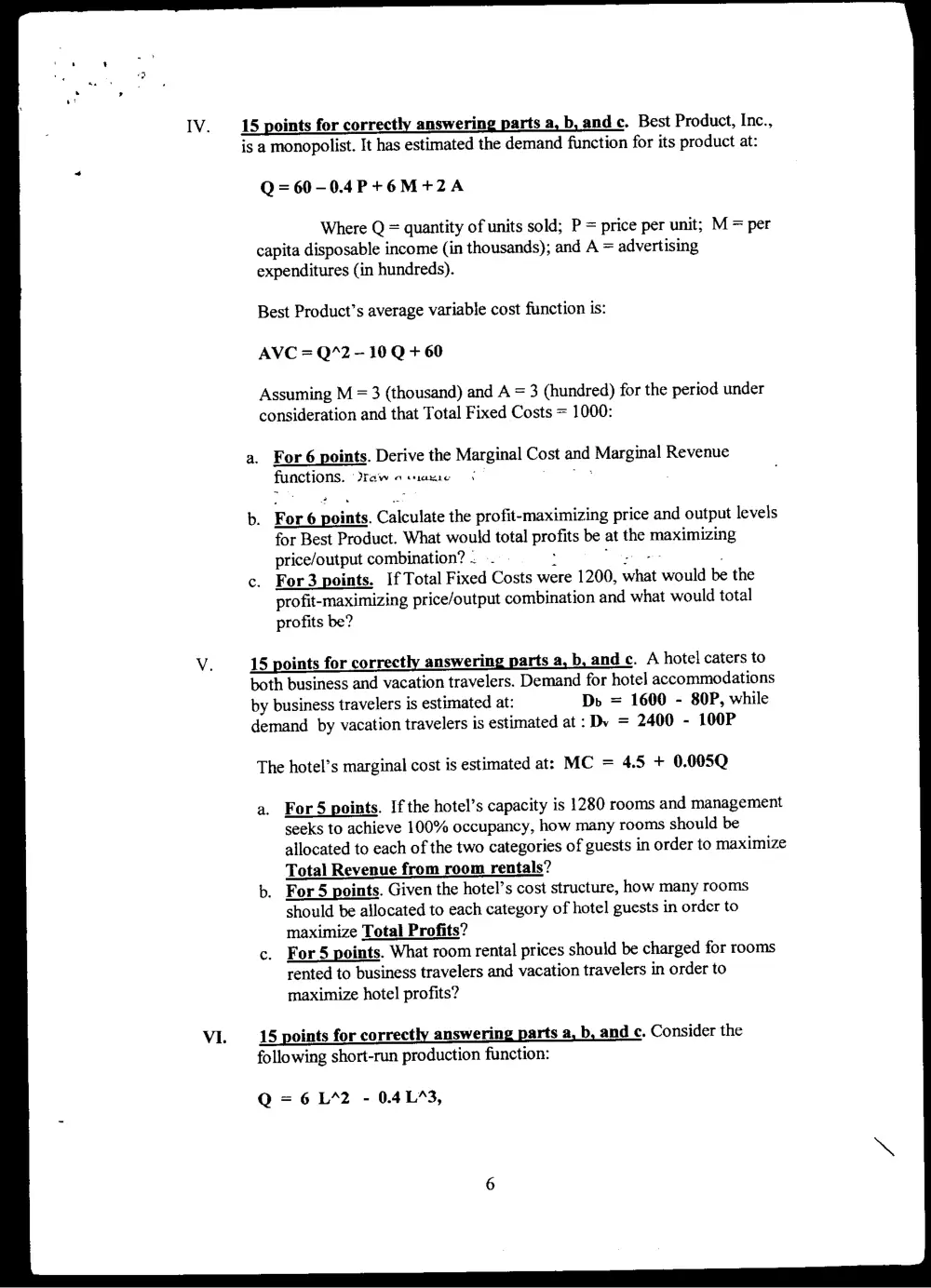
IV. 15 points for correctly answering parts a, b,and c. Best Product, Inc.,
is a monopolist. It has estimated the demand function for its product at:
Q=60-04P+6M+2A
Where Q = quantity of units sold; P = price per unit; M = per
capita disposable income (in thousands); and A = advertising
expenditures (in hundreds).
Best Product’s average variable cost function is:
AVC = Q42-10Q+ 60
Assuming M = 3 (thousand) and A = 3 (hundred) for the period under
consideration and that Total Fixed Costs = 1000:
a. For 6 points. Derive the Marginal Cost and Marginal Revenue
functions. Orawawiaxie f vs
. For 6 points. Calculate the profit-maximizing price and output levels
for Best Product. What would total profits be at the maximizing
price/output combination? - .. : Tee .
For 3 points. If Total Fixed Costs were 1200, what would be the
profit-maximizing price/output combination and what would total
profits be?
15 points for correctly answering parts a, b, and c. A hotel caters to
both business and vacation travelers. Demand for hotel accommodations
by business travelers is estimated at: Dp = 1600 - 80P, while
demand by vacation travelers is estimated at : Dv = 2400 - 100P
The hotel’s marginal cost is estimated at! MC = 4.5 + 0.005Q
a. For5 points. If the hotel’s capacity is 1280 rooms and management
seeks to achieve 100% occupancy, how many rooms should be
allocated to each of the two categories of guests in order to maximize
Total Revenue from room rentals?
. For 5 points. Given the hotel’s cost structure, how many rooms
should be allocated to each category of hotel guests in order to
maximize Total Profits?
For 5 points. What room rental prices should be charged for rooms
rented to business travelers and vacation travelers in order to
maximize hotel profits?
15 points for correctly answering parts a, b, and c. Consider the
following short-run production function:
Q =6 L*2 - 041L%3,
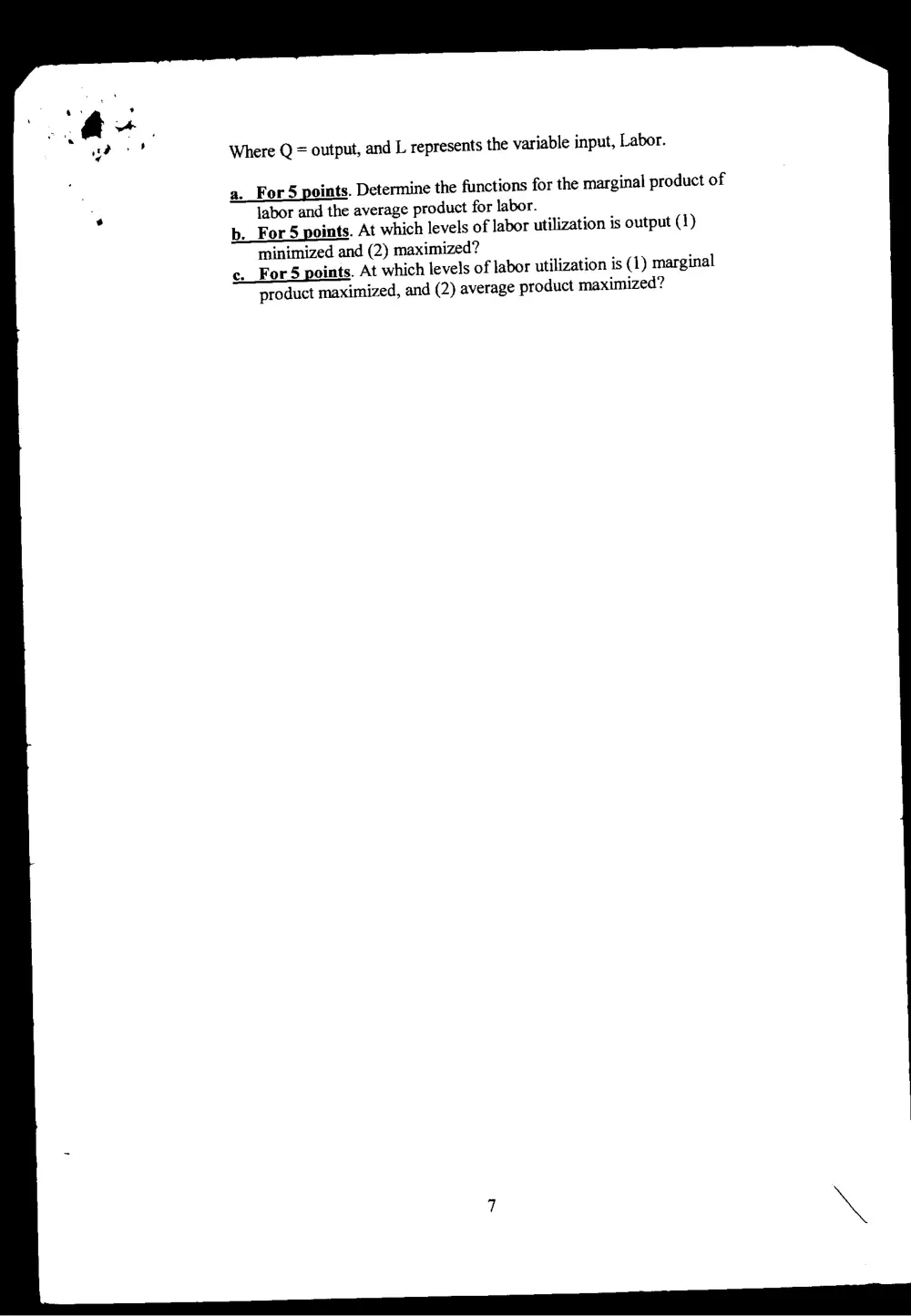
yao! Where Q = output, and L represents the variable input, Labor.
a. For 5 points. Determine the functions for the marginal product of
‘6 labor and the average product for labor.
b. For 5 points. At which levels of labor utilization is output (1)
minimized and (2) maximized?
ce. For5 points. At which levels of labor utilization is (1) marginal
product maximized, and (2) average product maximized?