
BUSS 230 Final, Fall 2004
American University of Beirut · Managerial Economics · 6 pages

More BUSS 230 files
Show the text of this final exam
. ‘
\- "
”
NAME:
Lei ARY¥
OF bELAOT
AMERICAN UNIVERSIT Y of BEIRUT
SCHOOL of BUSINESS
BUSS. 230
FINAL EXAM
Saturday, January 24, 2004
ID:
SECTION:
INSTRUCTOR:
ANSWER ALL QUESTIONS. TOTAL TIME ALLOWED: 2 hours
1. Multiple choice (20 points total). Circle the correct answer in each of the
foliowing 20 questions — (1 point for each correct answer)
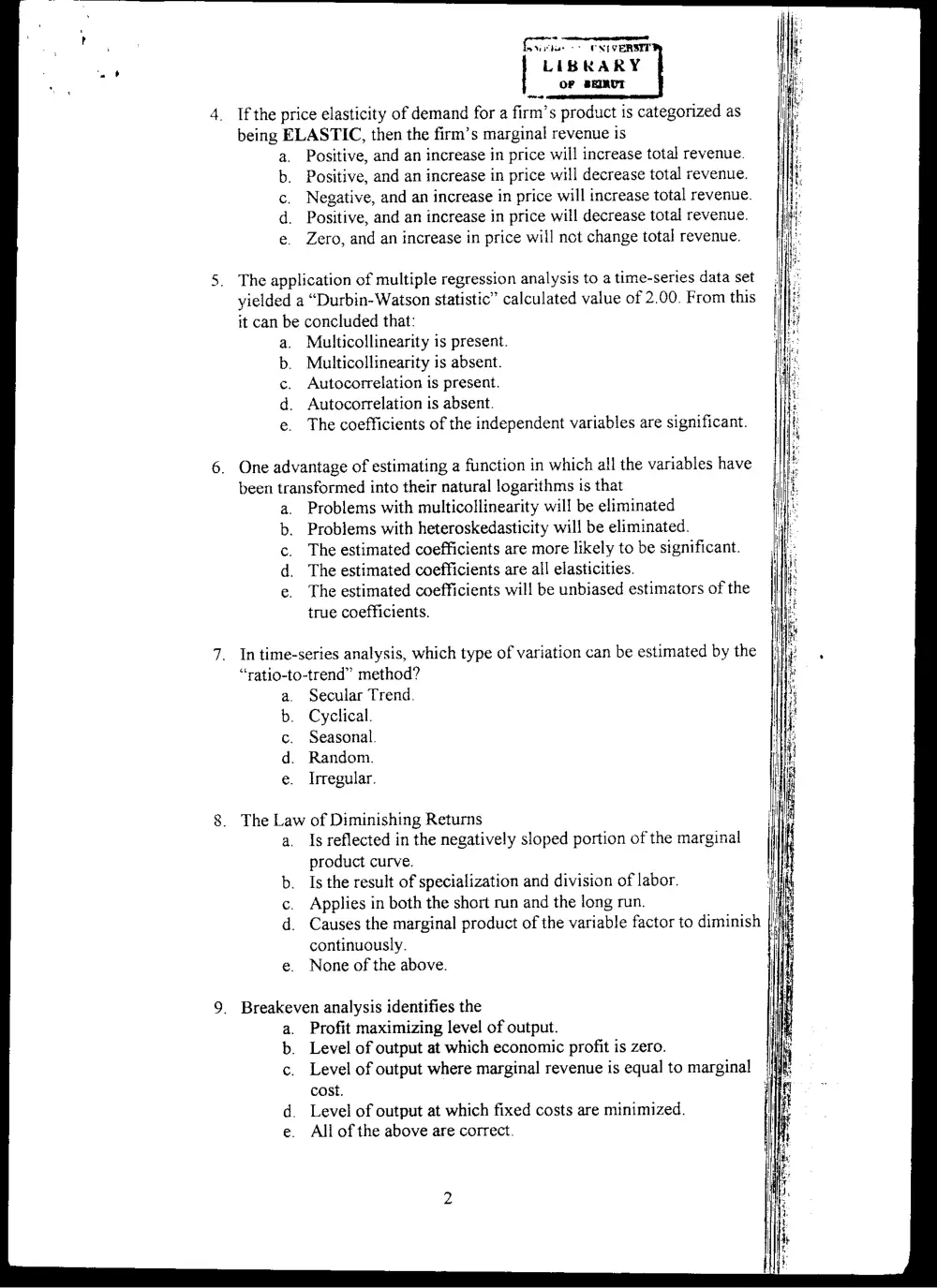
1. Ifautomobile manufacturers are producing cars faster than consumers
want to buy them:
a.
b.
There will be an excess supply of cars and car prices can be
expected to decrease.
There will be an excess supply of cars and car prices can be
expected to increase.
There will be an excess demand for cars and car prices can be
expected to decrease.
There will be an excess demand for cars and car prices can be |:
expected to increase.
Increased consumer income will ensure that production will
be absorbed by the market at the existing prices.
Assuming that a firm is producing 10 units of a product. At that level
of output the marginal cost is equal to
a.
b.
c.
d.
e.
The slope of the tangent to the total cost curve at that level of |
output.
The total cost of 10 units of output divided by 10.
The average cost of 10 units of output.
The slope of a ray drawn from the origin to the point on the
total cost curve where output = 10.
The variable cost of producing 10 units of output.
An increase in the price of hot dogs from $1.60 to $2.00 per unit
increased the average number of hamburgers demanded per capita per
week from 1 to 1.4. Assuming that all other economic variables were
unchanged, the arc cross price elasticity of demand between hot dogs
and hamburgers is
a.
b
c.
d.
e
fi
i
\
|
—1.5, which indicates that the two goods are substitutes.
. —1.5, which indicates that the two goods are complements.
+1.5, which indicates that the two goods are substitutes.
+1.5, which indicates that the two goods are complements.
There is not enough information to determine the answer.
-/e
aera -> ONEVERSIT
LIBKARY
OF BEIRUT
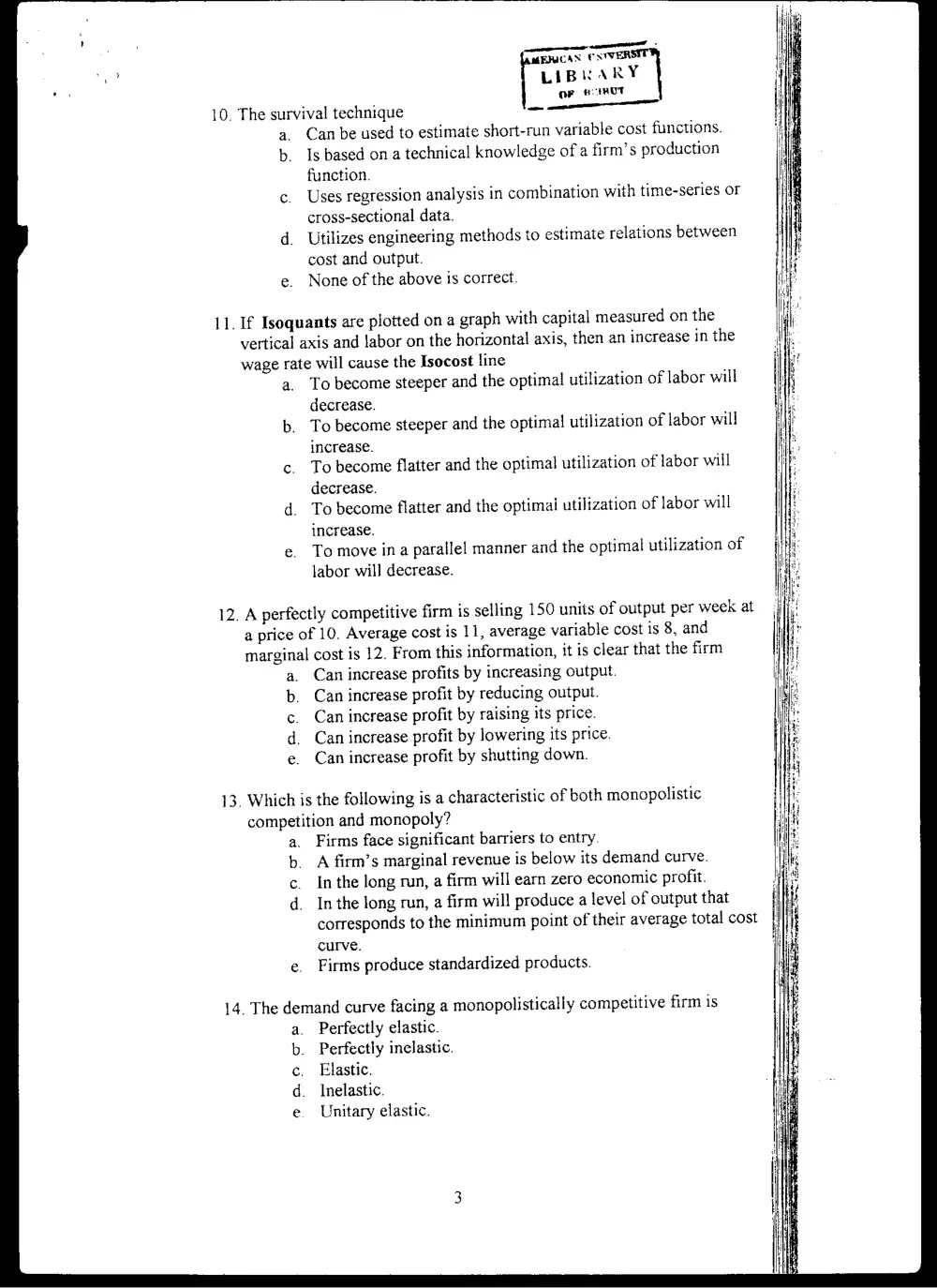
4. Ifthe price elasticity of demand for a firm’s product is categorized as
being ELASTIC, then the firm’s marginal revenue is
Positive, and an increase in price will increase total revenue.
Positive, and an increase in price will decrease total revenue.
Negative, and an increase in price will increase total revenue.
Positive, and an increase in price will decrease total revenue.
Zero, and an increase in price will not change total revenue.
ene ge
5. The application of multiple regression analysis to a time-series data set
yielded a “Durbin-Watson statistic” calculated value of 2.00. From this
it can be concluded that:
Multicollinearity is present.
Multicollinearity is absent.
Autocorrelation is present.
Autocorrelation is absent.
The coefficients of the independent variables are significant.
oao7e
6. One advantage of estimating a function in which all the variables have
been transformed into their natural logarithms is that
Problems with multicollinearity will be eliminated
Problems with heteroskedasticity will be eliminated.
The estimated coefficients are more likely to be significant.
The estimated coefficients are all elasticities.
The estimated coefficients will be unbiased estimators of the
true coefficients.
eno gp
7. In time-series analysis, which type of variation can be estimated by the
“ratio-to-trend” method?
Secular Trend.
Cyclical.
Seasonal.
Random.
Irregular.
eo a0 TP
8. The Law of Diminishing Returns
a. Is reflected in the negatively sloped portion of the marginal
product curve.
b. Is the result of specialization and division of labor.
c. Applies in both the short run and the long run.
d. Causes the marginal product of the variable factor to diminish |
continuously.
e. None of the above.
9. Breakeven analysis identifies the
a. Profit maximizing level of output.
b. Level of output at which economic profit is zero.
c. Level of output where marginal revenue is equal to marginal luk
cost.
d. Level of output at which fixed costs are minimized.
e. All of the above are correct.
ERICAN UNIVER!
e LIBRARY
- OF BCIROT
Oe
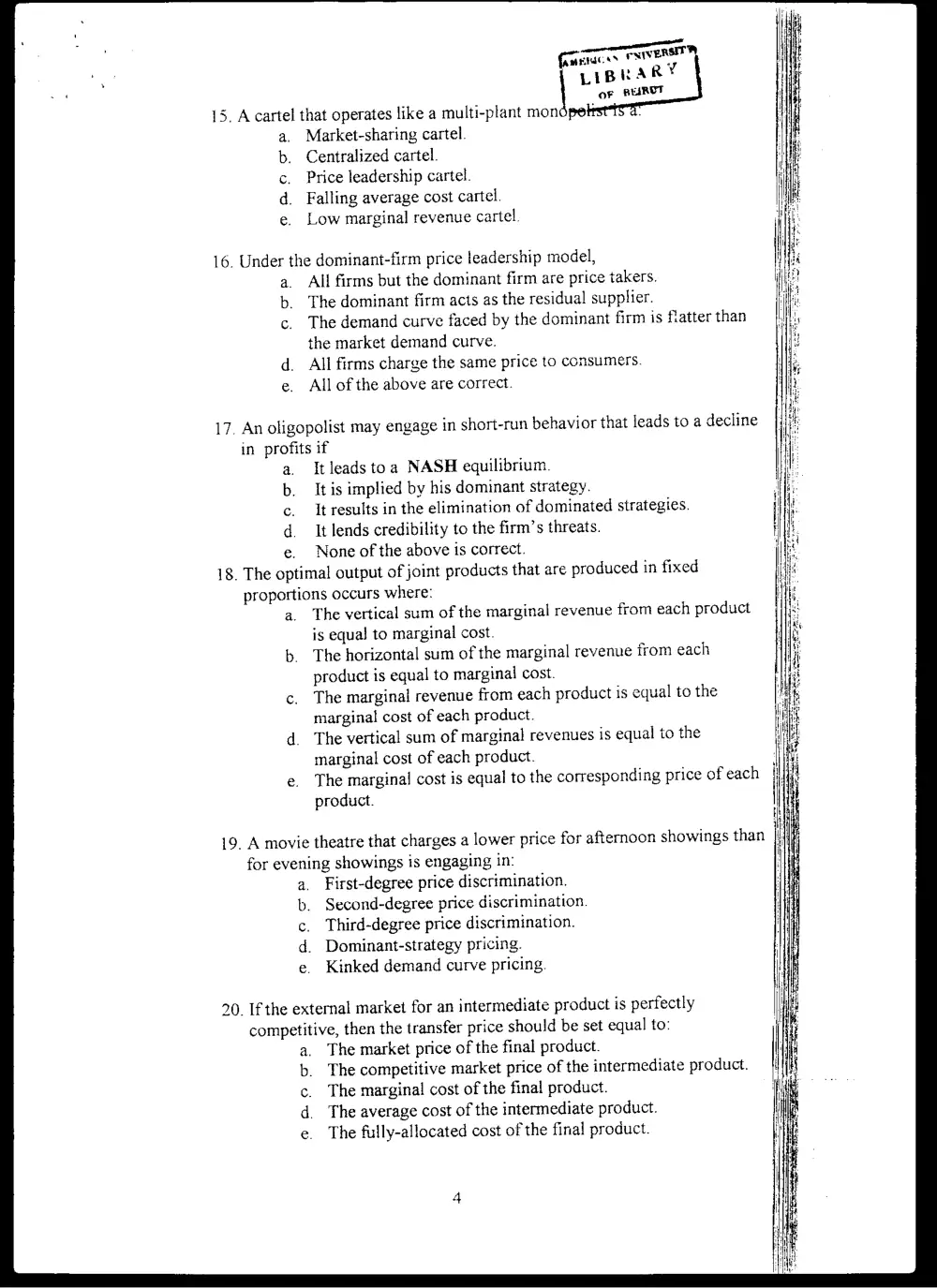
10. The survival technique _
a. Can be used to estimate short-run variable cost functions.
b. Is based on a technical knowledge of a firm’s production
function.
c. Uses regression analysis in combination with time-series or
cross-sectional data.
d. Utilizes engineering methods to estimate relations between
cost and output.
e. None of the above is correct.
11. If Isoquants are plotted on a graph with capital measured on the
vertical axis and labor on the horizontal axis, then an increase in the
wage rate will cause the Isocost line
a. To become steeper and the optimal utilization of labor will
decrease.
b. To become steeper and the optimal utilization of labor will
increase.
c. To become flatter and the optimal utilization of labor will
decrease.
d. To become flatter and the optimal utilization of labor will
increase.
e. To move ina parallel manner and the optimal utilization of
labor will decrease.
12. A perfectly competitive firm is selling 150 units of output per week at
a price of 10. Average cost is 11, average variable cost is 8, and
marginal cost is 12. From this information, it is clear that the firm
Can increase profits by increasing output.
Can increase profit by reducing output.
Can increase profit by raising its price.
Can increase profit by lowering its price.
Can increase profit by shutting down.
eaocP
13. Which is the following is a characteristic of both monopolistic
competition and monopoly?
a. Firms face significant barriers to entry.
b. A firm’s marginal revenue is below its demand curve.
c. Inthe long nun, a firm will earn zero economic profit.
d. Inthe long run, a firm will produce a level of output that
corresponds to the minimum point of their average total cost
curve.
e. Firms produce standardized products.
14. The demand curve facing a monopolistically competitive firm is
a. Perfectly elastic. Hye
b. Perfectly inelastic. | i
c. Elastic. ip
d. Inelastic. i
e. Unitary elastic.
ERT,
MERIC AS CNIVER
LIBRARY
oF BEIRUT
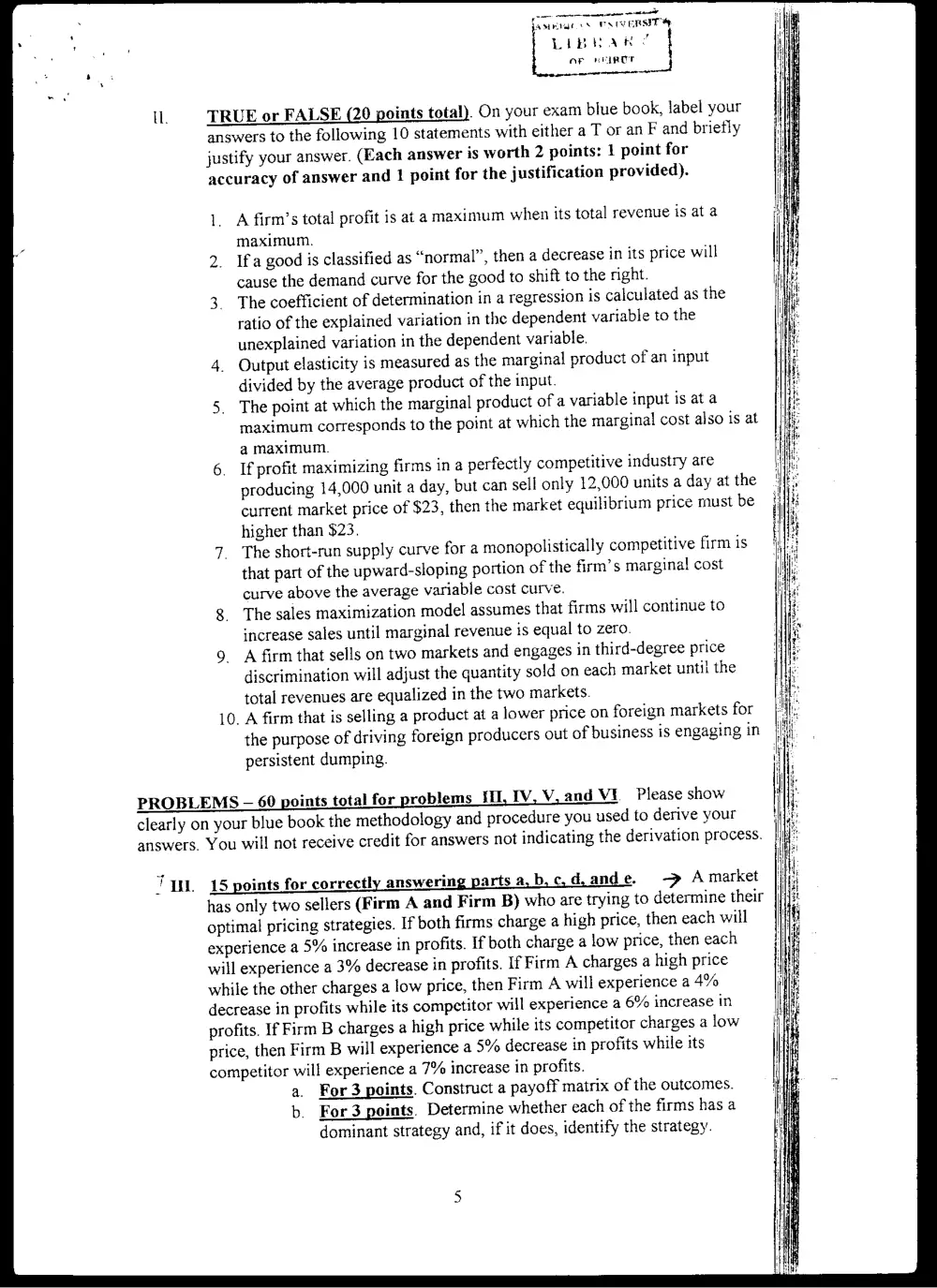
15, A cartel that operates like a multi-plant mondpe
a. Market-sharing cartel
Centralized cartel.
Price leadership cartel.
Falling average cost cartel.
Low marginal revenue cartel.
16. Under the dominant-firm price leadership model,
a. All firms but the dominant firm are price takers.
b. The dominant firm acts as the residual supplier.
c. The demand curve faced by the dominant firm is flatter than
the market demand curve.
d. All firms charge the same price to consumers.
e. All of the above are correct.
17. An oligopolist may engage in short-run behavior that leads to a decline
in profits if
a. Itleads toa NASH equilibrium.
b. It is implied by his dominant strategy.
c. It results in the elimination of dominated strategies.
d. It lends credibility to the firm’s threats.
e. None of the above is correct.
18. The optimal output of joint products that are produced in fixed
proportions occurs where:
a. The vertical sum of the marginal revenue from each product
is equal to marginal cost.
b. The horizontal sum of the marginal revenue from each
product is equal to marginal cost.
The marginal revenue from each product is equal to the
marginal cost of each product.
The vertical sum of marginal revenues is equal to the
marginal cost of each product.
The marginal cost is equal to the corresponding price of each
product.
19. A movie theatre that charges a lower price for afternoon showings than i
for evening showings is engaging in:
First-degree price discrimination.
Second-degree price discrimination.
Third-degree price discrimination.
Dominant-strategy pricing.
Kinked demand curve pricing.
20. If the external market for an intermediate product is perfectly
competitive, then the transfer price should be set equal to:
The market price of the final product.
The competitive market price of the intermediate product.
The marginal cost of the final product.
The average cost of the intermediate product.
The fully-allocated cost of the final product.
n
AMntae woe .
LiBbnAK ? i
ar nearer
nana |
TRUE or FALSE (20 points total). On your exam blue book, label your
answers to the following 10 statements with either a T or an F and briefly
justify your answer. (Each answer is worth 2 points: 1 point for
accuracy of answer and 1 point for the justification provided).
1. A firm’s total profit is at a maximum when its total revenue is at a
maximum.
2. Ifa good is classified as “normal”, then a decrease in its price will
cause the demand curve for the good to shift to the right.
The coefficient of determination in a regression is calculated as the
ratio of the explained variation in the dependent variable to the
unexplained variation in the dependent variable.
Output elasticity is measured as the marginal product of an input
divided by the average product of the input.
The point at which the marginal product of a variable input is ata
maximum corresponds to the point at which the marginal cost also is at
a maximum.
If profit maximizing firms in a perfectly competitive industry are
producing 14,000 unit a day, but can sell only 12,000 units a day at the
current market price of $23, then the market equilibrium price must be
higher than $23.
The short-run supply curve for a monopolistically competitive firm is
that part of the upward-sloping portion of the firm’s marginal cost
curve above the average variable cost curve.
8. The sales maximization model assumes that firms will continue to
increase sales until marginal revenue is equal to zero.
9. A firm that sells on two markets and engages in third-degree price
discrimination will adjust the quantity sold on each market until the
total revenues are equalized in the two markets
10. A firm that is selling a product at a lower price on foreign markets for
the purpose of driving foreign producers out of business is engaging in |[t)
persistent dumping. Ie
PROBLEMS — 60 points total for problems TH, TV, V,and VI Please show
clearly on your blue book the methodology and procedure you used to derive your
answers. You will not receive credit for answers not indicating the derivation process.
TIM. 15 points for correctly answering parts a,b, c,d. ande. —> Amarket
has only two sellers (Firm A and Firm B) who are trying to determine their
optimal pricing strategies. If both firms charge a high price, then each will
experience a 5% increase in profits. If both charge a low price, then each
will experience a 3% decrease in profits. If Firm A charges a high price
while the other charges a low price, then Firm A will experience a 4%
decrease in profits while its competitor will experience a 6% increase in
profits. If Firm B charges a high price while its competitor charges a low
price, then Firm B will experience a 5% decrease in profits while its
competitor will experience a 7% increase in profits.
a. For 3 points, Construct a payoff matrix of the outcomes.
b. For3 points. Determine whether each of the firms has a
dominant strategy and, if it does, identify the strategy.
od
(oman so OSV ERSIT
:
LIBKARY
OF FREIRUT
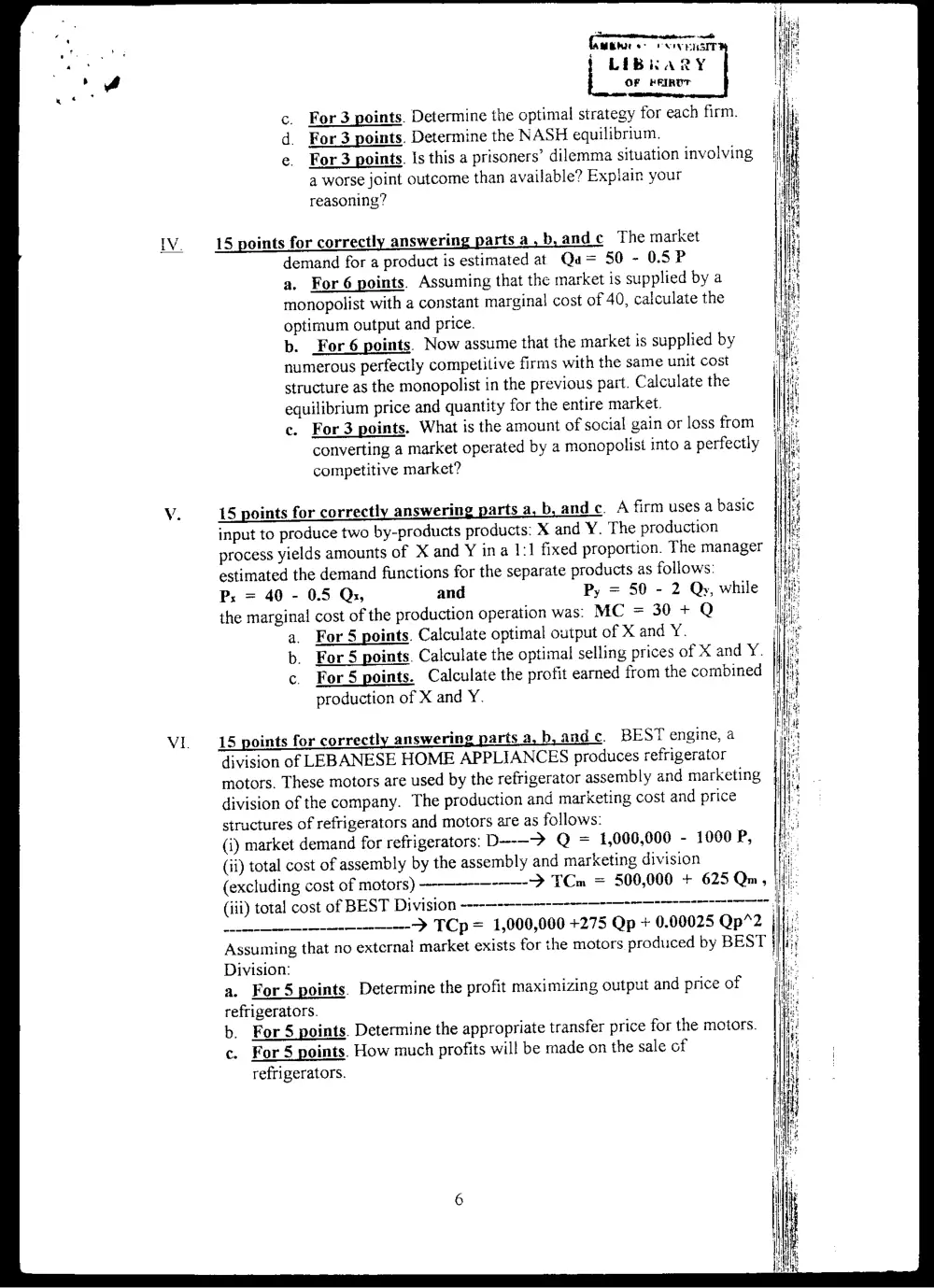
c. For 3 points. Determine the optimal strategy for each firm.
d. For 3 points. Determine the NASH equilibrium.
e. For3 points. |s this a prisoners’ dilemma situation involving fie
a worse joint outcome than available? Explain your
reasoning?
IV. 15 points for correctly answering parts a. b,ande The market
demand for a product is estimated at Qa= 50 - 0.5P
a. For 6 points. Assuming that the market is supplied by a
monopolist with a constant marginal cost of 40, calculate the
optimum output and price.
b. For 6 points. Now assume that the market is supplied by
numerous perfectly competitive firms with the same unit cost
structure as the monopolist in the previous part. Calculate the
equilibrium price and quantity for the entire market.
c. For 3 points, What is the amount of social gain or loss from
converting a market operated by a monopolist into a perfectly
competitive market?
15 points for correctly answering parts a, b, andc. A firm uses a basic
input to produce two by-products products: X and Y. The production
process yields amounts of X and Y ina 1:1 fixed proportion. The manager
estimated the demand functions for the separate products as follows:
Ps = 40 - 0.5 Q;, and Py = 50 - 2 Qy, while
the marginal cost of the production operation was: MC = 30+ Q
a. For 5 points. Calculate optimal output of X and Y.
b. For 5 points. Calculate the optimal selling prices of X and Y.
c. For5 points. Calculate the profit earned from the combined
production of X and Y.
15 points for correctly answering parts a, b,andc, BEST engine, a
division of LEBANESE HOME APPLIANCES produces refrigerator
motors, These motors are used by the refrigerator assembly and marketing
division of the company. The production and marketing cost and price
structures of refrigerators and motors are as follows:
(i) market demand for refrigerators: D—-—> Q = 1,060,000 - 1000 P,
(ii) total cost of assembly by the assembly and marketing division
(excluding cost of motors) -——----—- > TCm = 500,000 + 625 Qm,
(iii) total cost of BEST Division -----——a- a
> TCp = 1,000,000 +275 Qp + 0.00025 Qp*2 ji,’
Assuming that no external market exists for the motors produced by BEST \ Nis
Division:
a. For 5 points. Determine the profit maximizing output and price of
refrigerators.
b. For 5 points. Determine the appropriate transfer price for the motors.
c. For § points. How much profits will be made on the sale of
refrigerators.