
CIVE 320 Final + Midterm Previouses, Fall 2015
American University of Beirut · Construction Materials and Technology · 13 pages
Showing the first 10 of 13 pages. Download the PDF to see all of it.
More CIVE 320 files
- Final Sample · Spring 2015Final examView
- Final Possible Questions · Fall 2014Final examView
- Chapter 1 · Spring 2016ChapterView
- Chapter 2 · Spring 2016ChapterView
- Chapter 3.1 · Spring 2016ChapterView
- Chapter 3.2 · Spring 2016ChapterView
- Chapter 5.1 · Spring 2016ChapterView
- Chapter 5.2 · Spring 2016ChapterView
Show the text of this final exam
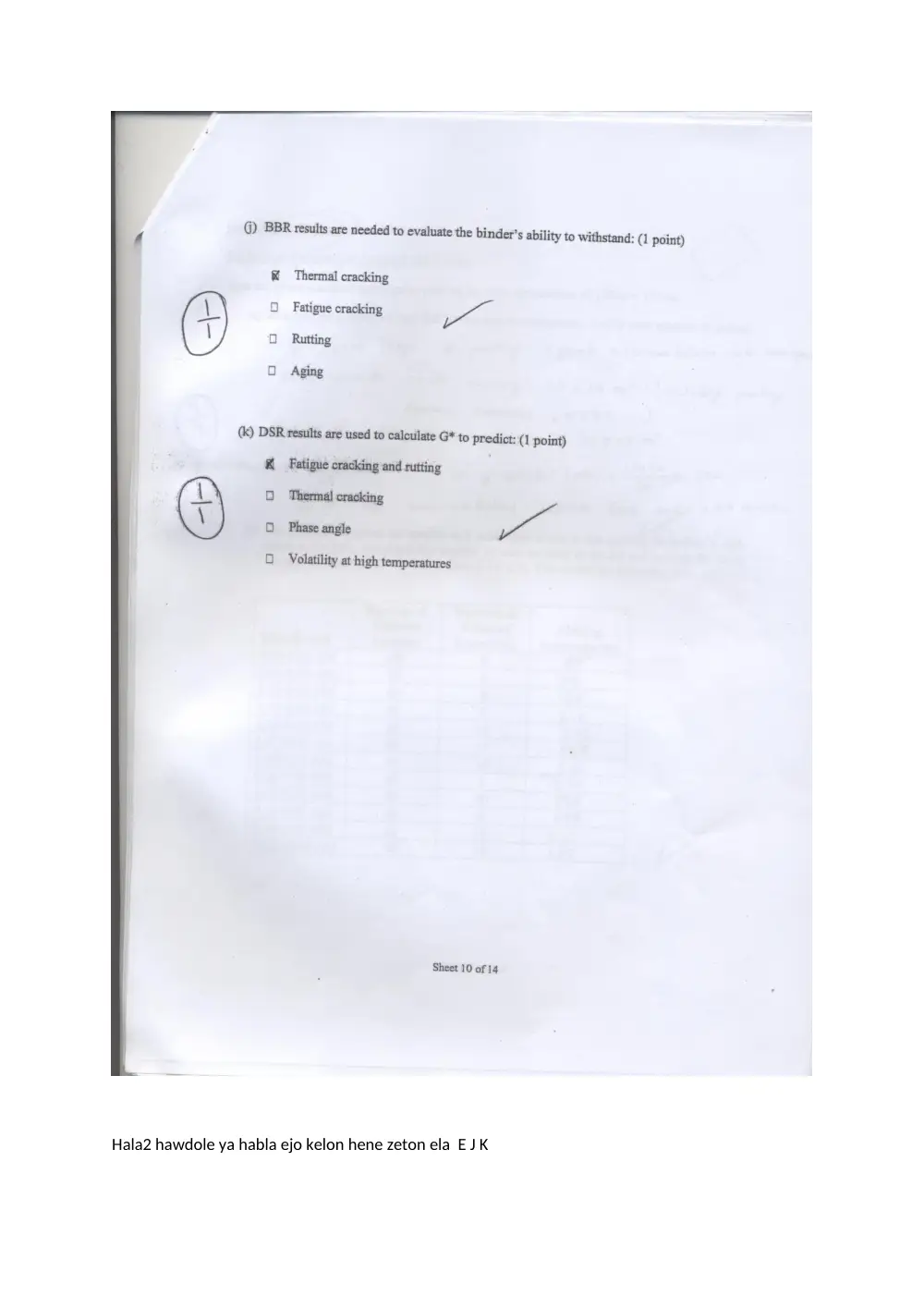
Hala2 hawdole ya habla ejo kelon hene zeton ela E J K
1) what does ASTM stand for
2) what does PG stand for
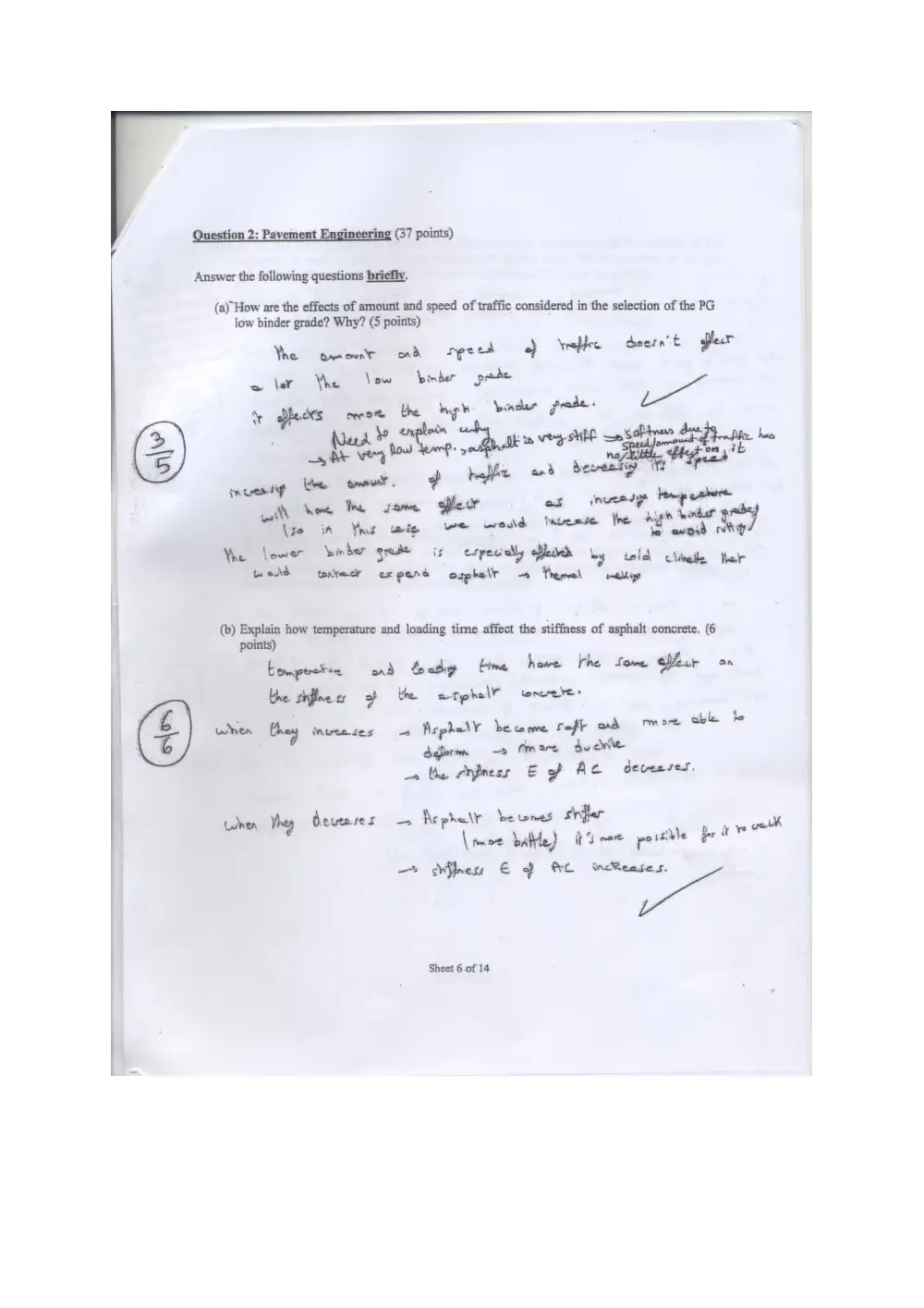
3) what happens to bitumen asphalt when temperature increases
4)3 reasons why we dont use cutbacks anymore
5) distresses
6)what is the difference between asphalt mixture and asphalt binder
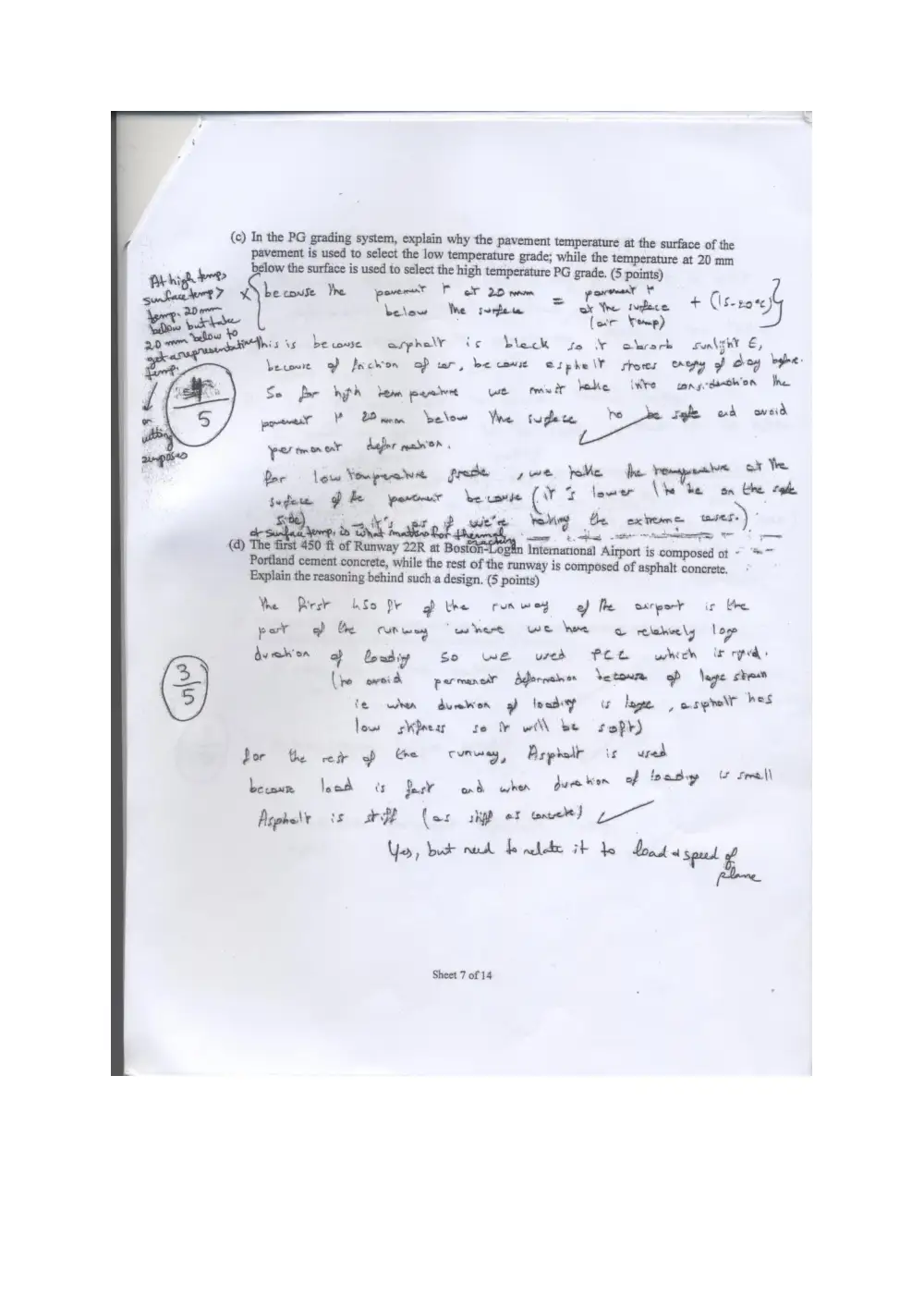
7)in a gas station do we use PCC or AC for pavement why?
8)how does emulsifiers work
9)talk briefly about fractional distillation
10) molecular structure of asphalt and which one of these components evaporates when there is
high temperature
11)what is the reason behind the curves found in pavement on a traffic light or a parking spot
12) 3 reasons: why we have shoving and corrugation in Lebanese roads
13) what is superpave
14) bya3tike PG 60 -14 massalan w byes2alik eno kel degit chou ya3ne
15) why is latitude a factor that effects pavements temperature
16) how can we measure the constructability of AC
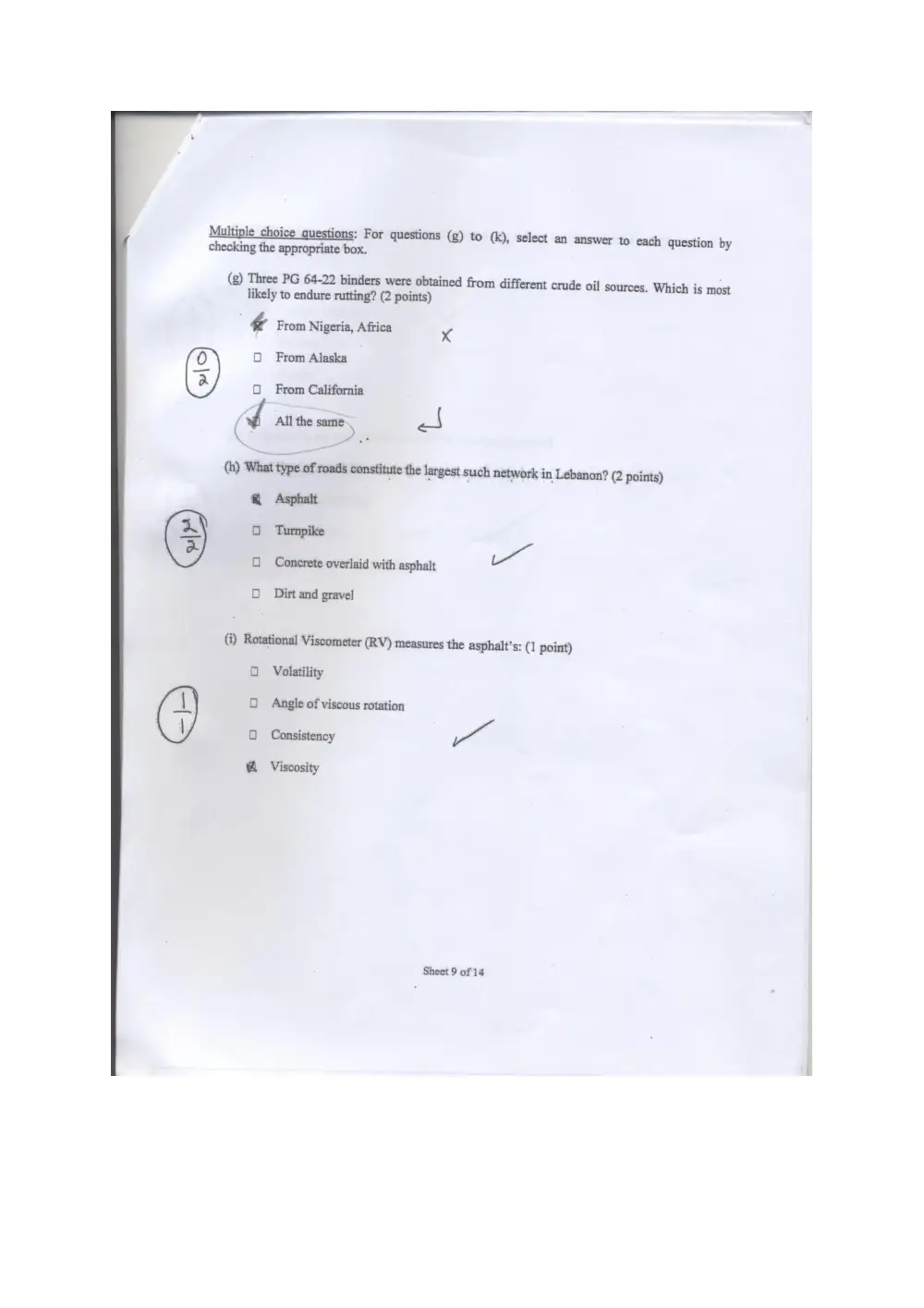
17) why is RV done on 135 c and 165 c
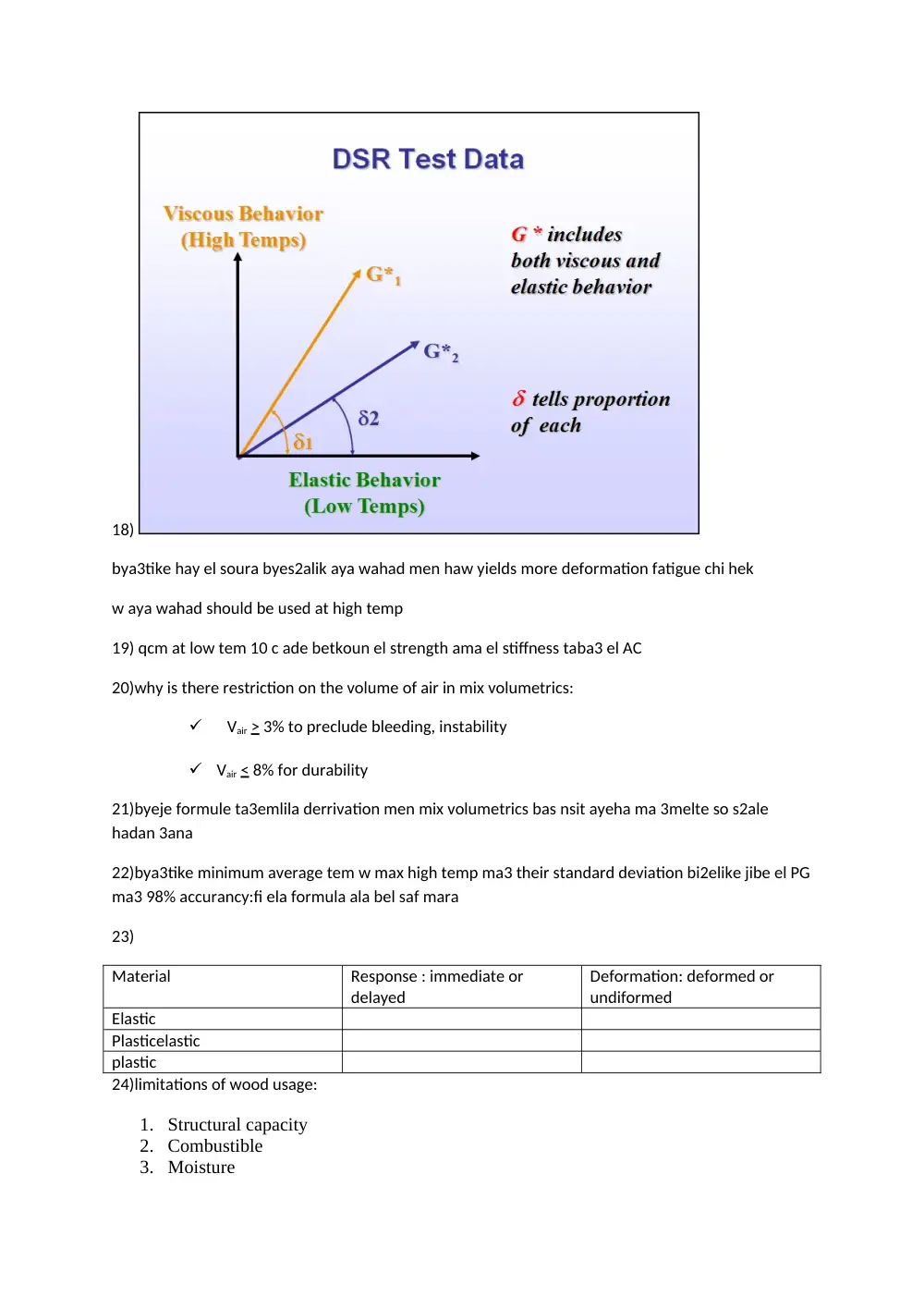
18)
bya3tike hay el soura byes2alik aya wahad men haw yields more deformation fatigue chi hek
w aya wahad should be used at high temp
19) qcm at low tem 10 c ade betkoun el strength ama el stiffness taba3 el AC
20)why is there restriction on the volume of air in mix volumetrics:
Vair > 3% to preclude bleeding, instability
Vair < 8% for durability
21)byeje formule ta3emlila derrivation men mix volumetrics bas nsit ayeha ma 3melte so s2ale
hadan 3ana
22)bya3tike minimum average tem w max high temp ma3 their standard deviation bi2elike jibe el PG
ma3 98% accurancy:fi ela formula ala bel saf mara
23)
Material
Response : immediate or
delayed
Deformation: deformed or
undiformed
Elastic
Plasticelastic
plastic
24)limitations of wood usage:
1. Structural capacity
2. Combustible
3. Moisture
4. Defects
5. Shrinkage
6. Decay
7. Destruction
25) cedar is what type of wood?
26) Water exists in 2 ways:
Free water in cell cavity
Bound or adsorbed water in cell wall
27) what is the difference between EMC and fiber saturation BTW EMC ya3ne equilibrium moisture
content ma khas einstein
28) Find density of Red Oak at 30% MC w bya3tike specific gravity
29) Kamen chi VFA chi hek taba3 el mix medre chou
30) Change this chemical composite to produce steel of different characteristics, such as hardness,
tensile strength, and toughness. byes2alik chi eno change bel carbon b ghayer bel strenght taba3 el
material bet2elilo eh
31)byejik graphe fi 2 curves ; byes2alik aya material has more
1 strength 2 stiffness 3 more elastic
32)what is the penetration grade used in lebanon
33)bya3tike penetration grade 200/300 w 40/50 byes2alik chou l fare2 bayneton w ayeha should be
used at high temperature
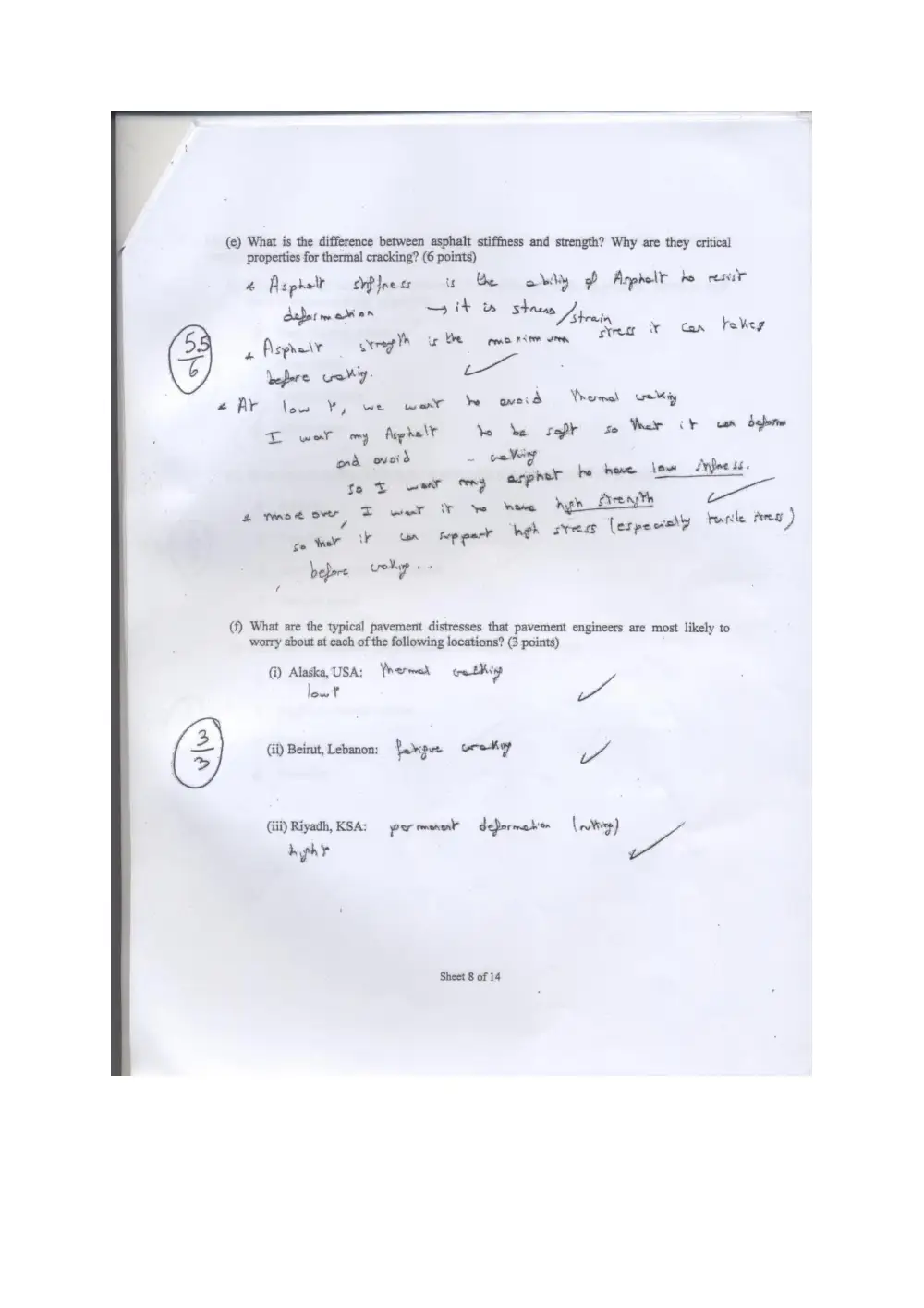
34)what different tests to measure AC strength and stiffness
35) chi whats the difference between direct tensile test for AC w test tene nsit chou essmo
36) 3 arguments that the penetration test in empirical
37)true or false: 3an el lignin taba3 el wood w chi 2 gher bas nsit chou keno
38)ekher kam sou2al tick the right answer haw haynin eno ma badon chi
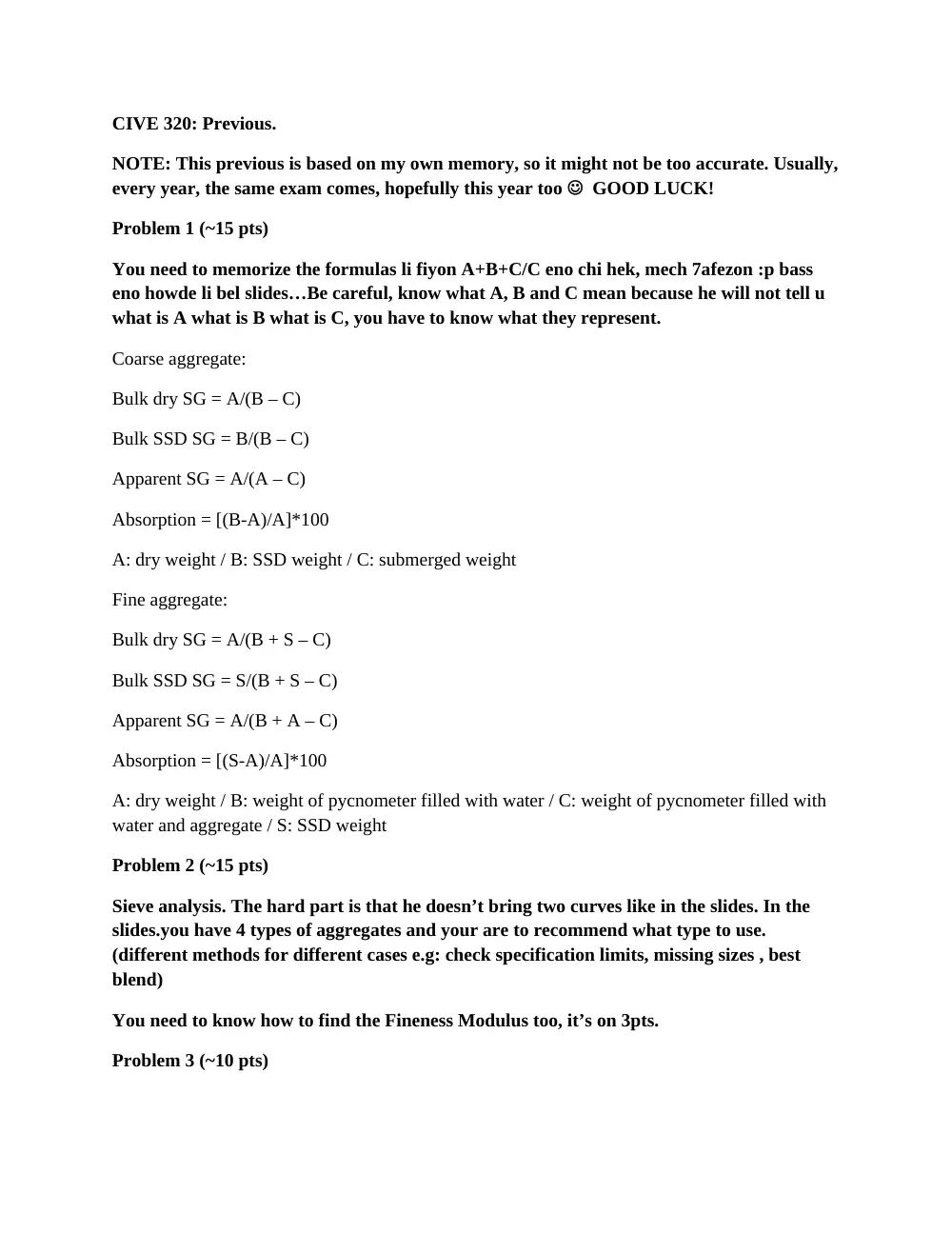
CIVE 320: Previous.
NOTE: This previous is based on my own memory, so it might not be too accurate. Usually,
every year, the same exam comes, hopefully this year too GOOD LUCK!
Problem 1 (~15 pts)
You need to memorize the formulas li fiyon A+B+C/C eno chi hek, mech 7afezon :p bass
eno howde li bel slides…Be careful, know what A, B and C mean because he will not tell u
what is A what is B what is C, you have to know what they represent.
Coarse aggregate:
Bulk dry SG = A/(B – C)
Bulk SSD SG = B/(B – C)
Apparent SG = A/(A – C)
Absorption = [(B-A)/A]*100
A: dry weight / B: SSD weight / C: submerged weight
Fine aggregate:
Bulk dry SG = A/(B + S – C)
Bulk SSD SG = S/(B + S – C)
Apparent SG = A/(B + A – C)
Absorption = [(S-A)/A]*100
A: dry weight / B: weight of pycnometer filled with water / C: weight of pycnometer filled with
water and aggregate / S: SSD weight
Problem 2 (~15 pts)
Sieve analysis. The hard part is that he doesn’t bring two curves like in the slides. In the
slides.you have 4 types of aggregates and your are to recommend what type to use.
(different methods for different cases e.g: check specification limits, missing sizes , best
blend)
You need to know how to find the Fineness Modulus too, it’s on 3pts.
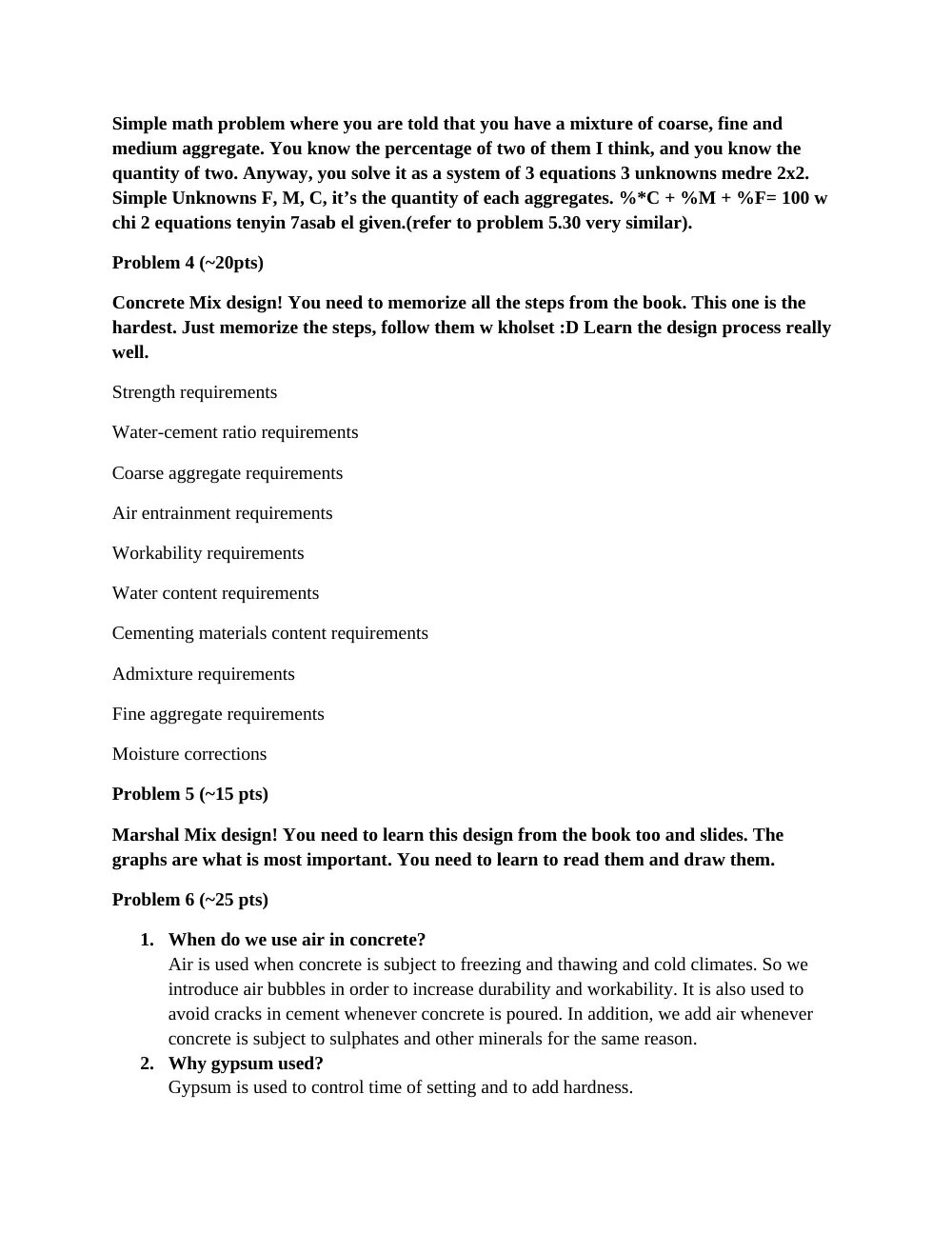
Problem 3 (~10 pts)
Simple math problem where you are told that you have a mixture of coarse, fine and
medium aggregate. You know the percentage of two of them I think, and you know the
quantity of two. Anyway, you solve it as a system of 3 equations 3 unknowns medre 2x2.
Simple Unknowns F, M, C, it’s the quantity of each aggregates. %*C + %M + %F= 100 w
chi 2 equations tenyin 7asab el given.(refer to problem 5.30 very similar).
Problem 4 (~20pts)
Concrete Mix design! You need to memorize all the steps from the book. This one is the
hardest. Just memorize the steps, follow them w kholset :D Learn the design process really
well.
Strength requirements
Water-cement ratio requirements
Coarse aggregate requirements
Air entrainment requirements
Workability requirements
Water content requirements
Cementing materials content requirements
Admixture requirements
Fine aggregate requirements
Moisture corrections
Problem 5 (~15 pts)
Marshal Mix design! You need to learn this design from the book too and slides. The
graphs are what is most important. You need to learn to read them and draw them.
Problem 6 (~25 pts)
1. When do we use air in concrete?
Air is used when concrete is subject to freezing and thawing and cold climates. So we
introduce air bubbles in order to increase durability and workability. It is also used to
avoid cracks in cement whenever concrete is poured. In addition, we add air whenever
concrete is subject to sulphates and other minerals for the same reason.
2. Why gypsum used?
Gypsum is used to control time of setting and to add hardness.
3. Define equilibrium moisture content in wood?
EMC is the moisture content at which wood neither gains nor loses moisture relative to
surrounding air.
4. Three differences between Marshall and super pave
1. Design methods.
2. Design specifications.
3. Acceptance criteria.
4. Super pave needs more equipment
5. Super pave is better because it takes more things into consideration giving a more
durable mix.
5. Why does decreasing w/c ratio increase strength in concrete
This is because large amount of water may result in disintegration of aggregate
components. Also, water that is not consumed by hydration reaction may leave concrete
as it hardens, resulting in microscopic pores that reduce final strength of concrete. In
addition, it may result in internal cracks and visible fractures.
6. Consistency: cement that is not consistent can still be used when
Check number 11
7. All admixtures
Admixtures are added to cement to give it certain properties.
1. Air entrainers (produce tiny air bubbles to provide space for water to expand upon
freezing)
2. Water reducers (reduce amount of water for workability and increase mobility of
cement particles)
3. Super plasticizers (reduce amount of water for workability and increase flow of
fresh concrete)
4. Retarders (delay initial set of concrete and provide time for special finishes)
5. Accelerators (develop early strength of concrete at fast rate and reduce curing
time)
6. Fine minerals (improve characteristics of plastic and hardened concrete)
7. Specialty admixtures (workability agents – bonding agents – coloring agents)
8. All types of cement plus function plus use
1. Type I (normal): Function (normal use – general condition – general concrete
work – other types not needed) – use (floors – reinforced concrete – pavements)
2. Type II (MSR): Function (protection against MS exposure – moderate HH) – use
(large piers – heavy abutments – retaining walls – MS exposure)
3. Type III (HES): Function (fast reaction - structure needs to be put in service as
soon as possible – reduce time for controlled curing) – use (fast track
construction)
4. Type IV (LHH): Function (careful control of HH) – use (large dams – mass of
structure)
5. Type V (HSR): Function (protection against HS exposure) – use (HS exposure)
9. Why does round aggregate need less water?
When using round aggregate, we need less water because roundness increases
workability and decreases strength, so decreasing water amount will compensate for the
decreased strength while keeping the same workability as if regular gravel were used.
10. Do we use asphalt in cold or hot weather? Explain
Hot areas: hard asphalt
Cold areas: soft asphalt
11. Why can HES cement (type III) have more normal consistency than others?
This is because type III is made of smaller particles which have a higher surface area so
more water is needed so that particles can get wet from all sides.
12. What is curing and why is it important?
Curing is the process of maintaining satisfactory moisture content and temperature in
concrete allowing continuous hydration and gain in concrete strength.
Without it, we lose 50% of the strength in 7 days. So we have to keep mixing water and
cement.
13. Why does air entrained concrete need less water than non-air entrained concrete?
Air entrained concrete have air bubble in them so less friction which leads to less amount
of water.
14. What is the importance of hollow blocks, mortar, and grout?
1. Hollow blocks: isolate sound and heat – reduce weight – reduce cost.
2. Mortar: bond masonry units – seating material for units – level and seat units.
3. Grout: bond masonry units – increase bearing area – increase fire resistance.
15. What are the steps to build a wall?
1. Put base (slab) below wall having twice the width of blocks used.
2. Put a column every 20 meters to stabilize wall so it doesn’t fall.
3. Tie threads together from corner to corner to have a straight wall.
4. Put pieces of wood to separate blocks, having same width as mortar, before
sticking blocks together.
5. Stick blocks together along with mortar.
6. Check leveling horizontally and diagonally.
7. Add reinforcements to resist lateral loads.
16. Define stiffness, ductility, malleability, brittleness, hardness, toughness
1. Stiffness: property by which a material can resist deformation.
2. Ductility: ability of a material to withstand considerable plastic deformation
without breaking when subjected to action of tensile stress beyond yield point.
3. Malleability: same as ductility but under compression.
4. Brittleness: absence of ductility and malleability. Small plastic deformation leads
to rupture. Ultimate strength is fracture strength or yield strength(whichever is
higher).
5. Hardness: ability of a material to resist abrasion and indentation.
6. Toughness: property of a material to absorb energy at high stress without fracture.
Measure of toughness is amount of energy that a unit volume of the material has
absorbed after being stressed up to fracture point. Measure of toughness is area
under stress.
17. What do we do if flash point = 130o?
We use cutback (volatile liquid) or we add water with an emulsifying agent instead of
heating asphalt.