
CIVE 320 Chapter 3.2, Spring 2016
American University of Beirut · Construction Materials and Technology · 9 pages


More CIVE 320 files
Show the text of this chapter
Faculty of Engineering and Architecture
American University of Beirut
Dept. of Civil and Environmental Engineering
Concrete Mixing-Placing-Handling
• Proper Batching
– Batching is measuring and introducing the concrete ingredients
into the mixer. Batching by wt. is more accurate than by volume
• Mixing
– Concrete should be mixed thoroughly either in a mixer or by hand,
until it becomes uniform in appearance. Mechanical mixers
include on-site mixers and central mixers in ready-mix plants.
Mixing time and number of revolutions vary with the size and type
of the mixer. Mixers are charged with 10% of the water, followed
by uniform additions of solids and 80% of water, finally the
remainder of water is added. The mixers capacity varies from 1.5
to 9 m3.
Faculty of Engineering and Architecture
American University of Beirut
Dept. of Civil and Environmental Engineering
Concrete Mixing-Placing-Handling
•
Ready-Mixed Concrete (3 methods)
1.
Central-mixed concrete is mixed completely in a stationary mixer
and delivered in an agitator truck (2 to 6 rpm)
2.
Shrink-mixed concrete is partially mixed in a stationary mixer and
completed in a mixer truck (4 to 16 rpm)
3.
Truck-mixed concrete is mixed completely in a mixer truck (4 to 16
rpm)
The number of revolutions in a truck is limited in order to avoid
segregation. And the concrete should be discharged on site within
60 minutes even if retarders are used (ASTM C94).
•
Mobile Batch Mixer: concrete mixed in a mobile batch mixer
on site
•
Depositing Concrete: concrete should be deposited continuously as
close as possible to its final position
Faculty of Engineering and Architecture
American University of Beirut
Dept. of Civil and Environmental Engineering
Concrete Mixing-Placing-Handling
Placing concrete using mixers, pumps. Finishing using long-hand straightedge.
Ready-mix plant and mixer. Continuous
concrete placement for pavements.
Faculty of Engineering and Architecture
American University of Beirut
Dept. of Civil and Environmental Engineering
Concrete Mixing-Placing-Handling
•
Pumped Concrete: frequently used for large construction projects.
Careful attention must be exercised to ensure well-mixed concrete
with proper workability. The slump should be between 40 to 100mm.
•
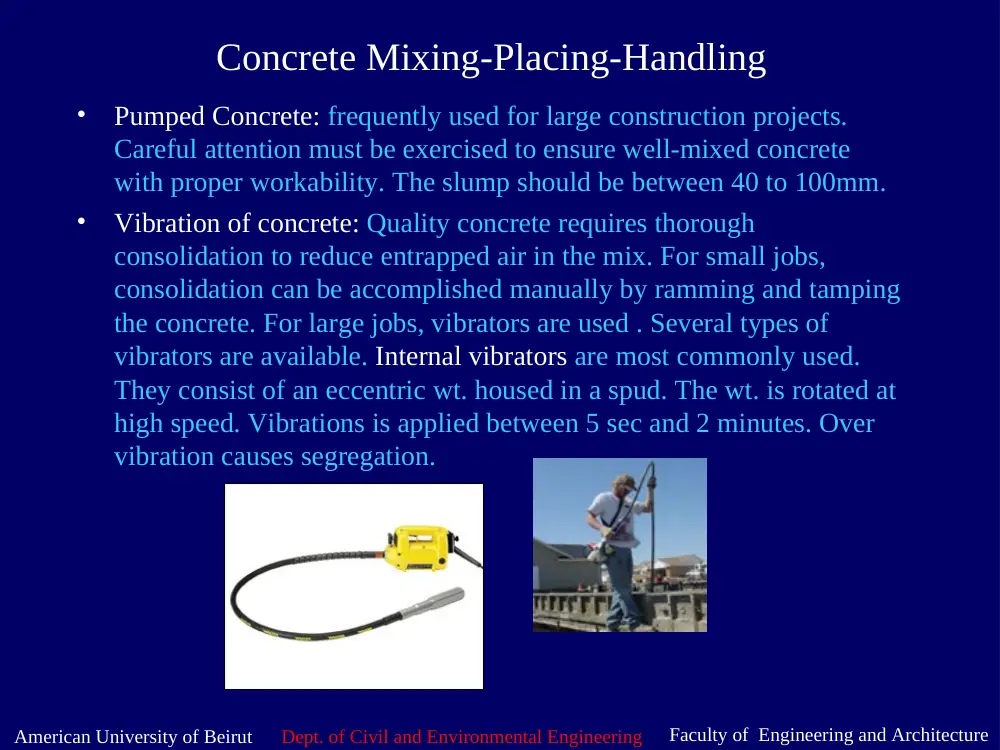
Vibration of concrete: Quality concrete requires thorough
consolidation to reduce entrapped air in the mix. For small jobs,
consolidation can be accomplished manually by ramming and tamping
the concrete. For large jobs, vibrators are used . Several types of
vibrators are available. Internal vibrators are most commonly used.
They consist of an eccentric wt. housed in a spud. The wt. is rotated at
high speed. Vibrations is applied between 5 sec and 2 minutes. Over
vibration causes segregation.
Faculty of Engineering and Architecture
American University of Beirut
Dept. of Civil and Environmental Engineering
Concrete Mixing-Placing-Handling
•
Precautions for Mixing water: water-cement ratio plays an important role
in the concrete quality. Water content must be carefully controlled on site.
Water should not be added during transport. The amount of water must not
exceed the mix design specifications.
•
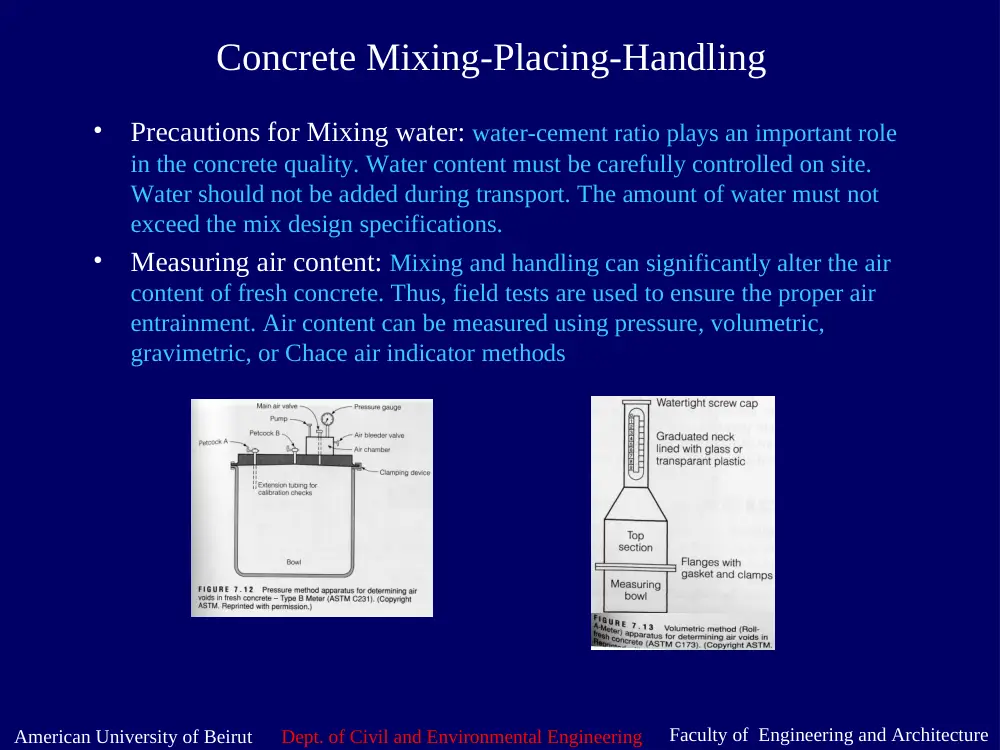
Measuring air content: Mixing and handling can significantly alter the air
content of fresh concrete. Thus, field tests are used to ensure the proper air
entrainment. Air content can be measured using pressure, volumetric,
gravimetric, or Chace air indicator methods
Faculty of Engineering and Architecture
American University of Beirut
Dept. of Civil and Environmental Engineering
Concrete Mixing-Placing-Handling
•
Spreading and Finishing Concrete: Different methods are available to
spread and finish concrete, depending on the nature and equipment
availability. Tools and equipment used include hand floats, power floats,
darbies, straightedges, trowels, vibratory screed, and slip forms.
Hand Floats
Slip Form
Faculty of Engineering and Architecture
American University of Beirut
Dept. of Civil and Environmental Engineering
Concrete Mixing-Placing-Handling
•
Curing: is the process of maintaining satisfactory moisture content and
temperature in the concrete for a definite period of time. Hydration of
cement is a long-term process and requires water and proper temperature.
Therefore, curing allows continuous hydration and, consequently,
continued gain in concrete strength. Increasing temperature increases the
rate of hydration and, consequently, the rate of strength development.
Temperatures below 10oC are unfavorable for hydration and should be
avoided. Curing should start after the final set of the cement. If not cured,
concrete will shrink, causing cracks.
•
Curing can be performed by any of the following methods:
– Maintain the presence of water in the concrete during early ages by:
pounding or immersion, spraying or fogging, and wet coverings.
– Preventing loss of mixing water from concrete by sealing the surface by:
impervious papers or plastic sheets, membrane-forming compounds, and
leaving the forms in place.
– Accelerating the strength gain by supplying heat and additional moisture
to the concrete by: steam curing, insulating blankets or covers, and
various heating techniques
Faculty of Engineering and Architecture
American University of Beirut
Dept. of Civil and Environmental Engineering
Concrete Mixing-Placing-Handling
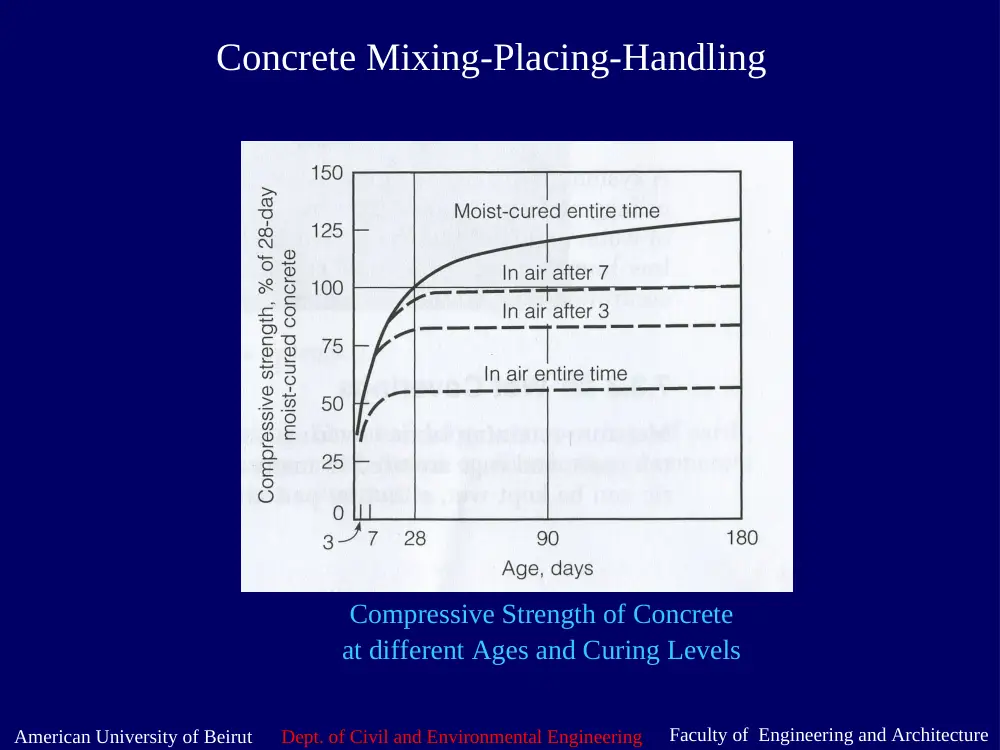
Compressive Strength of Concrete
at different Ages and Curing Levels
Faculty of Engineering and Architecture
American University of Beirut
Dept. of Civil and Environmental Engineering
Concrete Mixing-Placing-Handling
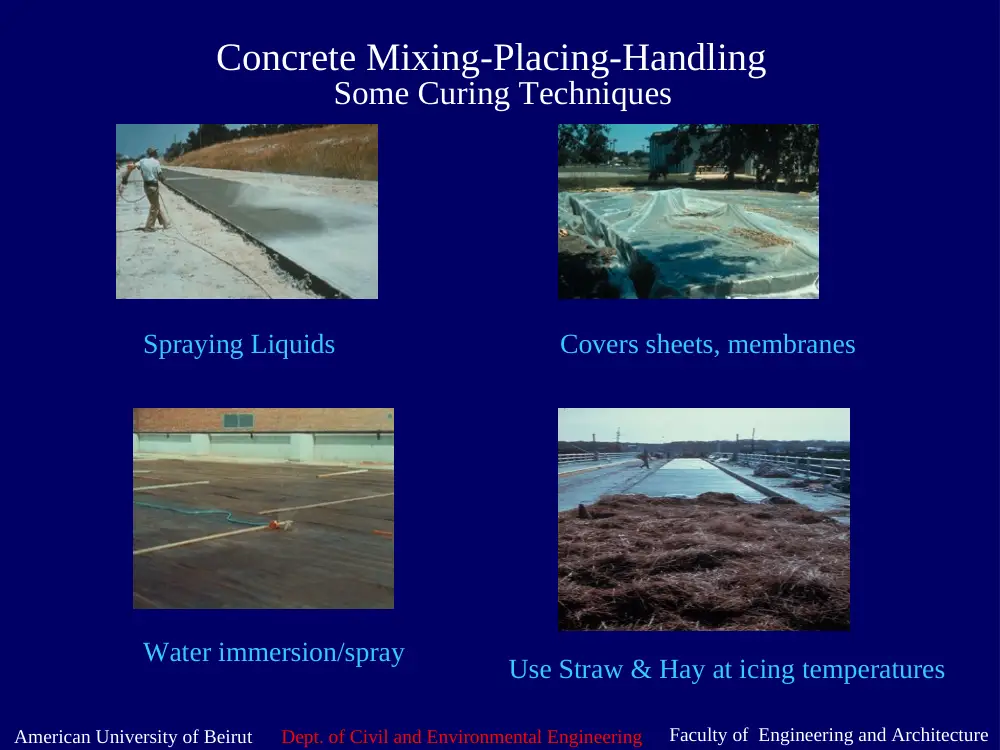
Some Curing Techniques
Spraying Liquids
Covers sheets, membranes
Water immersion/spray
Use Straw & Hay at icing temperatures