
CIVE 320 Chapter 2, Spring 2016
American University of Beirut · Construction Materials and Technology · 27 pages
Showing the first 10 of 27 pages. Download the PDF to see all of it.
More CIVE 320 files
- Chapter 1 · Spring 2016ChapterView
- Chapter 3.1 · Spring 2016ChapterView
- Chapter 3.2 · Spring 2016ChapterView
- Chapter 5.1 · Spring 2016ChapterView
- Chapter 5.2 · Spring 2016ChapterView
- Chapter 6 · Spring 2016ChapterView
- Syllabus · Spring 2016LabView
- Final + Midterm Previouses · Fall 2015Final examView
Show the text of this chapter
Faculty of Engineering and Architecture
American University of Beirut
Dept. of Civil and Environmental Engineering
Cement
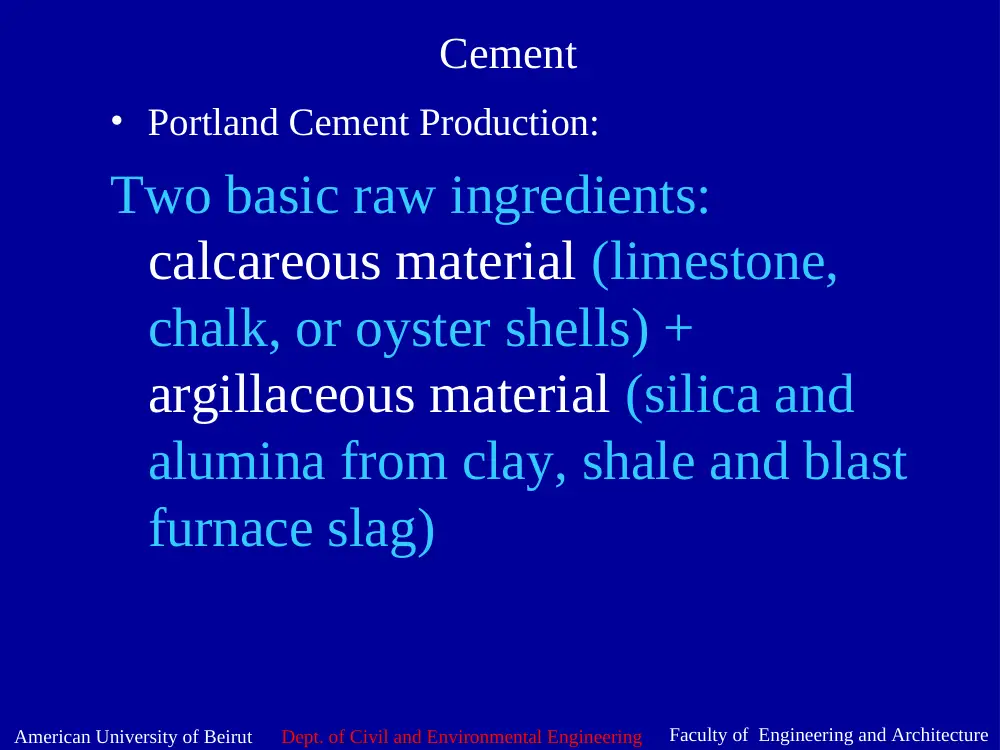
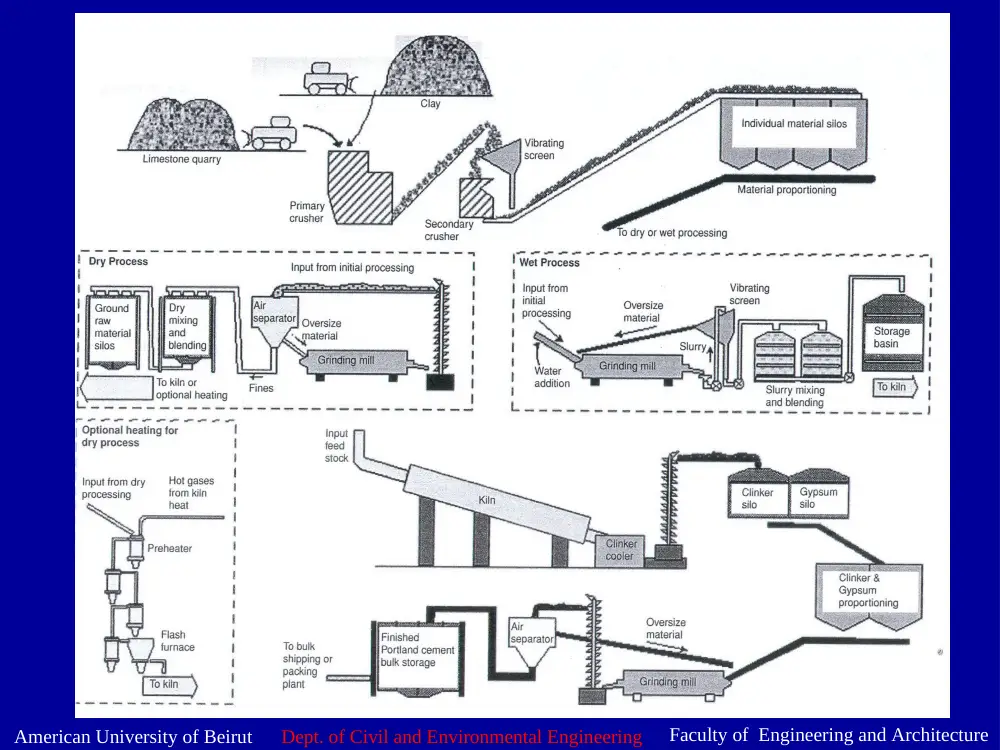
• Portland Cement Production:
Two basic raw ingredients:
calcareous material (limestone,
chalk, or oyster shells) +
argillaceous material (silica and
alumina from clay, shale and blast
furnace slag)
Faculty of Engineering and Architecture
American University of Beirut
Dept. of Civil and Environmental Engineering
Faculty of Engineering and Architecture
American University of Beirut
Dept. of Civil and Environmental Engineering
Cement
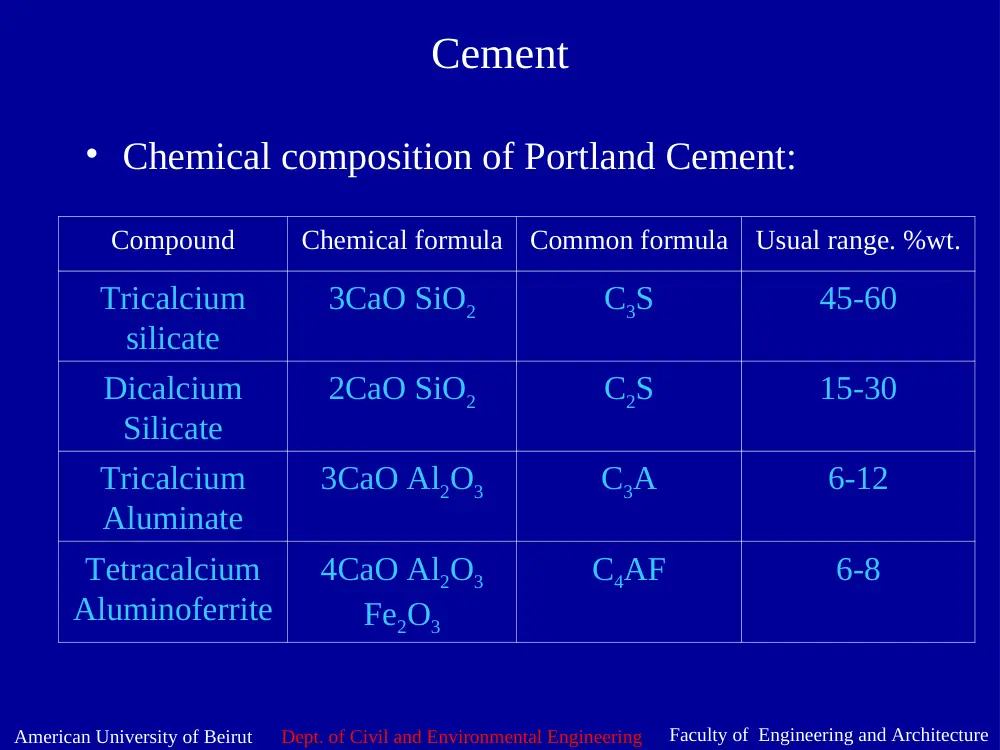
• Chemical composition of Portland Cement:
Compound
Chemical formula
Common formula
Usual range. %wt.
Tricalcium
silicate
3CaO SiO2
C3S
45-60
Dicalcium
Silicate
2CaO SiO2
C2S
15-30
Tricalcium
Aluminate
3CaO Al2O3
C3A
6-12
Tetracalcium
Aluminoferrite
4CaO Al2O3
Fe2O3
C4AF
6-8
Faculty of Engineering and Architecture
American University of Beirut
Dept. of Civil and Environmental Engineering
Cement
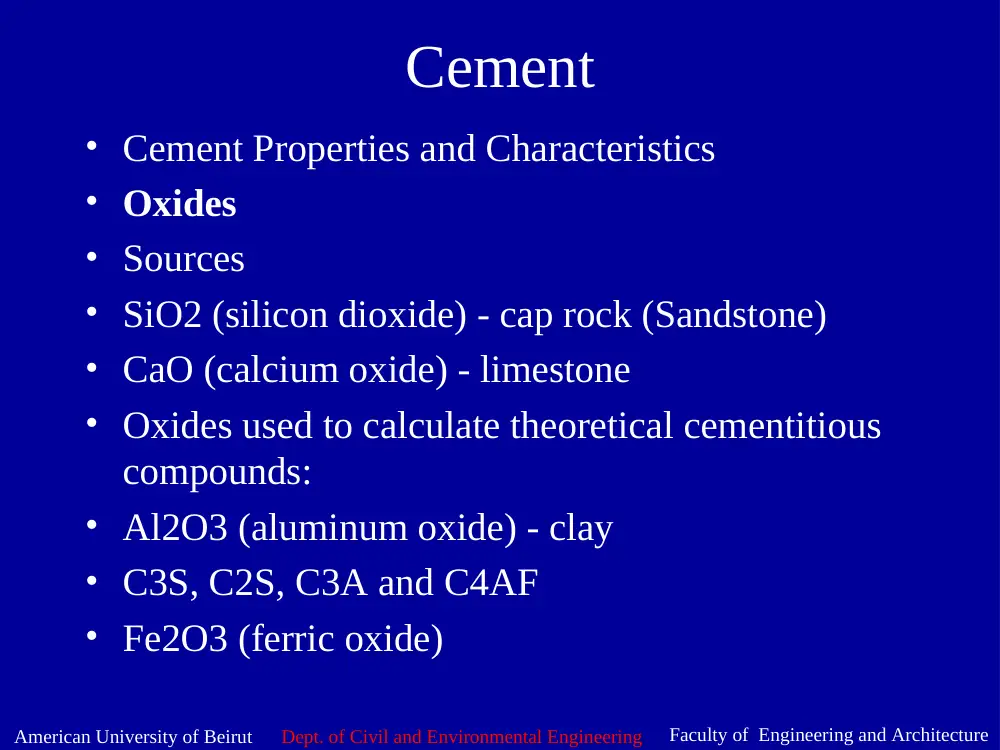
• Cement Properties and Characteristics
• Oxides
• Sources
• SiO2 (silicon dioxide) - cap rock (Sandstone)
• CaO (calcium oxide) - limestone
• Oxides used to calculate theoretical cementitious
compounds:
• Al2O3 (aluminum oxide) - clay
• C3S, C2S, C3A and C4AF
• Fe2O3 (ferric oxide)
Faculty of Engineering and Architecture
American University of Beirut
Dept. of Civil and Environmental Engineering
Cement
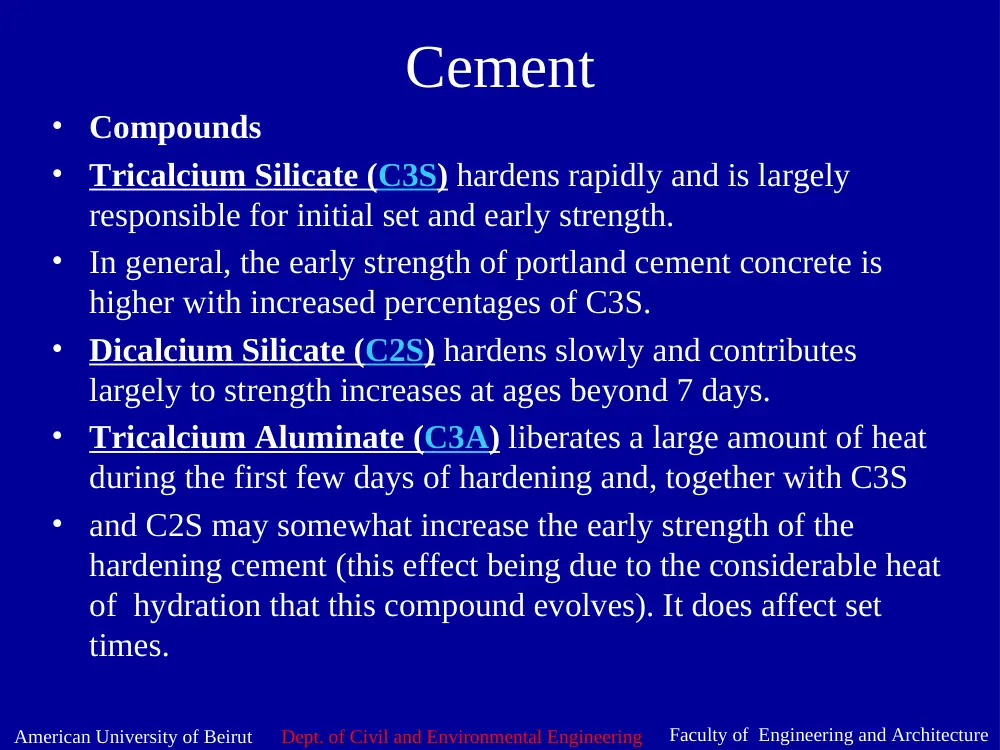
• Compounds
• Tricalcium Silicate (C3S) hardens rapidly and is largely
responsible for initial set and early strength.
• In general, the early strength of portland cement concrete is
higher with increased percentages of C3S.
• Dicalcium Silicate (C2S) hardens slowly and contributes
largely to strength increases at ages beyond 7 days.
• Tricalcium Aluminate (C3A) liberates a large amount of heat
during the first few days of hardening and, together with C3S
• and C2S may somewhat increase the early strength of the
hardening cement (this effect being due to the considerable heat
of hydration that this compound evolves). It does affect set
times.
Faculty of Engineering and Architecture
American University of Beirut
Dept. of Civil and Environmental Engineering
Cement
• Tetracalcium Aluminoferrite (C4AF) contributes
very slightly to strength gain. However, acts as a flux
during manufacturing. Contributes to the color effects
that makes cement grey.
Faculty of Engineering and Architecture
American University of Beirut
Dept. of Civil and Environmental Engineering
Hydration of cement
• Hydration of cement • When Portland
cement is mixed with water its chemical
compound constituents undergo a series of
chemical reactions that cause it to harden.
This chemical reaction with water is called
"hydration". Each one of these reactions
occurs at a different time and rate. Together,
the results of these reactions determine how
Portland cement hardens and gains strength.
Faculty of Engineering and Architecture
American University of Beirut
Dept. of Civil and Environmental Engineering
Hydration of cement
• OPC hydration • Hydration starts as soon as
the Hydration starts as soon as the cement
and water are mixed.
• The rate of hydration and the heat liberated
by the reaction of each compound is
different.
• Each compound produces different products
when it hydrates. •
Faculty of Engineering and Architecture
American University of Beirut
Dept. of Civil and Environmental Engineering
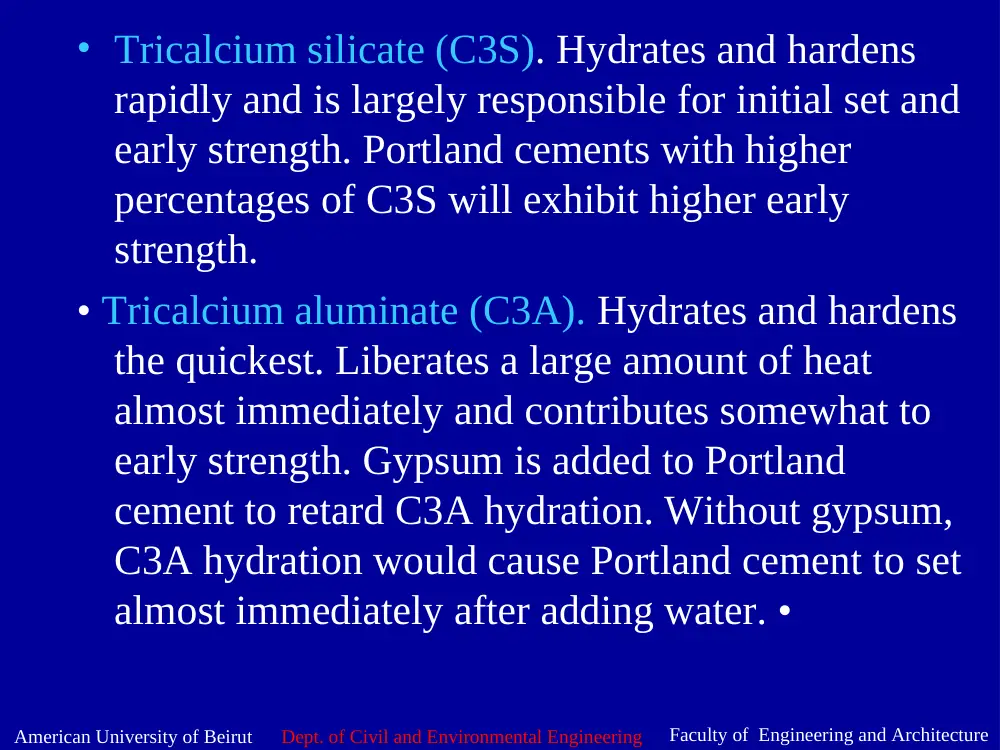
• Tricalcium silicate (C3S). Hydrates and hardens
rapidly and is largely responsible for initial set and
early strength. Portland cements with higher
percentages of C3S will exhibit higher early
strength.
• Tricalcium aluminate (C3A). Hydrates and hardens
the quickest. Liberates a large amount of heat
almost immediately and contributes somewhat to
early strength. Gypsum is added to Portland
cement to retard C3A hydration. Without gypsum,
C3A hydration would cause Portland cement to set
almost immediately after adding water. •
Faculty of Engineering and Architecture
American University of Beirut
Dept. of Civil and Environmental Engineering
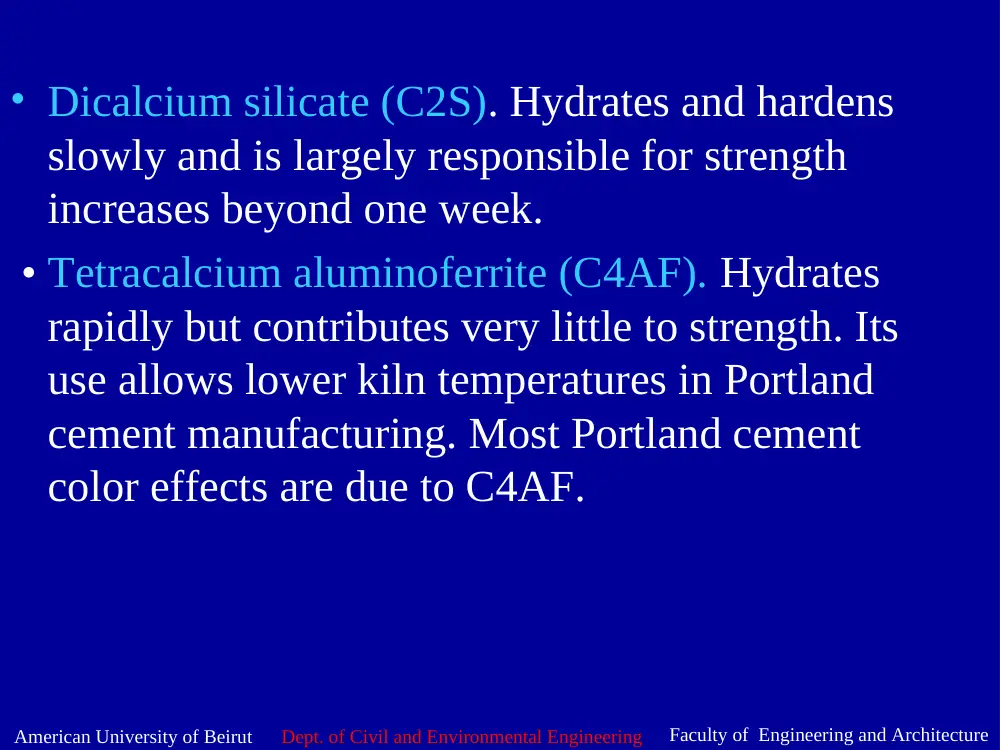
• Dicalcium silicate (C2S). Hydrates and hardens
slowly and is largely responsible for strength
increases beyond one week.
• Tetracalcium aluminoferrite (C4AF). Hydrates
rapidly but contributes very little to strength. Its
use allows lower kiln temperatures in Portland
cement manufacturing. Most Portland cement
color effects are due to C4AF.
Faculty of Engineering and Architecture
American University of Beirut
Dept. of Civil and Environmental Engineering
Compounds
Reaction
Rate
Amount of
Liberated
Strength
Heat
Liberation
C3S
Moderate Moderate
High
High
C2S
Slow
Low
Low
initially,
high later
Low
C3A
Fast
Very high
Low
Very high
C4AF
Moderate Moderate
Low
Moderate
Faculty of Engineering and Architecture
American University of Beirut
Dept. of Civil and Environmental Engineering
Cement
Faculty of Engineering and Architecture
American University of Beirut
Dept. of Civil and Environmental Engineering
Cement
• Main Types of Portland Cement:
Type
Name
Application
I
Normal
General concrete work when the special properties of other types
are not needed. Suitable for floors, reinforced structures,
pavements,…etc
II
Moderate
Sulfate
resistance
Protection against moderate sulfate exposure. 0.1-0.2% wt. Water
soluble sulfate in soil or 150-1500ppm sulfate in water
(seawater). Can be specified with a moderate heat of hydration
making it suitable for large piers, heavy abutments, and retaining
walls. Also for concrete in warm weather.
III
High early
strength
Used for fast track construction, forms need to be removed as
soon as possible, or structure need to be put in service as soon as
possible. In cold weather reduces time for controlled curing.
IV
Low Heat of
Hydration
Used when mass of structure, careful control of heat of hydration,
such as large dams.
V
High Sulfate
resistance
Protection from severe sulfate exposure 0.2-2.0% wt. Water-
soluble sulfate in soils or 1500-10,800ppm sulfate in water.
Faculty of Engineering and Architecture
American University of Beirut
Dept. of Civil and Environmental Engineering
Cement
Required chemical composition and fineness for Portland Cement (ASTM C150)
Type
C3S
C2S
C3A
C4AF
Blaine
Fineness,
m2/kg
I
55
19
10
7
380
II
51
24
6
11
380
III
56
19
10
7
540
IV
28
49
4
12
380
V
38
43
4
9
380
Faculty of Engineering and Architecture
American University of Beirut
Dept. of Civil and Environmental Engineering
Cement
• Types of Portland Cement (cont’d):
Air entrainers can be added to type I, II, III cement to get type
IA, IIA, IIIA.
Other types such as: white Portland cement, masonry cement,
expansive cements,…etc
I
IA
II
IIA
III
IIIA
IV
V
Air content
%vol
min-max
x-12
16-22
x-12
16-22
x-12
16-22
x-12
X-12
Fineness
m2/kg, Air
permeability
280
280
280
280
-
-
280
280
Time of
setting,
VICAT,
Initial-Final
45-375
45-375
45-375
45-375
45-375
45-375
45-375
45-375
Specifications of Standard Properties of Portland Cement (ASTM C150)
Faculty of Engineering and Architecture
American University of Beirut
Dept. of Civil and Environmental Engineering
Cement
• Hydration of Portland Cement (cont’d):
Primary Chemical reaction during Cement Hydration
2 (3CaO SiO2) + 6H2O = 3CaO 2SiO2 3H2O + 3 Ca(OH)2
Tricalcium silicate Water Calcium silicate Hydrates Calcium hydroxide
2 (2CaO SiO2) + 4H2O = 3CaO 2SiO2 3H2O + 3 Ca(OH)2
Dicalcium silicate Water Calcium silicate Hydrates Calcium hydroxide
3CaO Al2O3 + 12H2O + Ca(OH)2 = 3CaO AL2O3 Ca(OH)2 12H2O
Tricalcium aluminate Water Calcium hydroxide Calcium aluminate hydrate
4CaO Al2O3 Fe2O3 + 10H2O + 2Ca(OH)2 = 6CaO Al2O3 Fe2O3 12H2O
Tetracalcium aluminoferrite Water Calcium hydroxide Calcium aliminoferrite hydrate
3CaO Al2O3 + 10H2O + CaSO4 2H2O = 3CaO Al2O3 CaSO4 12H2O
Tricalcium aluminate water Gypsum Calcium monosulfoaluminate hydrate
Faculty of Engineering and Architecture
American University of Beirut
Dept. of Civil and Environmental Engineering
Cement
• Fineness of Portland Cement:
Fineness is important. Since hydration starts at the surface of
cement particles. The larger the surface area the faster the
hydration. i.e finer material results in faster strength
development. Finesses is related to productivity cost and
detrimental to concrete quality.
Blaine air permeability Test (ASTM C204) or
% passing the 0.045mm sieve (No.325) (ASTM C430)
• Hydration of Portland Cement:
Hydration is a chemical reaction between cement particles
and water. The solidification of the cement paste relates to
the time of setting.
Faculty of Engineering and Architecture
American University of Beirut
Dept. of Civil and Environmental Engineering
Cement
• Properties of Hydrated Cement: Quality control issue
– Setting: stiffening of the cement paste or change from
plastic to solid state.
• Setting = Final - Initial setting levels
• Vicat Test (ASTM C191) or Gillmore (ASTM C206)
– Soundness: ability of cement paste to retain its volume after
setting.
• Le Châtelier Test
– Compressive Strength: measured by preparing 50 mm cubes and
subject them to compression (ASTM C109). Minimum values of
compressive strength in ASTM C150
Faculty of Engineering and Architecture
American University of Beirut
Dept. of Civil and Environmental Engineering
Cement
• Water-Cement Ratio: (Abrams 1918) w/c affects the
concrete quality (strength and other desirable properties).
Hydration requires 0.22 – 0.25 kg water per 1 kg cement.
Concrete require excess moisture, beyond hydration, for
workability.
As w/c increases. Concrete porosity and permeability
increase, the strength decreases.
Low w/c increases the resistance to weathering, provides
good bond between concrete layers, and between concrete
and steel reinforcement, and limits volume change due to
wetting and drying.
Faculty of Engineering and Architecture
American University of Beirut
Dept. of Civil and Environmental Engineering
Cement
• Water-Cement Ratio (cont’d):
ksi
10
20
30
40
1
2
3
4
5
6
0.5
0.6
0.4
0
28-day
7-day
3-day
1-day
MPa
ksi
10
20
30
40
1
2
3
4
5
6
28-day
MPa
7-day
3-day
1-day
0.5
0.6
0.4
w/c , air-entrained
concrete
w/c , non-air-entrained
concrete
Cylinders 15x30 cms
Type I, 21oC cured
Faculty of Engineering and Architecture
American University of Beirut
Dept. of Civil and Environmental Engineering
Cement
Specifications of Standard Properties of Portland Cement (ASTM C150)- (cont’d)
Comp.
Strength
MPa
I
IA
II
IIA
III
IIIA
IV
V
1 day
-
-
-
-
12.4
10.0
-
-
3 days
12.4
10.0
10.3
8.3
24.1
19.3
-
8.3
7 days
19.3
15.5
17.2
13.8
-
-
6.9
15.2
28 days
-
-
-
-
-
-
17.2
20.7
Faculty of Engineering and Architecture
American University of Beirut
Dept. of Civil and Environmental Engineering
Cement
• Admixtures for Concrete:
– Air entrainers
– Water reducers
– High-range water reducers—Superplasticizers
– Retarders
– Accelerators
– Fine minerals
– Specialty admixtures
Faculty of Engineering and Architecture
American University of Beirut
Dept. of Civil and Environmental Engineering
Cement
• Admixtures for Concrete (cont’d):
– Air entrainers: produce tiny air bubbles in hardened
concrete to provide space for water to expand upon
freezing. ( salts of wood, synthetic…)
– Water Reducers: minimize the amount of water
required for workability. Increase the mobility of
cement particles in the plastic mix. (no effect on slump,
increase strength, decrease cost using less cement)
– Superplasticizers: increase the flow of fresh concrete or
reduce the amount of water required.
– Retarders: delay the initial set of concrete ( offset the
effect of hot weather, allow for long distances
placement, provide time for special finishes)
Faculty of Engineering and Architecture
American University of Beirut
Dept. of Civil and Environmental Engineering
Cement
• Admixtures for Concrete (cont’d):
– Accelerators: develop early strength of concrete at a
faster rate than that developed in normal concrete. The
ultimate strength, however, is the same as in normal
concrete. (reduce curing time, increase rate of strength,
plug leaks under hydraulic pressure efficiently).
– Fine minerals: (waste from a production process)
improve the characteristics of both plastic and hardened
concrete ( cementitious, pozzolanic, …)
– Specialty Admixtures: workability agents, corrosion
inhibitators, damp proofing agents, permeability
reducing agents, pumping aids, bonding agents,
coloring agents,…etc.
Faculty of Engineering and Architecture
American University of Beirut
Dept. of Civil and Environmental Engineering
Test
ASTM No.
Limits
Procedure
Portland Cement
ASTM C150
This specification covers eight types of portland cement,
as follows (see Note 2):
1.1.1 Type I—For use when the special properties
specified for any other type are not required.
1.1.2 Type IA—Air-entraining cement for the same uses
as Type I, where air-entrainment is desired.
1.1.3 Type II—For general use, more especially when
moderate
sulfate resistance or moderate heat of hydration is desired.
1.1.4 Type IIA—Air-entraining cement for the same uses
as Type II, where air-entrainment is desired.
1.1.5 Type III—For use when high early strength is
desired.
1.1.6 Type IIIA—Air-entraining cement for the same use
as Type III, where air-entrainment is desired.
1.1.7 Type IV—For use when a low heat of hydration is
desired.
1.1.8 Type V—For use when high sulfate resistance is
desired.
(see Table 3. Standard Physical Requirements)
Faculty of Engineering and Architecture
American University of Beirut
Dept. of Civil and Environmental Engineering
Test
ASTM No.
Procedure
Potential Alkali
Reactivity of
Cement-
Aggregate
Combinations
(Mortar-Bar
Method)
ASTM C227
This test method covers the determination of the
susceptibility of cement-aggregate combinations to
expansive reactions involving hydroxyl ions
associated with the alkalies (sodium and potassium)
by measurement of the increase (or decrease) in
length of mortar bars containing the combination
during storage under prescribed conditions of test.
Alkalies participating in the expansive reactions
usually are derived from the cement; under some
circumstances they may be derived from other
constituents of the concrete or from external sources.
Two types of alkali reactivity of aggregates are
recognized: (1) an alkali-silica reaction involving
certain siliceous rocks, minerals, and natural or
artificial glasses and (2) an alkali-carbonate reaction
involving dolomite in certain calcitic dolomites and
dolomitic limestones (see Standard C 294). The
method is not recommended as a means to detect the
latter reaction because expansions produced in the
mortar bar test by the alkali-carbonate reaction (see
Test Method C 586) are generally much less than
those produced by the alkali-silica reaction for
combinations having equally harmful effects in
service.
Faculty of Engineering and Architecture
American University of Beirut
Dept. of Civil and Environmental Engineering
Cement
CEN
LIBNOR
ASTM
CEN I ---
P
TYPE I C150-92
CEN I ---R
P-HR
TYPE III C150-92
CEN I---PRISE MER
P-RMS
TYPE II C150-92
CEN I---PMES
P-RSS
TYPE V C150-92
CEN II/1 ou B-S--
PA-S (RMS)
IS(MS) C592-93
CEN II/A ou B-V
PA-V (RMS)
IP(MS) C592-93
CEN III/A ou B---
C-S RSS/Ch B
S HS-LH C592-93
Table of Equivalence between different Norms