
CIVE 320 Syllabus, Spring 2016
American University of Beirut · Construction Materials and Technology · 3 pages

More CIVE 320 files
Show the text of this lab
1
American University of Beirut
Department of Civil & Environmental Engineering
Spring 2015-2016
CIVE 370
CONSTURCTION MATERIALS and TECHNOLOGIES
COURSE SYLLABUS
Course Title
:
Construction Materials and Technologies
Course Description : A Lecture and Laboratory Course that aims to acquaint students with different
construction materials, their characteristics, and the relevant tests according to international
standards.
Credits
:
3 credits
Instructor(s)
:
Mr. Helmi Khatib and Dr. Ghassan Chehab
Office Hours
:
Dr. Chehab: Bechtel – 4th floor
Mr. Khatib: M/T/W/Th from 10:00 to 11:00 am, Irani Building Room 110b
Location
:
Lecture: Irani Oxy Engineering Complex – Room 225
Lab: Geotechnical Lab, Irani Building, Level 1, Room 111
Textbook
:
“Materials for Civil and Construction Engineers”,
M. Mamlouk and J. Zaniewski, Pearson, latest edition
References
:
1- “Fundamentals of Building Construction: Material and Methods”, Edward Allen
& Joseph Iano, 1998
2- Construction: Principles, Materials, Methods”, Harold B.Olin, Walter H. Lewis,
Sixth ed., 1994
3- “Civil Engineering Materials”, Second Edition, Shan Somayaji
Course Objective: The objective of this course is to introduce civil engineering students to the usage of different
construction materials and their applications.
Course Outcome: After completion of this course:
Students will be able to measure and/or monitor material properties through standardized experimental
protocols.
Students will understand the empirical/mechanistic properties and performance of commonly used construction
materials.
Students will understand the importance of professional and ethical responsibilities in selecting proper materials
and material characteristics on structural safety and performance.
Students will be able to conduct research on specific issues related to construction materials.
Students will develop their life-long learning skills by conducting studies and reporting results in relation to
new or innovative construction materials.
Students will have some practice in performing forensic case studies on structures within a team environment.
Attendance Policy: A total of three absences for the semester will be permitted w/o penalty. For every absence beyond
the third, 5 points will be deducted from the final course grade. The student may seek to reverse the above, by
presenting a petition along with a documented valid excuse explaining the reasons for absences, to the FEA Academic
committee.
Exam: There will be two written Exams, (30 % each).
Lab Sessions:
Sessions are divided as follows: 30 min Lecture and 90 min Hands-on experiment
Lab Procedures:
The class will be divided into 4 groups; every group is assigned to complete 1 project and submit lab reports.
As a pre-lab duty, the student shall read and understand the corresponding chapter in the textbook.
Each group will cleanup and be responsible for his work area and equipment.
2
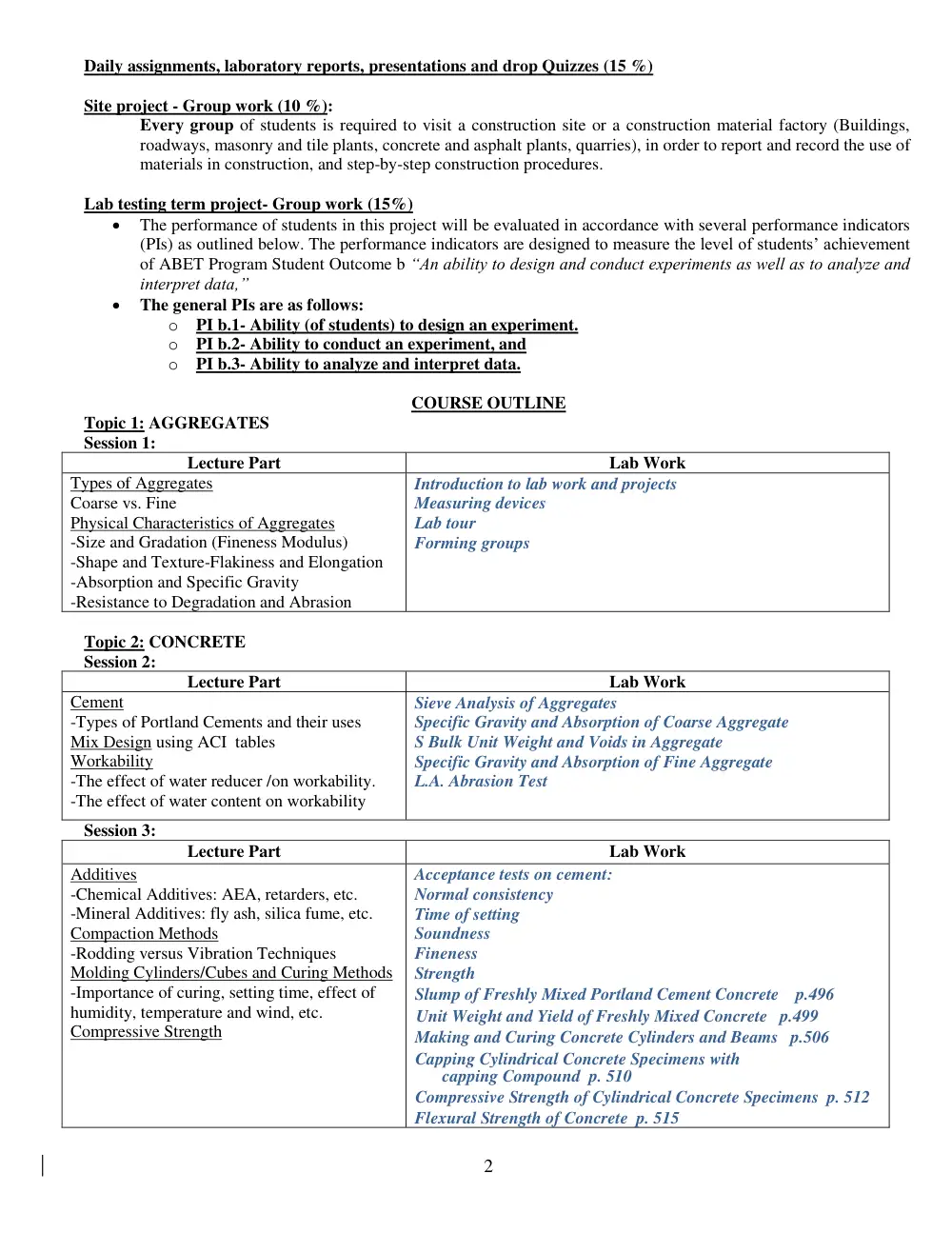
Daily assignments, laboratory reports, presentations and drop Quizzes (15 %)
Site project - Group work (10 %):
Every group of students is required to visit a construction site or a construction material factory (Buildings,
roadways, masonry and tile plants, concrete and asphalt plants, quarries), in order to report and record the use of
materials in construction, and step-by-step construction procedures.
Lab testing term project- Group work (15%)
The performance of students in this project will be evaluated in accordance with several performance indicators
(PIs) as outlined below. The performance indicators are designed to measure the level of students’ achievement
of ABET Program Student Outcome b “An ability to design and conduct experiments as well as to analyze and
interpret data,”
The general PIs are as follows:
o PI b.1- Ability (of students) to design an experiment.
o PI b.2- Ability to conduct an experiment, and
o PI b.3- Ability to analyze and interpret data.
COURSE OUTLINE
Topic 1: AGGREGATES
Session 1:
Lecture Part
Lab Work
Types of Aggregates
Coarse vs. Fine
Physical Characteristics of Aggregates
-Size and Gradation (Fineness Modulus)
-Shape and Texture-Flakiness and Elongation
-Absorption and Specific Gravity
-Resistance to Degradation and Abrasion
Introduction to lab work and projects
Measuring devices
Lab tour
Forming groups
Topic 2: CONCRETE
Session 2:
Lecture Part
Lab Work
Cement
-Types of Portland Cements and their uses
Mix Design using ACI tables
Workability
-The effect of water reducer /on workability.
-The effect of water content on workability
Sieve Analysis of Aggregates
Specific Gravity and Absorption of Coarse Aggregate
S Bulk Unit Weight and Voids in Aggregate
Specific Gravity and Absorption of Fine Aggregate
L.A. Abrasion Test
Session 3:
Lecture Part
Lab Work
Additives
-Chemical Additives: AEA, retarders, etc.
-Mineral Additives: fly ash, silica fume, etc.
Compaction Methods
-Rodding versus Vibration Techniques
Molding Cylinders/Cubes and Curing Methods
-Importance of curing, setting time, effect of
humidity, temperature and wind, etc.
Compressive Strength
Acceptance tests on cement:
Normal consistency
Time of setting
Soundness
Fineness
Strength
Slump of Freshly Mixed Portland Cement Concrete p.496
Unit Weight and Yield of Freshly Mixed Concrete p.499
Making and Curing Concrete Cylinders and Beams p.506
Capping Cylindrical Concrete Specimens with
capping Compound p. 510
Compressive Strength of Cylindrical Concrete Specimens p. 512
Flexural Strength of Concrete p. 515
3
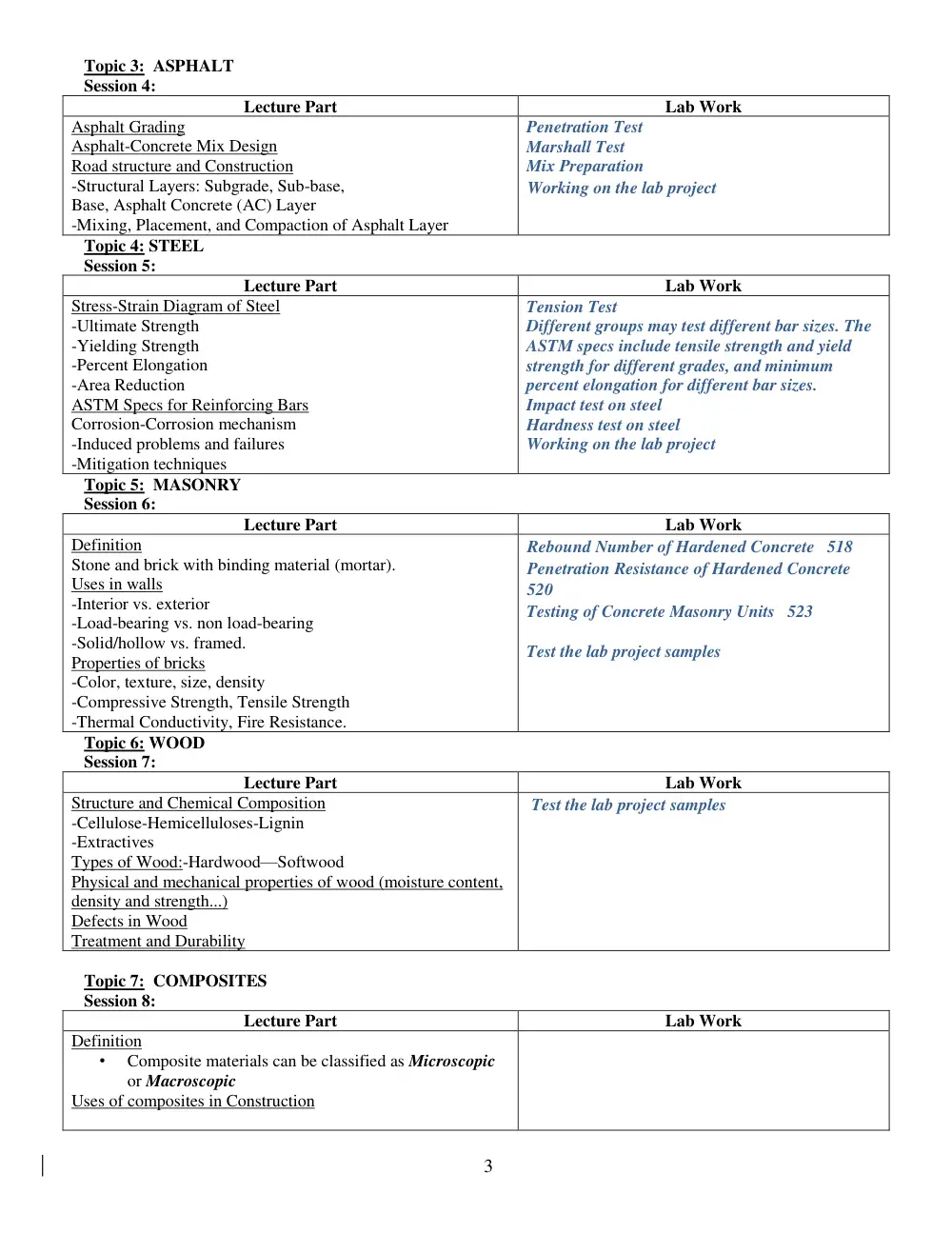
Topic 3: ASPHALT
Session 4:
Lecture Part
Lab Work
Asphalt Grading
Asphalt-Concrete Mix Design
Road structure and Construction
-Structural Layers: Subgrade, Sub-base,
Base, Asphalt Concrete (AC) Layer
-Mixing, Placement, and Compaction of Asphalt Layer
Penetration Test
Marshall Test
Mix Preparation
Working on the lab project
Topic 4: STEEL
Session 5:
Lecture Part
Lab Work
Stress-Strain Diagram of Steel
-Ultimate Strength
-Yielding Strength
-Percent Elongation
-Area Reduction
ASTM Specs for Reinforcing Bars
Corrosion-Corrosion mechanism
-Induced problems and failures
-Mitigation techniques
Tension Test
Different groups may test different bar sizes. The
ASTM specs include tensile strength and yield
strength for different grades, and minimum
percent elongation for different bar sizes.
Impact test on steel
Hardness test on steel
Working on the lab project
Topic 5: MASONRY
Session 6:
Lecture Part
Lab Work
Definition
Stone and brick with binding material (mortar).
Uses in walls
-Interior vs. exterior
-Load-bearing vs. non load-bearing
-Solid/hollow vs. framed.
Properties of bricks
-Color, texture, size, density
-Compressive Strength, Tensile Strength
-Thermal Conductivity, Fire Resistance.
Rebound Number of Hardened Concrete 518
Penetration Resistance of Hardened Concrete
520
Testing of Concrete Masonry Units 523
Test the lab project samples
Topic 6: WOOD
Session 7:
Lecture Part
Lab Work
Structure and Chemical Composition
-Cellulose-Hemicelluloses-Lignin
-Extractives
Types of Wood:-Hardwood—Softwood
Physical and mechanical properties of wood (moisture content,
density and strength...)
Defects in Wood
Treatment and Durability
Test the lab project samples
Topic 7: COMPOSITES
Session 8:
Lecture Part
Lab Work
Definition
•
Composite materials can be classified as Microscopic
or Macroscopic
Uses of composites in Construction