
CIVE 320 Chapter 6, Spring 2016
American University of Beirut · Construction Materials and Technology · 35 pages





Showing the first 10 of 35 pages. Download the PDF to see all of it.
More CIVE 320 files
- Chapter 1 · Spring 2016ChapterView
- Chapter 2 · Spring 2016ChapterView
- Chapter 3.1 · Spring 2016ChapterView
- Chapter 3.2 · Spring 2016ChapterView
- Chapter 5.1 · Spring 2016ChapterView
- Chapter 5.2 · Spring 2016ChapterView
- Syllabus · Spring 2016LabView
- Final + Midterm Previouses · Fall 2015Final examView
Show the text of this chapter
Faculty of Engineering and Architecture
Prof. Ghassan Chehab
Faculty of Engineering and Architecture
Dep. of Civil and Environmental Engineering
American University of Beirut
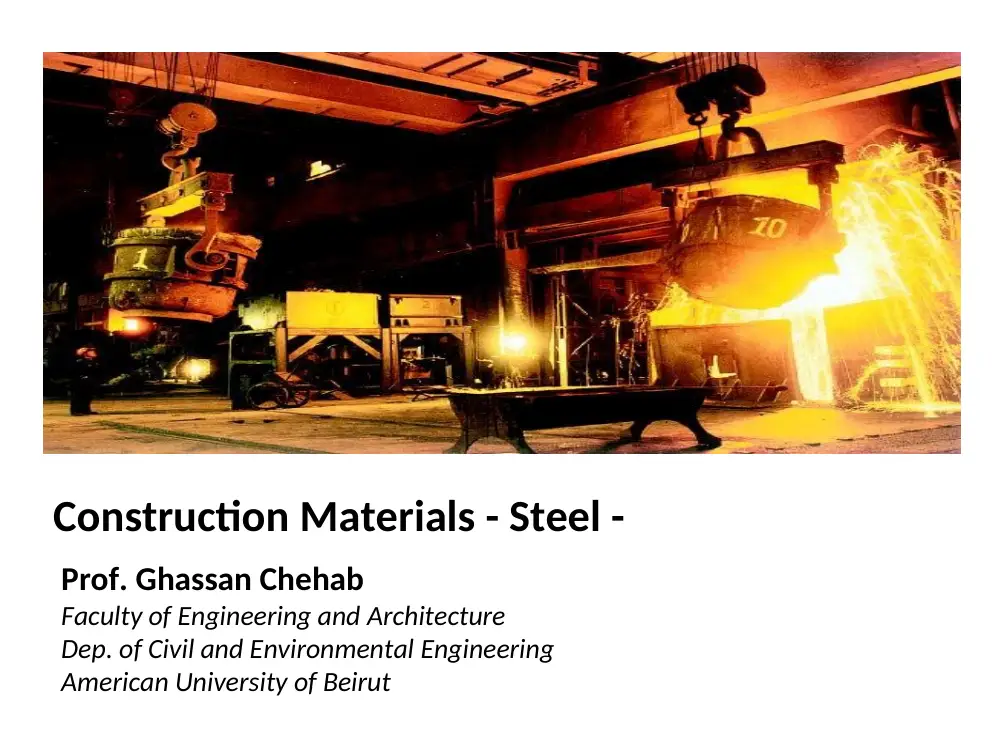
Construction Materials - Steel -
Faculty of Engineering and Architecture
Construction Materials
Ghassan Chehab
American University of Beirut
2
•
The steel is formed of iron and carbon.
•
The use of Iron, the basic constituent of steel, goes back to
1500 BC.
•
Iron forms about 4-5% of earth crust.
•
The steel production started in the mid 1800s.
•
The steel technology advanced in the second half of the 19th
century with the development of the basic oxygen furnace
and continuous wasting methods.
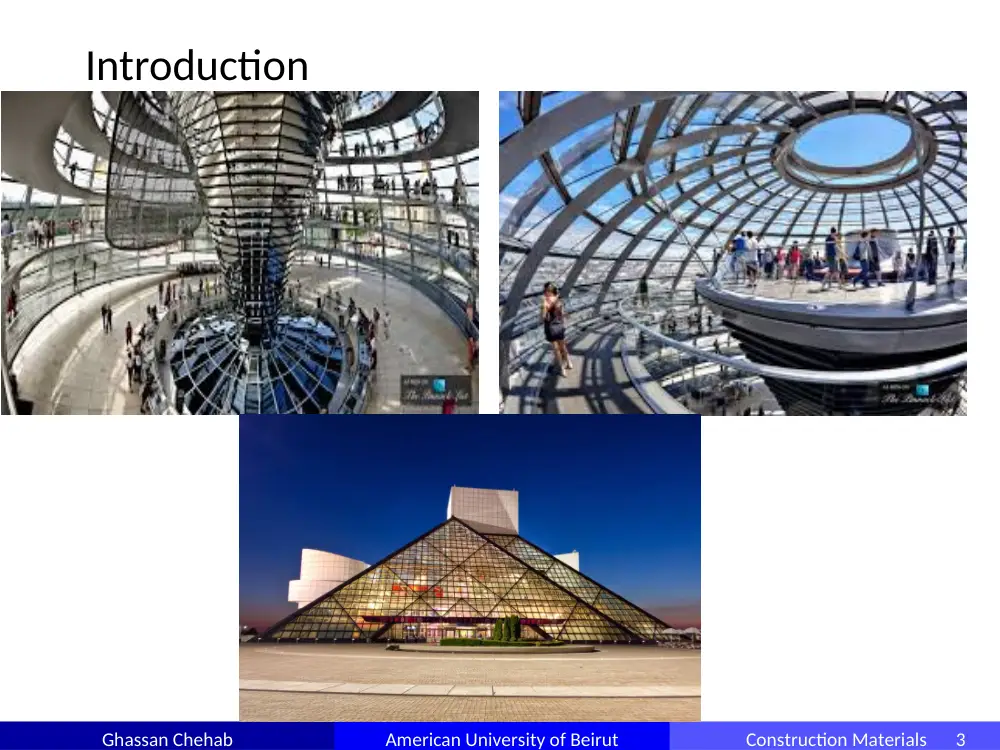
Introduction
• New technologies
increase the
efficiency and the
reduces the cost of
steel production.
Faculty of Engineering and Architecture
Construction Materials
Ghassan Chehab
American University of Beirut
Introduction
3
Faculty of Engineering and Architecture
Construction Materials
Ghassan Chehab
American University of Beirut
Introduction: Steel in the Circular Economy
4
Faculty of Engineering and Architecture
Construction Materials
Ghassan Chehab
American University of Beirut
5
Introduction
Steel products
Structural steel
Applications:
vertical columns,
plates…
Cold-formed
steel
Applications:
trusses,
decking…
Fastening
products
Applications:
structural
connections,
bolts, nuts…
Reinforced
steel
Applications:
rebars,
concrete
reinforcement
…
Miscellaneous
products
Applications:
forms and pans…
Faculty of Engineering and Architecture
Construction Materials
Ghassan Chehab
American University of Beirut
6
Steel Production
Faculty of Engineering and Architecture
Construction Materials
Ghassan Chehab
American University of Beirut
7
Steel Alloys
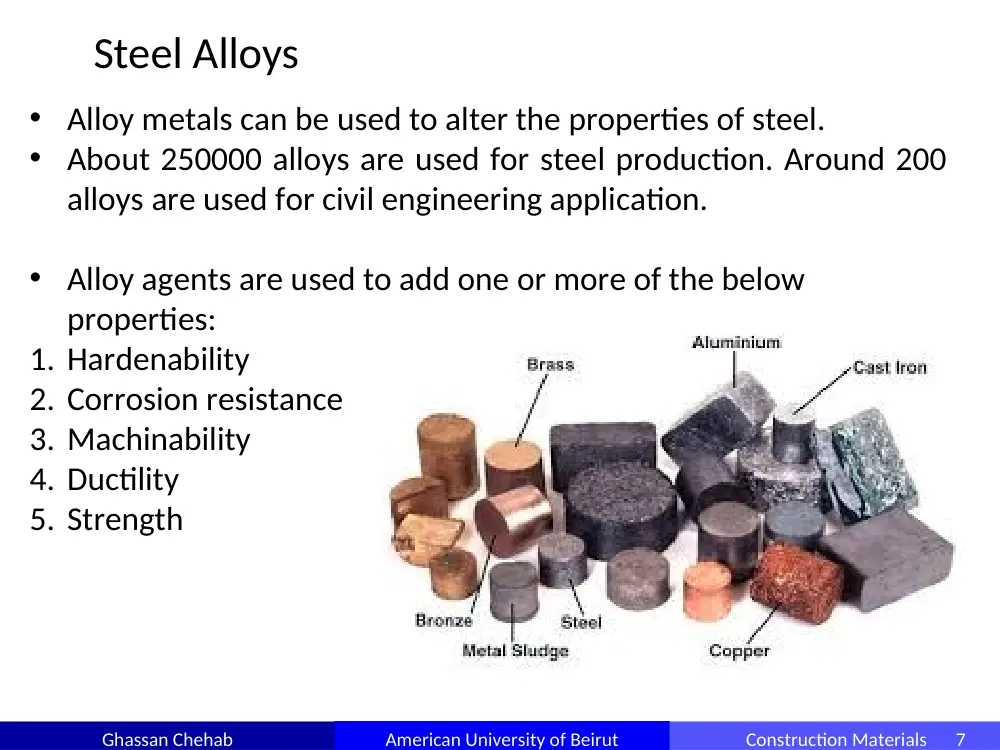
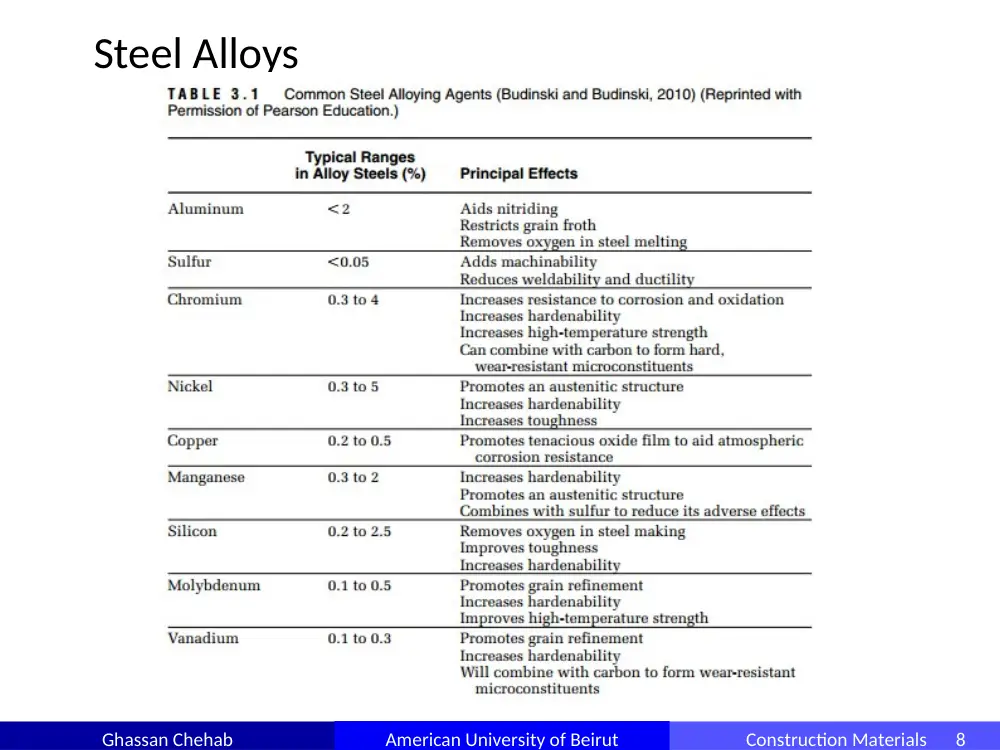
• Alloy metals can be used to alter the properties of steel.
• About 250000 alloys are used for steel production. Around 200
alloys are used for civil engineering application.
• Alloy agents are used to add one or more of the below
properties:
1. Hardenability
2. Corrosion resistance
3. Machinability
4. Ductility
5. Strength
Faculty of Engineering and Architecture
Construction Materials
Ghassan Chehab
American University of Beirut
8
Steel Alloys
Faculty of Engineering and Architecture
Construction Materials
Ghassan Chehab
American University of Beirut
9
Steel Alloys
• By varying the carbon and the alloy content using different
heat treatments, steel can be produced with different
characteristics.
Low alloy
• Low carbon
• Medium carbon
• High carbon
High alloy
• Tool
• Stainless
• The steel used in construction projects are usually low and
medium carbon steel.
Faculty of Engineering and Architecture
Construction Materials
Ghassan Chehab
American University of Beirut
Definitions of some basic properties:
•Stiffness :
property by which a material can resist
deformation. Measure of stiffness is E.
•Ductility :
ability of the material to withstand considerable
plastic deformation without breaking when subjected to the
action of tensile stress beyond the yield point. Measure of
ductility is % elongation before fracture (steel is ductile) = ℓf -
ℓ0/ℓ0
•Malleability: same as ductility but under compression
•Brittleness:
is the absence of ductility or malleability; small
plastic deformation leads to rupture. The ultimate strength is
the fracture strength or yield strength whichever is higher.
•Hardness:
is the ability of a material to resist abrasion or
indentation.
•Toughness:
property of a material to absorb energy at high
stress (usually above the elastic limit) without fracture.
Measure of toughness is amount of energy that a unit volume
of the material has absorbed after being stressed up to fracture
point. Measure of toughness is area under stress.
Faculty of Engineering and Architecture
Construction Materials
Ghassan Chehab
American University of Beirut
11
Heat Treatment of Steel
Steel heat treatment
Annealing
Normalizing
Temperin
g
• Steel properties depend on the carbon content.
• The properties of steel can vary depending on the heat
treatment.
• The response of steel to heat treatment depends upon its alloy
composition.
• Process of heat treatment: heat the steel to a specific
temperature, hold this temperature to a specific period of time,
then cool the material at a specific rate
Hardening
Faculty of Engineering and Architecture
Construction Materials
Ghassan Chehab
American University of Beirut
12
Tension Test
ASTM E8
To determine: the yield strength,
yield
point,
ultimate
tensile
strength,
elongation
and
reduction of area.
Performed at T= 10-35ºC
An axial load is applied to the
specimen at a specific rate.
Faculty of Engineering and Architecture
Construction Materials
Ghassan Chehab
American University of Beirut
13
Tension Test
• Tension Test
Faculty of Engineering and Architecture
Construction Materials
Ghassan Chehab
American University of Beirut
14
Tension Test
• Tension Test
= stress = force per unit area (N/m2
= Pa)
= P/A
= strain = L/L = (L-L0)/L0 =
deformation per unit length
L0 = gage length
L = observed length under a given
load
L = gage elongation or shortening
1 MPa = 106 N/m2
1 Gpa = 109 N/m2
Faculty of Engineering and Architecture
Construction Materials
Ghassan Chehab
American University of Beirut
15
Reinforcing Steel
• Structural concrete members subjected to tensile and flexural
stresses must be reinforced since concrete is weak in tension.
• Conventional or prestressed concrete can be used depending
on the design situation.
Conventional reinforcing steel
Plain bars
Deformed bars
Plain wire
fabrics
Deformed wire fabrics
Faculty of Engineering and Architecture
Construction Materials
Ghassan Chehab
American University of Beirut
Reinforcing Steel
Grades: 40, 60, 75, and 90
Grades: 40, 60, 75, and 90
For grade 60:
For grade 60:
•fy = yield strength = 60,000 psi (4200
kg/cm2)
•Es = modulus of elasticity = 29,000 ksi (2
x 106 kg/cm2)
•ℰy = yield strain = Es/ fy = 0.002
•ℇsh = strain corresponding to strain
hardening = 0.008 to 0.01
•fsu = ultimate stress = 1.35 to 1.6 fy
Density of Steel: 7850 kg/m3
Density of Steel: 7850 kg/m3
16
Faculty of Engineering and Architecture
Construction Materials
Ghassan Chehab
American University of Beirut
Reinforcing Steel
17
Tension
Reinforcement
Hanger Bars
Stirrups for shear
reinforcement
Faculty of Engineering and Architecture
Construction Materials
Ghassan Chehab
American University of Beirut
Structural Steel
•
Used in hot-rolled structural shapes, plates, and bars.
•
Used for different applications: columns, beams, bracings, frames,
trusses, bridges girders....
Structural Steel
Faculty of Engineering and Architecture
Construction Materials
Ghassan Chehab
American University of Beirut
19
Structural Steel
• Structural steel grades
Steel is designed based on grade, type and class.
The yieled strength of steel is also referred to as the steel’s grade
i.e. a steel with a yield strength of 50 ksi is called grade 50
Common systems for identifying and designing steel:
• ASTM : American Society for testing and materials
Faculty of Engineering and Architecture
Construction Materials
Ghassan Chehab
American University of Beirut
20
Structural Steel Commonly Used Sections
Faculty of Engineering and Architecture
Construction Materials
Ghassan Chehab
American University of Beirut
21
Structural Steel Commonly Used Sections
Faculty of Engineering and Architecture
Construction Materials
Ghassan Chehab
American University of Beirut
22
Structural Steel Commonly Used Sections
Faculty of Engineering and Architecture
Construction Materials
Ghassan Chehab
American University of Beirut
23
Structural Steel Commonly Used Sections
Faculty of Engineering and Architecture
Construction Materials
Ghassan Chehab
American University of Beirut
24
Structural Steel Commonly Used Sections
Faculty of Engineering and Architecture
Construction Materials
Ghassan Chehab
American University of Beirut
25
Structural Steel Commonly Used Sections
Faculty of Engineering and Architecture
Construction Materials
Ghassan Chehab
American University of Beirut
26
Structural Steel Commonly Used Sections
Faculty of Engineering and Architecture
Construction Materials
Ghassan Chehab
American University of Beirut
27
Structural Steel Commonly Used Sections
Faculty of Engineering and Architecture
Construction Materials
Ghassan Chehab
American University of Beirut
Structural Steel Member
Connections: Welds vs Bolts
28
Faculty of Engineering and Architecture
Construction Materials
Ghassan Chehab
American University of Beirut
29
Steel Corrosion
• Corrosion
is
an
electromechanical
reaction
to
the
environment. For steel, it can be defined as the destruction
that can be detected by rust formation.
• Corrosion requires 4 elements:
An Anode: the electrode
where corrosion occurs
A cathode: the other
electrode needed to cover
corrosion cell
Conductor: a metallic pathway
for electrodes to flow
Electrolyte: a liquid that can
support the flow of
electrons
Faculty of Engineering and Architecture
Construction Materials
Ghassan Chehab
American University of Beirut
30
Steel Corrosion
• Methods of Corrosion Resistance:
Barrier coating: works solely by isolating the steel from
moisture. These coatings have low water and oxygen
permeability.
Inhabitive primer coating: it contains passive pigments.
They are low-solubility pigments that migrate to the steel
surface when moisture passes through the film to passivate
the steel surface.
Sacrificial primers (cathodic protection): it contains
pigments such as elemental zinc. A close contact between
the steel and sacrificial primers should exist to have an
effective corrosion protection.→ Hot dip galvanizing
example: Z90, Z180, Z275….
Faculty of Engineering and Architecture
Construction Materials
Ghassan Chehab
American University of Beirut
31
Mechanical Testing of Steel
• Bend Test
ASTM E290
To check the ductility to
accommodate bending
To evaluate the ability of
steel or a weld to resist
cracking during bending.
A transverse force is
applied to the specimen
in the portion that is
being bent (usually at
midlength).
Faculty of Engineering and Architecture
Construction Materials
Ghassan Chehab
American University of Beirut
32
Mechanical Testing of Steel
• Torsion Test
ASTM E143
To determine the shear modulus of structural materials.
A cylindrical or tabular specimen is loaded either
incrementally or continually by applying an external torque
to cause a twist within the gauge length.
Faculty of Engineering and Architecture
Construction Materials
Ghassan Chehab
American University of Beirut
33
Mechanical Testing of Steel
• Charpy V Notch Impact Test
ASTM E23
To measure the toughness or
the energy required to fracture
V-notched simply supported
beam specimen.
Test used for structural steel in
tension members.
Faculty of Engineering and Architecture
Construction Materials
Ghassan Chehab
American University of Beirut
34
Mechanical Testing of Steel
• Charpy V Notch Impact Test
ASTM E23
Toughness is a function of temperature, it increases
with increasing the temperature.
The fracture surface consists of a dull shear area
(ductile) at the edges and a shiny cleavage area (brittle)
at the center.
Faculty of Engineering and Architecture
Construction Materials
Ghassan Chehab
American University of Beirut
35
Reference:
Mamlouk, M., Zaniewski,
J., Materials for Civil and
Construction Engineers,
Third Edition, Pearson
Education