
EDUC 215 Chapter 7, Fall 2009
American University of Beirut · Learning and Human Development · 35 pages · Dr. Vivian Khamis


Showing the first 10 of 35 pages. Download the PDF to see all of it.
More EDUC 215 files
Show the text of this chapter
Ch 7
Ch 7
Behavioral and Social
Behavioral and Social
Cognitive Approaches
Cognitive Approaches
11
Behavioral Approaches to Learning
Behavioral Approaches to Learning
Learning
Learning is a relatively permanent change in
is a relatively permanent change in
behavior, knowledge, and thinking skills, that
behavior, knowledge, and thinking skills, that
occurs through experience.
occurs through experience.
There are several major approaches to learning.
There are several major approaches to learning.
Behaviorism:
Behaviorism: Behavior is explained by
Behavior is explained by
observable experiences, not mental processes
observable experiences, not mental processes
– Mental Processes:
Mental Processes: The observable
The observable
thoughts, feelings, and motives that we
thoughts, feelings, and motives that we
experience
experience
– Associative Learning:
Associative Learning: Consists of learning
Consists of learning
that two events are connected or associated.
that two events are connected or associated.
22
Cognitive Approaches to Learning
Cognitive Approaches to Learning
Psychology began to be more cognitive in the last part
Psychology began to be more cognitive in the last part
of the twentieth century.
of the twentieth century.
There are many cognitive approaches to learning but
There are many cognitive approaches to learning but
we are focusing on four approaches : social cognitive,
we are focusing on four approaches : social cognitive,
cognitive information processing, cognitive
cognitive information processing, cognitive
constructivist, and social constructivist.
constructivist, and social constructivist.
1.
1. Social cognitive approaches emphasize how behavior,
Social cognitive approaches emphasize how behavior,
environment, and person (cognitive factors) interact to
environment, and person (cognitive factors) interact to
influence learning.
influence learning.
2.
2. Information processing: focuses on how children
Information processing: focuses on how children
process information through attention, memory, thinking
process information through attention, memory, thinking
and other cognitive processes .
and other cognitive processes .
3.
3. cognitive constructivist emphasizes the child’s cognitive
cognitive constructivist emphasizes the child’s cognitive
construction of knowledge and understanding.
construction of knowledge and understanding.
4.
4. Social constructivist approach focuses on collaboration
Social constructivist approach focuses on collaboration
with others to produce knowledge and understanding.
with others to produce knowledge and understanding.
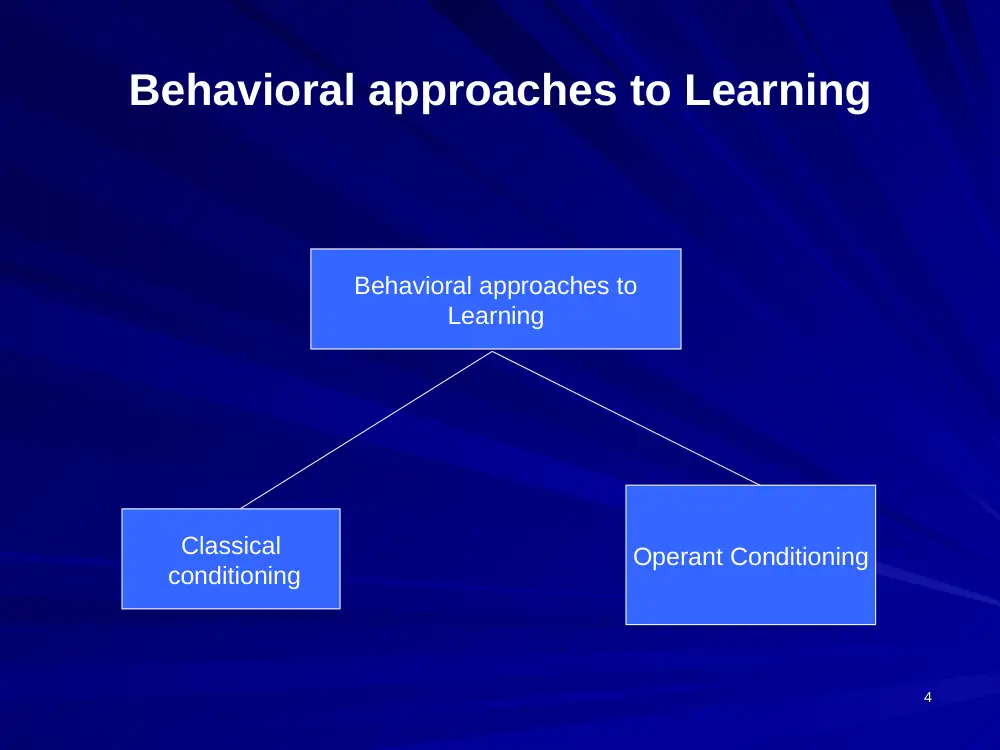
Behavioral approaches to Learning
Behavioral approaches to
Learning
Classical
conditioning
Operant Conditioning
44
Ivan Pavlov – Classical Conditioning
Ivan Pavlov – Classical Conditioning
Classical conditioning
Classical conditioning is a type of
is a type of
learning in which an organism learns
learning in which an organism learns
to connect or associate stimuli. A
to connect or associate stimuli. A
neutral stimulus becomes associated
neutral stimulus becomes associated
with a meaningful stimulus and
with a meaningful stimulus and
acquires the capacity to elicit a similar
acquires the capacity to elicit a similar
response.
response.
55
Classical conditioning (Cont’d)
Classical conditioning (Cont’d)
Some stimuli can elicit a reflexive response.
Some stimuli can elicit a reflexive response.
The reflexive stimulus (UCS) and response
The reflexive stimulus (UCS) and response
(UCR) are unconditioned or innate.
(UCR) are unconditioned or innate.
In classical conditioning, the CS is repeatedly
In classical conditioning, the CS is repeatedly
paired with the unconditioned stimulus (UCS).
paired with the unconditioned stimulus (UCS).
Eventually the CS will produce a response (CR)
Eventually the CS will produce a response (CR)
similar to that produced by the UCS.
similar to that produced by the UCS.
66
Pavlov’s Early Work
Pavlov’s Early Work
meat powder (UCS)=
meat powder (UCS)=Salivation to meat
Salivation to meat
(UCR)
(UCR)
Pairing meat with bell (CS)
Pairing meat with bell (CS) causes
causes
salivation to bell alone (CR)
salivation to bell alone (CR)
77
Classical Conditioning Principles
Classical Conditioning Principles
Generalization :
Generalization :The tendency of a new stimulus
The tendency of a new stimulus
similar to the original conditioned stimulus to
similar to the original conditioned stimulus to
produce a similar response.
produce a similar response.
Discrimination:
Discrimination: The organism responds to
The organism responds to
certain stimuli but not others.
certain stimuli but not others.
Extinction:
Extinction: The weakening of the conditioned
The weakening of the conditioned
response (CR) in the absence of the
response (CR) in the absence of the
unconditioned response (UCS).
unconditioned response (UCS).
88
Systematic Desensitization
Systematic Desensitization
Systematic Desensitization:
Systematic Desensitization: Reduces
Reduces
anxiety by getting the individual to
anxiety by getting the individual to
associate deep relaxation with successive
associate deep relaxation with successive
visualizations of increasingly anxiety-
visualizations of increasingly anxiety-
producing situations.
producing situations.
99
Learning Activity
Learning Activity
Mirna does poorly on a math test. This makes
Mirna does poorly on a math test. This makes
her feel anxious. From that point on, she always
her feel anxious. From that point on, she always
becomes anxious when taking a math test. As
becomes anxious when taking a math test. As
the school year progresses, she begins
the school year progresses, she begins
experiencing anxiety when she has tests in other
experiencing anxiety when she has tests in other
subject areas as well.
subject areas as well.
Q.1:
Q.1: Identify the US in the example above.
Identify the US in the example above.
Q.2:
Q.2: Identify the UR in the example above.
Identify the UR in the example above.
Q.3:
Q.3: Identify the CS in the example above.
Identify the CS in the example above.
Q.4:
Q.4: Identify the CR in the example above
Identify the CR in the example above
10
10
Learning Activity
Learning Activity
Mirna does poorly on a math test. This makes
Mirna does poorly on a math test. This makes
her feel anxious. From that point on, she always
her feel anxious. From that point on, she always
becomes anxious when taking a math test. As
becomes anxious when taking a math test. As
the school year progresses, she begins
the school year progresses, she begins
experiencing anxiety when she has tests in other
experiencing anxiety when she has tests in other
subject areas as well.
subject areas as well.
Q:
Q: Why would Mirna begin to experience anxiety
Why would Mirna begin to experience anxiety
in response to tests in content areas other than
in response to tests in content areas other than
math?
math?
11
11
Classical Conditioning
Classical Conditioning
Classical Conditioning
Classical Conditioning is a form of learning in
is a form of learning in
which the consequences of behavior produce changes in
which the consequences of behavior produce changes in
the probability that the behavior will occur.
the probability that the behavior will occur.
Thorndike’s Law of Effect
Thorndike’s Law of Effect
Behavior Positive outcome Behavior
Behavior Positive outcome Behavior
strengthened
strengthened
Behavior Negative outcome
Behavior Negative outcome
Behavior weakened
Behavior weakened
12
12
Operant conditioning
Operant conditioning
Operant conditioning
Operant conditioning is a form of
is a form of
learning in which the consequences of
learning in which the consequences of
behavior produce changes in the
behavior produce changes in the
probability that the behavior will occur.
probability that the behavior will occur.
Operant conditioning
Operant conditioning is at the heart of
is at the heart of
B.F. Skinner’s (1938) behavioral view.
B.F. Skinner’s (1938) behavioral view.
Consequences
Consequences __ rewards and
__ rewards and
punishments____ are contingent on the
punishments____ are contingent on the
organisms behavior.
organisms behavior.
Skinner’s Operant Conditioning (Cont’d)
Skinner’s Operant Conditioning (Cont’d)
Organisms make responses that have
Organisms make responses that have
consequences
consequences
– The consequences serve to increase or decrease the
The consequences serve to increase or decrease the
likelihood of making that response again.
likelihood of making that response again.
– The response can be associated with cues in the
The response can be associated with cues in the
environment (these cues set the occasion for the
environment (these cues set the occasion for the
response)
response)
E.g., we put coins in a machine to obtain food
E.g., we put coins in a machine to obtain food
But we refrain when an “
But we refrain when an “Out of Order”
Out of Order” sign is placed on the
sign is placed on the
machine
machine
Skinner’s Operant Conditioning
Skinner’s Operant Conditioning
Positive Reinforcement
Positive Reinforcement
Negative Reinforcement
Negative Reinforcement
Punishment
Punishment
Extinction
Extinction
Operant Conditioning )Cont’d)
Operant Conditioning )Cont’d)
In operant conditioning, the stimulus is a cue and does
In operant conditioning, the stimulus is a cue and does
not elicit the response.
not elicit the response.
Operant responses are voluntary.
Operant responses are voluntary.
In operant conditioning, the response elicits a reinforcing
In operant conditioning, the response elicits a reinforcing
stimulus, whereas in classical conditioning, the UCS
stimulus, whereas in classical conditioning, the UCS
elicits the reflexive response.
elicits the reflexive response.
16
16
Operant Conditioning Principles
Operant Conditioning Principles
Generalization:
Generalization: Giving the same response
Giving the same response
to similar stimuli.
to similar stimuli.
Discrimination:
Discrimination: Differentiating among stimuli or
Differentiating among stimuli or
environmental events.
environmental events.
Extinction:
Extinction: Previously reinforced response is no
Previously reinforced response is no
longer reinforced and the response decreases.
longer reinforced and the response decreases.
17
17
Classical conditioning
Classical conditioning
Generalization is the tendency
Generalization is the tendency
of a stimulus similar to the
of a stimulus similar to the
conditioned stimulus to
conditioned stimulus to
produce a response similar to
produce a response similar to
the conditioned response.
the conditioned response.
Discrimination means
Discrimination means
responding to certain stimuli
responding to certain stimuli
but not others
but not others
Extinction occurs when a
Extinction occurs when a
previously reinforced response
previously reinforced response
is no longer reinforced and the
is no longer reinforced and the
response decreases
response decreases
Operant conditioning
Operant conditioning
Generalization means giving
Generalization means giving
the same response to similar
the same response to similar
stimuli.
stimuli.
Discrimination involves
Discrimination involves
differentiating among stimuli or
differentiating among stimuli or
environmental events
environmental events
Extinction occurs when a
Extinction occurs when a
previously reinforced response
previously reinforced response
is no longer reinforced and the
is no longer reinforced and the
response decreases
response decreases
Skinner’s Operant Conditioning
Skinner’s Operant Conditioning
Theory into Practice
Theory into Practice
Ali frequently gets out of his seat and entertains
Ali frequently gets out of his seat and entertains
his classmates with humorous remarks. Mr.
his classmates with humorous remarks. Mr.
Danny often scolds Ali for his behavior.
Danny often scolds Ali for his behavior.
However, Ali’s classmates laugh when Ali makes
However, Ali’s classmates laugh when Ali makes
remarks. The scolding rarely has any impact. Ali
remarks. The scolding rarely has any impact. Ali
continues with his antics.
continues with his antics.
Q.1:
Q.1: What is Mr. Danny attempting to do when
What is Mr. Danny attempting to do when
he scolds Ali ?
he scolds Ali ?
Q.2:
Q.2: Why does Ali continue his antics in spite of
Why does Ali continue his antics in spite of
being scolded?
being scolded?
Q.3:
Q.3: What are three strategies Mr. Danny could
What are three strategies Mr. Danny could
try to keep Ali more on task?
try to keep Ali more on task?
19
19
Reinforcement Schedules
Reinforcement Schedules
Fixed-Ratio:
Fixed-Ratio: Reinforce after a set number of
Reinforce after a set number of
appropriate responses
appropriate responses
Variable-Ratio:
Variable-Ratio: Reinforce after an average but
Reinforce after an average but
unpredictable number of appropriate responses
unpredictable number of appropriate responses
Fixed-Interval:
Fixed-Interval: Reinforce appropriate response
Reinforce appropriate response
after a fixed amount of time
after a fixed amount of time
Variable-Interval:
Variable-Interval: Reinforce appropriate response
Reinforce appropriate response
after a variable amount of time
after a variable amount of time
20
20
Applied Behavior Analysis
Applied Behavior Analysis
Applied Behavior Analysis
Applied Behavior Analysis is applying
is applying
principles of operant conditioning to change
principles of operant conditioning to change
human behavior.
human behavior.
Choose effective reinforces
Choose effective reinforces
Make reinforces contingent and timely
Make reinforces contingent and timely
Select the best reinforcement schedule
Select the best reinforcement schedule
Consider contracting
Consider contracting
Use prompts and shaping
Use prompts and shaping
Use negative reinforcement effectively
Use negative reinforcement effectively
Reinforcement: The Premack principle
Reinforcement: The Premack principle
The
The Premack principle
Premack principle states that a high-
states that a high-
probability activity can serve as a reinforcer for a
probability activity can serve as a reinforcer for a
low-probability activity.
low-probability activity.
““Eat your dinner and you can go out to play.
Eat your dinner and you can go out to play.””
Guidelines for the Classroom:
Guidelines for the Classroom:
• Initial learning is better with
Initial learning is better with continuous
continuous
reinforcement.
reinforcement.
• Students on
Students on fixed schedules
fixed schedules show less
show less
persistence, faster response extinction.
persistence, faster response extinction.
• Students show greatest persistence on
Students show greatest persistence on variable-
variable-
interval schedule.
interval schedule.
22
22
Differential Reinforcement Strategies:
Differential Reinforcement Strategies:
Prompts and Shaping
Prompts and Shaping
Prompts:
Prompts: Added stimuli that are given just before the
Added stimuli that are given just before the
likelihood that the behavior will occur.
likelihood that the behavior will occur.
1.
1.
Use to initiate behavior.
Use to initiate behavior.
2.
2.
Once desired behavior is consistent, remove
Once desired behavior is consistent, remove
prompts.
prompts.
Shaping:
Shaping: Involves teaching new behaviors by
Involves teaching new behaviors by
reinforcing successive approximations of the desired
reinforcing successive approximations of the desired
behavior.
behavior.
1.
1.
First, reward any response.
First, reward any response.
2.
2.
Next, reward responses that resemble the desired
Next, reward responses that resemble the desired
behavior.
behavior.
3.
3.
Finally, reward only target behavior.
Finally, reward only target behavior.
23
23
Decreasing Undesirable Behaviors
Decreasing Undesirable Behaviors
Use
Use differential reinforcement
differential reinforcement by
by
reinforcing more appropriate behavior.
reinforcing more appropriate behavior.
Withdraw positive reinforcement
Withdraw positive reinforcement
(extinction) from a child’s inappropriate
(extinction) from a child’s inappropriate
behavior.
behavior.
Remove desirable stimuli
Remove desirable stimuli through “time-
through “time-
out” and “response cost.”
out” and “response cost.”
Present aversive stimuli
Present aversive stimuli (punishment).
(punishment).
24
24
Debate
Debate
Should teachers use tangible reinforcers
Should teachers use tangible reinforcers
for good behavior?
for good behavior?
25
25
Reflection & Observation
Reflection & Observation
Reflection:
Reflection:
In your educational experience, what
In your educational experience, what
types of incentives did teachers use?
types of incentives did teachers use?
How effective was their use? Why
How effective was their use? Why
were they effective or ineffective?
were they effective or ineffective?
26
26
Social Cognitive Approaches to
Social Cognitive Approaches to
Learning
Learning
Bandura’s Social Cognitive Theory
Bandura’s Social Cognitive Theory
Social, cognitive,
Social, cognitive, and
and behavioral
behavioral factors play
factors play
important roles in learning.
important roles in learning.
Self-efficacy:
Self-efficacy: The belief that one can master a
The belief that one can master a
situation and produce positive outcomes.
situation and produce positive outcomes.
Observational learning
Observational learning occurs when a person
occurs when a person
observes and imitates someone else’s behavior.
observes and imitates someone else’s behavior.
27
27
Bandura’s Reciprocal Determinism
Bandura’s Reciprocal Determinism
P/C
Personal and
cognitive factors
E
Environment
B
Behavior
Observational Learning
Observational Learning
Attention:
Attention: Students must attend to what the
Students must attend to what the
model is doing or saying before imitating a
model is doing or saying before imitating a
model’s action.
model’s action.
Retention:
Retention: Students must code the information
Students must code the information
and keep it in memory so that they retrieve it.
and keep it in memory so that they retrieve it.
Production:
Production: Students must be able to
Students must be able to
reproduce the model’s behavior.
reproduce the model’s behavior.
Some children might attend and code in memory
Some children might attend and code in memory
but because of limitations in their motor ability
but because of limitations in their motor ability
not be able to reproduce the model’s behavior.
not be able to reproduce the model’s behavior.
Motivation:
Motivation: Students must be motivated to
Students must be motivated to
imitate the modeled behavior
imitate the modeled behavior
29
29
Bandura’s Contemporary Model of
Bandura’s Contemporary Model of
Observational Learning
Observational Learning
Attention
Students are more likely to
be attentive to high-status
models (teachers).
Production
Poor motor ability inhibits
reproduction of the model’s
behavior. Help improve skills.
Retention
Students retention will be improved
when teachers give
logical and clear demonstrations
Motivation
When given a
reinforcement,
modeling increases.
30
30
Bandura’s Social Cognitive Theory
Bandura’s Social Cognitive Theory
Theory into Practice
Theory into Practice
• Mohamad
Mohamad frequently gets out of his seat and
frequently gets out of his seat and
entertains his classmates with humorous
entertains his classmates with humorous
remarks. Mr. Yousef often scolds Mohamad
remarks. Mr. Yousef often scolds Mohamad f for
or
his behavior. However, Mohamad
his behavior. However, Mohamad ’s classmates
’s classmates
laugh when Mohamad
laugh when Mohamad makes remarks. The
makes remarks. The
scolding rarely has any impact. Mohamad
scolding rarely has any impact. Mohamad
continues with his antics. After several days of
continues with his antics. After several days of
this, other boys in the class begin to get out of
this, other boys in the class begin to get out of
their seats and make humorous remarks as well.
their seats and make humorous remarks as well.
Q.1:
Q.1: Why do the other boys begin to
Why do the other boys begin to
misbehave? Explain.
misbehave? Explain.
Q.2:
Q.2: What does this say about Mohamad
What does this say about Mohamad ?
?
31
31
Classroom Use of Observational Learning
Classroom Use of Observational Learning
Demonstrate and teach new behaviors
Demonstrate and teach new behaviors
Decide what type of model you will be
Decide what type of model you will be
Use peers as effective models
Use peers as effective models
Use mentors as models
Use mentors as models
Consider the models children observe in
Consider the models children observe in
the media
the media
32
32
Self-Regulatory Learning
Self-Regulatory Learning
Self-Regulatory Learning
Self-Regulatory Learning Self-regulation
Self-regulation
involves the ability to self-regulate by monitoring
involves the ability to self-regulate by monitoring
your own progress, setting goals that are
your own progress, setting goals that are
proximal, specific, and challenging, and
proximal, specific, and challenging, and
managing time more effectively.
managing time more effectively.
These goals might be academic such as
These goals might be academic such as
improving comprehension while reading,
improving comprehension while reading,
becoming more organized writer, learning how to
becoming more organized writer, learning how to
do multiplications or they might be
do multiplications or they might be
socioemotional such as controlling one’s anger,
socioemotional such as controlling one’s anger,
getting along better with peers.
getting along better with peers.
33
33
A Model of Self-Regulatory Learning
A Model of Self-Regulatory Learning
Self-Evaluation
and Monitoring
Monitoring Outcomes
and Refining Strategies
Goal Setting and
Strategic Planning
Putting a Plan into
Action and
Monitoring it
34
34
Self-efficacy
Self-efficacy
Self-efficacy is our belief that we can
Self-efficacy is our belief that we can
master a situation and produce positive
master a situation and produce positive
outcomes.
outcomes.
Self-efficacy influences the choice of
Self-efficacy influences the choice of
behaviors we undertake, our persistence
behaviors we undertake, our persistence
in those activities, and our attitude as we
in those activities, and our attitude as we
approach these behaviors.
approach these behaviors.