
EDUC 215 Chapter 2, Fall 2009
American University of Beirut · Learning and Human Development · 51 pages · Dr. Vivian Khamis
Showing the first 10 of 51 pages. Download the PDF to see all of it.
More EDUC 215 files
Show the text of this chapter
11
Cognitive and Language
Cognitive and Language
Development
Development
Developmental Psychology
Developmental Psychology
The focus of developmental psychology is on age-
The focus of developmental psychology is on age-
related changes in behaviors throughout the life
related changes in behaviors throughout the life
span.
span.
Development
Development: The pattern of biological,
: The pattern of biological,
cognitive, and socioemotional changes that
cognitive, and socioemotional changes that
begins at conception and continues through
begins at conception and continues through
the life span.
the life span.
22
Developmental Processes
Developmental Processes
Biological processes
Biological processes and
and genetic inheritance
genetic inheritance
– Development of the brain
Development of the brain
– Gains in height and weight
Gains in height and weight
– Changes in motor skills
Changes in motor skills
– Puberty’s hormonal changes
Puberty’s hormonal changes
Cognitive processes
Cognitive processes
– Changes in the child’s thinking
Changes in the child’s thinking
– Intelligence
Intelligence
– Language
Language acquisition
acquisition
33
Socioemotional processes
Socioemotional processes
– Changes in the child’s relationships
Changes in the child’s relationships
with other people
with other people
– Changes in personality
Changes in personality
44
Key developmental issues include:
Key developmental issues include:
Nature versus nurture
Nature versus nurture
To what extent development is influenced by nature
To what extent development is influenced by nature
(biological inheritance, maturation) or the result of
(biological inheritance, maturation) or the result of
nurture (environmental experiences)?
nurture (environmental experiences)?
Continuity-Discontinuity Issue
Continuity-Discontinuity Issue
To what extent development involves gradual,
To what extent development involves gradual,
cumulative change (continuity ) or distinct stages
cumulative change (continuity ) or distinct stages
(discontinuity) ?
(discontinuity) ?
Early-Later Experience Issue
Early-Later Experience Issue
To which degree early experiences especially in infancy
To which degree early experiences especially in infancy
or later experiences are the key determinants of child's
or later experiences are the key determinants of child's
development.
development.
55
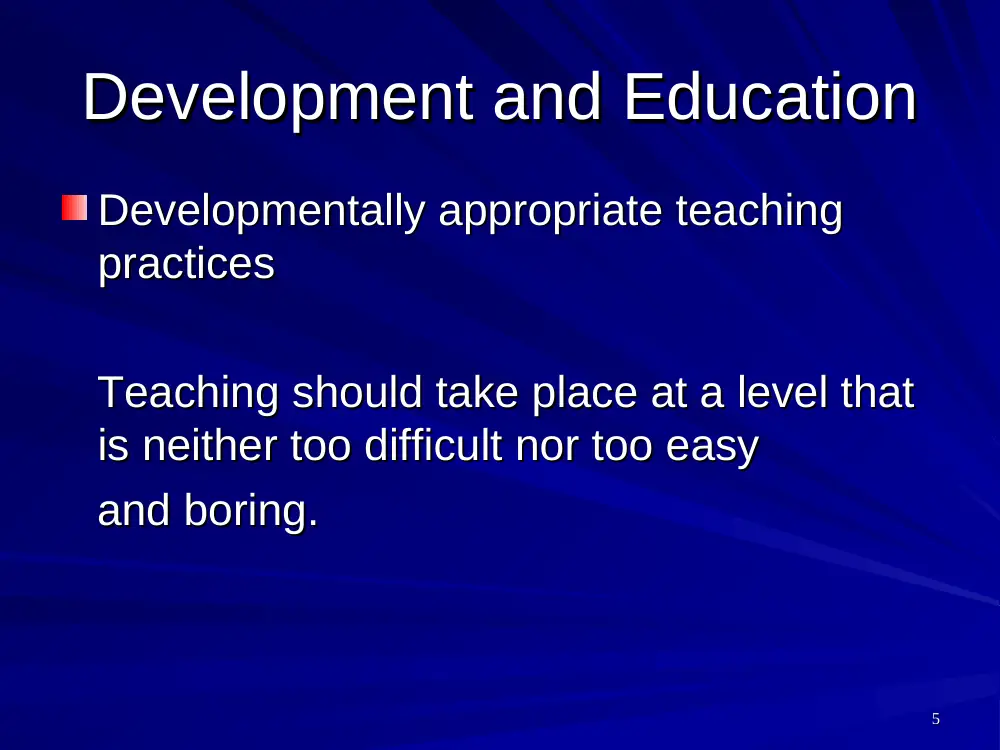
Development and Education
Development and Education
Developmentally appropriate teaching
Developmentally appropriate teaching
practices
practices
Teaching should take place at a level that
Teaching should take place at a level that
is neither too difficult nor too easy
is neither too difficult nor too easy
and boring.
and boring.
66
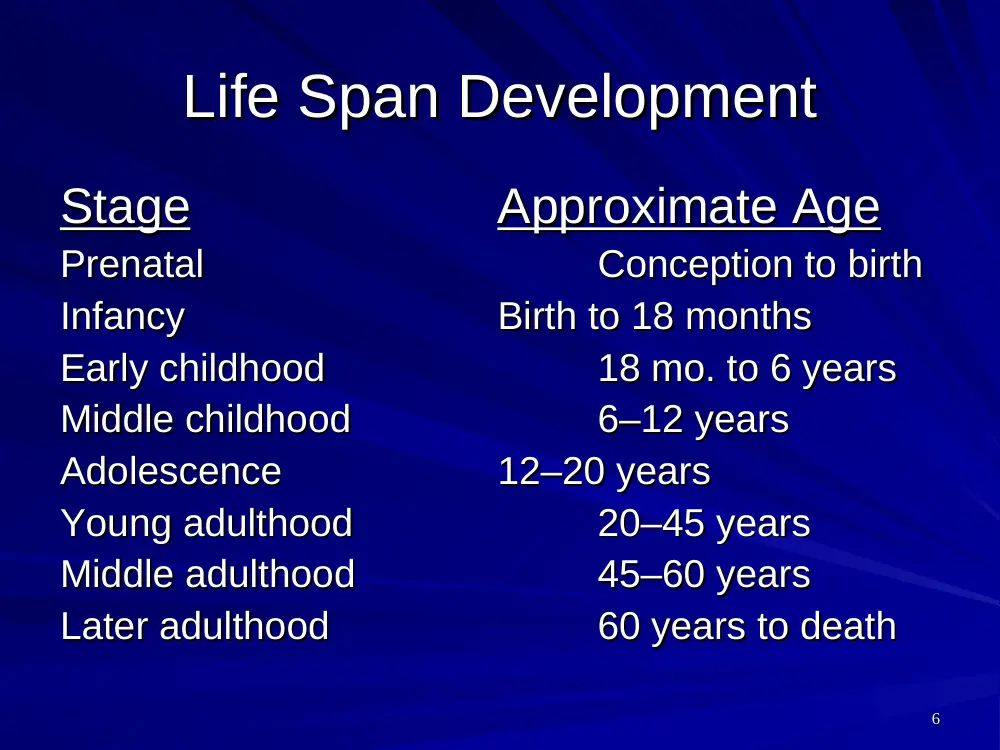
Life Span Development
Life Span Development
Stage
Stage
Approximate Age
Approximate Age
Prenatal
Prenatal
Conception to birth
Conception to birth
Infancy
Infancy
Birth to 18 months
Birth to 18 months
Early childhood
Early childhood
18 mo. to 6 years
18 mo. to 6 years
Middle childhood
Middle childhood
6–12 years
6–12 years
Adolescence
Adolescence
12–20 years
12–20 years
Young adulthood
Young adulthood
20–45 years
20–45 years
Middle adulthood
Middle adulthood
45–60 years
45–60 years
Later adulthood
Later adulthood
60 years to death
60 years to death
77
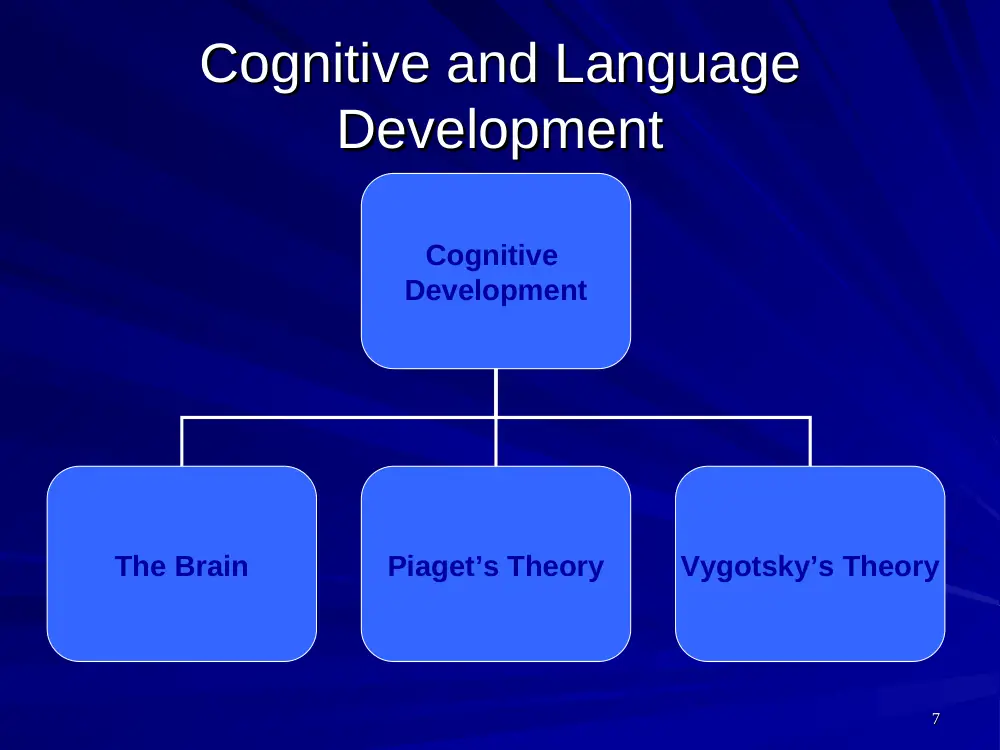
Cognitive and Language
Cognitive and Language
Development
Development
Cognitive
Development
The Brain
Piaget’s Theory
Vygotsky’s Theory
88
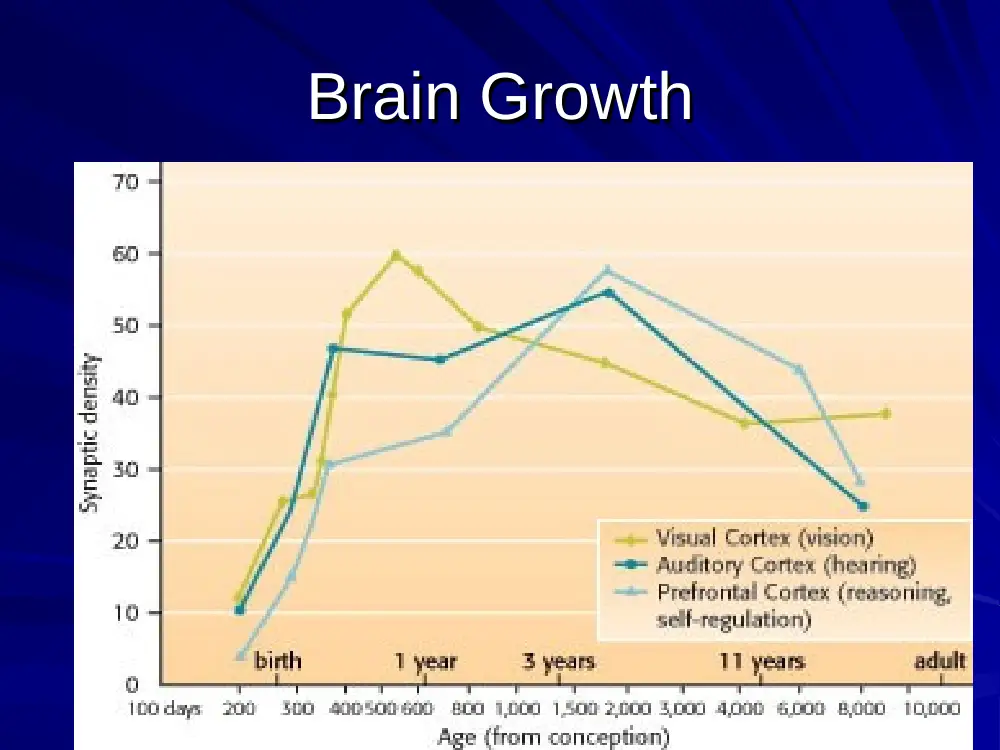
Brain Growth
Brain Growth
99
Neurons
Neurons
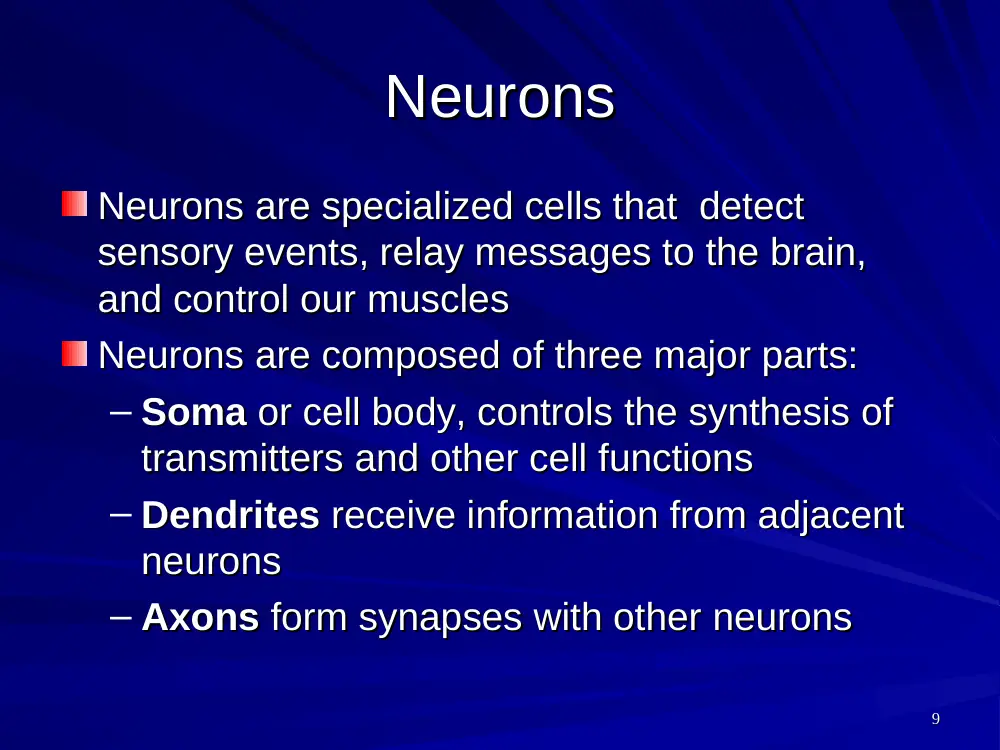
Neurons are specialized cells that detect
Neurons are specialized cells that detect
sensory events, relay messages to the brain,
sensory events, relay messages to the brain,
and control our muscles
and control our muscles
Neurons are composed of three major parts:
Neurons are composed of three major parts:
– Soma
Soma or cell body, controls the synthesis of
or cell body, controls the synthesis of
transmitters and other cell functions
transmitters and other cell functions
– Dendrites
Dendrites receive information from adjacent
receive information from adjacent
neurons
neurons
– Axons
Axons form synapses with other neurons
form synapses with other neurons
10
10
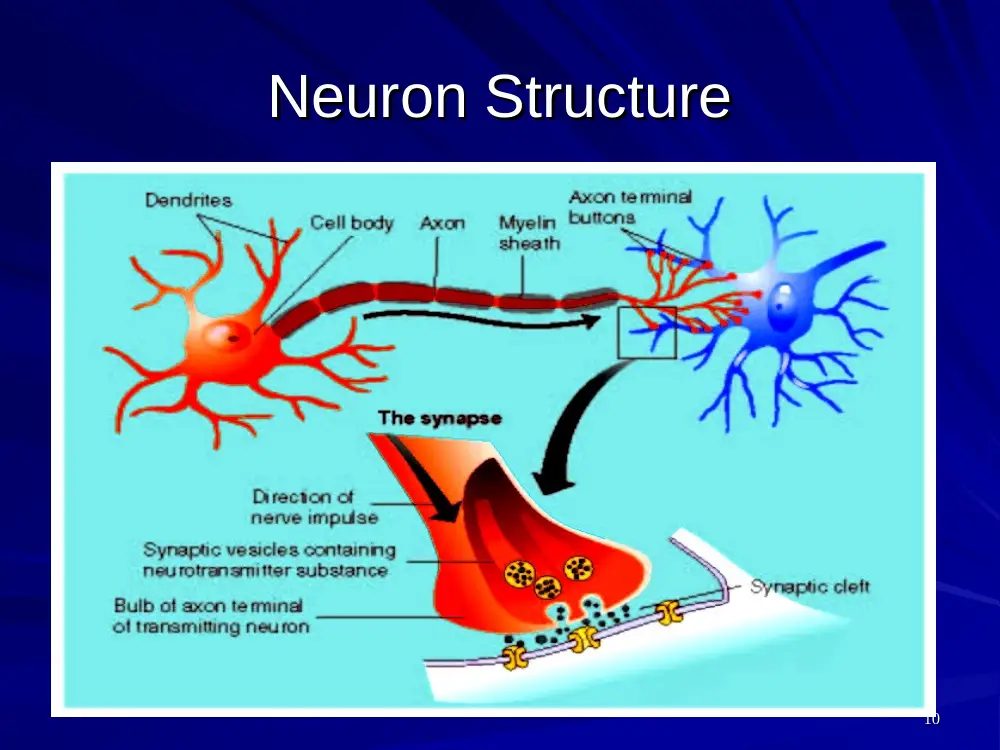
Neuron Structure
Neuron Structure
11
11
Myelination
Myelination
Myelination
Myelination increases the speed at which
increases the speed at which
information travels through the nervous
information travels through the nervous
system
system
12
12
Brain Lateralization the specialization of functions in one
Brain Lateralization the specialization of functions in one
hemisphere of the brain or the other.
hemisphere of the brain or the other.
Verbal Processing
Verbal Processing
In most individuals,
In most individuals,
speech and grammar
speech and grammar
are localized in the left
are localized in the left
hemisphere
hemisphere
Nonverbal Processing
Nonverbal Processing
Spatial perception,
Spatial perception,
visual recognition, and
visual recognition, and
emotions are localized
emotions are localized
in the right hemisphere
in the right hemisphere..
13
13
Piaget’s Cognitive Theory
Piaget’s Cognitive Theory
Cognitive processes:
Cognitive processes: What processes do children use
What processes do children use
as they construct their knowledge of the world?
as they construct their knowledge of the world?
Cognitive reasoning is primitive at birth and changes
Cognitive reasoning is primitive at birth and changes
from infancy to adulthood.
from infancy to adulthood.
These processes include :
These processes include :
Schemas:
Schemas: Schemas are the basic units of intellect.
Schemas are the basic units of intellect.
Piaget said as the child seeks to construct an
Piaget said as the child seeks to construct an
understanding of the world, the developing brain creates
understanding of the world, the developing brain creates
schemas.
schemas.
These schemas are actions or mental representations
These schemas are actions or mental representations
that organize knowledge.
that organize knowledge.
14
14
Cognitive adaptation reflects the actions of
Cognitive adaptation reflects the actions of
two complementary processes:
two complementary processes:
– Assimilation
Assimilation allows an existing schema to
allows an existing schema to
adapt to the environment.
adapt to the environment.
– Accommodation
Accommodation allows the schema to
allows the schema to
change in order to handle a new
change in order to handle a new
environmental situation.
environmental situation.
15
15
Piagetian Cognition
Piagetian Cognition
16
16
Organization
Organization: To make sense out of the
: To make sense out of the
world, children cognitively organize their
world, children cognitively organize their
experiences.
experiences.
Organization is the grouping of isolated
Organization is the grouping of isolated
behaviors and thoughts into a higher order
behaviors and thoughts into a higher order
system.
system.
Continual refinement of this organization is
Continual refinement of this organization is
an inherent part of development.
an inherent part of development.
17
17
Equilibration and stages of development:
Equilibration and stages of development:
Equilibration is a mechanism that Piaget propose
Equilibration is a mechanism that Piaget propose
to explain how children shift from one stage of
to explain how children shift from one stage of
thought to the next.
thought to the next.
The shift occurs as children experience cognitive
The shift occurs as children experience cognitive
conflict, or disequilibrium, in trying to understand
conflict, or disequilibrium, in trying to understand
the world. Eventually they resolve the conflict
the world. Eventually they resolve the conflict
and reach a balance or equilibrium.
and reach a balance or equilibrium.
18
18
Piaget’s Stages of Cognitive
Piaget’s Stages of Cognitive
Development
Development
Sensorimotor period:
Sensorimotor period: Birth through age 2
Birth through age 2
– Infant schemes are simple reflexes and interactions
Infant schemes are simple reflexes and interactions
with people and objects
with people and objects
Preoperational period
Preoperational period: Age 2 to 7
: Age 2 to 7
– Child begins to use mental representations, but
Child begins to use mental representations, but
problem solving is limited
problem solving is limited
Concrete operations:
Concrete operations: Age 7 to 11
Age 7 to 11
– Child performs mental operations (conservation)
Child performs mental operations (conservation)
Formal operations:
Formal operations: Age 12 through adulthood
Age 12 through adulthood
– Child can use formal problem solving and higher-level
Child can use formal problem solving and higher-level
abstract thinking
abstract thinking
19
19
The Sensorimotor Stage
The Sensorimotor Stage
Birth through age 2
Birth through age 2
The infant constructs an understanding of the
The infant constructs an understanding of the
world by coordinating sensory
world by coordinating sensory
experiences( hearing, seeing) with physical
experiences( hearing, seeing) with physical
actions( reaching, touching).
actions( reaching, touching).
An infant progresses from reflexive, instinctual
An infant progresses from reflexive, instinctual
actions at birth to the beginning of symbolic
actions at birth to the beginning of symbolic
thought toward the end of the stage.
thought toward the end of the stage.
Infant schemes are simple reflexes and
Infant schemes are simple reflexes and
interactions with people and objects
interactions with people and objects
Infants acquire a basic grasp of the concept of
Infants acquire a basic grasp of the concept of
cause and effect.
cause and effect.
20
20
The Sensorimotor Stage Con’t
The Sensorimotor Stage Con’t
Coordination of
Coordination of sensory experiences
sensory experiences with
with
motor actions
motor actions .Infants seem to know the world
.Infants seem to know the world
only through motor activities and sensory
only through motor activities and sensory
impressions
impressions
Have not yet learned to use mental symbols or
Have not yet learned to use mental symbols or
images to represent objects
images to represent objects
Acquire
Acquire object permanence
object permanence ( (the realization that
the realization that
objects continue to exist over time) at the end of
objects continue to exist over time) at the end of
the stage.
the stage.
Another accomplishment is the gradual
Another accomplishment is the gradual
realization that there is a difference between
realization that there is a difference between
oneself and the surrounding environment at the
oneself and the surrounding environment at the
end of the sensorimotor stage.
end of the sensorimotor stage.
21
21
The Preoperational Stage
The Preoperational Stage
Age 2 to 7
Age 2 to 7
At this stage symbolic thought increases but
At this stage symbolic thought increases but
operational thought is not yet present
operational thought is not yet present
Preoperational thought can be subdivided into
Preoperational thought can be subdivided into
two substages :
two substages :
1. The symbolic function stage (2-4years):
1. The symbolic function stage (2-4years):
2. The intuitive stage(4-7years)
2. The intuitive stage(4-7years)
The symbolic function stage
The symbolic function stage
Child begins to use mental representations, but
Child begins to use mental representations, but
problem solving is limited
problem solving is limited
Child begins to demonstrate symbolic play
Child begins to demonstrate symbolic play
Childs thought has two important limitations
Childs thought has two important limitations
egocentrism and animism.
egocentrism and animism.
22
22
The Preoperational Stage Con’t
The Preoperational Stage Con’t
Egocentrism:
Egocentrism: The inability of young
The inability of young
children to understand that others may
children to understand that others may
perceive the world differently than they do
perceive the world differently than they do
Animism:
Animism: It is the belief that inanimate
It is the belief that inanimate
objects have lifelike qualities and are
objects have lifelike qualities and are
capable of action
capable of action
23
23
The Preoperational Stage Con’t
The Preoperational Stage Con’t
The intuitive stage
The intuitive stage
Child begins to use primitive reasoning and want to know
Child begins to use primitive reasoning and want to know
the answer to all sorts of questions.
the answer to all sorts of questions.
Child seems to be so sure about his/her knowledge
Child seems to be so sure about his/her knowledge
Many of the thoughts are characterized by centration and
Many of the thoughts are characterized by centration and
lack of conservation
lack of conservation
Centration:
Centration: It is a characteristic of thought that involves
It is a characteristic of thought that involves
focusing (or centering ) attention on one characteristic to
focusing (or centering ) attention on one characteristic to
the exclusion of all others
the exclusion of all others
Lack of conservation:
Lack of conservation: Do not understand that certain
Do not understand that certain
physical attributes of an object remain unchanged even
physical attributes of an object remain unchanged even
though its outward appearance changes
though its outward appearance changes
24
24
Conservation of Liquid
Conservation of Liquid
25
25
Concrete Operations
Concrete Operations
Age 7 to 11
Age 7 to 11
At this stage logical reasoning
At this stage logical reasoning replaces intuitive
replaces intuitive
reasoning, but only in
reasoning, but only in concrete
concrete situations.
situations.
At this stage the child begins to represent the world with
At this stage the child begins to represent the world with
words and images. These words and images reflect
words and images. These words and images reflect
increased symbolic thinking and go beyond the connection
increased symbolic thinking and go beyond the connection
of sensory information and physical actions.
of sensory information and physical actions.
The child can now reason logically about concrete events
The child can now reason logically about concrete events
and classify objects into different sets.
and classify objects into different sets.
The child performs mental operations (conservation)
The child performs mental operations (conservation)
The emergence of logical thought
The emergence of logical thought
Become aware of the permanence of objects
Become aware of the permanence of objects
Understand
Understand reversibility which is
reversibility which is the fact that many
the fact that many
physical changes can be undone by a reversal of the
physical changes can be undone by a reversal of the
original action
original action
26
26
Concrete Operations Con’t
Concrete Operations Con’t
Conservation:
Conservation: The idea that some characteristics of
The idea that some characteristics of
an object stay the same even though the object
an object stay the same even though the object
might change in appearance.
might change in appearance.
Classification:
Classification: Coordinate several characteristics
Coordinate several characteristics
rather than focus on a single property of an object.
rather than focus on a single property of an object.
Seriation:
Seriation:
Order stimuli along some quantitative
Order stimuli along some quantitative
dimension.
dimension.
Transitivity:
Transitivity: Combine relations to understand certain
Combine relations to understand certain
conclusions.
conclusions.
IfIf A>B,
A>B, and
and B>C,
B>C, then
then A>C.
A>C.
27
27
Formal Operations
Formal Operations
Age 12 through adulthood
Age 12 through adulthood
At this stage the child can use formal problem
At this stage the child can use formal problem
solving and higher-level abstract thinking .
solving and higher-level abstract thinking .
Can now deal with abstractions rather than just
Can now deal with abstractions rather than just
concrete objects
concrete objects
Becomes capable of hypothetico-deductive
Becomes capable of hypothetico-deductive
reasoning (forming a general theory and
reasoning (forming a general theory and
deducing specific hypotheses from it).
deducing specific hypotheses from it).
The adolescent reasons in more abstract,
The adolescent reasons in more abstract,
idealistic, and logical ways.
idealistic, and logical ways.
28
28
Teaching strategies
Teaching strategies
Preoperational Thinkers
Preoperational Thinkers
Manipulate groups of objects
Manipulate groups of objects
Reduce egocentrism
Reduce egocentrism
Draw conclusions and explain why
Draw conclusions and explain why
Concrete Operations
Concrete Operations
Encourage children to discover concepts and
Encourage children to discover concepts and
principles
principles
Assign operational tasks
Assign operational tasks
Formal Operations
Formal Operations
Propose problems and encourage hypothesis
Propose problems and encourage hypothesis
formation
formation
Suggest alternative approaches to problems
Suggest alternative approaches to problems
Develop projects and investigations
Develop projects and investigations
29
29
Limitations of Piaget’s view of cognitive
Limitations of Piaget’s view of cognitive
development
development
First, some cognitive abilities are
First, some cognitive abilities are
suspected to emerge earlier or later than
suspected to emerge earlier or later than
depicted by Piaget.
depicted by Piaget.
Second, emerging aspects of each stage
Second, emerging aspects of each stage
may not appear in synchrony. Rather, a
may not appear in synchrony. Rather, a
child may develop conservation long
child may develop conservation long
before he or she learns to cross-classify.
before he or she learns to cross-classify.
Hence, some developmentalists argue
Hence, some developmentalists argue
that development is not as stage-like as
that development is not as stage-like as
suggested by Piaget.
suggested by Piaget.
30
30
Limitations of Piaget’s view of cognitive
Limitations of Piaget’s view of cognitive
development con’t
development con’t
Third, it has been shown, contrary to
Third, it has been shown, contrary to
Piaget’s beliefs, that children can be
Piaget’s beliefs, that children can be
trained to perform cognitive tasks that are
trained to perform cognitive tasks that are
beyond their current cognitive stages.
beyond their current cognitive stages.
Fourth, culture and education seem to
Fourth, culture and education seem to
exert stronger influences on children’s
exert stronger influences on children’s
development than Piaget believed.
development than Piaget believed.
31
31
Leaning activity
Leaning activity
Leila , Ralph , and several of their classmates
Leila , Ralph , and several of their classmates
are playing hide-and-go-seek during indoor
are playing hide-and-go-seek during indoor
recess one rainy day. Leila carefully conceals
recess one rainy day. Leila carefully conceals
her entire body behind Mrs. Batlouni
her entire body behind Mrs. Batlouni ’s long
’s long
smock. In contrast, Ralph hides only his upper
smock. In contrast, Ralph hides only his upper
body behind a jacket hanging on a hook. He
body behind a jacket hanging on a hook. He
giggles, sure that his classmates will never see
giggles, sure that his classmates will never see
him.
him.
Q:
Q: Based on the information given above, at which
Based on the information given above, at which
of Piaget’s stages of cognitive development is
of Piaget’s stages of cognitive development is
Ralph most likely operating? Explain.
Ralph most likely operating? Explain.
32
32
Leaning activity
Leaning activity
Mr. Mohammad has a sand table in his kindergarten
Mr. Mohammad has a sand table in his kindergarten
classroom. He provides his students with many
classroom. He provides his students with many
containers of different sizes and shapes to play with in
containers of different sizes and shapes to play with in
the sand. He watches as his students carefully pour
the sand. He watches as his students carefully pour
sand from one container to another. One little girl, Mona,
sand from one container to another. One little girl, Mona,
seems amazed when she pours sand back and forth
seems amazed when she pours sand back and forth
between two containers. The sand always fills up one
between two containers. The sand always fills up one
container and only half-fills the other, yet the containers
container and only half-fills the other, yet the containers
are the same height.
are the same height.
Q:
Q: Based on the information given above, what skill is
Based on the information given above, what skill is
Mona most likely developing? Explain.
Mona most likely developing? Explain.
33
33
Leaning activity
Leaning activity
Mr. Munir teaches high school English. He always asks
Mr. Munir teaches high school English. He always asks
his students to find the symbolism in the great works of
his students to find the symbolism in the great works of
literature he assigns. Some students do this with relative
literature he assigns. Some students do this with relative
ease. For others it is a real struggle. Many are only able
ease. For others it is a real struggle. Many are only able
to parrot back what he has told them in class.
to parrot back what he has told them in class.
Q.1:
Q.1: At which of Piaget’s stages are those who
At which of Piaget’s stages are those who
understand the symbolism in literature likely operating?
understand the symbolism in literature likely operating?
Q.2:
Q.2: At which of Piaget’s stages are those who cannot
At which of Piaget’s stages are those who cannot
understand the symbolism in literature likely operating?
understand the symbolism in literature likely operating?
34
34
Vygotsky’s Theory
Vygotsky’s Theory
Levy
Levy Vygotsky
Vygotsky proposed another major
proposed another major
theory of cognitive development.
theory of cognitive development.
Vygotsky
Vygotsky argued that children develop
argued that children develop
more systematic, logical, and rational
more systematic, logical, and rational
concepts as a result of dialogue with a
concepts as a result of dialogue with a
skilled helper.
skilled helper.
Thus, in Vygotsky’s theory, other people
Thus, in Vygotsky’s theory, other people
and language play key roles in a child’s
and language play key roles in a child’s
development.
development.
35
35
Vygotsky Theory Con’t
Vygotsky Theory Con’t
Vygotsky
Vygotsky said that language and thought
said that language and thought
develop independently of each other and then
develop independently of each other and then
merge.
merge.
Speech is not only used for social
Speech is not only used for social
communication but also to help them solve
communication but also to help them solve
tasks.
tasks.
He believed that children use language to
He believed that children use language to
plan, guide , and monitor their behavior. This
plan, guide , and monitor their behavior. This
use of language for self regulation is called
use of language for self regulation is called
private speech.
private speech.
36
36
Vygotsky Theory Con’t
Vygotsky Theory Con’t
Vygotsky
Vygotsky believed that cognitive
believed that cognitive
skills:
skills:
Can be understood when they are
Can be understood when they are
developmentally analyzed
developmentally analyzed
Are mediated by words, language, and
Are mediated by words, language, and
forms of discourse
forms of discourse
Have their origins in social relations and
Have their origins in social relations and
culture
culture
37
37
Zone of Proximal Development
Zone of Proximal Development
Zone of Proximal Development (ZPD)is a
Zone of Proximal Development (ZPD)is a
term that was coined by Vygotsky for the
term that was coined by Vygotsky for the
range of tasks that are too difficult for
range of tasks that are too difficult for
children to master alone but can be
children to master alone but can be
mastered with guidance and assistance
mastered with guidance and assistance
from adults or more skilled children.
from adults or more skilled children.
Vygotsky believed that difficult tasks cant
Vygotsky believed that difficult tasks cant
be performed by the child alone and
be performed by the child alone and
therefore requires assistance and
therefore requires assistance and
guidance.
guidance.
38
38
Zone of Proximal Development Con’t
Zone of Proximal Development Con’t
The ZPD has a lower limit and an upper limit.
The ZPD has a lower limit and an upper limit.
The lower limit of the zone of proximal
The lower limit of the zone of proximal
development is the level of problem solving
development is the level of problem solving
reached on these tasks by child working alone.
reached on these tasks by child working alone.
The upper limit of the zone of proximal
The upper limit of the zone of proximal
development is the level of additional
development is the level of additional
responsibility the child can accept with the
responsibility the child can accept with the
assistance of an able instructor
assistance of an able instructor
39
39
Scaffolding
Scaffolding
Scaffolding
Scaffolding is a technique that is closely linked
is a technique that is closely linked
to ZPD that involves changing the level of
to ZPD that involves changing the level of
support for learning.
support for learning. AA teacher adjusts the level
teacher adjusts the level
of support and guidance as performance rises in
of support and guidance as performance rises in
order to fit the student’s current performance.
order to fit the student’s current performance.
Dialogue is an important tool of scaffolding in
Dialogue is an important tool of scaffolding in
ZPD.
ZPD.
Asking probing questions is an excellent way to
Asking probing questions is an excellent way to
scaffold student’s learning.
scaffold student’s learning.
40
40
Teaching strategies for applying Vygotsky’s
Teaching strategies for applying Vygotsky’s
theory to children’s education.
theory to children’s education.
The teaching strategies for applying Vygotsky’s theory to
The teaching strategies for applying Vygotsky’s theory to
children’s education are:
children’s education are:
(a) Vygotsky’s use of zone of proximal development,
(a) Vygotsky’s use of zone of proximal development,
(b) Vygotsky’s use of scaffolding,
(b) Vygotsky’s use of scaffolding,
(c) using more skilled peers,
(c) using more skilled peers,
(d) encouraging collaborative learning and recognizing that
(d) encouraging collaborative learning and recognizing that
learning and knowledge are mutually built and
learning and knowledge are mutually built and
constructed,
constructed,
(e) considering the cultural context of learning,
(e) considering the cultural context of learning,
(f ) assessing the ZPD, not IQ
(f ) assessing the ZPD, not IQ
41
41
Piaget versus Vygotsky
Piaget versus Vygotsky
Piaget:
Piaget:
Constructivist approach
Constructivist approach
Piaget believed that self-
Piaget believed that self-
talk reflected immaturity.
talk reflected immaturity.
Piaget believed that
Piaget believed that
children construct
children construct
knowledge through
knowledge through
internal processes,
internal processes,
View the teacher as a
View the teacher as a
facilitator or guide.
facilitator or guide.
According to Piaget,
According to Piaget,
language plays a minor
language plays a minor
role.
role.
Vygotsky:
Vygotsky:
Social constructivist approach
Social constructivist approach
believed that children who
believed that children who
engage in “private speech” are
engage in “private speech” are
more socially competent than
more socially competent than
children who do not.
children who do not.
Vygotsky believed that private
Vygotsky believed that private
speech represents an early
speech represents an early
transition in becoming more
transition in becoming more
socially communicative
socially communicative
Vygotsky emphasized external
Vygotsky emphasized external
processes.
processes.
View the teacher as a facilitator
View the teacher as a facilitator
or guide.
or guide.
42
42
Learning activity
Learning activity
Ali is having difficulty with math assignment. His teacher
Ali is having difficulty with math assignment. His teacher
helps him work through the first problem step-by-step. Ali
helps him work through the first problem step-by-step. Ali
begins to understand the concepts and begins the other
begins to understand the concepts and begins the other
problems. Sara also struggles with the assignment.
problems. Sara also struggles with the assignment.
However, even when Ms. Farah works through the first
However, even when Ms. Farah works through the first
problem with her, she still cannot grasp how to do the
problem with her, she still cannot grasp how to do the
remaining problems. Meanwhile, Nada has breezed
remaining problems. Meanwhile, Nada has breezed
through the assignment with no difficulty at all.
through the assignment with no difficulty at all.
Q.1:
Q.1: What would Vygotsky say about the assignment for
What would Vygotsky say about the assignment for
Ali ?
Ali ?
Q.2:
Q.2: What would Vygotsky say about the assignment for
What would Vygotsky say about the assignment for
Sara?
Sara?
43
43
Learning activity
Learning activity
Peter is having difficulty with math assignment. His
Peter is having difficulty with math assignment. His
teacher helps him work through the first problem step-
teacher helps him work through the first problem step-
by-step. Peter begins to understand the concepts and
by-step. Peter begins to understand the concepts and
begins the other problems. Suzanne also struggles with
begins the other problems. Suzanne also struggles with
the assignment. However, even when Ms. Masri
the assignment. However, even when Ms. Masri works
works
through the first problem with her, she still cannot grasp
through the first problem with her, she still cannot grasp
how to do the remaining problems. Meanwhile, Hanadi
how to do the remaining problems. Meanwhile, Hanadi
has breezed through the assignment with no difficulty at
has