
EDUC 215 Chapter 13, Fall 2009
American University of Beirut · Learning and Human Development · 53 pages · Dr. Vivian Khamis
Showing the first 10 of 53 pages. Download the PDF to see all of it.
More EDUC 215 files
Show the text of this chapter
11
Ch 13
Ch 13
Motivation, Teaching, and
Motivation, Teaching, and
Learning
Learning
22
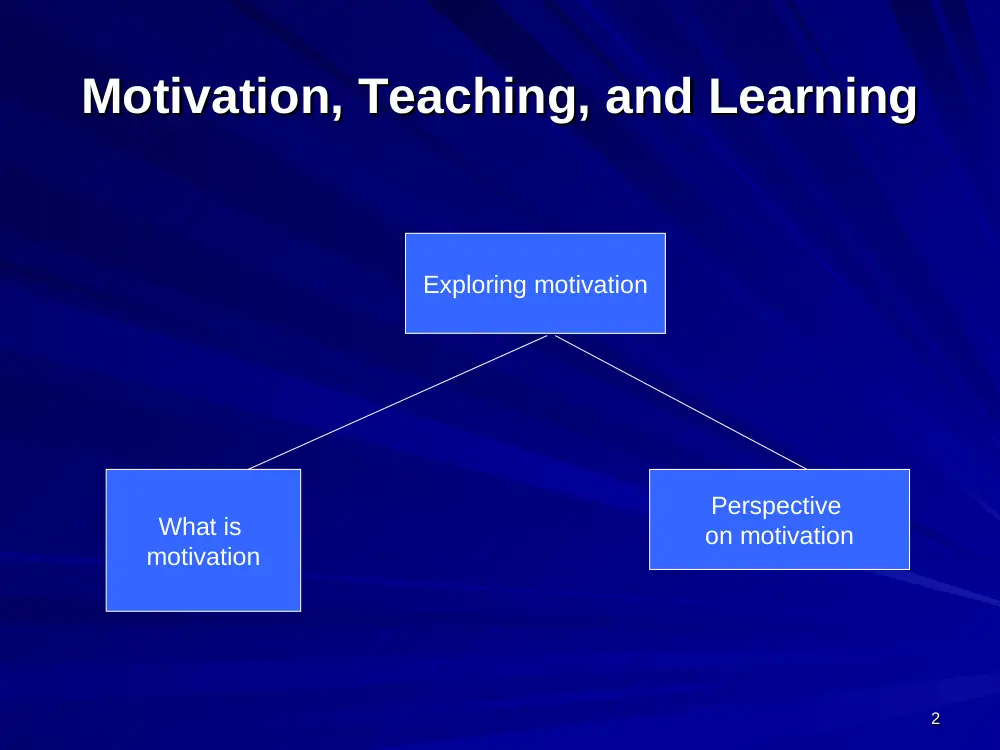
Motivation, Teaching, and Learning
Motivation, Teaching, and Learning
Exploring motivation
Perspective
on motivation
What is
motivation
33
Motivation
Motivation
Motivation involves the processes that
Motivation involves the processes that
energize, direct, and sustain behavior.
energize, direct, and sustain behavior.
44
Perspectives on Motivation
Perspectives on Motivation
Different psychological perspectives explain
Different psychological perspectives explain
motivation in different ways.
motivation in different ways.
The behavioral perspective
The behavioral perspective emphasizes
emphasizes
external rewards and punishments
external rewards and punishments as keys in
as keys in
determining student motivation.
determining student motivation.
Advocates of the use of incentives emphasize
Advocates of the use of incentives emphasize
that they add interest or excitement to the class
that they add interest or excitement to the class
and direct attention toward appropriate behavior
and direct attention toward appropriate behavior
and away from inappropriate behavior.
and away from inappropriate behavior.
55
Perspectives on Motivation
Perspectives on Motivation
The humanistic perspective
The humanistic perspective stresses
stresses
students’ capacity for personal growth,
students’ capacity for personal growth,
freedom to choose their own destinies,
freedom to choose their own destinies,
and positive qualities.
and positive qualities.
This perspective is associated with
This perspective is associated with
Abraham Maslow’s beliefs that basic
Abraham Maslow’s beliefs that basic
needs must be met before higher needs
needs must be met before higher needs
can be satisfied.
can be satisfied.
66
Maslow’s Hierarchy of Needs
Maslow’s Hierarchy of Needs
According to Maslow’s hierarchy of needs,
According to Maslow’s hierarchy of needs,
individuals’ needs must be satisfied in this
individuals’ needs must be satisfied in this
sequence:
sequence:
Physiological :Hunger, thirst, sleep
Physiological :Hunger, thirst, sleep
Safety: Ensuring survival such as protection from
Safety: Ensuring survival such as protection from
war and crimes.
war and crimes.
Love and belongingness: Security, affection, and
Love and belongingness: Security, affection, and
attention from others.
attention from others.
Esteem: Feeling good about oneself.
Esteem: Feeling good about oneself.
Self actualization: Realization of one’s potential.
Self actualization: Realization of one’s potential.
Characteristics of self actualized individuals
Characteristics of self actualized individuals
include being spontaneous, problem-centered
include being spontaneous, problem-centered
rather than self-centered and creative.
rather than self-centered and creative.
77
Perspectives on Motivation
Perspectives on Motivation
The cognitive perspective
The cognitive perspective focuses on students’
focuses on students’
competence motivation
competence motivation, their internal motivation to
, their internal motivation to
achieve, their attributions, and their beliefs that they
achieve, their attributions, and their beliefs that they
can effectively control their environment.
can effectively control their environment.
The cognitive perspective stresses that students
The cognitive perspective stresses that students
thoughts guide their motivation.
thoughts guide their motivation.
It stresses the importance of goal setting, planning
It stresses the importance of goal setting, planning
and monitoring progress toward a goal
and monitoring progress toward a goal
The cognitive perspective recommends that
The cognitive perspective recommends that
students should be given more opportunities and
students should be given more opportunities and
responsibility for controlling their own achievement
responsibility for controlling their own achievement
outcome.
outcome.
88
Perspectives on Motivation
Perspectives on Motivation
The social perspective
The social perspective stresses the
stresses the need for
need for
affiliation
affiliation or relatedness that involves
or relatedness that involves
establishing, maintaining, and restoring warm,
establishing, maintaining, and restoring warm,
close, personal relationships.
close, personal relationships.
Students need for affiliation or relatedness is
Students need for affiliation or relatedness is
reflected in their motivation to spend time with
reflected in their motivation to spend time with
peers, their classmates, relatives and teachers.
peers, their classmates, relatives and teachers.
Students in schools with caring and supportive
Students in schools with caring and supportive
interpersonal relationships have more positive
interpersonal relationships have more positive
academic attitudes and values and more
academic attitudes and values and more
satisfied with school.
satisfied with school.
99
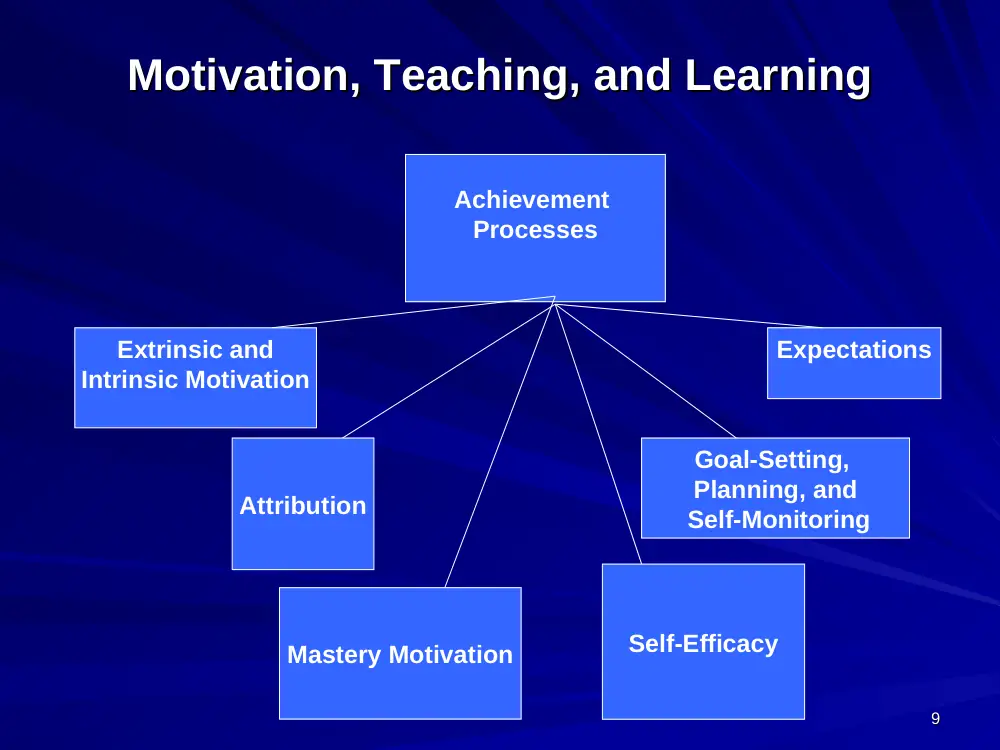
Motivation, Teaching, and Learning
Motivation, Teaching, and Learning
Achievement
Processes
Extrinsic and
Intrinsic Motivation
Expectations
Attribution
Goal-Setting,
Planning, and
Self-Monitoring
Mastery Motivation
Self-Efficacy
10
10
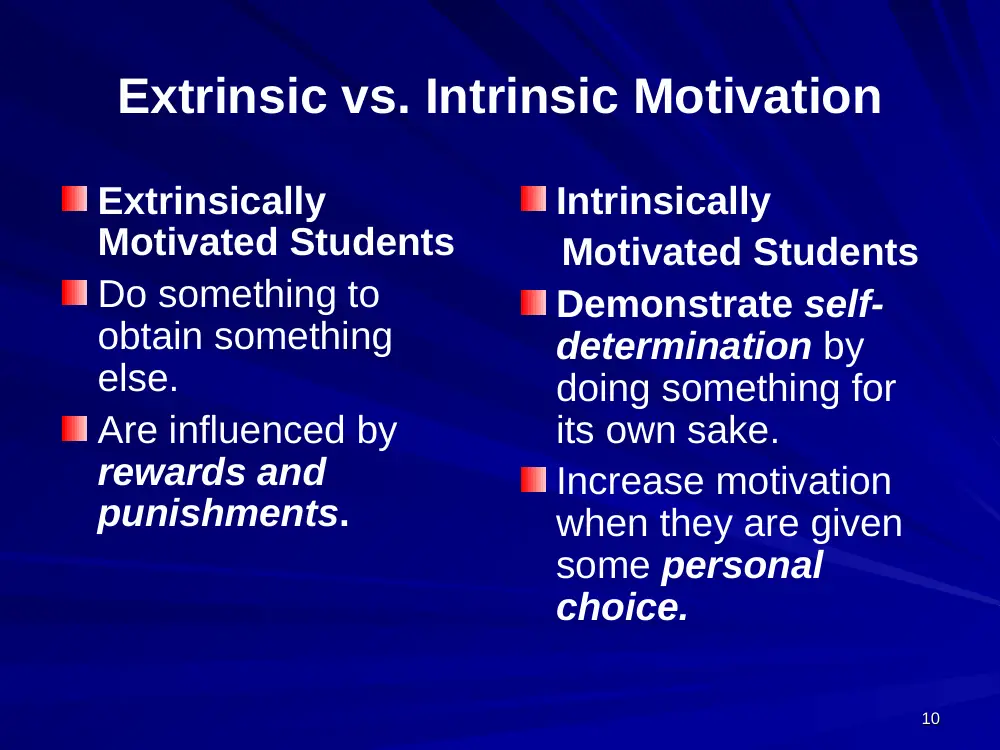
Extrinsic vs. Intrinsic Motivation
Extrinsically
Motivated Students
Do something to
obtain something
else.
Are influenced by
rewards and
punishments.
Intrinsically
Motivated Students
Demonstrate self-
determination by
doing something for
its own sake.
Increase motivation
when they are given
some personal
choice.
11
11
How can teachers promote intrinsic
motivation?
Intrinsic motivation is enhanced when you speak
to student interests.
Infuse academic instruction with content that is
familiar to them and that reflects their interests.
Also, when students see the real-world
significance of academic concepts, intrinsic
motivation is enhanced.
Share with them how they will use the things you
are teaching them.
Challenge them with activities that are
appropriate at their skill level, and avoid rewards
that will be perceived as controlling.
12
12
Types of intrinsic motivation
Self determination and personal choices: In
this view, students want to believe that they are
doing something because of their own will, not
because of external success or rewards.
Research results indicated that students in the
intrinsic motivation/self determination group
( were given opportunities to set their own goals,
plan how to reach the goals and monitor their
progress toward the goals) had higher
achievement gains and were more likely to
graduate from high school compared with a
control group.
13
13
Types of intrinsic motivation
Optimal Experiences and Flow:
Optimal Experiences and Flow: Mihaly
Mihaly
Csikszentmihalyi ( 1990,1993,2000) developed
Csikszentmihalyi ( 1990,1993,2000) developed
ideas that are relevant to understanding intrinsic
ideas that are relevant to understanding intrinsic
motivation)
motivation)
Optimal experiences involve feelings of deep
Optimal experiences involve feelings of deep
enjoyment and happiness.
enjoyment and happiness.
The term flow describe optimal experiences in
The term flow describe optimal experiences in
life.
life.
14
14
Optimal Experiences & Flow
Optimal Experiences & Flow
Students perceived level of their own skills
Students perceived level of their own skills
Students perceived level
Students perceived level
of Challenge
of Challenge
Flow
Flow occurs:
occurs:
When students
When students
develop a sense of
develop a sense of
mastery and are
mastery and are
absorbed in a state
absorbed in a state
of concentration while
of concentration while
they engage in an
they engage in an
activity.
activity.
When students are
When students are
challenged and perceive
challenged and perceive
that they have a high
that they have a high
degree of skill.
degree of skill.
Low
Low
High
High
Low
Low
Apathy
Apathy
Boredom
Boredom
High
High
Anxiety
Anxiety
Flow
Flow
15
15
Types of intrinsic motivation
Interest: research on interest has focused
on how interest is related to learning.
Interest is specifically linked to measures
of deep learning, such as recall of main
ideas and responses to more difficult
comprehension questions than to surface
learning such as responses to simple
questions and verbatim recall of text.
16
16
Types of intrinsic motivation
Cognitive engagement and self
responsibility: Phyllis Blumenfield and her
colleagues (2006) have proposed another
variation of intrinsic motivation.
They emphasize the importance of creating
learning environments that encourage students
to become cognitively engaged and take
responsibility for their learning.
The goal is to get the students to become
motivated to expend the effort to persist and
master ideas rather than to get the work done
and make passing grades.
17
17
Attribution Theory
Attribution Theory
Bernard Weiner
Bernard Weiner
Attribution theory:
Attribution theory: In their effort to make sense of their
In their effort to make sense of their
own behavior or performance, individuals are motivated
own behavior or performance, individuals are motivated
to discover its underlying causes.
to discover its underlying causes.
Locus:
Locus: Students who perceive their success as being due to
Students who perceive their success as being due to
internal factors (i.e., effort) are more likely to have higher
internal factors (i.e., effort) are more likely to have higher
self-esteem.
self-esteem.
Stability:
Stability: If a student attributes a positive outcome to a
If a student attributes a positive outcome to a
stable cause, there is an expectation of future success.
stable cause, there is an expectation of future success.
Controllability:
Controllability: Failure due to external factors causes anger.
Failure due to external factors causes anger.
Failure due to internal factors may cause guilt
Failure due to internal factors may cause guilt
18
18
Causal attributions for Failure
Combination of
causal attributions
Internal-stable
uncontrollable
Internal-stable
controllable
Internal-unstable
uncontrollable
Internal-unstable
controllable
Reasons students
give for failure
Low aptitude
Never study
Sick the day of the
test
Didn’t study for this
particular test
19
19
Causal attributions for Failure
Combination of
causal attributions
External-stable
uncontrollable
External-stable
controllable
External-unstable
uncontrollable
External-unstable
controllable
Reasons students
give for failure
School has tough
requirements
The instructor is
biased
Bad luck
Friends failed to help
20
20
Achievement Goal Orientation
Researchers have identified mastery as one of three
types of achievement orientation: mastery,
helplessness and performance.
Children with a Mastery Orientation
Focus on the task rather than their ability
Have positive affect (enjoy the challenge)
Generate solution-oriented strategies that improve their
performance.
Children with a Helpless Orientation
Focus on their personal inadequacies
Attribute their difficulty to lack of ability
Display negative affect such as boredom and anxiety
Performance Orientation
Students are concerned with the outcome rather than the
process
Winning is what matters and happiness is a result of winning
21
21
Self-Efficacy
Self-efficacy is the belief that one can master a
situation and produce positive outcomes.
Self-efficacy has much in common with mastery
motivation and intrinsic motivation
Self-efficacy is the belief that I can, helplessness
is the belief that I cannot
Students learn more from teachers with self-
efficacy rather than from those beset by self-
doubts.
Efficacious schools are pervaded by high
expectations and standards for achievement.
22
22
Strategies for improving students self
efficacy
Teach specific strategies that can improve their ability to
focus on their tasks
Help students develop short- and long-term goals
Give students performance-contingent rewards
Provide students with support from positive adult and
peer models
Make sure students are not overly aroused or anxious
Combine strategy training with an emphasis on goals,
and give feedback to students on how their learning
strategies relate to their performance
Provide students with positive adult and peer models.
23
23
Self-Regulation
Encourage and help students …
Set both short- and long-term challenging
goals
Manage time effectively, set priorities, and
be organized
Monitor progress toward goals
24
24
Motivation, Teaching, and Learning
Motivation, social
relationship, and
sociocultural
contexts
Social
Motives
Social
Relationship
Sociocultural
Context
25
25
Social motives and needs
affiliation
Social motives are needs and desires
that are learned through experiences
with the social world.
The need for affiliation is the motive to
be with other people and involves
establishing, maintaining, and restoring
warm, close, personal relationships.
26
26
Social Relationships
Students relationships with parents, peers and friends
have a tremendous impact on motivation.
Parents
Demographic characteristics: Parents with more
education are more likely than less educated parents to
be involved in their children education. They are more
active participants in their children education and have
intellectually stimulating materials at home.
When parents time and energy are consumed by other
concerns or other people then their child’s motivation
suffer.
Living in a single-parent family, having parents who are
consumed by their work, and living in a large family can
undercut children’s motivation
27
27
Childrearing practices: Has an impact on
child’s motivation.
Parenting practices that result in improved
motivation and achievement are:
Knowing enough about the child to provide the
right amount of challenge and support
Providing a positive emotional climate which
motivates children to internalize their parents’
values and goals
Modeling motivated achievement behavior,
working hard and persisting with effort at
challenging tasks
28
28
Provision of specific experiences at home
Provision of specific experiences at home
have a tremendous impact on child’s motivation
such as
Providing reading materials and reading to
children.
Children’s skills and work habits are among the
best predictors of academic motivation and
performance.
Emphasizing academic achievement or sports
and providing opportunities and resources for
children to participate in activities are important
factors that affect achievement and continuing
education in adolescence.
29
29
Peers
Peers: Peers can affect a student’s
motivation through
Social Comparison
Social competence and motivation
Peer co-learning
Peer-group influence
30
30
Teachers
31
31
Social Relationships
Motivation
to Achieve
Parents
should provide
the right
amount of
challenge in a
positive
environment
and model
achievement
behavior
Peers
with high
achievement
standards will
support student
achievement in
others.
Teachers
optimize
achievement
when they provide
challenging
tasks in a
supportive
environment.
32
32
Sociocultural Contexts
Ethnicity
There is DIVERSITY in
achievement motivation within
ethnic minority groups.
Socioeconomic
Status (SES)
When ethnicity and
socioeconomic status (SES) are
investigated in the same study,
SES is often the better predictor of
achievement.
33
33
Motivation and Gender
Males
Have higher competence
beliefs in math and sports
Are more rambunctious
Are more rambunctious
Receive more teacher
attention, yet receive
lower grades
List more career options
Females
Have higher competence
beliefs for English,
reading, and social
activities
Often experience conflicts
between gender roles
and achievement
Are more compliant, get
less teacher attention, by
middle school have lower
self-esteem
34
34
Motivation, Teaching, and Learning
Students with
Achievement
Problems
Students Who Are
Low-Achieving
and Have Low
Expectations for
Success
Students Who Protect
Their Self-Worth by
Avoiding Failure
Students Who
Procrastinate
Students Who Are
Uninterested or
Alienated
Students Who
Are Perfectionists
Students with
High Anxiety
35
35
Nonperformance versus procrastination
Nonperformance and procrastination are
strategies students engage in that are
designed to “protect” their self-worth.
Nonperformance refers to a protective strategy
where a student avoids the possibility of failure
by not engaging in tasks.
Procrastination involves putting off doing
something until the last minute, making it
nearly impossible to complete a task in a
thorough way. This strategy deflects attention
away from the possibility that they are
incompetent.
36
36
Failure syndrome
Failure syndrome refers to the belief that
one lacks the ability to succeed, and
therefore one gives up easily when
confronted with an obstacle.
37
37
Students with Achievement Problems
Low Achievers
with Low Expectations
Provide reassurance and
cognitive retraining, and
reward effort and progress
toward realistic goals
Protection
of Self-Worth
by Avoiding
Failure
Guide setting of realistic
goals, strengthen link between
effort and self-worth,
and encourage positive
self-perceptions
High
Anxiety
Modify negative thoughts by
engaging
students in more
positive, task-focused thoughts
38
38
Students with Achievement Problems
Procrastinators
Encourage
acknowledgement of
problem, assist in
time management
and task analysis,
and teach behavioral
and cognitive
strategies for dealing
with problem
Perfectionists
Identify cost/benefits,
decrease self-
criticism, set realistic
goals and time limits,
and encourage
acceptance of
criticism
39
39
Hard-to-Reach,
Low-Achieving Students
Develop positive teacher-student
relationships
Make school more interesting
Teach strategies to make learning
enjoyable
Consider including a mentor
40
40
Strategies for reaching uninterested or
alienated students
On the basis of Brophy’s research, a teacher
should:
Work on developing a positive relationship with
the student
Make school more intrinsically interesting for
the student by finding the student’s interests
and including those interests in assignments.
Teach the student strategies for making
academic work more enjoyable
Enlist the aid of a mentor in the community or
an older student whom the uninterested or
alienated student will respect.
41
41
Addressing achievement problems involves
identifying the specific problem and getting
students to acknowledge it. Then, there are a
variety of strategies teachers can implement to
help students reduce or eliminate these
problems:
Efficacy training : Efficacy training seeks to
Efficacy training seeks to
improve students’ efficacy perceptions or belief
improve students’ efficacy perceptions or belief
in their ability to master a given task. The
in their ability to master a given task. The
primary emphasis of efficacy training
primary emphasis of efficacy training is
Improving students’ academic confidence.
Improving students’ academic confidence.
Attribution and achievement orientation
retraining: Attribution retraining seeks to
Attribution retraining seeks to
change students’ beliefs about the
change students’ beliefs about the
causality of their success and the reason
causality of their success and the reason
behind their performance.
behind their performance.
Strategy training: Strategy training seeks
Strategy training seeks
to provide students with the learning
to provide students with the learning
strategies necessary to succeed.
strategies necessary to succeed.
The primary emphasis is improving
mproving
students’ domain- and task-specific skills
students’ domain- and task-specific skills
42
42
Realistic goal setting: Goals should be
specific, proximal and challenging. Students
can set both long-term (distal) and short-term
(proximal) goals, however short term goals
are very important. Goals should also be
challenging. Goals that are easy to reach
generate little interest or effort. However
goals should optimally be matched to the
students skill level. If goals are unrealistically
high, the results will be repeated failures that
lower the students efficacy.
43
43
Expectations: Students expectations for
Expectations: Students expectations for
success and value they place on what they
success and value they place on what they
want to achieve influence their motivation.
want to achieve influence their motivation.
Teachers expectations have a powerful
Teachers expectations have a powerful
influence on students’ motivation and
influence on students’ motivation and
achievement. Teachers often have higher
achievement. Teachers often have higher
expectations for high-ability students than
expectations for high-ability students than
low ability students. It is important for
low ability students. It is important for
teachers to monitor their expectations and
teachers to monitor their expectations and
to have high expectations for all students.
to have high expectations for all students.
44
44
Cognitive interventions: Students anxiety
increases as they get older and face more
evaluation, social comparison and failure.
Cognitive programs that replace students’ self
damaging thoughts with positive constructive
thoughts have been more effective than
relaxation programs in benefiting student
achievement.
45
45
Values and purpose: Very few
Values and purpose: Very few
students engage in purposeful
students engage in purposeful
reflection about what they want to do
reflection about what they want to do
with their lives. Parents and teachers
with their lives. Parents and teachers
need to ask students more questions
need to ask students more questions
especially “why” questions to
especially “why” questions to
encourage them to think more deeply
encourage them to think more deeply
about what their purpose is.
about what their purpose is.
46
46
Teachers would establish opportunities for
Teachers would establish opportunities for
communities of learning. Peer tutoring,
communities of learning. Peer tutoring,
collaborative projects and writing, and cooperative
collaborative projects and writing, and cooperative
learning are some examples.
learning are some examples.
In general, establishing a community
In general, establishing a community
atmosphere for the classroom as a whole will
atmosphere for the classroom as a whole will
provide students with a supportive network
provide students with a supportive network
necessary to optimize learning
necessary to optimize learning..
47
47
Teachers can improve students’ efficacy
Teachers can improve students’ efficacy
by:
by:
teaching students specific strategies.
teaching students specific strategies.
helping students to set short-term
helping students to set short-term
goals.
goals.
providing support.
providing support.
monitoring student anxiety.
monitoring student anxiety.
exposing students to positive models.
exposing students to positive models.
48
48
Pretask
Pretask
Several variables influence students’ incoming
Several variables influence students’ incoming
motivation.
motivation.
Students enter tasks with various goals such as
Students enter tasks with various goals such as
learn the material, perform well, be the first one to
learn the material, perform well, be the first one to
finish.
finish.
Students enter tasks with various expectations.
Students enter tasks with various expectations.
This may involve capabilities ( self efficacy and
This may involve capabilities ( self efficacy and
perceptions of the consequences of learning
perceptions of the consequences of learning
( outcome expectations.
( outcome expectations.
Students have differing perceptions of value or
Students have differing perceptions of value or
perceived importance of learning.
perceived importance of learning.
49
49
Pretask Con’t
Pretask Con’t
Students differ in their affects associated
Students differ in their affects associated
with learning. They may be excited, anxious
with learning. They may be excited, anxious
or feel no particular emotion. These affects
or feel no particular emotion. These affects
may relate closely to students’ needs.
may relate closely to students’ needs.
Social support in students lives will vary. It
Social support in students lives will vary. It
includes the types of assistance from
includes the types of assistance from
teachers, peers and parents.
teachers, peers and parents.
Learning often requires that others provide
Learning often requires that others provide
time, money, effort, transportation and so
time, money, effort, transportation and so
forth.
forth.
50
50
During Task
During Task
Instructional, contextual and personal variables come
Instructional, contextual and personal variables come
into play during learning .
into play during learning .
Instructional variables include teachers, forms of
Instructional variables include teachers, forms of
feedback, materials and equipment. For example
feedback, materials and equipment. For example
teacher feedback can encourage or discourage,
teacher feedback can encourage or discourage,
instruction can clarify or confuse, materials can provide
instruction can clarify or confuse, materials can provide
for many or few successes.
for many or few successes.
Contextual variables include social and environmental
Contextual variables include social and environmental
resources. Factors such as location, time of day,
resources. Factors such as location, time of day,
distractions, temperature, ongoing events and the like
distractions, temperature, ongoing events and the like
can enhance or retard motivation.Higly competitive
can enhance or retard motivation.Higly competitive
conditions can affect motivation. Students social
conditions can affect motivation. Students social
comparisons of ability with peers directly link to
comparisons of ability with peers directly link to
motivation.
motivation.
51
51
During Task Con’t
During Task Con’t
Personal variables include those associated
Personal variables include those associated
with learning such as knowledge construction
with learning such as knowledge construction
and skill acquisition, self regulation variables,
and skill acquisition, self regulation variables,
and motivational indexes ( choice of activities,
and motivational indexes ( choice of activities,
effort, persistence).
effort, persistence).
Students perceptions of how well they are
Students perceptions of how well they are
learning and of the effects of instructional ,
learning and of the effects of instructional ,
contextual, and personal variables influence
contextual, and personal variables influence
motivation for continued learning.
motivation for continued learning.
52
52
Posttask
Posttask
Posttask denotes the time when the task is completed and
Posttask denotes the time when the task is completed and
periods of self reflection ( think about their work).
periods of self reflection ( think about their work).
The same variables important prior to task engagement are
The same variables important prior to task engagement are
critical during self reflection with the addition of attribution.
critical during self reflection with the addition of attribution.
Attributions ( perceived causes of outcomes). Students
Attributions ( perceived causes of outcomes). Students
who believe that they are progressing toward their goals and
who believe that they are progressing toward their goals and
make positive attributions for success are apt to sustain their
make positive attributions for success are apt to sustain their
self-efficacy for learning, outcome expectations, perceived
self-efficacy for learning, outcome expectations, perceived
value, and positive emotional climate.
value, and positive emotional climate.
Factors associated with instruction, such as teacher
Factors associated with instruction, such as teacher
feedback provide information about goal progress and
feedback provide information about goal progress and
outcome expectations
outcome expectations
53
53