
EDUC 215 Chapter 3, Fall 2009
American University of Beirut · Learning and Human Development · 50 pages · Dr. Vivian Khamis
Showing the first 10 of 50 pages. Download the PDF to see all of it.
More EDUC 215 files
Show the text of this chapter
Social Contexts and
Social Contexts and
Socioemotional Development
Socioemotional Development
11
Bronfenbrenner’s Ecological Theory
Bronfenbrenner’s Ecological Theory
The ecological theory developed by
The ecological theory developed by
Bronfenbrenner
Bronfenbrenner (1917-2005)
(1917-2005) focuses on
focuses on
the social contexts in which children live
the social contexts in which children live
and the people who influence their
and the people who influence their
development.
development.
The theory consists of five environmental
The theory consists of five environmental
systems that range from close
systems that range from close
interpersonal interactions to broad-based
interpersonal interactions to broad-based
influences of culture.
influences of culture.
22
The five environmental systems
The five environmental systems
Microsystem:
Microsystem: A microsystem is the setting in
A microsystem is the setting in
which the individual spends considerable time
which the individual spends considerable time
and has direct interactions with parents,
and has direct interactions with parents,
teachers, peers, and others.
teachers, peers, and others.
For Bronfenbrenner the student is not a passive
For Bronfenbrenner the student is not a passive
recipient of experiences but reciprocally interacts
recipient of experiences but reciprocally interacts
and helps to construct the microsystem.
and helps to construct the microsystem.
Mesosystem:
Mesosystem: The mesosystem involves
The mesosystem involves
linkages between microsystems such as family
linkages between microsystems such as family
and school, and relationships between students
and school, and relationships between students
and peers.
and peers.
33
Exosystem:
Exosystem: experiences in
experiences in settings
settings
in which a child does not have an
in which a child does not have an
active role influence the child’s
active role influence the child’s
experiences (e.g., community
experiences (e.g., community
members, mass media etc)
members, mass media etc)
44
Macrosystem:
Macrosystem: The macrosystem is the
The macrosystem is the
broader culture in which students and
broader culture in which students and
teachers live(e.g., gender inequities,
teachers live(e.g., gender inequities,
ethnicity , socioeconomic status etc).
ethnicity , socioeconomic status etc).
Chronosystem:
Chronosystem: The
The chronosystem
chronosystem
includes the sociohistorical conditions of a
includes the sociohistorical conditions of a
student’s development( e.g., use of
student’s development( e.g., use of
computers, child care centers, less
computers, child care centers, less
extended family connections).
extended family connections).
55
Critics of the Ecological Theory
Critics of the Ecological Theory
The theory gives little attention to
The theory gives little attention to
biological and cognitive factors in child
biological and cognitive factors in child
development
development
The theory doesn’t address step by step
The theory doesn’t address step by step
developmental changes.
developmental changes.
66
Bronfenbrenner’s Theory in the
Bronfenbrenner’s Theory in the
Classroom
Classroom
Think about children embedded in several
Think about children embedded in several
environmental systems and influences
environmental systems and influences
Attend to connections between school and
Attend to connections between school and
families
families
Recognize the importance of community,
Recognize the importance of community,
culture, and socioeconomic status
culture, and socioeconomic status
77
Erikson’s Life-Span Development
Erikson’s Life-Span Development
Theory
Theory
Erikson believed that human development
Erikson believed that human development
proceeds in stages
proceeds in stages
Each stage consists of a developmental task that
Each stage consists of a developmental task that
confronts individuals with a crisis. Therefore
confronts individuals with a crisis. Therefore
each stage is characterized by a psychosocial
each stage is characterized by a psychosocial
challenge or crisis
challenge or crisis
Stages reflect the motivation of the individual.
Stages reflect the motivation of the individual.
The more the individual is successful in resolving
The more the individual is successful in resolving
the crisis the more he or she will stay healthy.
the crisis the more he or she will stay healthy.
88
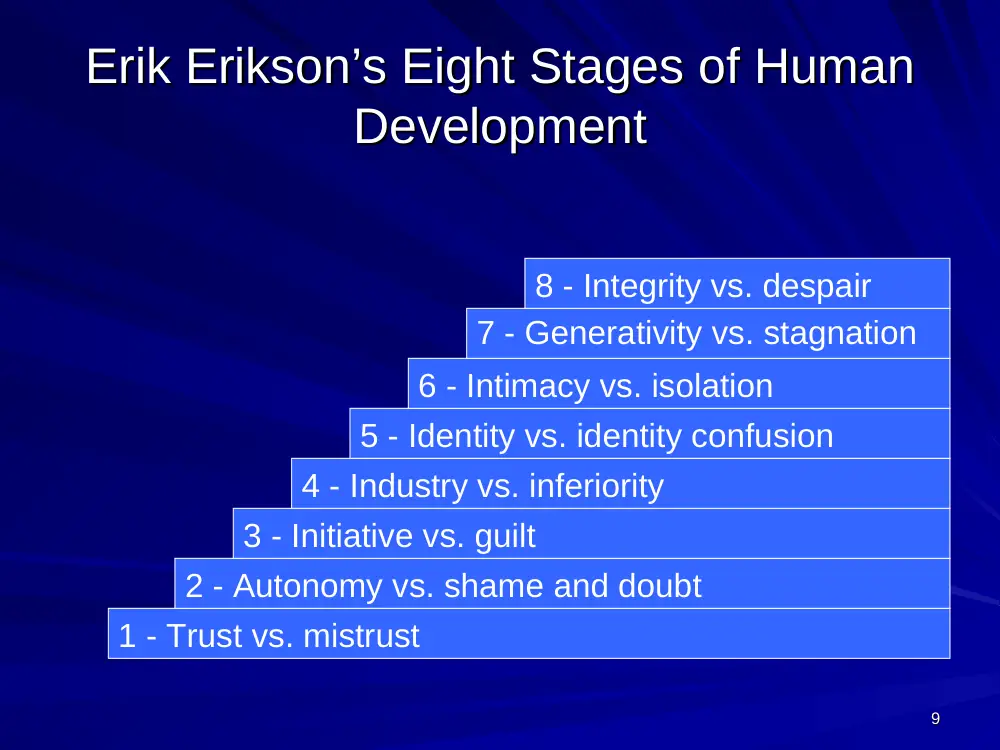
Erik Erikson’s Eight Stages of Human
Erik Erikson’s Eight Stages of Human
Development
Development
1 - Trust vs. mistrust
2 - Autonomy vs. shame and doubt
3 - Initiative vs. guilt
4 - Industry vs. inferiority
5 - Identity vs. identity confusion
6 - Intimacy vs. isolation
7 - Generativity vs. stagnation
8 - Integrity vs. despair
99
1 -
1 - Trust vs. Mistrust (
Trust vs. Mistrust (0–1 years)
0–1 years)
Infants learn either to trust the
Infants learn either to trust the
environment (when needs are met) or
environment (when needs are met) or
mistrust. Mistrust develops when infants
mistrust. Mistrust develops when infants
are neglected or ignored.
are neglected or ignored.
The development of trust requires warm,
The development of trust requires warm,
nurturing caregiving.Developed through
nurturing caregiving.Developed through
consistent love and support.
consistent love and support.
10
10
2 -
2 - Autonomy vs. Shame and Doubt
Autonomy vs. Shame and Doubt
(1–3 years). It occurs in late infancy and
(1–3 years). It occurs in late infancy and
the toddler years.
the toddler years.
Toddlers acquire self confidence if they
Toddlers acquire self confidence if they
learn to regulate their bodies and act
learn to regulate their bodies and act
independently. If they fail or are labeled
independently. If they fail or are labeled
as inadequate , restrained or punished
as inadequate , restrained or punished
they experience shame and doubt.
they experience shame and doubt.
Independence fostered by support and
Independence fostered by support and
encouragement
encouragement
11
11
3 -
3 - Initiative vs. Guilt
Initiative vs. Guilt (3–5 years )
(3–5 years )
As young children experience a widening
As young children experience a widening
social world, they are challenged more
social world, they are challenged more
than they were infants.
than they were infants.
To cope with the challenges , they need to
To cope with the challenges , they need to
engage in active purposeful behavior that
engage in active purposeful behavior that
involves initiative. Children develop
involves initiative. Children develop
uncomfortable guilt feelings if they are
uncomfortable guilt feelings if they are
irresponsible or are made to feel too
irresponsible or are made to feel too
anxious.
anxious.
Developed by exploring and accepting
Developed by exploring and accepting
challenges
challenges
12
12
4 -
4 - Industry vs. Inferiority
Industry vs. Inferiority (6 years–puberty)
(6 years–puberty)
Children acquire many skills and
Children acquire many skills and
competencies. If they take pride in these,
competencies. If they take pride in these,
they acquire high self esteem. If they
they acquire high self esteem. If they
compare themselves unfavorably
compare themselves unfavorably
with others, they may develop low self
with others, they may develop low self
esteem, inferiority, unproductiveness ,
esteem, inferiority, unproductiveness ,
and
and
incompetence.
incompetence.
Mastery comes from success and
Mastery comes from success and
recognition
recognition
13
13
5 -
5 - Identity vs. Role Confusion
Identity vs. Role Confusion
((Adolescence)
Adolescence)
Adolescents must integrate various
Adolescents must integrate various
roles (e.g., vocational and romantic)
roles (e.g., vocational and romantic)
into a consistent self identity. If they fail
into a consistent self identity. If they fail
to do so, they may experience confusion
to do so, they may experience confusion
over who they are.
over who they are.
Exploration of different paths to attain a
Exploration of different paths to attain a
healthy identity.
healthy identity.
14
14
6 -
6 - Intimacy vs. Isolation
Intimacy vs. Isolation
(Early adult years)
(Early adult years)
Young adults must develop the ability to
Young adults must develop the ability to
form deep intimate relationships with
form deep intimate relationships with
others . If they don’t, they may become
others . If they don’t, they may become
socially or emotionally isolated.
socially or emotionally isolated.
Form positive, close relationships with
Form positive, close relationships with
others
others
15
15
7 -
7 - Generativity vs. Stagnation
Generativity vs. Stagnation (Middle Adulthood)
(Middle Adulthood)
Adults must develop an active interest in helping and
Adults must develop an active interest in helping and
guiding younger persons. If they don’t , they may become
guiding younger persons. If they don’t , they may become
preoccupied with purely selfish needs.
preoccupied with purely selfish needs.
Generativity means transmitting something positive to the
Generativity means transmitting something positive to the
next generation. This can involve parenting and
next generation. This can involve parenting and
teaching ,through which adults assist the next generation
teaching ,through which adults assist the next generation
in developing useful lives.
in developing useful lives.
Stagnation is the feeling of having done nothing to help
Stagnation is the feeling of having done nothing to help
the next generation.
the next generation.
Transmitting something positive to the next generation
Transmitting something positive to the next generation
16
16
8 -
8 - Integrity vs. Despair
Integrity vs. Despair (Late Adulthood)
(Late Adulthood)
In the closing decades of life, individuals
In the closing decades of life, individuals
ask themselves whether their lives had any
ask themselves whether their lives had any
meaning. If the retrospective evaluations
meaning. If the retrospective evaluations
are positive, they develop a sense of
are positive, they develop a sense of
integrity. If they answer no, they
integrity. If they answer no, they
experience despair.
experience despair.
Life review and retrospective evaluation
Life review and retrospective evaluation
of one’s past
of one’s past
17
17
Strategies for Educating Children
Strategies for Educating Children
Based on Erikson’s Theory
Based on Erikson’s Theory
Initiative
Initiative
– Encourage social play
Encourage social play
– Have children assume responsibility
Have children assume responsibility
– Structure assignments for success
Structure assignments for success
Industry
Industry
– Nourish motivation for mastery
Nourish motivation for mastery
– Be tolerant of honest mistakes
Be tolerant of honest mistakes
Identity
Identity
– Recognize that identity is multidimensional
Recognize that identity is multidimensional
– Encourage independent thinking
Encourage independent thinking
– Stimulate students to examine different perspectives
Stimulate students to examine different perspectives
18
18
Social Contexts
of
Socioemotional
Development
Families
Peers
Schools
19
19
Diana Baumrind’s Parenting Styles
Diana Baumrind’s Parenting Styles
Diana Baumrind states that parents should
Diana Baumrind states that parents should
be neither punitive nor aloof. Rather they
be neither punitive nor aloof. Rather they
should develop rules for children while at
should develop rules for children while at
the same time being supportive and
the same time being supportive and
nurturing.
nurturing.
Baumrind says that parenting styles come
Baumrind says that parenting styles come
in four main forms.
in four main forms.
20
20
Diana Baumrind’s Parenting Styles
Diana Baumrind’s Parenting Styles
(Cont’d)
(Cont’d)
– Authoritarian parenting is restrictive and
Authoritarian parenting is restrictive and
punitive.
punitive.
– Parents place
Parents place firm limits and controls
firm limits and controls on
on
children and allow very little verbal exchange.
children and allow very little verbal exchange.
“Do it my way or else “.
“Do it my way or else “.
– Children of authoritarian parents tend to be
Children of authoritarian parents tend to be
socially incompetent with poor communication
socially incompetent with poor communication
skills. They tend to be anxious about social
skills. They tend to be anxious about social
comparison, fail to initiate activity, and have
comparison, fail to initiate activity, and have
poor communication skills.
poor communication skills.
21
21
Baumrind’s Parenting Styles
Baumrind’s Parenting Styles
(Cont’d)
(Cont’d)
– Authoritative parenting
Authoritative parenting encourages children
encourages children
to be independent but still put limits and
to be independent but still put limits and
controls on their actions.
controls on their actions.
“
“You know you shouldn’t have done it. Lets
You know you shouldn’t have done it. Lets
talk about how you can handle it next time”.
talk about how you can handle it next time”.
Extensive verbal-give and take is allowed.
Extensive verbal-give and take is allowed.
– Parents are
Parents are nurturing and supportive
nurturing and supportive. .
Children are self-reliant, get along with peers,
Children are self-reliant, get along with peers,
and have high self-esteem
and have high self-esteem
22
22
Diana Baumrind’s Parenting Styles
Diana Baumrind’s Parenting Styles
(Cont’d)
(Cont’d)
– Neglectful parenting
Neglectful parenting is a style of parenting in
is a style of parenting in
which parents are uninvolved in their
which parents are uninvolved in their
children’s lives.
children’s lives.
– Parents are
Parents are permissive and uninvolved
permissive and uninvolved. .
Children have poor self-control ,don’t handle
Children have poor self-control ,don’t handle
independence well, and low achievement
independence well, and low achievement
motivation. They often behave in a socially
motivation. They often behave in a socially
incompetent way.
incompetent way.
23
23
Diana Baumrind’s Parenting Styles
Diana Baumrind’s Parenting Styles
(Cont’d)
(Cont’d)
– Indulgent parenting
Indulgent parenting is a parenting style in
is a parenting style in
which parents are highly involved with their
which parents are highly involved with their
children but set few limits and restrictions on
children but set few limits and restrictions on
their children.
their children.
– Parents let their children do what they like and
Parents let their children do what they like and
what they want to do. They don’t take into
what they want to do. They don’t take into
account the development of the whole child.
account the development of the whole child.
– Children tend to have poor self-control.
Children tend to have poor self-control.
24
24
The Changing Family
The Changing Family
Children in families of divorce
Children in families of divorce
- The quality of parental relationships, the use of
- The quality of parental relationships, the use of
support services, the type of custody, and the
support services, the type of custody, and the
socioeconomic status all affect students.
socioeconomic status all affect students.
- Elementary schoolchildren did best when the parent
- Elementary schoolchildren did best when the parent
and the school environment were
and the school environment were authoritative.
authoritative.
Single parents
Single parents
- Have less time, money, and energy, yet many still find
- Have less time, money, and energy, yet many still find
ways to raise competent children.
ways to raise competent children.
25
25
Ethnic and Socioeconomic
Ethnic and Socioeconomic
Variations in Families
Variations in Families
Minority students
Minority students
- Families tend to be larger; depend more on
- Families tend to be larger; depend more on
the extended family for support
the extended family for support
- Single parents are more common
- Single parents are more common
- Less educated; lower income
- Less educated; lower income
Low-income parents
Low-income parents
- Tend to value external characteristics such as
- Tend to value external characteristics such as
obedience and neatness
obedience and neatness
- See education as the teachers’ job
- See education as the teachers’ job
26
26
Ethnic and Socioeconomic
Ethnic and Socioeconomic
Variations in Families
Variations in Families
Middle-class families
Middle-class families
- Often place high value on internal
Often place high value on internal
characteristics such as self-control and
characteristics such as self-control and
delayed gratification
delayed gratification
- See education as a mutual responsibility
- See education as a mutual responsibility
27
27
School-Family Linkages
School-Family Linkages
• Provide assistance to families
Provide assistance to families
• Include families as participants in school
Include families as participants in school
decisions
decisions
• Encourage parents to be volunteers
Encourage parents to be volunteers
• Communicate effectively with families about
Communicate effectively with families about
school programs and their child’s progress
school programs and their child’s progress
• Involve families with their children in learning
Involve families with their children in learning
activities at home
activities at home
• Coordinate community collaboration
Coordinate community collaboration
28
28
Peer Statuses
Peer Statuses
Developmentalists have pinpointed five
Developmentalists have pinpointed five
types of peer status.
types of peer status.
Popular :
Popular :Listen carefully, act like
Listen carefully, act like
themselves, show enthusiasm, are happy
themselves, show enthusiasm, are happy
Rejected :
Rejected :Seldom" best friend," often
Seldom" best friend," often
disliked
disliked
Neglected:
Neglected: Infrequently “best friend," are
Infrequently “best friend," are
not disliked
not disliked
29
29
Peer Statuses
Peer Statuses
Average:
Average: Receive both positive and
Receive both positive and
negative peer nominations
negative peer nominations
Controversial:
Controversial: Frequently, “best friend,”
Frequently, “best friend,”
often disliked
often disliked
30
30
Benefits of Friendships
Benefits of Friendships
Companionship
Companionship
Physical support
Physical support
Ego support
Ego support
Intimacy/affection
Intimacy/affection
31
31
Early Childhood and Elementary School
Early Childhood and Elementary School
The early childhood setting is a protected
The early childhood setting is a protected
educational environment with one or two teachers
educational environment with one or two teachers
Head Start project were designed to provide young
Head Start project were designed to provide young
children from low income families opportunities and
children from low income families opportunities and
experiences that are important for success in
experiences that are important for success in
schools. High-quality Head Start interventions are
schools. High-quality Head Start interventions are
effective
effective
Great emphasis on peer groups
Great emphasis on peer groups
Developmentally appropriate education is based on
Developmentally appropriate education is based on
knowledge of the typical development of children
knowledge of the typical development of children
within an age span (age appropriateness) as well as
within an age span (age appropriateness) as well as
the uniqueness of the child( individual-
the uniqueness of the child( individual-
appropriateness).
appropriateness).
32
32
Schools for Adolescents
Schools for Adolescents
Middle schools are massive, impersonal
Middle schools are massive, impersonal
institutions where students trust few adults and
institutions where students trust few adults and
have limited access to health care and
have limited access to health care and
counseling.
counseling.
School’s emphasis on achievement often
School’s emphasis on achievement often
overshadows physical and socioemotional
overshadows physical and socioemotional
changes, causing stress.
changes, causing stress.
Beginning students are relegated to the bottom
Beginning students are relegated to the bottom
of the school hierarchy.
of the school hierarchy.
33
33
Social Contexts and
Social Contexts and
Socioemotional Development
Socioemotional Development
Socioemotional
Development
The Self
Moral
Development
34
34
Self-Concept and Self-Esteem
Self-Concept and Self-Esteem
Self-concept
Self-concept is a cognitive appraisal of our
is a cognitive appraisal of our
social, physical, and academic competence
social, physical, and academic competence
(measures of such things are our skill in various
(measures of such things are our skill in various
subject areas, our assessment of our
subject areas, our assessment of our
appearance, and the skill we have in peer
appearance, and the skill we have in peer
relationships).
relationships).
Self-esteem
Self-esteem is the affective or emotional
is the affective or emotional
reaction to one’s self-concept (reflects a
reaction to one’s self-concept (reflects a
person’s overall confidence and satisfaction).
person’s overall confidence and satisfaction).
Self esteem is also refer to as self worth or self
Self esteem is also refer to as self worth or self
image.
image.
35
35
Improving Children’s Self-
Improving Children’s Self-
Esteem
Esteem
Encourage
Encourage and
and facilitate
facilitate
– Competence
Competence in areas students find important
in areas students find important
– Improvement of academic skills
Improvement of academic skills through the use of
through the use of
professional tutors, parent volunteers, and peer tutors
professional tutors, parent volunteers, and peer tutors
– Emotional support and social approval
Emotional support and social approval by parents,
by parents,
friends, and peers
friends, and peers
– Social skills
Social skills that promote positive peer relationships
that promote positive peer relationships
– Coping skills
Coping skills to face the day-to-day problems as
to face the day-to-day problems as
they appear
they appear
36
36
Identity Development
Identity Development
James Marcia’s Four Statuses of Identity
James Marcia’s Four Statuses of Identity
Identity is another aspect of the self.
Marcia proposed that adolescents have
Marcia proposed that adolescents have
one of four identity statuses based on the
one of four identity statuses based on the
extent to which they have explored or are
extent to which they have explored or are
exploring alternative paths and whether
exploring alternative paths and whether
they have made a commitment.
they have made a commitment.
37
37
Identity Development (Cont’d)
Identity Development (Cont’d)
Marcia distinguished between exploration
Marcia distinguished between exploration
and commitment.
and commitment.
Exploration involves experiencing
Exploration involves experiencing
meaningful alternative identities.
meaningful alternative identities.
Commitment means showing a personal
Commitment means showing a personal
investment in an identity and staying with
investment in an identity and staying with
whatever that identity implies.
whatever that identity implies.
38
38
Identity Development (Cont’d)
Identity Development (Cont’d)
Adolescents can explore alternative
Adolescents can explore alternative
identities in numerous areas such as
identities in numerous areas such as
vocational, religious, intellectual, political,
vocational, religious, intellectual, political,
sexual, gender, ethnic and interests.
sexual, gender, ethnic and interests.
The extent of an individual/s exploration
The extent of an individual/s exploration
and commitment is used to classify him or
and commitment is used to classify him or
her according to one of four identity status.
her according to one of four identity status.
39
39
Identity Development (Cont’d)
Identity Development (Cont’d)
Identity Diffusion: occurs when a
Identity Diffusion: occurs when adolescents
dolescents
have not yet explored meaningful alternatives (have
have not yet explored meaningful alternatives (have
not yet experienced crisis) or made commitments.
not yet experienced crisis) or made commitments.
Not only are they undecided about occupational
Not only are they undecided about occupational
and ideological choices, but they are also likely to
and ideological choices, but they are also likely to
show little interest in such matters.
show little interest in such matters.
Identity Foreclosure: occurs when a
Identity Foreclosure: occurs when adolescents
dolescents
have made a commitment without exploring
have made a commitment without exploring
alternatives (have not yet experienced crisis). This
alternatives (have not yet experienced crisis). This
often happens when parents hand down
often happens when parents hand down
commitments to their adolescents. In this case,
commitments to their adolescents. In this case,
adolescents have not had adequate opportunities to
adolescents have not had adequate opportunities to
explore different approaches, ideologies, and
explore different approaches, ideologies, and
vocations on their own.
vocations on their own.
40
40
Identity Development (Cont’d)
Identity Development (Cont’d)
Identity Moratorium:
Identity Moratorium: occurs when
occurs when
individuals are in the midst of a crisis.
individuals are in the midst of a crisis.
When alternatives have been explored but
When alternatives have been explored but
commitments are absent
commitments are absent
Identity Achievement:
Identity Achievement: occurs when
occurs when
alternatives have been explored (have
alternatives have been explored (have
undergone crisis) and commitments have
undergone crisis) and commitments have
been made
been made
41
41
Moral Development
Moral development concerns rules and
conventions about just interactions between
people.
These rules can be studied in three domains,
cognitive, behavioral and emotional.
1. In the cognitive domain, the key issue is how
students reason or think about rules for ethical
conduct.
2. In the behavioral domain, the focus is on how
students actually behave rather than on the
morality of their thinking.
3. In the emotional domain, the emphasis is on
how students morally feel.
42
42
Piaget’s Theory of Moral Development
Piaget’s Theory of Moral Development
Heteronomous morality
Heteronomous morality
age 4–7:In this stage justice and rules are
age 4–7:In this stage justice and rules are
conceived
conceived as unchangeable properties of the
as unchangeable properties of the
world and are outside the control of people.
world and are outside the control of people.
Imminent justice
Imminent justice—if the rule is broken,
—if the rule is broken,
punishment is immediate.
punishment is immediate.
Autonomous morality
Autonomous morality
age 7–10: Child becomes aware that
age 7–10: Child becomes aware that laws are
laws are
created by people, and intention and
created by people, and intention and
consequences should be considered
consequences should be considered
43
43
Kohlberg’s Levels of Moral Development
Kohlberg’s Levels of Moral Development
Lawrence Kohlberg stressed that moral
Lawrence Kohlberg stressed that moral
development primarily involves moral reasoning
development primarily involves moral reasoning
and occur in stages.
and occur in stages.
Kohlberg arrived at his theory after interviewing
Kohlberg arrived at his theory after interviewing
children , adolescents, and adults (primarily
children , adolescents, and adults (primarily
males) about their views on a series of moral
males) about their views on a series of moral
dilemmas.
dilemmas.
Kohlberg constructed a theory of moral
Kohlberg constructed a theory of moral
development that has three main levels with two
development that has three main levels with two
stages at each of these levels.
stages at each of these levels.
A key concept in understanding Kohlberg's
A key concept in understanding Kohlberg's
theory is internalization, which refers to the
theory is internalization, which refers to the
developmental change from externally controlled
developmental change from externally controlled
behavior to internally controlled behavior.
behavior to internally controlled behavior.
44
44
Kohlberg’s Levels of Moral Development
Kohlberg’s Levels of Moral Development
At different points in our lives, we exhibit
At different points in our lives, we exhibit
different forms of thoughts and beliefs regarding
different forms of thoughts and beliefs regarding
moral behavior
moral behavior
Kohlberg examined moral thought by asking
Kohlberg examined moral thought by asking
people of various ages to comment on moral
people of various ages to comment on moral
situations evident in a vignette:
situations evident in a vignette:
– ““Ahmad steals an expensive drug in order to
Ahmad steals an expensive drug in order to
save the life of his wife who suffers from
save the life of his wife who suffers from
cancer.”
cancer.”
45
45
Kohlberg’s Levels of Moral Development
Kohlberg’s Levels of Moral Development
Preconventional reasoning
Preconventional reasoning is the lowest level of moral
is the lowest level of moral
development in Kohlberg’s theory. At this level the child
development in Kohlberg’s theory. At this level the child
shows no internalization of moral values. Moral
shows no internalization of moral values. Moral reasoning
reasoning
is controlled by external rewards and punishments
is controlled by external rewards and punishments
Conventional reasoning
Conventional reasoning is the second or intermediate
is the second or intermediate
level in Kohlberg’s theory. At this level the child
level in Kohlberg’s theory. At this level the child
internalization is intermediate. The child abides internally
internalization is intermediate. The child abides internally
by certain standards, but they are essentially the
by certain standards, but they are essentially the
standards imposed by other people such as parents, or
standards imposed by other people such as paren