
EECE 210 Lecture Circuit Variables, Spring 2012
American University of Beirut · Electric Circuits · 17 pages
Showing the first 10 of 17 pages. Download the PDF to see all of it.
More EECE 210 files
Show the text of this lab
Chapter 1
Circuit Variables
Introduction
Electrical systems pervade our lives; they are found in homes,
schools, workplaces, and transportation vehicles everywhere.
Circuit Theory
Three basic assumptions permit us to use
circuit theory to study a physical system
represented by an electric circuit. These
assumptions are as follows:
Electrical effects happen
instantaneously throughout a system
We can make this assumption because we know that
electric signals travel at or near the speed of light.
Thus, if the system is physically small, electric
signals move through it so quickly that we can
consider them to affect every point in the system
simultaneously.
A system that is small enough so that we can make
this assumption is called a lumped-parameter
system.
The net charge on every component in
the system is always zero
Thus no component can collect a net excess
of charge, although some components, can
hold equal but opposite separated charges.
There is no magnetic coupling
between the components in a system
Circuit Analysis: An Overview
A commonly used mathematical model for electrical
systems is a circuit model.
The elements that comprise the circuit model are
called ideal circuit components.
An ideal circuit component is a mathematical model
of an actual electrical component, like a battery or a
light bulb.
It is important for the ideal circuit component used in
a circuit model to represent the behavior of the
actual electrical component to an acceptable degree
of accuracy.
Circuit Analysis: An Overview
Circuit analysis is based on the variables of
voltage and current
Voltage and Current
The concept of electric charge is the basis for
describing all electrical phenomena.
The charge is bipolar, meaning that electrical effects
are described in terms of positive and negative
charges.
In circuit theory, the separation of charge creates an
electric force (voltage), and the motion of charge
creates an electric fluid (current).
Whenever positive and negative charges are
separated, energy is consumed.
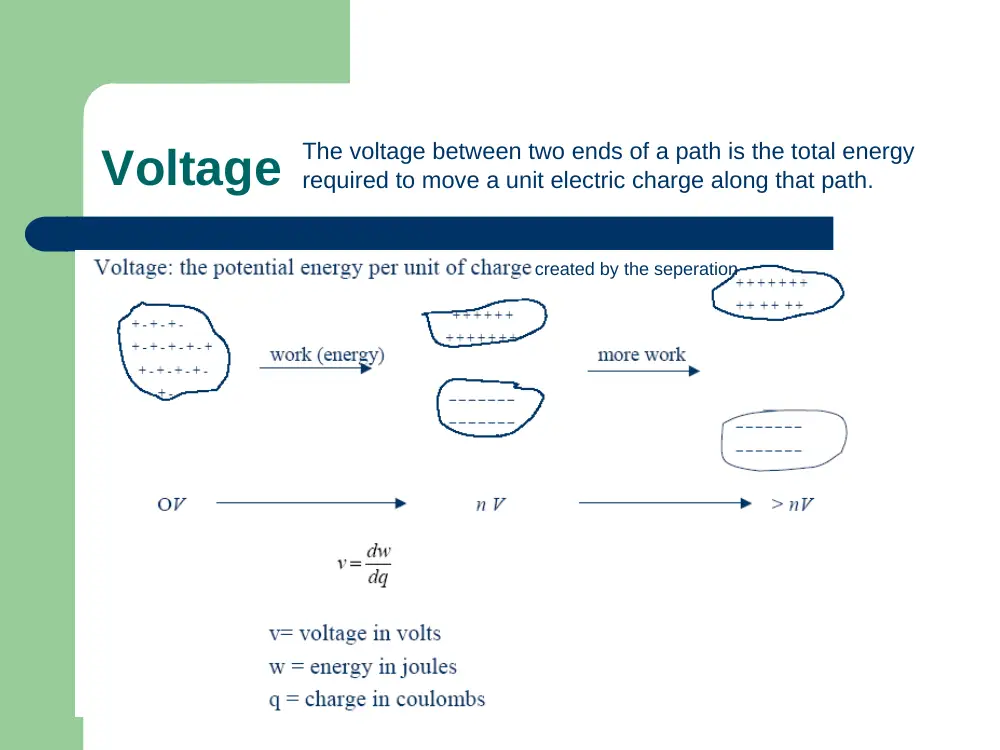
Voltage
created by the seperation
The voltage between two ends of a path is the total energy
required to move a unit electric charge along that path.
Current
Electric Power
vi
dt
dq
dq
dw
)
)(
(
The assignments of the reference
polarity for the voltage and the
reference direction for the current
is arbitrary.
As a simplifying convention
choose the assigned polarity of
the voltage across a Basic circuit
element in such a way that the
current passing through the
element is in the direction of
voltage drop.
+
-
Passive Sign Convention
Whenever the reference direction for the
current in an element is in the direction of the
reference voltage drop across the element,
use the positive sign in any expression that
relates the voltage to the current
(for ex: V = IR,
P = IV).
Otherwise, use a negative sign.
(V = -IR,
P = -IV).