
EECE 210 Syllabus, Spring 2015
American University of Beirut · Electric Circuits · 3 pages · Dr. Lama Hamandi
More EECE 210 files
Show the text of this lab
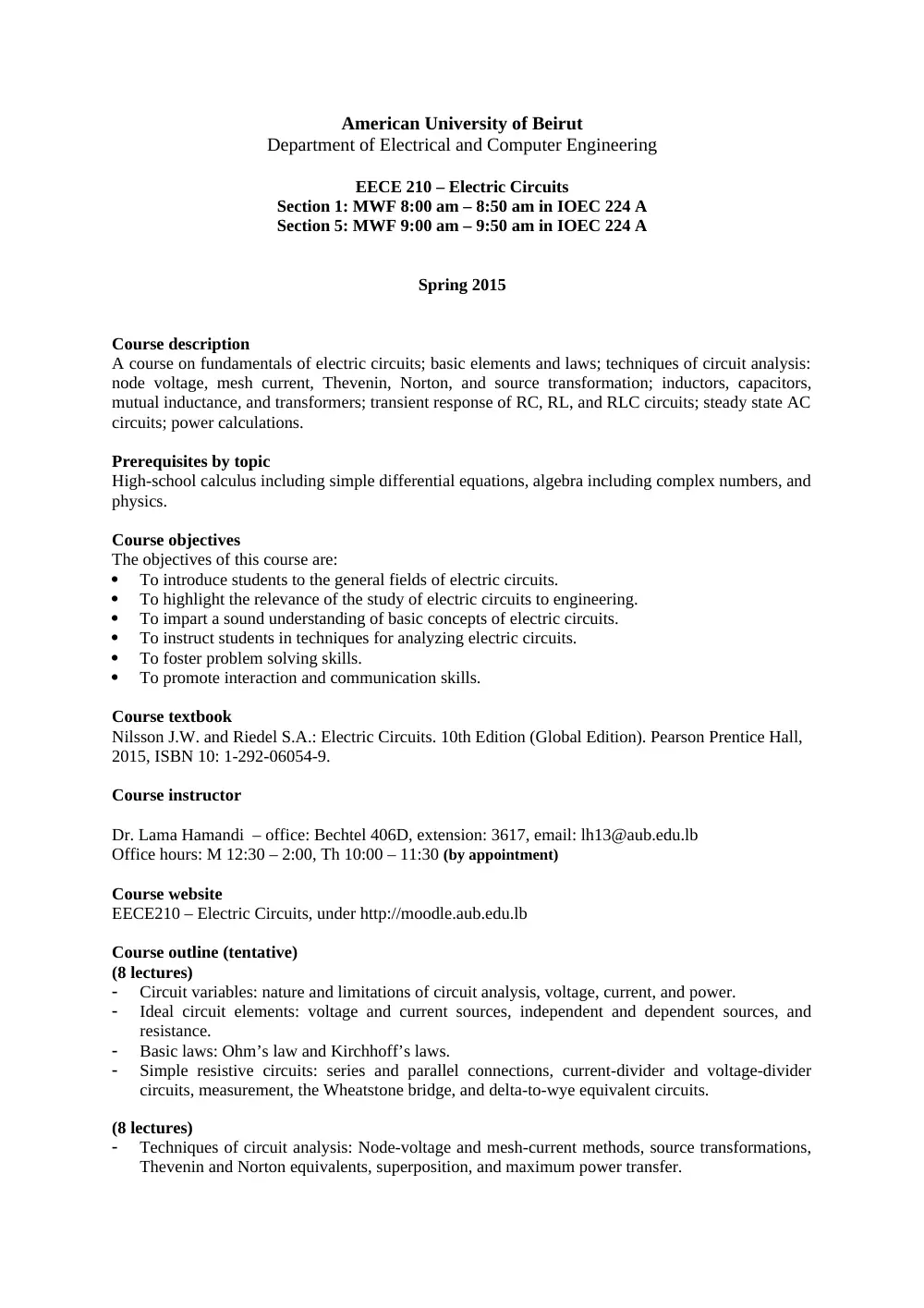
American University of Beirut
Department of Electrical and Computer Engineering
EECE 210 – Electric Circuits
Section 1: MWF 8:00 am – 8:50 am in IOEC 224 A
Section 5: MWF 9:00 am – 9:50 am in IOEC 224 A
Spring 2015
Course description
A course on fundamentals of electric circuits; basic elements and laws; techniques of circuit analysis:
node voltage, mesh current, Thevenin, Norton, and source transformation; inductors, capacitors,
mutual inductance, and transformers; transient response of RC, RL, and RLC circuits; steady state AC
circuits; power calculations.
Prerequisites by topic
High-school calculus including simple differential equations, algebra including complex numbers, and
physics.
Course objectives
The objectives of this course are:
To introduce students to the general fields of electric circuits.
To highlight the relevance of the study of electric circuits to engineering.
To impart a sound understanding of basic concepts of electric circuits.
To instruct students in techniques for analyzing electric circuits.
To foster problem solving skills.
To promote interaction and communication skills.
Course textbook
Nilsson J.W. and Riedel S.A.: Electric Circuits. 10th Edition (Global Edition). Pearson Prentice Hall,
2015, ISBN 10: 1-292-06054-9.
Course instructor
Dr. Lama Hamandi – office: Bechtel 406D, extension: 3617, email: lh13@aub.edu.lb
Office hours: M 12:30 – 2:00, Th 10:00 – 11:30 (by appointment)
Course website
EECE210 – Electric Circuits, under http://moodle.aub.edu.lb
Course outline (tentative)
(8 lectures)
Circuit variables: nature and limitations of circuit analysis, voltage, current, and power.
Ideal circuit elements: voltage and current sources, independent and dependent sources, and
resistance.
Basic laws: Ohm’s law and Kirchhoff’s laws.
Simple resistive circuits: series and parallel connections, current-divider and voltage-divider
circuits, measurement, the Wheatstone bridge, and delta-to-wye equivalent circuits.
(8 lectures)
Techniques of circuit analysis: Node-voltage and mesh-current methods, source transformations,
Thevenin and Norton equivalents, superposition, and maximum power transfer.
(4 lectures)
The operational amplifier: terminal voltages and currents, the inverting and non-inverting
amplifier circuits, the summing-amplifier circuit, and the difference-amplifier circuit.
(4 lectures)
Inductance, capacitance and mutual inductance: basic properties of inductors and capacitors,
series and parallel combinations, mutual coupling, concept of mutual inductance, and the dot
marking convention.
(8 lectures)
Response of first-order RL and RC circuits: natural and step response of RL and RC circuits,
sequential switching.
Natural and step responses of RLC circuits: over damped, under damped, and critically damped
response.
(6 lectures)
Sinusoidal steady-state analysis: phasor representation, passive circuit elements in the frequency
domain, circuit simplifications, techniques of circuit analysis, and ideal transformers.
Course learning outcomes
At the end of the course, students:
Become familiar with the scope and general nature of the fields of electric circuits.
Become aware of the relevance of the study of electric circuits to engineering.
Acquire a sound understanding of basic concepts of electric circuits.
Learn techniques for analyzing electric circuits.
Acquire problem-solving skills.
Acquire interaction and communication skills.
Course assessment
Final exam
40%
Two Quizzes
48% (Quiz 1: 24%, Quiz 2: 24%)
Short Tests
10%
Class attendance
2%
Course policy
The quizzes and final exams are closed-book, objective exams, and common to all sections.
Quiz 1 is scheduled on Friday March 6, 2015 at 6:00 pm.
Quiz 2 is scheduled on Friday April 17, 2015 at 6:00 pm.
There is no makeup for quizzes or tests.
The final exam is comprehensive. It will be scheduled by the Office of the Registrar.
General Rules and Regulations
All graded work should be based on individual effort without external help. Any suspected misconduct
will be handled according to the American University of Beirut rules and regulations. Consult the
AUB’s website for details of these policies.
You are required to be in class on time.
There is no makeup for short tests and quizzes.
You are required to check the class website on Moodle for information and updates.
Suggested problems, some solutions and previous quizzes are posted on moodle.
You are not allowed to attend a different section.
As per AUB policy, students who miss more than one fifth of the lectures in the first ten weeks of the
semester will be dropped from the course: 1/5*(10*3) = 6.
Cell phones, tablets, Laptops, … are not allowed in class.
You can ask me as many questions as you want in class or during office hours to understand the
material.