
EECE 320 Lecture 13, Fall 2011
American University of Beirut · Digital Systems Design · 10 pages · Prof. Ali Chehab
More EECE 320 files
Show the text of this lab
EECE 320 L13: Combinational Logic design Practices 1
Chehab, AUB, 2003
EECE 320
Digital Systems Design
Lecture 13:
Combinational Logic Design
Practices
Ali Chehab
EECE 320 L13: Combinational Logic design Practices 2
Chehab, AUB, 2003
Generic Array Logic Devices (GALs)
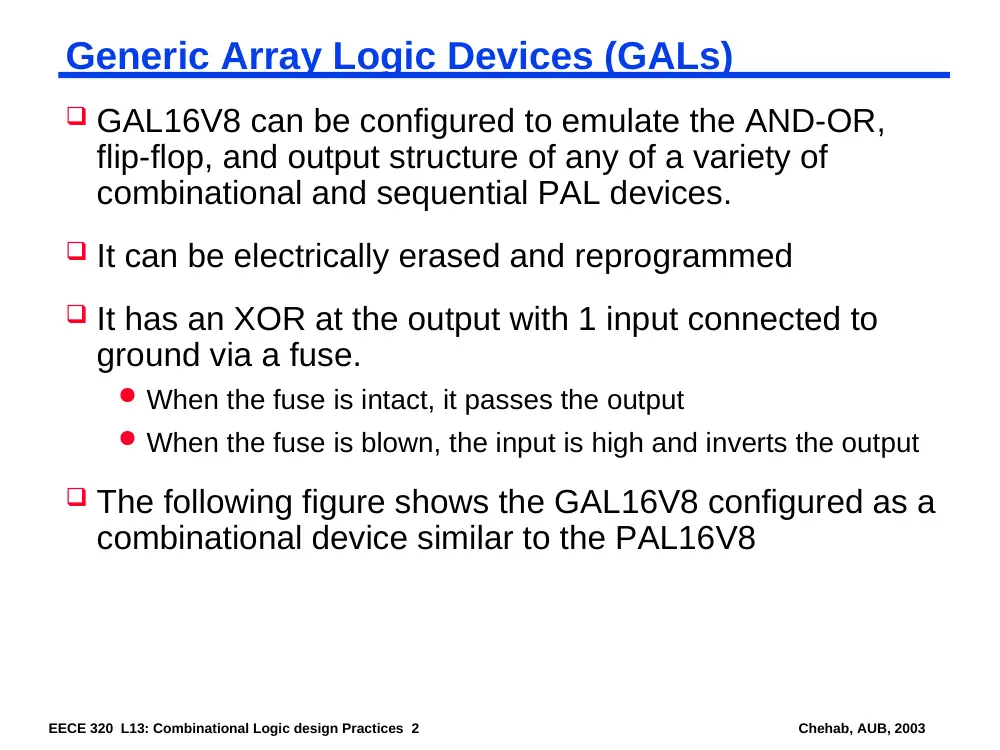
GAL16V8 can be configured to emulate the AND-OR,
flip-flop, and output structure of any of a variety of
combinational and sequential PAL devices.
It can be electrically erased and reprogrammed
It has an XOR at the output with 1 input connected to
ground via a fuse.
When the fuse is intact, it passes the output
When the fuse is blown, the input is high and inverts the output
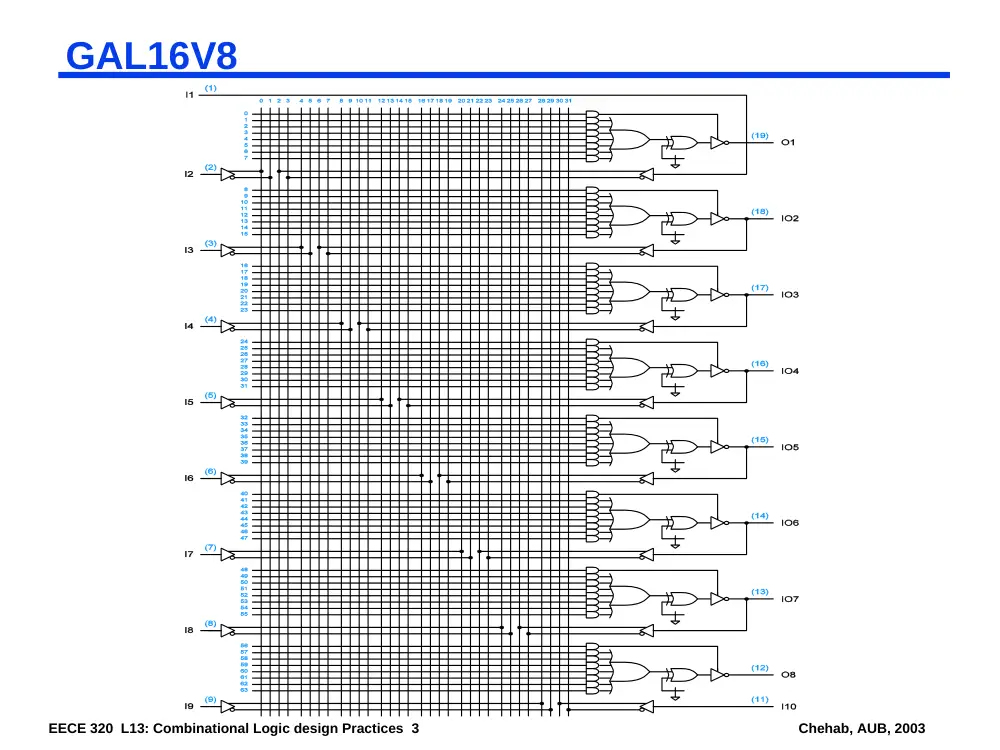
The following figure shows the GAL16V8 configured as a
combinational device similar to the PAL16V8
EECE 320 L13: Combinational Logic design Practices 3
Chehab, AUB, 2003
GAL16V8
EECE 320 L13: Combinational Logic design Practices 4
Chehab, AUB, 2003
Decoders
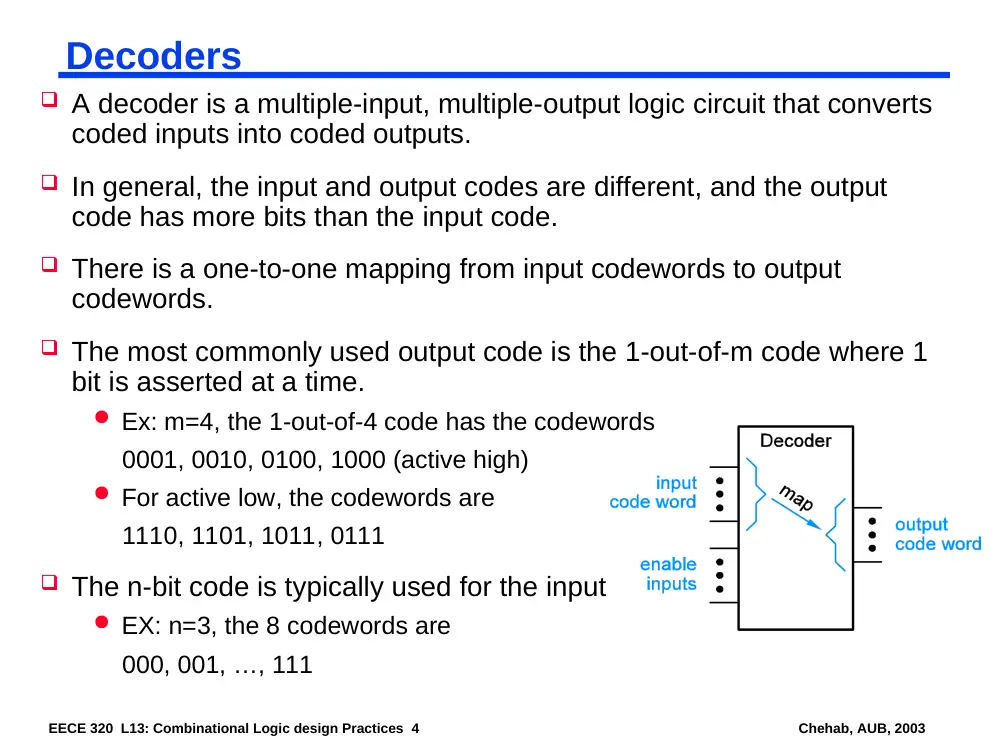
A decoder is a multiple-input, multiple-output logic circuit that converts
coded inputs into coded outputs.
In general, the input and output codes are different, and the output
code has more bits than the input code.
There is a one-to-one mapping from input codewords to output
codewords.
The most commonly used output code is the 1-out-of-m code where 1
bit is asserted at a time.
Ex: m=4, the 1-out-of-4 code has the codewords
0001, 0010, 0100, 1000 (active high)
For active low, the codewords are
1110, 1101, 1011, 0111
The n-bit code is typically used for the input
EX: n=3, the 8 codewords are
000, 001, …, 111
EECE 320 L13: Combinational Logic design Practices 5
Chehab, AUB, 2003
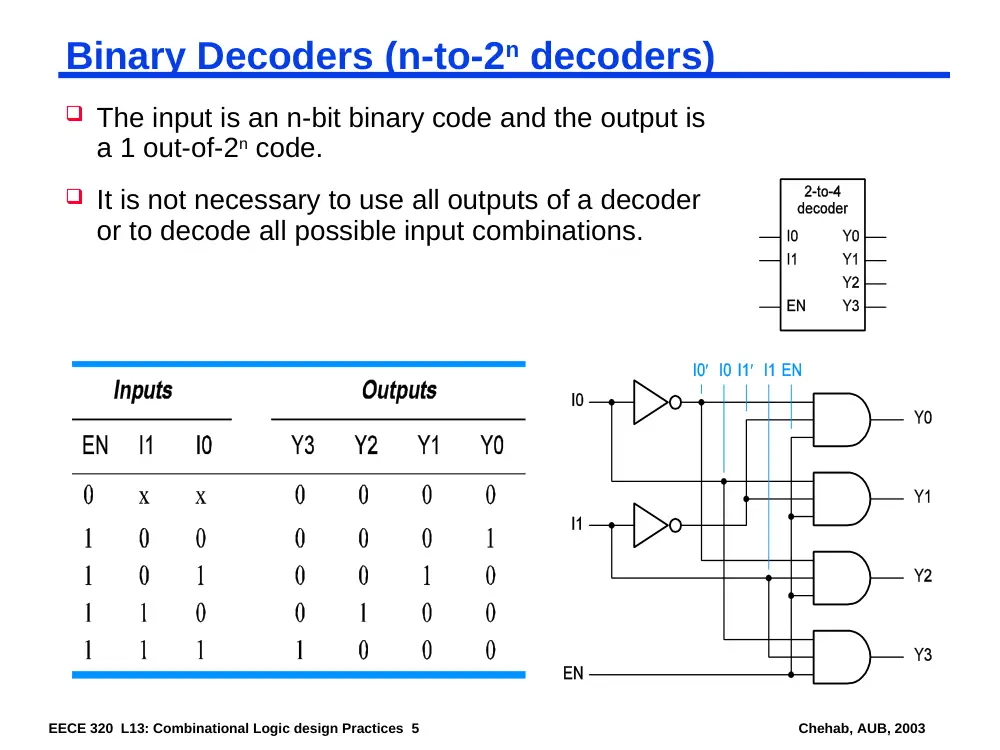
Binary Decoders (n-to-2n decoders)
The input is an n-bit binary code and the output is
a 1 out-of-2n code.
It is not necessary to use all outputs of a decoder
or to decode all possible input combinations.
EECE 320 L13: Combinational Logic design Practices 6
Chehab, AUB, 2003
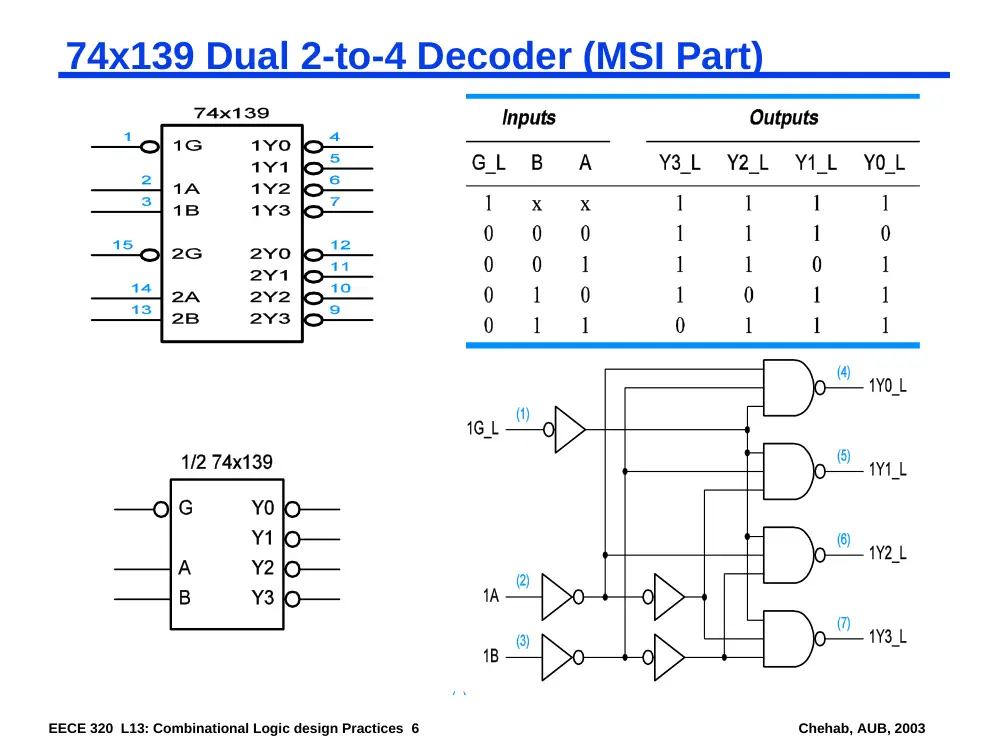
74x139 Dual 2-to-4 Decoder (MSI Part)
EECE 320 L13: Combinational Logic design Practices 7
Chehab, AUB, 2003
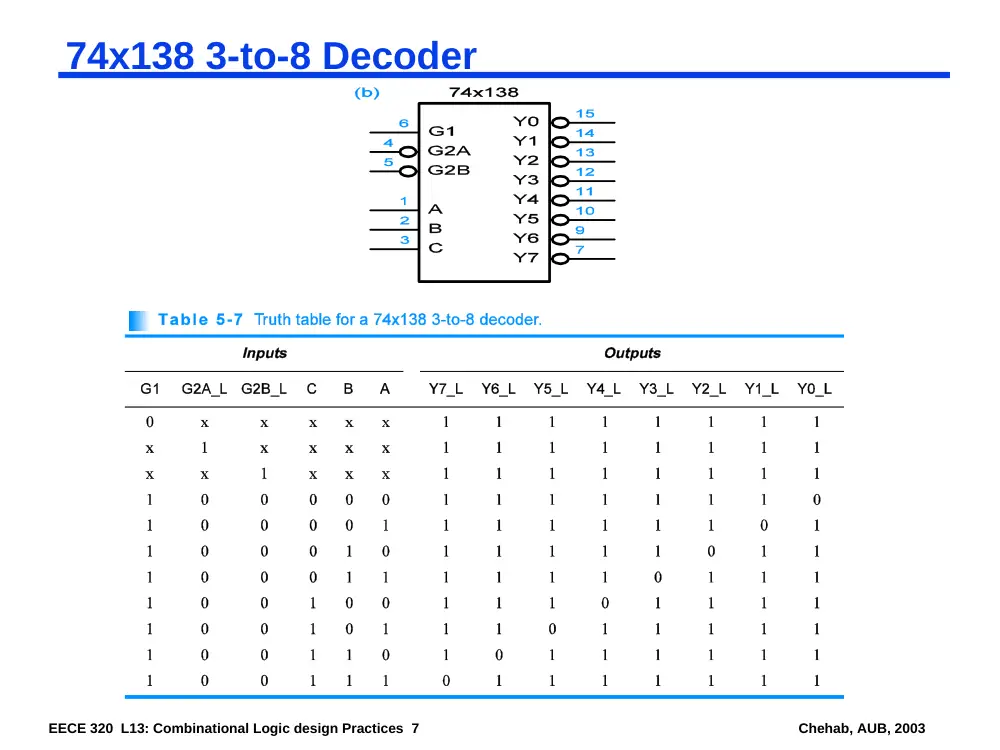
74x138 3-to-8 Decoder
EECE 320 L13: Combinational Logic design Practices 8
Chehab, AUB, 2003
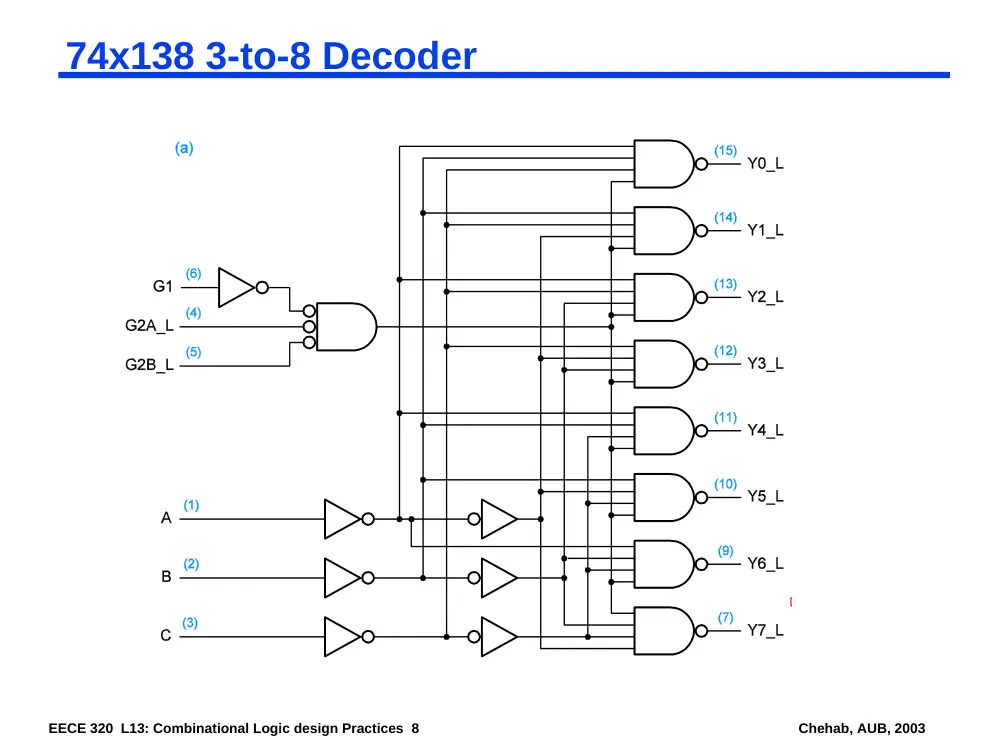
74x138 3-to-8 Decoder
EECE 320 L13: Combinational Logic design Practices 9
Chehab, AUB, 2003
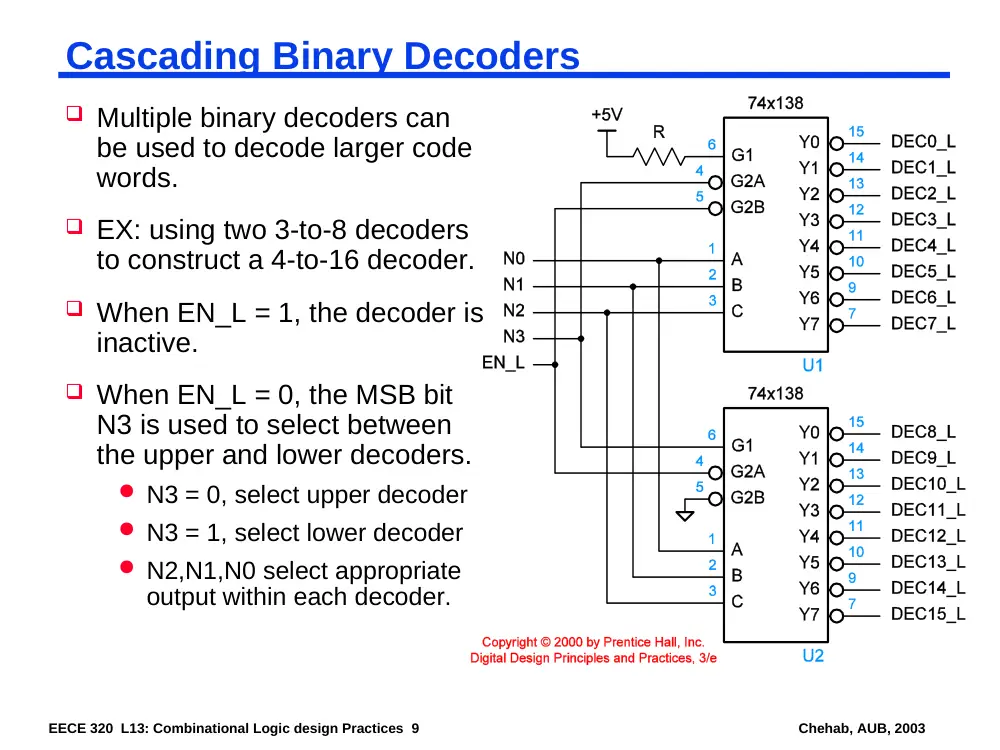
Cascading Binary Decoders
Multiple binary decoders can
be used to decode larger code
words.
EX: using two 3-to-8 decoders
to construct a 4-to-16 decoder.
When EN_L = 1, the decoder is
inactive.
When EN_L = 0, the MSB bit
N3 is used to select between
the upper and lower decoders.
N3 = 0, select upper decoder
N3 = 1, select lower decoder
N2,N1,N0 select appropriate
output within each decoder.
EECE 320 L13: Combinational Logic design Practices 10
Chehab, AUB, 2003
Next Lecture and Reminders
Next lecture
Reminders