
EECE 320 Lecture 1, Fall 2011
American University of Beirut · Digital Systems Design · 7 pages · Prof. Ali Chehab

More EECE 320 files
Show the text of this lab
EECE 320 L1: Introduction 7
Chehab, AUB, 2003
Chapter1: Introduction
One of book goals:
Learn enough about basic principles to understand what
happens when you use software tools
A digital designer must be competent in:
Debugging good troubleshooter
- Planning
- Systematic approach
- Patience
- Logic (work by elimination)
Business requirements and practices
- Documentation standards
- Component availability
- Target specifications
- Scheduling
Good communications skills Transmit and Receive
EECE 320 L1: Introduction 8
Chehab, AUB, 2003
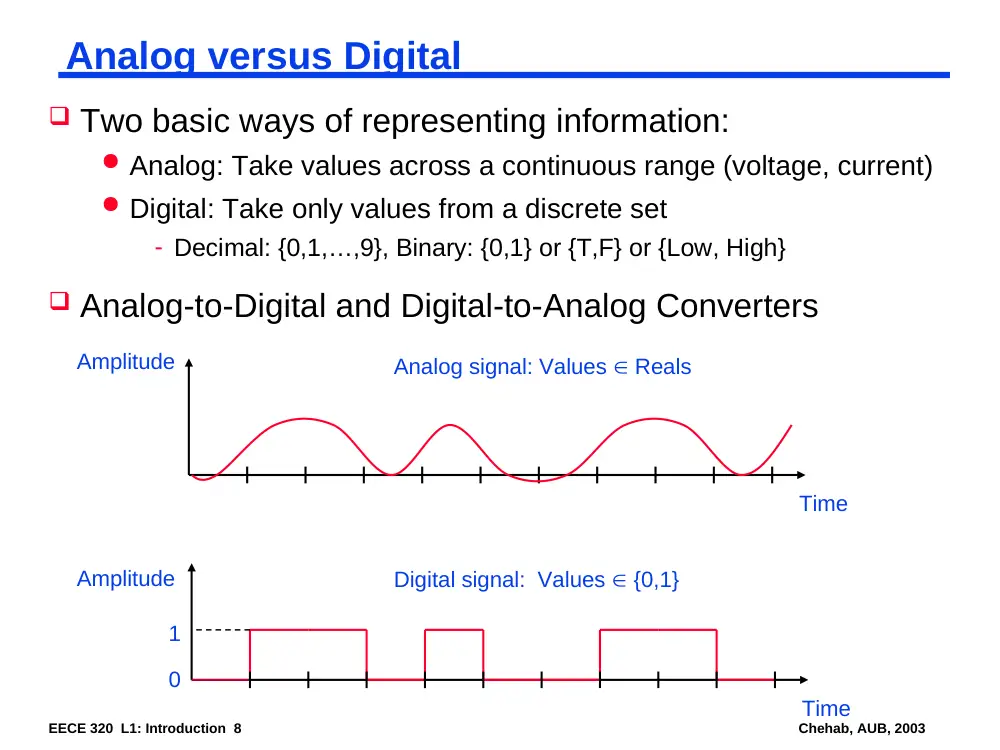
Analog versus Digital
Two basic ways of representing information:
Analog: Take values across a continuous range (voltage, current)
Digital: Take only values from a discrete set
- Decimal: {0,1,…,9}, Binary: {0,1} or {T,F} or {Low, High}
Analog-to-Digital and Digital-to-Analog Converters
Time
0
1
Time
Amplitude
Analog signal: Values Reals
Digital signal: Values {0,1}
Amplitude
EECE 320 L1: Introduction 9
Chehab, AUB, 2003
Digital Revolution
Digital Revolution
Cameras: A picture is stored as an array of pixels. A pixel stores
the intensities of RGB components as 8 bits each. (JPEG
compression digital storage and processing)
Video Recording: Digital Versatile Disk, DVD, (MPEG2)
Audio Recording: Digital Compact Disk, CD
Telephone system: Digital transmission between central offices,
cellular systems
Traffic lights: from electromechanical timers to controllers to
maximize vehicle throughput
Movie effects: computer synthesis instead of tricks & miniatures
EECE 320 L1: Introduction 10
Chehab, AUB, 2003
Reasons for Digital Revolution
1.
Reproducibility of results
Digital circuit: same inputs same outputs
Analog circuit: the output depends on temperature, power-
supply voltage, component aging, …
2.
Ease of design
No need for special math skills, just logic
3.
Flexibility and functionality
4.
Programmability
Hardware descriptive languages, HDLs
5.
Speed
•
A transistor can switch in less than 10 ps
•
A circuit can produce an output in 1 ns 1 Billion results/s
EECE 320 L1: Introduction 11
Chehab, AUB, 2003
Reasons for Digital Revolution
Economy
Commonly used circuits can be integrated into chips and mass-
produced at low cost and used in different products such as
calculators, digital watches, …
Steadily advancing technology
Digital designers try to accommodate advances in technology
while designing. An example is expansion memory slots in a
computer
EECE 320 L1: Introduction 12
Chehab, AUB, 2003
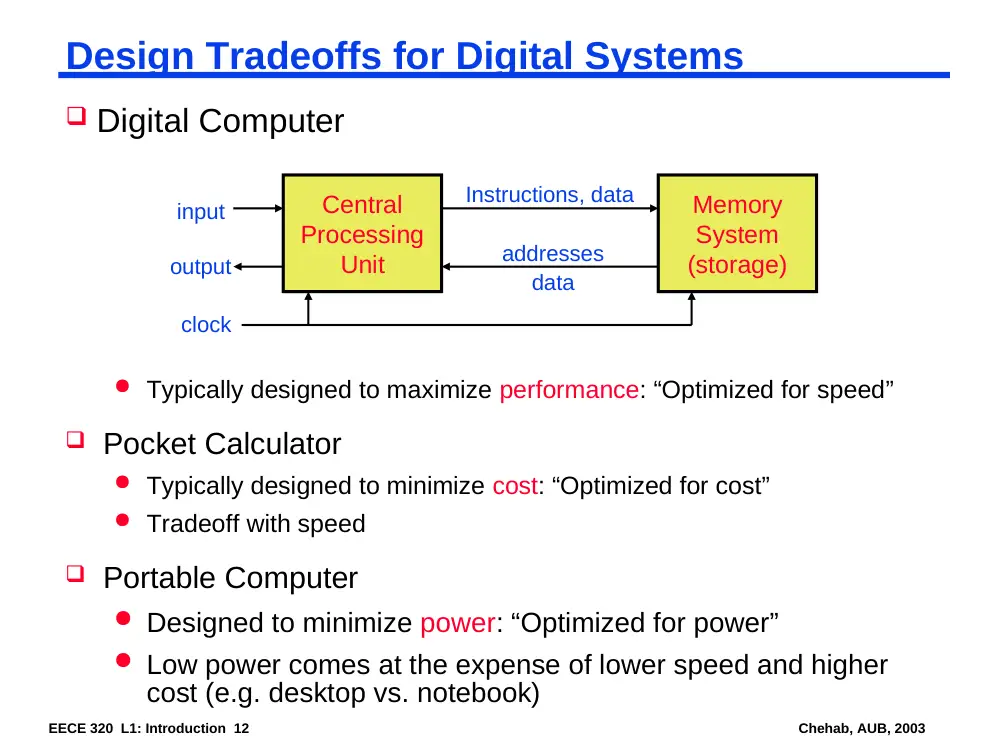
Design Tradeoffs for Digital Systems
Digital Computer
Typically designed to maximize performance: “Optimized for speed”
Pocket Calculator
Typically designed to minimize cost: “Optimized for cost”
Tradeoff with speed
Portable Computer
Designed to minimize power: “Optimized for power”
Low power comes at the expense of lower speed and higher
cost (e.g. desktop vs. notebook)
Central
Processing
Unit
Memory
System
(storage)
Instructions, data
data
input
output
clock
addresses
EECE 320 L1: Introduction 13
Chehab, AUB, 2003
Next Lecture and Reminders
Next lecture
Number Systems and Codes
Reminders