
EECE 340 Exam 2, Spring 2016
American University of Beirut · Signals and Systems · 7 pages · Prof. Karim Kabalan
More EECE 340 files
- Exam 1 Kabalan · Spring 2017ExamView
- Exam 2 · Spring 2017ExamView
- Exam 1 · Spring 2016ExamView
- Midterm · Summer 2015ExamView
- Midterm Solution · Summer 2015Exam · with solutionView
- Midterm Solutions Only · Spring 2014Exam · with solutionView
- Midterm · Spring 2014ExamView
- Midterm Solution · Spring 2014Exam · with solutionView
Show the text of this exam
EECE 340-Signals and Systems-Spring 2016-Solution
Page 1
AMERICAN UNIVERSITY OF BEIRUT
FACULTY OF ENGINEERING AND ARCHITECTURE
ELECTRICAL AND COMPUTER ENGINEERING DEPARTMENT
______________________________________________________________________________________
EECE 340 -Signals & Systems
Quiz II - Spring 2016
Solution
_____________________________________________________________________________________
Problem 1 (5 pts)
Let X(ω) be the Fourier Transform of x(t). As a function of X(ω), determine
the Fourier transform of y(t) given by
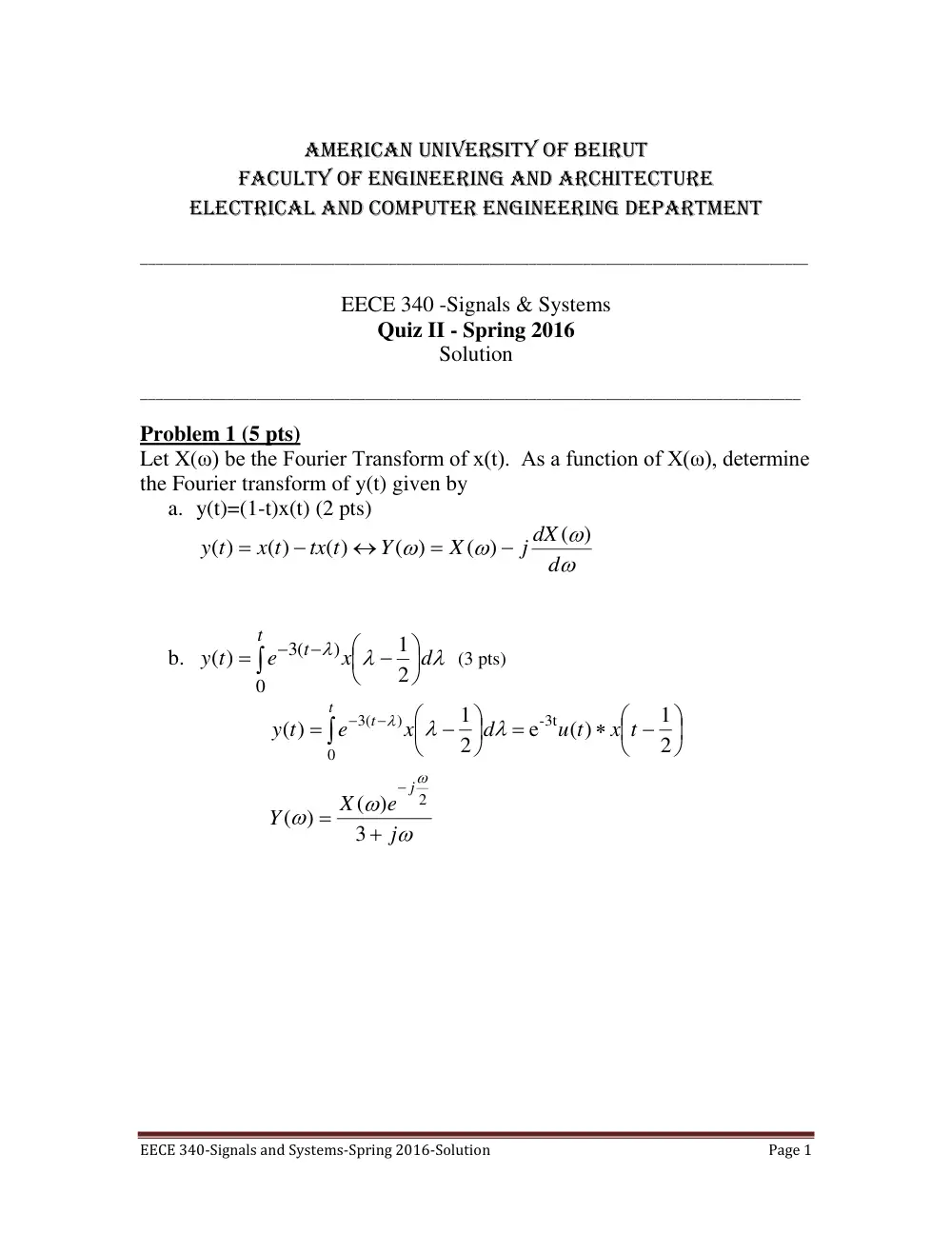
a. y(t)=(1-t)x(t) (2 pts)
)
(
( )
( )
( )
( )
( )
d
j dX
X
Y
tx t
x t
y t
b.
2
1
)
(
0
)
3(
t
t
d
x
e
y t
(3 pts)
j
e
X
Y
x t
u t
d
x
e
t
y
j
t
t
3
( )
)
(
2
1
( )
e
2
1
)
(
2
3t
-
0
)
(
3
EECE 340-Signals and Systems-Spring 2016-Solution
Page 2
Problem 2 (6 pts)
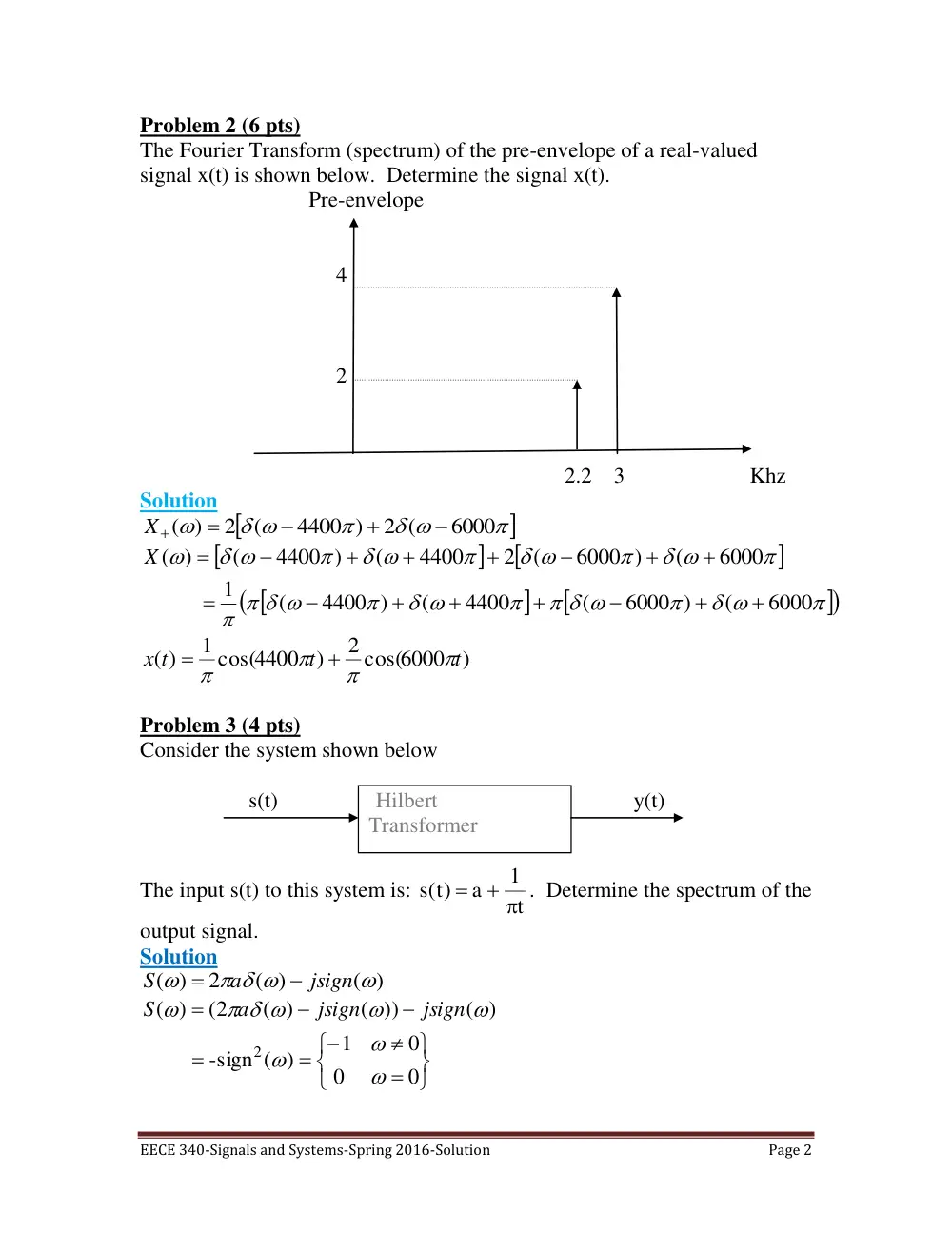
The Fourier Transform (spectrum) of the pre-envelope of a real-valued
signal x(t) is shown below. Determine the signal x(t).
Pre-envelope
4
2
2.2 3 Khz
Solution
6000
2 (
4400 )
(
2
( )
X
6000
(
6000 )
(
4400
(
4400 )
(
1
6000
(
6000 )
(
2
4400
(
4400 )
(
)
(
X
)
2 cos(6000
)
1 cos(4400
( )
t
t
x t
Problem 3 (4 pts)
Consider the system shown below
s(t) Hilbert y(t)
Transformer
The input s(t) to this system is:
t
1
a
)t(s
. Determine the spectrum of the
output signal.
Solution
( )
( )
2
( )
jsign
a
S
0
0
0
1
-sign ( )
( )
( ))
( )
(2
)
(
2
jsign
jsign
a
S
EECE 340-Signals and Systems-Spring 2016-Solution
Page 3
Problem 4 (5 pts)
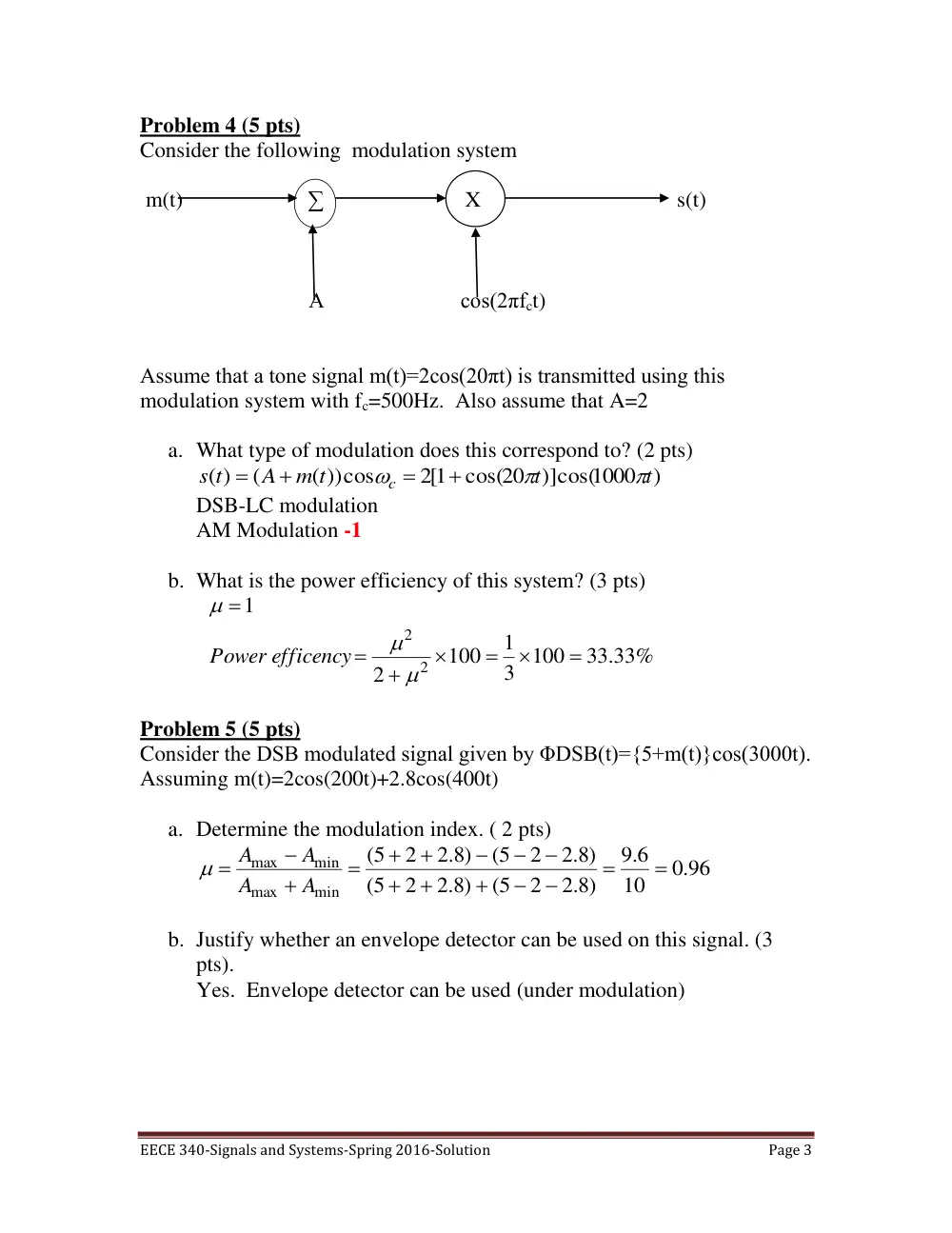
Consider the following modulation system
m(t) ∑ X s(t)
A cos(2πfct)
Assume that a tone signal m(t)=2cos(20πt) is transmitted using this
modulation system with fc=500Hz. Also assume that A=2
a. What type of modulation does this correspond to? (2 pts)
1000 )
cos(20 )]cos(
1[2
( ))cos
(
( )
t
t
m t
A
s t
c
DSB-LC modulation
AM Modulation -1
b. What is the power efficiency of this system? (3 pts)
33.33%
3 100
1
100
2
1
2
2
Power efficency
Problem 5 (5 pts)
Consider the DSB modulated signal given by ΦDSB(t)={5+m(t)}cos(3000t).
Assuming m(t)=2cos(200t)+2.8cos(400t)
a. Determine the modulation index. ( 2 pts)
.0 96
10
6.9
8.2 )
2
(5
8.2 )
2
5
(
8.2 )
2
(5
8.2 )
2
5
(
min
max
min
max
A
A
A
A
b. Justify whether an envelope detector can be used on this signal. (3
pts).
Yes. Envelope detector can be used (under modulation)
EECE 340-Signals and Systems-Spring 2016-Solution
Page 4
Problem 6 (7 pts)
The output (modulated signal) from an AM modulator is given by: s(t)=5
cos(1800πt)+20cos(2000π)+5cos(2200πt).
a. Determine the modulating signal m(t)? (2 pts)
)
cos(200
5.0
)
(
)
)]cos(2000
cos(200
5.0
20 1[
)
(
t
k
t
m
t
t
t
s
a
b. Determine the carrier signal c(t)? (1 pts)
20cos(2000 )
( )
t
s t
c. Determine the modulation index? (2 pts)
5.0
d. Determine the ration of the power of the sidebands to the power of the
carrier. (2 pts)
8
1
400
50
2
400
2
25
2
25
Ratio
Problem 7 (6 pts)
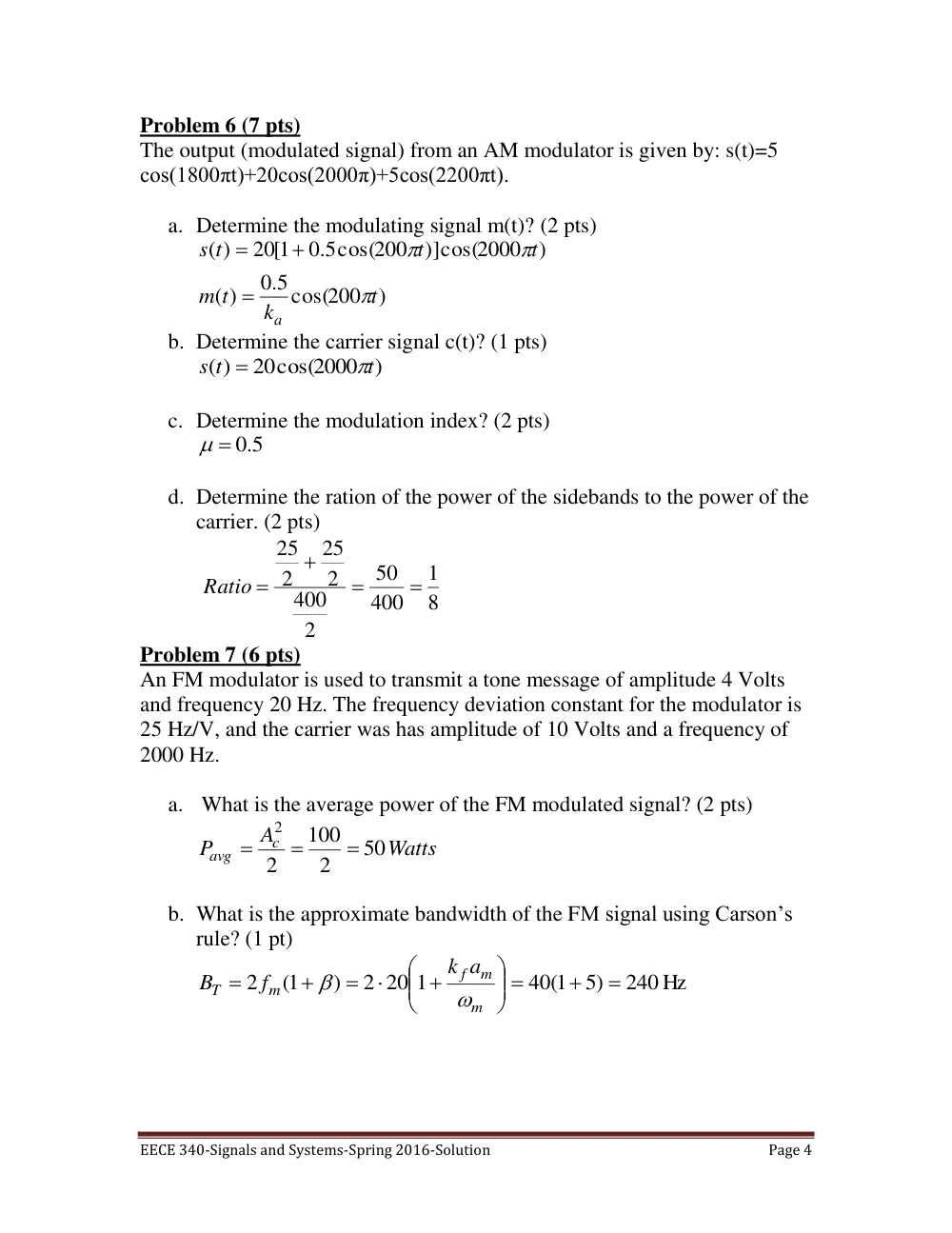
An FM modulator is used to transmit a tone message of amplitude 4 Volts
and frequency 20 Hz. The frequency deviation constant for the modulator is
25 Hz/V, and the carrier was has amplitude of 10 Volts and a frequency of
2000 Hz.
a. What is the average power of the FM modulated signal? (2 pts)
Watts
A
P
c
avg
50
2
100
2
2
b. What is the approximate bandwidth of the FM signal using Carson’s
rule? (1 pt)
240 Hz
5)
40 1(
2 20 1
)
1(
2
m
m
f
m
T
k a
f
B
EECE 340-Signals and Systems-Spring 2016-Solution
Page 5
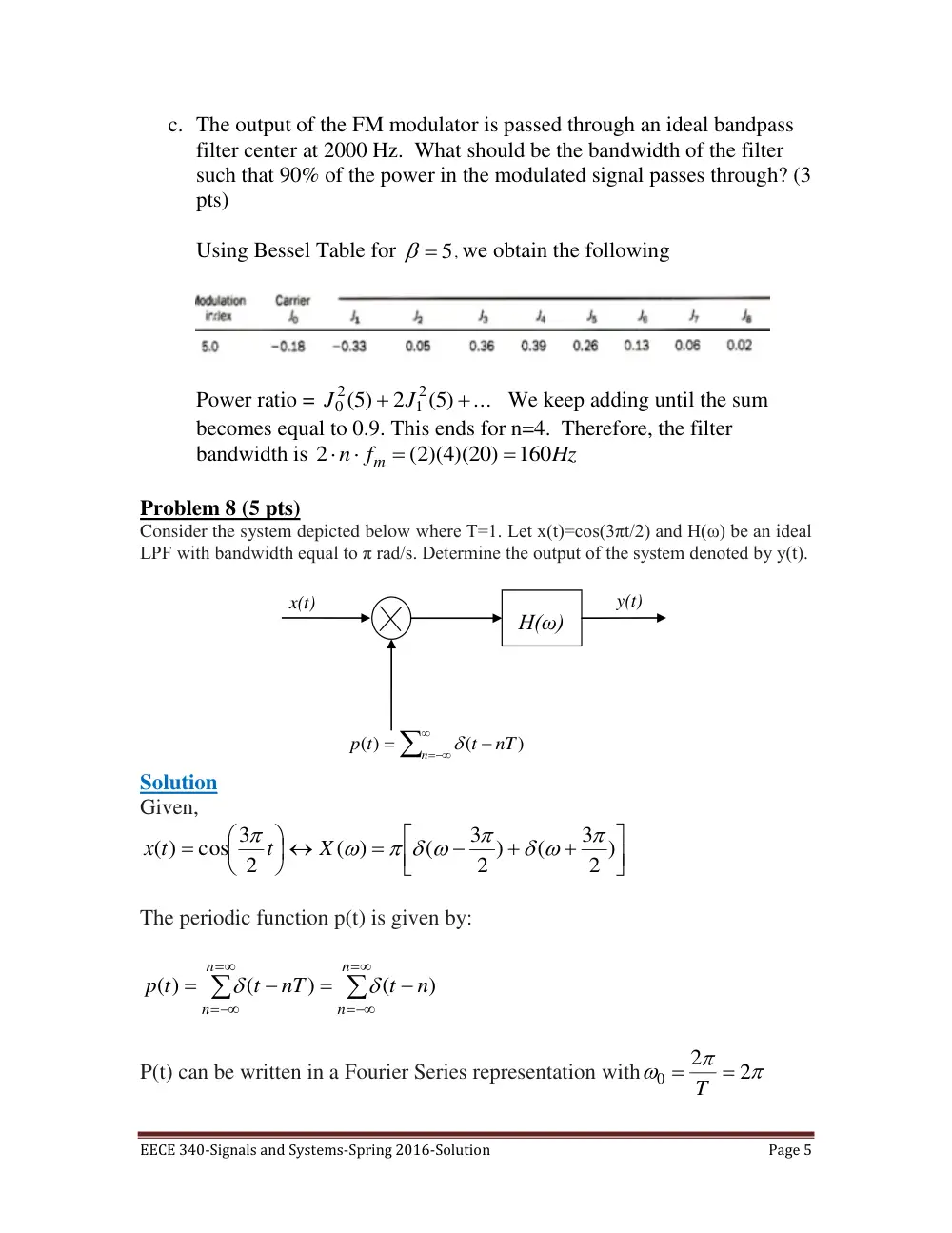
c. The output of the FM modulator is passed through an ideal bandpass
filter center at 2000 Hz. What should be the bandwidth of the filter
such that 90% of the power in the modulated signal passes through? (3
pts)
Using Bessel Table for
5
, we obtain the following
Power ratio =
...
(5)
2
(5)
2
1
2
0
J
J
We keep adding until the sum
becomes equal to 0.9. This ends for n=4. Therefore, the filter
bandwidth is
Hz
f
n
m
160
(2)(4)(20)
2
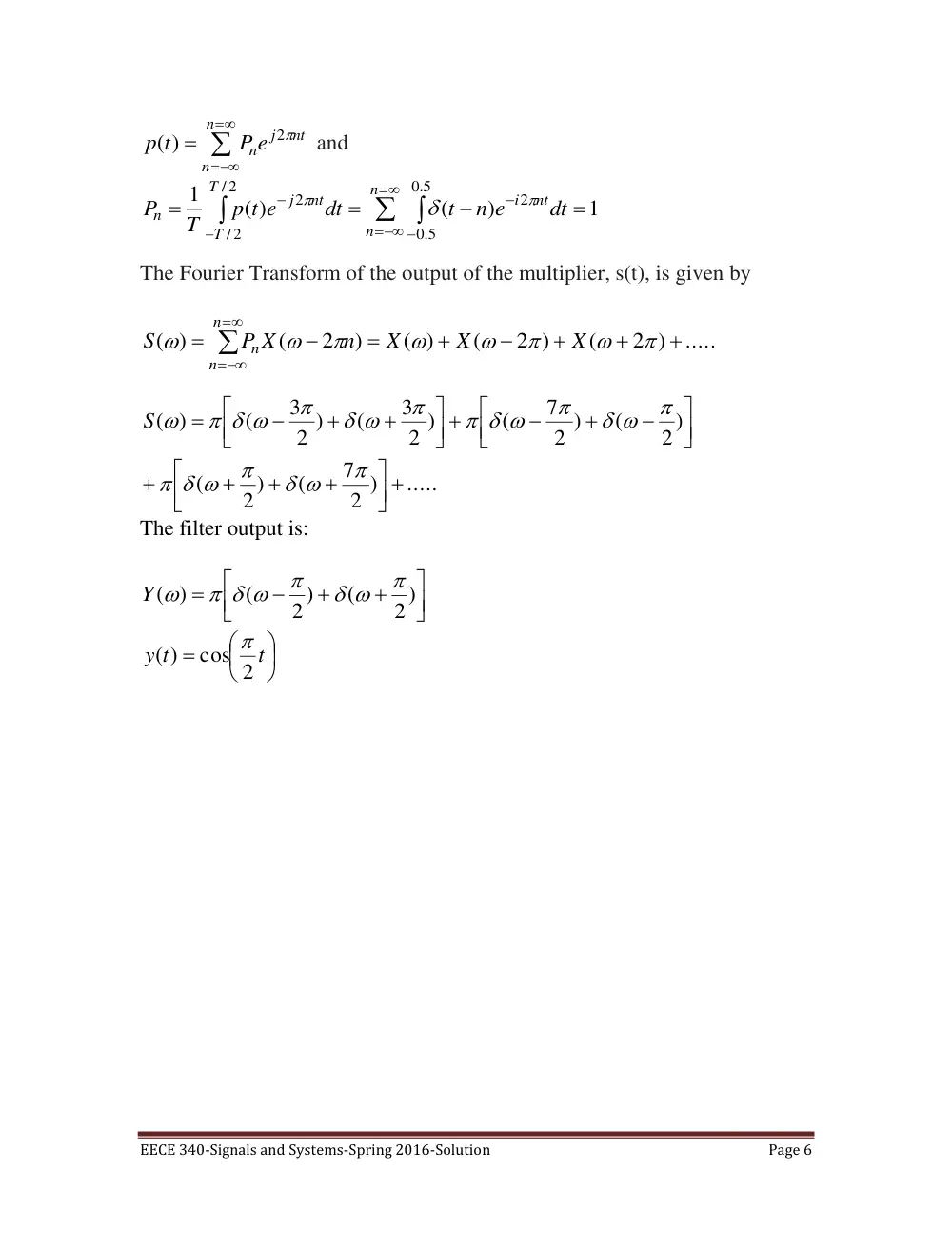
Problem 8 (5 pts)
Consider the system depicted below where T=1. Let x(t)=cos(3πt/2) and H(ω) be an ideal
LPF with bandwidth equal to π rad/s. Determine the output of the system denoted by y(t).
Solution
Given,
2 )
3
(
2 )
3
(
( )
2
cos 3
( )
X
t
x t
The periodic function p(t) is given by:
n
n
n
n
n
t
nT
t
p t
)
(
)
(
( )
P(t) can be written in a Fourier Series representation with
2
2
0
T
H(ω)
x(t)
y(t)
n
nT
t
p t
)
(
( )
EECE 340-Signals and Systems-Spring 2016-Solution
Page 6
n
n
nt
j
ne
P
p t
2
( )
and
1
)
(
( )
1
5.0
5.0
2
2
/
2
/
2
n
n
nt
i
T
T
nt
j
n
dt
n e
t
dt
p t e
T
P
The Fourier Transform of the output of the multiplier, s(t), is given by
.....
2 )
(
2 )
(
( )
)
2
(
( )
X
X
X
n
P X
S
n
n
n
.....
2 )
7
(
2)
(
2)
(
2 )
7
(
2 )
3
(
2 )
3
(
)
(
S
The filter output is:
2)
(
2)
(
( )
Y
t
y t
cos 2
( )
EECE 340-Signals and Systems-Spring 2016-Solution
Page 7
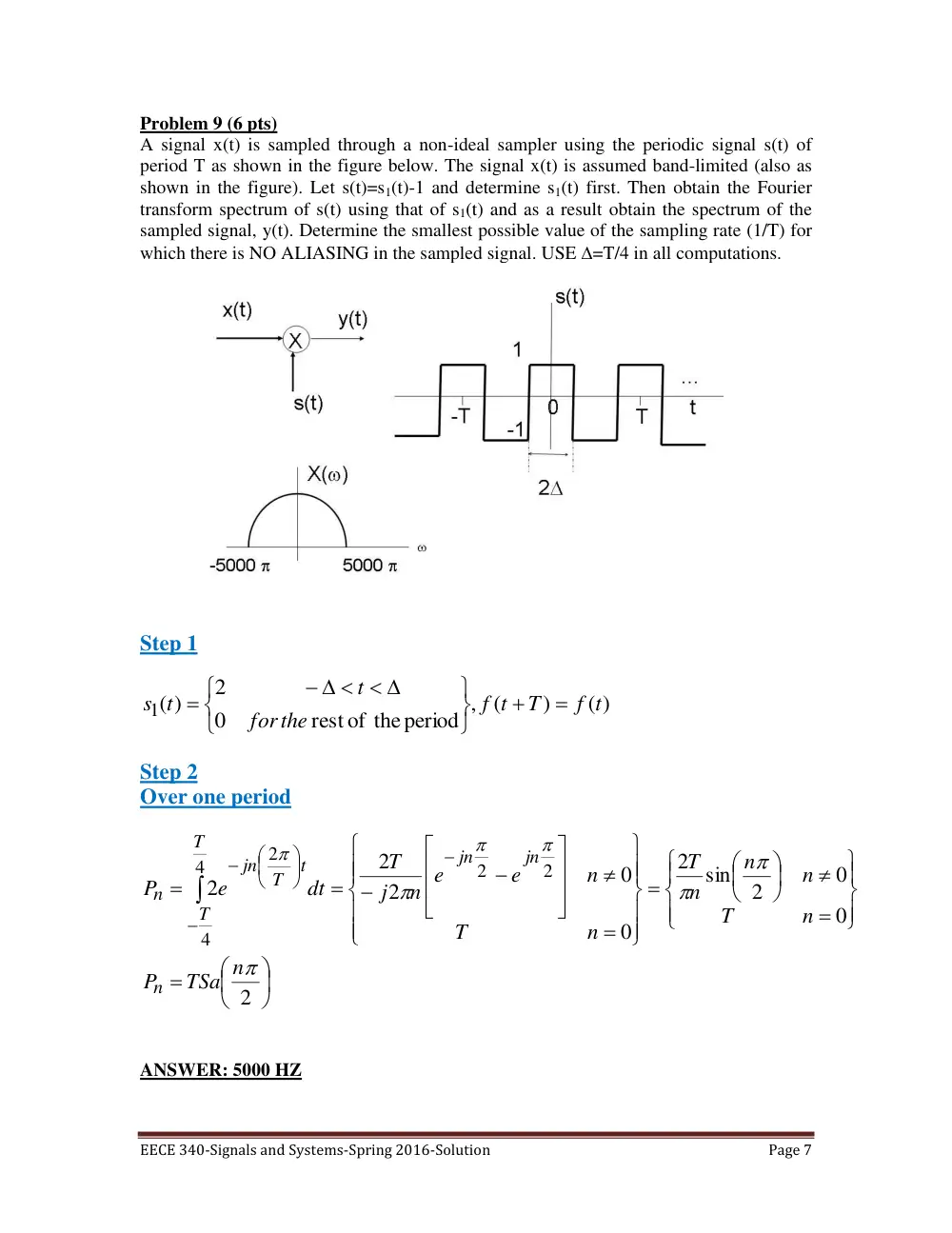
Problem 9 (6 pts)
A signal x(t) is sampled through a non-ideal sampler using the periodic signal s(t) of
period T as shown in the figure below. The signal x(t) is assumed band-limited (also as
shown in the figure). Let s(t)=s1(t)-1 and determine s1(t) first. Then obtain the Fourier
transform spectrum of s(t) using that of s1(t) and as a result obtain the spectrum of the
sampled signal, y(t). Determine the smallest possible value of the sampling rate (1/T) for
which there is NO ALIASING in the sampled signal. USE =T/4 in all computations.
Step 1
( )
)
rest of the period , (
0
2
1( )
f t
T
f t
the
for
t
s t
Step 2
Over one period
2
0
0
2
sin
2
0
0
2
2
2
2
2
4
4
2
TSa n
P
n
T
n
n
n
T
n
T
n
e
n e
j
T
dt
e
P
n
jn
jn
T
T
t
T
jn
n
ANSWER: 5000 HZ