
EECE 340 Exam 2, Spring 2017
American University of Beirut · Signals and Systems · 7 pages · Prof. Karim Kabalan


More EECE 340 files
- Exam 1 Kabalan · Spring 2017ExamView
- Exam 1 · Spring 2016ExamView
- Exam 2 · Spring 2016ExamView
- Midterm · Summer 2015ExamView
- Midterm Solution · Summer 2015Exam · with solutionView
- Midterm Solutions Only · Spring 2014Exam · with solutionView
- Midterm · Spring 2014ExamView
- Midterm Solution · Spring 2014Exam · with solutionView
Show the text of this exam
EECE 340-Signals and Systems-Quiz II - Spring 2017
Page 1
AMERICAN UNIVERSITY OF BEIRUT
FACULTY OF ENGINEERING AND ARCHITECTURE
ELECTRICAL AND COMPUTER ENGINEERING DEPARTMENT
EECE 340 - Signals & Systems
Quiz II - Spring 2017- Solution
______________________________________________________________________________________
Problem 1 (5 pts)
f(t) has a spectrum
( )
F shown below
y(t) has a spectrum Y(ω) shown below
Y(ω)
2
10 rad/s
a. Is y(t) a real-valued signal? Why? (2 pts)
No. No symmetry about the imaginary axis
b. Write y(t) as a function of x(t). (3 pts)
x t e j t
y t
5
2 ( )
1
( )
Wrong Coefficient -1
Wrong shifting -2
Wrong answer: -3
EECE 340-Signals and Systems-Quiz II - Spring 2017
Page 2
Problem 2 (5 pts)
f(t) has a spectrum
( )
F shown below
y(t) has a spectrum Y(ω) shown below
2
-35 -30 -25 25 30 35 rad/s
Write y(t) as a function of f(t)
Answer
t
j
t
j
t
j
j t
e
e
t
fj
f t
e
e
t
fj
f t
y t
25
35
35
25
( )]
4[ ( )
1
( )]
4[ ( )
1
( )
OR
cos(30 )
( )]
2[ ( )
1
( )]
2[ ( )
1
( )
5
5
t
t e
fj
f t
t e
fj
f t
y t
j t
t
j
-4 for incorrect answer
EECE 340-Signals and Systems-Quiz II - Spring 2017
Page 3
Problem 3 (5 pts)
Consider the signal
t
j sin
t
cos
)
t(f
c
c
3
2
a. Determine the pre-envelope of f(t). (2 pts)
t
j
t
c
c
c
c
c
e
t
j
t
j
t
j
t
fj
f t
t
f
3
j
2
e
)
2 cos3
(sin
2 sin3
cos
)ˆ
( )
)
(
c
b. Determine the complex envelope of f(t). (3 pts)
t
j
t
j
c
c
e
t e
f
f t
2
2
1
( )
( )
Problem 4 (4 pts)
The spectrum M() of a base-band signal m(t) is given by:
M( )
( )
(
)
.
(
)
(
)
.
(
)
2
1
05
2
1
05
2
Determine the spectrum of the Hilbert transform of m(t).
Answer
( )
(
)
.
(
)
(
)
.
(
)
M
j
j
j
j
1
05
2
1
05
2
Problem 5 (6 pts)
The output (modulated) signal from an AM modulator is given by:
5cos(2200 )
20cos(2000 )
1800 )
5cos(
( )
t
t
t
s t
a. Determine the modulating signal m(t). (2 pts)
s(t) can be re-written as:
5.0 cos(200 ) cos(2000 )
201
( )
t
t
s t
)
cos(200
5.0
( )
t
k
t
m
a
b. Determine the carrier signal c(t). (1 pt)
20cos(2000 )
( )
t
c t
c. Determine the modulation index. (1 pt)
5.0
d. Can m(t) be recovered using an envelope detector? Justify your
answer. (1 pt).
EECE 340-Signals and Systems-Quiz II - Spring 2017
Page 4
Yes. Under-modulation
e. Determine the ratio of the power of the sidebands to the power of the
carrier. (1 pt)
200 Watts
2 (20)
1
P
25 Watts
2 (5)
1
2 (5)
1
2
c
2
2
s
P
12 5. %
8
1
200
25
Ratio
Problem 6 (8 pts)
A frequency modulated signal with carrier frequency of 2 MHZ is described
by the following equation
)
5sin(400
10cos 2
( )
t
f t
s t
c
a. Find the power of the modulated signal. (1 pt)
Watts
A
P
c
50
2
2
b. Find the instantaneous frequency. (2 pts)
) rad/s
,2 000 cos(400
2
)
5sin(400
2
( )
t
f
dt
t
f t
d
t
c
c
i
Or
) Hz
1000cos(400
( )
t
f
f t
c
i
c. Find the peak phase deviation in radians. (1 pt)
2000 rad/s
400
5
5
m
m
d. Determine the modulation index. Is it a Narrow-band of Wide band
FM signal? (1 pt)
.5
Wide band FM
EECE 340-Signals and Systems-Quiz II - Spring 2017
Page 5
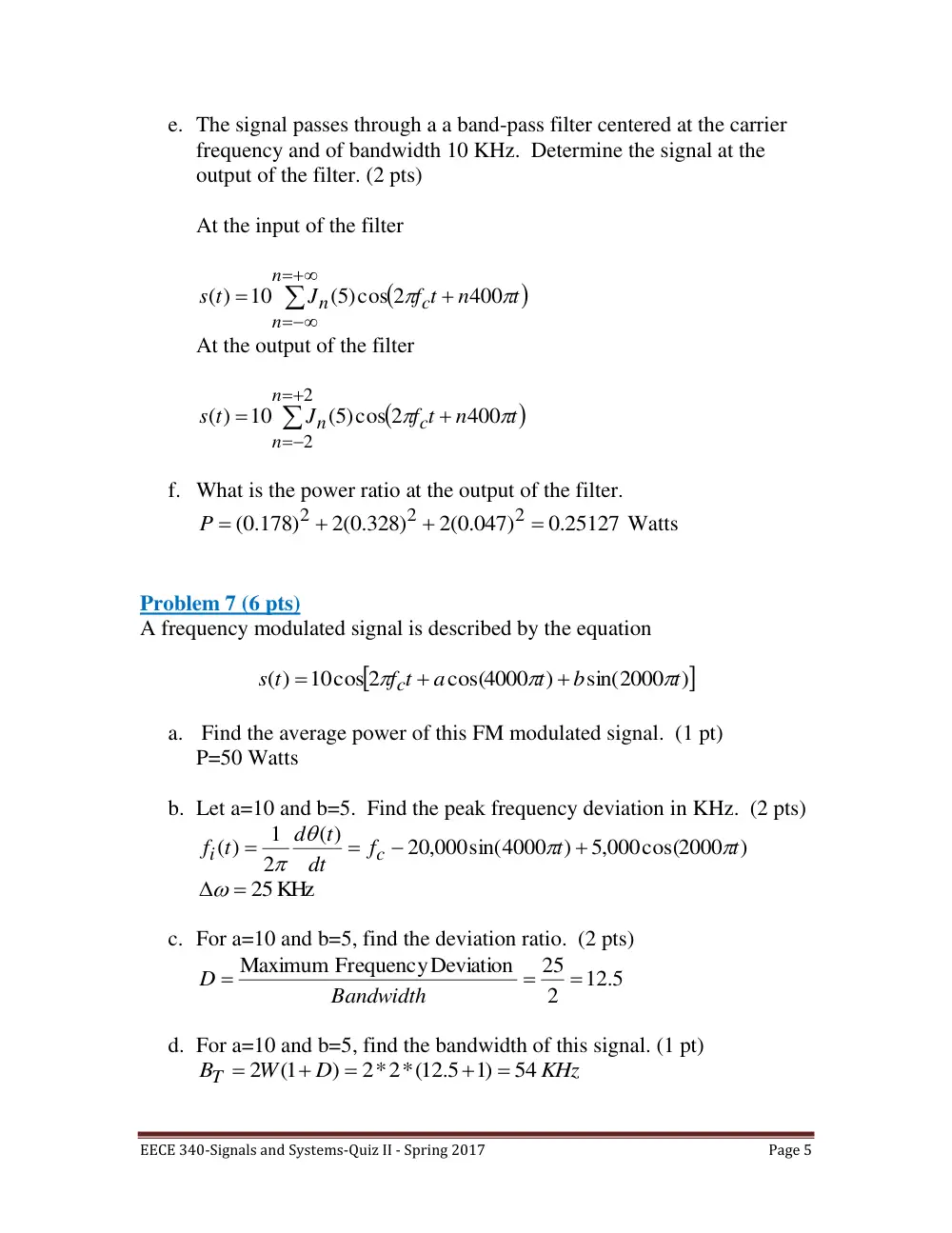
e. The signal passes through a a band-pass filter centered at the carrier
frequency and of bandwidth 10 KHz. Determine the signal at the
output of the filter. (2 pts)
At the input of the filter
n
n
c
n
t
n
f t
J
s t
400
(5)cos 2
10
( )
At the output of the filter
2
2
400
(5)cos 2
10
)
(
n
n
c
n
t
n
f t
J
s t
f. What is the power ratio at the output of the filter.
.0 25127
2( .0 047)
2( .0 328)
( .0 178)
2
2
2
P
Watts
Problem 7 (6 pts)
A frequency modulated signal is described by the equation
)
sin(2000
cos(4000 )
10cos 2
( )
t
b
t
a
f t
s t
c
a. Find the average power of this FM modulated signal. (1 pt)
P=50 Watts
b. Let a=10 and b=5. Find the peak frequency deviation in KHz. (2 pts)
)
,5 000cos(2000
)
20,000sin(4000
)
(
2
1
( )
t
t
f
dt
t
d
t
f
c
i
25 KHz
c. For a=10 and b=5, find the deviation ratio. (2 pts)
12 5.
2
25
Deviation
Maximum Frequency
Bandwidth
D
d. For a=10 and b=5, find the bandwidth of this signal. (1 pt)
KHz
D
W
BT
54
)1
2*2*(12 5.
)
1(
2
EECE 340-Signals and Systems-Quiz II - Spring 2017
Page 6
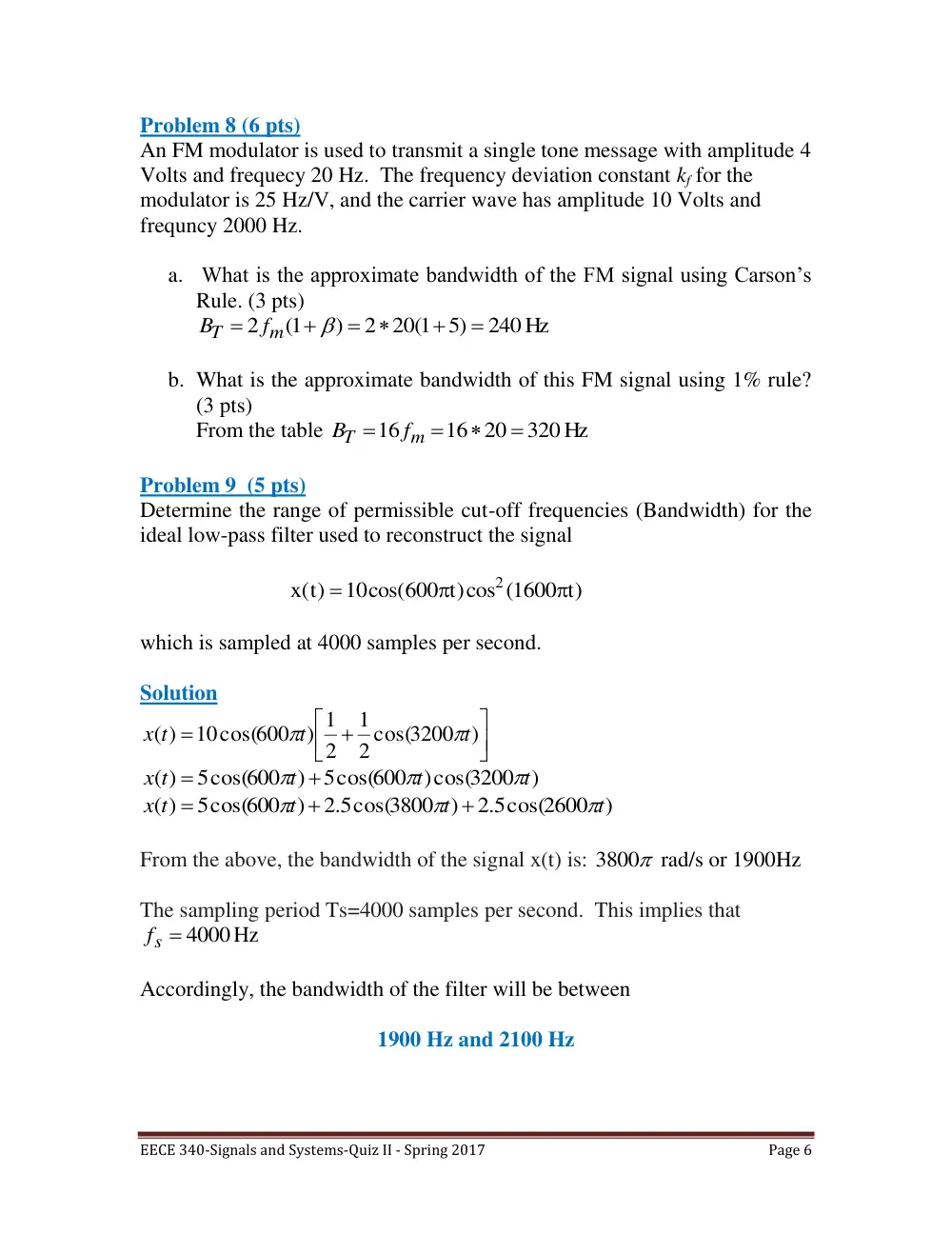
Problem 8 (6 pts)
An FM modulator is used to transmit a single tone message with amplitude 4
Volts and frequecy 20 Hz. The frequency deviation constant kf for the
modulator is 25 Hz/V, and the carrier wave has amplitude 10 Volts and
frequncy 2000 Hz.
a. What is the approximate bandwidth of the FM signal using Carson’s
Rule. (3 pts)
240 Hz
5)
2 20 1(
)
1(
2
m
T
f
B
b. What is the approximate bandwidth of this FM signal using 1% rule?
(3 pts)
From the table
320 Hz
16 20
16
m
T
f
B
Problem 9 (5 pts)
Determine the range of permissible cut-off frequencies (Bandwidth) for the
ideal low-pass filter used to reconstruct the signal
x t
t
t
( )
cos(
)cos (
)
10
600
2 1600
which is sampled at 4000 samples per second.
Solution
)
2 cos(3200
1
2
) 1
10cos(600
( )
t
t
x t
5cos(600 )cos(3200 )
5cos(600 )
( )
t
t
t
x t
cos(2600 )
5.2
5.2 cos(3800 )
5cos(600 )
( )
t
t
t
x t
From the above, the bandwidth of the signal x(t) is:
3800 rad/s or 1900Hz
The sampling period Ts=4000 samples per second. This implies that
sf 4000
Hz
Accordingly, the bandwidth of the filter will be between
1900 Hz and 2100 Hz
EECE 340-Signals and Systems-Quiz II - Spring 2017
Page 7
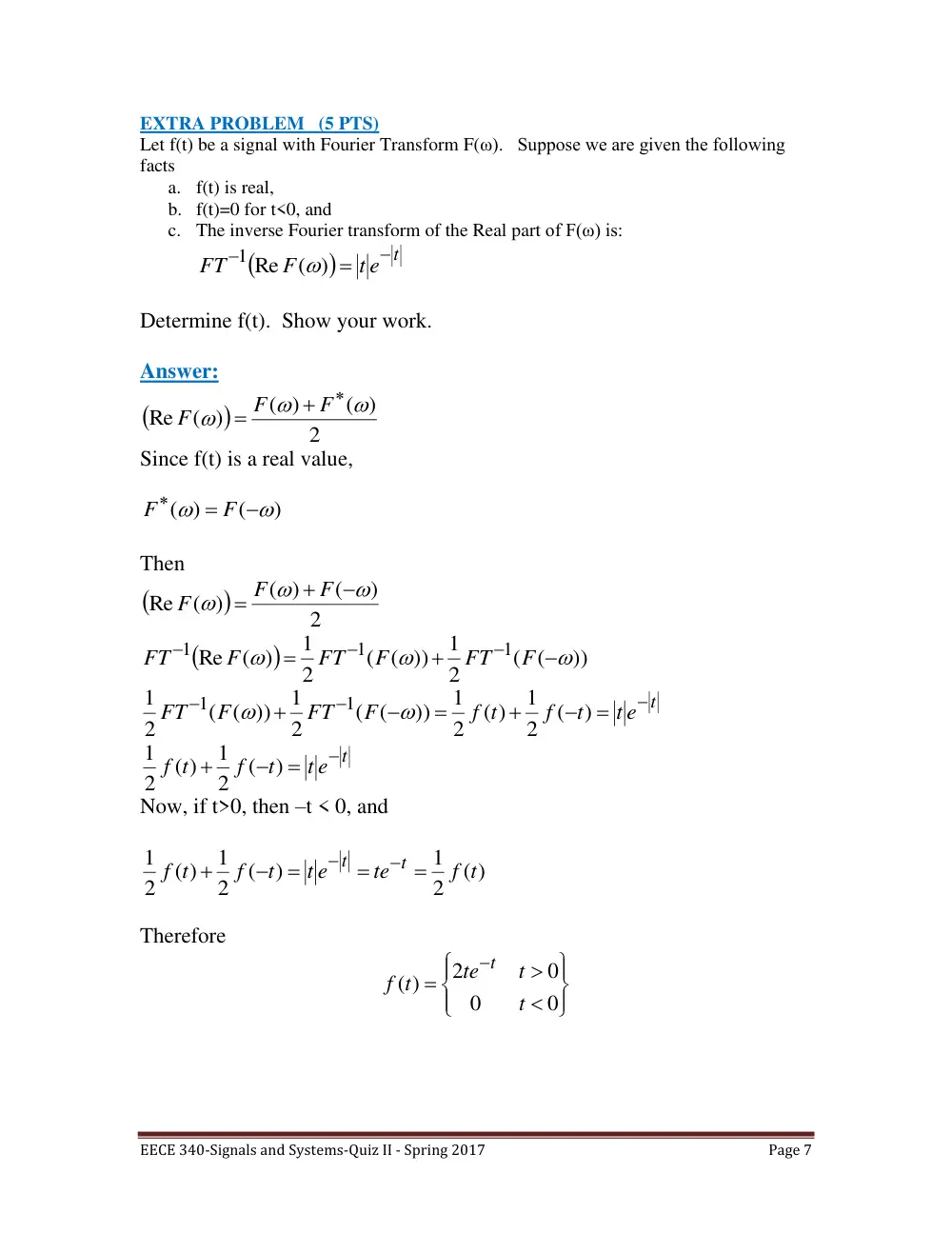
EXTRA PROBLEM (5 PTS)
Let f(t) be a signal with Fourier Transform F(ω). Suppose we are given the following
facts
a. f(t) is real,
b. f(t)=0 for t<0, and
c. The inverse Fourier transform of the Real part of F(ω) is:
t e t
F
FT
( )
1 Re
Determine f(t). Show your work.
Answer:
2
( )
( )
( )
Re
F
F
F
Since f(t) is a real value,
)
(
( )
F
F
Then
2
)
(
( )
( )
Re
F
F
F
))
( (
2
1
( ( ))
2
1
( )
Re
1
1
1
F
FT
F
FT
F
FT
t e t
t
f
f t
F
FT
F
FT
)
(
2
1
( )
2
1
))
( (
2
1
( ( ))
2
1
1
1
t e t
t
f
f t
)
(
2
1
( )
2
1
Now, if t>0, then –t < 0, and
( )
2
1
)
(
2
1
( )
2
1
f t
te
t e
t
f
f t
t
t
Therefore
0
0
0
2
)
(
t
t
te
t
f
t