
EECE 340 Midterm, Spring 2014
American University of Beirut · Signals and Systems · 5 pages · Dr. Ibrahim Abou Faycal


More EECE 340 files
- Exam 1 Kabalan · Spring 2017ExamView
- Exam 2 · Spring 2017ExamView
- Exam 1 · Spring 2016ExamView
- Exam 2 · Spring 2016ExamView
- Midterm · Summer 2015ExamView
- Midterm Solution · Summer 2015Exam · with solutionView
- Midterm Solutions Only · Spring 2014Exam · with solutionView
- Midterm Solution · Spring 2014Exam · with solutionView
Show the text of this exam
EECE 340 Signals and Systems
March 27, 2013
American University of Beirut, Spring 2012–2013
Midterm
Name:
ID:
Do not open this booklet until you are told to do so
• You have 1 hour 50 minutes to complete the exam.
• There are 4 problems on this exam. The problems are not in order of difficulty.
Please read fully the problems before starting.
• A correct answer does not guarantee full credit. Please indicate concisely but pre-
cisely your reasoning. All answers need to be justified, unless you are specifically
told otherwise,
• You may use one double-sided “cheat-sheet” of size “A4” of hand-written notes.
• Calculators are allowed.
• Cell-phones are not allowed. Please turn them off and put them aside or give them
to the staff to hold them for you until the end of the exam.
1
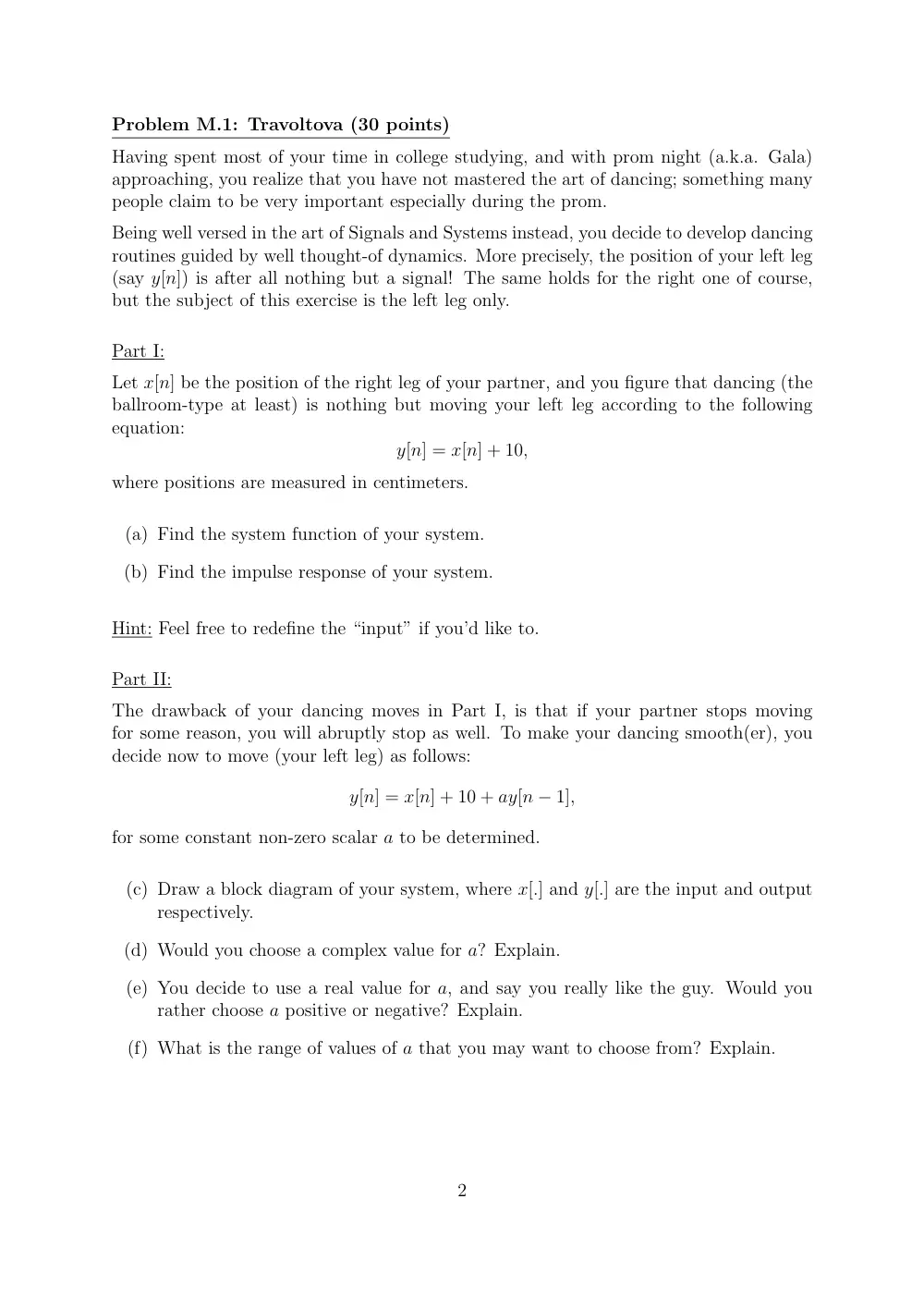
Problem M.1: Travoltova (30 points)
Having spent most of your time in college studying, and with prom night (a.k.a. Gala)
approaching, you realize that you have not mastered the art of dancing; something many
people claim to be very important especially during the prom.
Being well versed in the art of Signals and Systems instead, you decide to develop dancing
routines guided by well thought-of dynamics. More precisely, the position of your left leg
(say y[n]) is after all nothing but a signal! The same holds for the right one of course,
but the subject of this exercise is the left leg only.
Part I:
Let x[n] be the position of the right leg of your partner, and you figure that dancing (the
ballroom-type at least) is nothing but moving your left leg according to the following
equation:
y[n] = x[n] + 10,
where positions are measured in centimeters.
(a) Find the system function of your system.
(b) Find the impulse response of your system.
Hint: Feel free to redefine the “input” if you’d like to.
Part II:
The drawback of your dancing moves in Part I, is that if your partner stops moving
for some reason, you will abruptly stop as well. To make your dancing smooth(er), you
decide now to move (your left leg) as follows:
y[n] = x[n] + 10 + ay[n − 1],
for some constant non-zero scalar a to be determined.
(c) Draw a block diagram of your system, where x[.] and y[.] are the input and output
respectively.
(d) Would you choose a complex value for a? Explain.
(e) You decide to use a real value for a, and say you really like the guy. Would you
rather choose a positive or negative? Explain.
(f) What is the range of values of a that you may want to choose from? Explain.
2
Part III:
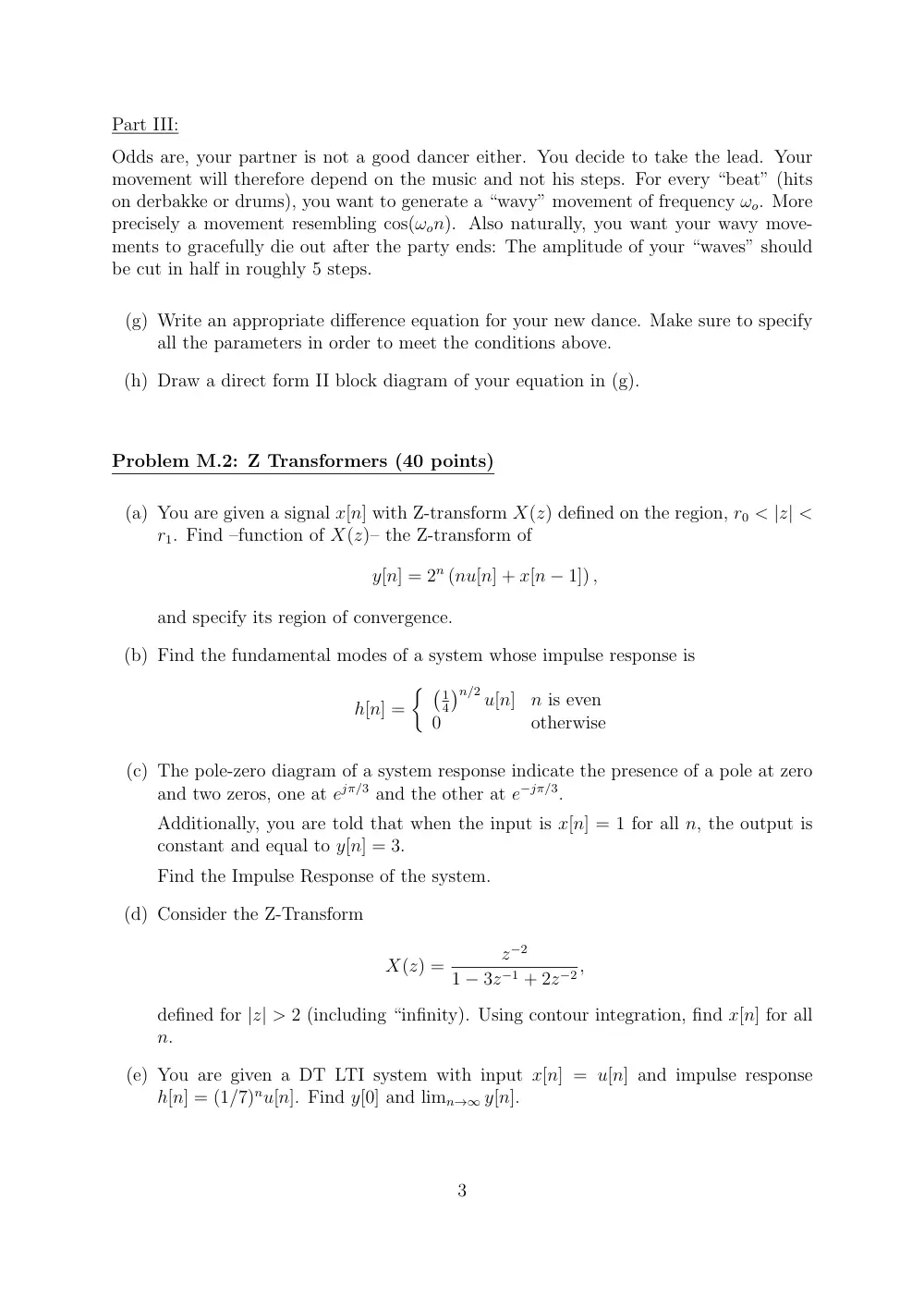
Odds are, your partner is not a good dancer either. You decide to take the lead. Your
movement will therefore depend on the music and not his steps. For every “beat” (hits
on derbakke or drums), you want to generate a “wavy” movement of frequency ωo. More
precisely a movement resembling cos(ωon). Also naturally, you want your wavy move-
ments to gracefully die out after the party ends: The amplitude of your “waves” should
be cut in half in roughly 5 steps.
(g) Write an appropriate difference equation for your new dance. Make sure to specify
all the parameters in order to meet the conditions above.
(h) Draw a direct form II block diagram of your equation in (g).
Problem M.2: Z Transformers (40 points)
(a) You are given a signal x[n] with Z-transform X(z) defined on the region, r0 < |z| <
r1. Find –function of X(z)– the Z-transform of
y[n] = 2n (nu[n] + x[n − 1]) ,
and specify its region of convergence.
(b) Find the fundamental modes of a system whose impulse response is
h[n] =
� �1
4
�n/2 u[n]
n is even
0
otherwise
(c) The pole-zero diagram of a system response indicate the presence of a pole at zero
and two zeros, one at ejπ/3 and the other at e−jπ/3.
Additionally, you are told that when the input is x[n] = 1 for all n, the output is
constant and equal to y[n] = 3.
Find the Impulse Response of the system.
(d) Consider the Z-Transform
X(z) =
z−2
1 − 3z−1 + 2z−2,
defined for |z| > 2 (including “infinity). Using contour integration, find x[n] for all
n.
(e) You are given a DT LTI system with input x[n] = u[n] and impulse response
h[n] = (1/7)nu[n]. Find y[0] and limn→∞ y[n].
3
Problem M.3: Square-Root of the Unit Step (15 points)
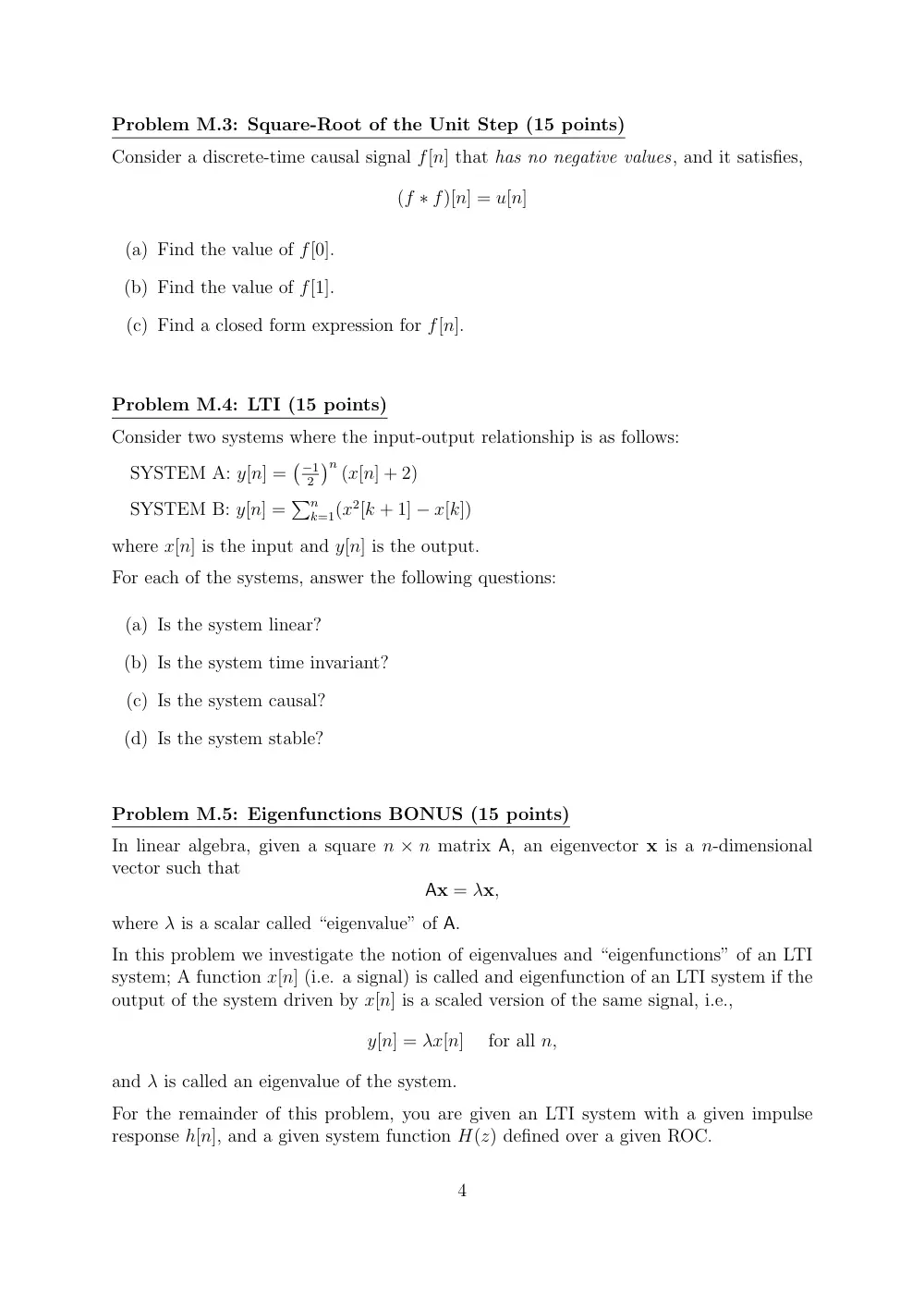
Consider a discrete-time causal signal f[n] that has no negative values, and it satisfies,
(f ∗ f)[n] = u[n]
(a) Find the value of f[0].
(b) Find the value of f[1].
(c) Find a closed form expression for f[n].
Problem M.4: LTI (15 points)
Consider two systems where the input-output relationship is as follows:
SYSTEM A: y[n] =
� −1
2
�n (x[n] + 2)
SYSTEM B: y[n] = �n
k=1(x2[k + 1] − x[k])
where x[n] is the input and y[n] is the output.
For each of the systems, answer the following questions:
(a) Is the system linear?
(b) Is the system time invariant?
(c) Is the system causal?
(d) Is the system stable?
Problem M.5: Eigenfunctions BONUS (15 points)
In linear algebra, given a square n × n matrix A, an eigenvector x is a n-dimensional
vector such that
Ax = λx,
where λ is a scalar called “eigenvalue” of A.
In this problem we investigate the notion of eigenvalues and “eigenfunctions” of an LTI
system; A function x[n] (i.e. a signal) is called and eigenfunction of an LTI system if the
output of the system driven by x[n] is a scaled version of the same signal, i.e.,
y[n] = λx[n]
for all n,
and λ is called an eigenvalue of the system.
For the remainder of this problem, you are given an LTI system with a given impulse
response h[n], and a given system function H(z) defined over a given ROC.
4
(a) The Prof. tells you that the signal
x[n] = αn,
∀n ∈ Z
is an eigenfunction of the system for some fixed scalar α.
Find the corresponding eigenvalue.
Express your answer function of α, h[n] or
H(z).
Hint: In the Prof. we trust
(b) Prove that such a signal:
x[n] = αn,
∀n ∈ Z
is an eigenfunction of the system; state the corresponding eigenvalue; and determine
the possible values of α.
5