
EECE 340 Midterm Solution, Summer 2015
American University of Beirut · Signals and Systems · 5 pages · Dr. Ibrahim Abou Faycal · with solution




More EECE 340 files
Show the text of this exam
EECE 340 Signals and Systems
June 26, 2015
American University of Beirut, Summer 2014–2015
Midterm – Solutions
Problem M.1: (10 points)
(a) We have a difference equation
y[n] =
√
2y[n − 1] − y[n − 2] + x[n].
We can obtain the system function
Y =
√
2DY − D2Y + X
Y
X =
1
1 −
√
2D + D2.
The block diagram may be readily drawn. A DF II may be used.
And finally, the impulse response may be obtained by performing a partial fraction
expansion:
• Replacing D by z−1: 1 −
√
2z−1 + z−2
• Factoring the lowest power of z: z2 −
√
2z + 1
• Finding the roots: ∆ = 2 − 4 = −2 = (
√
2j)2. The roots are
p1 = 1 + j
√
2 = ejπ/4
p1 = 1 − j
√
2
= e−jπ/4
• In conclusion: 1 −
√
2D + D2 = (1 − ejπ/4D)(1 − e−jπ/4D)
Performing the partial fraction expansion:
Y
X =
1
(1 − ejπ/4D)(1 − e−jπ/4D) =
1/(1 + j)
(1 − ejπ/4D) +
1/(1 − j)
(1 − e−jπ/4D).
Finally, the impulse response is
h[n] =
�
1
1 + j ejπn/4 +
1
1 − j e−jπn/4
�
u[n]
=
� 1
√
2e−jπ/4ejπn/4 + 1
√
2ejπ/4e−jπn/4
�
u[n]
=
√
2 cos[π(n − 1)/4] u[n]
(b) The system is causal as it is apparent from the impulse response that is a causal
function.
1
(c) The system is not stable. Indeed, the impulse response does not go to zero. Alter-
natively there are two poles on the unit circle.
Problem M.2: (10 points)
Examining the denominator of the rational function, we identify the roots:
z3 − 5z2 + 8z − 4 = (z − 1)(z2 − 4z + 4) = (z − 1)(z − 2)2.
Checking the numerator,
z4 − 1 = (z2 − 1)(z2 + 1) = (z − 1)(z + 1)(z2 + 1),
and hence 1 is also a zero. Therefore, we have a pole-zero cancellation, and 1 is not really
a pole. We have only a double pole at 2. Performing a partial fraction expansion yields:
X(z) =
z4 − 1
z3 − 5z2 + 8z − 4 =
z4 − 1
(z − 1)(z − 2)2 = (z + 1)(z2 + 1)
(z − 2)2
= z + 5 + 17z − 19
(z − 2)2
= z + 5 +
15
(z − 2)2 +
17
z − 2
The possible ROC’s are rings delimited by poles and hence we have two choices
(i) |z| < 2 (0 included)
The inverse transform is here
x[n] = δ[n + 1] + 5δ[n] + 15
4 (−n + 1) 1
2−nu[−n] − 17
2
1
2−nu[−n]
= δ[n + 1] + 5δ[n] − 1
4(15n + 19)2nu[−n]
= 1
4δ[n] + 1
2δ[n + 1] − (15n + 19)2n−2u[−n − 2].
The signal is anti-causal because the ROC extends inward and 0 is included. If it
were the impulse response of a DT LTI system, that system will be stable because
the ROC includes the UC.
(ii) 2 < |z| (“infinity” not included)
The inverse transform is here
x[n] = δ[n + 1] + 5δ[n] + 15(n − 1)2n−2u[n − 2] + 17
2 2nu[n]
= δ[n + 1] + 27
2 δ[n] + 17δ[n − 1] + 1
4(15n + 19)2nu[n − 2].
The signal is right sided but not causal because the ROC extends outward and
“infinity” is not included. If it were the impulse response of a DT LTI system, that
system will not be stable because the ROC does not include the UC.
2
Problem M.3: (15 points)
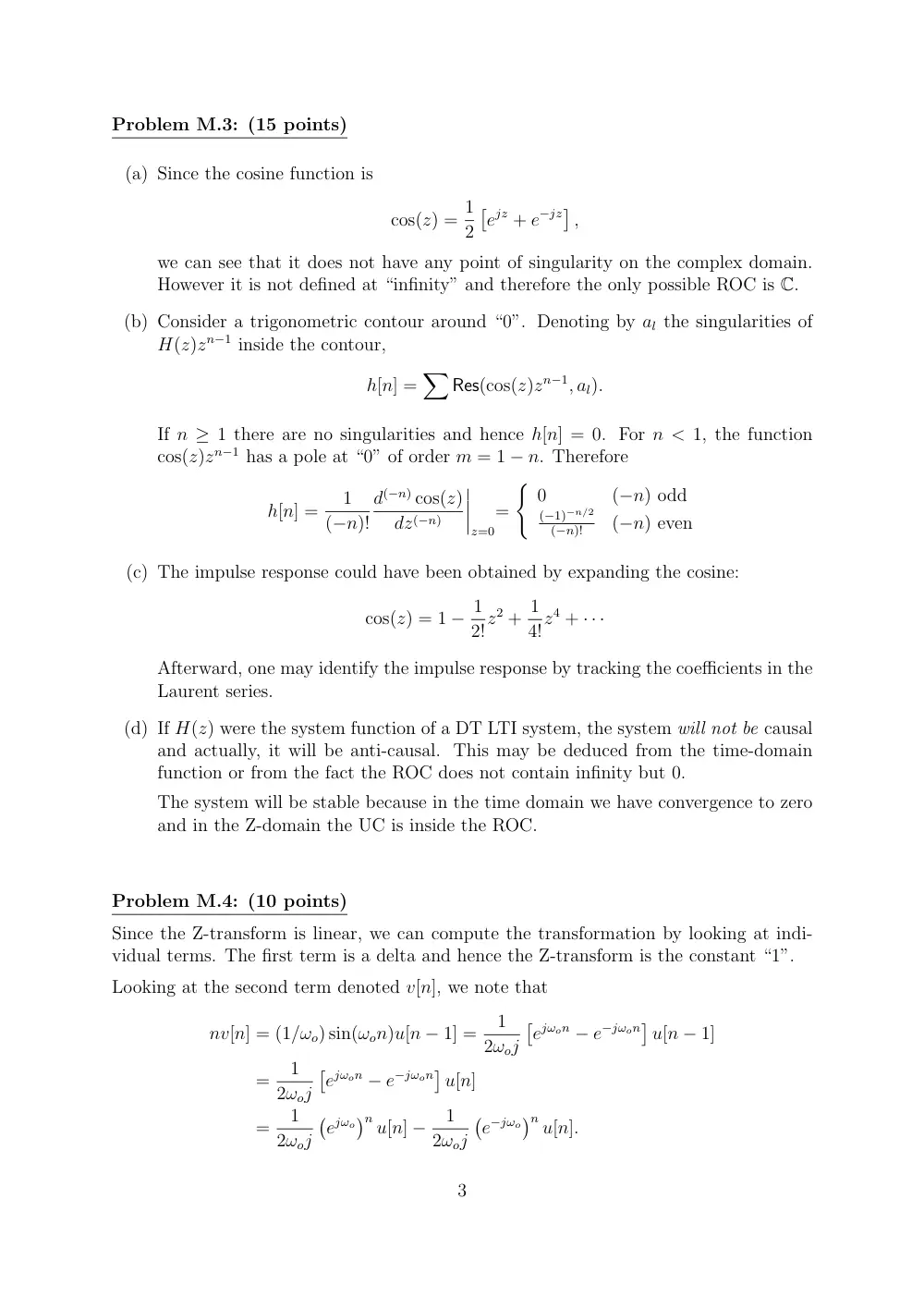
(a) Since the cosine function is
cos(z) = 1
2
�
ejz + e−jz�
,
we can see that it does not have any point of singularity on the complex domain.
However it is not defined at “infinity” and therefore the only possible ROC is C.
(b) Consider a trigonometric contour around “0”. Denoting by al the singularities of
H(z)zn−1 inside the contour,
h[n] =
�
Res(cos(z)zn−1, al).
If n ≥ 1 there are no singularities and hence h[n] = 0. For n < 1, the function
cos(z)zn−1 has a pole at “0” of order m = 1 − n. Therefore
h[n] =
1
(−n)!
d(−n) cos(z)
dz(−n)
����
z=0
=
�
0
(−n) odd
(−1)−n/2
(−n)!
(−n) even
(c) The impulse response could have been obtained by expanding the cosine:
cos(z) = 1 − 1
2!z2 + 1
4!z4 + · · ·
Afterward, one may identify the impulse response by tracking the coefficients in the
Laurent series.
(d) If H(z) were the system function of a DT LTI system, the system will not be causal
and actually, it will be anti-causal. This may be deduced from the time-domain
function or from the fact the ROC does not contain infinity but 0.
The system will be stable because in the time domain we have convergence to zero
and in the Z-domain the UC is inside the ROC.
Problem M.4: (10 points)
Since the Z-transform is linear, we can compute the transformation by looking at indi-
vidual terms. The first term is a delta and hence the Z-transform is the constant “1”.
Looking at the second term denoted v[n], we note that
nv[n] = (1/ωo) sin(ωon)u[n − 1] =
1
2ωoj
�
ejωon − e−jωon�
u[n − 1]
=
1
2ωoj
�
ejωon − e−jωon�
u[n]
=
1
2ωoj
�
ejωo�n u[n] −
1
2ωoj
�
e−jωo�n u[n].
3
Therefore,
−zdV
dz =
1
2ωoj
1
1 − ejωoz−1 −
1
2ωoj
1
1 − e−jωoz−1
dV
dz =
1
2ωoj
1
z − e−jωo −
1
2ωoj
1
z − ejωo
V (z) =
1
2ωoj log
�
z − e−jωo�
−
1
2ωoj log
�
z − ejωo�
=
1
2ωoj log
�z − e−jωo
z − ejωo
�
.
In summary,
X(z) = 1 +
1
2ωoj log
�1 − e−jωoz−1
1 − ejωoz−1
�
.
Problem M.5: (10 points)
Applying the definition,
(x ∗ y)[n] =
�
k∈Z
cos(ωok)an−ku[n − k] = an
n
�
k=−∞
cos(ωok)a−k
= an
2
�
n
�
k=−∞
(ejωo)ka−k +
n
�
k=−∞
(e−jωo)ka−k
�
= an
2
�
∞
�
k=−n
(e−jωo)kak +
∞
�
k=−n
(ejωo)kak
�
= an
2
� ejωona−n
1 − e−jωoa + e−jωona−n
1 − ejωoa
�
= 1
2
�
ejωon
1 − e−jωoa +
e−jωon
1 − ejωoa
�
,
where the convergence is guarantees as long as |a| < 1.
Problem M.6: (15 points)
Since H(z) is rational and it has only one simple pole at “1” and no zeros, its expression
is of the form:
H(z) = C
1
z − 1,
where C is a constant to be determined. Note that since the system is causal, the ROC
is |z| > 1.
We also know that if its input is x[n] = 2n for all n, then y[n] = 2n+1 for all n. Since
an are eigenfunctions then we know that y[n] = H(2)2n (since z = 2 is in the ROC). By
identification H(2) = C = 2. In conclusion,
H(z) =
2
z − 1,
|z| > 1.
4
(a) The impulse response is
h[n] = 2u[n − 1].
(b) To stabilize the system, the pole at “1” on the UC has to be canceled. The overall
system function of a cascade is the product of the individual ones and therefore, it
is possible to achieve stability by using a system with function
(z − 1).
(c) This solution is “implementable”. Indeed, it is a stable system but also even though
it is not causal, it is finite length and with enough delay it becomes causal.
(d) When a system is added in parallel, the overall response is the sum
2
z − 1 + P(z)
Q(z) = 2Q(z) + (z − 1)P(z)
(z − 1)Q(z)
and for the pole at “1” to cancel, it needs to be also a root of Q(z), which means
even after simplification there will remain a pole at “1”.
In summary, it is not possible to obtain an overall stable system.
(e) Not applicable since the answer is “no”.
5