
EECE 340 Midterm, Summer 2015
American University of Beirut · Signals and Systems · 3 pages · Dr. Ibrahim Abou Faycal


More EECE 340 files
- Exam 1 Kabalan · Spring 2017ExamView
- Exam 2 · Spring 2017ExamView
- Exam 1 · Spring 2016ExamView
- Exam 2 · Spring 2016ExamView
- Midterm Solution · Summer 2015Exam · with solutionView
- Midterm Solutions Only · Spring 2014Exam · with solutionView
- Midterm · Spring 2014ExamView
- Midterm Solution · Spring 2014Exam · with solutionView
Show the text of this exam
Mi
EECE 340 Signals and Systems June 26, 2015
American University of Beirut, Summer 2014-2015
Midterm
are a el am
Do not open this booklet until you are told to do so
e You have 1 hour 10 minutes to complete the exam.
e There are 6 problems on this exam. The problems are not in order of difficulty.
Please read fully the problems before starting.
e A correct answer does not guarantee full credit. Please indicate concisely but pre-
cisely your reasoning. All answers need to be justified, unless you are specifically
” told otherwise,
e You may use TWO double-sided “cheat-sheets” of size “A4” of hand-written notes.
e Calculators are allowed.
e Cell-phones are not allowed. Please turn them off and put them aside or give them
to the staff to hold them for you until the end of the exam.
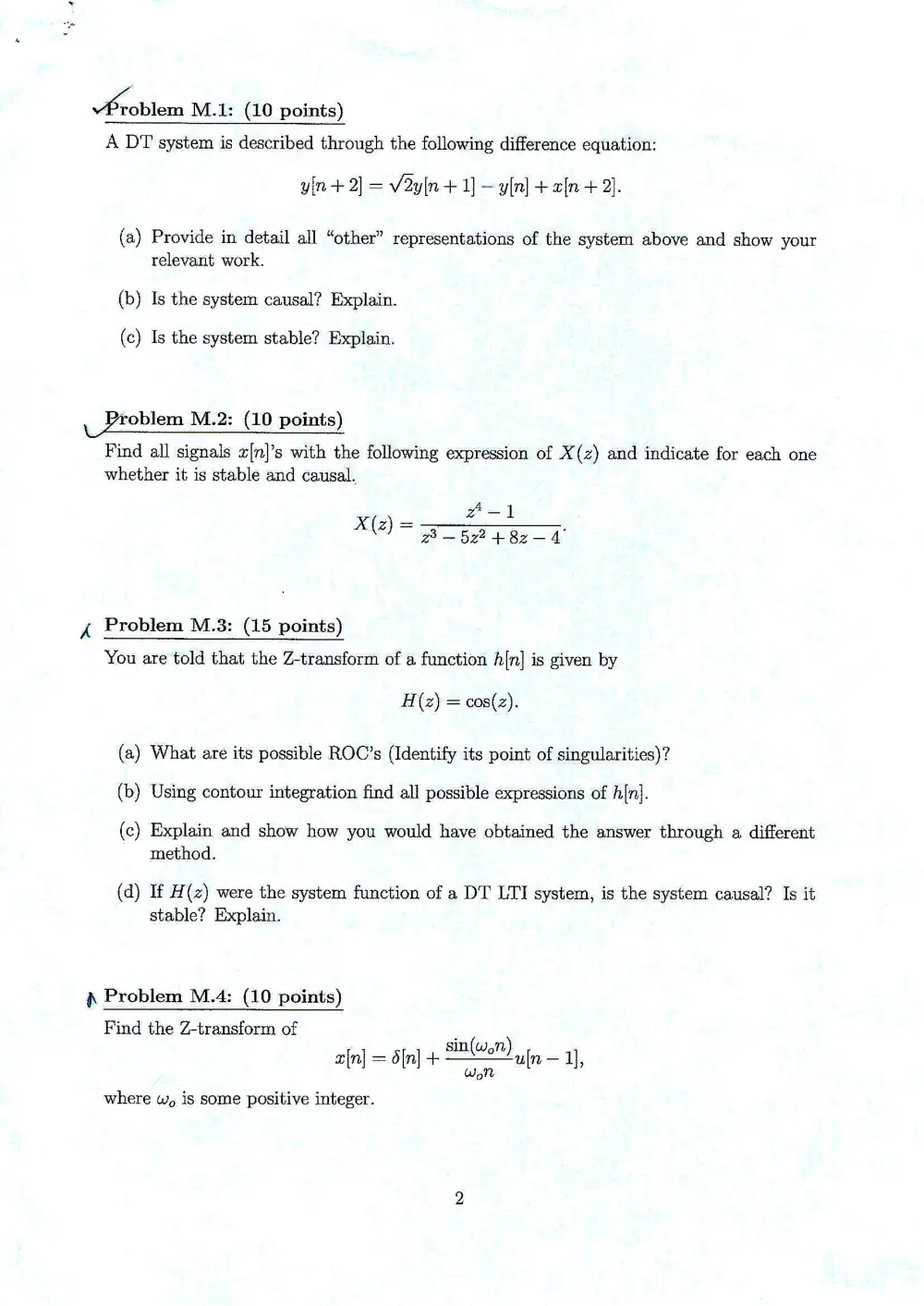
rcbiem M.1: (10 points)
A DT system is described through the following difference equation:
y(n +2] = V2y[n +1] ~y[n] + 2[n + 2).
(a) Provide in detail all “other” representations of the system above and show your
relevant work.
(b) Is the system causal? Explain.
(c) Is the system stable? Explain.
Problem M.2: (10 points)
Find all signals z[n]’s with the following expression of X(z) and indicate for each one
whether it is stable and causal.
z=
X(z) = = ———_..
(2) 23 — 5224 82-4
Xx Problem M.3: (15 points)
You are told that the Z-transform of a function h[n] is given by
H(z) = cos(z).
(a) What are its possible ROC’s (Identify its point of singularities)?
(b) Using contour integration find all possible expressions of h[n].
(c) Explain and show how you would have obtained the answer through a different
method.
(d) If H(z) were the system function of a DT LTI system, is the system causal? Is it
stable? Explain.
§ Problem M.4: (10 points)
Find the Z-transform of
sin(w,n)
a[n] = d[n] + .o
uln — I],
where w, is some positive integer.
¢Problem M.5: (10 points)
Compute the convolution of the following two signals:
z{n] =cos(wsn) —_yln] = aun,
where w, is some positive constant.
“Problem M.6: (15 points)
A DT causal LTI system has a rational system function H(z) that is known to have one
simple pole at “1” and no zeros. It is also known that if its input is z[n] = 2” for all n,
then y[n] = 2"*? for all n.
(a) Determine its impulse response.
Since this system is unstable, you decide to “stabilize” it as follows: You are to feed the
output of H(z) as an input to another system (i.e., in series).
(b) Is it possible to obtain an overall stable system? If yes, explain how and if no,
explain why.
c) If your answer is “yes”, is your solution “implementable” ? Explain.
Pp. XD.
Alternatively, you decide to “stabilize” H(z) as follows: You are to feed the input of H(z)
as an input to another system (i.e., in parallel) and add their outputs.
(d) Is it possible to obtain an overall stable system? If yes, explain how and if no,
explain why.
(e) If your answer is “yes”, is your solution “implementable” ? Explain.